


ISO 9439:1990
(Main)Water quality — Evaluation in an aqueous medium of the "ultimate" aerobic biodegradability of organic compounds — Method by analysis of released carbon dioxide
Water quality — Evaluation in an aqueous medium of the "ultimate" aerobic biodegradability of organic compounds — Method by analysis of released carbon dioxide
Qualité de l'eau — Évaluation, en milieu aqueux, de la biodégradabilité aérobie "ultime" des composés organiques — Méthode par dosage du dioxyde de carbone dégagé
General Information
- Status
- Withdrawn
- Publication Date
- 21-Nov-1990
- Withdrawal Date
- 21-Nov-1990
- Technical Committee
- ISO/TC 147/SC 5 - Biological methods
- Drafting Committee
- ISO/TC 147/SC 5 - Biological methods
- Current Stage
- 9599 - Withdrawal of International Standard
- Start Date
- 04-Mar-1999
- Completion Date
- 12-Feb-2026
Relations
- Effective Date
- 06-Jun-2022
- Effective Date
- 15-Apr-2008
- Effective Date
- 15-Apr-2008
ISO 9439:1990 - Water quality -- Evaluation in an aqueous medium of the "ultimate" aerobic biodegradability of organic compounds -- Method by analysis of released carbon dioxide
ISO 9439:1990 - Qualité de l'eau -- Évaluation, en milieu aqueux, de la biodégradabilité aérobie "ultime" des composés organiques -- Méthode par dosage du dioxyde de carbone dégagé
Get Certified
Connect with accredited certification bodies for this standard

NSF International
Global independent organization facilitating standards development and certification.

CIS Institut d.o.o.
Personal Protective Equipment (PPE) certification body. Notified Body NB-2890 for EU Regulation 2016/425 PPE.

Kiwa BDA Testing
Building and construction product certification.
Sponsored listings
Frequently Asked Questions
ISO 9439:1990 is a standard published by the International Organization for Standardization (ISO). Its full title is "Water quality — Evaluation in an aqueous medium of the "ultimate" aerobic biodegradability of organic compounds — Method by analysis of released carbon dioxide". This standard covers: Water quality — Evaluation in an aqueous medium of the "ultimate" aerobic biodegradability of organic compounds — Method by analysis of released carbon dioxide
Water quality — Evaluation in an aqueous medium of the "ultimate" aerobic biodegradability of organic compounds — Method by analysis of released carbon dioxide
ISO 9439:1990 is classified under the following ICS (International Classification for Standards) categories: 13.060.70 - Examination of biological properties of water. The ICS classification helps identify the subject area and facilitates finding related standards.
ISO 9439:1990 has the following relationships with other standards: It is inter standard links to ISO 9439:1990/Cor 1:1992, ISO 9439:1999; is excused to ISO 9439:1990/Cor 1:1992. Understanding these relationships helps ensure you are using the most current and applicable version of the standard.
ISO 9439:1990 is available in PDF format for immediate download after purchase. The document can be added to your cart and obtained through the secure checkout process. Digital delivery ensures instant access to the complete standard document.
Standards Content (Sample)
IS0
INTER NATIONAL
STANDARD 9439
First edition
1990-1 2-01
Water quality - Evaluation in an aqueous
medium of the “ultimate” aerobic
biodegradability of organic compounds -
Method by analysis of released carbon dioxide
Qualité de l‘eau - Évaluation, en milieu aqueux, de la biodégradahilité
aérobie “ultime” des composés organiques - Méthode par dosage du
dioxyde de carbone dégagé
Reference number
IS0 9439: 1990( E)
IS0 9439:1990(E)
Foreword
IS0 (the International Organization for Standardization) is a worldwide
federation of national standards bodies (IS0 member bodies). The work
of preparing International Standards is normally carried out through IS0
technical committees. Each member body interested in a subject for
which a technical committee has been established has the right io be
represented on that committee. International organizations, govern-
mental and non-governmental, in liaison with ISO, also take pari in the
work. IS0 collaborates closely with the International Electrotechnical
Commission (IEC) on all matters of electrotechnical standardization.
Draft International Standards adopted by the technical committees are
circulated to the member bodies for voting. Publication as an Inter-
national Standard requires approval by at least 75% of the member
bodies casting a vote.
International Standard IS0 9439 was prepared by Technical Committee
ISO/TC 147, Wafer quality.
Annexes A, B and C of this International Standard are for information
only.
O IS0 1990
All rights reserved. No part of this publication may be reproduced or utilized in any form
or by any means, electronic or mechanical, including photocopying and microfilm, without
permission in writing from the publisher.
International Organization for Standardization
Case Postale 56 CH-1211 Genève 20 Switzerland
Printed in Switzerland
ii
INTERNATIONAL STANDARD IS0 9439:1990(E)
- - ~ ___ ____
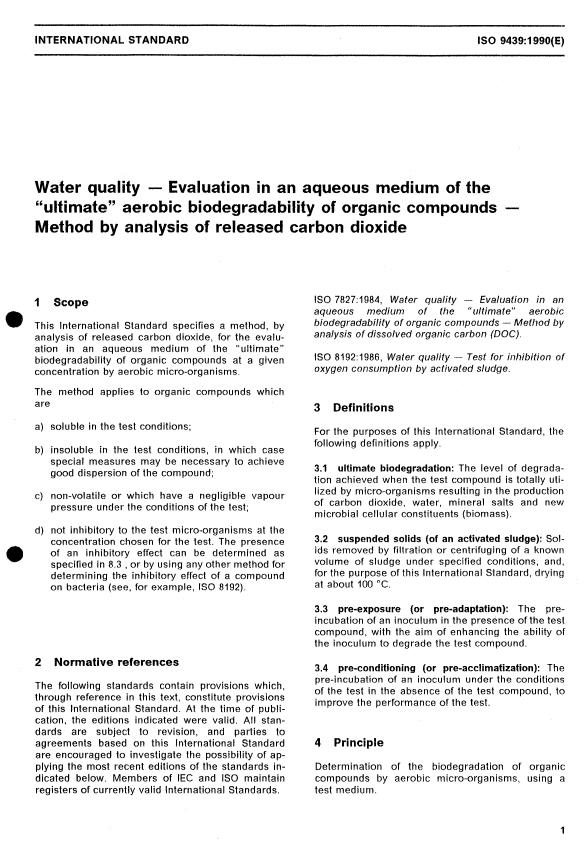
Water quality - Evaluation in an aqueous medium of the
”ultimate” aerobic biodegradability of organic compounds -
Method by analysis of released carbon dioxide
IS0 7827:1984, Water quality - Evaluation in an
1 scope
aqueous medium of the “ultimate” aerobic
biodegradability of organic compounds - Method by
0 This International Standard specifies a method, by
analysis of dissolved organic carbon (DOC).
analysis of released carbon dioxide, for the evalu-
ation in an aqueous medium of the “ultimate”
IS0 8192:1986, Water quality - Test for inhibition of
biodegradability of organic compounds at a given
oxygen consumption by activated sludge.
conce nt rat ion by a e robi c mi cro-org a n i s m s,
The method applies to organic compounds which
a re
3 Definitions
a) soluble in the test conditions;
For the purposes of this International Standard, the
following definitions apply.
b) insoluble in the test conditions, in which case
special measures may be necessary to achieve
3.1 ultimate biodegradation: The level of degrada-
good dispersion of the compound;
tion achieved when the test compound is totally uti-
lized by micro-organisms resulting in the production
c) non-volatile or which have a negligible vapour
of carbon dioxide, water, mineral salts and new
pressure under the conditions of the test;
microbial ce I I u I a r constituents (biom ass).
d) not inhibitory to the test micro-organisms at the
3.2 suspended solids (of an activated sludge): Sol-
concentration chosen for the test. The presence
ids removed by filtration or centrifuging of a known
of an inhibitory effect can be determined as
volume of siiidge under specified conditions, and,
specified in 8.3 , or by using any other method for
for the purpose of this International Standard, drying
determining the inhibitory effect of a compound
at about 100 “C.
on bacteria (see, for example, IS0 8192).
3.3 pre-exposure (or pre-adaptation): The pre-
incubation of an inoculum in the presence of the test
compound, with the aim of enhancing the ability of
the inoculum to degrade the test compound.
2 Normative references
3.4 pre-conditioning (or pre-acclimatization): The
pre-incubation of an inoculum under the conditions
The following standards contain provisions which,
of the test in the absence of the test compound, to
through reference in this text, constitute provisions
improve the performance of the test.
of this International Standard. At the time of publi-
cation, the editions indicated were valid. All stan-
dards are subject to revision, and parties to
agreements based on this International Standard 4 Principle
are encouraged to investigate the possibility of ap-
plying the most recent editions of the standards in- Determination of the biodegradation of organic
dicated below. Members of IEC and IS0 maintain compounds by aerobic micro-organisms, using a
registers of currently valid International Standards. test medium.
IS0 9439:1990(E)
6.2.1.3 Solution e).
The organic compound is the sole source of carbon
and energy in the medium. The level of
Dissolve 27,5 g of anhydrous calcium chloride
biodegradation is determined indirectly by meas-
(CaCI,) or 36,4 g of calcium chloride dihydrate
urement of the released carbon dioxide during the
(CaCl2.2H,O) in 1 O00 ml of the water (6.1).
test time (generally 28 days). The concentration of
the compounds used is such that the initial organic
6.2.1.4 Solution d)
carbon content of the medium is normally between
10 mg/l and 40 mg/l. If required, more than 40 mg/l
Dissolve 0,25 g of iron(ll1) chloride hexahydrate
may be used to give additional information.
(FeCI,.GH,O) in 1 O00 ml of the water (6.1). Prepare
this solution just before use.
For sufficiently water-soluble compounds, DOC re-
moval at the end of the test may be determined.
NOTE 1 It is not necessary to prepare this solution just
before use if a drop of concentrated hydrochloric acid
(HCI) or 0,4 g/l of ethylenediamine-tetraacetic acid (EDTA)
is added.
5 Test environment
6.2.2 Preparation of the test medium.
Incubation shall take place in the dark or in diffused
light, in an enclosure which is maintained at a con-
For 1 litre of test medium, add just before use to
stant temperature (within at least & 1 OC) between
800 ml of the water (6.1)
20 "C and 25 "C and which is free from toxic va-
pours.
- 10 ml of solution a);
- and then 1 ml of each solution b), c) and d), (to
6 Reagents avoid the formation of turbidity in the final me-
dium).
Use only reagents of recognized analytical grade.
Make up to 1 O00 ml with the water (6.1).
6.1 Distilled or de-ionized water.
7 Apparatus
Containing less than 10 % of the initial DOC content
Ensure that all glassware is thoroughly cleaned and,
introduced by the organic compound to be tested.
in particular, free from organic or toxic matter.
Usual laboratory equipment, and
6.2 Test medium
Glass vessels, Erlenmeyer flasks or bottles al-
7.1
6.2.1 Composition lowing gas purge and magnetic stirring (see 8.3).
7.2 CO,-free air production system, capable of
6.2.1.1 Solution a).
supplying each test flask at a flow rate between
50 ml/min and 100 ml/min, held constant within
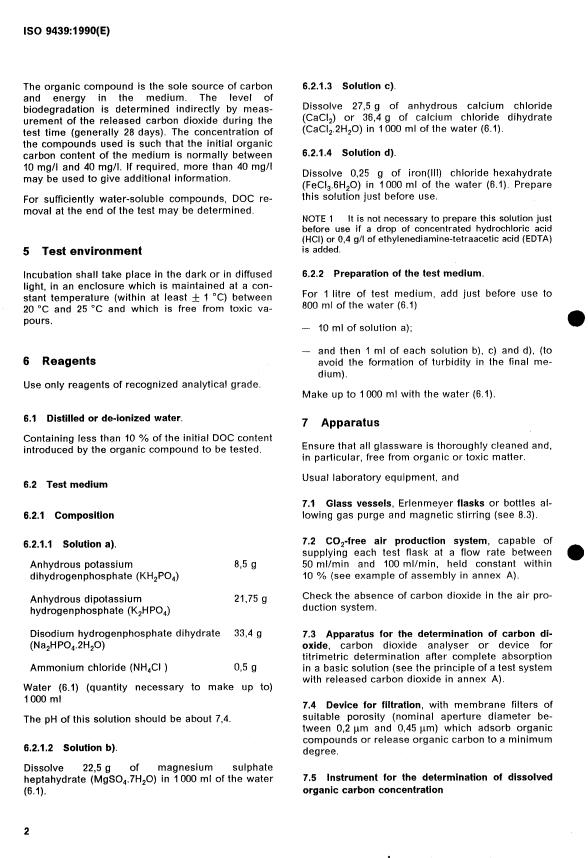
Anhydrous potassium 8,5 9
10 Oh (see example of assembly in annex A).
dihydrogenphosphate (KH,PO,)
Check the absence of carbon dioxide in the air pro-
Anhydrous di pot as si u m 21,75 g
duction system.
hydrogenphosphate (K,HPO,)
Disodium hydrogenphosphate dihydrate 33,4 g
7.3 Apparatus for the determination of carbon di-
(Na,H P0,.2H20) oxide, carbon dioxide analyser or device for
titrimetric determination afler complete absorption
Ammonium chloride (",CI ) in a basic solution (see the principle of a test system
03 g
with released carbon dioxide in annex A).
Water (6.1) (quantity necessary to make up to)
1 O00 ml
7.4 Device for filtration, with membrane filters of
suitable porosity (nominal aperture diameter be-
of this solution should be about 7,4.
The pH
tween 0,2 pm and 0,45 pm) which adsorb organic
compounds or release organic carbon to a minimum
6.2.1.2 Solution b).
degree.
Dissolve 22,5 g of magnesium sulphate
7.5 Instrument for the determination of dissolved
heptahydrate (MgS0,.7H20) in 1 O00 ml of the water
organic carbon concentration
(6.1).
IS0 9439:1990(E)
7.6 Centrifuge greater than 70 mg/l. To reduce the influence of the
blank, it may be helpful to precondition the sludge
by aerating it up to one week before it is used [see
7.7 pH-meter.
clause 10, item b)].
The quantity of dissolved organic carbon provided
8 Procedure
by the inoculum shall be less than 10 of the initial
concentration of organic carbon introduced by the
8.1 Preparation of the test solutions
test compound.
8.1.1 Solution of the test compound
NOTE 3 In certain circumstances, pre-exposed inocula
may be used, provided that this is clearly stated in the
test results (e.g. per cent biodegradation = x YO, using
Prepare a stock solution of the test compound in the
pre-exposed inocula) and the method of pre-exposure de-
test medium (6.2). Dilute a suitable amount of this
tailed in the test report.
solution in the previously aerated test medium (see
8.3 ) in order to obtain a final organic carbon con-
Pre-exposed inocula can be obtained from laboratory
centration of between 10 mg/l and 40 mg/l.
biodegradation tests conducted under a variety of condi-
tions (e.g. Zahn-Wellens and SCAS tests) or from samples
NOTE 2 Compounds of low water solubility may be collected from locations where relevant environmental
added directly, in solid or liquid form to the medium in the conditions exist (e.g. treatment plants dealing with similar
appropriate flask; an IS0 International Standard will be compounds, contaminated areas, etc.).
prepared for guidance.
8.2.1 Inoculum from a secondary effluent
8.1.2 Solution of the reference compound
Take a sample of secondary effluent collected from
Prepare a stock solution of the reference compound
a treatment plant dealing with predominantly do-
(an organic compound of known biodegradability
mestic sewage. Keep this sample under aerobic
such as sodium acetate, sodium benzoate, aniline)
conditions and use on the day of collection.
in the test medium (6.2) in the same way as in
From this sample, prepare an inoculum as follows:
8.1.1, in order to obtain a final organic carbon con-
centration of 20 mg/l.
- let the sample of effluent settle for 1 h;
- take a suitable volume') of the supernatant, to be
8.1.3 Solution to check inhibition
used as inoculum for the test carried out that
day.
If necessary, prepare the solution containing, in the
test medium (6.2), the test compound and the refer-
8.2.2 Inoculum from an activated sludge plant
ence compound in the respective concentrations
used for the preparation of solutions in 8.1.1 and
Take a suitable volume1) of inoculum, for example,
8.1.2 .
a sample of activated sludge from the aeration tank
of a sewage works treating predominantly domestic
8.2 Preparation of the inoculum
sewage.
Prepare the inoculum using the following sources
Mix well, keep under aerobic conditions and use on
or using a mixture of these sources to obtain a
the day of collection.
microbial population that offers sufficient
Just before use, determine the concentration of
biodegradation activity. Check this activity by means
suspended solids'). If necessary, concentrate the
of the reference compound (8.1.2).
sludge by settling so that the volume of sludge
The carbon dioxide production of the blank solution added to obtain 30 mg of dry matter per litre be
should be in the range of 30 mg/l to 40 mg/l but not minimum.
1) "Suitable" volume means
=
sufficient to give a population which offers enough biodegradation activity;
=
degrades the reference compound(s) by the stipulated percentage;
gives between IO3 and IO5 active cellslml;
...
IS0
NORME
I NTE R NAT1 O NALE
Premiére édition
1990-1 2-0 1
Qualité de l’eau - Évaluation, en milieu aqueux,
de la biodégradabilité aérobie (cultirne>) des
composés organiques - Méthode par dosage
du dioxyde de carbone dégagé
Water quality - Evaluation in an aqueous medium of the «ultimate))
aerobic biodegradability of organic compounds -- Method by analysis
of released carbon dioxide
Numéro de référence
IS0 9439: 1990( F)
IS0 94391 99O(F)
Avant-propos
L’ISO (Organisation internationale de normalisation) est une fédération
mondiale d‘organismes nationaux de normalisation (comités membres
de I’ISO). L‘élaboration des Normes internationales est en général
confiée aux comités techniques de I’ISO. Chaque comité membre inté-
ressé par une étude a le droit de faire partie du comité technique créé
à cet effet. Les organisations internationales, gouvernementales et non
gouvernementales, en liaison avec 1’1S0 participent également aux tra-
vaux. L’ISO collabore étroitement avec la Commission électrotechnique
internationale (CEI) en ce qui concerne la normalisation électrotech-
nique.
Les projets de Normes internationales adoptés par les comités techni-
ques sont soumis aux comités membres pour vote. Leur publication
comme Normes internationales requiert l’approbation de 75 % au moins
des comités membres votants.
La Norme internationale IS0 9439 a été élaborée par le comité techni-
que ISO/TC 147, Qualité de l’eau.
Les annexes A, B et C de la présente Norme internationale sont don-
nées uniquement à titre d’information.
O IS0 1990
Droits de reproduction réservés. Aucune partie de cette publication ne peut être repro-
duite ni utilisée sous quelque forme que ce soit et par aucun procede, électronique ou
mécanique, y compris la photocopie et les microfilms, sans i’accord écrit de l’éditeur.
Organisation internationale de normalisation
Case Postale 56 CH-1211 Genève 20 Suisse
Imprimé en Suisse
ii
NORME INTERNATIONALE IS0 9439:1990(F)
Qualité de l’eau - Évaluation, en milieu aqueux, de la
biodégradabilité aérobie ~~ultirne~~ des composés
organiques - Méthode par dosage du dioxyde de carbone
dégagé
1 Domaine d’application
2 Références normatives
LF normes suivantes contiennent de dis, çitions
qui, par suite de la référence qui en est faite,
La présente Norme internationale prescrit une mé-
constituent des dispositions valables pour la pré-
thode d’évaluation en milieu aqueux de la biodé-
sente Norme internationale. Au moment de la pri-
g rada bilité < de composés organiques
blication, les éditions indiquées étaient en vigueur.
présents à une concentration donnée sous l’action
Toute norme est sujette à révision et les parties
de micro-organismes aérobies, par dosage du
prenantes des accords fondés sur la présente
dioxyde de carbone dégagé.
Norme internationale sont invitées à rechercher la
possibilité d’appliquer les éditions les plus récentes
La méthode est applicable à des composés organi-
des normes indiquées ci-après. Les membres de la
CE1 et de I’ISO possèdent le registre des Normes
e ques
internationales en vigueur à un moment donné.
a) solubles dans les conditions de l’essai;
IS0 7827:1984, Qualité de l’eau - Evaluation en mi-
b) insolubles dans les conditions de l’essai, auquel
lieu aqueux de la biodégradabilité aérobie «ultime,,
cas il peut être nécessaire de prendre des me-
des composés organiques - Méthode par analyse
sures particulières assurant une bonne disper-
du carbone organique dissous (COD).
sion du composé:
IS0 8192:1986, Qualité de l’eau - Essai d‘inhibition
c) non volatils ou ayant une pression de vapeur
de la consommation d‘oxygène par des boues acti-
négligeable dans les conditions de l’essai;
vées.
d) n’ayant pas d‘action inhibitrice, à la concen-
tration choisie, sur les micro-organismes utilisés
pour l’essai. L’existence d’une action inhibitrice
3 Définitions
peut être mise en évidence suivant la méthode
prescrite en 8.3, ou par toute autre méthode de
Pour les besoins de la présente Norme internatio-
détermination de l’action inhibitrice d’une sub-
nale, les définitions suivantes s’appliquent.
stance sur les bactéries (voir par exemple
IS0 8192).
3.1 dégradation ultime: Niveau de dégradation at-
teint lorsque le composé soumis à l’essai a été to-
talement transformé par les micro-organismes en
IS0 94391 99O(F)
dioxyde de carbone, eau, sels minéraux et nouveaux 6.1 Eau distillée ou déminéralisée
constituants cellulaires microbiens (biomasse).
Elle doit contenir moins de 10 YO de la concentration
initiale du COD apporté par le composé organique.
3.2 matières en suspension (dans une boue acti-
vée): Matières éliminées par filtration ou centrifu-
gation d’un volume connu de boue dans des
6.2 Milieu d’essai
conditions définies et, dans le cadre de la présente
Norme internationale, dessiccation à environ
100 OC.
6.2.1 Composition
3.3 préexposition (ou préadaptation): Préincu bation
6.2.1.1 Solution a).
d‘un inoculum en présence du composé à expéri-
menter, destinée à accroître l‘aptitude de I’inoculum
Di h ydrog énop hos p ha te de potassium
à dégrader le composé.
anhydre (KHiPO,)
3.4 préconditionnement: Preincubation d’un Monohydrogénophosphate de potas-
inoculum dans les conditions d’essai, mais en I’ab- sium anhydre (K,HPO,)
sence du composé à expérimenter, destinée à
Monohydrogénophosphate de sodium
améliorer l’efficacité de l’essai.
di hydraté (Na,H P0,,2H,O)
Chlorure d’ammonium (NH,CI )
Eau (6.1): compléter à 1 000 ml
4 Principe
Le pH de la solution doit normalement être d’envi-
Évaluation de la biodégradation de composés orga-
ron 7,4.
niques par des micro-organismes aérobies, dans un
milieu d’essai.
6.2.1.2 Solution b).
Le composé organique à expérimenter constitue la
seule source de carbone et d’énergie dans le milieu.
Dissoudre dans 1 O00 ml d’eau (6.1), 22,5 g de SUI-
Le taux de biodégradation est déterminé indirec-
fate de magnésium heptahydraté (MgS0,,7H,O).
tement par mesurage de la quantité de dioxyde de
carbone libéré pendant la durée de l’essai (géné-
6.2.1.3 Solution c).
ralement 28 jours). Le composé est utilisé à une
concentration telle que la teneur initiale en carbone
Dissoudre dans 1 O00 ml d’eau (6.1), 27,5 g de chlo-
organique du milieu soit normalement comprise en-
rure de calcium anhydre (CaCI,) ou 36,4 g de chlo-
tre 10 et 40 rng/l. Pour obtenir des données supplé-
rure de calcium dihydraté (CaC1,,2H20).
mentaires, il est admis d’utiliser, si nécessaire, des
concentrations supérieures à 40 mg/l.
6.2.1.4 Solution d).
Pour les composés suffisamment solubles dans
Dissoudre dans 1 000 ml d’eau (6.1), 0,25 g de chlo-
l’eau, on peut mesurer la baisse de concentration
rure de fer(ll1) hexahydraté (FeCI,,GH,O). Préparer la
du COD en fin d’essai.
solution juste avant emploi.
NOTE 1 Cette précaution n’est pas nécessaire si l’on
ajoute à la solution une goutte d’acide chlorhydrique
concentré (HCI) ou 0,4 gll d’acide éthylènediamine-
5 Environnement d’essai
tétracétique (EDTA).
L’incubation doit être menée à l’obscurité ou sous
lumière diffuse dans une enceinte maintenue à
6.2.2 Préparation du milieu d’essai
température constante (à f 1 OC près) comprise
entre 20 “C et 25 OC, et ne contenant pas de vapeurs Pour 1 I de milieu d’essai, ajouter juste avant emploi
toxiques. à 800 ml d‘eau (6.1).
- 10 ml de solution a);
- puis (pour éviter l’apparition de turbidité dans le
6 Réactifs
milieu final) 1 ml de chacune des solutions b), c)
et d).
Utiliser exclusivement des réactifs de qualité analy-
Compléter à 1 O00 ml avec de l’eau (6.1).
tique reconnue.
IS0 9439:1990(F)
NOTE 2 Les composés faiblement solubles dans l’eau
7 Appareillage
peuvent être ajoutés directement au milieu, SOUS forme
solide ou liquide, dans la fiole appropriée; une Norme
S’assurer que la verrerie de laboratoire a été soi-
internationale sera ultérieurement élaborée comme di-
gneusement nettoyée et, notamment, qu’elle est
rective à ce sujet.
exempte de toute trace de substances organiques
ou toxiques.
8.1.2 Solution du composé de référence
Matériel courant de laboratoire, et
Préparer une solution mère du composé de réfé-
rence (composé organique de biodégradabilité
7.1 Fioles en verre, coniques (Erlenmeyers), ou
connue, tel que l’acétate de sodium, le benzoate de
flacons permettant la purge des gaz et l‘utilisation
sodium, l’aniline) dans le milieu d’essai (6.2) en
d’un agitateur magnétique (voir 8.3).
procédant comme en 8.1.1, de facon à obtenir une
concentration finale de carbone organique de
7.2 Système de production d‘air sans dioxyde de
20 mg/l.
carbone, capable d’alimenter chacune des fioles à
un débit compris entre 50 mllmin et 100 rnllmin et
constant à 10 près (voir exemple de montage
dans l’annexe A). 8.1.3 Solution destinée au test d’inhibition
Vérifier l’absence de dioxyde de carbone dans le
Si nécessaire, préparer une solution contenant,
système de production de l’air.
dans le milieu d’essai (6.2), le composé à expéri-
menter et le composé de référence aux concen-
trations respectivement définies pour les solutions
7.3 Dispositif de mesure du dioxyde de carbone,
8.1.1 et 8.1.2.
analyseur de dioxyde de carbone, ou dispositif de
dosage titrimétrique après absorption totale dans
A le principe
une solution alcaline (voir en annexe
de fonctionnement d’un système de dosage du
dioxyde de carbone produit). 8.2 Préparation de I‘inoculum
Préparer I’inoculum à partir de matériel provenant
7.4 Dispositif de filtration, comportant des mem-
d‘une ou plusieurs des sources spécifiées ci-
branes de porosité adéquate (diamètre nominal des
dessous, de facon à obtenir une population micro-
pores de 0,2 pm à 0,45 pn), dans lequel l’adsorption
bienne suffisamment active. Vérifier son activité au
des composés organiques ou le relargage du car-
moyen du composé de référence (8.1.2).
bone organique sont réduits au minimum.
La production de dioxyde de carbone dans la solu-
tion à blanc doit normalement être comprise entre
7.5 Dispositif de mesure de la concentration en
30 mg/l et 40 mg/l et ne pas dépasser 70 mg/l. II
carbone organique dissous.
peut être utile, pour réduire l’influence du blanc, de
préconditionner la boue par aération pendant au
plus une semaine avant utilisation [voir I’ article 10
7.6 Centrifugeuse.
b)l.
7.7 pH-mètre. La quantité de carbone organique dissous apportée
par I’inoculum doit être inférieure à 10 % de la
concentration initiale du carbone organique apporté
par le composé à expérimenter.
NOTE 3 Dans certaines circonstances, il est admis
8 Mode opératoire
d‘utiliser des inocula préexposés, à condition que cela soit
clairement mentionné dans les résultats d’essai (par
exemple: pourcent de biodégradation = x %, avec ino-
8.1 Préparation des solutions d’essai
cula préexpoçés) et que la méthode de préexposition soit
détaillée dans le rapport d’essai.
8.1.1 Solution du composé à expérimenter
Des inocula préexposés peuvent être obtenus à partir
d‘essais de biodégradation en laboratoire effectués dans
Préparer une solution mère du composé à expéri-
différentes conditions (par exemple, essais SCAS ou de
menter dans le milieu d’essai (6.2). Diluer une
Zahn-Wellens) ou à partir d’échantillons prélevés à des
quantité adéquate de cette solution dans le milieu
emplacements où sont réunies les conditions d’environ-
d’essai préalablement aéré (voir 8.3) de facon à ob-
nement appropriées (par exemple, usines assurant le
tenir une concentration finale de carbone organique
traitement de composés identiques, zones contaminées,
comprise entre 10 mg/l et 40 mgll. etc.).
?‘O
IS0 9439:1990(F)
8.2.1 Inoculum provenant d’un effluent secondaire Prélever pour I’inoculum un volume convenable‘) de
cet échantillon.
Prélever un échantillon d’effluent secondaire prove-
Si nécessaire, I’inoculum peut être concentré par
nant d‘une usine de traitement d’eaux résiduaires
filtration ou centrifugation.
d’origine principalement domestique. Conserver cet
échantillon dans des conditions aérobies et l’utiliser
le jour du prélèvement. 8.3 Essai
A partir de cet échantillon, préparer un inoculum en
Prévoir un nombre de fioles (7.1) suffisant pour que
procédant comme suit:
l’expérience comprenne au moins:
- laisser décanter l’échantillon pendant 1 h;
a) deux fioles destinées à l’essai proprement dit
(symbole FT);
- prélever dans le surnageant un volume conve-
nable‘) de liquide, qui servira d’inoculum, et réa-
b) deux fioles destinées à l’essai à blanc (symbole
liser l’essai le jour même.
Fa);
c) une fiole destinée au contrôle de l’activité de
8.2.2 Inoculum provenant d’une usine de traitement
I’inoculum (symbole Fc);
des boues activées
plus, si nécessaire,
Prélever un volume convenable‘) d’inoculum, par
exemple, un échantillon de b
...
Questions, Comments and Discussion
Ask us and Technical Secretary will try to provide an answer. You can facilitate discussion about the standard in here.
Loading comments...