


ISO/TR 21808:2021
(Main)Guidance on the selection, use, care and maintenance of personal protective equipment (PPE) designed to provide protection for firefighters
Guidance on the selection, use, care and maintenance of personal protective equipment (PPE) designed to provide protection for firefighters
This document sets out guidance for the selection, use, care and maintenance of PPE designed to provide protection for firefighters while carrying out their duties. The PPE covered in this document is intended for firefighting personnel exposed to risks associated with but not necessarily limited to the following activities: — structural firefighting; — wildland firefighting; — incidents involving hazardous materials; — incidents involving motor vehicle; — urban search and rescue. The purpose of this document is to highlight the main areas that a Fire service needs to consider when providing PPE to its members. This document is a supplement to the information provided in the PPE standards or used in conjunction with them. Most paragraphs of the document contain bulletlists, these lists are provided for guidance only and they are not exhaustive.
Lignes directices sur la sélection, l'utilisation, le soin et l'entretien des équipements de protection individuelle (PPE) conçus pour pourvoir à la protection des pompiers
General Information
- Status
- Withdrawn
- Publication Date
- 09-Feb-2021
- Technical Committee
- ISO/TC 94/SC 14 - Firefighters' personal equipment
- Drafting Committee
- ISO/TC 94/SC 14/WG 1 - General requirements
- Current Stage
- 9599 - Withdrawal of International Standard
- Start Date
- 09-Jan-2024
- Completion Date
- 13-Dec-2025
Relations
- Effective Date
- 24-Sep-2022
- Effective Date
- 13-May-2017

Frequently Asked Questions
ISO/TR 21808:2021 is a technical report published by the International Organization for Standardization (ISO). Its full title is "Guidance on the selection, use, care and maintenance of personal protective equipment (PPE) designed to provide protection for firefighters". This standard covers: This document sets out guidance for the selection, use, care and maintenance of PPE designed to provide protection for firefighters while carrying out their duties. The PPE covered in this document is intended for firefighting personnel exposed to risks associated with but not necessarily limited to the following activities: — structural firefighting; — wildland firefighting; — incidents involving hazardous materials; — incidents involving motor vehicle; — urban search and rescue. The purpose of this document is to highlight the main areas that a Fire service needs to consider when providing PPE to its members. This document is a supplement to the information provided in the PPE standards or used in conjunction with them. Most paragraphs of the document contain bulletlists, these lists are provided for guidance only and they are not exhaustive.
This document sets out guidance for the selection, use, care and maintenance of PPE designed to provide protection for firefighters while carrying out their duties. The PPE covered in this document is intended for firefighting personnel exposed to risks associated with but not necessarily limited to the following activities: — structural firefighting; — wildland firefighting; — incidents involving hazardous materials; — incidents involving motor vehicle; — urban search and rescue. The purpose of this document is to highlight the main areas that a Fire service needs to consider when providing PPE to its members. This document is a supplement to the information provided in the PPE standards or used in conjunction with them. Most paragraphs of the document contain bulletlists, these lists are provided for guidance only and they are not exhaustive.
ISO/TR 21808:2021 is classified under the following ICS (International Classification for Standards) categories: 13.340.10 - Protective clothing. The ICS classification helps identify the subject area and facilitates finding related standards.
ISO/TR 21808:2021 has the following relationships with other standards: It is inter standard links to ISO/TR 21808:2024, ISO/TR 21808:2009. Understanding these relationships helps ensure you are using the most current and applicable version of the standard.
You can purchase ISO/TR 21808:2021 directly from iTeh Standards. The document is available in PDF format and is delivered instantly after payment. Add the standard to your cart and complete the secure checkout process. iTeh Standards is an authorized distributor of ISO standards.
Standards Content (Sample)
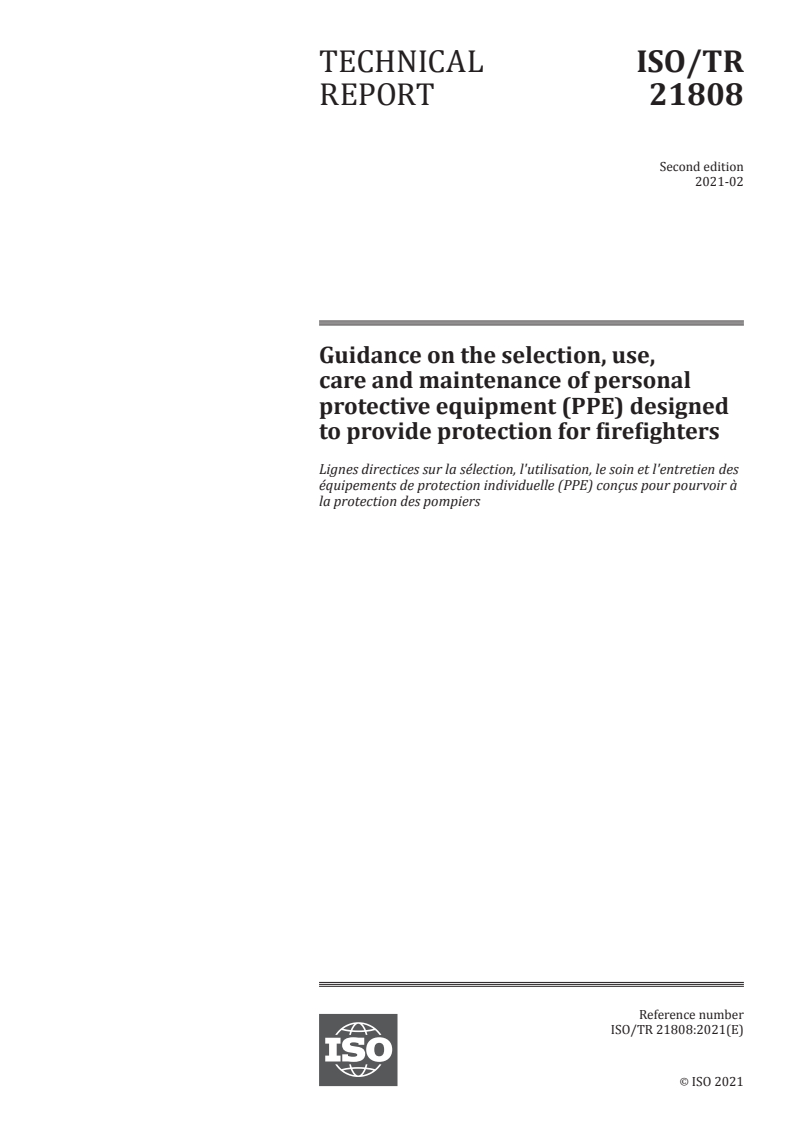
TECHNICAL ISO/TR
REPORT 21808
Second edition
2021-02
Guidance on the selection, use,
care and maintenance of personal
protective equipment (PPE) designed
to provide protection for firefighters
Lignes directices sur la sélection, l'utilisation, le soin et l'entretien des
équipements de protection individuelle (PPE) conçus pour pourvoir à
la protection des pompiers
Reference number
©
ISO 2021
© ISO 2021
All rights reserved. Unless otherwise specified, or required in the context of its implementation, no part of this publication may
be reproduced or utilized otherwise in any form or by any means, electronic or mechanical, including photocopying, or posting
on the internet or an intranet, without prior written permission. Permission can be requested from either ISO at the address
below or ISO’s member body in the country of the requester.
ISO copyright office
CP 401 • Ch. de Blandonnet 8
CH-1214 Vernier, Geneva
Phone: +41 22 749 01 11
Email: copyright@iso.org
Website: www.iso.org
Published in Switzerland
ii © ISO 2021 – All rights reserved
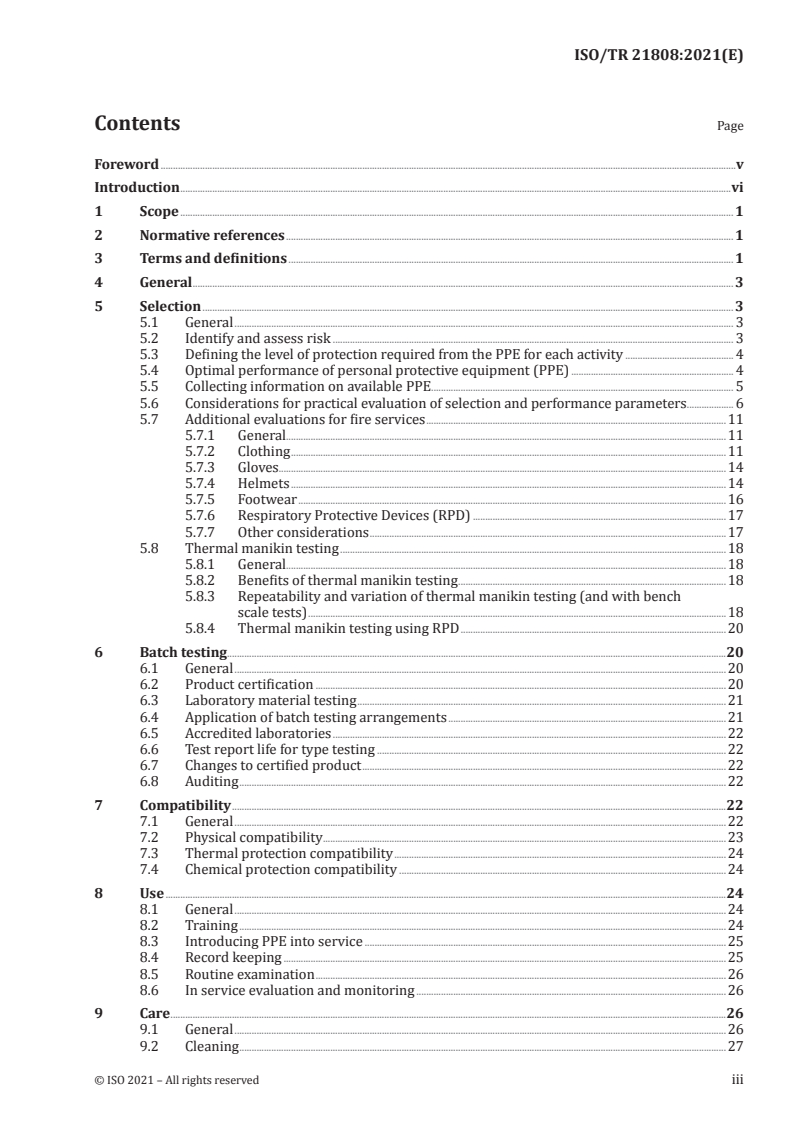
Contents Page
Foreword .v
Introduction .vi
1 Scope . 1
2 Normative references . 1
3 Terms and definitions . 1
4 General . 3
5 Selection . 3
5.1 General . 3
5.2 Identify and assess risk . 3
5.3 Defining the level of protection required from the PPE for each activity . 4
5.4 Optimal performance of personal protective equipment (PPE) . 4
5.5 Collecting information on available PPE . 5
5.6 Considerations for practical evaluation of selection and performance parameters . 6
5.7 Additional evaluations for fire services .11
5.7.1 General.11
5.7.2 Clothing .11
5.7.3 Gloves.14
5.7.4 Helmets .14
5.7.5 Footwear .16
5.7.6 Respiratory Protective Devices (RPD) .17
5.7.7 Other considerations .17
5.8 Thermal manikin testing .18
5.8.1 General.18
5.8.2 Benefits of thermal manikin testing .18
5.8.3 Repeatability and variation of thermal manikin testing (and with bench
scale tests) .18
5.8.4 Thermal manikin testing using RPD .20
6 Batch testing .20
6.1 General .20
6.2 Product certification .20
6.3 Laboratory material testing .21
6.4 Application of batch testing arrangements .21
6.5 Accredited laboratories .22
6.6 Test report life for type testing .22
6.7 Changes to certified product .22
6.8 Auditing .22
7 Compatibility .22
7.1 General .22
7.2 Physical compatibility .23
7.3 Thermal protection compatibility .24
7.4 Chemical protection compatibility .24
8 Use .24
8.1 General .24
8.2 Training .24
8.3 Introducing PPE into service .25
8.4 Record keeping .25
8.5 Routine examination .26
8.6 In service evaluation and monitoring .26
9 Care .26
9.1 General .26
9.2 Cleaning .27
9.2.1 General.27
9.2.2 Clothing .28
9.2.3 Other PPE .28
9.3 Storage .29
10 Maintenance .29
10.1 General .29
10.2 Inspection .30
10.2.1 General.30
10.2.2 Inspection schedule.30
10.2.3 Elements to be inspected .31
10.2.4 Decisions .31
10.3 Repairs and alterations .32
10.4 Disposal .32
11 Manufacturer information .32
11.1 General .32
11.2 Manufacturer information for selection and use .32
11.3 Manufacturer information for care .33
11.4 Manufacturer information for maintenance .34
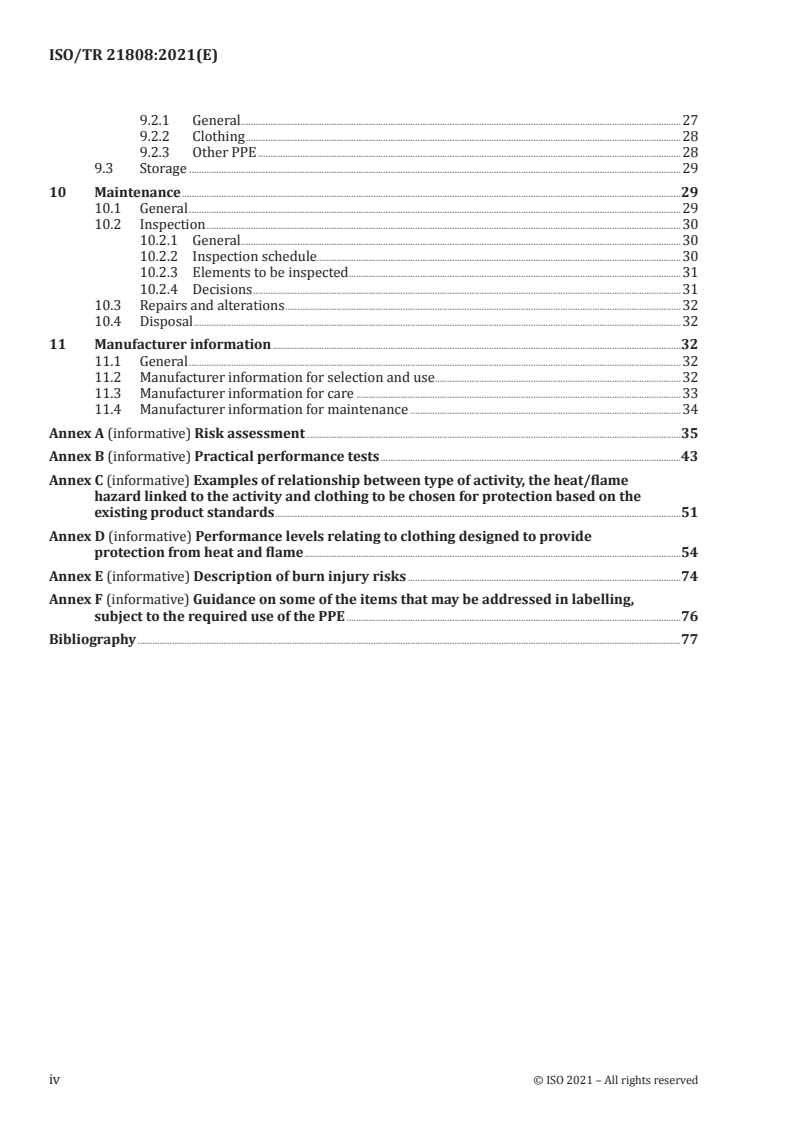
Annex A (informative) Risk assessment .35
Annex B (informative) Practical performance tests .43
Annex C (informative) Examples of relationship between type of activity, the heat/flame
hazard linked to the activity and clothing to be chosen for protection based on the
existing product standards .51
Annex D (informative) Performance levels relating to clothing designed to provide
protection from heat and flame .54
Annex E (informative) Description of burn injury risks .74
Annex F (informative) Guidance on some of the items that may be addressed in labelling,
subject to the required use of the PPE .76
Bibliography .77
iv © ISO 2021 – All rights reserved
Foreword
ISO (the International Organization for Standardization) is a worldwide federation of national standards
bodies (ISO member bodies). The work of preparing International Standards is normally carried out
through ISO technical committees. Each member body interested in a subject for which a technical
committee has been established has the right to be represented on that committee. International
organizations, governmental and non-governmental, in liaison with ISO, also take part in the work.
ISO collaborates closely with the International Electrotechnical Commission (IEC) on all matters of
electrotechnical standardization.
The procedures used to develop this document and those intended for its further maintenance are
described in the ISO/IEC Directives, Part 1. In particular, the different approval criteria needed for the
different types of ISO documents are noted. This document was drafted in accordance with the editorial
rules of the ISO/IEC Directives, Part 2 (see www .iso .org/ directives).
Attention is drawn to the possibility that some of the elements of this document may be the subject of
patent rights. ISO shall not be held responsible for identifying any or all such patent rights. Details of
any patent rights identified during the development of the document will be in the Introduction and/or
on the ISO list of patent declarations received (see www .iso .org/ patents).
Any trade name used in this document is information given for the convenience of users and does not
constitute an endorsement.
For an explanation of the voluntary nature of standards, the meaning of ISO specific terms and
expressions related to conformity assessment, as well as information about ISO's adherence to the
World Trade Organization (WTO) principles in the Technical Barriers to Trade (TBT), see www .iso .org/
iso/ foreword .html.
This document was prepared by Technical Committee ISO/TC 94, Personal safety — Protective
equipment, Subcommittee SC 14, Firefighters personal equipment.
This second edition cancels and replaces the first edition (ISO/TR 21808:2009), which has been
technically revised and completely rewritten.
Introduction
The information in this document has been produced to assist firefighters, fire services and purchasers
(or the person who advises the employer) in making the necessary decisions regarding the selection,
use, care and maintenance of PPE for firefighters.
The purpose of this document is to establish a guidance document for PPE with the goal to evaluate and
reduce the hazards and potential health risks associated with firefighting. This selection use, care and
maintenance guideline provides basic answers, criteria, and options for the fire service personnel that
are selecting or using PPE through its life cycle with respect to protection it provides related to heat
and flame or damaged PPE.
The main topics that the fire service needs to consider are highlighted in this document. This guidance
document goes through the various steps and considerations such as risk assessment, compatibility,
testing, cleaning, information to be provided with the PPE so that the right management choices can be
made for each fire service. Many paragraphs of the document contain bullet-lists as thought provokers
or options that may need to be considered. The annexes provide additional information that if included,
would make the main body of this document too complicated to read, but are necessary to describe
hazards and risks, the value of the test methods for the end user, for example Annex E “Description
of burn injury risks” and Annex F “Guidance on some of the items that may be addressed in labelling,
subject to the required use of the PPE” provide importance guidance information.
The selection of appropriate PPE for heat and flame are based on your own risk assessment and not be
copied from other procurement documents.
The compatibility in this document focused mainly on the physical compatibility between each element
of PPE and the documentation.
1)
This document is not intended for cleaning, inspection or repair of firefighter PPE. Use ISO 23616 for
cleaning, inspection and repair of firefighters personal protective equipment (PPE).
Currently, TC 94/WG1 works to establish a parent standard for the development of this document. In
case of the parent standard publication, the consistency of this document is to be considered.
1) Under preparation. Stage at the time of publication ISO/DIS 23616:2021.
vi © ISO 2021 – All rights reserved
TECHNICAL REPORT ISO/TR 21808:2021(E)
Guidance on the selection, use, care and maintenance of
personal protective equipment (PPE) designed to provide
protection for firefighters
1 Scope
This document sets out guidance for the selection, use, care and maintenance of PPE designed to provide
protection for firefighters while carrying out their duties.
The PPE covered in this document is intended for firefighting personnel exposed to risks associated
with but not necessarily limited to the following activities:
— structural firefighting;
— wildland firefighting;
— incidents involving hazardous materials;
— incidents involving motor vehicle;
— urban search and rescue.
The purpose of this document is to highlight the main areas that a Fire service needs to consider when
providing PPE to its members. This document is a supplement to the information provided in the PPE
standards or used in conjunction with them. Most paragraphs of the document contain bulletlists, these
lists are provided for guidance only and they are not exhaustive.
2 Normative references
The following documents are referred to in the text in such a way that some or all of their content
constitutes requirements of this document. For dated references, only the edition cited applies. For
undated references, the latest edition of the referenced document (including any amendments) applies.
ISO/TR 19591, Personal protective equipment for firefighters — Standard terms and definitions
3 Terms and definitions
For the purposes of this document, the terms and definitions given in ISO 19591 and the following apply.
ISO and IEC maintain terminological databases for use in standardization at the following addresses:
— ISO Online browsing platform: available at https:// www .iso .org/ obp
— IEC Electropedia: available at http:// www .electropedia .org/
3.1
base-layer garment
the first layer of a textile structure that is in direct contact with the skin (i.e. briefs, t-shirts, bras, socks)
3.2
care
processes and procedures for cleaning, decontamination, and storage of protective clothing and
equipment
[SOURCE: ISO/TR 19591:2018, 3.30]
3.3
cleaning
act of removing soils and contaminants from protective clothing and equipment by a mechanical,
chemical, thermal, or combined processes
[SOURCE: ISO/TR 19591:2018, 3.45]
3.4
compatibility
capability of two or more items or components of personal protective equipment to exist or function in
the same system without modification, adaption or mutual interference with respect to interfaces and
performance
3.5
contamination
contaminate
process by which elements of PPE are exposed to hazardous materials, body fluids, CBRN agent, the
products of combustion, soils and general dirt
3.6
coverall
one-piece garment that completely covers the wearer’s torso, together with arms, and legs, excluding
the head, hands, and feet
3.7
deterioration
downgrading of the effectiveness or physical characteristics of PPE component due to use, care (3.2),
maintenance or storage conditions
3.8
ensemble
combination or assembly of multiple items that are individually compliant with a standard that provide
protection to the head, upper torso including arms and hands and the lower torso including feet
[SOURCE: ISO 11999-1:2015, 3.24]
3.9
flame resistance
property of a material whereby combustion is prevented, terminated, or inhibited following the
application of a source of ignition, with or without subsequent removal of the ignition source
[SOURCE: ISO/TR 19591:2018, 3.114]
Note 1 to entry: Usually flame resistance materials for fire fighter are Index III of ISO 14116, but flame resistance
is denoted by meeting one of the Index of ISO 14416 using the flame spread test method ISO 15025.
3.10
maintenance
the act of preserving PPE from loss or deterioration (3.8) and includes procedures for inspection, repair
and ultimate removal from service
3.11
risk
probability of a specific undesired event (e.g. injury) occurring so that a hazard is realized
[SOURCE: ISO/TR 11610:2004, 3.205]
3.12
risk assessment
overall process that identifies hazards, estimates the potential severity of injury or damage to health,
estimates the likelihood of occurrence of injury or danger to health
2 © ISO 2021 – All rights reserved
3.13
selection
process determining/assessing what PPE is necessary for protection of fire and emergency services
response personnel from an anticipated specific hazard or other activity, the procurement of the
appropriate PPE, and the choice of the proper PPE for a specific hazard or activity at an emergency
incident
3.14
use
application of PPE including its limitations
4 General
Fire services develop procedures for selection, use, care, and maintenance (SUCAM) of PPE for
firefighters.
2)
NOTE 1 ISO 23616 is a companion to this document.
NOTE 2 ISO/TS 16975-1 is also a companion to this document.
NOTE 3 ISO/TR 18690 is an additional companion to this document.
5 Selection
5.1 General
The process for selecting appropriate PPE is predicated by the use of a risk assessment process that
includes the identification of the tasks to be undertaken and the hazards associated with those tasks.
The aim of this process is to ensure that firefighters are provided with PPE that is suitable for the task
being undertaken and provides protection against heat and flame and other related hazards.
The process of selecting PPE is divided into several stages:
5.2 Identify and assess risk
The process of carrying out a risk assessment include the following items as a minimum but not be
limited to:
— identification of the activities and work environment to be undertaken by person(s) wearing the PPE;
— type of incident (understand mitigation measures in place, organisation’s knowledge, training and
other control measures before the application of PPE);
— geographical location and climate (environmental temperature and conditions);
— frequency and term of use of the PPE;
— a list of the hazards present;
— thermal hazards: heat flux, (e.g. convective, radiant, mixture of heat types), and contact heat etc.;
— chemical: phase of chemical (e.g. gas, liquid, particulate or solids), and which chemical or mixtures (e.g.
acids/basis, organic solvents, petrol, chlorine, etc.), combustion residue (e.g. smoke, particulates, etc);
— biological: viruses, bacteria and other biological risks;
— contaminants: smoke, particulates, asbestos;
2) Under preparation. Stage at the time of publication ISO/DIS 23616:2021.
— hot or cold: environmental temperature or cryogenics, etc.;
— mechanical: abrasion, cut, vibration, flying object, etc.;
— other hazards (e.g. noise, electrical hazards, fall, lighting, etc.);
— other aspects;
— a quantification of the risks that would result from exposure to the hazards;
— what other factors are there to mitigate the risks/hazards;
— determination of the level and extent of protection required from the PPE (in absolute or relative
terms);
— evaluation of risks resulting from the use of the PPE (frequency and term of use of the PPE);
— organisation’s knowledge;
— evaluation of risks resulting from the use of the PPE;
— learning from incidents and reviews injuries and causes.
A number of risk assessment models may be used to determine the level of risk associated with the
activities.
For further guidance see Annex A.
5.3 Defining the level of protection required from the PPE for each activity
When defining the level of protection required, consideration is given to the following as a minimum,
but not be limited to:
— determine which parts of the body require protection;
— identify what kind of protection is required;
— identify the appropriate Standards or methods that provide the required protection;
— determine the level(s) of protection required (for the relevant parts of the body) in relative or
absolute terms for each item of PPE;
— assessment of previously used PPE for meeting standards (any issues and concerns these may have
caused such as comfort, incidents, improper use);
— identify compatibility issues and requirements of PPE items.
5.4 Optimal performance of personal protective equipment (PPE)
Select PPE that provides the optimal level of protection as under-protection can lead to the risk of injury
through burns, or other hazards while over-protection may lead to a lack of comfort or heat stress.
Heat stress occurs when the body is no longer able to control its internal temperature. In addition to
ambient air temperature, factors such as work intensity, humidity and clothing worn while working
may lead to heat stress.
Although when looking at heat stress one focuses on the clothing; boots, gloves, fire hood, helmet, RPD,
weight of combined PPE are all factors that lead to overexertion and to heat stress. Fire services are
required to be sensitive to these factors as firefighters working in hazardous environments are more
likely to behave in an unsafe manner due to their loss of ability to make sound decisions. For example
— firefighters might not wear PPE properly in hot environments increasing the risks for burn injury, and
4 © ISO 2021 – All rights reserved
— firefighter’s ability to concentrate on a given task may start to drop off, which increases the risk of
errors occurring.
Firefighters are required to be protected from the hazards associated with the tasks they are
undertaking; therefore, the fire services has to balance the health and comfort, and the long-term and
short-term risks. Therefore items of PPE are to be worn as late as possible, and for as shortest period
possible without exposing firefighters to potential hazards.
By identifying the hazards that firefighters might face and then engineering out or reducing the hazard
level where possible, may reduce the risk. In some cases, and only after being based on a risk assessment
process, the fire service can often reduce the required flame-resistant protection level needed for
protective garments and therefore increase the comfort and breathability. PPE is the last line of defence
for the firefighter.
Provision of optimal performance PPE depends on several factors. The following provides some
examples of what can be adopted:
— The ability to layering concept especially used in garment technology to achieve a balance between
comfort and level of protection needed for different tasks e.g. station wear/work wear providing
limited heat and flame protection could be used for some tasks and for those tasks requiring
additional protection a second heat and flame-resistant garment layer added.
— When a layered approach is used, clearly identify so it is understood that if such layered protective
clothing is capable of being compliant with the required Standard.
— PPE construction can increase or decrease the perception of comfort.
NOTE 1 The more pockets, pads, etc. that are added the heavier the garment becomes, and the PPE’s
breathability is reduced.
— Use of liners may have a positive effect by increasing protection against hot steam, chemical,
moisture, etc. but they may also decrease the breathability.
— PPE materials can be a critical factor in determining comfort.
— RPD construction can protect scratches or dents on metal surface or deterioration of rubber
materials by adding protective pads or increasing thickness of materials but it may affect the ease
of movement due to bulkiness and may lead to fatigue accumulation of firefighters due to added
weight. Familiarize with the construction of RPD to determine correct action.
— High breathability (air permeability and/or water vapour permeability) of PPE influences strongly
wearing comfort.
NOTE 2 The body produces sweat when regulating the body’s core temperature back to normal temperatures.
The evaporation of the sweat and breathability of the PPE allows moisture displacement from the skin. Comfort
of fabric is frequently measured by its vapour resistance (Ret). Different fabric weaves will provide a difference
level of air permeability. Knitted fabrics will generally be more air permeable than woven fabrics.
— When considering comfort, one needs to consider not only the PPE but the whole clothing system
including underwear and base layers influence on the moisture management.
Supporting equipment which provides information such as environmental temperature, remaining air
pressure of cylinders, communication, etc. are capable of increasing safety and accuracy of activities of
firefighters. Adding such equipment is one of the most important factors and needs to be considered.
5.5 Collecting information on available PPE
When purchasing PPE, the fire service carry out market research to determine products that are
available.
Consider that systems and innovations of protection have consequences (advantages and disadvantages)
and are taken into account and that this can also cause a paradox.
Take into account:
— sensibility;
— comfort; e.g. heavy weight;
— ergonomics;
— compatibility of all items of PPE;
— suitable for purpose;
— correct fitting;
— durability;
— guidance given regarding wash and care (including and coating re-impregnation/refurbishment);
— information obtained from the potential suppliers on performance levels and manufacturer’s
information including the compliance to relevant standards and certification by a recognised
independent certification body.
— Information gathered from comparable organisations using similar items of PPE for similar tasks.
NOTE If after collating all available information, it is established that suitable PPE is not available, then it
can be necessary for a fire service to carry out research and development work.
5.6 Considerations for practical evaluation of selection and performance parameters
When procuring PPE, practical evaluation are conducted to assess the compatibility and the ergonomics
of the PPE. See also Annex B.
Structured trials with participants undertaking standardised, representative tasks are recommended.
The number of participants, the diversity as well as the repeatability using the same population need to
be considered.
When conducting practical evaluation, a systematic approach is adopted with the following issues
considered:
— ability to protect based on expectation and the outcomes of the risk assessment;
— ease and speed of putting on and taking off;
— ease of activity;
— hindrance of use of PPE;
— durability;
— ease and extent of adjustability;
— acceptance in terms of comfort, mobility, weight and metabolic heat release;
— compatibility with all other items of PPE;
— ability to undertake all tasks expected without hindrance or difficulty;
— preservation of the protection in all working positions.
Practical evaluations are carried out under the following conditions:
— participants are selected based on a cross section of the firefighters (height, weight, age, gender, etc.);
— participants evaluate each item of the PPE on trial individually;
6 © ISO 2021 – All rights reserved
— performance of the garments including fire hoods after a number of cleaning cycles according to the
manufacturer’s instructions;
— objective physiological measurements are used to determine thermal impact (metabolic heat
release/retention);
— the number of firefighters are sufficient to ensure that the results obtained are statistically
significant and representatives of the total workforce.
Evaluation feedback is obtained in a structured manner allowing for both qualitative and quantitative
data collection and analysis. Using a structured questionnaire, structured or semi-structured
interviews and/or group discussions may achieve this.
NOTE 1 For consistency of data the same firefighters are used to conduct the practical evaluation. Obtaining
feedback from the intended firefighters is imperative at this stage, as such information will provide valuable data
relating to the practical performance of the PPE and give confidence to the firefighters, thus ensuring that the
selected items are suitable for use.
NOTE 2 Further guidance on the ergonomics of PPE in general can be found in EN 13921. A detailed test
protocol, specifically for firefighters PPE, can be found in BS 8469. Also, selection protocol can be found in
the German Fire Protection Association (vfdb) guideline 0810 (Guideline for the selection of personal protective
equipment (PPE) based on a risk assessment for operations of German fire services).
Table 1 — Summary on properties and wearability of Head protection. (Helmet)
Property Consideration Parameters (as examples)
Physiological — Sound attenuation — Jet style all surround shell
design
— Loss of spatial awareness — Decrease in visual and audio
sensitivity
— Increased brain temperature (hyper- — Heat dissipation rate, good air
thermia) ventilation
Ergonomics — Weight — Pressure points; neck mus-
cles fatigue
— Weight distribution (helmet design, add- — Fit when running
on accessories)
— Wearing height — Area of coverage; wobbliness
— Wearing comfort — Heat dissipation; air circula-
tion; sweat wicking material
on headband
— Interface with other components — Between neck protector and
jacket collar; between face
shield and BA mask; between
headband and BA mask;
between helmet and comms
system
— Head size — Gender specific helmets
— Head shape — Non-ethnocentric liner design
that fits user of all ethnic
groups
— Wearing size — Fits a wider range of head
sizes; secure down-sizing kit
for smaller head sizes
— Interface with BA mask that uses mount- — Face seal security
ing adaptor
Durability — Resistance to chemical — Cleaning agents; adhesive
from decals and retro-reflec-
tive trims
Table 1 (continued)
Property Consideration Parameters (as examples)
— Resistance to UV degradation — Solar radiation
Wash and care — Decontamination of internal components — Ease of component removal
and re-assembly
Protection: Thermal — Flame resistance — Inherently FR shell; FR com-
(convective, radiant ponentry
and contact heat)
— Heat resistance — Level of dropping ad sagging
— Heat insulation — Increase in internal tempera-
ture
Protection mechani- — Resistance to impacts — Shock impacts (force, accel-
cal & other eration)
— Resistance to crushing — Penetration by blunt and
sharp objects
— Electrical insulation — High speed particle shock
impacts
— Shell design
— Non-conductive shell or paint
Table 2 — Summary on properties and wearability of Respiratory protection (RPD)
Property Consideration Parameters (as examples)
Physiological — Comfort — Weight
— Activity — Field test
— Fitness — Fatigue resistant
— Movement of limbs and body
— Transport
— Training
— Airtightness
Ergonomics — Comfort — Size
— Environmental performance — Visibility
— Conversation
— Breathing
— Activities
— Interference with other PPE
— Abrasion with other PPE
Durability — Comfort — Comfort
— Environmental — Flame resistance
— Performance — Abrasion resistance
— Weatherability
— Aging of materials
Wash and care — Cleaning — Materials not affected by
detergent
— Decomposition and Manual — Not to affect breathability
performance
— Visibility
Thermal (convective, — Environmental performance — Flame resistance
radiant and contact
heat)
8 © ISO 2021 – All rights reserved
Table 2 (continued)
Property Consideration Parameters (as examples)
— Heat resistance
Table 3 — Summary on properties and wearability of protective clothing, protective gloves, and
firehoods
Property Consideration Parameters (as examples)
Physiological — Breathability — Air permeability
— Flexibility — Water vapour permeability
— Elasticity — Thermal heat loss by sweating
torso or manikin test
— Skin effects — Weight
— Thickness
— Surface roughness
— allergy
— pH value and chromium (VI)
content in a case of leather PPE
Ergonomics — While carrying out work — Size
— Fit
— Weight
— Freedom of movement and
work
— Friction against undergar-
ments in walking
— Dressing
— Compatibility with another PPE
— Heat stress
— Discomfort
Durability — While being worn — Tensile strength
— In storage — Tear strength
— Burst strength
— Abrasion resistance
— Flex cracking
— Seam resistance
— Aging
Wash and care — Single use — Easy to clean
— (Water) washing — Dimensional stability
— Laundry — Pilling
— Workplace — Visual appearance
— Home — Absence of physical damages
after cleaning
— Dry cleaning — Performance preservation
Thermal (convective, — Insulation for heat — Compare exposed body parts
radiant and contact
heat)
— Feeling heat — Protection from burns
Table 3 (continued)
Property Consideration Parameters (as examples)
— Skin burn risk prediction by
thermal human simulator
measurement
Table 4 — Summary on properties and wearability of Foot protection (Fire Boots)
Property Consideration Parameters (as examples)
Physiological — Cold — Cold insulation
— Environment — Water penetration and water
— Cold surface — Absorption of upper
— Moist or wet conditions — Water resistance
— Drops
— splashes
Ergonomics — Wearing comfort — Energy absorption of seat
— Region
— Walking and standing
— Orthopedic footwear
— Stepping down from height (e.g. cab of
truck)
Durability — Wear and tear — Strength (tensile, burst, etc)
— Abrasion
Wash and care — Ensure protective function — Maintaining repellency (to
water and chemical) washing
away treatment and need for
re-treatment
— Wear and tear of garments — Potentiation re-activation of
repellency
— Chemicals used in cleaning
(bleach and peroxide, starch)
as they all have an effect on the
heat and flame requirements
Thermal (convective, — Environment — Heat insulation
radiant and contact
heat)
— Hot surfaces — Heat resistance of outsole
— Flame resistance
— Insulation against heat
— Resistance to hot contact
— Resistance to radiant heat
Mechanical hazards — Falling objects — Toecap
— Compression — Metatarsal protection
— Ankle protection
— Sharp objects — Penetration resistance
— Cut (by sharp objects or chain saw) — Cut resistance
— Resistance to chain saw cutting
— Slip potential — Cleated outsole slip resistance
(coefficient of friction)
10 © ISO 2021 – All rights reserved
Table 4 (continued)
Property Consideration Parameters (as examples)
See also ISO/TR 18690 SUCAM Footwear and other PPE offering foot and leg protection.
5.7 Additional evaluations for fire services
5.7.1 General
To assist any decision making process, additional evaluations, tests or assessments can be required
to determine the strength or weakness of various items of PPE. For example, bench scale testing for
clothing, firehoods and gloves.
Laboratory bench scale transferred energy tests are used to select suitable materials for a protective
...
ISO/TR 21808:2021は、消防士のために設計された個人防護具(PPE)の選定、使用、手入れ及び保守に関するガイダンスを提供する重要な文書です。この標準は、消防士がその職務を遂行する際のリスクに対処するためのPPEに特化しており、特に構造火災、森林火災、有害物質関連の事故、自動車事故及び都市救助活動など、多様な状況における使用を考慮しています。 この文書の強みは、消防サービスがそのメンバーにPPEを提供する際に考慮すべき主要な事項を明確に示している点にあります。具体的な活動に応じた適切なPPEの選択ルールを提示することで、消防士の安全を確保するための実用的な指針を提供しています。また、文書内のほとんどの段落には箇条書きのリストが含まれており、これにより情報を視覚的に整理し、理解しやすくしています。ただし、これらのリストはあくまでガイダンスに過ぎず、完全なものではないことに注意が必要です。 ISO/TR 21808:2021の関連性は、特に危険な状況に身を置く消防士にとって、適切なPPEの重要性が高まっている現代において非常に高いと言えます。消防士が直面するさまざまなリスクを軽減するため、この標準に従ったPPEの使用と管理は不可欠です。消防サービスはこのガイダンスを参考にすることで、より安全な作業環境を確保し、消防士の職務遂行能力を向上させることが可能になります。
Die ISO/TR 21808:2021 bietet eine umfassende Übersicht über die Auswahl, Nutzung, Pflege und Wartung von persönlicher Schutzausrüstung (PSA), die speziell für Feuerwehrleute entwickelt wurde. Das Dokument deckt eine Vielzahl von relevanten Aspekten ab, die für das Feuerwehrpersonal bei der Durchführung ihrer Aufgaben von entscheidender Bedeutung sind. Der Anwendungsbereich dieser Norm ist klar definiert und fokussiert sich auf die besonderen Anforderungen, die an die PSA gestellt werden, insbesondere in gefährlichen Umgebungen wie strukturellen Bränden, Wildlandbränden, Einsätzen mit gefährlichen Materialien, Verkehrsunfällen und der urbanen Suche und Rettung. Diese klare Zielsetzung stellt sicher, dass die Feuerwehrkräfte optimal geschützt sind, während sie sich den Risiken ihrer Tätigkeit stellen. Ein hervorzuhebendes Merkmal dieser Norm sind die zahlreichen praktischen Hinweise, die in Form von Aufzählungen bereitgestellt werden. Obwohl diese Listen nicht erschöpfend sind, bieten sie wertvolle Orientierungshilfen für die Feuerwehrorganisationen und deren Mitglieder. Dies zeigt die Stärke der Norm, da sie nicht nur technische Standards berücksichtigt, sondern auch praxisnahe Empfehlungen integriert, die den Einsatz von PSA in kritischen Situationen unterstützen. Die Relevanz der ISO/TR 21808:2021 in der modernen Brandbekämpfung kann nicht genug betont werden. In einer Zeit, in der die Sicherheit des Personals an oberster Stelle steht, liefert dieses Dokument unverzichtbare Informationen, um die Wirksamkeit der PSA sicherzustellen und gleichzeitig das Risiko von Verletzungen zu minimieren. Es ergänzt die bestehenden PSA-Normen und fördert damit ein umfassenderes Verständnis und eine bessere Anwendung von Schutzausrüstung im Feuerwehrdienst. Zusammengefasst bietet die ISO/TR 21808:2021 eine wertvolle Anleitung, die sich durch ihren klaren Anwendungsbereich, die praktischen Empfehlungen und die hohe Relevanz für die Sicherheit und Effizienz von Feuerwehroperationen auszeichnet.
ISO/TR 21808:2021 문서는 소방관을 보호하기 위해 설계된 개인 보호 장비(PPE)의 선택, 사용, 관리 및 유지보수에 대한 지침을 제공합니다. 이 표준의 범위는 소방관이 직무 수행 중 직면할 수 있는 여러 위험 요소에 대한 PPE의 적절한 적용을 강조합니다. 구체적으로 이 문서는 구조 화재, 야외 화재, 위험 물질 사건, 차량 관련 사고, 도시 수색 및 구조와 같은 활동을 포함하며, 이러한 활동이 소방관의 안전에 얼마나 중요한지를 잘 설명합니다. 이 표준의 강점은 PPE 선정 시 고려해야 할 주요 사항을 명확하게 정리하고 있어, 소방 서비스가 회원들에게 적합한 개인 보호 장비를 제공하는 데 필요한 모든 요소를 포괄하고 있다는 점입니다. 이 문서는 PPE에 대한 기존 표준 정보를 보완하며, 소방관이 직면할 수 있는 다양한 상황에 따라 어떻게 PPE를 조정하고 관리해야 하는지를 안내합니다. 또한, 이 문서의 각 단락에는 점검 목록 형태의 안내가 포함되어 있어, 사용자들이 현장에서 요구되는 PPE의 관리 및 유지보수 절차를 쉽게 이해할 수 있도록 돕습니다. 이러한 점검 목록은 포괄적이지 않지만, 사용자가 주의해야 할 핵심 요소를 요약하여 제공함으로써 실질적인 가이드를 제공합니다. 결론적으로, ISO/TR 21808:2021 표준은 소방관을 위한 PPE와 관련된 실질적이고 유용한 지침을 제공하여, 소방 서비스의 안전성과 효과성을 높이는 데 기여하는 중요한 문서입니다. 소방관의 안전을 위한 PPE의 중요성을 인식하는 데 필수적이며, 개인 보호 장비의 선택 및 관리에 대한 안내는 소방 환경에서의 효율적인 대응을 가능하게 합니다.
ISO/TR 21808:2021 serves as a comprehensive guidance document addressing the critical aspects of the selection, use, care, and maintenance of personal protective equipment (PPE) specifically designed for firefighters. The standard's scope is appropriately focused, encompassing not only typical structural firefighting situations but also extends to challenging scenarios such as wildland firefighting, incidents involving hazardous materials, motor vehicle incidents, and urban search and rescue operations. This broad applicability ensures that firefighting personnel are equipped to handle a variety of risks effectively. One of the strengths of ISO/TR 21808:2021 is its well-structured guidance framework that outlines key considerations for fire services in the provision of PPE. The emphasis on a structured approach to PPE selection, use, and maintenance underlines the standard's relevance in enhancing safety protocols within fire service environments. Additionally, the document reinforces best practices surrounding PPE through bulleted lists, which, while not exhaustive, serve as invaluable tools for practitioners in the field to ensure thorough compliance with safety measures. Moreover, ISO/TR 21808:2021 underscores the importance of continuous education and training in the proper use and maintenance of PPE. By focusing on the care and maintenance aspects, the document promotes the longevity and reliability of protective gear, which is vital for ensuring the safety of firefighters under various conditions. This is particularly relevant in the context of increasing demands on firefighting services and the diverse environments they operate in, demonstrating the standard's timely applicability. Overall, ISO/TR 21808:2021 stands out for its targeted approach and practical utility in guiding fire services towards effective PPE strategies. Its relevance in today's firefighting landscape cannot be overstated, as it provides essential knowledge and best practices that contribute to the safety and effectiveness of firefighters across a range of operational scenarios.
La norme ISO/TR 21808:2021 fournit des lignes directrices précieuses concernant la sélection, l'utilisation, le soin et l'entretien des équipements de protection individuelle (EPI) destinés à protéger les pompiers. Le champ d'application de ce document est clairement défini, s'adressant aux pompiers confrontés à divers risques liés à des activités telles que la lutte contre les incendies structurels, les incendies de forêt, les incidents impliquant des matériaux dangereux, les accidents de véhicules et les opérations de recherche et sauvetage urbaines. L'un des principaux atouts de la norme est sa clarté et sa spécificité. En détaillant les critères essentiels que les services d'incendie doivent considérer lors de la fourniture d'EPI à leurs membres, la norme assure que les pompiers disposent de l'équipement adéquat pour faire face à leurs missions tout en minimisant les risques pour leur sécurité. Les paragraphes sont enrichis de listes à puces qui, bien que non exhaustives, servent de guide pratique pour les utilisateurs. La pertinence de cette norme dans le contexte actuel ne peut être sous-estimée. En raison de l'évolution constante des environnements d'intervention et des défis auxquels sont confrontés les pompiers, la norme ISO/TR 21808:2021 se positionne comme un outil indispensable pour améliorer la sécurité et l’efficacité des opérations. En complétant les autres normes relatives aux EPI, ce document facilite l'intégration de meilleures pratiques au sein des services d'incendie, favorisant ainsi une culture de sécurité renforcée. Enfin, la normativité de ce document renforce la responsabilité des gestionnaires des services d'incendie en leur fournissant une base solide pour établir des protocoles d'évaluation et de maintenance des EPI, garantissant ainsi un niveau de protection optimal pour les pompiers engagés dans des missions périlleuses.
Questions, Comments and Discussion
Ask us and Technical Secretary will try to provide an answer. You can facilitate discussion about the standard in here.
Loading comments...