

ISO/TS 22270:2026
(Main)Mechanical vibration — Practical guidance and requirements for the monitoring and measurement of hand-transmitted vibration on the hand, wrist or forearm
- Abstract
This document provides guidance and requirements on the evaluation of daily exposures to hand-arm vibration in the workplace where measurement or monitoring systems are fitted to the hand, wrist, or arm. This document provides guidance and to equipment manufacturers on how to provide suitable information to users on the scope and limitations of their equipment. It also provides guidance to users on the practical use and validation of these systems for monitoring or measurement in the workplace. This document provides information on measurement methods that complement the methods required for ISO 5349-1. NOTE The methods described in this document are not meant to replace measurements carried out in accordance with ISO 5349-1 when, for example, fulfilling duties under national regulations for either workplace vibration exposures or machinery vibration emissions.
- Status
- Published
- Publication Date
- 05-Jul-2026
- Technical Committee
- ISO/TC 108/SC 4 - Human exposure to mechanical vibration and shock
- Drafting Committee
- ISO/TC 108/SC 4 - Human exposure to mechanical vibration and shock
- Current Stage
- 6060 - International Standard published
- Start Date
- 06-Jul-2026
- Due Date
- 28-Aug-2026
- Completion Date
- 06-Jul-2026


ISO/TS 22270:2026 is an ISO Technical Specification about practical guidance and requirements for monitoring and measuring hand-transmitted vibration on the hand, wrist, or forearm. It is written for equipment manufacturers and for users who assess daily hand-arm vibration exposure in the workplace. The document explains how on-body systems should be selected, validated, used and reported, and it presents them as a complement to ISO 5349-1.
What does ISO/TS 22270:2026 specify?
ISO/TS 22270:2026 specifies guidance and requirements for evaluating daily hand-arm vibration exposure when the measurement or monitoring system is fitted to the hand, wrist or arm. It covers both how manufacturers should describe and support their equipment and how users should apply and validate these systems in practice.
The document is organized into scope, normative references, terms and definitions, an overview of on-body monitoring, monitoring requirements, signal processing, and reporting. The annexes add practical support material for transfer-characteristic evaluation and example reports.
| Annex | What it covers |
|---|---|
| Annex A | Evaluation of vibration transfer characteristics for on-body monitoring systems |
| Annex B | Example of on-body monitoring validation and test reports |
The scope positions on-body methods as complementary to the ISO 5349-1 approach. The methods in this document are not intended to replace ISO 5349-1 measurements when those are needed for workplace vibration exposure duties or machinery vibration emission duties.
What are the key requirements of ISO/TS 22270:2026?
ISO/TS 22270:2026 focuses on making wearable or body-mounted vibration measurements repeatable, interpretable and traceable. In practice, that means the system has to be specified clearly, checked against known references, and reported in a way that lets users understand the limits of the result.
Measurement location and body side
Clause 5.1 requires the on-body location to be clearly specified so that repeated measurements use the same position and coupling conditions. Clause 5.2 says measurements should be made on the hand expected to experience the highest exposure, and both hands should be assessed when the exposure differs significantly. This matters because small changes in position, strap tightness or hand choice can change the reading.
Orientation and transmission
Clause 5.3 addresses transducer orientation. The system should measure perpendicular to the body surface where possible, and triaxial systems should capture all three axes simultaneously. Clause 5.4 requires the vibration transmission characteristics between the tool-user interface and the sensor to be assessed and compensated with a suitable conversion function. In practice, the sensor does not see the same vibration as the hand-machine interface, so the system has to correct for attenuation and frequency change.
Device design and verification
Clause 5.5 covers the device itself: transducer type, fixing force, mass and size, repeatability, reproducibility, verification and in situ checks. The attachment should be robust and consistent, while the system should be as small and light as practical so it does not alter the work or the vibration transfer. The document also points users toward calibration and functional checks before and after monitoring, and it asks manufacturers to support mechanical calibration checks and self-testing. That matters because a wearable device can drift, loosen or fail during unattended use.
Comparison with ISO 5349-1 measurements
Clause 5.5.8 requires comparative testing for manufacturers and for research use, using a fully compliant ISO 5349-1 and ISO 8041-1 measurement system as the reference. The comparison should cover machines that represent the intended use, including both continuous and impulsive tools where relevant. The report should show the machine type, measurement locations, means and standard deviations, and a statistical significance test for the differences. This is the core evidence that the wearable system can estimate hand-machine vibration in a defensible way.
Signal processing and artefact handling
Clause 6 requires the monitoring system to handle the limits of compact electronics without losing important exposure data. Manufacturers need to document the usable frequency range, dynamic range, filtering, sampling approach, wake-up behavior and any gaps in acquisition. Clause 6.2 also requires a way to identify and exclude errors and artefacts such as overloads, connection failures, movement unrelated to tool use, contact with other objects, electromagnetic radiation and misuse. In practice, this protects the result from false peaks, missed impacts and bad data.
Reporting
Clause 7 requires reporting to cover instrument characteristics, validation and monitoring results. The report should identify the device settings, mounting method, body location, hand assessed, orientation, calibration or verification record and the monitored person. Supplementary information such as machine type, gloves, posture, forces, work activity and environmental conditions can also be recorded. This is what makes the result usable for review, comparison and follow-up.
Data protection
Clause 4.4 states that personal information collected during body-mounted monitoring should be handled under national legislation for collection, storage, analysis and disposal. That matters because vibration monitoring can record identifiable worker data as well as exposure data.
What terms does ISO/TS 22270:2026 define?
ISO/TS 22270:2026 defines the key terms used to distinguish conventional measurement from body-mounted monitoring.
- Hand-arm vibration measurement - measurement of vibration magnitude data that represents exposure and is acquired in accordance with ISO 5349-1 using equipment in conformity with ISO 8041-1 or ISO 8041-2.
- Hand-arm vibration on-body monitoring - provision of indicative exposure values based on exposure time and measurements on the hand, wrist or forearm, used to estimate the value that would be given by hand-arm vibration measurement.
- On-body monitor - the device used for on-body monitoring of hand-arm vibration.
- Monitoring - characterization of vibration exposures using measurements made on the body.
- Transfer function - the mathematical relationship between the vibration at the point entering the body and the vibration measured at the on-body location.
- Conversion function - the function that converts on-body measurements into estimates of vibration magnitude at a gripping zone location.
- Vibration transfer characteristic - the overall observed or measured behavior of vibration transmission from the tool interface to the on-body sensor location.
Who uses ISO/TS 22270:2026?
ISO/TS 22270:2026 is aimed at manufacturers of on-body vibration measurement and monitoring systems, including systems using MEMS transducers, inertial measurement units and other wearable technologies. It is also used by employers, safety professionals, researchers and technicians who measure hand-arm vibration in the workplace.
In practice, these users apply it when they need to set up a wearable system, judge whether a result is suitable for a particular machine or task, compare on-body monitoring with ISO 5349-1 measurements, or document long-term exposure patterns for individuals and work groups.
Which standards are used with ISO/TS 22270:2026?
| Standard | How it contributes |
|---|---|
| ISO 5349-1 | Gives the general requirements for measurement and evaluation of human exposure to hand-transmitted vibration and is the reference for compliant exposure assessment |
| ISO 8041-1 | Provides requirements for general purpose vibration meters used as the reference measurement system in comparisons |
| ISO 8041-2 | Is used for personal vibration exposure meters and is referenced for in situ checks and related functionality |
| ISO 5349-2 | Provides practical workplace guidance and is cited when measurements away from the gripping zone are contrasted with traditional methods |
| ISO 18431-1 | Supports frequency-response and signal-processing analysis used in transfer-characteristic evaluation |
| ISO 10819 and ISO 10819:2013/Amd 2:2021 | Provide an example methodology and test setup that can inform transfer-characteristic evaluation |
| ISO/TR 19664 | Gives guidance and terminology for instrumentation and equipment used in daily vibration exposure assessment |
| ISO/TR 18570 | Is cited for supplementary information on hand-transmitted vibration risk assessment |
What does the ISO/TS 22270:2026 document contain?
ISO/TS 22270:2026 contains an overview of on-body monitoring, including its advantages, limitations and data-protection considerations. It then sets out practical choices for location, hand selection, sensor orientation, vibration transmission characteristics, transducer fixation, repeatability and reproducibility, verification, in situ checks and comparative testing against ISO 5349-1.
The document also addresses signal-processing trade-offs in wearable systems, such as sampling range, dynamic range, sleep modes and missed events. Clause 7 gives the structure of a useful report, and Annex B shows example validation and monitoring reports with fields for system identity, mounting, comparison results and exposure results.
Annex A gives guidance for evaluating vibration transfer characteristics and developing conversion functions. It points to frequency-response testing in three axes and to the use of controlled vibration inputs so manufacturers can characterize how a wearable system responds before it is used in the workplace.
Get Certified
Connect with accredited certification bodies for this standard

CIS Institut d.o.o.
Personal Protective Equipment (PPE) certification body. Notified Body NB-2890 for EU Regulation 2016/425 PPE.

Kiwa BDA Testing
Building and construction product certification.
Kmetijski inštitut Slovenije
Agricultural Institute of Slovenia. Soil testing, plant health, agricultural product analysis.
Sponsored listings
Frequently Asked Questions
ISO/TS 22270:2026 is a technical specification published by the International Organization for Standardization (ISO). Its full title is "Mechanical vibration — Practical guidance and requirements for the monitoring and measurement of hand-transmitted vibration on the hand, wrist or forearm". This standard covers: This document provides guidance and requirements on the evaluation of daily exposures to hand-arm vibration in the workplace where measurement or monitoring systems are fitted to the hand, wrist, or arm. This document provides guidance and to equipment manufacturers on how to provide suitable information to users on the scope and limitations of their equipment. It also provides guidance to users on the practical use and validation of these systems for monitoring or measurement in the workplace. This document provides information on measurement methods that complement the methods required for ISO 5349-1. NOTE The methods described in this document are not meant to replace measurements carried out in accordance with ISO 5349-1 when, for example, fulfilling duties under national regulations for either workplace vibration exposures or machinery vibration emissions.
This document provides guidance and requirements on the evaluation of daily exposures to hand-arm vibration in the workplace where measurement or monitoring systems are fitted to the hand, wrist, or arm. This document provides guidance and to equipment manufacturers on how to provide suitable information to users on the scope and limitations of their equipment. It also provides guidance to users on the practical use and validation of these systems for monitoring or measurement in the workplace. This document provides information on measurement methods that complement the methods required for ISO 5349-1. NOTE The methods described in this document are not meant to replace measurements carried out in accordance with ISO 5349-1 when, for example, fulfilling duties under national regulations for either workplace vibration exposures or machinery vibration emissions.
ISO/TS 22270:2026 is classified under the following ICS (International Classification for Standards) categories: 13.160 - Vibration and shock with respect to human beings. The ICS classification helps identify the subject area and facilitates finding related standards.
ISO/TS 22270:2026 is available in PDF format for immediate download after purchase. The document can be added to your cart and obtained through the secure checkout process. Digital delivery ensures instant access to the complete standard document.
Standards Content (Sample)
Technical
Specification
ISO/TS 22270
First edition
Mechanical vibration — Practical
2026-07
guidance and requirements for the
monitoring and measurement of
hand-transmitted vibration on the
hand, wrist or forearm
Vibrations mécaniques — Directives pratiques et exigences pour
la surveillance et le mesurage des vibrations transmises à la main
vibration sur la main, le poignet ou l'avant-bras
Reference number
© ISO 2026
All rights reserved. Unless otherwise specified, or required in the context of its implementation, no part of this publication may
be reproduced or utilized otherwise in any form or by any means, electronic or mechanical, including photocopying, or posting on
the internet or an intranet, without prior written permission. Permission can be requested from either ISO at the address below
or ISO’s member body in the country of the requester.
ISO copyright office
CP 401 • Ch. de Blandonnet 8
CH-1214 Vernier, Geneva
Phone: +41 22 749 01 11
Email: copyright@iso.org
Website: www.iso.org
Published in Switzerland
ii
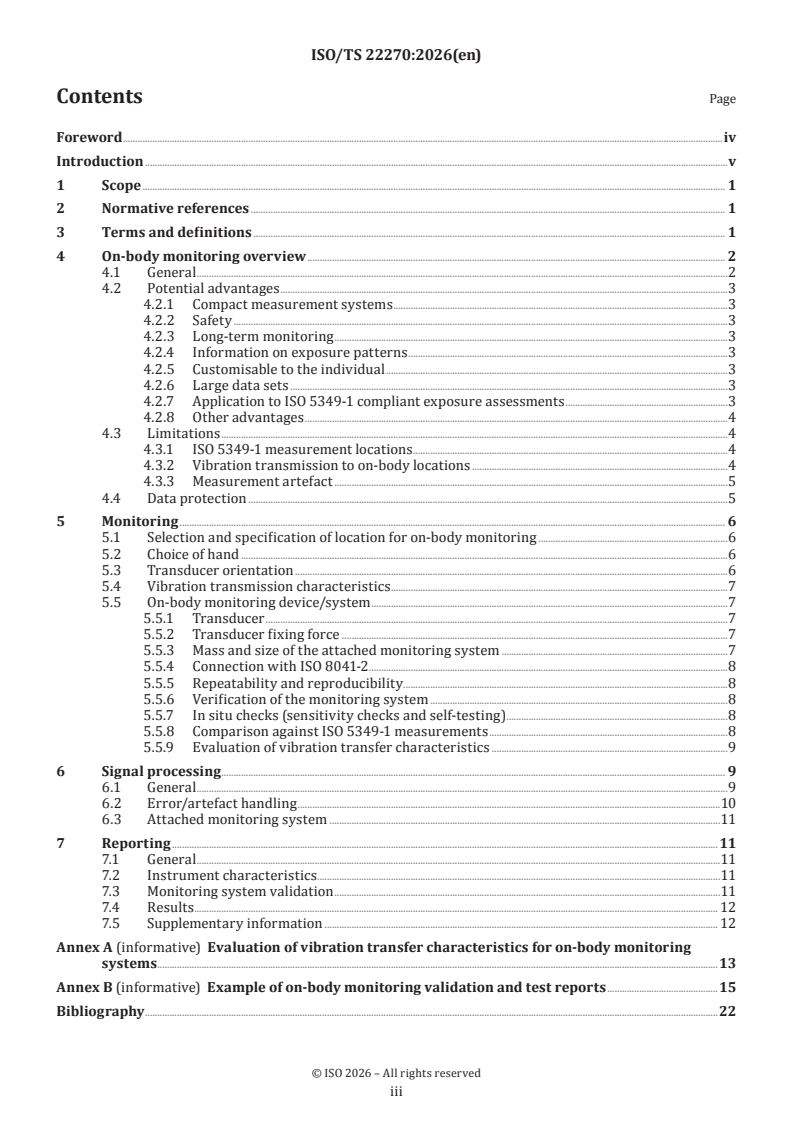
Contents Page
Foreword .iv
Introduction .v
1 Scope . 1
2 Normative references . 1
3 Terms and definitions . 1
4 On-body monitoring overview . 2
4.1 General .2
4.2 Potential advantages .3
4.2.1 Compact measurement systems .3
4.2.2 Safety .3
4.2.3 Long-term monitoring .3
4.2.4 Information on exposure patterns .3
4.2.5 Customisable to the individual .3
4.2.6 Large data sets .3
4.2.7 Application to ISO 5349-1 compliant exposure assessments .3
4.2.8 Other advantages .4
4.3 Limitations .4
4.3.1 ISO 5349-1 measurement locations .4
4.3.2 Vibration transmission to on-body locations .4
4.3.3 Measurement artefact .5
4.4 Data protection .5
5 Monitoring . 6
5.1 Selection and specification of location for on-body monitoring .6
5.2 Choice of hand .6
5.3 Transducer orientation .6
5.4 Vibration transmission characteristics .7
5.5 On-body monitoring device/system .7
5.5.1 Transducer .7
5.5.2 Transducer fixing force .7
5.5.3 Mass and size of the attached monitoring system .7
5.5.4 Connection with ISO 8041-2 .8
5.5.5 Repeatability and reproducibility .8
5.5.6 Verification of the monitoring system .8
5.5.7 In situ checks (sensitivity checks and self-testing) .8
5.5.8 Comparison against ISO 5349-1 measurements .8
5.5.9 Evaluation of vibration transfer characteristics .9
6 Signal processing . 9
6.1 General .9
6.2 Error/artefact handling .10
6.3 Attached monitoring system .11
7 Reporting .11
7.1 General .11
7.2 Instrument characteristics . .11
7.3 Monitoring system validation .11
7.4 Results . . 12
7.5 Supplementary information . 12
Annex A (informative) Evaluation of vibration transfer characteristics for on-body monitoring
systems .13
Annex B (informative) Example of on-body monitoring validation and test reports .15
Bibliography .22
iii
Foreword
ISO (the International Organization for Standardization) is a worldwide federation of national standards
bodies (ISO member bodies). The work of preparing International Standards is normally carried out through
ISO technical committees. Each member body interested in a subject for which a technical committee
has been established has the right to be represented on that committee. International organizations,
governmental and non-governmental, in liaison with ISO, also take part in the work. ISO collaborates closely
with the International Electrotechnical Commission (IEC) on all matters of electrotechnical standardization.
The procedures used to develop this document and those intended for its further maintenance are described
in the ISO/IEC Directives, Part 1. In particular the different approval criteria needed for the different types
of ISO documents should be noted. This document was drafted in accordance with the editorial rules of the
ISO/IEC Directives, Part 2 (see www.iso.org/directives).
ISO draws attention to the possibility that the implementation of this document may involve the use of (a)
patent(s). ISO takes no position concerning the evidence, validity or applicability of any claimed patent
rights in respect thereof. As of the date of publication of this document, ISO had not received notice of (a)
patent(s) which may be required to implement this document. However, implementers are cautioned that
this may not represent the latest information, which may be obtained from the patent database available at
www.iso.org/patents. ISO shall not be held responsible for identifying any or all such patent rights.
Any trade name used in this document is information given for the convenience of users and does not
constitute an endorsement.
For an explanation of the voluntary nature of standards, the meaning of ISO specific terms and expressions
related to conformity assessment, as well as information about ISO's adherence to the World Trade
Organization (WTO) principles in the Technical Barriers to Trade (TBT), see www.iso.org/iso/foreword.html.
This document was prepared by Technical Committee ISO/TC 108, Mechanical vibration, shock and condition
monitoring, Subcommittee SC 4, Human exposure to mechanical vibration and shock.
Any feedback or questions on this document should be directed to the user’s national standards body. A
complete listing of these bodies can be found at www.iso.org/members.html.
iv
Introduction
The objective of this document is to provide practical guidance and requirements for the monitoring and
measurement of hand-transmitted vibration on the hand, wrist, or forearm.
Wearables, MEMS (micro-electro-mechanical systems) transducers, and other technologies are widely
available and routinely used for monitoring hand-arm vibration (HAV) exposure in the workplace. These
systems and devices are robust, can be inexpensive and substantially smaller than traditional measurement
[1] [2]
systems on which standards such as ISO 5349-1 and ISO 5349-2 are based.
These evolving technologies provide opportunities for practical in situ monitoring and measurements
conducted over long periods of time, which can include the use of multiple machines and work processes.
These new types of measurements can be at locations on the hand, wrist or forearm; away from the vibrating
surface interface where vibration enters the hand.
[1]
Formally, measurements away from the hand-machine interface do not comply with ISO 5349-1 . For this
[1]
reason, measurements away from the hand-machine interface should not replace ISO 5349-1 measurement
when, for example, fulfilling duties under national regulations for either workplace vibration exposures or
[1]
machinery vibration emissions. Full conformity with ISO 5349-1 is not always required, for example
[3]
if the purpose is to reduce vibration exposures or for research applications . However, devices using
measurement on the body are available and are being used to monitor vibration exposures and augment
traditional measurements. If users account for the limitations of the devices, including the additional
[1]
measurement uncertainties, they can provide data which supplements that given by the ISO 5349-1
methodology, leading to a better understanding of the risks for those exposed to hand arm vibration. The
objective of this document is to highlight the potential benefits and limitations of measurement on the hand,
wrist or arm and to provide guidance on how to reduce the impact of the limitations on vibration evaluations.
Body-mounted measurement can allow a simpler, lower-cost monitoring of an individual’s vibration
exposure over long periods, such as a full working day, shift, or even a year or more. This type of long-term
monitoring can provide valuable information on vibration exposure patterns and indicators to vibration
risks. These data can then inform risk control management procedures and thereby reduce the vibration
exposure of individuals.
One objective of body-mounted measurement systems is to reduce or remove the need for specialist
technicians to be present during measurement, by allowing simple fitting and removal by operators with
basic training and automatic data download. By comparison, traditional measurement, that conforms
[1]
to ISO 5349-1 , should be performed by specialists who should have a detailed understanding of the
measurement system and awareness of the possible sources of error.
This document provides guidance to those developing on-body measurement systems and for those using
these systems. It discusses the factors that need to be considered, such as: instrumentation characteristics,
measurement locations on the hand, wrist, or forearm, and the vibration transfer characteristics from the
vibrating surface to the body-mounted sensor.
This document is aimed at manufacturers of systems that measure or monitor vibration on the hand, wrist
or arm. This document is also aimed at those performing measurements or monitoring of vibration on the
hand, wrist, or arm, including those involved in research.
v
Technical Specification ISO/TS 22270:2026(en)
Mechanical vibration — Practical guidance and requirements
for the monitoring and measurement of hand-transmitted
vibration on the hand, wrist or forearm
1 Scope
This document provides guidance and requirements on the evaluation of daily exposures to hand-arm
vibration in the workplace where measurement or monitoring systems are fitted to the hand, wrist, or arm.
This document provides guidance and to equipment manufacturers on how to provide suitable information
to users on the scope and limitations of their equipment. It also provides guidance to users on the practical
use and validation of these systems for monitoring or measurement in the workplace.
This document provides information on measurement methods that complement the methods required for
[1]
ISO 5349-1 .
NOTE The methods described in this document are not meant to replace measurements carried out in accordance
[1]
with ISO 5349-1 when, for example, fulfilling duties under national regulations for either workplace vibration
exposures or machinery vibration emissions.
2 Normative references
The following documents are referred to in the text in such a way that some or all of their content constitutes
requirements of this document. For dated references, only the edition cited applies. For undated references,
the latest edition of the referenced document (including any amendments) applies.
ISO 5349-1, Mechanical vibration — Measurement and evaluation of human exposure to hand-transmitted
vibration — Part 1: General requirements
ISO 8041-1, Human response to vibration — Measuring instrumentation — Part 1: General purpose vibration
meters
3 Terms and definitions
For the purposes of this document, the terms and definitions given in ISO 5349-1, as well as the following
apply.
ISO and IEC maintain terminology databases for use in standardization at the following addresses:
— ISO Online browsing platform: available at http:// www .iso .org/ obp
— IEC Electropedia: available at http:// www .electropedia .org/
3.1
hand-arm vibration measurement
measurement of vibration magnitude data that is representative of exposure and acquired in accordance
[4]
with ISO 5349-1, using equipment in conformity with ISO 8041-1 or ISO 8041-2
3.2
hand-arm vibration on-body monitoring
provision of indicative values for hand-arm vibration exposures based on a combination of exposure time
and measurements on the hand, wrist, or forearm, which estimate values that would be given by hand-arm
vibration measurement (3.1)
3.3
on-body monitor
device used for on-body monitoring (3.4) of hand-arm vibration
3.4
monitoring
characterization of vibration exposures using measurements made on the body
3.5
transfer function
mathematical function describing the relationship between vibration magnitude at the point entering the
body and the corresponding vibration measured at the on-body location, typically expressed as a ratio of
output to input in the frequency domain
3.6
conversion function
mathematical function that converts measurements at an on-body location to estimates of the likely
vibration magnitude at a gripping zone location
Note 1 to entry: The conversion function (3.6) and the W frequency weighting will often be combined into a single
h
function.
3.7
vibration transfer characteristic
general term describing the observed or measured behaviour of vibration transmission from the tool
interface to the on-body sensor location, including but not limited to the vibration transfer function (3.5)
4 On-body monitoring overview
4.1 General
Evaluation of hand-arm vibration using measurements on the body can provide valuable complementary
methods for obtaining hand-arm vibration data.
[1] [2]
Hand-arm vibration measurements in accordance with ISO 5349-1 and ISO 5349-2 require
measurement on the vibrating surface at the interface between the vibrating surface and the hand. However,
these measurements can be complex and require technical knowledge, skill and experience to achieve
reliable results. For hand-arm vibration on-body monitoring it is not always necessary for on-body monitors
[1]
to fulfil all the requirements of ISO 5349-1 , for example, if the purpose is to reduce vibration exposures or
for research purposes.
Measurements of vibration transmitted to the hand can be made on the hand, wrist, or arm of machine
operators. In this document, devices used for on-body measurements are referred to as “on-body monitors”.
On-body monitors estimate the vibration magnitude where the hand is in contact with the vibrating surface
by applying a vibration conversion function to the vibration signal at the on-body location.
NOTE Direct measurement at an on-body location (i.e. without applying a conversion function) provides
information on the vibration at the location of the sensor(s). For an individual, these measurements can be relevant
for physiological or pathological processes occurring at the on-body location. However, this application of on-body
measurement is not covered by this document.
It is important to recognize that there are limitations to on-body monitoring. Due to the location of the
[1]
sensors, the measurements do not comply with existing measurement standards like ISO 5349-1 , and
[5]
the instrumentation cannot fully comply with existing instrumentation standards like ISO 8041-1 and
[4] [6]
ISO 8041-2 , and the terminology for these instruments in ISO/TR 19664 . For these reasons, on-body
measurement is referred to as “monitoring”.
4.2 Potential advantages
4.2.1 Compact measurement systems
Small transducers and compact signal processors allow for both the transducer set, and, in some cases, the
entire measurement system to be constructed into a compact device. These devices can then be fitted on the
hand, wrist, or arm of the machine operator, where they are unobtrusive and monitor vibration exposures
of a wearer.
4.2.2 Safety
In some cases, on-body monitors allow the evaluation of hand-arm vibration exposures in situations where
[1]
traditional measurement according to ISO 5349-1 would be impractical or unsafe (for example where
cables risk being caught in rotating machinery, where it is not practical to safely fix transducers to small
tools or hand-fed workpieces or in hazardous working environments).
4.2.3 Long-term monitoring
Compact, on-body measurement systems often allow for long-term monitoring, which can provide useful
insights into vibration exposure patterns. For example, daily and longer-term measurements of vibration
levels over long periods will usually provide:
— a more complete understanding of exposure patterns,
— information on variants/outliers and how they are associated to individual machines, tasks, or operators,
and
— indication of changes that are required to maintain low-vibration exposures (for example the need for
replacement, maintenance, or training).
4.2.4 Information on exposure patterns
Used with care, measurement away from the gripping point can provide valuable supplementary information,
which, for example, can provide information on daily hand-arm vibration exposure patterns for individual
workers. Employers can use the information from exposure patterns to improve the targeting of control
measures.
4.2.5 Customisable to the individual
On-body measurement systems can be assigned to individuals, with the potential to set customised daily
exposure warning levels, limits, or restrictions on machine usage for that individual.
4.2.6 Large data sets
Compact, inexpensive systems that can automatically monitor information on vibration exposure on many
people, over many shifts have the capability to create very large data sets. Analysis of large data sets
provides an opportunity to look for patterns of exposures that would not otherwise be apparent.
4.2.7 Application to ISO 5349-1 compliant exposure assessments
[1]
Exposure time information from monitoring devices can be used in conjunction with data from ISO 5349-1
[1]
measurements to give ISO 5349-1 compliant evaluations of the individual’s hand-arm vibration exposure.
Total daily vibration exposures can be provided either as real-time cumulative exposure or post-monitoring
calculations.
Care shall be taken when comparing on-body exposure time with ISO 5349-1 methods. Due to their
precision, exposure time from on-body measurement devices will often give results that are shorter than
times determined by other methods and can be much shorter than self-estimates of exposure time.
4.2.8 Other advantages
Fixing a transducer to the hand, wrist, or arm of the machine operator has several potential advantages:
— the monitoring is directly associated with one individual throughout the working day or days;
— the monitoring automatically incorporates vibration exposures from all machines used throughout a
working day;
— the monitoring automatically incorporates operational factors such as coupling forces and postures;
— the monitoring can capture processes which include changes of grip position or contact position.
On-body monitoring can be combined with other smart working devices via wireless communication or
other methods. These can include biometric assessments such as skin temperature, pulse rate, or other
environmental assessments such as noise, humidity, dust and chemicals. These combined data sets allow for
the possibility of increased safety in the workplace.
4.3 Limitations
4.3.1 ISO 5349-1 measurement locations
Measurement away from the gripping zone of the hand should be used with caution. Users should be aware
of the limitations and risks (under or over-assessment of exposure) of this type of measurement.
[1]
Measurements at locations away from the gripping zone are not permitted by ISO 5349-1 and discouraged
[2]
in ISO 5349-2 .
4.3.2 Vibration transmission to on-body locations
Fixing transducers to the hand, wrist, or arm is likely to be affected by the variabilities caused by factors
[7]
such as (see ISO 5349-1:2001 , Annex D):
— machine-hand and body-instrument coupling:
— inconsistent or variable hand position or orientation on the machine handle;
— inconsistent or variable grip and push forces;
— inexact measurement location or orientation;
— inconsistent coupling of the measurement device to the surface of the body;
— individual characteristics:
— inconsistent or variable posture (affecting grip and push force directions);
— differing hand-arm physiologies (size, hand-arm mass, muscle strength) between subjects;
— other factors:
— use of gloves;
— use of exoskeletons;
— machine support aids;
— use of resilient materials or coverings.
All these have the potential to affect the transmission of vibration from the machine handle to the monitoring
system.
For vibration measured on the hand, arm or wrist, high-frequency vibration is unlikely to be transmitted
to the measurement location, so the transducers are unlikely to experience the high-level, high-frequency
vibration on the machine surface. Figure 1 illustrates some possible measurement locations and the
maximum transmitted frequency of vibration at that location are shown in Table 1.
[8]
NOTE 1 See ISO/TR 18570 for examples of rms vibration levels, where the upper cut-off frequency is set to
400 Hz. The corresponding peak levels will be significantly higher, especially for impulsive machines.
NOTE 2 Hand-arm vibration presents a significant measurement challenge for any transducer fitted to the
gripping zone of a machine. Approximate maximum transmitted frequency of the tool is not subject to attenuation
and, therefore, can reach frequencies in excess of 2000 Hz. Where machines produce shock vibration, the unfiltered
[9] [10]
vibration level can reach (30 000 to 50 000) m/s², see ISO 8041-1:2017 , Annex E and Reference .
Table 1 — Examples of likely maximum transmitted frequencies reaching selected on-body
measurement locations
Approximate maximum
Location in Figure 1 Monitoring location
a
transmitted frequency (Hz)
b
A Fingernail >1000 Hz
c
B Back of hand 500
C Distal end of radial or ulnar bone 150
c
D Wrist 150
a
Approximate maximum transmitted frequency represents the approximate attenuation to 0,1 transmissibility based on
experimental data using lightweight transducers.
b [11]
See Reference .
c [12] [10]
See References and .
The transmission characteristics and suitability of compact measurement systems vary by location. Statements in 4.2.1 to
4.2.3 should be interpreted with reference to the frequency-specific attenuation data in this table and dependent on individual
coupling conditions.
Figure 1 — Illustration of possible on-body measurement locations
4.3.3 Measurement artefact
Any measurement of hand-transmitted vibration shall also consider the capabilities of the measurement
system. Long-term, unattended measurement on a user requires awareness of factors such as measurement
artefact and how these are handled by the instrumentation or affect the measurement result. See 6.2 and
[13]
ISO 8041-2:2021 , Annex A for additional information.
4.4 Data protection
When collecting hand-arm vibration data using instrumentation connected to the body it is likely that some
personal information relating to the person exposed to vibration will be collected. The type and extent of
personal data will depend on the detailed requirements of the hand-arm vibration monitoring. Wherever
personal data are collected, national legislation should be followed for collection, data storage, data handling,
data analysis, data mining and data disposal.
5 Monitoring
5.1 Selection and specification of location for on-body monitoring
This document does not specify a single measurement location for on-body monitoring. There are many
potential locations for on-body monitoring, as can be seen in Figure 1. The location chosen shall be clearly
specified, so that the transmission of vibration to the measurement transducer is consistent with validation
measurements and other monitoring with the same system.
Measurements made at a specified location on the body shall be repeatable and reproducible. Therefore,
the locations used by the monitoring system are allowed for repeatable positioning. The measurement
output should not be overly sensitive to small changes in measurement location and changes to coupling
characteristics (for example the tightness of a wrist strap).
NOTE 1 Measurement on the body for research
...