

ISO 6638-2:1984
(Main)Fruit and vegetable products — Determination of formic acid content — Part 2: Routine method
General Information
- Abstract
The method consists in quantitative entraining by steam of the acid present in a test portion, determing of the amount of iodine equivalent to the amount of bromine consumed by the acid in the distillate, by titration with sodium thiosulfate standard volumetric solution.
- Status
- Published
- Publication Date
- 30-Sep-1984
- Technical Committee
- ISO/TC 34/SC 3 - Fruits and vegetables and their derived products
- Drafting Committee
- ISO/TC 34/SC 3 - Fruits and vegetables and their derived products
- Current Stage
- 9093 - International Standard confirmed
- Start Date
- 13-Jan-2022
- Completion Date
- 29-Aug-2026
Buy Documents
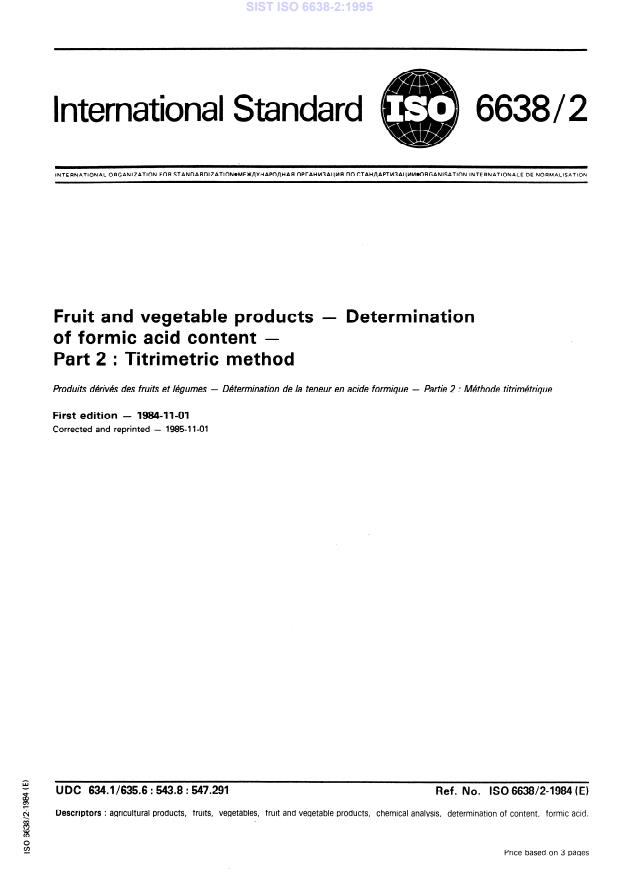

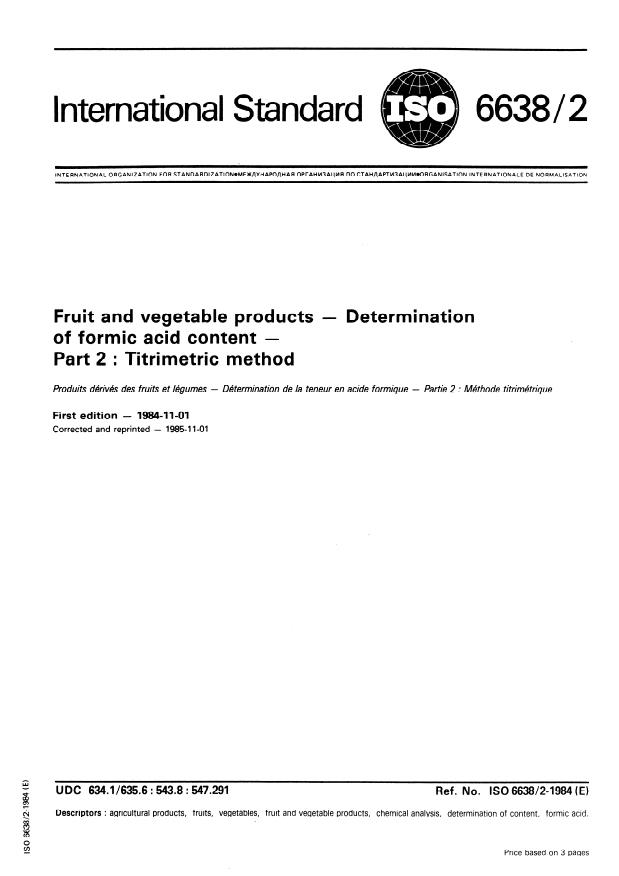
ISO 6638-2:1984 - Fruit and vegetable products — Determination of formic acid content — Part 2: Routine method Released:10/1/1984
ISO 6638-2:1984 - Produits dérivés des fruits et légumes — Détermination de la teneur en acide formique — Partie 2: Méthode pratique Released:10/1/1984
ISO 6638-2:1984 - Produits dérivés des fruits et légumes — Détermination de la teneur en acide formique — Partie 2: Méthode pratique Released:10/1/1984
Overview
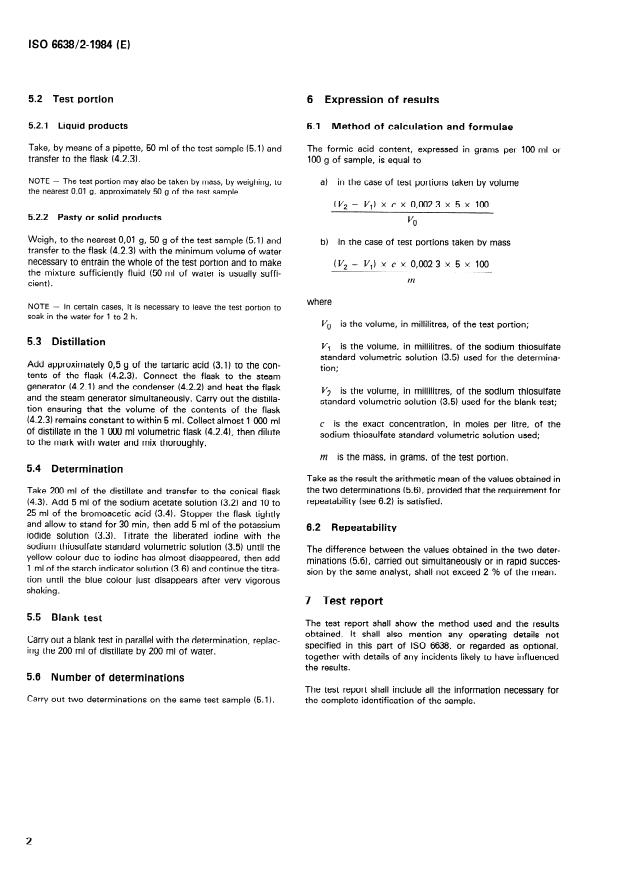
ISO 6638-2:1984 specifies a titrimetric (routine) method for determining formic acid content in fruit and vegetable products. The method is based on quantitative entrainment of formic acid by steam from a prepared test portion, followed by an indirect titration: the acid in the distillate reacts to consume bromine, the amount of iodine equivalent to the bromine consumed is liberated, and the liberated iodine is titrated with a standard sodium thiosulfate solution.
Key topics and technical requirements
- Principle: steam distillation (quantitative entrainment) of formic acid, followed by iodometric titration with Na2S2O3 to quantify the acid.
- Sample size and preparation:
- Typical test portion: 50 ml (or 50 g) of homogenized sample; solids/pastes weighed and diluted to ensure fluidity (about 50 ml water often sufficient).
- Frozen samples must be thawed and thaw liquid returned to the product.
- Distillation apparatus and conditions:
- Steam generator, condenser (refrigerant ~50 cm), 500 ml and 1 000 ml flasks, conical flask with ground stopper, burette, homogenizer/grinder.
- Collect ~1 000 ml distillate, adjust to mark and mix; take 200 ml aliquot for titration.
- Reagents:
- Tartaric acid, 10% sodium acetate solution, 10% potassium iodide solution, bromoacetic acid, standard sodium thiosulfate solution (≈0.1 mol/L), 1% starch paste.
- Titration procedure:
- Treat 200 ml distillate with acetate and bromoacetic acid, allow reaction, add iodide, titrate liberated iodine with sodium thiosulfate using starch as endpoint indicator.
- Run a blank in parallel.
- Calculation and reporting:
- Formic acid content is calculated from titrant volume and concentration, expressed as g per 100 ml or 100 g.
- Two determinations are performed and the arithmetic mean used if repeatability is met: difference between duplicates must not exceed 2% of the mean.
- Test record: method used, operational details, deviations and incidents must be recorded.
Applications and users
- Practical for routine analytical laboratories, food quality control, beverage and preserve manufacturers, and regulatory/inspection bodies monitoring formic acid in fruit- and vegetable-derived products.
- Useful for assessing product safety, compliance with specifications, and process control where formic acid concentration is relevant.
Related standards
- ISO 6638-1: Gravimetric method for formic acid (alternative method referenced in ISO 6638 series).
Keywords: ISO 6638-2, formic acid content, fruit and vegetable products, titrimetric method, steam distillation, sodium thiosulfate titration, bromoacetic acid, iodine.
Buy Documents
ISO 6638-2:1984 - Fruit and vegetable products — Determination of formic acid content — Part 2: Routine method Released:10/1/1984
ISO 6638-2:1984 - Produits dérivés des fruits et légumes — Détermination de la teneur en acide formique — Partie 2: Méthode pratique Released:10/1/1984
ISO 6638-2:1984 - Produits dérivés des fruits et légumes — Détermination de la teneur en acide formique — Partie 2: Méthode pratique Released:10/1/1984
Get Certified
Connect with accredited certification bodies for this standard

BSI Group
BSI (British Standards Institution) is the business standards company that helps organizations make excellence a habit.

Bureau Veritas
Bureau Veritas is a world leader in laboratory testing, inspection and certification services.

DNV
DNV is an independent assurance and risk management provider.
Sponsored listings
Frequently Asked Questions
ISO 6638-2:1984 is a standard published by the International Organization for Standardization (ISO). Its full title is "Fruit and vegetable products — Determination of formic acid content — Part 2: Routine method". This standard covers: The method consists in quantitative entraining by steam of the acid present in a test portion, determing of the amount of iodine equivalent to the amount of bromine consumed by the acid in the distillate, by titration with sodium thiosulfate standard volumetric solution.
The method consists in quantitative entraining by steam of the acid present in a test portion, determing of the amount of iodine equivalent to the amount of bromine consumed by the acid in the distillate, by titration with sodium thiosulfate standard volumetric solution.
ISO 6638-2:1984 is classified under the following ICS (International Classification for Standards) categories: 67.080.01 - Fruits, vegetables and derived products in general. The ICS classification helps identify the subject area and facilitates finding related standards.
ISO 6638-2:1984 is available in PDF format for immediate download after purchase. The document can be added to your cart and obtained through the secure checkout process. Digital delivery ensures instant access to the complete standard document.
Standards Content (Sample)
2003-01.Slovenski inštitut za standardizacijo. Razmnoževanje celote ali delov tega standarda ni dovoljeno.Produits dérivés des fruits et légumes -- Détermination de la teneur en acide formique -- Partie 2: Méthode pratiqueFruit and vegetable products -- Determination of formic acid content -- Part 2: Routine method67.080.01Sadje, zelenjava in njuni proizvodi na splošnoFruits, vegetables and derived products in generalICS:Ta slovenski standard je istoveten z:ISO 6638-2:1984SIST ISO 6638-2:1995en01-marec-1995SIST ISO 6638-2:1995SLOVENSKI
STANDARD
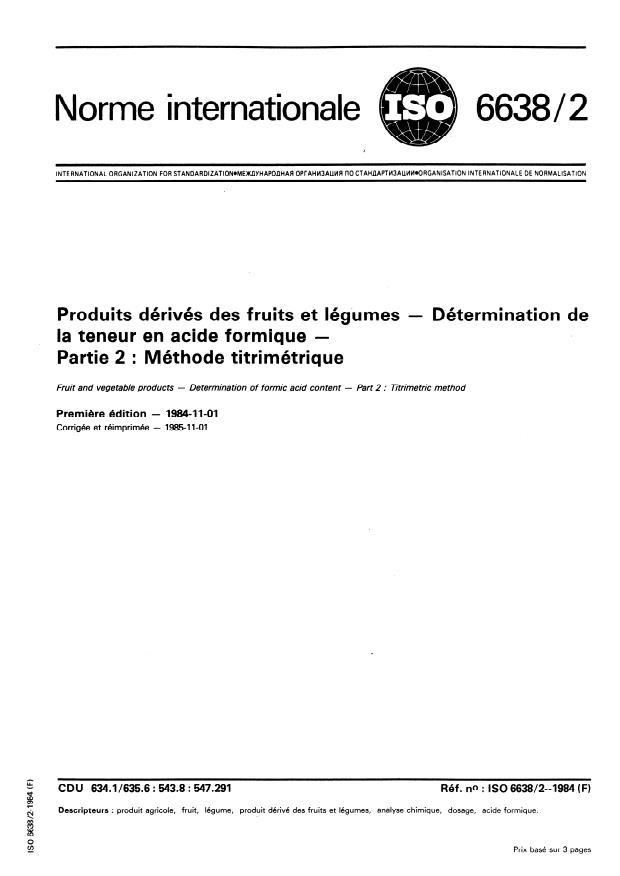
International Standard 663812 INTERNATIONAL ORGANIZATION FOR STANDARDIZATlON.MEXAYiiAPOJIHAR OPfAHbl3AUMR fl0 CTAH~APTM3AL&lM.ORGANISATlON INTERNATIONALE DE NORMALISATION Fruit and vegetable products - Determination of formic acid content - Part 2 : Titrimetric method Prod&s d&iv&s des fruits et l6gumes - Ddtermination de la teneur en acide formique - Partie 2 : Mbhode titrim&rique First edition - 1984-11-01 Corrected and reprinted - 1985-11-01 UDC 634.V635.6 : 543.8 : 547.291 Ref. No. IS0 6638/2-1984 (E) Descriptors : agricultural products, fruits, vegetables, fruit and vegetable products, chemical analysis, determination of content, formic acid. Price based on 3 pages SIST ISO 6638-2:1995
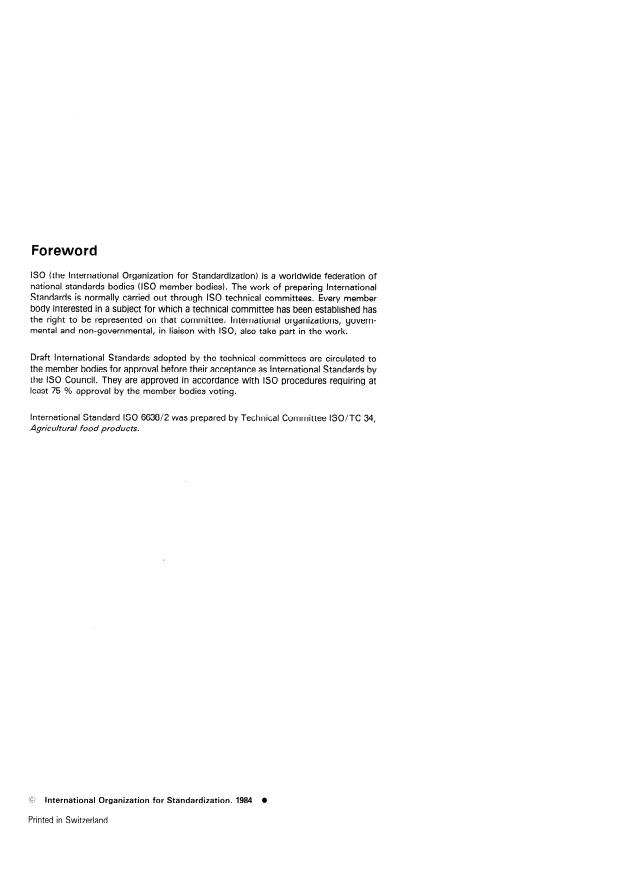
Foreword IS0 (the International Organization for Standardization) is a worldwide federation of national standards bodies (IS0 member bodies). The work of preparing International Standards is normally carried out through IS0 technical committees. Every member body interested in a subject for which a technical committee has been established has the right to be represented on that committee. International organizations, govern- mental and non-governmental, in liaison with ISO, also take part in the work. Draft International Standards adopted by the technical committees are circulated to the member bodies for approval before their acceptance as International Standards by the IS0 Council. They are approved in accordance with IS0 procedures requiring at least 75 % approval by the member bodies voting. International Standard IS0 6638/2 was prepared by Technical Committee lSO/TC 34, Agricultural food products. International Organization for Standardization, 1984 Printed in Switzerland SIST ISO 6638-2:1995
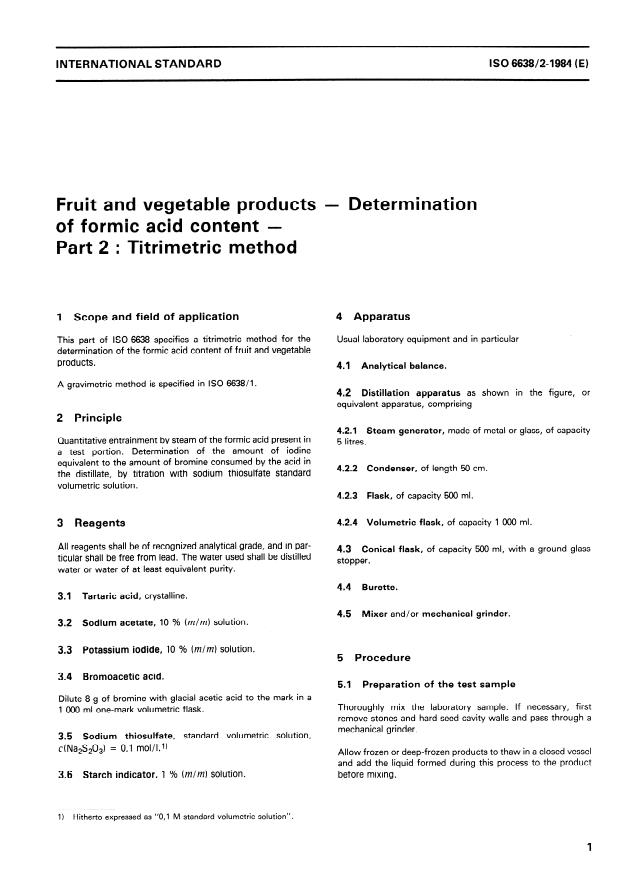
INTERNATIONAL STANDARD IS0 6638/2-1984 (E) Fruit and vegetable products - Determination of formic acid content - Part 2 : Titrimetric method 1 Scope and field of application This part of IS0 6638 specifies a titrimetric method for the determination of the formic acid content of fruit and vegetable products. A gravimetric method is specified in IS0 6638/l. 2 Principle Quantitative entrainment by steam of the formic acid present in a test portion. Determination of the amount of iodine equivalent to the amount of bromine consumed by the acid in the distillate, by titration with sodium thiosulfate standard volumetric solution. 3 Reagents All reagents shall be of recognized analytical grade, and in par- ticular shall be free from lead. The water used shall be distilled water or water of at least equivalent purity. 4 Apparatus Usual laboratory equipment and in particular 4.1 Analytical balance. 4.2 Distillation apparatus as shown in the figure, or equivalent apparatus, comprising 4.2.1 Steam generator, made of metal or glass, of capacity 5 litres. 4.2.2 Condenser, of length 50 cm. 4.2.3 Flask, of capacity 500 ml. 4.2.4 Volumetric flask, of capacity 1 000 ml. 4.3 Conical flask, of capacity 506 ml, with a ground glass stopper. 4.4 Burette. 3.1 Tartaric acid, crystalline. 4.5 Mixer and/or mechanical grinder. 3.2 Sodium acetate, 10 % (m/m) solution. 3.3 Potassium iodide, 10 % (m/m) solution. 5 Procedure 3.4 Bromoacetic acid. 5.1 Preparation of the test sample Dilute 8 g of bromine with glacial acetic acid to the mark in a 1 000 ml one-mark volumetric flask. 3.5 Sodium thiosulfate, standard volumetric solution, c(Na2S203) = 0,l moM.1) 3.6 Starch indicator, 1 % (m/m) soluti
...
International Standard 663812
INTERNATIONAL ORGANIZATION FOR STANDARDIZATlON.MEXAYiiAPOJIHAR OPfAHbl3AUMR fl0 CTAH~APTM3AL&lM.ORGANISATlON INTERNATIONALE DE NORMALISATION
Fruit and vegetable products - Determination
of formic acid content -
Part 2 : Titrimetric method
Prod&s d&iv&s des fruits et l6gumes - Ddtermination de la teneur en acide formique - Partie 2 : Mbhode titrim&rique
First edition - 1984-11-01
Corrected and reprinted - 1985-11-01
UDC 634.V635.6 : 543.8 : 547.291 Ref. No. IS0 6638/2-1984 (E)
Descriptors : agricultural products, fruits, vegetables, fruit and vegetable products,
chemical analysis, determination of content, formic acid.
Price based on 3 pages
Foreword
IS0 (the International Organization for Standardization) is a worldwide federation of
national standards bodies (IS0 member bodies). The work of preparing International
Standards is normally carried out through IS0 technical committees. Every member
body interested in a subject for which a technical committee has been established has
the right to be represented on that committee. International organizations, govern-
mental and non-governmental, in liaison with ISO, also take part in the work.
Draft International Standards adopted by the technical committees are circulated to
the member bodies for approval before their acceptance as International Standards by
the IS0 Council. They are approved in accordance with IS0 procedures requiring at
least 75 % approval by the member bodies voting.
International Standard IS0 6638/2 was prepared by Technical Committee lSO/TC 34,
Agricultural food products.
International Organization for Standardization, 1984
Printed in Switzerland
IS0 6638/2-1984 (E)
INTERNATIONAL STANDARD
Fruit and vegetable products - Determination
of formic acid content -
Part 2 : Titrimetric method
4 Apparatus
1 Scope and field of application
Usual laboratory equipment and in particular
This part of IS0 6638 specifies a titrimetric method for the
determination of the formic acid content of fruit and vegetable
products.
4.1 Analytical balance.
A gravimetric method is specified in IS0 6638/l.
4.2 Distillation apparatus as shown in the figure, or
equivalent apparatus, comprising
2 Principle
4.2.1 Steam generator, made of metal or glass, of capacity
Quantitative entrainment by steam of the formic acid present in
5 litres.
Determination of the amount of iodine
a test portion.
equivalent to the amount of bromine consumed by the acid in
4.2.2 Condenser, of length 50 cm.
the distillate, by titration with sodium thiosulfate standard
volumetric solution.
4.2.3 Flask, of capacity 500 ml.
4.2.4 Volumetric flask, of capacity 1 000 ml.
3 Reagents
All reagents shall be of recognized analytical grade, and in par-
4.3 Conical flask, of capacity 506 ml, with a ground glass
ticular shall be free from lead. The water used shall be distilled
stopper.
water or water of at least equivalent purity.
4.4 Burette.
3.1 Tartaric acid, crystalline.
4.5 Mixer and/or mechanical grinder.
3.2 Sodium acetate, 10 % (m/m) solution.
3.3 Potassium iodide, 10 % (m/m) solution.
5 Procedure
3.4 Bromoacetic acid.
5.1 Preparation of the test sample
Dilute 8 g of bromine with glacial acetic acid to the mark in a
Thoroughly mix the laboratory sample. If necessary, first
1 000 ml one-mark volumetric flask.
remove stones and hard seed-cavity walls and pass through a
mechanical grinder.
standard volumetric solution,
3.5 Sodium thiosulfate,
c(Na2S203) = 0,l moM.1)
Allow frozen or deep-frozen products to thaw in a closed vessel
and add the liquid formed during this process to the product
before mixing.
3.6 Starch indicator, 1 % (m/m) solution.
1) Hitherto expressed as “0,l M standard volumetric solution”.
IS0 6638/2-1984
(El
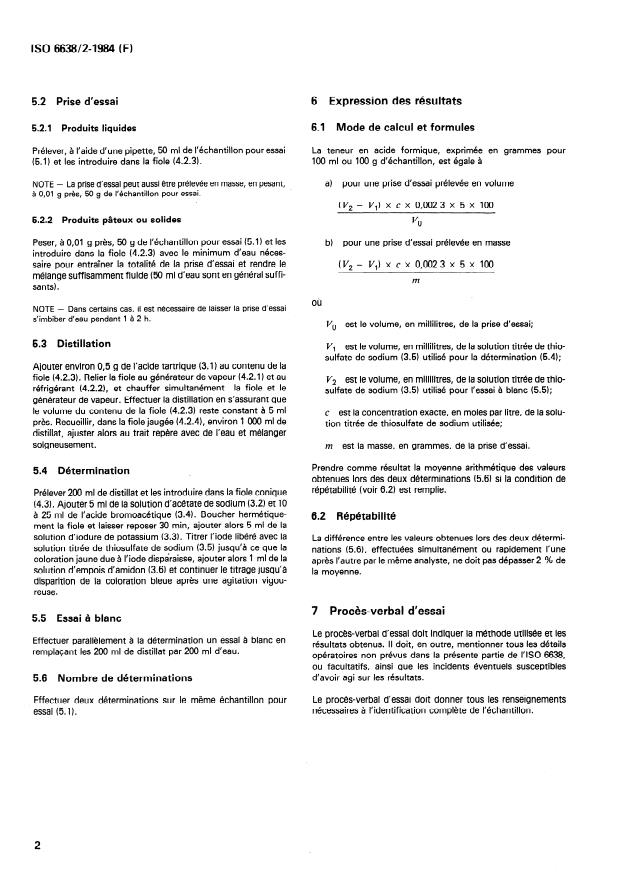
6 Expression of result
...
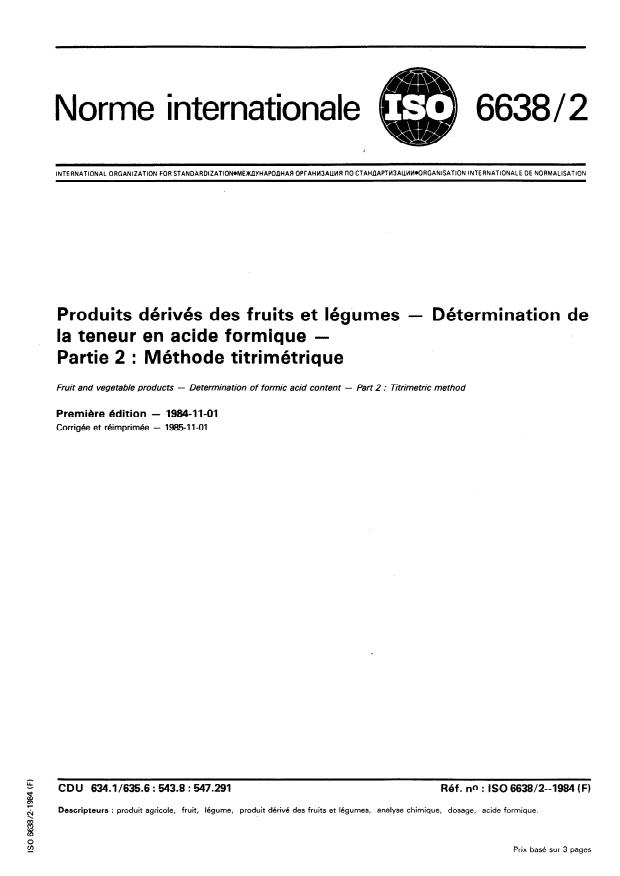
Norme internationale
,
INTERNATIONAL ORGANIZATION FOR STANDARDI~ATI~N~MEX~YHAP~~HA~ oprAt443A~m no cTAHAApTM3AUMM~ORGANISAi‘ioN INTERNATIONALE DE NORMALISATION
Produits dérivés des fruits et légumes - Détermination de
la teneur en acide formique -
Partie 2 : Méthode titrimétrique
Fruit and vegetable products - Determination of formic acid content - Part 2 : Titrimetric method
Première édition - 1984-11-01
Corrigée et réimprimée - 1985-1 l-01
CDU 634.V635.6 : 543.8 : 547.291 Réf. no : ISO 6638/2--1984 (FI
fruit, légume, produit dérivé des fruits et légumes, analyse chimique, dosage, acide formique.
Descripteurs : produit agricole,
.
Prix basé sur 3 pages
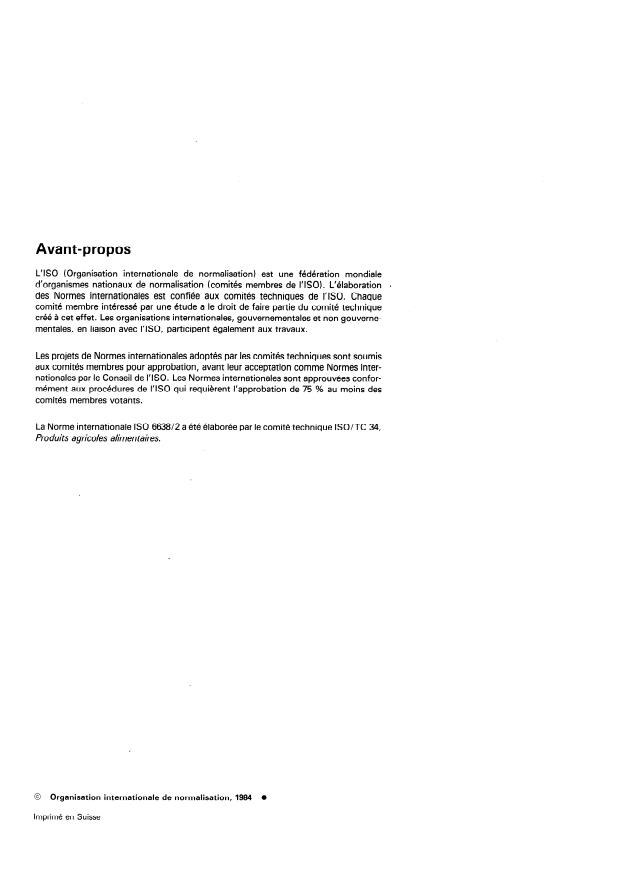
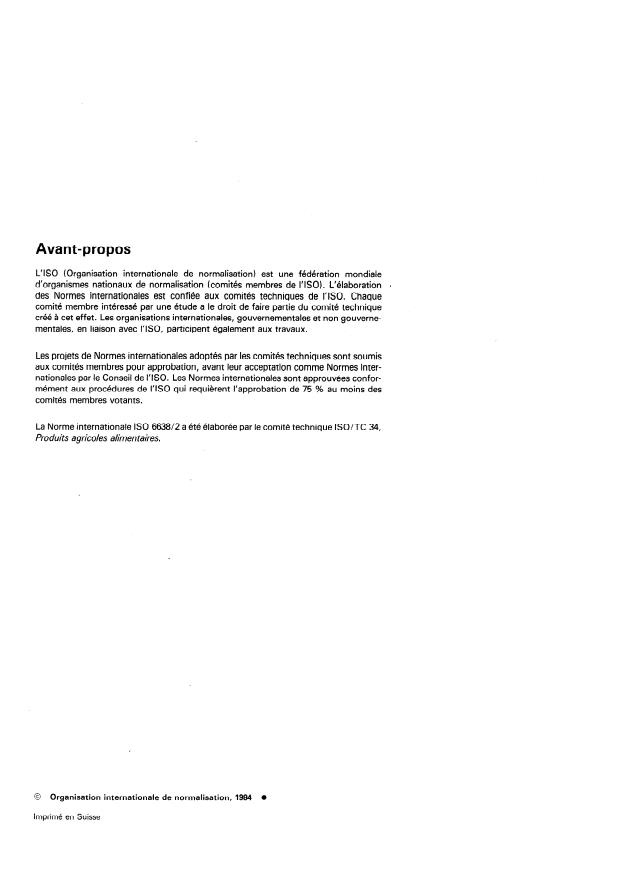
Avant-propos
L’ISO (Organisation internationale de normalisation) est une fédération mondiale
d’organismes nationaux de normalisation (comités membres de I’ISO). L’élaboration 6
des Normes internationales est confiée aux comités techniques de I’ISO. Chaque
comité membre intéressé par une étude a le droit de faire partie du comité technique
créé à cet effet. Les organisations internationales, gouvernementales et non gouverne-
mentales, en liaison avec I’ISO, participent également aux travaux.
Les projets de Normes internationales adoptés par les comités techniques sont soumis
aux comités membres pour approbation, avant leur acceptation comme Normes inter-
nationales par le Conseil de I’ISO. Les Normes internationales sont approuvees confor-
mément aux procédures de I’ISO qui requièrent l’approbation de 75 % au moins des
comités membres votants.
La Norme internationale ISO 6638/2 a été élaborée par le comité technique ISO/TC 34,
Produits agricoles alimentaires.
0 Organisation internationale de normalisation, 1984 0
imprimé en Suisse
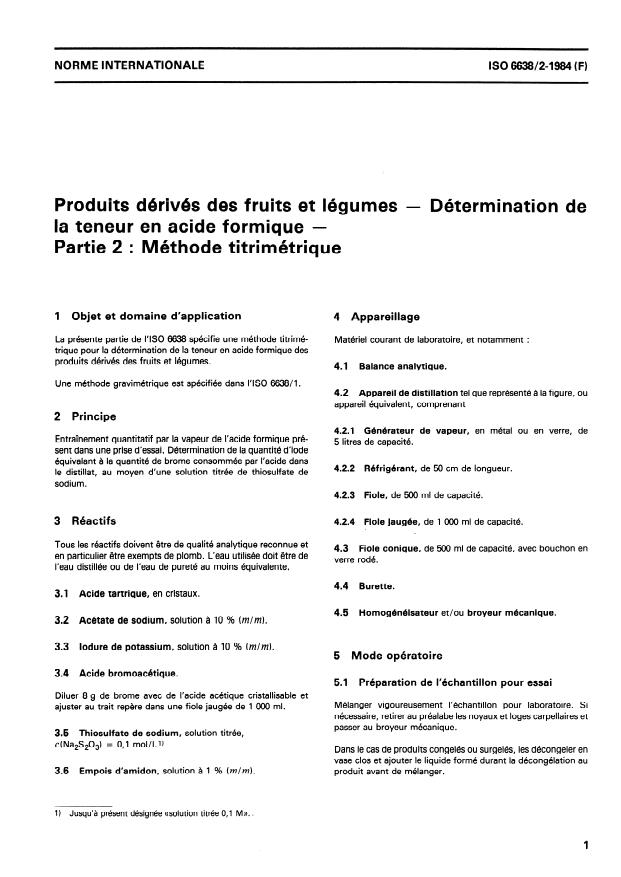
NORME INTERNATIONALE ISO 6638/2-1984 (F)
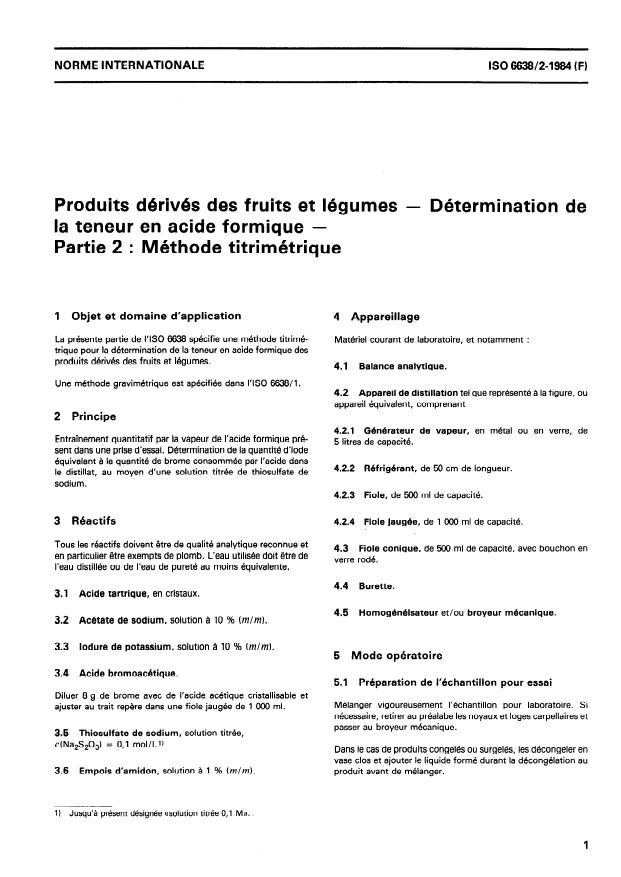
Produits dérivés des fruits et légumes - Détermination de
la teneur en acide formique -
Partie 2 : Méthode titrimétrique
1 Objet et domaine d’application 4 Appareillage
La présente partie de I’ISO 6638 spécifie une methode titrimé- Matériel courant de laboratoire, et notamment :
trique pour la détermination de la teneur en acide formique des
produits dérivés des fruits et légumes.
4.1 Balance analytique.
Une méthode gravimétrique est spécifiée dans I’ISO 6638/1.
4.2 Appareil de distillation tel que représenté à la figure, ou
appareil équivalent, comprenant
2 Principe
4.21 G6n6rateur de vapeur, en métal ou en verre, de
Entraînement quantitatif par la vapeur de l’acide formique pré-
5 litres de capacité.
sent dans une prise d’essai. Détermination de la quantité d’iode
équivalant à la quantité de brome consommée par l’acide dans
4.2.2 Rbfrigkant, de 50 cm de longueur.
le distillat, au moyen d’une solution titrée de thiosulfate de
sodium.
4.2.3 Fiole, de 500 ml de capacité.
3 Réactifs 4.2.4 Fiole jaugée, de 1 000 ml de capacité.
Tous les réactifs doivent être de qualité analytique reconnue et
4.3 Fiole conique, de 500 ml de capacité, avec bouchon en
en particulier être exempts de plomb. L’eau utilisée doit être de
verre rodé.
l’eau distillée ou de l’eau de pureté au moins équivalente.
4.4 Burette.
3.1 Acide tartrique, en cristaux.
4.5 Homog6néisateur et/ou broyeur mécanique.
3.2 Acétate de sodium, solution à 10 % (mlm).
3.3 Iodure de potassium, solution à 10 % (mlm).
5 Mode opératoire
3.4 Acide bromoacétique.
5.1 Préparation de l’échantillon pour essai
Diluer 8 g de brome avec de l’acide acétique cristallisable et
Mélanger vigoureusement l’échantillon pour laboratoire. Si
ajuster au trait repére dans une fiole jaugée de 1 000 ml.
nécessaire, retirer au préalabe les noyaux et loges carpellaires et
passer au broyeur mécanique.
3.5 Thiosulfate de sodium, solution titrée,
= 0,l mol/lJ)
c(Na2S203)
Dans le cas de produits congelés ou surgelés, les décongeler en
vase clos et ajouter le liquide formé durant la décongélation au
3.6 Empois d’amidon, solution à 1 % (mlm). produit avant de mélanger.
1) Jusqu’à présent désignée «solution titrée 0,l MN. .
-------------
...
Norme internationale
,
INTERNATIONAL ORGANIZATION FOR STANDARDI~ATI~N~MEX~YHAP~~HA~ oprAt443A~m no cTAHAApTM3AUMM~ORGANISAi‘ioN INTERNATIONALE DE NORMALISATION
Produits dérivés des fruits et légumes - Détermination de
la teneur en acide formique -
Partie 2 : Méthode titrimétrique
Fruit and vegetable products - Determination of formic acid content - Part 2 : Titrimetric method
Première édition - 1984-11-01
Corrigée et réimprimée - 1985-1 l-01
CDU 634.V635.6 : 543.8 : 547.291 Réf. no : ISO 6638/2--1984 (FI
fruit, légume, produit dérivé des fruits et légumes, analyse chimique, dosage, acide formique.
Descripteurs : produit agricole,
.
Prix basé sur 3 pages
Avant-propos
L’ISO (Organisation internationale de normalisation) est une fédération mondiale
d’organismes nationaux de normalisation (comités membres de I’ISO). L’élaboration 6
des Normes internationales est confiée aux comités techniques de I’ISO. Chaque
comité membre intéressé par une étude a le droit de faire partie du comité technique
créé à cet effet. Les organisations internationales, gouvernementales et non gouverne-
mentales, en liaison avec I’ISO, participent également aux travaux.
Les projets de Normes internationales adoptés par les comités techniques sont soumis
aux comités membres pour approbation, avant leur acceptation comme Normes inter-
nationales par le Conseil de I’ISO. Les Normes internationales sont approuvees confor-
mément aux procédures de I’ISO qui requièrent l’approbation de 75 % au moins des
comités membres votants.
La Norme internationale ISO 6638/2 a été élaborée par le comité technique ISO/TC 34,
Produits agricoles alimentaires.
0 Organisation internationale de normalisation, 1984 0
imprimé en Suisse
NORME INTERNATIONALE ISO 6638/2-1984 (F)
Produits dérivés des fruits et légumes - Détermination de
la teneur en acide formique -
Partie 2 : Méthode titrimétrique
1 Objet et domaine d’application 4 Appareillage
La présente partie de I’ISO 6638 spécifie une methode titrimé- Matériel courant de laboratoire, et notamment :
trique pour la détermination de la teneur en acide formique des
produits dérivés des fruits et légumes.
4.1 Balance analytique.
Une méthode gravimétrique est spécifiée dans I’ISO 6638/1.
4.2 Appareil de distillation tel que représenté à la figure, ou
appareil équivalent, comprenant
2 Principe
4.21 G6n6rateur de vapeur, en métal ou en verre, de
Entraînement quantitatif par la vapeur de l’acide formique pré-
5 litres de capacité.
sent dans une prise d’essai. Détermination de la quantité d’iode
équivalant à la quantité de brome consommée par l’acide dans
4.2.2 Rbfrigkant, de 50 cm de longueur.
le distillat, au moyen d’une solution titrée de thiosulfate de
sodium.
4.2.3 Fiole, de 500 ml de capacité.
3 Réactifs 4.2.4 Fiole jaugée, de 1 000 ml de capacité.
Tous les réactifs doivent être de qualité analytique reconnue et
4.3 Fiole conique, de 500 ml de capacité, avec bouchon en
en particulier être exempts de plomb. L’eau utilisée doit être de
verre rodé.
l’eau distillée ou de l’eau de pureté au moins équivalente.
4.4 Burette.
3.1 Acide tartrique, en cristaux.
4.5 Homog6néisateur et/ou broyeur mécanique.
3.2 Acétate de sodium, solution à 10 % (mlm).
3.3 Iodure de potassium, solution à 10 % (mlm).
5 Mode opératoire
3.4 Acide bromoacétique.
5.1 Préparation de l’échantillon pour essai
Diluer 8 g de brome avec de l’acide acétique cristallisable et
Mélanger vigoureusement l’échantillon pour laboratoire. Si
ajuster au trait repére dans une fiole jaugée de 1 000 ml.
nécessaire, retirer au préalabe les noyaux et loges carpellaires et
passer au broyeur mécanique.
3.5 Thiosulfate de sodium, solution titrée,
= 0,l mol/lJ)
c(Na2S203)
Dans le cas de produits congelés ou surgelés, les décongeler en
vase clos et ajouter le liquide formé durant la décongélation au
3.6 Empois d’amidon, solution à 1 % (mlm). produit avant de mélanger.
1) Jusqu’à présent désignée «solution titrée 0,l MN. .
-------------
...