

ISO/FDIS 13760
(Main)Plastics pipes for the conveyance of fluids under pressure — Miner’s rule — Calculation method for cumulative damage
- Status
- Not Published
- Technical Committee
- ISO/TC 138/SC 5 - General properties of pipes, fittings and valves of plastic materials and their accessories -- Test methods and basic specifications
- Drafting Committee
- ISO/TC 138/SC 5/WG 5 - Polyolefin pipes
- Current Stage
- 5020 - FDIS ballot initiated: 2 months. Proof sent to secretariat
- Start Date
- 20-Oct-2026
- Completion Date
- 20-Oct-2026
Buy Documents
ISO/FDIS 13760 - Plastics pipes for the conveyance of fluids under pressure — Miner’s rule — Calculation method for cumulative damage
REDLINE ISO/FDIS 13760 - Plastics pipes for the conveyance of fluids under pressure — Miner’s rule — Calculation method for cumulative damage
ISO/FDIS 13760 is an ISO standard on applying Miner’s rule to plastics pipes for the conveyance of fluids under pressure. It specifies a calculation method for cumulative damage so designers can estimate design time to failure, or work backward to tolerable stress or pressure levels, under known varying conditions. The document also covers oxidative damage in polyolefins when temperature and time change during service.
What does ISO/FDIS 13760 specify?
ISO/FDIS 13760 specifies how to use Miner’s rule for plastics pipes and piping systems made of plastics materials under varying, but known, load conditions. In practice, that means it gives a calculation basis for service-life assessment, stress or pressure regime selection, and oxidative-life evaluation.
The standard is organized into a short technical body plus two informative annexes. Clauses 1 to 7 cover scope, references, symbols, the Miner’s rule principle, the general calculation procedure, and application guidance. Annex A gives worked procedures for design stress and design pressure, and Annex B gives worked procedures for oxidative stability.
| Annex | What it covers |
|---|---|
| Annex A | Examples of using Miner’s rule to determine design stress for ISO 10508 application classes and design pressure for multilayer M-pipes |
| Annex B | Miner’s rule applied to oxidative stability and oxidative life for polyolefins under varying temperatures |
The document is aimed at known service profiles, not unknown or random loading. Clause 5 treats each failure mechanism separately, so mechanical pressure damage is assessed apart from oxidative or dehydrochlorinative degradation when there is no interaction.
What are the key requirements of ISO/FDIS 13760?
ISO/FDIS 13760 is built around two calculation steps: first determine the yearly damage, then convert that damage into accumulated design time. Clause 5 sets the assumptions, Clause 6 gives the formulas, and Annexes A and B show how to apply them.
Miner’s rule assumptions
Clause 5 says total damage for a given attack mechanism is taken as 100%, damage under constant conditions is proportional to exposure time, and damage from different sets of conditions is additive. In practice, a designer can combine several operating periods into one life prediction instead of analyzing each period in isolation.
Yearly damage and accumulated design time
Clause 6 calculates total yearly damage, TYD, by summing the fractions of a year spent at each condition divided by the corresponding time to failure. It then calculates accumulated design time, t, from TYD. In practice, this turns a temperature or pressure profile into a life estimate in years.
Separate treatment of failure mechanisms
The introduction states that Miner’s rule must be applied separately to each failure mechanism. For plastics pipes, that means pressure-related mechanical failure is evaluated on its own, and oxidative attack is evaluated on its own. This matters because a material is acceptable only when it satisfies the criteria for all relevant mechanisms.
Design stress and design pressure procedures
Annex A uses the method to find design stress for a selected material and application class, and to find design pressure for a multilayer M-pipe. The annex converts the ISO 10508 temperature-time profile into fractions, applies material design coefficients, takes the relevant defined times from the material data, and iterates until the target accumulated design time is reached. In practice, this is the calculation path for sizing pipe systems to a chosen service profile.
Oxidative-life procedures
Annex B applies the same logic to polyolefins, using an Arrhenius relationship for oxidative stability. It gives one procedure with a reference point of 1 year at 110 °C and another with an arbitrary reference point and activation energy. In practice, this is used to estimate how long oxidative damage contributes to design life under mixed temperatures.
Iteration and rounding in the examples
Annex A shows that the design stress or pressure is selected by repeating the calculation until the accumulated design time reaches 50,000 years at one value and falls below it at the next higher value. The annex also notes that values are rounded down when lower precision is needed. That gives a repeatable way to pick the final design value from the calculation.
What terms does ISO/FDIS 13760 define?
ISO/FDIS 13760 uses a small set of symbols and abbreviations to express the calculation steps clearly.
- Miner’s rule - An empirically based method that adds damage from successive exposure periods to estimate cumulative damage.
- a_i - The fraction of a year spent under condition i, expressed as a percentage.
- t_i - The defined time under condition i, expressed in years.
- t - The accumulated design time of use under varying conditions, expressed in years.
- TYD - Total yearly damage, expressed as a percentage.
- Design stress - The stress value selected in Annex A for a material and application class.
- Design pressure - The pressure value selected in Annex A for a multilayer M-pipe and application class.
Who uses ISO/FDIS 13760?
ISO/FDIS 13760 is used by designers and technical specialists working on plastics piping systems for fluids under pressure. It is relevant to hot and cold-water installations, polyolefin pipe life assessment, and multilayer pipe constructions.
Typical users include:
- pipe and piping-system designers
- polymer and materials engineers
- product developers for plastics piping systems
- laboratory or test engineers assessing long-term performance
- technical reviewers or quality managers checking design calculations against an application class
What changed in ISO/FDIS 13760 from the previous edition?
ISO/FDIS 13760 is the second edition and it cancels and replaces ISO 13760:1998. The changes stated in the document are:
- the scope has been rephrased to describe Miner’s rule for designing plastics piping systems in more detail
- the application examples in Annexes A and B have been reformulated to give exact procedures and have been extended
Which standards are used with ISO/FDIS 13760?
ISO/FDIS 13760 names these standards and parts for use with its procedures:
- ISO 10508:2006 - provides the application classes and temperature-time profiles used in the main procedures and Annex A
- ISO 10508:2006/Amd 1:2018 - updates ISO 10508:2006 and is named in the normative references
- ISO 21003 series - supports the multilayer M-pipe example in Annex A
- ISO 15876-2:2017 - provides design coefficients for the Polybutylene PB-H example in Annex A
- ISO 12230 - provides reference lines and long-term strength data used in the PB-H example
- ISO 9080 - is used in Annex B for the oxidative-stability example through the activation energy value cited there
What does the ISO/FDIS 13760 document contain?
ISO/FDIS 13760 contains a short method-driven structure: scope, references, symbols, principle, procedure, and application guidance. The core content is the TYD and accumulated-time calculation, supported by formulas in Clause 6.
Annex A contains step-by-step worked calculations for design stress and design pressure, including a detailed example for Polybutylene PB-H and application class 2. Annex B contains the Arrhenius-based oxidative-life method and a table of accumulated design times for the ISO 10508 application classes.
The document also includes:
- a symbols section for the calculation variables
- formulas for cumulative damage and accumulated design time
- an example calculation table in Annex A
- a table of accumulated design times in Annex B
- a bibliography with supporting references for strength, materials, and Miner’s rule history
Relations
- Effective Date
- 12-Feb-2026
- Effective Date
- 07-Jan-2025
- Effective Date
- 07-Jan-2025
Buy Documents
ISO/FDIS 13760 - Plastics pipes for the conveyance of fluids under pressure — Miner’s rule — Calculation method for cumulative damage
REDLINE ISO/FDIS 13760 - Plastics pipes for the conveyance of fluids under pressure — Miner’s rule — Calculation method for cumulative damage
Get Certified
Connect with accredited certification bodies for this standard

Institut za varilstvo d.o.o. (Welding Institute)
Slovenia's leading welding institute since 1952. ISO 3834, EN 1090, pressure equipment certification, NDT personnel, welder qualification. Only IIW Au
Sponsored listings
Frequently Asked Questions
ISO/FDIS 13760 is a draft published by the International Organization for Standardization (ISO). Its full title is "Plastics pipes for the conveyance of fluids under pressure — Miner’s rule — Calculation method for cumulative damage". This standard covers: Plastics pipes for the conveyance of fluids under pressure — Miner’s rule — Calculation method for cumulative damage
Plastics pipes for the conveyance of fluids under pressure — Miner’s rule — Calculation method for cumulative damage
ISO/FDIS 13760 is classified under the following ICS (International Classification for Standards) categories: 23.040.20 - Plastics pipes. The ICS classification helps identify the subject area and facilitates finding related standards.
ISO/FDIS 13760 has the following relationships with other standards: It is inter standard links to FprEN ISO 13760, ISO 362-1:2022, ISO 13760:1998. Understanding these relationships helps ensure you are using the most current and applicable version of the standard.
ISO/FDIS 13760 is available in PDF format for immediate download after purchase. The document can be added to your cart and obtained through the secure checkout process. Digital delivery ensures instant access to the complete standard document.
Standards Content (Sample)
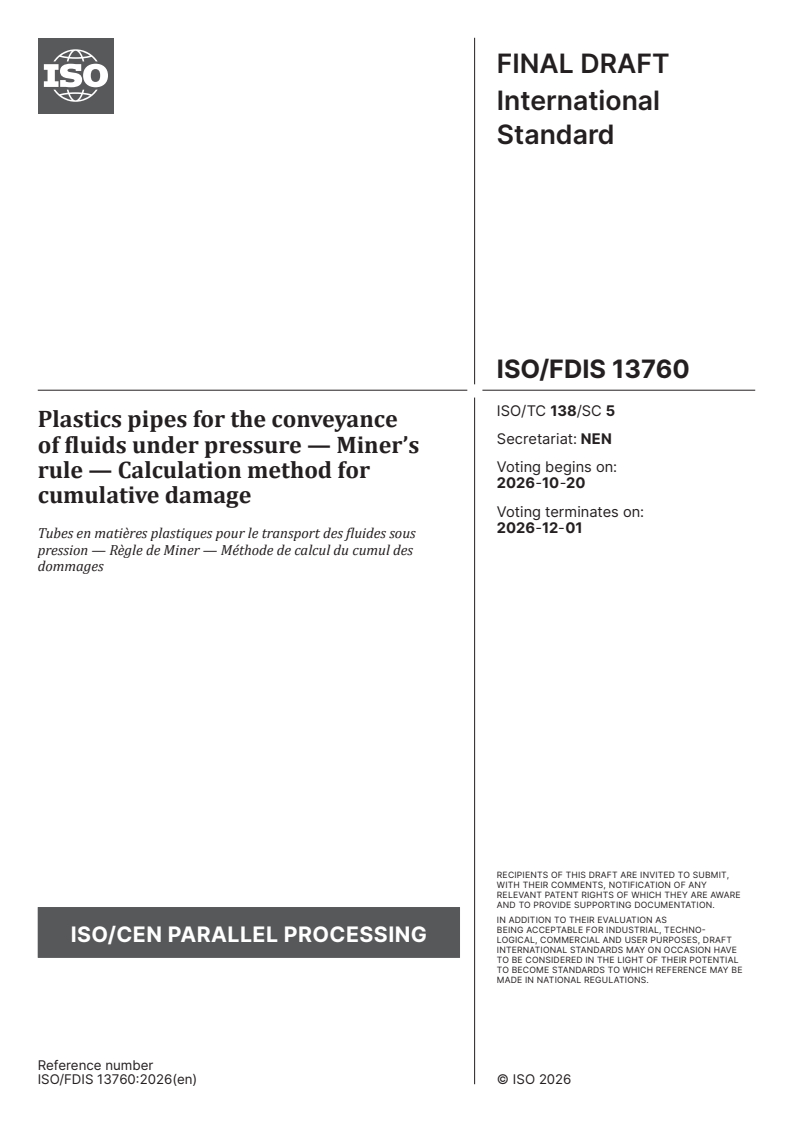
FINAL DRAFT
International
Standard
ISO/TC 138/SC 5
Plastics pipes for the conveyance
Secretariat: NEN
of fluids under pressure — Miner’s
Voting begins on:
rule — Calculation method for
2026-10-20
cumulative damage
Voting terminates on:
2026-12-01
Tubes en matières plastiques pour le transport des fluides sous
pression — Règle de Miner — Méthode de calcul du cumul des
dommages
RECIPIENTS OF THIS DRAFT ARE INVITED TO SUBMIT,
WITH THEIR COMMENTS, NOTIFICATION OF ANY
RELEVANT PATENT RIGHTS OF WHICH THEY ARE AWARE
AND TO PROVIDE SUPPOR TING DOCUMENTATION.
IN ADDITION TO THEIR EVALUATION AS
BEING ACCEPTABLE FOR INDUSTRIAL, TECHNO
ISO/CEN PARALLEL PROCESSING LOGICAL, COMMERCIAL AND USER PURPOSES, DRAFT
INTERNATIONAL STANDARDS MAY ON OCCASION HAVE
TO BE CONSIDERED IN THE LIGHT OF THEIR POTENTIAL
TO BECOME STAN DARDS TO WHICH REFERENCE MAY BE
MADE IN NATIONAL REGULATIONS.
Reference number
FINAL DRAFT
International
Standard
ISO/TC 138/SC 5
Plastics pipes for the conveyance
Secretariat: NEN
of fluids under pressure — Miner’s
Voting begins on:
rule — Calculation method for
cumulative damage
Voting terminates on:
Tubes en matières plastiques pour le transport des fluides sous
pression — Règle de Miner — Méthode de calcul du cumul des
dommages
© ISO 2026
All rights reserved.
RECIPIENTS OF THIS DRAFT ARE INVITED TO SUBMIT,
WITH THEIR COMMENTS, NOTIFICATION OF ANY
This ISO publication is protected by copyright and is owned by ISO and/or its licensors.
RELEVANT PATENT RIGHTS OF WHICH THEY ARE AWARE
The content of this ISO publication is provided under licence, not sold. Use is subject to the applicable licence terms issued by ISO,
AND TO PROVIDE SUPPOR TING DOCUMENTATION.
an ISO member body, or an authorized third-party distributor.
IN ADDITION TO THEIR EVALUATION AS
BEING ACCEPTABLE FOR INDUSTRIAL, TECHNO
Except as required for implementation or expressly permitted by a separate licence, no part of this ISO publication may be
ISO/CEN PARALLEL PROCESSING
LOGICAL, COMMERCIAL AND USER PURPOSES, DRAFT
reproduced, distributed, modified, used, or made available in any form or by any means – electronic or mechanical, including
INTERNATIONAL STANDARDS MAY ON OCCASION HAVE
photocopying, scanning, recording, or posting on internal or external digital platforms. TO BE CONSIDERED IN THE LIGHT OF THEIR POTENTIAL
TO BECOME STAN DARDS TO WHICH REFERENCE MAY BE
Any use beyond the scope of the granted rights is prohibited and may result in legal action.
MADE IN NATIONAL REGULATIONS.
ISO copyright office
CP 401 • CH-1214 Vernier, Geneva
Phone: +41 22 749 01 11
Email: copyright@iso.org
Website: www.iso.org
Published in Switzerland
Reference number
ii
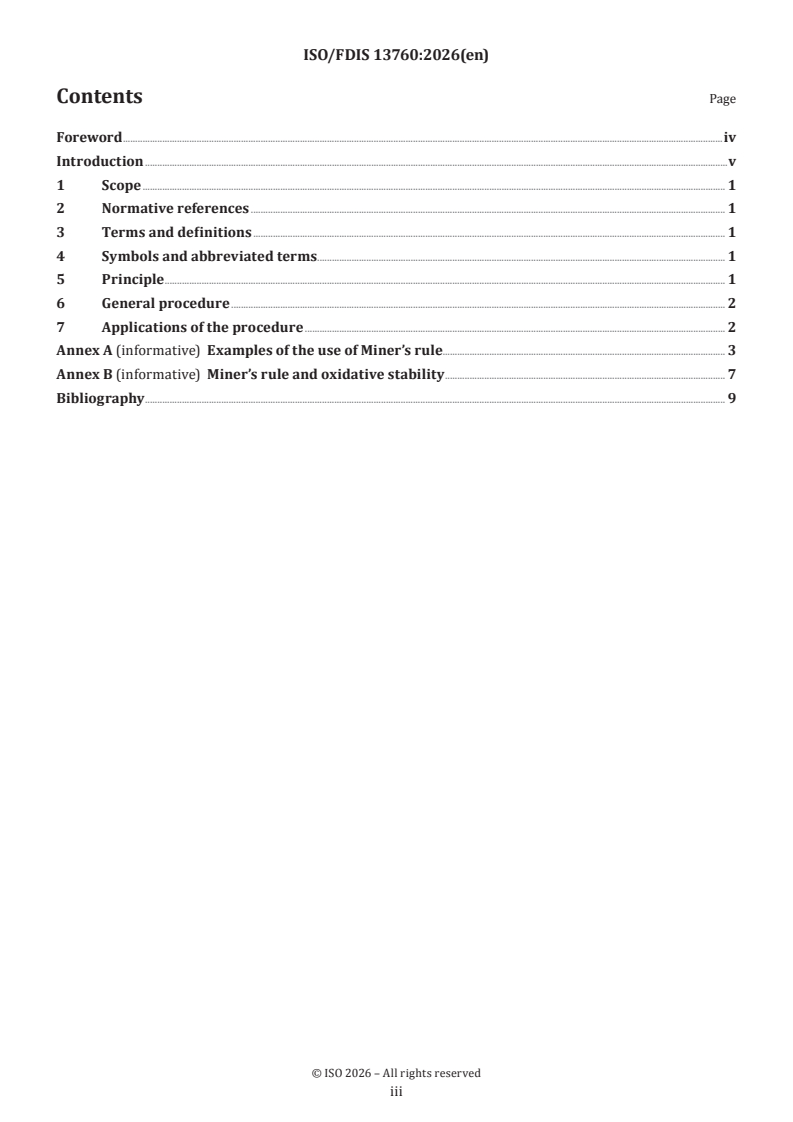
Contents Page
Foreword .iv
Introduction .v
1 Scope . 1
2 Normative references . 1
3 Terms and definitions . 1
4 Symbols and abbreviated terms. 1
5 Principle . 1
6 General procedure . 2
7 Applications of the procedure . 2
Annex A (informative) Examples of the use of Miner’s rule. 3
Annex B (informative) Miner’s rule and oxidative stability . 7
Bibliography . 9
iii
Foreword
ISO (the International Organization for Standardization) is a worldwide federation of national standards
bodies (ISO member bodies). The work of preparing International Standards is normally carried out through
ISO technical committees. Each member body interested in a subject for which a technical committee
has been established has the right to be represented on that committee. International organizations,
governmental and non-governmental, in liaison with ISO, also take part in the work. ISO collaborates closely
with the International Electrotechnical Commission (IEC) on all matters of electrotechnical standardization.
The procedures used to develop this document and those intended for its further maintenance are described
in the ISO/IEC Directives, Part 1. In particular, the different approval criteria needed for the different types
of ISO document should be noted. This document was drafted in accordance with the editorial rules of the
ISO/IEC Directives, Part 2 (see www.iso.org/directives).
ISO draws attention to the possibility that the implementation of this document may involve the use of (a)
patent(s). ISO takes no position concerning the evidence, validity or applicability of any claimed patent
rights in respect thereof. As of the date of publication of this document, ISO had not received notice of (a)
patent(s) which may be required to implement this document. However, implementers are cautioned that
this may not represent the latest information, which may be obtained from the patent database available at
www.iso.org/patents. ISO shall not be held responsible for identifying any or all such patent rights.
Any trade name used in this document is information given for the convenience of users and does not
constitute an endorsement.
For an explanation of the voluntary nature of standards, the meaning of ISO specific terms and expressions
related to conformity assessment, as well as information about ISO’s adherence to the World Trade
Organization (WTO) principles in the Technical Barriers to Trade (TBT), see www.iso.org/iso/foreword.html.
This document was prepared by Technical Committee ISO/TC 138, Plastics pipes, fittings and valves for the
transport of fluids, Subcommittee SC 5, General properties of pipes, fittings and valves of plastic materials and
their accessories — Test methods and basic specifications, in collaboration with the European Committee for
Standardization (CEN) Technical Committee CEN/TC 155, Plastics piping systems and ducting systems, in
accordance with the Agreement on technical cooperation between ISO and CEN (Vienna Agreement).
This second edition cancels and replaces the first edition (ISO 13760:1998), which has been technically
revised.
The main changes are as follows:
— the Scope has been re-phrased to provide a more detailed description of Miner’s rule with respect to
designing plastics piping systems;
— the application examples given in Annexes A and B have been reformulated to provide exact procedures
and have been extended.
Any feedback or questions on this document should be directed to the user’s national standards body. A
complete listing of these bodies can be found at www.iso.org/members.html.
iv
Introduction
In plastics piping systems, operating conditions such as temperature and pressure can vary over the whole
service time.
One example is in hot and cold water application, where variation is found mainly in temperature (e.g. a hot
water pipe is not necessary at constant high temperature throughout the entire service time, but it is usually
at the same pressure). Typical time temperature profiles are defined in ISO 10508:2006 as application
classes. These profiles are used for designing the dimensions of the plastics piping components.
In general terms, Miner’s rule is a common approach to calculate how the accumulation of a specific load
that varies over time effects the time until failure.
Miner’s rule, which allows the assessment of a load collective on the cumulative damage, has also been found
to be suitable for dimensioning plastics piping components under varying conditions to achieve a targeted
design time. The effect of cumulative damage caused by oxidative attack (e.g. for polyolefins), at varying
operating conditions, on the design life can be evaluated with Miner’s rule.
It is necessary to apply Miner’s rule to each failure mechanism separately. Thus, for mechanical failure due
to internal pressure, other failure mechanisms, such as oxidative or dehydrochlorinative degradative failure
mechanisms, can be neglected (assuming, of course, no interaction). A material may be used only when it is
proven to conform to all failure mechanism criteria.
NOTE 1 Miner’s rule is an empirically based procedure and is only a first approximation to reality.
[7]
NOTE 2 The original article by M.A. Miner deals with fatigue analysis at various stress levels. Experimental
verification has been carried out on an aluminium alloy.
[8]
NOTE 3 In Germany, Miner’s rule is incorporated in DVS 2205-1 (November 1985) for thermoplastics pipes.
v
FINAL DRAFT International Standard ISO/FDIS 13760:2026(en)
Plastics pipes for the conveyance of fluids under pressure —
Miner’s rule — Calculation method for cumulative damage
1 Scope
This document specifies the application of Miner’s rule for calculating the design time until failure of plastics
pipes and piping systems of plastics materials under varying, but known, load conditions. Miner’s rule can
also be applied reciprocally to calculate the tolerable load levels along a desired design time.
In particular, this document specifies the application of Miner’s rule to calculate stress or pressure regimes
that are tolerable during a targeted design time for plastics or composite pipes.
Further, the application of Miner’s rule on the effect of accumulated damage on polyolefins caused by
oxidative attack under varying temperatures and times on the design life is specified.
2 Normative references
There are no normative references in this document.
3 Terms and definitions
No terms and definitions are listed in this document.
ISO and IEC maintain terminology databases for use in standardization at the following addresses:
— ISO Online browsing platform: available at https:// www .iso .org/ obp
— IEC Electropedia: available at https:// www .electropedia .org/
4 Symbols and abbreviated terms
For the purposes of this document, the following symbols and abbreviated terms apply.
a fraction of a year, when referring to set of conditions “i”; expressed as a percentage
i
t defined time under a specified set of conditions “i” (i = 1, 2, 3, etc.) expressed in years
i
t accumulated design time of use under varying conditions, expressed in years
x
D total yearly damage, expressed as a percentage
tot,y
5 Principle
Miner’s rule is based on the following assumptions:
a) The total damage that a material or product can suffer from a certain type of attack is constant (100 %).
b) Under constant conditions, the damage done is proportional to the duration of the attack. The material
or product will last till the 100 % damage level has been reached. The time needed for this is represented
by t in this
...
ISO/DISFDIS 13760:2026(en)
ISO/TC 138/SC 5
Secretariat: NEN
Date: 2025-11-172026-10-05
Plastics pipes for the conveyance of fluids under pressure — Miner’s
rule — Calculation method for cumulative damage
Tubes en matières plastiques pour le transport des fluides sous pression — Règle de Miner — Méthode de calcul
du cumul des dommages
FDIS stage
TThhiiss d drraftaft i iss s suubbmmiitttteded t too a pa pararallel vallel vootte e iinn I ISSOO,, C CEENN.
All rights reserved.
This ISO publication is protected by copyright and is owned by ISO and/or its licensors.
The content of this ISO publication is provided under licence, not sold. Use is subject to the applicable licence terms issued
by ISO, an ISO member body, or an authorized third-party distributor.
Except as required for implementation or expressly permitted by a separate licence, no part of this ISO publication may
be reproduced, distributed, modified, used, or made available in any form or by any means – electronic or mechanical,
including photocopying, scanning, recording, or posting on internal or external digital platforms.
Any use beyond the scope of the granted rights is prohibited and may result in legal action.
ISO copyright office
CP 401 • CH-1214 Vernier, Geneva
Phone: + 41 22 749 01 11
Email: copyright@iso.org
Website: www.iso.org
Published in Switzerland
ii
Contents
Foreword . iv
Introduction . v
1 Scope . 1
2 Normative references . 1
3 Terms and definitions . 1
4 Symbols and abbreviated terms . 1
5 Principle . 1
6 General procedure . 2
7 Applications of the procedure . 2
Annex A (informative) Examples of the use of Miner’s rule . 3
Annex B (informative) Miner’s rule and oxidative stability . 7
Bibliography . 9
iii
Foreword
ISO (the International Organization for Standardization) is a worldwide federation of national standards
bodies (ISO member bodies). The work of preparing International Standards is normally carried out through
ISO technical committees. Each member body interested in a subject for which a technical committee has been
established has the right to be represented on that committee. International organizations, governmental and
non-governmental, in liaison with ISO, also take part in the work. ISO collaborates closely with the
International Electrotechnical Commission (IEC) on all matters of electrotechnical standardization.
The procedures used to develop this document and those intended for its further maintenance are described
in the ISO/IEC Directives, Part 1. In particular, the different approval criteria needed for the different types of
ISO document should be noted. This document was drafted in accordance with the editorial rules of the
ISO/IEC Directives, Part 2 (see www.iso.org/directives).
ISO draws attention to the possibility that the implementation of this document may involve the use of (a)
patent(s). ISO takes no position concerning the evidence, validity or applicability of any claimed patent rights
in respect thereof. As of the date of publication of this document, ISO had not received notice of (a) patent(s)
which may be required to implement this document. However, implementers are cautioned that this may not
represent the latest information, which may be obtained from the patent database available at
www.iso.org/patents. ISO shall not be held responsible for identifying any or all such patent rights.
Any trade name used in this document is information given for the convenience of users and does not
constitute an endorsement.
For an explanation of the voluntary nature of standards, the meaning of ISO specific terms and expressions
related to conformity assessment, as well as information about ISO’s adherence to the World Trade
Organization (WTO) principles in the Technical Barriers to Trade (TBT), see www.iso.org/iso/foreword.html.
This document was prepared by Technical Committee ISO/TC 138, (Plastics pipes, fittings and valves for the
transport of fluids),, Subcommittee SC 5, (General properties of pipes, fittings and valves of plastic materials and
their accessories — Test methods and basic specifications, in collaboration with the European Committee for
Standardization (CEN) Technical Committee CEN/TC 155, Plastics piping systems and ducting systems, in
accordance with the Agreement on technical cooperation between ISO and CEN (Vienna Agreement).
This second edition cancels and replaces the first edition (ISO 13760:1998), which has been
technicaltechnically revised.
The main changes compared tom the previous edition are as follows:
— The scope of the documentScope has been re-phrased to provide a more detailed description of Miner’s
rule with respect to designing plastics piping systems.;
— Thethe application examples given in Annexes A and B have been reformulated to provide exact
procedures and have been extended.
Any feedback or questions on this document should be directed to the user’s national standards body. A
complete listing of these bodies can be found at www.iso.org/members.html.
iv
Introduction
In plastics piping systems, operating conditions likesuch as temperature and pressure can vary over the whole
service time.
One example is in hot and cold -water application, where variation is found mainly in temperature (e.g. a hot
water pipe is not necessary at constant high temperature throughout the entire service time, but it is usually
at the same pressure). Typical time temperature profiles are defined in ISO 10508:2006 as application classes.
These profiles are used for designing the dimensions of the plastics piping components.
In general terms, Miner’s rule is a common approach to calculate how the accumulation of a specific load that
varies over time effects the time until failure.
Miner’s rule, which allows the assessment of a load collective on ththe cumulative damage, has also been found
to be suitable for dimensioning plastics piping components under varying conditions to achieve a targeted
design time. The effect of cumulative damage caused by oxidative attack (e.g. for polyolefins), at varying
operating conditions, on the design life can be evaluated with Miner’s rule.
It is necessary to apply Miner’s rule to each failure mechanism separately. Thus, for mechanical failure due to
internal pressure, other failure mechanisms, such as oxidative or dehydrochlorinative degradative failure
mechanisms, are tocan be neglected (assuming, of course, no interaction). A material may be used only when
it is proven to conform to all failure mechanism criteria.
NOTE —1 Miner’s rule is an empirically based procedure and is only a first approximation to reality.
[7]
NOTE 2 The original article by M.A. Miner deals with fatigue analysis at various stress levels. Experimental
verification has been carried out on an aluminium alloy.
[8]
NOTE 3 In Germany, Miner’s rule is incorporated in DVS 2205-1 (November 1985) for thermoplastics pipes.
v
Plastics pipes for the conveyance of fluids under pressure — Miner’s
rule — Calculation method for cumulative damage
1 Scope
This document specifies the application of Miner’s rule for calculating the design time until failure of plastics
pipes and piping systems of plastics materials under varying, but known, load conditions. Miner’s rule can also
be applied reciprocally to calculate the tolerable load levels along a desired design time.
In particular, this document specifies the application of Miner’s rule to calculate stress or pressure regimes
that are tolerable during a targeted design time for plastics or composite pipes.
Further, the application of Miner’s rule on the effect of accumulated damage on polyolefins caused by oxidative
attack under varying temperatures and times on the design life is specified.
2 Normative references
The following documents are referred to in the text in such a way that some or all of their content constitutes
requirements of this document. For dated references, only the edition cited applies. For undated references,
the latest edition of the referenced document (including any amendments) applies.
ISO 10508:2006, Plastics piping systems for hot and cold water installations — Guidance for classification and
design
ISO 10508:2006/Amd 1:2018, Plastics piping systems for hot and cold water installations — Guidance for
classification and design Amendment 1
There are no normative references in this document.
3 Terms and definitions
No terms and definitions are listed in this document.
ISO and IEC maintain terminology databases for use in standardization at the following addresses:
— ISO Online browsing platform: available at https://www.iso.org/obp
— IEC Electropedia: available at https://www.electropedia.org/
4 Symbols and abbreviated terms
For the purposes of this document, the following symbols and abbreviationsabbreviated terms apply.:
a fraction of a year, when referring to set of conditions “i”; expressed as a percentage;
i
ti defined time under a specified set of conditions “i” (i = 1, 2, 3, etc.) expressed in years;
t accumulated design time of use under varying conditions, expressed in years;
x
TYDD total yearly damage, expressed as a percentage;
tot,y
5 Principle
Miner’s rule is based on the following assumptions:
a) The total damage that a material or product can suffer from a certain type of attack is constant (100 %).
b) Under constant conditions, the damage done is proportional to the duration of the attack. The material or
product will last till the 100 % damage level has been reached. The time needed for this is
calledrepresented by t in this contextdocument, expressed in years. Per year, the amount of damage done
i,
is 100/ti (%). This is the proportionality rule.
NOTE The amount of damage is not necessarily visible or measurable; it can also be, for example, the passing
of an induction time in accelerate damaging, for example.
c) If a material is exposed to attack for only part of a year (e.g. a % of the year, instead of 100 % of the year),
i
the yearly damage is not 100/t (%) but a /t (%.) This follows from the proportionality rule.
i i i
d) In the case of damage of the same type but under various sets of conditions (differing severity,
temperature, pressure, stress, etc.), one after the other, the total damage per year will be the combined
effect of the various sets of conditions. This is the additivity rule. The additivity rule states that the
separate amounts of damage may be added. The result is the cumulative damage under varying
conditions.
This is the additivity rule.
The additivity rule states that the separate amounts of damage may be added. The result is the e cumulative
damage under varying conditions.
6 General procedure
Calculate the total yearly damage (TYD) using Formula (1):
TYD = Σ a /t (1)
i i
, D , expressed as a percentage of the total permissible damage, by using Formula (1).:
tot,y
𝑎𝑎
𝑖𝑖
𝐷𝐷 = (1)
tot,y �
𝑡𝑡
𝑖𝑖
Calculate the accumulated design time of use, t , expressed in years, by using Formula (2)Formula (2):
x
t = 100/TYD
x
𝑡𝑡 =
𝑥𝑥
𝐷𝐷
tot,y
...