

ISO 24994:2026
(Main)Plastics piping systems — Determination of selected metal and semi-metal migration values of plastic pipes, fittings and their joints
- Abstract
This document specifies a method for the determination of the selected metals and semi-metals migration from the internal surface of plastics pipes, fittings and joints to be used for the transport of water intended for human consumption by inductively coupled plasma mass spectrometry (ICP-MS). This document is used to determine the selected metal and semi-metals migration values of lead (Pb), tin (Sn), antimony (Sb), cadmium (Cd), chromium (Cr), copper (Cu), barium (Ba), magnesium (Mg), aluminium (Al), nickel (Ni), zinc (Zn) and arsenic (As). This method is suitable for all plastics pipes, fittings and joints to be used for the transport of water and raw water intended for human consumption.
- Status
- Published
- Publication Date
- 27-Jul-2026
- Technical Committee
- ISO/TC 138/SC 5 - General properties of pipes, fittings and valves of plastic materials and their accessories -- Test methods and basic specifications
- Drafting Committee
- ISO/TC 138/SC 5/WG 22 - Thermoplastics pipes for the transport of fluids
- Current Stage
- 6060 - International Standard published
- Start Date
- 28-Jul-2026
- Due Date
- 03-Apr-2027
- Completion Date
- 28-Jul-2026
ISO 24994:2026 is an International Standard from ISO for testing plastics piping systems used to transport water intended for human consumption. It specifies an ICP-MS method for measuring the migration of selected metals and semi-metals from the internal surfaces of plastic pipes, fittings and their joints, so laboratories can compare products on the same basis.
What does ISO 24994:2026 specify?
ISO 24994:2026 specifies how to determine migration values for selected metals and semi-metals from plastics pipes, fittings and joints used for water and raw water intended for human consumption. The method uses inductively coupled plasma mass spectrometry (ICP-MS), which matters in practice because it allows multi-element measurement in one analysis.
The scope covers lead, tin, antimony, cadmium, chromium, copper, barium, magnesium, aluminium, nickel, zinc and arsenic. The document is organized into clauses for scope, normative references, terms and definitions, principle, reagents and materials, apparatus, sample preparation, procedure, expression of results and test report.
What are the key requirements of ISO 24994:2026?
ISO 24994:2026 requires a controlled migration and analysis sequence, from sample preparation through ICP-MS measurement to reporting. The main practical point is that the same exposure liquids, instrument setup and calculation approach are used so results are comparable.
Sample preparation and migration liquids
Clause 7 requires sample preparation in accordance with ISO 8795:2001, Clause 8. Clause 8.1 then uses ISO 8795:2001 for preparation of the migration liquid, stagnation, prewashing and the migration test. In practice, this ties the method to a defined extraction history before analysis begins.
Clause 8.1.3 allows tap water, grade 1 water or deionized water for prewashing, but if tap water is used the sample is rinsed three times with grade 1 water or deionized water before migration testing. This limits carry-over from the prewash step.
Reagents, standards and blanks
Clause 5 specifies the water types, acids, salts, gases and certified reference materials used to prepare test liquids and standards. The method uses a blank migration liquid in parallel with the sample, which matters because the blank is subtracted from the measured result.
The standard working solutions must match the matrix of the migration liquid and cover 0 μg/l to 50 μg/l. The internal standard solution must use elements not present in the sample or standards and must avoid isobaric and polyatomic interference.
Instrument and measurement conditions
Clause 6 requires an ICP-MS capable of scanning from 6 amu to 208 amu and using collision/reaction cell capability. It also specifies a thermostatically controlled environment at 60 °C or 90 °C, which is important because migration depends on temperature.
Clause 8.5 requires instrument tuning, calibration curve establishment and repeated measurements. The calibration curve must be linear for each element, with a correlation coefficient greater than 0.995, otherwise it must be rebuilt. The sample result is based on the average of three repetitions, with relative standard deviation no more than 10%.
Calculation and reporting
Clause 9 allows results to be expressed either as concentration or as migration rate. The concentration result is corrected using the blank and any dilution, and the migration rate uses the exposed surface area, migration volume and migration time.
Clause 10 sets the report content. A test report must identify the sample, state the test liquid, temperature, migration time, S/V ratio, results and mean values, any deviations, anomalies, and the date and time of migration testing and element analysis.
What terms does ISO 24994:2026 use?
ISO 24994:2026 uses these terms and abbreviations throughout the procedure:
- ICP-MS - inductively coupled plasma mass spectrometry, the analytical technique used to measure the selected elements in the migration liquid.
- Migration liquid - the liquid collected after the sample has been in contact with the test conditions and is then analyzed for migrated elements.
- Blank migration liquid - a parallel liquid prepared under the same test conditions to correct the measured result.
- Internal standard - an added reference element used to help correct analytical variation during ICP-MS measurement.
- RSD - relative standard deviation, used here to check repeatability of the three measurements.
- S/V - surface-area-to-volume ratio, the relationship reported in the test report because it affects the migration result.
- Test liquid - the liquid used for the migration test and for preparing calibration solutions.
Who uses ISO 24994:2026?
ISO 24994:2026 is used by laboratories that test plastics piping systems for drinking water applications. It is also relevant to manufacturers, quality control teams and buyers who need comparable data on metal and semi-metal migration.
The introduction links the method to additive monitoring and quality control. In practice, that means it supports product assessment, routine verification and technical comparison of pipes, fittings and joints before use in water supply systems.
Which standards are used with ISO 24994:2026?
ISO 24994:2026 refers to two standards that supply the test basis and laboratory water quality:
- ISO 3696 - provides the specification for grade 1 water used for sample preparation, dilution and several test liquids.
- ISO 8795:2001 - provides the migration assessment method used for sample preparation, stagnation, prewashing and migration liquid preparation.
What does the ISO 24994:2026 document contain?
ISO 24994:2026 contains the full test method, including the chemicals and gases needed, the apparatus requirements and the detailed sequence for preparing samples and test liquids. It also includes instrument setup guidance for ICP-MS, recommended operating parameters in Table 2, and recommended element analysis modes in Table 3.
Clause 5 gives the reagent list, including water types, acids, reference materials and gases. Clause 6 lists the balance, ICP-MS, nebulizer, temperature-controlled enclosure and suitable vessels. Clause 8 covers calibration, blank measurement and repeated analysis, while Clause 9 gives the calculation approach for concentration and migration rate. Clause 10 defines the report content needed for a complete test record.
Get Certified
Connect with accredited certification bodies for this standard

Institut za varilstvo d.o.o. (Welding Institute)
Slovenia's leading welding institute since 1952. ISO 3834, EN 1090, pressure equipment certification, NDT personnel, welder qualification. Only IIW Au
Sponsored listings
Frequently Asked Questions
ISO 24994:2026 is a standard published by the International Organization for Standardization (ISO). Its full title is "Plastics piping systems — Determination of selected metal and semi-metal migration values of plastic pipes, fittings and their joints". This standard covers: This document specifies a method for the determination of the selected metals and semi-metals migration from the internal surface of plastics pipes, fittings and joints to be used for the transport of water intended for human consumption by inductively coupled plasma mass spectrometry (ICP-MS). This document is used to determine the selected metal and semi-metals migration values of lead (Pb), tin (Sn), antimony (Sb), cadmium (Cd), chromium (Cr), copper (Cu), barium (Ba), magnesium (Mg), aluminium (Al), nickel (Ni), zinc (Zn) and arsenic (As). This method is suitable for all plastics pipes, fittings and joints to be used for the transport of water and raw water intended for human consumption.
This document specifies a method for the determination of the selected metals and semi-metals migration from the internal surface of plastics pipes, fittings and joints to be used for the transport of water intended for human consumption by inductively coupled plasma mass spectrometry (ICP-MS). This document is used to determine the selected metal and semi-metals migration values of lead (Pb), tin (Sn), antimony (Sb), cadmium (Cd), chromium (Cr), copper (Cu), barium (Ba), magnesium (Mg), aluminium (Al), nickel (Ni), zinc (Zn) and arsenic (As). This method is suitable for all plastics pipes, fittings and joints to be used for the transport of water and raw water intended for human consumption.
ISO 24994:2026 is classified under the following ICS (International Classification for Standards) categories: 23.040.20 - Plastics pipes; 23.040.45 - Plastics fittings. The ICS classification helps identify the subject area and facilitates finding related standards.
ISO 24994:2026 is available in PDF format for immediate download after purchase. The document can be added to your cart and obtained through the secure checkout process. Digital delivery ensures instant access to the complete standard document.
Standards Content (Sample)
International
Standard
ISO 24994
First edition
Plastics piping systems —
2026-07
Determination of selected metal
and semi-metal migration values
of plastic pipes, fittings and their
joints
Systèmes de canalisations en plastique — Détermination des
valeurs de migration de certains métaux et semi-métaux dans les
tubes, raccords en plastique et leurs assemblages
Reference number
© ISO 2026
All rights reserved. Unless otherwise specified, or required in the context of its implementation, no part of this publication may
be reproduced or utilized otherwise in any form or by any means, electronic or mechanical, including photocopying, or posting on
the internet or an intranet, without prior written permission. Permission can be requested from either ISO at the address below
or ISO’s member body in the country of the requester.
ISO copyright office
CP 401 • Ch. de Blandonnet 8
CH-1214 Vernier, Geneva
Phone: +41 22 749 01 11
Email: copyright@iso.org
Website: www.iso.org
Published in Switzerland
ii
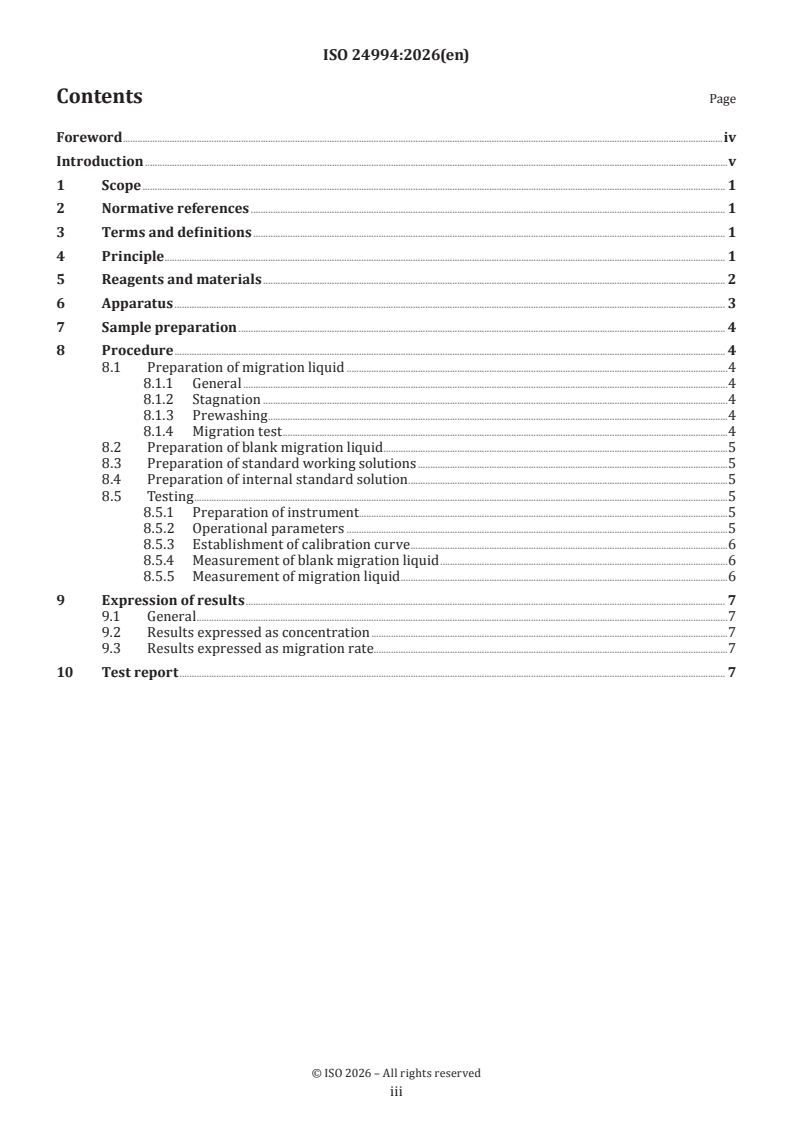
Contents Page
Foreword .iv
Introduction .v
1 Scope . 1
2 Normative references . 1
3 Terms and definitions . 1
4 Principle . 1
5 Reagents and materials . 2
6 Apparatus . 3
7 Sample preparation . 4
8 Procedure . 4
8.1 Preparation of migration liquid .4
8.1.1 General .4
8.1.2 Stagnation .4
8.1.3 Prewashing .4
8.1.4 Migration test .4
8.2 Preparation of blank migration liquid .5
8.3 Preparation of standard working solutions .5
8.4 Preparation of internal standard solution .5
8.5 Testing .5
8.5.1 Preparation of instrument .5
8.5.2 Operational parameters .5
8.5.3 Establishment of calibration curve .6
8.5.4 Measurement of blank migration liquid .6
8.5.5 Measurement of migration liquid .6
9 Expression of results . 7
9.1 General .7
9.2 Results expressed as concentration .7
9.3 Results expressed as migration rate.7
10 Test report . 7
iii
Foreword
ISO (the International Organization for Standardization) is a worldwide federation of national standards
bodies (ISO member bodies). The work of preparing International Standards is normally carried out through
ISO technical committees. Each member body interested in a subject for which a technical committee
has been established has the right to be represented on that committee. International organizations,
governmental and non-governmental, in liaison with ISO, also take part in the work. ISO collaborates closely
with the International Electrotechnical Commission (IEC) on all matters of electrotechnical standardization.
The procedures used to develop this document and those intended for its further maintenance are described
in the ISO/IEC Directives, Part 1. In particular, the different approval criteria needed for the different types
of ISO document should be noted. This document was drafted in accordance with the editorial rules of the
ISO/IEC Directives, Part 2 (see www.iso.org/directives).
ISO draws attention to the possibility that the implementation of this document may involve the use of (a)
patent(s). ISO takes no position concerning the evidence, validity or applicability of any claimed patent
rights in respect thereof. As of the date of publication of this document, ISO had not received notice of (a)
patent(s) which may be required to implement this document. However, implementers are cautioned that
this may not represent the latest information, which may be obtained from the patent database available at
www.iso.org/patents. ISO shall not be held responsible for identifying any or all such patent rights.
Any trade name used in this document is information given for the convenience of users and does not
constitute an endorsement.
For an explanation of the voluntary nature of standards, the meaning of ISO specific terms and expressions
related to conformity assessment, as well as information about ISO's adherence to the World Trade
Organization (WTO) principles in the Technical Barriers to Trade (TBT), see www.iso.org/iso/foreword.html.
This document was prepared by Technical Committee ISO/TC 138, Plastics pipes, fittings and valves for the
transport of fluids, Subcommittee SC 5, General properties of pipes, fittings and valves of plastic materials and
their accessories -- Test methods and basic specifications.
Any feedback or questions on this document should be directed to the user’s national standards body. A
complete listing of these bodies can be found at www.iso.org/members.html.
iv
Introduction
Migratable elements in water supply pipes, fittings and their joints, especially metal elements, can affect
water quality and endanger human health. This document provides a method for the detection of selected
metals and semi-metals in migration liquid acquiring from a series of migration periods according to
ISO 8795. The method of detection is conducive to providing a unified test method and conditions to obtain
comparative test data. This document can serve as a measure for additive monitoring and quality control.
In this document, inductively coupled plasma mass spectrometry (ICP-MS) is used to determine the
elements' migration values in migration liquid of plastic pipes, fittings and their joints. The main advantages
of ICP-MS include multi-element measurement capability, wide linear dynamic range and high sensitivity.
v
International Standard ISO 24994:2026(en)
Plastics piping systems — Determination of selected metal
and semi-metal migration values of plastic pipes, fittings and
their joints
WARNING — Persons using this document should be familiar with normal laboratory practice, if
applicable. This document does not purport to address all the safety concerns, if any, associated with
its use. It is the responsibility of the user to establish appropriate safety and health practices.
1 Scope
This document specifies a method for the determination of the selected metals and semi-metals migration
from the internal surface of plastics pipes, fittings and joints to be used for the transport of water intended
for human consumption by inductively coupled plasma mass spectrometry (ICP-MS).
This document is used to determine the selected metal and semi-metals migration values of lead (Pb), tin
(Sn), antimony (Sb), cadmium (Cd), chromium (Cr), copper (Cu), barium (Ba), magnesium (Mg), aluminium
(Al), nickel (Ni), zinc (Zn) and arsenic (As).
This method is suitable for all plastics pipes, fittings and joints to be used for the transport of water and raw
water intended for human consumption.
2 Normative references
The following documents are referred to in the text in such a way that some or all of their content constitutes
requirements of this document. For dated references, only the edition cited applies. For undated references,
the latest edition of the referenced document (including any amendments) applies.
ISO 3696, Water for analytical laboratory use — Specification and test methods
ISO 8795:2001, Plastics piping systems for the transport of water intended for human consumption — Migration
assessment — Determination of migration values of plastics pipes and fittings and their joints
3 Terms and definitions
No terms and definitions are listed in this document.
ISO and IEC maintain terminology databases for use in standardization at the following addresses:
— ISO Online browsing platform: available at https:// www .iso .org/ obp
— IEC Electropedia: available at https:// www .electropedia .org/
4 Principle
Test samples of plastics pipes, fittings or their joints are subjected to stagnation and prewashing with water.
Test samples are then filled with test liquid at a specified temperature and kept for a series of migration
periods. After migration periods have been completed, samples are collected into storage bottles and
preserved appropriately for analysis. The analysis of the migration liquid at the ICP-MS initiates with the
migration liquid being converted to aerosol via a nebulizer and introduced into inductively coupled plasma
(ICP) flame by a carrier gas. At elevated temperatures, the solution undergoes various processes, including
evaporation, dissociation, atomization and ionization, ultimately transforming into positively charged ions.
The ions are subsequently guided into the mass spectrometer through an ion collection system. The ions are
separated by the mass spectrometer based on their mass-to-charge ratio. Within a certain concentration
range, the signal response value corresponding to the mass number of the target element is directly
proportional to its concentration, enabling qualitative and quantitative analysis.
5 Reagents and materials
Use only reagents of recognized analytical grade, unless otherwise specified. The reagents shall be of
adequate purity. If validated, reagents of other grades that achieve sufficient purity without affecting the
accuracy of the determination can also be used.
5.1 Water, grade 1 water or deionized water, for all sample preparation and dilutions. Grade 1 water
shall be in accordance with ISO 3696. The resistivity of deionized water should be greater than or equal to
18,2 MΩ·cm at 25 °C.
5.2 Chlorinated water, comprising wa
...