


ISO 1751:2012
(Main)Ships and marine technology — Ships' side scuttles
Ships and marine technology — Ships' side scuttles
This International Standard specifies the classification of side scuttles for ships (series, types and models), and gives the dimensions for interchangeability and construction, materials, tests, marking and designation of these framed side scuttles with thermally toughened safety glass panes. NOTE This International Standard is based on the experience of side scuttles and glass manufacturers, shipbuilders and authorities who apply to ships the Regulations of the International Convention for the Safety of Life at Sea, 1974 (SOLAS 1974), as amended, 1981, and of the International Convention of Load Lines, 1966, as amended.
Navires et technologie maritime — Hublots de navires
General Information
- Status
- Published
- Publication Date
- 28-Jun-2012
- Technical Committee
- ISO/TC 8/SC 8 - Ship design
- Drafting Committee
- ISO/TC 8/SC 8 - Ship design
- Current Stage
- 9093 - International Standard confirmed
- Start Date
- 21-Jul-2023
- Completion Date
- 12-Feb-2026
Relations
- Effective Date
- 30-May-2009
Overview
ISO 1751:2012 - Ships and marine technology - Ships’ side scuttles - defines standardized classification, dimensions and technical requirements for framed side scuttles fitted with thermally toughened safety glass panes. The standard covers interchangeability and construction details, materials, testing, marking and designation for side scuttles used on ships and is informed by SOLAS and Load Line conventions.
Key topics and technical requirements
- Classification: side scuttles are organized by series, type and model:
- Series N (regular) - uses thermally toughened glass per ISO 21005.
- Series P (fire‑resistant) - uses fire‑resistant panes complying with ISO 5797 and additional construction/testing requirements.
- Types A, B, C - heavy, medium and light constructions respectively.
- Models defined by opening/non‑opening, deadlight, opening direction and fastening (bolted or welded).
- Nominal sizes: clear light diameters standardized (200, 250, 300, 350, 400, 450 mm) for interchangeability.
- Dimensions & spigot heights: main dimensions and spigot recommendations are specified (e.g., bolted spigot ≈ 16 mm; welded spigot ≥ 30 mm).
- Glass fixing: standardized glass retaining frames - RFA (threaded), RFB and RFC (flanged) - and mounting details (screw thread M6, minimum length 16 mm, corrosion‑resistant materials).
- Materials: material classes for main frame, glassholder, retaining frame, hinges and fasteners; fire‑resistant series require materials retaining mechanical properties at elevated temperatures.
- Testing: includes board test, shop test, mechanical strength test and fire‑resistance test (where applicable). Annex A provides maximum allowable pressure limits for glass panes.
- Marking & designation: requirements for product marking and standardized designation formats to support survey and certification.
Practical applications
- Ensures interchangeability of marine windows across shipbuilders and suppliers.
- Supports compliance with SOLAS and load‑line safety regulations for passenger and merchant ships.
- Guides selection and procurement of side scuttles for newbuilds, refits and repairs - especially where fire‑resistant glazing or standardized replacement parts are required.
- Used in design documentation for accommodation, wheelhouse and other hull openings where side scuttles are installed.
Who should use ISO 1751:2012
- Ship designers and naval architects
- Shipbuilders and ship repair yards
- Window/side‑scuttle manufacturers and glass suppliers
- Classification societies, flag state surveyors and maritime inspectors
- Procurement and maintenance teams on commercial and passenger vessels
Related standards
- ISO 21005 - Thermally toughened safety glass panes
- ISO 5797 - Windows and side scuttles for fire‑resistant constructions
- ISO 6345 - Vocabulary for windows and side scuttles
- ISO 5780 - Side scuttles - Positioning
Using ISO 1751 helps ensure safe, uniform and certifiable marine side scuttles that meet regulatory and operational requirements.
Get Certified
Connect with accredited certification bodies for this standard

DNV
DNV is an independent assurance and risk management provider.

Lloyd's Register
Lloyd's Register is a global professional services organisation specialising in engineering and technology.

ABS Quality Evaluations Inc.
American Bureau of Shipping quality certification.
Sponsored listings
Frequently Asked Questions
ISO 1751:2012 is a standard published by the International Organization for Standardization (ISO). Its full title is "Ships and marine technology — Ships' side scuttles". This standard covers: This International Standard specifies the classification of side scuttles for ships (series, types and models), and gives the dimensions for interchangeability and construction, materials, tests, marking and designation of these framed side scuttles with thermally toughened safety glass panes. NOTE This International Standard is based on the experience of side scuttles and glass manufacturers, shipbuilders and authorities who apply to ships the Regulations of the International Convention for the Safety of Life at Sea, 1974 (SOLAS 1974), as amended, 1981, and of the International Convention of Load Lines, 1966, as amended.
This International Standard specifies the classification of side scuttles for ships (series, types and models), and gives the dimensions for interchangeability and construction, materials, tests, marking and designation of these framed side scuttles with thermally toughened safety glass panes. NOTE This International Standard is based on the experience of side scuttles and glass manufacturers, shipbuilders and authorities who apply to ships the Regulations of the International Convention for the Safety of Life at Sea, 1974 (SOLAS 1974), as amended, 1981, and of the International Convention of Load Lines, 1966, as amended.
ISO 1751:2012 is classified under the following ICS (International Classification for Standards) categories: 47.020.10 - Hulls and their structure elements. The ICS classification helps identify the subject area and facilitates finding related standards.
ISO 1751:2012 has the following relationships with other standards: It is inter standard links to ISO 1751:1993. Understanding these relationships helps ensure you are using the most current and applicable version of the standard.
ISO 1751:2012 is available in PDF format for immediate download after purchase. The document can be added to your cart and obtained through the secure checkout process. Digital delivery ensures instant access to the complete standard document.
Standards Content (Sample)
INTERNATIONAL ISO
STANDARD 1751
Third edition
2012-07-01
Ships and marine technology — Ships’
side scuttles
Navires et technologie maritime — Hublots de navires
Reference number
©
ISO 2012
All rights reserved. Unless otherwise specified, no part of this publication may be reproduced or utilized in any form or by any means,
electronic or mechanical, including photocopying and microfilm, without permission in writing from either ISO at the address below or ISO’s
member body in the country of the requester.
ISO copyright office
Case postale 56 • CH-1211 Geneva 20
Tel. + 41 22 749 01 11
Fax + 41 22 749 09 47
E-mail copyright@iso.org
Web www.iso.org
Published in Switzerland
ii © ISO 2012 – All rights reserved
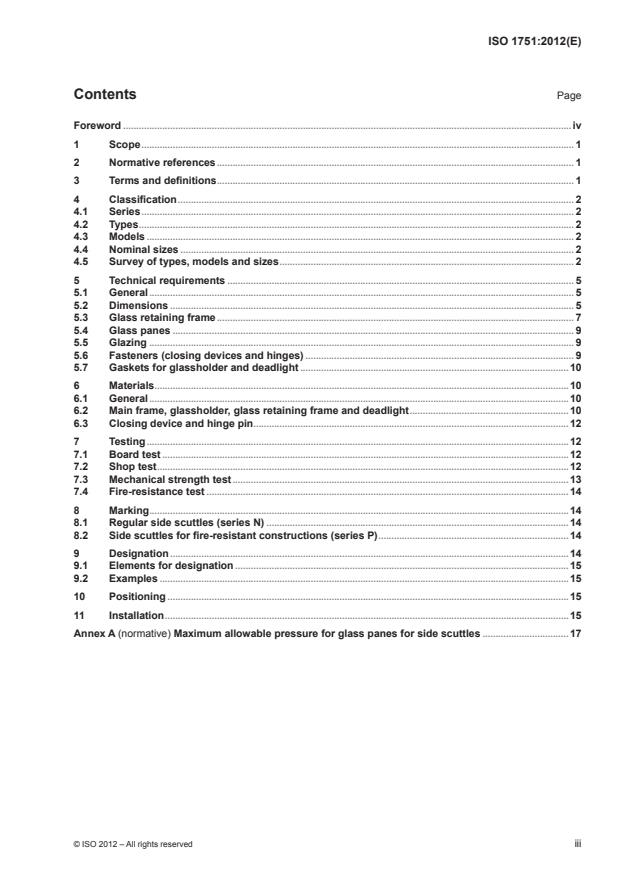
Contents Page
Foreword .iv
1 Scope . 1
2 Normative references . 1
3 Terms and definitions . 1
4 Classification . 2
4.1 Series . 2
4.2 Types . 2
4.3 Models . 2
4.4 Nominal sizes . 2
4.5 Survey of types, models and sizes . 2
5 Technical requirements . 5
5.1 General . 5
5.2 Dimensions . 5
5.3 Glass retaining frame . 7
5.4 Glass panes . 9
5.5 Glazing . 9
5.6 Fasteners (closing devices and hinges) . 9
5.7 Gaskets for glassholder and deadlight .10
6 Materials .10
6.1 General .10
6.2 Main frame, glassholder, glass retaining frame and deadlight .10
6.3 Closing device and hinge pin .12
7 Testing .12
7.1 Board test .12
7.2 Shop test .12
7.3 Mechanical strength test .13
7.4 Fire-resistance test .14
8 Marking .14
8.1 Regular side scuttles (series N) .14
8.2 Side scuttles for fire-resistant constructions (series P) .14
9 Designation .14
9.1 Elements for designation .15
9.2 Examples .15
10 Positioning .15
11 Installation .15
Annex A (normative) Maximum allowable pressure for glass panes for side scuttles .17
Foreword
ISO (the International Organization for Standardization) is a worldwide federation of national standards bodies
(ISO member bodies). The work of preparing International Standards is normally carried out through ISO
technical committees. Each member body interested in a subject for which a technical committee has been
established has the right to be represented on that committee. International organizations, governmental and
non-governmental, in liaison with ISO, also take part in the work. ISO collaborates closely with the International
Electrotechnical Commission (IEC) on all matters of electrotechnical standardization.
International Standards are drafted in accordance with the rules given in the ISO/IEC Directives, Part 2.
The main task of technical committees is to prepare International Standards. Draft International Standards
adopted by the technical committees are circulated to the member bodies for voting. Publication as an
International Standard requires approval by at least 75 % of the member bodies casting a vote.
Attention is drawn to the possibility that some of the elements of this document may be the subject of patent
rights. ISO shall not be held responsible for identifying any or all such patent rights.
ISO 1751 was prepared by Technical Committee ISO/TC 8, Ships and marine technology, Subcommittee
SC 8, Ship design.
This third edition cancels and replaces the second edition (ISO 1751:1993), which has been technically revised.
iv © ISO 2012 – All rights reserved
INTERNATIONAL STANDARD ISO 1751:2012(E)
Ships and marine technology — Ships’ side scuttles
1 Scope
This International Standard specifies the classification of side scuttles for ships (series, types and models),
and gives the dimensions for interchangeability and construction, materials, tests, marking and designation of
these framed side scuttles with thermally toughened safety glass panes.
NOTE This International Standard is based on the experience of side scuttles and glass manufacturers, shipbuilders
and authorities who apply to ships the Regulations of the International Convention for the Safety of Life at Sea, 1974
(SOLAS 1974), as amended, 1981, and of the International Convention of Load Lines, 1966, as amended.
2 Normative references
The following referenced documents are indispensable for the application of this document. For dated
references, only the edition cited applies. For undated references, the latest edition of the referenced document
(including any amendments) applies.
ISO 261, ISO general purpose metric screw threads — General plan
ISO 614, Ships and marine technology — Toughened safety glass panes for rectangular windows and side
scuttles — Punch method of non-destructive strength testing
ISO 1207, Slotted cheese head screws — Product grade A
ISO 1580, Slotted pan head screws — Product grade A
ISO 2009, Slotted countersunk flat head screws — Product grade A
ISO 2010, Slotted raised countersunk head screws — Product grade A
ISO 3902, Shipbuilding and marine structures — Gaskets for rectangular windows and side scuttles
ISO 5780, Shipbuilding — Side scuttles — Positioning
ISO 5797, Ships and marine technology — Windows and side scuttles for fire-resistant constructions
ISO 6345, Shipbuilding and marine structures — Windows and side scuttles — Vocabulary
ISO 7045, Pan head screws with type H or type Z cross recess — Product grade A
ISO 7046-2, Countersunk flat head screws (common head style) with type H or type Z cross recess — Product
grade A — Part 2: Steel screws of property class 8.8, stainless steel screws and non-ferrous metal screws
ISO 7047, Raised countersunk head screws (common head style) with type H or type Z cross recess —
Product grade A
ISO 21005, Ships and marine technology — Thermally toughened safety glass panes for windows and side scuttles
3 Terms and definitions
For the purposes of this document, the terms and definitions given in ISO 6345 and ISO 21005 apply.
4 Classification
Side scuttles shall be classified by series, types, models and nominal sizes in accordance with 4.1 to 4.4,
respectively.
NOTE A survey of standardized side scuttles is given in 4.5 and Table 3.
Further classification characteristics are the material classes; see 6.2 and Table 10.
4.1 Series
4.1.1 Regular series (N)
Side scuttles of the regular series shall contain a thermally toughened safety glass pane that meets the
requirements of ISO 21005.
4.1.2 Fire-resistant series (P)
Side scuttles of the fire-resistant series shall be provided for installation in “A” or “B” class divisions. These side
scuttles shall contain glass panes that meet the requirements of ISO 5797.
Modifications to the construction and installation of the glassholder and main frame, as well as additional
testing and marking, shall be in accordance with ISO 5797.
4.2 Types
Ships’ side scuttles may be of three types:
— Type A: Heavy-type side scuttle;
— Type B: Medium-type side scuttle;
— Type C: Light-type side scuttle.
4.3 Models
Models shall be designated in accordance with the following principal characteristics:
— opening or non-opening model;
— with or without deadlight;
— opening direction of glassholder;
— type of fastening.
The various combinations of these, which are in accordance with the definitions in ISO 6345, are given in Table 1.
4.4 Nominal sizes
The nominal size is defined by the clear light diameter d of the side scuttle; see Table 2.
4.5 Survey of types, models and sizes
A survey is given in Table 3 for all side scuttles standardized in this International Standard. It applies to series N
(regular) and series P (fire-resistant) side scuttles.
The illustrations given in Table 3 do not define the construction; they are simplified examples for information only.
2 © ISO 2012 – All rights reserved
Table 1 — Principal characteristics of models
Fastening Model designation code
Opening or Further
Deadlight bolted welded Type
non-opening attributes
(B) (W) A B C
a
left hand B — LB —
— W LW —
(L)
a
right hand B — RB —
with
— W RW —
(R)
opening
common hinged B — SB —
— W SW —
(S)
B — — LRB
without —
— W — LRW
B — NB —
with
— W NW —
non-opening —
B — NB
without —
— W NW
a
The deadlight opening upwards. Opening side scuttles with deadlight opening downwards may be supplied by special agreement
only.
Table 2 — Nominal sizes of side scuttles
Nominal size
Type d Illustration
mm
A 200 250 300 350 400 450
B 200 250 300 350 400 450
C 200 250 300 350 400 450
Table 3 — Survey of side scuttles
Type Model Nominal size Illustration
(see 4.2) (see 4.3) d (bolted side scuttles are shown)
bolted welded
(see 4.4)
Opening side scuttle
LB —
Type A:
— LW
with deadlight
200 to 450
RB —
A
and
B
— RW
Type B:
SB —
200 to 450
— SW
without deadlight
LRB —
C 200 to 450
— LRW
Non-opening side scuttle
with deadlight
Type A:
NB —
200 to 450
A
and
B
Type B:
— NW
200 to 450
without deadlight
NB —
C 200 to 450
— NW
4 © ISO 2012 – All rights reserved
5 Technical requirements
5.1 General
Side scuttles of all series, types, models and nominal sizes shall be manufactured to the requirements
(dimensions, materials, etc.) given in this International Standard. They shall be capable of meeting the test
requirements specified in Clause 7.
In addition, for side scuttles for fire-resistant construction, the glassholder and the main frame shall be made
of a material that keeps its mechanical characteristics at the temperatures given in ISO 5797.
They shall be designed so that temperature gradients do not develop stresses in the glass which could
result in rupture.
5.2 Dimensions
5.2.1 Main dimensions
The main dimensions of side scuttles shall be as given in Figure 1 and Tables 4 and 5.
NOTE Figure 1 does not define the construction of any series, type or model of side scuttle; it is given for the
indication of standardized dimensions only. The illustration shows an opening side scuttle with deadlight.
Table 4 — Main dimensions and number of fasteners of side scuttles
a
d d g Minimum number of fasteners
2 3
Nominal size
Type A Type B Type C
mm mm mm
d
glass- glass- glass-
dead-light dead-light
± 2 max. max.
mm
holder holder holder
200 250 350 50 2 2 2 2 2
250 305 400 47,5 3 2 3 2 2
300 360 450 45 3 3 3 2 3
350 410 500 45 3 3 3 3 3
400 460 550 45 3 3 3 3 3
450 510 600 45 4 3 4 3 3
a
The number of fasteners comprises only closing devices and hinges with round holes; see 5.6.
a) Bolted model
b) Welded model
a
For the spigot height (dimension c), see 5.2.2 and Table 5.
Figure 1 — Main dimensions of side scuttle
5.2.2 Height of spigot
The recommended nominal heights of the main frame spigot, which should be preferred for all types, models
and nominal sizes of side scuttles, are given in Table 5.
Table 5 — Height of spigot (dimension c)
Manufacturing
Actual height
height
Model
mm mm
Bolted 16
The actual required
delivery height of the
spigot may be agreed
when ordering the
side scuttle.
Welded ≥ 30
5.2.3 Glass recess
The diameter of the glass recess, d , in the glassholder of opening side scuttles and in the main frame of
non-opening side scuttles shall be as given in Figure 5 and Table 6.
The minimum glass thicknesses for side scut
...
Questions, Comments and Discussion
Ask us and Technical Secretary will try to provide an answer. You can facilitate discussion about the standard in here.
Loading comments...