

ISO/TR 11762:1992
(Main)Light-gauge metal containers — Round open-top cans for liquid products with added gas — Classification of can sizes by construction type
General Information
- Abstract
Gives a list of nominal filling volumes for the following containers: straight-sided cans, single necked-in cans, multiple necked-in cans. Annex A gives a reference list to can sizes formerly standardized in ISO 3004-3, but now these cans do not meet the required criteria to be standardized and incorporated in ISO 10654.
- Status
- Published
- Publication Date
- 27-May-1992
- Technical Committee
- ISO/TC 52 - Light gauge metal containers
- Drafting Committee
- ISO/TC 52 - Light gauge metal containers
- Current Stage
- 6060 - International Standard published
- Start Date
- 28-May-1992
- Completion Date
- 29-Aug-2026
Buy Documents


ISO/TR 11762:1992 - Light-gauge metal containers — Round open-top cans for liquid products with added gas — Classification of can sizes by construction type Released:5/28/1992


ISO/TR 11762:1992 - Emballages métalliques légers — Boîtes rondes serties pour produits liquides avec addition de gaz — Classification par type de construction Released:5/28/1992


ISO/TR 11762:1992 - Emballages métalliques légers — Boîtes rondes serties pour produits liquides avec addition de gaz — Classification par type de construction Released:5/28/1992
Overview
ISO/TR 11762:1992 is a Technical Report from ISO/TC 52 that classifies round open-top, light-gauge metal cans for liquid products with added gas by construction type. Rather than establishing new mandatory specifications, this type‑3 Technical Report provides informational data - notably a list of nominal filling volumes and opening diameters organized by can construction: straight-sided cans, single necked‑in cans, and multiple necked‑in cans. Annex A supplies a reference list of sizes formerly standardized in ISO 3004-3 that no longer meet criteria for inclusion in ISO 10654.
Key Topics
- Classification by construction type: The report separates can sizes for straight-sided, single necked‑in and multiple necked‑in constructions, helping users map size options to form factor.
- Nominal filling volumes: A compiled list of nominal volumes is provided for each construction type (the report cross-references ISO 10654, which specifies nominal filling volumes).
- Opening diameters: Opening sizes are listed in millimetres; the publication includes representative diameters such as 50, 53, 57, 63 and 65 mm.
- Legacy size references: Annex A lists can sizes that were standardized under the former ISO 3004-3 but are now considered non-conforming for ISO 10654 - examples shown in the report include numeric size entries like 275, 296, 330.
- Informational status: As a Technical Report (type 3), ISO/TR 11762:1992 documents the state of the art and is intended as background information rather than a prescriptive standard.
Applications
ISO/TR 11762:1992 is useful for:
- Packaging engineers and product designers selecting an appropriate can construction and nominal volume for carbonated or gas‑added liquid products.
- Can manufacturers and tooling designers aligning manufacturing options (opening diameter, necking approach) with commonly referenced size classifications.
- Beverage producers evaluating packaging formats for production line compatibility and product presentation.
- Procurement and specification writers who need an authoritative reference to common can sizes by construction type.
- Standards bodies and technical committees reviewing historical sizes and harmonizing current standards (see Annex A).
Practical benefits include faster format selection during concept development, clearer communication between suppliers and manufacturers, and a historical reference to legacy can sizes.
Related Standards
- ISO 90‑1 - Definitions and methods for dimensions and capacities for open-top cans.
- ISO 10654 - Round open-top cans defined by nominal filling volumes (current reference for standardized volumes).
- ISO 3004-3 - Former standard referenced in Annex A for legacy sizes.
Keywords: ISO/TR 11762:1992, light-gauge metal containers, round open-top cans, straight-sided cans, necked-in cans, nominal filling volumes, opening diameters, can size classification, metal packaging.
Relations
- Effective Date
- 15-Apr-2008
- Effective Date
- 15-Apr-2008
- Effective Date
- 15-Apr-2008
- Effective Date
- 15-Apr-2008
- Effective Date
- 15-Apr-2008
Buy Documents
ISO/TR 11762:1992 - Light-gauge metal containers — Round open-top cans for liquid products with added gas — Classification of can sizes by construction type Released:5/28/1992
ISO/TR 11762:1992 - Emballages métalliques légers — Boîtes rondes serties pour produits liquides avec addition de gaz — Classification par type de construction Released:5/28/1992
ISO/TR 11762:1992 - Emballages métalliques légers — Boîtes rondes serties pour produits liquides avec addition de gaz — Classification par type de construction Released:5/28/1992
Get Certified
Connect with accredited certification bodies for this standard

BRCGS (Brand Reputation Compliance Global Standards)
Global food safety and quality standards owner.
Sponsored listings
Frequently Asked Questions
ISO/TR 11762:1992 is a technical report published by the International Organization for Standardization (ISO). Its full title is "Light-gauge metal containers — Round open-top cans for liquid products with added gas — Classification of can sizes by construction type". This standard covers: Gives a list of nominal filling volumes for the following containers: straight-sided cans, single necked-in cans, multiple necked-in cans. Annex A gives a reference list to can sizes formerly standardized in ISO 3004-3, but now these cans do not meet the required criteria to be standardized and incorporated in ISO 10654.
Gives a list of nominal filling volumes for the following containers: straight-sided cans, single necked-in cans, multiple necked-in cans. Annex A gives a reference list to can sizes formerly standardized in ISO 3004-3, but now these cans do not meet the required criteria to be standardized and incorporated in ISO 10654.
ISO/TR 11762:1992 is classified under the following ICS (International Classification for Standards) categories: 55.120 - Cans. Tins. Tubes. The ICS classification helps identify the subject area and facilitates finding related standards.
ISO/TR 11762:1992 has the following relationships with other standards: It is inter standard links to ISO 3004-4:1986, ISO 3004-5:1988, ISO 3004-6:1986, ISO 3004-3:1986, ISO 3004-2:1989. Understanding these relationships helps ensure you are using the most current and applicable version of the standard.
ISO/TR 11762:1992 is available in PDF format for immediate download after purchase. The document can be added to your cart and obtained through the secure checkout process. Digital delivery ensures instant access to the complete standard document.
Standards Content (Sample)
IS0
TECHNICAL
REPORT 11762
First edition
1992-05-01
Light-gauge metal containers - Round open-top
cans for liquid products with added gas -
Classification of can sizes by construction type
Emballages mbtalliques lbgers - Boites rondes serties
pour produits
liquides avec addition de gaz - Classification par type de construction
--
Reference number
ISOfTR 11762: 1992(E)
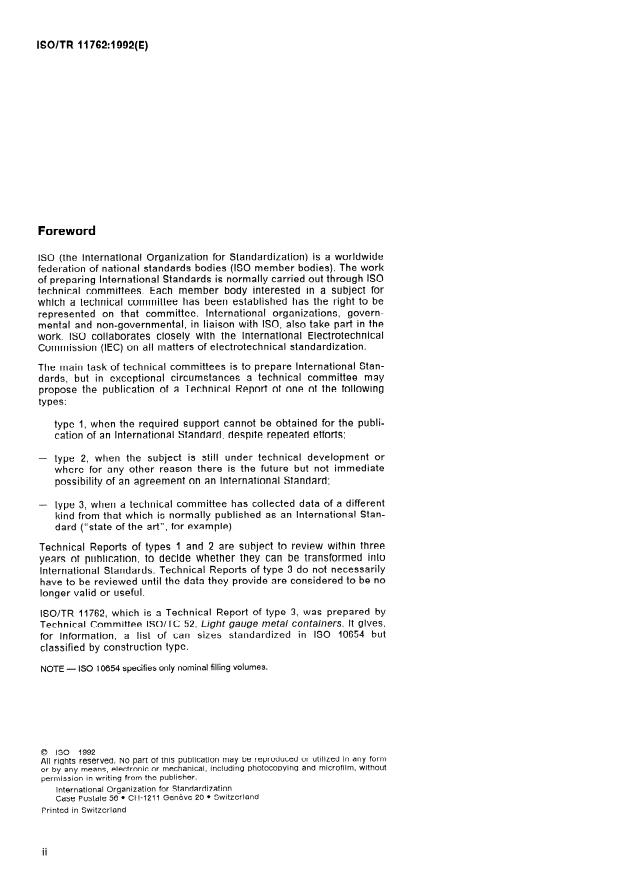
Foreword
IS0 (the International Organization for Standardization) is a worldwide
federation of national standards bodies (IS0 member bodies). The work
of preparing International Standards is normally carried out through IS0
technical committees. Each member body interested in a subject for
which a technical committee has been established has the right to be
represented on that committee. International organizations, govern-
mental and non-governmental, in liaison with ISO, also take part in the
work. IS0 collaborates closely with the International Electrotechnical
Commission (IEC) on all matters of electrotechnical standardization.
The main task of technical committees is to prepare International Stan-
dards, but in exceptional circumstances a technical committee may
propose the publication of a Technical Report of one of the following
types:
-
type 1, when the required support cannot be obtained for the publi-
cation of an International Standard, despite repeated efforts;
-
type 2, when the subject is still under technical development or
where for any other reason there is the future but not immediate
possibility of an agreement on an International Standard;
-
type 3, when a technical committee has collected data of a different
kind from that which is normally published as an International Stan-
dard (“state of the art”, for example).
Technical Reports of types 1 and 2 are subject to review within three
years of publication, to decide whether they can be transformed into
International Standards. Technical Reports of type 3 do not necessarily
have to be reviewed until the data they provide are considered to be no
longer valid or useful.
ISO/TR 11762, which is a Technical Report of type 3, was prepared by
Technical Committee ISO/TC 52, Light gauge metal containers. It gives,
for information, a list of can sizes standardized in ISO 406541 but
c
...
ISO
RAPPORT
TECHNIQUE 11762
Première édition
1992-05-o 1
Emballages métalliques légers - Boîtes rondes
serties pour produits liquides avec addition de
- Classification par type de construction
gaz
Light-gauge metal containers - Round open-top tans for liquid products
wifh added gas - Classification of cari sizes by construction type
Numéro de référence
~---_
_ -.__. --.-- __.--_ -. ___ _ ISWTR 11762: 1992(F)
ISOITR 11762:1992(F)
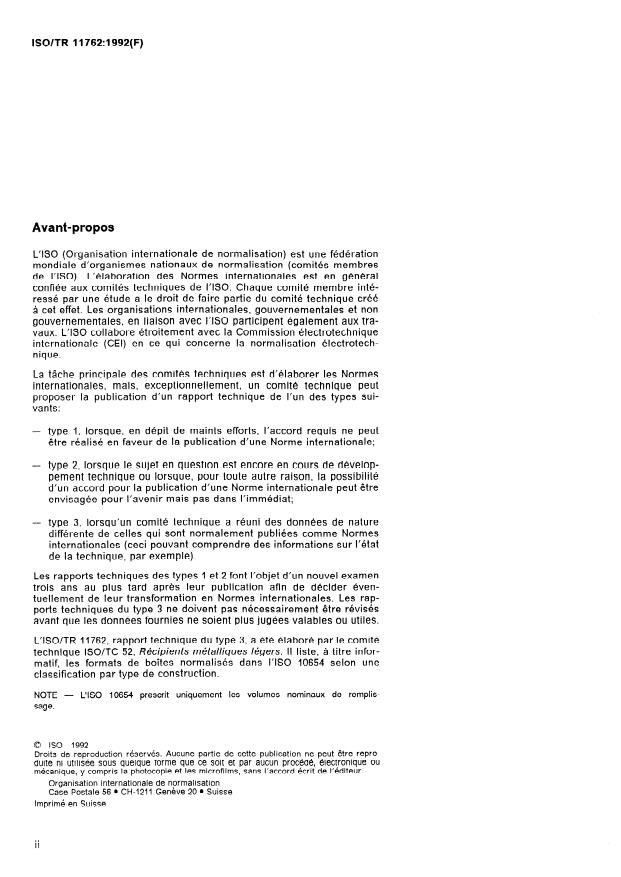
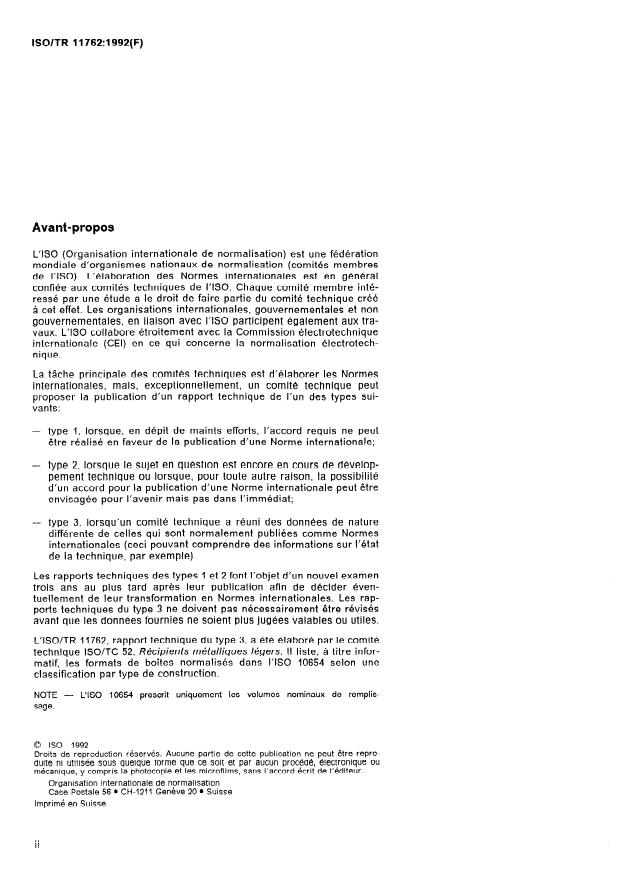
Avant-propos
L’ISO (Organisation internationale de normalisation) est une fédération
mondiale d’organismes nationaux de normalisation (comités membres
de I’ISO). L’élaboration des Normes internationales est en général
confiée aux comités techniques de I’ISO. Chaque comité membre int&
ressé par une étude a le droit de faire partie du comité technique créé
à cet effet. Les organisations internationales, gouvernementales et non
gouvernementales, en liaison avec I’ISO participent également aux tra-
vaux. L’ISO collabore étroitement avec la Commission électrotechnique
internationale (CEI) en ce qui concerne la normalisation électrotech-
nique.
La tâche principale des comités techniques est d’élaborer les Normes
internationales, mais, exceptionnellement, un comité technique peut
proposer la publication d’un rapport technique de l’un des types sui-
vants:
lors dépit de ma ints efforts, 1’
accord requis ne peut
- type 1, que f en
être ré alisé en fave ur de la publ ication d’un e Norme interna tionale;
-
type 2, lorsque le sujet en question est encore en cours de dévelop-
pement technique ou lorsque, pour toute autre raison, la possibilité
d’un accord pour la publication d’une Norme internationale peut être
envisagée pour l’avenir mais pas dans l’immédiat;
-
type 3, lorsqu’un comité technique a réuni des données de nature
différente de celles qui sont normalement publiées comme Normes
internationales (ceci pouvant comprendre des informations sur l’état
de la technique, par exemple).
Les rapports techniques des types 1 et 2 font l’objet d’un nouvel examen
trois ans au plus tard après leur publication afin de décider éven-
tuellement de leur transformation en Normes internationales. Les rap-
ports techniques du type 3 ne doivent pas nécessairement être révisés
avant que les données fournies ne soient plus jugées valables ou utiles.
L’ISO/TR 11762, rapport technique du type 3, a été élaboré par le comité
technique ISO/TC 52, Récipients métalliques légers. II liste, à titre infor-
matif, les formats de boîtes normalisés dans I’ISO 10654 selon une
classification par type de construction.
NOTE - L'ISO 10654 prescrit uniquement les volumes nominaux remplis-
sage.
0 ISO 1992
Droits de reproduction réservés. Aucune partie de cette publication ne peut être repro-
duite ni utilisée sous quelque forme que ce soit et par aucun procédé, électronique ou
mécanique, y compris la photocopie et le
...
ISO
RAPPORT
TECHNIQUE 11762
Première édition
1992-05-o 1
Emballages métalliques légers - Boîtes rondes
serties pour produits liquides avec addition de
- Classification par type de construction
gaz
Light-gauge metal containers - Round open-top tans for liquid products
wifh added gas - Classification of cari sizes by construction type
Numéro de référence
~---_
_ -.__. --.-- __.--_ -. ___ _ ISWTR 11762: 1992(F)
ISOITR 11762:1992(F)
Avant-propos
L’ISO (Organisation internationale de normalisation) est une fédération
mondiale d’organismes nationaux de normalisation (comités membres
de I’ISO). L’élaboration des Normes internationales est en général
confiée aux comités techniques de I’ISO. Chaque comité membre int&
ressé par une étude a le droit de faire partie du comité technique créé
à cet effet. Les organisations internationales, gouvernementales et non
gouvernementales, en liaison avec I’ISO participent également aux tra-
vaux. L’ISO collabore étroitement avec la Commission électrotechnique
internationale (CEI) en ce qui concerne la normalisation électrotech-
nique.
La tâche principale des comités techniques est d’élaborer les Normes
internationales, mais, exceptionnellement, un comité technique peut
proposer la publication d’un rapport technique de l’un des types sui-
vants:
lors dépit de ma ints efforts, 1’
accord requis ne peut
- type 1, que f en
être ré alisé en fave ur de la publ ication d’un e Norme interna tionale;
-
type 2, lorsque le sujet en question est encore en cours de dévelop-
pement technique ou lorsque, pour toute autre raison, la possibilité
d’un accord pour la publication d’une Norme internationale peut être
envisagée pour l’avenir mais pas dans l’immédiat;
-
type 3, lorsqu’un comité technique a réuni des données de nature
différente de celles qui sont normalement publiées comme Normes
internationales (ceci pouvant comprendre des informations sur l’état
de la technique, par exemple).
Les rapports techniques des types 1 et 2 font l’objet d’un nouvel examen
trois ans au plus tard après leur publication afin de décider éven-
tuellement de leur transformation en Normes internationales. Les rap-
ports techniques du type 3 ne doivent pas nécessairement être révisés
avant que les données fournies ne soient plus jugées valables ou utiles.
L’ISO/TR 11762, rapport technique du type 3, a été élaboré par le comité
technique ISO/TC 52, Récipients métalliques légers. II liste, à titre infor-
matif, les formats de boîtes normalisés dans I’ISO 10654 selon une
classification par type de construction.
NOTE - L'ISO 10654 prescrit uniquement les volumes nominaux remplis-
sage.
0 ISO 1992
Droits de reproduction réservés. Aucune partie de cette publication ne peut être repro-
duite ni utilisée sous quelque forme que ce soit et par aucun procédé, électronique ou
mécanique, y compris la photocopie et le
...