

ISO/ASTM 52935:2023
(Main)Additive manufacturing of metals — Qualification principles — Qualification of coordination personnel
General Information
- Abstract
This document specifies qualification requirements for coordination personnel in industrial manufacturing sites responsible for additive manufacturing of metal parts. This document is applicable to all metallic processes that are described by ISO 17296-2. In this context, the skills, tasks and responsibilities for different levels of AM coordination personnel are typically adapted according to the applicable regulations, depending on the process. This document is intended to provide guidance and requirements for the qualification of coordination personnel in general-industrial applications. Additional requirements are typically needed for specific industries or applications (e.g. aerospace, medical) or to meet regulatory requirements.
- Status
- Published
- Publication Date
- 01-Nov-2023
- Technical Committee
- ISO/TC 261 - Additive manufacturing
- Current Stage
- 6060 - International Standard published
- Start Date
- 02-Nov-2023
- Due Date
- 09-Mar-2024
- Completion Date
- 02-Nov-2023
Buy Documents

ISO/ASTM 52935:2023 - Additive manufacturing of metals — Qualification principles — Qualification of coordination personnel Released:2. 11. 2023
ISO/ASTM 52935:2023 - Fabrication additive des métaux — Principes de qualification — Qualification du personnel de coordination Released:2. 11. 2023
Overview - ISO/ASTM 52935:2023 (Additive manufacturing of metals)
ISO/ASTM 52935:2023 specifies qualification principles for AM coordination personnel in industrial sites that produce metal parts. It applies to metallic additive manufacturing processes covered by ISO 17296-2 and provides requirements and guidance for appointing, assessing and documenting personnel who coordinate AM production. The standard targets general-industrial applications; additional industry- or regulation‑specific requirements (e.g. aerospace, medical) are typically needed.
Key topics and technical requirements
- Scope and applicability: Qualification requirements for coordination personnel for all metallic AM processes described in ISO 17296-2; intended for general-industrial contexts.
- Tasks and responsibilities: Employers must define and document AM coordinator tasks and extent of authorization. Tasks can be allocated to one or several persons; delegations must be recorded.
- Competence and technical knowledge: Competence must be demonstrated by education, training and/or experience, and include relevant AM standards and procedures. Competence is documented on a qualification test certificate (see Annex A).
- Competence levels: Three levels are defined:
- Level 1 - Basic: Supervision of basic work, application of established procedures within strict boundaries.
- Level 2 - Standard: Apply and adapt procedures, select and supervise personnel (includes Level 1 skills).
- Level 3 - Advanced: Develop/specify procedures, coordinate the full manufacturing chain and supervise other coordinators (includes Levels 1–2 skills).
- Assessment and certification: Examinations are conducted by personnel with equal or higher competence. The assessment method and acceptance criteria must be recorded. Passing candidates receive the qualification test certificate; failing candidates receive no certificate.
- Validity and re‑qualification: Qualification remains valid while knowledge is maintained. If not otherwise specified, a maximum validity of 5 years from the last review applies. Re‑qualification and revocation processes are addressed.
- Normative references: Links to ISO/ASTM 52900, 52920 and ISO/ASTM/TS 52930 for related AM fundamentals, site quality requirements and PBF‑LB IQ/OQ/PQ.
Applications - who uses this standard
- AM manufacturers and production managers appointing AM coordinators
- Quality, compliance and HR teams for training and certification programs
- OEMs, integrators and subcontractors clarifying contractual responsibilities
- Auditors and regulators assessing personnel qualification for industrial metal AM
- Training providers developing AM coordinator curricula
Related standards
- ISO/ASTM 52900 - AM fundamentals and vocabulary
- ISO/ASTM 52920 - Quality requirements for industrial AM sites
- ISO/ASTM/TS 52930 - IQ/OQ/PQ of PBF‑LB equipment
Keywords: ISO/ASTM 52935:2023, additive manufacturing, AM coordination personnel, qualification, metals, ISO 17296-2, qualification test certificate, competence levels.
Relations
- Effective Date
- 12-Feb-2026
Buy Documents
ISO/ASTM 52935:2023 - Additive manufacturing of metals — Qualification principles — Qualification of coordination personnel Released:2. 11. 2023
ISO/ASTM 52935:2023 - Fabrication additive des métaux — Principes de qualification — Qualification du personnel de coordination Released:2. 11. 2023
Get Certified
Connect with accredited certification bodies for this standard

DVS-ZERT GmbH
German welding certification society.
CARES (UK Certification Authority for Reinforcing Steels)
UK certification for reinforcing steels and construction.
EWF/IIW (European/International Welding Federation)
International welding personnel certification.
Sponsored listings
Frequently Asked Questions
ISO/ASTM 52935:2023 is a standard published by the International Organization for Standardization (ISO). Its full title is "Additive manufacturing of metals — Qualification principles — Qualification of coordination personnel". This standard covers: This document specifies qualification requirements for coordination personnel in industrial manufacturing sites responsible for additive manufacturing of metal parts. This document is applicable to all metallic processes that are described by ISO 17296-2. In this context, the skills, tasks and responsibilities for different levels of AM coordination personnel are typically adapted according to the applicable regulations, depending on the process. This document is intended to provide guidance and requirements for the qualification of coordination personnel in general-industrial applications. Additional requirements are typically needed for specific industries or applications (e.g. aerospace, medical) or to meet regulatory requirements.
This document specifies qualification requirements for coordination personnel in industrial manufacturing sites responsible for additive manufacturing of metal parts. This document is applicable to all metallic processes that are described by ISO 17296-2. In this context, the skills, tasks and responsibilities for different levels of AM coordination personnel are typically adapted according to the applicable regulations, depending on the process. This document is intended to provide guidance and requirements for the qualification of coordination personnel in general-industrial applications. Additional requirements are typically needed for specific industries or applications (e.g. aerospace, medical) or to meet regulatory requirements.
ISO/ASTM 52935:2023 is classified under the following ICS (International Classification for Standards) categories: 25.030 - Additive manufacturing. The ICS classification helps identify the subject area and facilitates finding related standards.
ISO/ASTM 52935:2023 has the following relationships with other standards: It is inter standard links to EN ISO/ASTM 52935:2023. Understanding these relationships helps ensure you are using the most current and applicable version of the standard.
ISO/ASTM 52935:2023 is available in PDF format for immediate download after purchase. The document can be added to your cart and obtained through the secure checkout process. Digital delivery ensures instant access to the complete standard document.
Standards Content (Sample)
INTERNATIONAL ISO/ASTM
STANDARD 52935
First edition
2023-11
Additive manufacturing of
metals — Qualification principles
— Qualification of coordination
personnel
Fabrication additive des métaux — Principes de qualification —
Qualification du personnel de coordination
Reference number
© ISO/ASTM International 2023
© ISO/ASTM International 2023
All rights reserved. Unless otherwise specified, or required in the context of its implementation, no part of this publication may
be reproduced or utilized otherwise in any form or by any means, electronic or mechanical, including photocopying, or posting on
the internet or an intranet, without prior written permission. Permission can be requested from either ISO at the address below
or ISO’s member body in the country of the requester. In the United States, such requests should be sent to ASTM International.
ISO copyright office ASTM International
CP 401 • Ch. de Blandonnet 8 100 Barr Harbor Drive, PO Box C700
CH-1214 Vernier, Geneva West Conshohocken, PA 19428-2959, USA
Phone: +41 22 749 01 11 Phone: +610 832 9634
Fax: +610 832 9635
Email: copyright@iso.org Email: khooper@astm.org
Website: www.iso.org Website: www.astm.org
Published in Switzerland
ii
© ISO/ASTM International 2023 – All rights reserved
Contents Page
Foreword .iv
Introduction .v
1 Scope . 1
2 Normative references . 1
3 Terms and definitions . 1
4 Tasks and responsibilities.2
4.1 General . 2
4.2 Specification of tasks and responsibilities . 2
4.3 Tasks and responsibilities . 2
4.4 Responsibilities and extent of authorization. 2
5 Technical knowledge and competence . 3
5.1 General . 3
5.2 Competence levels for AM coordination personnel . 3
5.2.1 Level 1 - Basic . 3
5.2.2 Level 2 - Standard . 3
5.2.3 Level 3 – Advanced . 3
6 Qualification . 3
6.1 Assessment of AM coordination personnel . 3
6.2 Validity of qualification . 4
6.3 Re-qualification . 4
7 Qualification test certificate . 4
Annex A (informative) Qualification test certificate of AM coordination personnel .6
Annex B (normative) AM coordination personnel tasks/responsibilities and levels .7
Bibliography .17
iii
© ISO/ASTM International 2023 – All rights reserved
Foreword
ISO (the International Organization for Standardization) is a worldwide federation of national standards
bodies (ISO member bodies). The work of preparing International Standards is normally carried out
through ISO technical committees. Each member body interested in a subject for which a technical
committee has been established has the right to be represented on that committee. International
organizations, governmental and non-governmental, in liaison with ISO, also take part in the work.
ISO collaborates closely with the International Electrotechnical Commission (IEC) on all matters of
electrotechnical standardization.
The procedures used to develop this document and those intended for its further maintenance are
described in the ISO/IEC Directives, Part 1. In particular, the different approval criteria needed for the
different types of ISO document should be noted. This document was drafted in accordance with the
editorial rules of the ISO/IEC Directives, Part 2 (see www.iso.org/directives).
ISO draws attention to the possibility that the implementation of this document may involve the use
of (a) patent(s). ISO takes no position concerning the evidence, validity or applicability of any claimed
patent rights in respect thereof. As of the date of publication of this document, ISO had not received
notice of (a) patent(s) which may be required to implement this document. However, implementers are
cautioned that this may not represent the latest information, which may be obtained from the patent
database available at www.iso.org/patents. ISO shall not be held responsible for identifying any or all
such patent rights.
Any trade name used in this document is information given for the convenience of users and does not
constitute an endorsement.
For an explanation of the voluntary nature of standards, the meaning of ISO specific terms and
expressions related to conformity assessment, as well as information about ISO's adherence to
the World Trade Organization (WTO) principles in the Technical Barriers to Trade (TBT), see
www.iso.org/iso/foreword.html.
This document was prepared by Technical Committee ISO/TC 261, Additive manufacturing, in
cooperation with ASTM Committee F42, Additive manufacturing technologies, on the basis of a
partnership agreement between ISO and ASTM International with the aim to create a common set of
ISO/ASTM standards on additive manufacturing, in collaboration with the European Committee for
Standardization (CEN) Technical Committee CEN/TC 438, Additive manufacturing, in accordance with
the Agreement on technical cooperation between ISO and CEN (Vienna Agreement).
Any feedback or questions on this document should be directed to the user’s national standards body. A
complete listing of these bodies can be found at www.iso.org/members.html.
iv
© ISO/ASTM International 2023 – All rights reserved
Introduction
For many companies, additive manufacturing (AM) represents an interesting alternative to established
manufacturing processes. The trend towards complex, customised or consolidated components, in
addition to opportunities for reduced lead times and decentralised production allows an economically
feasible use for a growing number of areas. This increasingly applies to many series applications, which
add further demands on the efficiency and consistency of the processes. In particular, components used
in regulated industries (e.g. automotive, rail, aerospace, process and industrial plants, medical) are
subject to high demands in terms of quality and safety.
Where industrial components are produced using additive manufacturing processes, these shall
satisfy the equivalent quality and safety requirements demanded of conventional processes. To this
end, the production chain and environment are designed such that the process quality and resulting
product quality are always consistent and reproducible. To achieve consistency and reproducibility, it
is of utmost importance to ensure that the involved workforce is adequately qualified for all stages of
production.
This document describes the activities and responsibilities of the personnel with coordination roles in
the field of additive manufacturing for metallic parts.
v
© ISO/ASTM International 2023 – All rights reserved
INTERNATIONAL STANDARD ISO/ASTM 52935:2023(E)
Additive manufacturing of metals — Qualification
principles — Qualification of coordination personnel
1 Scope
This document specifies qualification requirements for coordination personnel in industrial
manufacturing sites responsible for additive manufacturing of metal parts.
This document is applicable to all metallic processes that are described by ISO 17296-2. In this context,
the skills, tasks and responsibilities for different levels of AM coordination personnel are typically
adapted according to the applicable regulations, depending on the process.
This document is intended to provide guidance and requirements for the qualification of coordination
personnel in general-industrial applications. Additional requirements are typically needed for specific
industries or applications (e.g. aerospace, medical) or to meet regulatory requirements.
2 Normative references
The following documents are referred to in the text in such a way that some or all of their content
constitutes requirements of this document. For dated references, only the edition cited applies. For
undated references, the latest edition of the referenced document (including any amendments) applies.
ISO/ASTM 52900, Additive manufacturing — General principles — Fundamentals and vocabulary
ISO/ASTM 52920, Additive manufacturing — Qualification principles — Quality requirements for industrial
additive manufacturing sites
ISO/ASTM/TS 52930, Additive manufacturing — Qualification principles — Installation, operation and
performance (IQ/OQ/PQ) of PBF-LB equipment
3 Terms and definitions
For the purposes of this document, the terms and definitions given in in ISO/ASTM 52900 and the
following apply.
ISO and IEC maintain terminology databases for use in standardization at the following addresses:
— ISO Online browsing platform: available at https:// www .iso .org/ obp
— IEC Electropedia: available at https:// www .electropedia .org/
3.1
AM coordination personnel
AM coordinator
person or group of people performing defined AM coordination tasks, designated by the company to be
responsible for a specific process
Note 1 to entry: The designation can be valid for one specific AM process or covering several process categories
as specified in ISO/ASTM 52900 and illustrated in ISO 17296-2.
Note 2 to entry: Different personnel may be appointed by the manufacturer for different AM related tasks.
© ISO/ASTM International 2023 – All rights reserved
3.2
examiner
person with knowledge and experience relevant to the qualification, and acceptable to the customer or
examining body or engineering authority
Note 1 to entry: In certain cases, an external independent examining body can be required (ISO/IEC 17024).
4 Tasks and responsibilities
4.1 General
Coordination personnel can have multiple tasks and responsibilities for additive manufacturing of
metals. These tasks and responsibilities can have varying levels depending on the companies’ needs
and the coordination personnel’s education and experience. Coordination personnel can have tasks and
responsibilities that are at their level of qualification or lower. The company specifies if these tasks,
regardless of the level, are assigned to one single staff or to several staff members.
4.2 Specification of tasks and responsibilities
Each manufacturer is responsible for appointing their AM coordination personnel and specifying their
levels of responsibility for coordination.
The tasks and responsibilities of AM coordination personnel should be selected from Annex B and/
or as specified in applicable standards, contracts, and regulations. The level of competence of AM
coordination personnel should be determined in accordance with the complexity of the AM and related
activities, product type(s), criticality of the application and the quality requirements.
Where more than one person carries out AM coordination, the tasks and responsibilities should be
clearly allocated, such that responsibility is clearly specified, and the persons are competent for each
specific AM coordination task.
The manufacturer shall appoint at least one person to be responsible for AM coordination tasks.
If AM coordination is subcontracted, the tasks and responsibilities shall be specified and documented.
However, compliance with this document remains the responsibility of the manufacturer.
4.3 Tasks and responsibilities
The tasks and responsibilities assigned to AM coordination personnel shall be identified in accordance
with 4.1, 4.2 and Annex B, and documented per Annex A.
Persons other than the AM coordinator may be designated to perform specific tasks on their behalf.
Delegations of this type shall be documented.
4.4 Responsibilities and extent of authorization
The responsibilities and extent of authorization assigned to the AM coordination personnel are
identified as follows:
— their position in the manufacturer’s organization and their responsibilities;
— the extent of authorization assigned to them to carry out the assigned tasks (see Annex B);
— the extent of authorization assigned to them to accept or validate, by signature, technical
administrative documents or contracts, on behalf of the manufacturer, as needed to fulfil the
assigned tasks, for example, for procedure specification and supervision reports.
© ISO/ASTM International 2023 – All rights reserved
5 Technical knowledge and competence
5.1 General
All AM coordination personnel shall be able to demonstrate
— competence in the AM-related tasks allocated to them, and
— technical knowledge in AM technologies relevant to the assigned tasks, defined in Annex B, obtained
by a combination of education, training and/or experience.
Competence includes application of AM and related standards when relevant to the assigned tasks.
Competence shall be documented on the qualification test certificate given in Annex A for each task and
responsibility based on:
— the level of qualification may be different for different categories;
— qualification in every category is not required, if not applicable.
NOTE For recommendations in terms of training, education and assessment minimum requirements,
see References [6] and [7].
AM coordination personnel should be allocated to one of the levels described in 5.2, depending on the
nature and/or complexity of the production.
5.2 Competence levels for AM coordination personnel
5.2.1 Level 1 - Basic
At Level 1, AM coordination personnel shall be competent to make decisions in basic work and
supervise basic aspects of AM production related topics and activities, apply established procedures,
apply variation within strict boundaries and supervise operators.
5.2.2 Level 2 - Standard
At Level 2, AM coordination personnel shall be competent to select and apply established procedures
and implement variations in response to technical or economic requirements, select and supervise AM
personnel.
Qualification for Level 2 shall include knowledge and skills of Level 1.
5.2.3 Level 3 – Advanced
At Level 3, AM coordination personnel shall be competent to evaluate application, develop, specify
and apply procedures, select, instruct and supervise AM personnel and coordination personnel and
implementing AM production, for a specific process and including coordination/supervision of the full
manufacturing chain, and related topics and activities.
Qualification of Level 3 shall include the knowledge and skills of Level 2.
6 Qualification
6.1 Assessment of AM coordination personnel
The examination or assessment shall be conducted by personnel with a level of competence or
responsibility equal or higher than the person under assessment.
© ISO/ASTM International 2023 – All rights reserved
The method applied for assessment shall be recorded in a specific document and contain the acceptance
criteria to be applied in examination to assess the capabilities of the candidate against the expected
responsibilities and performances described in Annex B.
The examiner or examining body shall certify that the AM coordination personnel have met the criteria
specified.
Upon a passing result, the examiner completes the level assessment per task and responsibility on the
qualification test certificate.
If the candidate fails to pass the test related to the tasks in Annex B of this standard, no qualification
test certificate shall be issued.
6.2 Validity of qualification
The qualification remains valid whilst the AM coordination personnel maintains the appropriate level
of knowledge relevant to the processes for which the AM coordination personnel is qualified.
Qualification can be maintained by periodic review to ensure the AM Coordination personnel still has
the appropriate level of knowledge.
When the period of validity is not specified by the part manufacturer or by the specific industry sector
or application, a maximum validity of 5 years from the last review shall apply.
The qualification can be revoked, and re-qualification required if there is evidence that the AM
coordination personnel has not fulfilled the requirements of their qualification.
The qualification is not transferable to other manufacturers.
6.3 Re-qualification
The method applied for re-qualification shall be recorded in a specific document and contain the
acceptance criteria to be applied in examination to assess the capabilities of the candidate against the
expected responsibilities and performances described in Annex B.
The assessment may be adapted to the AM Coordination personnel’s professional experience.
If a candidate wishes to raise the levels they are qualified to, then a new test shall be carried out.
Any practical element of the assessment may be undertaken during production.
The examiner or examining body shall certify that the AM coordination personnel have met the criteria
specified.
7 Qualification test certificate
The certificate shall contain as a minimum the following:
a) name;
b) unique identifier;
c) scope of the application;
d) summary of aspects covered during assessment;
e) date of issue of the certificate;
f) name and signature of the examiner;
g) a reference to this document and its edition, i.e. ISO/ASTM 52935:2023;
© ISO/ASTM International 2023 – All rights reserved
h) level for each task/responsibility.
The certificate shall be issued under the responsibility of the examiner or examining body. A suggested
certificate format is provided in Annex A.
The manufacturer may choose to keep a record of qualifications for the candidate or issue a certificate
to the candidate.
© ISO/ASTM International 2023 – All rights reserved
Annex A
(informative)
Qualification test certificate of AM coordination personnel
Table A.1 — Contents of qualification test certificate
Qualification test certificate number:
Examiner/examining body or company:
Surname, first name:
Employee number/unique identifier:
Process categories (see ISO 172
...
NORME ISO/ASTM
INTERNATIONALE 52935
Première édition
2023-11
Fabrication additive des métaux —
Principes de qualification —
Qualification du personnel de
coordination
Additive manufacturing of metals — Qualification principles —
Qualification of coordination personnel
Numéro de référence
© ISO/ASTM International 2023
DOCUMENT PROTÉGÉ PAR COPYRIGHT
© ISO/ASTM International 2023
Tous droits réservés. Sauf prescription différente ou nécessité dans le contexte de sa mise en œuvre, aucune partie de cette
publication ne peut être reproduite ni utilisée sous quelque forme que ce soit et par aucun procédé, électronique ou mécanique,
y compris la photocopie, ou la diffusion sur l’internet ou un intranet, sans autorisation écrite soit de l’ISO à l’adresse ci-après,
soit d’un organisme membre de l’ISO dans le pays du demandeur. Aux États-Unis, les demandes doivent être adressées à ASTM
International.
ISO copyright office ASTM International
Case postale 401 • Ch. de Blandonnet 8 100 Barr Harbor Drive, PO Box C700
CH-1214 Vernier, Genève West Conshohocken, PA 19428-2959, USA
Tél.: +41 22 749 01 11 Tél.: +610 832 9634
Fax: +41 22 749 09 47 Fax: +610 832 9635
E-mail: copyright@iso.org E-mail: khooper@astm.org
Web: www.iso.org Web: www.astm.org
Publié en Suisse
ii
© ISO/ASTM International 2023 – Tous droits réservés
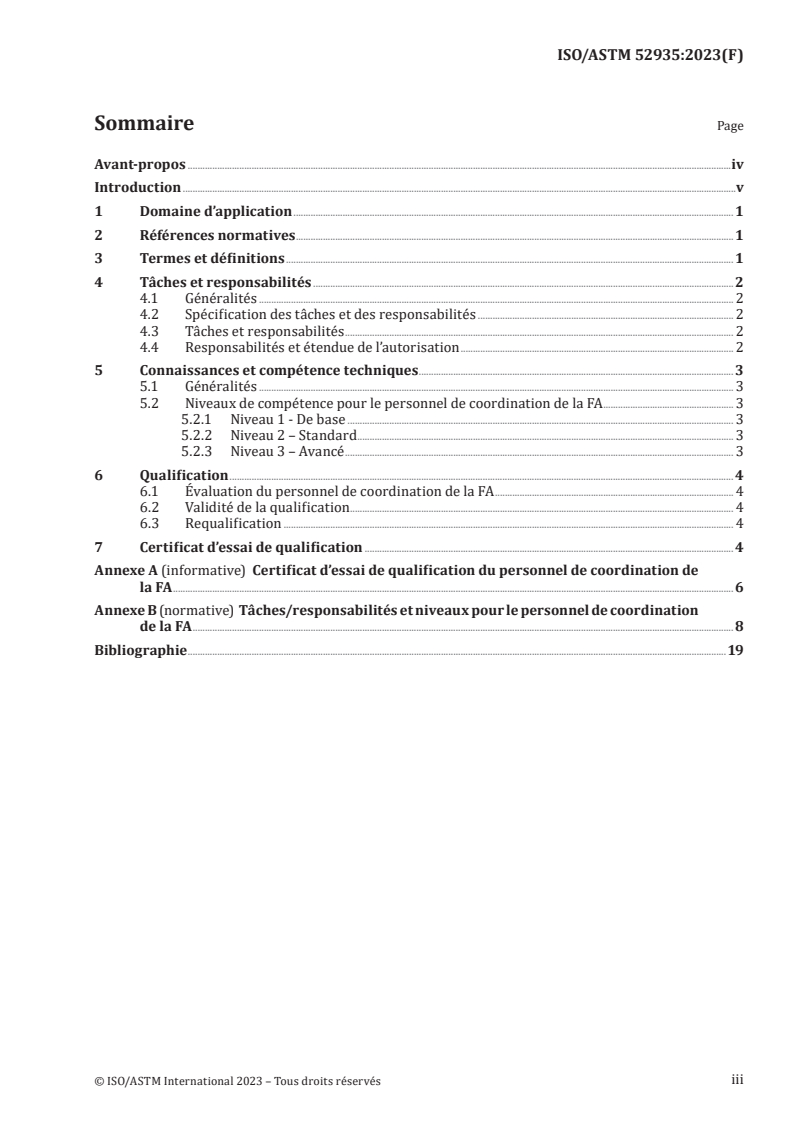
Sommaire Page
Avant-propos .iv
Introduction .v
1 Domaine d’application . 1
2 Références normatives .1
3 Termes et définitions . 1
4 Tâches et responsabilités .2
4.1 Généralités . 2
4.2 Spécification des tâches et des responsabilités . 2
4.3 Tâches et responsabilités . 2
4.4 Responsabilités et étendue de l’autorisation . 2
5 Connaissances et compétence techniques . 3
5.1 Généralités . 3
5.2 Niveaux de compétence pour le personnel de coordination de la FA . 3
5.2.1 Niveau 1 - De base . 3
5.2.2 Niveau 2 – Standard . 3
5.2.3 Niveau 3 – Avancé . 3
6 Qualification . 4
6.1 Évaluation du personnel de coordination de la FA . 4
6.2 Validité de la qualification . 4
6.3 Requalification . 4
7 Certificat d’essai de qualification . 4
Annexe A (informative) Certificat d’essai de qualification du personnel de coordination de
la FA . 6
Annexe B (normative) Tâches/responsabilités et niveaux pour le personnel de coordination
de la FA . 8
Bibliographie .19
iii
© ISO/ASTM International 2023 – Tous droits réservés
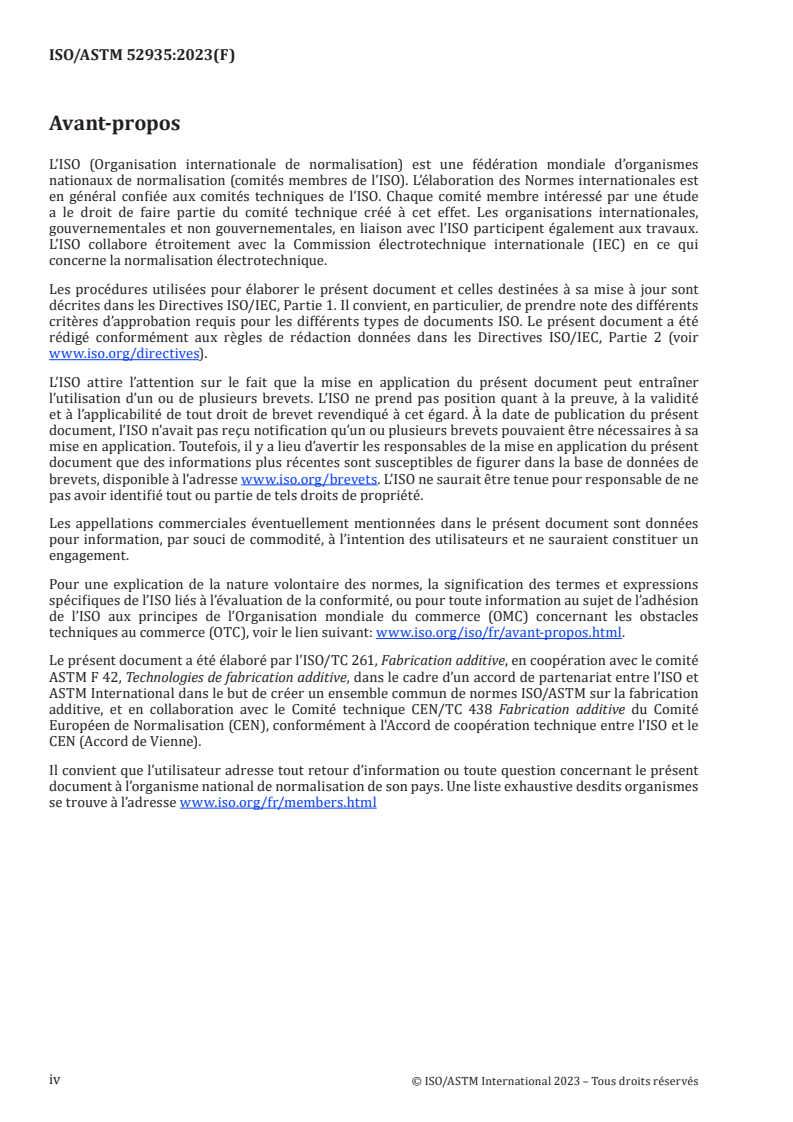
Avant-propos
L’ISO (Organisation internationale de normalisation) est une fédération mondiale d’organismes
nationaux de normalisation (comités membres de l’ISO). L’élaboration des Normes internationales est
en général confiée aux comités techniques de l’ISO. Chaque comité membre intéressé par une étude
a le droit de faire partie du comité technique créé à cet effet. Les organisations internationales,
gouvernementales et non gouvernementales, en liaison avec l’ISO participent également aux travaux.
L’ISO collabore étroitement avec la Commission électrotechnique internationale (IEC) en ce qui
concerne la normalisation électrotechnique.
Les procédures utilisées pour élaborer le présent document et celles destinées à sa mise à jour sont
décrites dans les Directives ISO/IEC, Partie 1. Il convient, en particulier, de prendre note des différents
critères d’approbation requis pour les différents types de documents ISO. Le présent document a été
rédigé conformément aux règles de rédaction données dans les Directives ISO/IEC, Partie 2 (voir
www.iso.org/directives).
L’ISO attire l’attention sur le fait que la mise en application du présent document peut entraîner
l’utilisation d’un ou de plusieurs brevets. L’ISO ne prend pas position quant à la preuve, à la validité
et à l’applicabilité de tout droit de brevet revendiqué à cet égard. À la date de publication du présent
document, l’ISO n'avait pas reçu notification qu’un ou plusieurs brevets pouvaient être nécessaires à sa
mise en application. Toutefois, il y a lieu d’avertir les responsables de la mise en application du présent
document que des informations plus récentes sont susceptibles de figurer dans la base de données de
brevets, disponible à l'adresse www.iso.org/brevets. L’ISO ne saurait être tenue pour responsable de ne
pas avoir identifié tout ou partie de tels droits de propriété.
Les appellations commerciales éventuellement mentionnées dans le présent document sont données
pour information, par souci de commodité, à l’intention des utilisateurs et ne sauraient constituer un
engagement.
Pour une explication de la nature volontaire des normes, la signification des termes et expressions
spécifiques de l’ISO liés à l’évaluation de la conformité, ou pour toute information au sujet de l’adhésion
de l’ISO aux principes de l’Organisation mondiale du commerce (OMC) concernant les obstacles
techniques au commerce (OTC), voir le lien suivant: www.iso.org/iso/fr/avant-propos.html.
Le présent document a été élaboré par l’ISO/TC 261, Fabrication additive, en coopération avec le comité
ASTM F 42, Technologies de fabrication additive, dans le cadre d’un accord de partenariat entre l’ISO et
ASTM International dans le but de créer un ensemble commun de normes ISO/ASTM sur la fabrication
additive, et en collaboration avec le Comité technique CEN/TC 438 Fabrication additive du Comité
Européen de Normalisation (CEN), conformément à l'Accord de coopération technique entre l'ISO et le
CEN (Accord de Vienne).
Il convient que l’utilisateur adresse tout retour d’information ou toute question concernant le présent
document à l’organisme national de normalisation de son pays. Une liste exhaustive desdits organismes
se trouve à l’adresse www.iso.org/fr/members.html
iv
© ISO/ASTM International 2023 – Tous droits réservés
Introduction
Pour de nombreuses sociétés, la fabrication additive (FA) représente une alternative intéressante
aux procédés de fabrication traditionnels. La tendance à produire des composants complexes,
personnalisés ou consolidés, ainsi que les possibilités de délais d’exécution réduits et de production
décentralisée permettent un usage économiquement réalisable dans un nombre croissant de domaines.
Cela s'applique de plus en plus à de nombreuses applications en série, qui ajoutent des exigences
supplémentaires en matière d'efficacité et de cohérence des procédés. En particulier, les composants
utilisés dans les industries réglementées (par exemple, automobile, ferroviaire, aéronautique, usines
de traitement et installations industrielles, médical) sont soumis à des exigences élevées en termes de
qualité et de sécurité.
Lorsque les composants industriels sont produits en utilisant des procédés de fabrication additive, ces
derniers doivent répondre à des exigences de qualité et de sécurité équivalentes à celles des procédés
conventionnels. Pour cela, la chaîne de production et l’environnement sont conçus de sorte que la
qualité du procédé et la qualité du produit obtenu soient toujours cohérentes et reproductibles. Pour
obtenir cette cohérence et cette reproductibilité, il est extrêmement important de s’assurer que la
main-d’œuvre impliquée est qualifiée de manière adéquate pour toutes les étapes de la production.
Le présent document décrit les activités et les responsabilités du personnel responsable de la
coordination dans le domaine de la fabrication additive des pièces métalliques.
v
© ISO/ASTM International 2023 – Tous droits réservés
NORME INTERNATIONALE ISO/ASTM 52935:2023(F)
Fabrication additive des métaux — Principes de
qualification — Qualification du personnel de coordination
1 Domaine d’application
Le présent document spécifie les exigences de qualification du personnel de coordination sur les sites
de fabrication industrielle responsable de la fabrication additive de pièces métalliques.
Le présent document est applicable à tous les procédés métalliques qui sont décrits par l’ISO 17296-2.
Dans ce contexte, les compétences, les tâches et les responsabilités afférentes à différents niveaux de
personnel de coordination de la FA sont habituellement adaptées aux réglementations applicables, selon
le procédé.
Le présent document est destiné à fournir des indications et des exigences pour la qualification du
personnel de coordination dans les applications industrielles générales. Des exigences supplémentaires
sont habituellement nécessaires pour des industries ou des applications spécifiques (par exemple,
aéronautique, médical) ou pour satisfaire aux exigences réglementaires.
2 Références normatives
Les documents suivants sont cités dans le texte de sorte qu’ils constituent, pour tout ou partie de leur
contenu, des exigences du présent document. Pour les références datées, seule l’édition citée s’applique.
Pour les références non datées, la dernière édition du document de référence s’applique (y compris les
éventuels amendements).
ISO/ASTM 52900, Fabrication additive — Principes généraux — Fondamentaux et vocabulaire
ISO/ASTM 52920, Fabrication additive — Principes de qualification — Exigences pour les procédés et les
sites industriels de production en fabrication additive
ISO/ASTM/TS 52930, Fabrication additive — Principes de qualification — Installation, fonctionnement et
performances (IQ/OQ/PQ) de l'équipement de PBF-LB
3 Termes et définitions
Pour les besoins du présent document, les termes et définitions donnés dans l’ISO/ASTM 52900 ainsi
que les suivants, s’appliquent.
L’ISO et l’IEC tiennent à jour des bases de données terminologiques destinées à être utilisées en
normalisation, consultables aux adresses suivantes:
— ISO Online browsing platform: disponible à l’adresse https:// www .iso .org/ obp
— IEC Electropedia: disponible à l’adresse https:// www .electropedia .org/
3.1
personnel de coordination de la FA
coordinateur de FApersonne ou groupe de personnes réalisant des tâches de coordination de FA
définies, désigné(e) par la société comme étant responsable d’un procédé spécifique
Note 1 à l'article: La désignation peut être valable pour un procédé spécifique de FA ou pour plusieurs catégories
de procédés comme spécifié dans l'ISO/ASTM 52900 et illustré dans l’ISO 17296 2.
Note 2 à l'article: Un personnel différent peut être nommé par le fabricant pour différentes tâches liées à la FA.
© ISO/ASTM International 2023 – Tous droits réservés
3.2
examinateur
personne possédant les connaissances et l’expérience pertinentes pour la qualification, et acceptable
pour le client ou l’organisme d’examen ou l’autorité responsable de l’ingénierie
Note 1 à l'article: Dans certains cas, un organisme d’examen indépendant externe peut être requis [ISO/IEC 17024].
4 Tâches et responsabilités
4.1 Généralités
Le personnel de coordination peut avoir de nombreuses tâches et responsabilités pour la fabrication
additive de métaux. Ces tâches et responsabilités peuvent avoir des niveaux variables en fonction des
besoins de la société et de l’éducation et de l’expérience du personnel de coordination. Le personnel de
coordination peut avoir des tâches et des responsabilités correspondant à leur niveau de qualification
ou à un niveau inférieur. La société spécifie si ces tâches, quel que soit le niveau, soient assignées à un
seul membre du personnel ou à plusieurs membres du personnel.
4.2 Spécification des tâches et des responsabilités
Chaque fabricant est responsable de la nomination de son personnel de coordination de la FA et spécifie
leur niveau de responsabilité pour la coordination.
Il convient que les tâches et responsabilités du personnel de coordination de la FA soient sélectionnées à
partir de Annexe B et/ou comme spécifié dans les normes, contrats et règlements applicables. Il convient
que le niveau de compétence du personnel de coordination de la FA soit déterminé en fonction de la
complexité des activités de FA et connexes, du ou des types de produits, de la criticité de l’application et
des exigences de qualité.
Lorsque plusieurs personnes sont chargées de la coordination de la FA, il convient que les tâches et
responsabilités soient clairement attribuées, de sorte que la responsabilité soit clairement spécifiée, et
les personnes sont compétentes pour chaque tâche spécifique de coordination de la FA.
Le fabricant doit nommer au moins une personne comme responsable des tâches de coordination de la
FA.
Si la coordination de la FA est sous-traitée, les tâches et responsabilités doivent être spécifiées et
documentées. Cependant, la conformité au présent document reste de la responsabilité du fabricant.
4.3 Tâches et responsabilités
Les tâches et responsabilités assignées au personnel de coordination de la FA doivent être identifiées
conformément à 4.1, 4.2 et à l’Annexe B et être documentées selon l’Annexe A.
Des personnes autres que le coordinateur de FA peuvent être désignées pour réaliser des tâches
spécifiques en son nom. Les délégations de ce type doivent être documentées.
4.4 Responsabilités et étendue de l’autorisation
Les responsabilités et l’étendue de l’autorisation assignée au personnel de coordination de la FA sont
identifiées comme suit:
— leur position dans l’organisation du fabricant et leur responsabilités;
— l'étendue de l’autorisation qui leur est assignée pour réaliser les tâches assignées (voir l’Annexe B);
— l'étendue de l’autorisation qui leur est assignée pour accepter ou valider, par signature, des documents
administratifs techniques ou des contrats, au nom du fabricant, selon ce qui est nécessaire pour
© ISO/ASTM International 2023 – Tous droits réservés
réaliser les tâches assignées, par exemple, pour la spécification de procédure et les rapports de
supervision.
5 Connaissances et compétence techniques
5.1 Généralités
Tout le personnel de coordination de la FA doit être capable de démontrer
— la compétence pour les tâches liées à la FA qui lui sont assignées, et
— les connaissances techniques dans les technologies de FA pertinentes pour les tâches assignées,
définies dans l’Annexe B, obtenues par combinaison de l’éducation, de la formation et/ou de
l’expérience.
La compétence comprend l’application des normes de FA et connexes lorsque cela est pertinent pour les
tâches assignées.
La compétence doit être documentée dans le certificat d’essai de qualification donné en Annexe A pour
chaque tâche et responsabilité, sur la base suivante:
— le niveau de qualification peut être différent pour différentes catégories;
— la qualification dans chaque catégorie n’est pas requise si elle n’est pas applicable.
NOTE Pour des recommandations concernant les exigences minimales en matière de formation, d'éducation
et d'évaluation, voir Références [6] et [7].
Il convient que le personnel de coordination FA soit alloué à un des niveaux décrits en 5.2, en fonction
de la nature et/ou de la complexité de la production.
5.2 Niveaux de compétence pour le personnel de coordination de la FA
5.2.1 Niveau 1 - De base
Au niveau 1, le personnel de coordination de la FA doit être compétent pour prendre des décisions
concernant le travail de base et superviser les aspects fondamentaux des sujets et activités liés à la
production par FA, appliquer les procédures établies, appliquer des variations dans des limites strictes
et superviser les opérateurs.
5.2.2 Niveau 2 – Standard
Au niveau 2, le personnel de coordination de la FA doit être compétent pour sélectionner et appliquer
les procédures établies et mettre en œuvre des variations en réponse aux exigences techniques ou
économiques, sélectionner et superviser le personnel de FA.
La qualification du niveau 2 doit comprendre les connaissances et compétences du niveau 1.
5.2.3 Niveau 3 – Avancé
Au niveau 3, le personnel de coordination de la FA doit être compétent pour évaluer l’application,
élaborer, spécifier et appliquer des procédures, sélectionner, former et superviser le personnel de FA et
le personnel de coordination et mettre en œuvre la production de FA, pour un procédé spécifique et en
incluant la coordination/supervision de toute la chaîne de fabrication, et les sujets et activités connexes.
La qualification du niveau 3 doit comprendre les connaissances et compétences du niveau 2.
© ISO/ASTM International 2023 – Tous droits réservés
6 Qualification
6.1 Évaluation du personnel de coordination de la FA
L’examen ou l’évaluation doit être réalisé(e) par un personnel possédant le niveau de compétence ou de
responsabilité égal ou supérieur à la personne faisant l’objet de l’évaluation.
La méthode appliquée pour l’évaluation doit être consignée dans un document spécifique et contenir les
critères d’acceptation à appliquer lors de l’examen pour évaluer les aptitudes du candidat par rapport
aux responsabilités et aux performances attendues décrites dans l’Annexe B.
L’examinateur ou l’organisme d’examen doit certifier que le personnel de coordination de la FA a rempli
les critères spécifiés.
En cas de résultat positif, l’examinateur complète l’évaluation du niveau par tâche et responsabilité
dans le certificat d’essai de qualification.
Si le candidat échoue lors de l’essai portant sur les tâches de l’Annexe B de la présente norme, aucun
certificat d’essai de qualification ne doit être émis.
6.2 Validité de la qualification
La qualification reste valable tant que le personnel de coordination de la FA conserve le niveau approprié
de connaissances pertinentes pour les procédés pour lesquels le personnel de coordination de la FA est
qualifié.
La qualification peut être maintenue par révision périodique pour s’assurer que le personnel de
coordination de la FA a toujours le niveau approprié de connaissances.
Lorsque la période de validité n'est pas spécifiée par le fabricant de la pièce, ou par la filière ou
l’application industrielle concernée, une validité maximale de 5 ans depuis la dernière révision doi être
appliquée.
La qualification peut être révoquée, et une requalification exigée, s’il existe des preuves que le personnel
de coordination de la FA n’a pas satisfait aux exigences de leurs qualifications.
La qualification n'est pas transposable à d'autres fabricants.
6.3 Requalification
La méthode appliquée pour la requalification doit être consignée dans un document spécifique et
contenir les critères d’acceptation à appliquer lors de l’examen pour évaluer les aptitudes du candidat
par rapport aux responsabilités et aux performances attendues décrites dans l’Annexe B.
L’évaluation peut être adaptée à l’expérience professionnelle du personnel de coordination de la FA.
Si un candidat souhaite accéder à des niveaux supérieurs à ceux pour lesquels il est qualifié, alors un
nouvel essai doit être réalisé.
Tout élément pratique de l’évaluation peut être entrepris pendant la production.
L’examinateur ou l’organisme d’examen doit certifier que le personnel de coordination de la FA a rempli
les critères spécifiés.
7 Certificat d’essai de qualification
Le certificat doit contenir au minimum ce qui suit:
a) nom;
© ISO/ASTM International 2023 – Tous droits réservés
b) identifiant unique;
c) domaine d’application;
d) récapitulatif des aspects couverts pendant l’évaluation;
e) date de délivrance du certificat;
f) nom et signature de l’examinateur;
g) une référence au présent document et sa date d'édition, c'est-à-dire ISO/ASTM 52935:2023;
h) niveau pour chaque tâche/responsabilité.
Le certificat doit être délivré sous la responsabilité de l’examinateur ou de l’organisme d’examen. Un
format suggéré de certificat est fourni à l’Annexe A.
Le fabricant peut choisir de conserver un enregistrement des qualifications pour le candidat ou
d’émettre un certificat pour le candidat.
© ISO/ASTM International 2023 – Tous droits réservés
Annexe A
(informative)
Certificat d’essai de qualification du personnel de coordination de
la FA
Tableau A.1 — Contenu des certificats d'essai de qualification
Numéro de certificat d’essai de qualification:
Examinateur/organisme ou société d’examen:
Nom, prénom:
Numéro d’employé/identifiant unique:
Catégories de procédés (voir l’ISO 17296-2):
Fabricant/société:
Site du fabricant/de la société:
Date de certification:
Lieu de délivrance:
Date de délivrance:
Date d’expiration:
Signature de l’examinateur/de l’organisme d’examen:
Le Tableau A.2 indique le domaine de qualification du coordinateur de fabrication additive mentionné
ci-dessus, conformément au présent document. Pour chaque qualification, mettre un «X» dans la case
correspondant au niveau approprié. Indiquer N/A si la personne ne possède aucun niveau pour la
catégorie de qualification.
© ISO/ASTM International 2023 – Tous droits réservés
Tableau A.2 — Domaine d'application du personnel de qualification FA
Niveau 1 Niveau 2 Niveau 3
Catégorie de qualification
De base Standard Avancé
Procédé de FA
Utilisation de l’équipement
Paramètres du procédé
Matière première
Disposition de la fabrication
Post-traitement
Traçabilité
Plans d’implantation
...