

ISO/IEC 9075-16:2023
(Main)Information technology — Database languages SQL — Part 16: Property Graph Queries (SQL/PGQ)
General Information
- Abstract
This document defines ways for the SQL language to represent property graphs and to interact with them.
- Status
- Published
- Publication Date
- 31-May-2023
- Technical Committee
- ISO/IEC JTC 1/SC 32 - Data management and interchange
- Drafting Committee
- ISO/IEC JTC 1/SC 32/WG 3 - Database language
- Current Stage
- 9092 - International Standard to be revised
- Start Date
- 22-Jun-2025
- Completion Date
- 03-Oct-2026
Overview
ISO/IEC 9075-16:2023 defines the Property Graph Queries (SQL/PGQ) extension for SQL. Developed by ISO and IEC, this international standard specifies how SQL can represent and interact with property graphs - a critical data structure for modeling complex relationships, widely used in modern database applications. By extending the existing SQL language, this part of the ISO/IEC 9075 series enables standardized querying, definition, and management of property graph data using familiar SQL syntax and concepts.
Property graphs allow storage of vertices (nodes) and edges (relationships), each of which may have labels and key-value properties. With SQL/PGQ, users gain the ability to define, manipulate, and query property graphs directly within the SQL framework, supporting advanced analytics and graph pattern matching in a consistent and interoperable manner.
Key Topics
Property Graph Concepts
- Vertices and edges as fundamental elements
- Labels and properties for both vertices and edges
- Support for directed and undirected edges, multigraphs, and mixed graphs
SQL-Property Graph Integration
- Representation of property graphs using SQL tables
- Schema and data management for property graphs within relational databases
Graph Pattern Matching
- Expression of graph traversal and pattern search
- Match, path, and predicate constructs for analyzing graph data
Security and Access Control
- Privileges specific to property graphs
- Grant/revoke mechanisms for graph data
Schema Definition and Manipulation
- SQL statements for creating, altering, and dropping property graphs and their elements
- Use of vertex and edge tables, label sets, and properties
Information and Definition Schema
- Views and base tables describing the structure and metadata of graphs
Conformance and Optional Features
- Criteria for SQL/PGQ implementation compliance
- Summary of optional features and deprecated functionalities
Applications
SQL/PGQ enables powerful new capabilities for a wide range of industries and use cases, including:
- Social Networks: Efficiently modeling complex user relationships, communities, and social interactions.
- Fraud Detection: Rapid analysis of transaction networks, uncovering hidden connections and patterns of interest.
- Network Analysis: Monitoring data or telecommunications networks for connectivity, influence, and anomaly detection.
- Knowledge Graphs: Integrating business, product, or organizational information in a highly connected fashion.
- Recommendation Engines: Analyzing relationships between users, products, and preferences for personalized suggestions.
SQL/PGQ supports organizations transitioning to graph-based data models, while leveraging existing SQL expertise and infrastructure. By standardizing property graph support in SQL, interoperability across database platforms and applications is greatly enhanced.
Related Standards
ISO/IEC 9075-16:2023 is part of the broader SQL standards family and directly references several related documents, including:
- ISO/IEC 9075-1: SQL/Framework
- ISO/IEC 9075-2: SQL/Foundation
- ISO/IEC 9075-4: SQL/Persistent Stored Modules
- ISO/IEC 9075-11: SQL/Information and Definition Schemas
Together, these standards provide a comprehensive framework for SQL, supporting both traditional relational and modern property graph databases.
Keywords: ISO/IEC 9075-16:2023, SQL/PGQ, SQL property graph queries, property graph standard, property graph SQL, database graph standards, graph pattern matching SQL, property graph schema, SQL graph analytics, database interoperability.
Relations
- Effective Date
- 07-Jan-2026
Get Certified
Connect with accredited certification bodies for this standard

BSI Group
BSI (British Standards Institution) is the business standards company that helps organizations make excellence a habit.

NYCE
Mexican standards and certification body.
Sponsored listings
Frequently Asked Questions
ISO/IEC 9075-16:2023 is a standard published by the International Organization for Standardization (ISO). Its full title is "Information technology — Database languages SQL — Part 16: Property Graph Queries (SQL/PGQ)". This standard covers: This document defines ways for the SQL language to represent property graphs and to interact with them.
This document defines ways for the SQL language to represent property graphs and to interact with them.
ISO/IEC 9075-16:2023 is classified under the following ICS (International Classification for Standards) categories: 35.060 - Languages used in information technology. The ICS classification helps identify the subject area and facilitates finding related standards.
ISO/IEC 9075-16:2023 has the following relationships with other standards: It is inter standard links to ISO/IEC 9075-16:2023/Cor 1:2026. Understanding these relationships helps ensure you are using the most current and applicable version of the standard.
ISO/IEC 9075-16:2023 is available in PDF format for immediate download after purchase. The document can be added to your cart and obtained through the secure checkout process. Digital delivery ensures instant access to the complete standard document.
Standards Content (Sample)
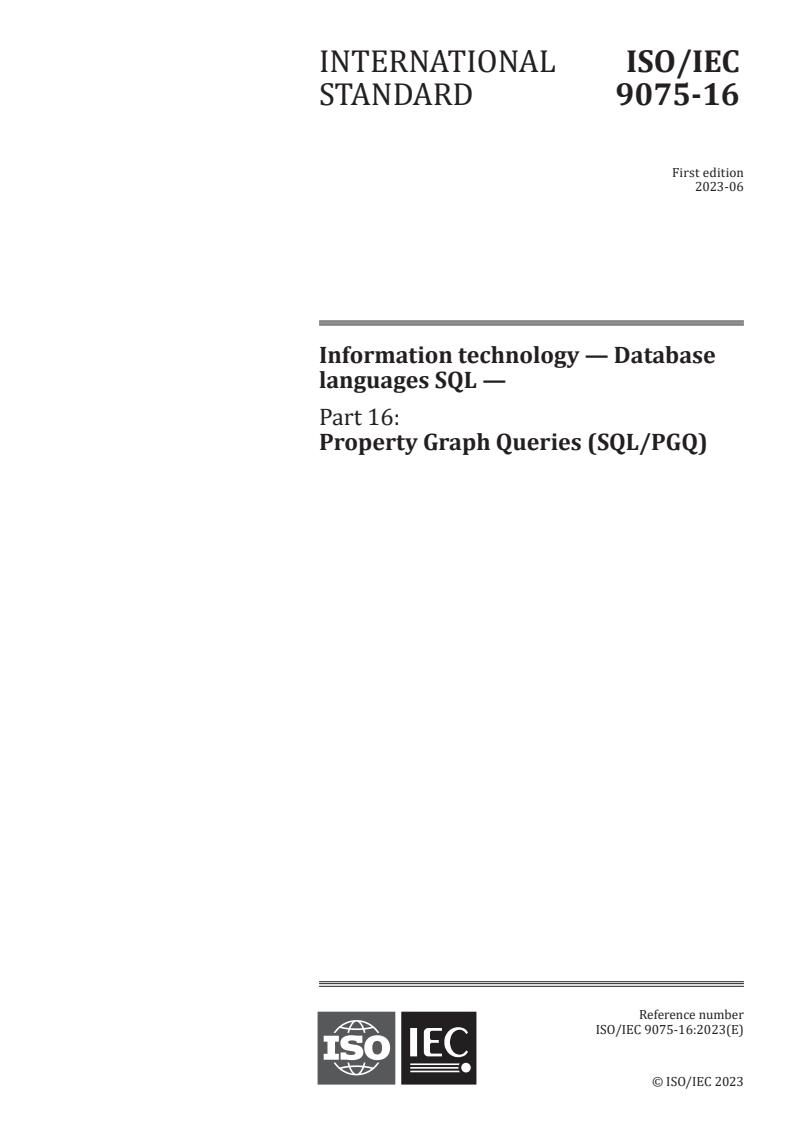
INTERNATIONAL ISO/IEC
STANDARD 9075-16
First edition
2023-06
Information technology — Database
languages SQL —
Part 16:
Property Graph Queries (SQL/PGQ)
Reference number
© ISO/IEC 2023
© ISO/IEC 2023
All rights reserved. Unless otherwise specified, or required in the context of its implementation, no part of this publication may
be reproduced or utilized otherwise in any form or by any means, electronic or mechanical, including photocopying, or posting on
the internet or an intranet, without prior written permission. Permission can be requested from either ISO at the address below
or ISO’s member body in the country of the requester.
ISO copyright office
CP 401 • Ch. de Blandonnet 8
CH-1214 Vernier, Geneva
Phone: +41 22 749 01 11
Email: copyright@iso.org
Website: www.iso.org
Published in Switzerland
ii
© ISO/IEC 2023 – All rights reserved
ISO/IEC9075-16:2023(E)
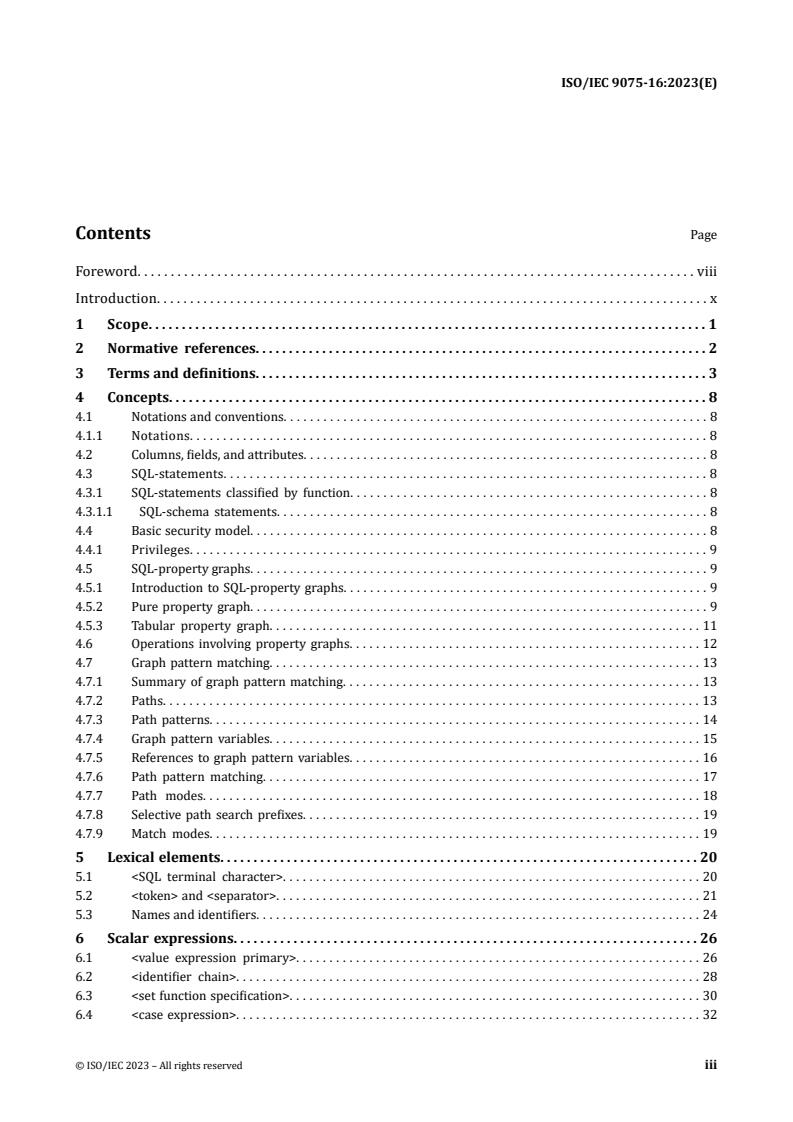
Contents Page
Foreword.viii
Introduction.x
1 Scope.1
2 Normativereferences.2
3 Termsanddefinitions.3
4 Concepts.8
4.1 Notationsandconventions.8
4.1.1 Notations.8
4.2 Columns,fields,andattributes.8
4.3 SQL-statements.8
4.3.1 SQL-statementsclassifiedbyfunction.8
4.3.1.1 SQL-schemastatements.8
4.4 Basicsecuritymodel.8
4.4.1 Privileges.9
4.5 SQL-propertygraphs.9
4.5.1 IntroductiontoSQL-propertygraphs.9
4.5.2 Purepropertygraph.9
4.5.3 Tabularpropertygraph.11
4.6 Operationsinvolvingpropertygraphs.12
4.7 Graphpatternmatching.13
4.7.1 Summaryofgraphpatternmatching.13
4.7.2 Paths.13
4.7.3 Pathpatterns.14
4.7.4 Graphpatternvariables.15
4.7.5 Referencestographpatternvariables.16
4.7.6 Pathpatternmatching.17
4.7.7 Path modes.18
4.7.8 Selectivepathsearchprefixes.19
4.7.9 Matchmodes.19
5 Lexicalelements.20
5.1 .20
5.2 and.21
5.3 Namesandidentifiers.24
6 Scalarexpressions.26
6.1 .26
6.2 .28
6.3 .30
6.4 .32
©ISO/IEC2023–Allrightsreserved iii
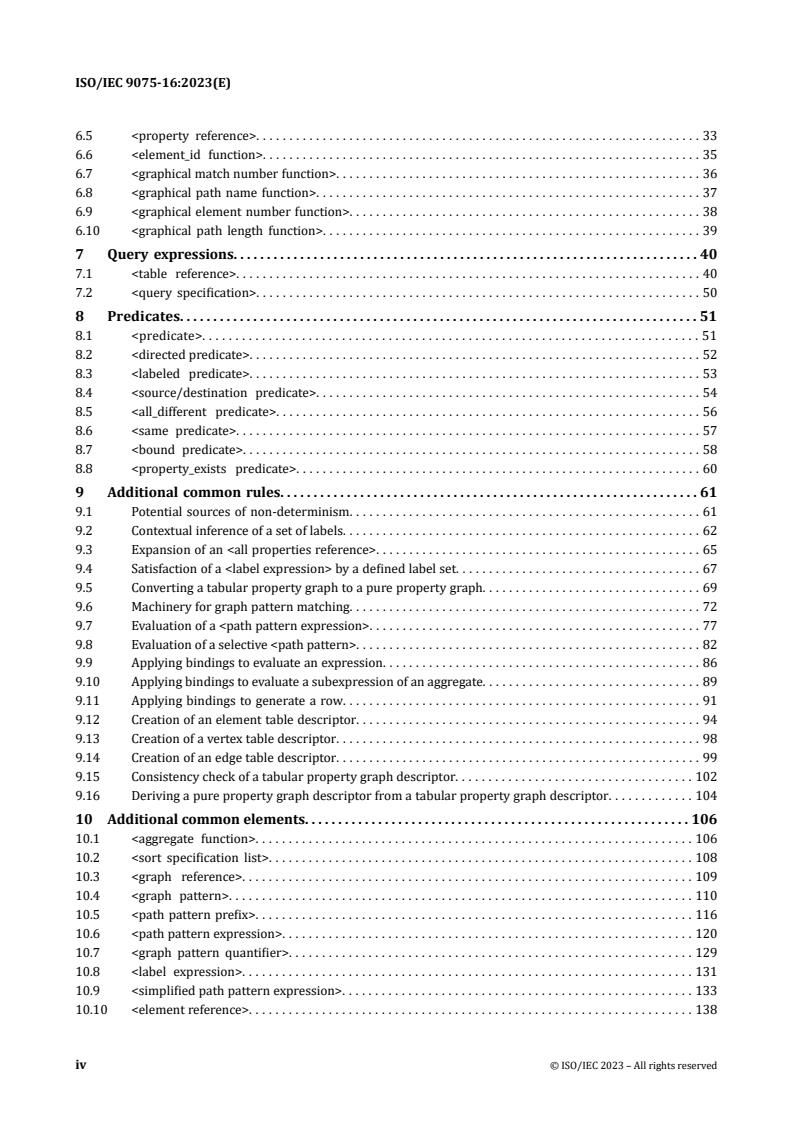
ISO/IEC9075-16:2023(E)
6.5 .33
6.6 .35
6.7 .36
6.8 .37
6.9 .38
6.10 .39
7 Queryexpressions.40
7.1 .40
7.2 .50
8 Predicates.51
8.1 .51
8.2 .52
8.3 .53
8.4
8.5 .56
8.6 .57
8.7 .58
8.8 .60
9 Additionalcommonrules.61
9.1 Potentialsourcesofnon-determinism.61
9.2 Contextualinferenceofasetoflabels.62
9.3 Expansionofan.65
9.4 Satisfactionofabyadefinedlabelset.67
9.5 Convertingatabularpropertygraphtoapurepropertygraph.69
9.6 Machineryforgraphpatternmatching.72
9.7 Evaluationofa.77
9.8 Evaluationofaselective.82
9.9 Applyingbindingstoevaluateanexpression.86
9.10 Applyingbindingstoevaluateasubexpressionofanaggregate.89
9.11 Applyingbindingstogeneratearow.91
9.12 Creationofanelementtabledescriptor.94
9.13 Creationofavertextabledescriptor.98
9.14 Creationofanedgetabledescriptor.99
9.15 Consistencycheckofatabularpropertygraphdescriptor.102
9.16 Derivingapurepropertygraphdescriptorfromatabularpropertygraphdescriptor.104
10 Additionalcommonelements.106
10.1 .106
10.2 .108
10.3 .109
10.4 .110
10.5 .116
10.6 .120
10.7 .129
10.8