

ISO/IEC TR 19583-21:2025
(Main)Information technology — Concepts and usage of metadata — Part 21: 11179-3, -31, -32 Data model in SQL
General Information
- Abstract
This document provides a possible instantiation of the registry metamodel specified in ISO/IEC 11179-3, ISO/IEC 11179-31, ISO/IEC 11179-32 using the SQL database language as specified in ISO/IEC 9075-2.
- Status
- Published
- Publication Date
- 06-Mar-2025
- Technical Committee
- ISO/IEC JTC 1/SC 32 - Data management and interchange
- Drafting Committee
- ISO/IEC JTC 1/SC 32 - Data management and interchange
- Current Stage
- 6060 - International Standard published
- Start Date
- 07-Mar-2025
- Due Date
- 22-Jun-2026
- Completion Date
- 07-Mar-2025

Overview
ISO/IEC TR 19583-21:2025 is a Technical Report that provides a concrete SQL instantiation of the metadata registry metamodel defined in ISO/IEC 11179-3, ISO/IEC 11179-31, and ISO/IEC 11179-32, using the SQL language family specified in ISO/IEC 9075. It complements the UML-based conceptual models by showing how UML class diagrams and metamodel constructs can be translated into SQL schema, constraints and example statements - enabling implementers to deploy a standards‑compliant Metadata Registry (MDR) in a relational database.
Key topics and technical requirements
- Metamodel-to-SQL translation: Principles and conventions for converting UML Class Diagrams into SQL tables, columns and constraints (e.g., classes → tables; attributes → columns; class‑typed attributes → foreign keys).
- Naming and style guidelines: Practical recommendations such as using UPPER CASE for SQL keywords and lower_case (snake_case) for object names to preserve clarity and traceability back to the UML metamodel.
- Handling complex constructs: Approaches for composite datatypes, specialization hierarchies, association classes, cross‑table constraints and datatype mappings that preserve the semantics of ISO/IEC 11179 metamodels.
- Traceability and documentation: Embedding comments and references in SQL to map SQL objects to UML artefacts and metamodel clauses.
- Examples and specimen SQL: Informative annexes with example SQL instantiations - Annex A for ISO/IEC 11179-3, Annex B for ISO/IEC 11179-32, Annex C for ISO/IEC 11179-31 - showing create table statements, keys, foreign keys and constraints.
Practical applications and users
Who benefits:
- Metadata architects and data stewards building a Metadata Registry or data catalog aligned to ISO/IEC 11179.
- Database designers and RDBMS implementers wanting a reference SQL schema for MDR implementation.
- Systems integrators and software vendors implementing interoperable metadata management solutions.
- Standards bodies and data governance teams adopting a standardized representation for data elements, value domains and concept systems.
Practical uses:
- Deploying a standards‑based MDR to support data discovery, reuse and semantic interoperability.
- Implementing registries for data element registration, concept systems/ontologies, value domains and permissible values.
- Translating UML metadata models into executable SQL for testing, prototyping and production deployments.
Related standards
- ISO/IEC 11179 series (parts 3, 30, 31, 32, 33, 34, 35) - metadata registry metamodels
- ISO/IEC 9075 - SQL (database language specification)
- ISO/IEC 19505 - UML standards (class diagram notation)
Keywords: ISO/IEC TR 19583-21:2025, metadata registry, ISO/IEC 11179, SQL data model, UML to SQL, metadata management, concept system registration, data specification registration.
Relations
- Effective Date
- 24-Jun-2023
Get Certified
Connect with accredited certification bodies for this standard

BSI Group
BSI (British Standards Institution) is the business standards company that helps organizations make excellence a habit.

NYCE
Mexican standards and certification body.
Sponsored listings
Frequently Asked Questions
ISO/IEC TR 19583-21:2025 is a technical report published by the International Organization for Standardization (ISO). Its full title is "Information technology — Concepts and usage of metadata — Part 21: 11179-3, -31, -32 Data model in SQL". This standard covers: This document provides a possible instantiation of the registry metamodel specified in ISO/IEC 11179-3, ISO/IEC 11179-31, ISO/IEC 11179-32 using the SQL database language as specified in ISO/IEC 9075-2.
This document provides a possible instantiation of the registry metamodel specified in ISO/IEC 11179-3, ISO/IEC 11179-31, ISO/IEC 11179-32 using the SQL database language as specified in ISO/IEC 9075-2.
ISO/IEC TR 19583-21:2025 is classified under the following ICS (International Classification for Standards) categories: 35.040.50 - Automatic identification and data capture techniques; 35.060 - Languages used in information technology. The ICS classification helps identify the subject area and facilitates finding related standards.
ISO/IEC TR 19583-21:2025 has the following relationships with other standards: It is inter standard links to ISO/IEC TR 19583-21:2022. Understanding these relationships helps ensure you are using the most current and applicable version of the standard.
ISO/IEC TR 19583-21:2025 is available in PDF format for immediate download after purchase. The document can be added to your cart and obtained through the secure checkout process. Digital delivery ensures instant access to the complete standard document.
Standards Content (Sample)
Technical
Report
ISO/IEC TR
19583-21
Second edition
Information technology — Concepts
2025-03
and usage of metadata —
Part 21:
11179-3, -31, -32 Data model in SQL
Technologies de l'information — Concepts et utilisation des
métadonnées —
Partie 21: Modèle de données en SQL 11179-3, -31, -32
Reference number
© ISO/IEC 2025
All rights reserved. Unless otherwise specified, or required in the context of its implementation, no part of this publication may
be reproduced or utilized otherwise in any form or by any means, electronic or mechanical, including photocopying, or posting on
the internet or an intranet, without prior written permission. Permission can be requested from either ISO at the address below
or ISO’s member body in the country of the requester.
ISO copyright office
CP 401 • Ch. de Blandonnet 8
CH-1214 Vernier, Geneva
Phone: +41 22 749 01 11
Email: copyright@iso.org
Website: www.iso.org
Published in Switzerland
© ISO/IEC 2025 – All rights reserved
ii
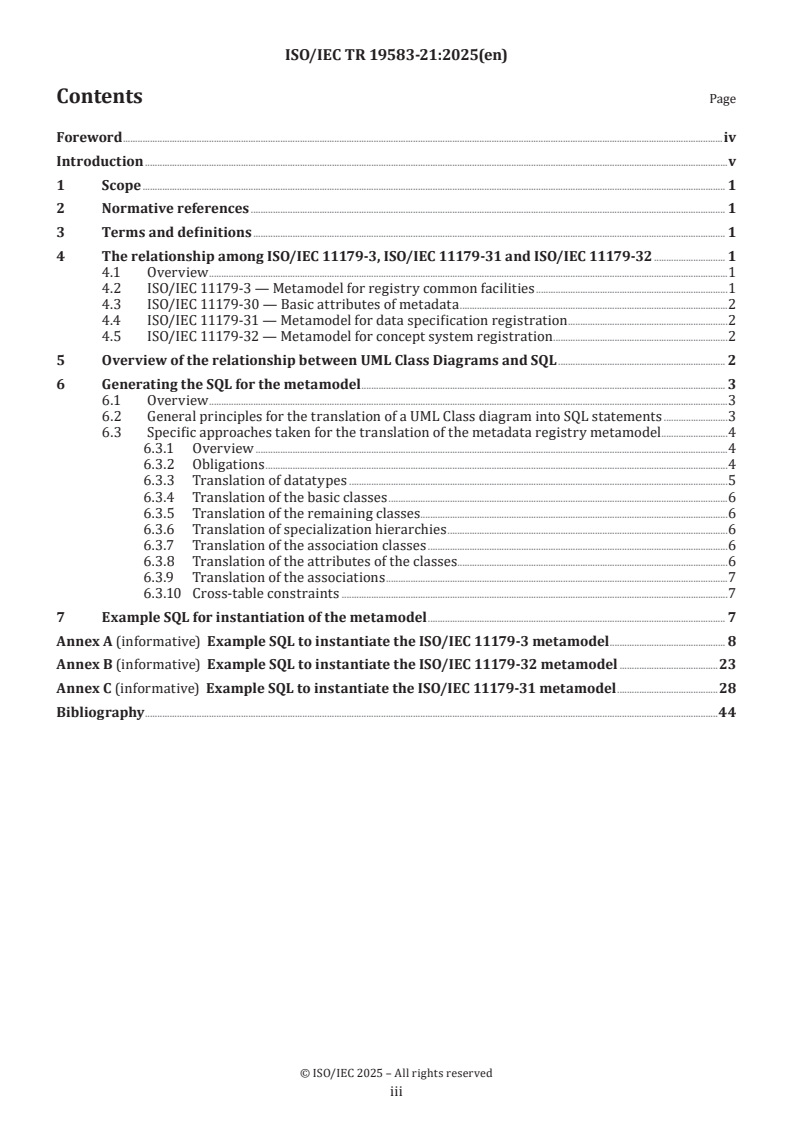
Contents Page
Foreword .iv
Introduction .v
1 Scope . 1
2 Normative references . 1
3 Terms and definitions . 1
4 The relationship among ISO/IEC 11179-3, ISO/IEC 11179-31 and ISO/IEC 11179-32 . 1
4.1 Overview .1
4.2 ISO/IEC 11179-3 — Metamodel for registry common facilities .1
4.3 ISO/IEC 11179-30 — Basic attributes of metadata .2
4.4 ISO/IEC 11179-31 — Metamodel for data specification registration .2
4.5 ISO/IEC 11179-32 — Metamodel for concept system registration .2
5 Overview of the relationship between UML Class Diagrams and SQL . 2
6 Generating the SQL for the metamodel . 3
6.1 Overview .3
6.2 General principles for the translation of a UML Class diagram into SQL statements .3
6.3 Specific approaches taken for the translation of the metadata registry metamodel .4
6.3.1 Overview .4
6.3.2 Obligations .4
6.3.3 Translation of datatypes .5
6.3.4 Translation of the basic classes .6
6.3.5 Translation of the remaining classes . .6
6.3.6 Translation of specialization hierarchies .6
6.3.7 Translation of the association classes .6
6.3.8 Translation of the attributes of the classes.6
6.3.9 Translation of the associations .7
6.3.10 Cross-table constraints .7
7 Example SQL for instantiation of the metamodel . 7
Annex A (informative) Example SQL to instantiate the ISO/IEC 11179-3 metamodel . 8
Annex B (informative) Example SQL to instantiate the ISO/IEC 11179-32 metamodel .23
Annex C (informative) Example SQL to instantiate the ISO/IEC 11179-31 metamodel .28
Bibliography .44
© ISO/IEC 2025 – All rights reserved
iii
Foreword
ISO (the International Organization for Standardization) and IEC (the International Electrotechnical
Commission) form the specialized system for worldwide standardization. National bodies that are
members of ISO or IEC participate in the development of International Standards through technical
committees established by the respective organization to deal with particular fields of technical activity.
ISO and IEC technical committees collaborate in fields of mutual interest. Other international organizations,
governmental and non-governmental, in liaison with ISO and IEC, also take part in the work.
The procedures used to develop this document and those intended for its further maintenance are described
in the ISO/IEC Directives, Part 1. In particular, the different approval criteria needed for the different types
of document should be noted. This document was drafted in accordance with the editorial rules of the ISO/
IEC Directives, Part 2 (see www.iso.org/directives or www.iec.ch/members_experts/refdocs).
ISO and IEC draw attention to the possibility that the implementation of this document may involve the
use of (a) patent(s). ISO and IEC take no position concerning the evidence, validity or applicability of any
claimed patent rights in respect thereof. As of the date of publication of this document, ISO and IEC had not
received notice of (a) patent(s) which may be required to implement this document. However, implementers
are cautioned that this may not represent the latest information, which may be obtained from the patent
database available at www.iso.org/patents and https://patents.iec.ch. ISO and IEC shall not be held
responsible for identifying any or all such patent rights.
Any trade name used in this document is information given for the convenience of users and does not
constitute an endorsement.
For an explanation of the voluntary nature of standards, the meaning of ISO specific terms and expressions
related to conformity assessment, as well as information about ISO's adherence to the World Trade
Organization (WTO) principles in the Technical Barriers to Trade (TBT) see www.iso.org/iso/foreword.html.
In the IEC, see www.iec.ch/understanding-standards.
This document was prepared by Joint Technical Committee ISO/IEC JTC 1, Information technology,
Subcommittee SC 32, Data management and interchange.
This second edition cancels and replaces the first edition (ISO/IEC 19583-21:2022), which has been
technically revised.
The main changes are as follows:
— examples have been added to instatiate the metamodel of the latest version of the ISO/IEC 11179 series
(Annexes B and C have been added).
A list of all parts in the ISO/IEC 19583 series can be found on the ISO and IEC websites.
Any feedback or questions on this document should be directed to the user’s national standards
body. A complete listing of these bodies can be found at www.iso.org/members.html and
www.iec.ch/national-committees.
© ISO/IEC 2025 – All rights reserved
iv
Introduction
[1]
The ISO/IEC 11179 series provides a specification for a registry in which information about metadata can
be recorded and maintained.
The metamodel to instantiate such a registry is expressed in text as a conceptual model. This conceptual
model is illustrated with a series of diagrams which use the class diagram notation from the Unified
[2][3]
Modeling Language (UML).
Implementers and users of the registries described in ISO/IEC 11179 require further guidance to turn the
conceptual models into concrete instantiations. This document provides a possible instantiation of the
[4] [5] [6]
registry metamodel specified in ISO/IEC 11179-3 , ISO/IEC 11179-31 and ISO/IEC 11179-32 using the
[7]
SQL database language as specified in the ISO/IEC 9075 series.
This specimen instantiation is provided to increase the understanding of ISO/IEC 11179-3, ISO/IEC 11179-31
and ISO/IEC 11179-32, and hence, to promote its adoption.
This document is not intended to replace the UML version but rather serves as a complement, providing SQL
statements that describe the ISO/IEC 11179 metamodel. It aims to facilitate the application of ISO/IEC 11179
in a database or related environment.
© ISO/IEC 2025 – All rights reserved
v
Technical Report ISO/IEC TR 19583-21:2025(en)
Information technology — Concepts and usage of metadata —
Part 21:
11179-3, -31, -32 Data model in SQL
1 Scope
This document provides a possible instantiation of the registry metamodel specified in ISO/IEC 11179-3,
ISO/IEC 11179-31, ISO/IEC 11179-32 using the SQL database language as specified in ISO/IEC 9075-2.
2 Normative references
There are no normative references in this document.
3 Terms and definitions
No terms and definitions are listed in this document.
ISO and IEC maintain terminology databases for use in standardization at the following addresses:
— ISO Online browsing platform: available at https:// www .iso .org/ obp
— IEC Electropedia: available at https:// www .electropedia .org/
4 The relationship among ISO/IEC 11179-3, ISO/IEC 11179-31 and ISO/IEC 11179-32
4.1 Overview
The relationships among these parts are mutually dependent, and they collectively form a complete metadata
registry system. ISO/IEC 11179-3 provides infrastructure support for the entire registry. ISO/IEC 11179-31
and ISO/IEC 11179-32 extend the functionality of the metadata registry by registering data specifications
and concept systems, further enriching the metadata information stored in the registry. These parts
work together to enable the metadata registry to effectively support data management and the discovery,
understanding, and utilization of data assets.
4.2 ISO/IEC 11179-3 — Metamodel for registry common facilities
ISO/IEC 11179-3 specifies the core metamodel for a Metadata Registry (MDR), but it does so in a generic
way, so that the resulting registry could be used to register anything, not just metadata.
The registry metamodel is not a complete description of all the metadata an organization might wish to
record. Therefore, the model is designed to be extended if required. However, extensions are, by their nature,
not part of ISO/IEC 11179-3.
Some extensions to the ISO/IEC 11179-3 metamodel are specified in other parts of ISO/IEC 11179, such as:
— ISO/IEC 11179-31: Metamodel for data specification registration;
— ISO/IEC 11179-32: Metamodel for concept system registration;
— ISO/IEC 11179-33: Metamodel for data set registration;
© ISO/IEC 2025 – All rights reserved
— ISO/IEC 11179-34: Metamodel for computable object registration;
— ISO/IEC 11179-35: Metamodel for model registration.
4.3 ISO/IEC 11179-30 — Basic attributes of metadata
[8]
ISO/IEC 11179-30 describes basic attributes for data elements and related metadata for use in contexts
where a full metadata registry is not appropriate, such as standards documents. It is limited to a set of basic
attributes for: data elements, data element concepts, value domains, conceptual domains and other related
classes.
4.4 ISO/IEC 11179-31 — Metamodel for data specification registration
ISO/IEC 11179-31 provides a specification for an extension to a Metadata Registry (MDR), as specified in
ISO/IEC 11179-3, in which metadata that describe data elements and associated concepts, such as data
element concepts, conceptual domains and value domains can be registered.
The specification in ISO/IEC 11179-31, together with the relevant clauses of the specification in
ISO/IEC 11179-3, provides the ability to record metadata about:
— data elements, units of measure and derivation rules;
— data element concepts and associated object classes and properties;
— conceptual domains and value meanings;
— value domains, value domain subsets and permissible values.
ISO/IEC 11179-31 is applicable to the formulation of data representations, concepts, meanings and
relationships to be shared among people and machines, independent of the organization that produces the
data. It is not applicable to the physical representation of data as bits and bytes at the machine level.
4.5 ISO/IEC 11179-32 — Metamodel for concept system registration
ISO/IEC 11179-32 provides a specification for an extension to a Metadata Registry (MDR), as specified in
ISO/IEC 11179-3, in which metadata that describe concept systems can be registered.
The specification in ISO/IEC 11179-32, together with the relevant clauses of the specification in
ISO/IEC 11179-3, provides the ability to record the following metadata:
— concept systems and associated concepts;
— relations among concepts in a concept system;
— assertions about concepts in a concept system.
The metamodel in ISO/IEC 11179-32 is intended to support the full description of a concept system, including
ontologies.
5 Overview of the relationship between UML Class Diagrams and SQL
The Unified Modeling Language (UML) provides a family of graphical notations that can be used in the
analysis and design of software systems. The UML is under the control of the Object Management Group
(OMG) and, as such, it is (a) a relatively ‘open’ standard, and (b) firmly rooted in the object-oriented paradigm
for software engineering. The UML is now at Version 2 and is the subject of two international standards:
ISO/IEC 19505-1 and ISO/IEC 19505-2.
Within the UML, the Class Diagram notation is used to represent information (and, hence, data) requirements
for a particular ‘universe of discourse’, a business area or the scope of a proposed information system.
A UML Object is often defined as a:
© ISO/IEC 2025 – All rights reserved
construct within a system for which a set of attributes and operations can be specified.
Whilst this is a reasonable definition within the context of object-oriented system development, a more
appropriate definition of an Object for the purposes of this document is a:
representation of something of interest within the universe of discourse about which information needs to be
recorded.
An Object Class in both contexts can then defined as a:
definition of a set of Objects that share the same attributes, associations, and operations.
NOTE Although UML Class diagrams allow the specification of operations on the classes, the ISO/IEC 11179 series
data models do not specify operations on their classes, so this document does not specify any operations either.
The Database Language SQL is a, largely, declarative language used to manage structured data held in a
database under the control of a Relational Database Management System (RDBMS). As such, it was originally
[9]
based on Edgar F. Codd’s relational model of data published in 1970, but its scope has grown over the
years. SQL is the subject of the ISO/IEC 9075 series. Most commercial SQL products, however, deviate from
the standards to some extent, some more than others.
6 Generating the SQL for the metamodel
6.1 Overview
The UML (and the Class Diagrams, in particular) and the SQL database language exist in two separate
programming paradigms and there is, therefore, no direct translation from one (the UML) to the other (SQL).
There are, however, approaches that can be taken to achieve a translation. This document uses one of those
approaches to generate a set of SQL statements to instantiate the metadata registry metamodel, where the
SQL statements enable easy reference back to the original UML Class Diagram and text of the metamodel.
This is achieved by using names for the SQL objects that reflect the names of the UML artefacts and, also, by
embedding comments referencing the metamodel within the SQL statements.
6.2 General principles for the translation of a UML Class diagram into SQL statements
It is good practice to distinguish between SQL keywords and the names given to the SQL objects. One
convention is to use UPPER CASE for the keywords and lower_case (using snake case) for the object names.
Each UML class is represented by an SQL table. To make correlation to the model easier, the name of a table
that represents a class is the same as that of the class.
Each composite datatype is also represented by an SQL table. To make correlation to the model easier, the
name of the table is the same as that of the datatype.
Each single-valued attribute of a class or a composite datatype is represented by a column in the appropriate
table. The name of this column is the same as that of the attribute in the class or datatype. The datatype of
an attribute column is intuitively selected to be similar to that of the datatype of the attribute.
If the datatype of an attribute of a class is another class or a composite datatype, the column that represents
that attribute is additionally declared as a foreign key column referencing the relevant table that represents
the class or composite datatype.In this case, the column name is suffixed with “_id” to reflect the fact that it
contains a reference to the data, not the data itself.
Where an attribute is multivalued (that is, it has a multiplicity of [0.*] or [1.*] in the UML diagram) there are
two possible instantiations available. These are the following.
a) Use one of the collection types, MULTISET or ARRAY, available in SQL.
b) Create a new table, a characteristic table, to hold the multiple values, with each row in the table having a
foreign key referencing the kernel (prime) table and one of the values.
© ISO/IEC 2025 – All rights reserved
In object-orientation, and, hence, UML, there is no equivalent of the SQL primary key, so each table that
represents a class or a composite datatype has an additional column that is used as a surrogate identifier.
This column then becomes the primary key for the table.
UNIQUE or CHECK constraints may be added to a table where required. The latter are used, for example,
to control the valid values for a column or to control which columns should, or should not, take values in
different circumstances.
Specialization hierarchies (superclasses and their subclasses) can be instantiated in one of two ways using
SQL structures.
1) It is possible to integrate all the classes (the superclass and its subclasses) into one table, named
after the superclass, which includes a column for each attribute of the superclass, with those columns
representing mandatory attributes being declared NOT NULL, and columns for each of the attributes of
the subclasses. None of these subclass columns are declared as NOT NULL, irrespective of whether they
are mandatory or optional within their subclass. An additional column, often called a discriminator
column, with possible values representing each of the subclasses and a CHECK constraint are provided
to manage which columns are populated for each subclass. Where a subclass is related to another class
via a one-to-many association, such that there is a foreign key in the table representing the other class, a
cross-table constraint is needed to ensure that a row in the other table will only exist if the value of the
discriminator column represents the relevant subclass in the inheritance relationship.
2) Another possibility is the creation of a separate table for the superclass and the creation of additional
tables for each of the subclasses. When the hierarchy is complete, disjoint and static (the normal situation
in most models), a fully mandatory ‘one-to-one’ relationship is provided between the table representing
the superclass and each table representing the subclasses. To achieve this, a subclass type column is
added, which has a fixed value in each subclass type, but the value of which in the superclass is set to
match the corresponding subclass. Although this column does not form part of the primary key of either
the superclass or subclass tables, it is appended to the primary key in the referential constraints that
enforce the subclassing. This ensures that for each row in the superclass table there is a corresponding
row in one of the subclass tables, and that there is no duplication of primary key values across the tables
representing the subclasses.
There are a number of different approaches that can be used when translating UML Class Diagram
associations into SQL. Since each association in the metadata registry metamodel is named, the approach
used in this document is to create a table for each association, with the table named with the name of the
association.
Some many-to-many associations are annotated with association classes. These association classes also
become tables.
Since the ISO/IEC 11179 metamodel does not specify operations on the UML classes, this document does not
specify how operations can be specified in SQL.
6.3 Specific approaches taken for the translation of the metadata registry metamodel
6.3.1 Overview
The following subclauses provide specific detail about the translation of the metamodel artefacts, where the
information in 6.2 is either not applicable or insufficient.
6.3.2 Obligations
In the metamodel the obligations applicable to each attribute or association are described as one of
“Mandatory”, “Conditional” or “Optional”, with these obligations being enforced if, and only if, the
Registration Status of the associated metadata item is Recorded or higher, that is, if the Registration Status of
the associated item is one of “Recorded”, “Qualified”, “Standard” or “Preferred Standard”. The obligations are
not enforced if the Registration Status of the associated item is one of “Candidate”, “Incomplete”, “Retired”
and “Superseded”.
© ISO/IEC 2025 – All rights reserved
Any registry instantiation has to be able to register items with a lower Registration Status than “Recorded”,
and the obligations cannot, therefore, be simply enforced.
The example SQL instantiation allows the attributes and associations to be optional so that items with a
Registration Status lower than “Recorded” can be accommodated. The obligations applicable to items with a
Registration Status of “Recorded” or higher will, therefore, need to be enforced in the registry application as
opposed to the register (the database) itself.
6.3.3 Translation of datatypes
The datatypes used in the metamodel can be considered to be ‘primitive’ or more complex.
The primitive datatypes are translated as described in Table 1.
Table 1 — Translation of the primitive datatypes
Metadata registry
Examples or Comment SQL Datatype
metamodel datatype
Boolean This simply translates as a column of type BOOLEAN
Date This simply translates as a column of type DATE
Datetime This simply translates as a column of type TIMESTAMP
Integer This simply translates as a column of type INTEGER
XCL Common Logic,
Notation This translates as a column of type CHARACTER VARYING (2500)
OWL-DL XML
This translates as a column of type CHARACTER VARYING
This could be a bit string,
(2500).
Sign but, at a minimum, String
If the SQL implementation supports the BINARY LARGE OBJECT
must be supported.
type, this could be used instead.
String This translates as a column of type CHARACTER VARYING (255)
This translates as a column of type CHARACTER VARYING
(2500).
Text
If the SQL implementation supports the CHARACTER LARGE
OBJECT type, this could be used instead.
The more complex datatypes are translated as described in Table 2.
Table 2 — Translation of the more complex datatypes
Metadata registry
Examples or Comment SQL Datatype
metamodel datatype
This is instantiated with three columns, one INTEGER column for
the lower bound, one INTEGER column for the fixed upper bound,
Natural_Range 0, 1, 2, 1.2, 2.8, 0.*, 3.* and a CHARACTER column, defaulting to ‘many’, for the many
upper bound. The columns are then managed with a CHECK
constraint.
This represents a value This is instantiated using many different columns, one, or more,
Value of any of the types listed for each of the datatypes listed and then a CHECK constraint im-
above plemented to ensure that only one datatype is represented.
A table is created (named cdt_phone_number) with columns as
[10]
specified in ISO/IEC 19773 ; the table has a surrogate primary
Phone_Number key of datatype INTEGER. Tables representing classes that have
attributes specified with this datatype have foreign keys that
reference cdt_phone_number.
A table is created (named cdt_postal_address) with columns as
[10]
specified in ISO/IEC 19773 ; the table has a surrogate primary
Postal_Address key of datatype INTEGER. Tables representing classes that have
attributes specified with this datatype have foreign keys that
reference cdt_postal_address.
© ISO/IEC 2025 – All rights reserved
6.3.4 Translation of the basic classes
Each basic class in the metamodel is represented by a table, with the name prefixed by cls_. Each table
representing a basic class has a surrogate primary key of type INTEGER.
6.3.5 Translation of the remaining classes
Each of the remaining classes in the metamodel is represented by a table, with the name prefixed by cls_.
Each table representing a class has a surrogate primary key of type INTEGER.
6.3.6 Translation of specialization hierarchies
Each superclass and its subclasses are represented by separate tables. Those tables that represent subclasses
inherit the surrogate primary key of the superclass, either as the primary key or as an additional column,
with that inherited primary key also being declared as a foreign key. Keys and constraints are normally
included when the tables are created.
6.3.7 Translation of the association classes
Each association class in the metamodel is represented by a table, with the name prefixed by asscls_. Each
table representing an association class has a surrogate primary key of type INTEGER, a column, or columns
representing the attributes of the association class, and two additional columns: one each for the roles of the
association class, both of which have datatype INTEGER and are specified as foreign keys referencing the
tables representing the relevant classes.
6.3.8 Translation of the attributes of the classes
Where the metamodel datatype of the attribute is listed in the first column of Table 1, the attribute is
translated as a single column of the relevant table representing the parent class, with a datatype as specified
in the third column of Table 1.
Where the metamodel datatype of the attribute is listed in the first column of Table 2, the attribute is
instantiated as specified in the third column of Table 2.
Where the attribute is a multivalued attribute, there are three options available.
— Where the metamodel datatype is specified in Table 1 and the values are unordered, a separate
characteristic table, prefixed mva_, is created with a column for the multivalued attribute specified with
the SQL datatype identified in Table 1. The second column in Table 1 is a foreign key column referencing
the table representing the class that specifies the attribute. Both columns are declared as the primary
key. If the SQL implementation supports the MULTISET collection type, this can be used instead of
creating the characteristic table.
— Where the datatype is specified in Table 1 and the values are specified as being ordered, or it makes
sense to order them, a separate characteristic table, prefixed mva_, is created with a column for the
multivalued attribute specified with the SQL datatype identified in Table 1. The second column in Table 1
is a column of datatype INTEGER named ‘priority’ to indicate the order of the value. The third column in
this table is a foreign key column referencing the table representing the class that specifies the attribute.
All three columns are declared as the primary key. If the SQL implementation supports the ARRAY
collection type, this could be used instead of creating the characteristic table.
— Where the datatype is specified in Table 2, a separate characteristic table, prefixed mva_, is created
with a column for the multivalued attribute specified with the datatype INTEGER and as a foreign key
referencing the table representing the complex datatype. The second column in this table is a foreign
key column referencing the table representing the class that specifies the attribute. Both columns are
declared as the primary key.
Where the datatype of the attribute is specified as another class specified in the metamodel, the attribute
is instantiated as a column specified with the datatype INTEGER and as a foreign key referencing the table
representing the class that is specified as the datatype in the metamodel. Where feasible, this column is
© ISO/IEC 2025 – All rights reserved
included in the CREATE TABLE statement. If this is not feasible, later ALTER TABLE statements are used to
add the column and the foreign key.
6.3.9 Translation of the associations
Each association is one of three basic types, as follows:
— A zero or one-to-many association: In this case, a column is included in the table representing the class
at the ‘many’ end of the association, with a referential constraint to the table representing the class at
the other end of the association. The referential constraint is named with the name of the association
prefixed by ass_.
— A many-to-many association: In this case, a separate association table is created, named with the name
of the association prefixed by ass_, with two columns: one each for the roles of the association, both of
which have datatype INTEGER and are specified as foreign keys referencing the tables representing the
relevant classes. Both columns are declared as the primary key of the association table.
— A one-to-one association: In this case, a separate association table is created as for the many-to-many
association, but, in addition, each column is declared with a UNIQUE constraint to enforce the one-to-
oneness.
6.3.10 Cross-table constraints
Because obligations specified in the metamodel are only applicable if, and only if, the Registration Status
of the associated metadata item is Recorded or higher, very few of the constraints needed to enforce the
obligations are included in the example SQL.
No cross-table constraints are specified in this document.
7 Example SQL for instantiation of the metamodel
The complete set of SQL statements needed to provide this example SQL instantiation is contained in
Annexes A, B and C.
The statements are provided in the following order.
a) CREATE TABLE statements to create the tables to represent the two complex datatypes, the Phone_
Number class and the Postal_Address class.
b) CREATE TABLE statements to create the tables to represent the basic classes, with additional
characteristic tables to represent multi-valued attributes where needed.
c) CREATE TABLE statements to create the tables to represent the remaining classes. These tables are
created grouped by the metamodel regions of the ISO/IEC 11179 part from which they are sourced.
Additional characteristic tables are created to represent multi-valued attributes where needed.
d) CREATE TABLE statements to create the tables to represent the association classes. These tables
are specified following the class tables within each metamodel region grouping, and are specified in
alphabetical order within each group. Additional characteristic tables are created to represent multi-
valued attributes where needed.
e) CREATE TABLE statements to create the tables to represent the metamodel associations.
This set of SQL statements does not provide the most optimal instantiation of a database for a metadata
registry, but it does provide an instantiation that can easily be traced back to the metamodel.
© ISO/IEC 2025 – All rights reserved
Annex A
(informative)
Example SQL to instantiate the ISO/IEC 11179-3 metamodel
A.1 Predefined types metamodel
/* ------------------------------------------------------------------------- */
/* create tables for predefined types */
/* ------------------------------------------------------------------------- */
CREATE TABLE cdt_phone_number
(
/* surrogate primary key */
phone_number_id INTEGER PRIMARY KEY ,
/* columns to represent attributes */
international_numbering_plan_prefix CHARACTER VARYING(255) ,
country_code CHARACTER VARYING(255) ,
city_code CHARACTER VARYING(255) ,
local_number CHARACTER VARYING(255) NOT NULL ,
extension CHARACTER VARYING(255)
);
CREATE TABLE cdt_postal_address
(
/* surrogate primary key */
postal_address_id INTEGER PRIMARY KEY ,
/* columns to represent attributes */
sub_building_name CHARACTER VARYING(255) ,
building_name CHARACTER VARYING(255) ,
throughfare CHARACTER VARYING(255) ,
dependent_locality CHARACTER VARYING(255) ,
post_town CHARACTER VARYING(255) ,
region CHARACTER VARYING(255) ,
postcode CHARACTER VARYING(255) ,
country CHARACTER VARYING(255)
);
A.2 Basic classes metamodel
/* ------------------------------------------------------------------------- */
/* create tables for basic classes */
/* ------------------------------------------------------------------------- */
CREATE TABLE cls_individual
(
/* surrogate primary key */
individual_id INTEGER PRIMARY KEY ,
/* columns to represent attributes */
name CHARACTER VARYING(255) NOT NULL ,
"title" CHARACTER VARYING(255) ,
mail_address_id INTEGER
REFERENCES cdt_postal_address (postal_address_id)
/* the multi-valued attributes email_address and phone_number */
/* instantiated as the characteristic tables mva_individual_email_addresses */
/* and mva_individual_phone_numbers */
);
CREATE TABLE mva_individual_email_addresses
(
/* column to represent multi-valued attribute */
email_address CHARACTER VARYING(255) ,
/* identification of the individual this email address belongs to */
owning_individual_id INTEGER
REFERENCES cls_individual (individual_id) ,
© ISO/IEC 2025 – All rights reserved
PRIMARY KEY (email_address, owning_individual_id)
);
CREATE TABLE mva_individual_phone_numbers
(
/* column to represent multi-valued attribute */
phone_number_id INTEGER
REFERENCES cdt_phone_number (phone_number_id) ,
/* identification of the individual this phone number belongs to */
owning_individual_id INTEGER
REFERENCES cls_individual (individual_id) ,
PRIMARY KEY (phone_number_id, owning_individual_id)
);
CREATE TABLE cls_organization
(
/* surrogate primary key */
organization_id INTEGER PRIMARY KEY ,
/* columns to represent attributes */
mail_address_id INTEGER
REFERENCES cdt_postal_address (postal_address_id) ,
web_address CHARACTER VARYING(255)
/* the multi-valued attributes name, email_address and phone_number are */
/* instantiated as the characteristic tables mva_organization_names, */
/* mva_organization_email_addresses and mva_organization_phone_numbers */
);
CREATE TABLE mva_organization_names
(
/* column to represent multi-valued attribute */
name CHARACTER VARYING(2500) ,
/* identification of the organization this name belongs to */
owning_organization_id INTEGER
REFERENCES cls_organization (organization_id) ,
PRIMARY KEY (name, owning_organization_id)
);
CREATE TABLE mva_organization_email_addresses
(
/* column to represent multi-valued attribute */
email_address CHARACTER VARYING(255) ,
/* identification of the organization this email address belongs to */
owning_organization_id INTEGER
REFERENCES cls_organization (organization_id) ,
PRIMARY KEY (email_address, owning_organization_id)
);
CREATE TABLE mva_organization_phone_numbers
(
/* column to represent multi-valued attribute */
phone_number_id INTEGER
REFERENCES cdt_phone_number (phone_number_id) ,
/* identification of the organization this phone number belongs to */
owning_organization_id INTEGER
REFERENCES cls_organization (organization_id) ,
PRIMARY KEY (phone_number_id, owning_organization_id)
);
CREATE TABLE cls_role
(
/* surrogate primary key */
role_id INTEGER PRIMARY KEY ,
/* columns to represent attributes */
role_name CHARACTER VARYING(255) ,
mail_address_id INTEGER
REFERENCES cdt_postal_address (postal_address_id)
/* the multi-valued attributes email_address and phone_number are */
/* instantiated as the characteristic tables mva_role_email_addresses */
/* and mva_role_phone_numbers */
);
CREATE TABLE mva_role_email_addresses
© ISO/IEC 2025 – All rights reserved
(
/* column to represent multi-valued attribute */
email_address CHARACTER VARYING(255) ,
/* identification of the role this email address belongs to */
owning_role_id INTEGER
REFERENCES cls_role (role_id) ,
PRIMARY KEY (email_address, owning_role_id)
);
CREATE TABLE mva_role_phone_numbers
(
/* column to represent multi-valued attribute */
phone_number_id INTEGER
REFERENCES cdt_phone_number (phone_number_id) ,
/* identification of the role this phone number belongs to */
owning_role_id INTEGER
REFERENCES cls_role (role_id) ,
PRIMARY KEY (phone_number_id, owning_role_id)
);
CREATE TABLE cls_contact
(
/* surrogate primary key */
contact_id INTEGER PRIMARY KEY ,
/* columns to represent attributes */
organization_id INTEGER NOT NULL
REFERENCES cls_organization (organization_id) ,
individual_id INTEGER
REFERENCES cls_individual (individual_id) ,
role_id INTEGER
REFERENCES cls_role (role_id) ,
/* constraint to check that individual_id and role_id attributes */
CONSTRAINT contact_constraint
CHECK
( ( individual_id IS NOT NULL ) OR ( role_id IS NOT NULL ) )
);
CREATE TABLE cls_document_type
(
/* surrogate primary key */
document_type_id INTEGER PRIMARY KEY ,
/* columns to represent attributes */
identifier CHARACTER VARYING(255) ,
description CHARACTER VARYING(2500) ,
scheme_reference CHARACTER VARYING(2500) ,
/* constraint to check identified and described attributes */
CONSTRAINT document_type_constraint1
CHECK
( ( identifier IS NOT NULL ) OR ( description IS NOT NULL ) ) ,
/* constraint to check identifier and scheme_reference attributes */
CONSTRAINT document_type_constraint2
CHECK
( ( ( identifier IS NOT NULL ) AND ( scheme_reference IS NOT NULL ) )
OR ( ( identifier IS NULL ) AND ( scheme_reference IS NULL ) ) )
);
CREATE TABLE cls_language_identification
(
/* surrogate primary key */
language_identification_id INTEGER PRIMARY KEY ,
/* columns to represent attributes */
language_identifier CHARACTER VARYING(255) NOT NULL ,
script_identifier CHARACTER VARYING(255) ,
geopolitical_territory_identifier CHARACTER VARYING(255) ,
private_use_qualifier CHARACTER VARYING(255)
/* the multi-valued attributes variant_identifiers and extension_identifiers */
/* are instantiated as the characteristic tables */
/* mva_language_identification_variant_identifiers and */
/* mva_language_i
...