

ISO/TR 19915:2023
(Main)Clean cookstoves and clean cooking solutions — Guidelines for social impact assessment
General Information
- Abstract
This document provides a guidance to evaluate and assess the social impact of improved cooking energy systems. This document is an informative document, which provides orientation in terms of: — considerations for stakeholders involved in the cooking sector; — background information regarding various social impacts resulting from cooking systems; — example results chains illustrating the simplified and aspirational causal linkages related to energy transitions; and — descriptive tools and methods to measure direct and indirect social impacts. The target group for this document is any stakeholder interested in evaluating the impacts of improved cooking, such as: researchers, development organisations, non-governmental organisations, government bodies private sector companies, and donor or investors.
- Status
- Published
- Publication Date
- 28-Nov-2023
- Technical Committee
- ISO/TC 285 - Clean cookstoves and clean cooking solutions
- Drafting Committee
- ISO/TC 285/WG 4 - Social impacts
- Current Stage
- 6060 - International Standard published
- Start Date
- 29-Nov-2023
- Due Date
- 19-Mar-2023
- Completion Date
- 29-Nov-2023

Overview
ISO/TR 19915:2023 - "Clean cookstoves and clean cooking solutions - Guidelines for social impact assessment" is an informative ISO technical report that provides guidance to evaluate the social impacts of improved cooking energy systems. It explains concepts, definitions (e.g., cooking system, baseline, DALY), result chains, and practical tools and metrics to measure direct and indirect social outcomes arising from adoption and sustained use of improved cookstoves and clean cooking solutions.
Keywords: ISO/TR 19915:2023, clean cookstoves, social impact assessment, improved cooking energy systems, clean cooking solutions.
Key Topics
This document focuses on measuring and interpreting social impacts associated with clean cooking, including:
- Impact categories
- Gender impacts and empowerment
- Socioeconomic impacts (household finance, employment, entrepreneurship)
- Time use and perceived well‑being
- Health impacts (accidents, burns, poisoning, exposure to emissions)
- Environmental and food‑security linkages (descriptive)
- Measurement and metrics
- Guidance on baseline definition and data collection
- Metrics and assessment methodologies for gender, finance, time use, well‑being
- Approaches to quantify exposure to smoke and health outcomes, including notes on calculating averted DALYs
- Tools for assessing accidents, safety and self‑reported health outcomes
- Concepts and system view
- Use of the term “improved cooking energy system” to include stove, fuel, behaviour, ventilation and utensils
- Recognition of stove and fuel stacking and its effect on impact realization
- Results chains
- Example simplified and aspirational causal linkages to help design impact evaluations
Note: ISO/TR 19915:2023 is informative (technical report) and provides guidance and methods rather than normative prescriptions.
Applications
ISO/TR 19915:2023 is practical for stakeholders needing robust social impact assessment frameworks:
- Researchers designing impact evaluations and academic studies
- Development organisations and NGOs implementing cookstove programs
- Government bodies setting monitoring and evaluation approaches
- Private sector companies and product designers assessing social outcomes
- Donors, investors and impact funders tracking socioeconomic and health returns
Typical uses: establishing baselines, selecting gender‑sensitive indicators, choosing metrics for time‑use studies, estimating health benefits from reduced exposure, and designing monitoring frameworks that account for stove/fuel stacking.
Related Standards
- ISO 19867 - Harmonized laboratory testing of cookstoves (performance testing)
- ISO 19869 - Field testing methods for cooking energy systems (real‑world performance and use)
These companion standards cover technical performance and field use; ISO/TR 19915 complements them by focusing on social impact assessment and measurement approaches for clean cooking solutions.
Frequently Asked Questions
ISO/TR 19915:2023 is a technical report published by the International Organization for Standardization (ISO). Its full title is "Clean cookstoves and clean cooking solutions — Guidelines for social impact assessment". This standard covers: This document provides a guidance to evaluate and assess the social impact of improved cooking energy systems. This document is an informative document, which provides orientation in terms of: — considerations for stakeholders involved in the cooking sector; — background information regarding various social impacts resulting from cooking systems; — example results chains illustrating the simplified and aspirational causal linkages related to energy transitions; and — descriptive tools and methods to measure direct and indirect social impacts. The target group for this document is any stakeholder interested in evaluating the impacts of improved cooking, such as: researchers, development organisations, non-governmental organisations, government bodies private sector companies, and donor or investors.
This document provides a guidance to evaluate and assess the social impact of improved cooking energy systems. This document is an informative document, which provides orientation in terms of: — considerations for stakeholders involved in the cooking sector; — background information regarding various social impacts resulting from cooking systems; — example results chains illustrating the simplified and aspirational causal linkages related to energy transitions; and — descriptive tools and methods to measure direct and indirect social impacts. The target group for this document is any stakeholder interested in evaluating the impacts of improved cooking, such as: researchers, development organisations, non-governmental organisations, government bodies private sector companies, and donor or investors.
ISO/TR 19915:2023 is classified under the following ICS (International Classification for Standards) categories: 97.040.20 - Cooking ranges, working tables, ovens and similar appliances. The ICS classification helps identify the subject area and facilitates finding related standards.
ISO/TR 19915:2023 is available in PDF format for immediate download after purchase. The document can be added to your cart and obtained through the secure checkout process. Digital delivery ensures instant access to the complete standard document.
Standards Content (Sample)
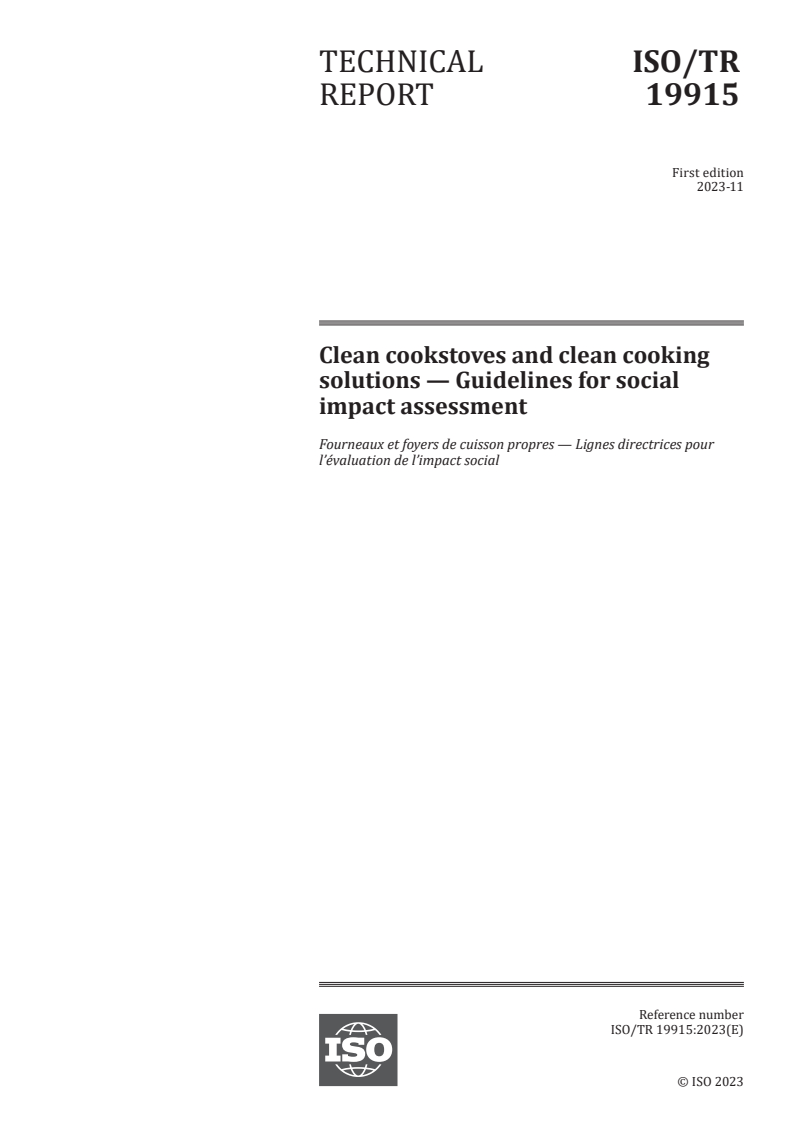
TECHNICAL ISO/TR
REPORT 19915
First edition
2023-11
Clean cookstoves and clean cooking
solutions — Guidelines for social
impact assessment
Fourneaux et foyers de cuisson propres — Lignes directrices pour
l’évaluation de l’impact social
Reference number
© ISO 2023
All rights reserved. Unless otherwise specified, or required in the context of its implementation, no part of this publication may
be reproduced or utilized otherwise in any form or by any means, electronic or mechanical, including photocopying, or posting on
the internet or an intranet, without prior written permission. Permission can be requested from either ISO at the address below
or ISO’s member body in the country of the requester.
ISO copyright office
CP 401 • Ch. de Blandonnet 8
CH-1214 Vernier, Geneva
Phone: +41 22 749 01 11
Email: copyright@iso.org
Website: www.iso.org
Published in Switzerland
ii
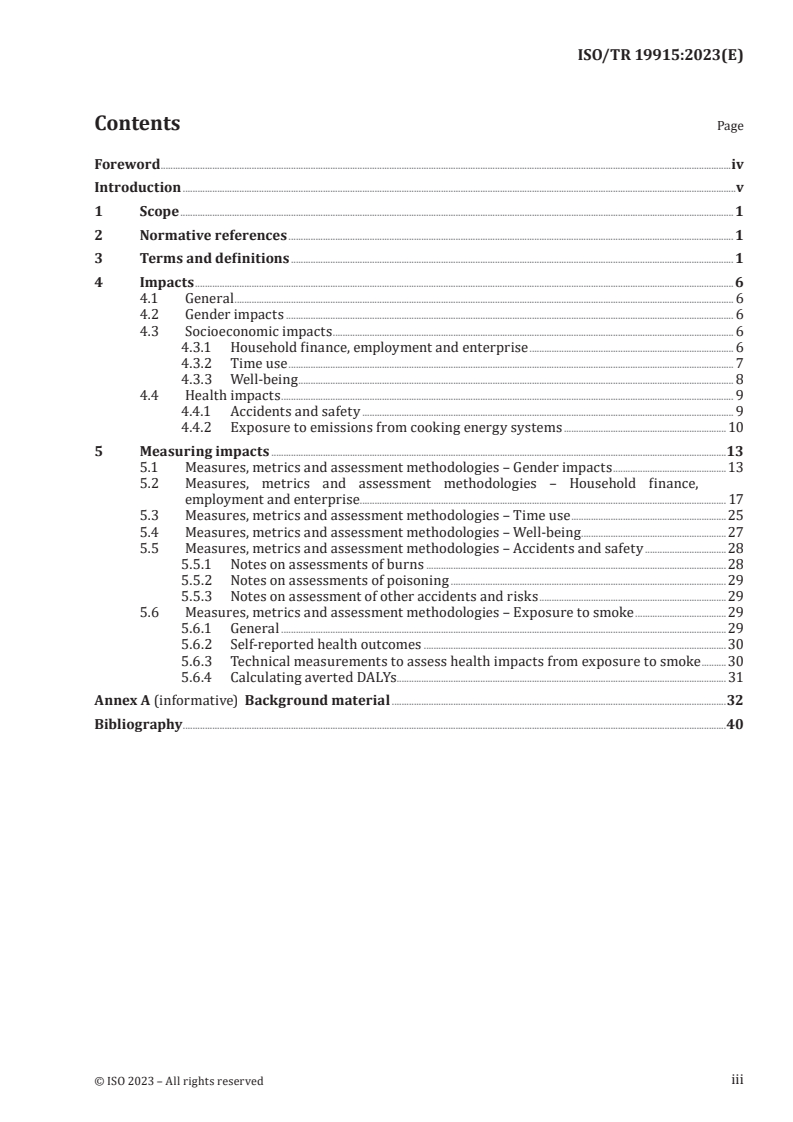
Contents Page
Foreword .iv
Introduction .v
1 Scope . 1
2 Normative references . 1
3 Terms and definitions . 1
4 Impacts . 6
4.1 General . 6
4.2 Gender impacts . 6
4.3 Socioeconomic impacts . 6
4.3.1 Household finance, employment and enterprise . 6
4.3.2 Time use . 7
4.3.3 Well-being . 8
4.4 Health impacts . 9
4.4.1 Accidents and safety . 9
4.4.2 Exposure to emissions from cooking energy systems . 10
5 Measuring impacts .13
5.1 Measures, metrics and assessment methodologies – Gender impacts .13
5.2 Measures, metrics and assessment methodologies – Household finance,
employment and enterprise. 17
5.3 Measures, metrics and assessment methodologies – Time use . 25
5.4 Measures, metrics and assessment methodologies – Well-being . 27
5.5 Measures, metrics and assessment methodologies – Accidents and safety .28
5.5.1 Notes on assessments of burns .28
5.5.2 Notes on assessments of poisoning .29
5.5.3 Notes on assessment of other accidents and risks .29
5.6 Measures, metrics and assessment methodologies – Exposure to smoke .29
5.6.1 General .29
5.6.2 Self-reported health outcomes .30
5.6.3 Technical measurements to assess health impacts from exposure to smoke .30
5.6.4 Calculating averted DALYs . . 31
Annex A (informative) Background material .32
Bibliography .40
iii
Foreword
ISO (the International Organization for Standardization) is a worldwide federation of national standards
bodies (ISO member bodies). The work of preparing International Standards is normally carried out
through ISO technical committees. Each member body interested in a subject for which a technical
committee has been established has the right to be represented on that committee. International
organizations, governmental and non-governmental, in liaison with ISO, also take part in the work.
ISO collaborates closely with the International Electrotechnical Commission (IEC) on all matters of
electrotechnical standardization.
The procedures used to develop this document and those intended for its further maintenance are
described in the ISO/IEC Directives, Part 1. In particular, the different approval criteria needed for the
different types of ISO document should be noted. This document was drafted in accordance with the
editorial rules of the ISO/IEC Directives, Part 2 (see www.iso.org/directives).
ISO draws attention to the possibility that the implementation of this document may involve the use
of (a) patent(s). ISO takes no position concerning the evidence, validity or applicability of any claimed
patent rights in respect thereof. As of the date of publication of this document, ISO had not received
notice of (a) patent(s) which may be required to implement this document. However, implementers are
cautioned that this may not represent the latest information, which may be obtained from the patent
database available at www.iso.org/patents. ISO shall not be held responsible for identifying any or all
such patent rights.
Any trade name used in this document is information given for the convenience of users and does not
constitute an endorsement.
For an explanation of the voluntary nature of standards, the meaning of ISO specific terms and
expressions related to conformity assessment, as well as information about ISO's adherence to
the World Trade Organization (WTO) principles in the Technical Barriers to Trade (TBT), see
www.iso.org/iso/foreword.html.
This document was prepared by Technical Committee ISO/TC 285, Clean cookstoves and clean cooking
solutions.
Any feedback or questions on this document should be directed to the user’s national standards body. A
complete listing of these bodies can be found at www.iso.org/members.html.
iv
Introduction
This document provides guidance for assessing social impacts. It illustrates social impacts deriving
from improved cooking and inspires the implementation of such assessments. This document is not
exclusive nor comprehensive but provides a solid basis for an assessment. It is important to note that
these guidelines are limited by the fact that social impact assessments have been carried out over a
limited time and in limited number. Therefore, the guidelines can be considered in evolution.
By social impacts, it is meant consequences to human populations (which can be viewed as harmful
or beneficial by those impacted) of any public or private actions related to the adoption of improved
cooking solutions that alter and affect the ways in which people live, work, play, relate to one another
and organize to meet their needs as members of society (men, women, boys, girls, all ages and all
genders). The term also includes cultural impacts involving changes to cooking habits, norms, values
[98]
and beliefs that guide and rationalize their cognition of themselves and their society .
The social impacts this document currently reflects are socio-economic impacts (e.g. gender impacts,
employment, entrepreneurship, economic impacts, time use and perception of well-being), health
impacts (e.g. accidents and safety, exposure to smoke and resulting health effects, and food security)
and environmental impacts. The impact hypotheses however might appear rather linear, even though
in reality they are not. This simplified presentation is for illustrative purposes.
This document is a companion to the International Standard for harmonised laboratory testing
(ISO 19867) (describing procedures to analyse and characterize the performance of a technology
under laboratory conditions) and to the International Standard for field testing methods (ISO 19869)
(describing procedures to analyse and characterize the performance of the entire cooking energy
system including user behaviour and cooking location in real settings). This document describes
procedures to analyse and characterize the impacts people experience after improving their cooking
energy system.
Impacts result from the adoption and consistent use of the improved cooking energy system; guidance
on assessing adoption and use is provided in ISO 19869.
Stove and fuel stacking is a common practice in which households use various stoves and fuels for
specific purposes and cooking tasks. Households commonly adopt an improved cookstove as one
cooking tool among others that can accommodate several cooking methods and fuels. This practice can
limit or change the intended impacts of a cooking intervention.
This document refers to a solution called “improved cooking energy system” or “improved cookstove”.
The term “improved” was chosen as it is generic and inclusive: it includes fuel saving and efficiency,
usability, durability, etc. In contrast, the term “clean cookstoves” or “clean cooking solution” does
not encompass all issues that are trying to be resolved in the sector. For instance, it does not address
efficiency/fuel savings nor include significant social impacts that are, at times, the determining decision
factors (besides smoke reduction, comfort, time saving, etc.) that move households to decide to buy and
use technologies and change their cooking habits. Therefore, this document uses the term “improved.”
Furthermore, a cookstove alone does not change the cooking reality of families and does not generate
all intended impacts. Therefore, this document considers the entire “cooking energy system,” which is
a term that reflects and acknowledges the following impact-influencing factors: fuel properties, user
behaviour, cooking practice, cooking location and ventilation as well as cooking utensils. Working
towards including all these factors will provide the expected benefits.
v
TECHNICAL REPORT ISO/TR 19915:2023(E)
Clean cookstoves and clean cooking solutions — Guidelines
for social impact assessment
1 Scope
This document provides a guidance to evaluate and assess the social impact of improved cooking
energy systems.
This document is an informative document, which provides orientation in terms of:
— considerations for stakeholders involved in the cooking sector;
— background information regarding various social impacts resulting from cooking systems;
— example results chains illustrating the simplified and aspirational causal linkages related to energy
transitions; and
— descriptive tools and methods to measure direct and indirect social impacts.
The target group for this document is any stakeholder interested in evaluating the impacts of
improved cooking, such as: researchers, development organisations, non-governmental organisations,
government bodies private sector companies, and donor or investors.
2 Normative references
There are no normative references in this document.
3 Terms and definitions
For the purposes of this document, the following terms and definitions apply.
ISO and IEC maintain terminology databases for use in standardization at the following addresses:
— ISO Online browsing platform: available at https:// www .iso .org/ obp
— IEC Electropedia: available at https:// www .electropedia .org/
3.1
agency
ability to define one’s goals and act upon them
[SOURCE: ISO/TR 21276:2018, 3.6.2]
3.2
baseline
status of a market or a community prior to introduction of improved cooking energy systems, described
by measurements and metadata derived from the field
[SOURCE: ISO/TR 21276:2018, 3.3.1, modified — The phrase “community or cooking system” has been
replaced by “community”, and “prior to intervention” has been replaced by “prior to introduction of
improved cooking energy systems”.]
3.3
cooking system
combination of cookstove (3.5), fuel, cooking equipment, cooking environment (including ventilation),
and user behaviour, which all influence the quality of the cooking energy service provided
[SOURCE: ISO/TR 21276:2018, 3.5.4, modified — The phrase “and user behaviour, which all influence
the quality of the cooking energy service provided” has been added.]
3.4
cooking time
total time of cooking a dish; it is the time difference between finishing time minus starting time of
cooking (in minutes)
[SOURCE: Reference [19] modified — The formula ∆t = t – t was translated into the phrase “total time
f i
of cooking a dish; it is the time difference between finishing time minus starting time of cooking (in
minutes)”, with t being start time and t being finish time of cooking (minutes).]
i f
3.5
cookstove
appliance primarily employed for the cooking of food, but which can also be employed for space or
water heating, or other purposes
[SOURCE: ISO/TR 21276:2018, 3.1.7]
3.6
DALY
disability-adjusted life year
loss of the equivalent of one year of full health
Note 1 to entry: DALYs for a disease or health condition are the sum of the years of life lost to due to premature
mortality (YLLs) and the years lived with a disability (YLDs) due to prevalent cases of the disease or health
condition in a population.
[SOURCE: Reference [112] modified — Note 1 to entry was originally part of the definition.]
3.7
economic impact
net change in an economic activity associated with an industry, event or policy in an existing regional
economy
Note 1 to entry: These changes are most often viewed in terms of business output, value added, wealth, personal
income or jobs.
[SOURCE: ISO/TR 21276:2018, 3.6.3, modified — The phrase “net change, either positive or negative,
in an economic activity” has been replaced by “net change in an economic activity”, and “including
industrial output, value added, wealth, personal income, jobs and resources” has been replaced by
“associated with an industry, event or policy in an existing regional economy”. Note 1 to entry was
originally part of the definition.]
3.8
employment
occupation for which people are paid either in cash or in kind
Note 1 to entry: Persons who during a specified brief period, (a) performed some work for wage or salary in
cash or in kind, (b) had a formal attachment to their job but were temporarily not at work during the reference
period, (c) performed some work for profit or family gain in cash or in kind, (d) were with an enterprise such as
a business, farm or service but who were temporarily not at work during the reference period for any specific
reason.
[SOURCE: ISO/TR 21276:2018, 3.6.4, modified — Note 1 to entry was added.]
3.9
empowerment
process of expansion in people’s ability to make strategic life choices in a context where this ability was
previously denied to them
Note 1 to entry: Empowerment is comprised of the following dimensions: resources, agency (3.1) and
achievements. Resources is defined as the necessary skills and information; achievement is defined as the
outcomes of the empowerment process.
[SOURCE: ISO/TR 21276:2018, 3.6.5, modified — Note 1 to entry was added.]
3.10
entrepreneur
person who seeks to generate value through the creation or expansion of economic activity, by
identifying and exploiting new products, processes or markets
[SOURCE: ISO/TR 21276:2018, 3.6.6]
3.11
environmental impact
positive, neutral or negative effect on the social or material environment in a given area resulting from
a change
[SOURCE: ISO/TR 21276:2018, 3.6.7]
3.12
exposure
contact of an organism with chemical, biological or physical influences
Note 1 to entry: This contact can occur via mouth (e.g. by food), the respiratory system or skin.
[SOURCE: ISO/TR 21276:2018, 3.4.4, modified — The phrase “physical or biological agent at levels above
those normally found in the organism’s environment” has been replaced by “biological or physical
influences” and Note 1 to entry was added.]
3.13
food security
point in time, when all people, at all times, have physical and economic access to sufficient, safe and
nutritious food that meets their dietary needs and food preferences for an active and healthy life
[SOURCE: ISO/TR 21276:2018, 3.6.8, modified — The term “condition” was replaced by “point in time”
and “for an active and healthy life” was added.]
3.14
gender
socially constructed roles and responsibilities of women and men in society and the power relations
that exist between them
Note 1 to entry: The concept of gender also includes the expectations held about the characteristics, aptitudes
and likely behaviours of both women and men (femininity and masculinity). Gender roles and expectations are
learned. They can change over time and they vary within and between cultures. Systems of social differentiation
[105]
such as political status, class, ethnicity, physical and mental disability, age and more, modify gender roles .
Note 2 to entry: The concept of gender is vital because, applied to social analysis, it reveals how women’s and
men’s roles and relationships are largely socially constructed. In most societies, there are differences and
inequalities between women and men in decision-making opportunities, responsibilities assigned, activities
undertaken, and access to and control over resources.
[SOURCE: ISO/TR 21276:2018, 3.6.9, modified — The phrase “culturally and socially constructed”
has been replaced by “socially constructed” and “of different sexes that exist in families, societies and
cultures, and the power relations that exist between different sexes” has been replaced by “of women
and men in society and the power relations that exist between them”. Notes 1 and 2 to entry were
added.]
3.15
HIC
high income country
economy with a gross national income per capita of 13 206 USD or more
[SOURCE: Reference [44] modified — The abbreviation “GNI” has been replaced by “economy with a
gross national income”.]
3.16
HAP
household air pollution
presence of air pollutants including solid particles or gases in air in both indoor and outdoor
environments of living spaces
[SOURCE: ISO 19869:2019, 3.4.9]
3.17
improved cookstove
cookstove (3.5) proposed for a geographic region or target community, which has been shown
to outperform a baseline (3.2) with respect to primary criteria including emission factors, fuel
consumption, thermal efficiency, durability and/or safety
[SOURCE: ISO/TR 21276:2018, 3.1.9]
3.18
livelihood
capabilities, assets, income and activities required to obtain the necessities of life
Note 1 to entry: People pursue a variety of livelihood outcomes [such as more income, increased well-being
(3.28), reduced vulnerability, improved food security (3.13)] through various livelihood strategies. Livelihood
strategies aim to build or contribute to an individual’s livelihood assets- comprised of human capital, natural
capital, financial capital, physical capital, social capital, and political capital.
[SOURCE: ISO/TR 21276:2018, 3.6.11, modified — Note 1 to entry was added.]
3.19
LMICs
low and middle income countries
economies with a gross national income per capita of less than 13 205 USD
[SOURCE: Reference [120] modified — The abbreviation “GNI” has been replaced by “economies with a
gross national income”]
3.20
PM
2,5
particulate matter with diameter of 2,5 micrometres (µm) or less
[SOURCE: ISO/TR 21276:2018, 3.4.8, modified — The phrase “fine particulate matter such that the
aerodynamic equivalent diameter of the particles is less than or equal to 2,5 μm” has been replaced by
“particulate matter with diameter of 2,5 micrometres (µm) or less”.]
3.21
quality of life
individuals’ objective and perceived position in life in the context of culture and value systems in which
they live, including personal security, physical and mental health, education and skills, environmental
quality, social connections, civic engagement and governance, as well as recreational and leisure time
[SOURCE: ISO/TR 21276:2018, 3.6.12, modified — The phrase “and in relation to their goals,
expectations, standards and concerns, and the sum of the above as expressed in their community”
has been replaced by “including personal security, physical and mental health, education and skills,
environmental quality, social connections, civic engagement and governance, as well as recreational
and leisure time”.]
3.22
results chain
causal chain
description of steps that can result from an intervention, defined as inputs, activities, outputs, outcomes
(direct results) and impacts (indirect results)
[SOURCE: Reference [21] modified — The phrase “The causal sequence for a development intervention
that stipulates the necessary sequence to achieve desired objectives beginning with inputs, moving
through activities and outputs, and culminating in outcomes, impacts, and feedback.” has been replaced
by “description of steps that can result from an intervention, defined as inputs, activities, outputs,
outcomes (direct results), and impacts (indirect results)”.]
3.23
self efficacy
belief that one will be able to accomplish the things he/she sets out to do
[SOURCE: Reference [52] modified — The phrase “beliefs have the potential to influence imagery
outcomes and can show if an intervention has had an effect.” has been replaced by “belief that one will
be able to accomplish the things he/she sets out to do”.]
3.24
social impact
positive and negative consequences of any actions to improve cooking that can alter or affect the ways
in which people live
[SOURCE: ISO/TR 21276:2018, 3.6.13]
3.25
stacking
common practice in which households use various stoves and fuels for specific purposes and cooking
tasks
[SOURCE: ISO/TR 21276:2018, 3.5.13, modified — The original term was "stove stacking" and the
phrase “practice of a household using more than one cookstove” was replaced by “common practice in
which households use various stoves and fuels for specific purposes and cooking tasks”.]
3.26
stakeholder
organization, government, company, researcher, user and/or community involved in cooking system
(3.3) research, design, development, production, sale, promotion, regulation and/or use
[SOURCE: ISO/TR 21276:2018, 3.6.14, modified — The phrase “those involved in the development of
clean cookstoves” was replaced by “organization, government, company, researcher, user and/or
community involved in cooking system research, design, development, production, sale, promotion,
regulation, and/or use”.]
3.27
time use
time spent on fuel procurement and preparation, food preparation, cooking, cleaning, and stove tending,
as well as shifts in time and activity patterns, including among household members
Note 1 to entry: This includes both perceived changes and actual measured shifts in how people spend their time.
Note 2 to entry: Adapted from ISO/TR 21276:2018, 3.3.24.
3.28
well-being
dynamic process that gives people a sense of how their lives are going as a result of the interaction
between their circumstances, activities and psychological resources or ‘mental capital’
Note 1 to entry: It includes objective and subjective factors.
Note 2 to entry: Adapted from ISO/TR 21276:2018, 3.6.17 and Reference [100].
4 Impacts
4.1 General
Around the world, three billion people rely on open fires and traditional cookstoves and fuels to cook
[110]
food and to light and heat their homes – causing serious environmental and health problems . Over
four million people globally die each year from exposure to household air pollution caused by cooking
[110]
fires . Scaling the adoption of clean and efficient cookstoves and fuels is imperative to ending energy
poverty. Increasing access to and the adoption and consistent use of clean and efficient cookstoves
and fuels has the potential to contribute to the achievement of UN Sustainable Development Goals
(SDGs) related to poverty eradication, food security, health and well-being, education, gender equality,
economic growth, reducing inequalities, sustainable cities, environmental protection, and climate
[101,97]
change mitigation . Stakeholders can consider including an assessment of adoption and usage as a
central component of their impact evaluations (for guidance, see ISO 19869).
4.2 Gender impacts
Stakeholders can consider the potential positive, negative or neutral gender impacts to individuals
and households from the adoption of an alternative cooking energy system, given that women and
girls generally perform an overwhelming majority of the cooking tasks, and in most contexts, are
responsible for managing household energy, including collecting or purchasing fuel. These impacts can
concern health, safety, economic circumstance, education, household energy, time use and/or quality
of life. Knowing that these factors overwhelmingly impact the lives of women and children, a gender
analysis can be undertaken to capture gender and power dynamics in a given context or intervention.
(See Table 1 for gender analysis and implementation resources and Table 2 for guidance on gender
impact assessment.)
NOTE 1 It is important to consider different roles and responsibilities played by women, men and children in
and outside the household that could be affected by cookstove interventions. For instance, women often shoulder
the burden of caregiver responsibilities. Roles can also be viewed across the entire cooking value chain (including
design, production, marketing, sales, distribution and use). Assessing both the extent and quality of these roles is
important (such as access and control/ownership of resources, the ease of access to credit and loans, leadership,
and decision-making opportunities, paid and unpaid labour, domestic duties and care, etc.).
NOTE 2 The assessment can consider any policies that are enacted to ensure or foster gender equality and
a conducive working environment for women (such as issues of maternity and paternity leave, flexible working
hours, consideration of work/life balance, equal salary/wages, opportunities for training, mentorship, and
promotion, sexual harassment policies, health care, etc.).
NOTE 3 The assessment can consider the gendered household, social, and economic impacts of alternative
cooking energy system adoption (such as household finances, time use, gender norms and workload, health, the
impacts of drudgery, injuries, accidents, harassment, and the risk of violence).
4.3 Socioeconomic impacts
4.3.1 Household finance, employment and enterprise
Stakeholders can consider the potential positive, negative or neutral economic impacts to individuals
and households from the adoption of alternative cooking energy systems. Possible impacts include
household economic shifts from reduced fuel expenditure or changes in income-generating
opportunities.
NOTE 1 Changes in the money spent on fuel is a common direct impact resulting from the adoption and use
of improved stoves in some contexts. Not only do the prices of various fuels differ (including free fuelwood),
[3]
but depending on the fuel efficiency of the cookstove, less or more fuel can also be required . (See Table 3 for
resources on economic impact assessment.)
NOTE 2 Shifts in fuel expenditures are also dependent on how consistently the family uses the improved
cooking energy system, whether they are using it correctly, and whether they are using it in place of other
[13]
cooking energy system or in combination with other cooking technologies .
NOTE 3 While more efficient cooking can reduce fuel costs, such advantages could be offset by the added costs
or investment required for the purchase of new cookstoves, including the burden of credit/finance. For instance,
the adoption of new cookstove technologies and fuels can greatly shift household costs in terms of cash flow and
time.
EXAMPLE If a family borrows money to buy a liquefied petroleum gas (LPG) stove to replace or supplement
a cookstove that burns collected wood fuel, they could experience a reduction in their cash resources in order to
pay back the credit and refill their LPG cylinder but also an increase in time for productive or leisure activities, as
they no longer have to collect as much wood.
NOTE 4 Product design, production, distribution and after-sales service of cooking energy systems can
encourage new skills and retraining, as well as the potential creation of businesses, entrepreneurship and
employment opportunities.
NOTE 5 The adoption of alternative cooking energy systems could negatively impact the livelihoods of people
involved in the distribution of existing stoves and fuels. This could include job losses, lower profit margins or
disruptive effects of importing products. The opportunity to access, use and manage credit can be considered.
NOTE 6 It is also important to consider skills and knowledge gained as well as traditional or indigenous
knowledge lost because of the introduction of alternative cooking energy systems. These can relate to
technical skills related to cooking or the production and use of fuel, as well as knowledge related to health and
environmental impacts of cooking practices. The extent and quality of training activities can also be considered.
4.3.2 Time use
Stakeholders can consider that in LMICs, household members typically spend long days balancing a
variety of responsibilities that are integral to the family’s survival. Cooking and related fuel collection
and preparation tasks are commonly integrated into long days of unpaid care work, such as caring for
children, tending to animals and crops, fetching water, washing clothes and other cleaning tasks. In
general, while not universally true, these responsibilities and their impacts fall most heavily on women
and female children.
Stakeholders can consider the ways in which changes in cooking technology, fuel or practices (alone or in
combination) impact household time use, whether through time savings, increased time expenditures,
or balance-neutral transference of time among activities and/or household members. (See Table 4 on
methods for collecting time use data.)
NOTE 1 Cooking-related activities and fuel-related activities are sometimes performed by distinct household
[96]
members, with the division often determined by gender and/or age .
NOTE 2 These activities often occur on quite separate time scales, with cooking performed at least once
per day year-round, while fuel procurement could be undertaken less frequently, and patterns could vary
significantly across seasons. The frequency and duration of these activities are affected by very different factors,
and how time is allocated and prioritized can vary at different times of the year.
EXAMPLE 1 Fuel collection can be a function of forest cover, whereas cooking time can be a function of food
preparation (like pre-soaking beans). During agricultural harvesting seasons, women could have less time for
fuel collection due to increased farming responsibilities and could need to collect more fuel before this time
period to have a sufficient stock.
NOTE 3 Who experiences the impacts and to what degree (if at all) depends on who is performing the
cooking-related activities, and this is often determined by gender and age. Although most (but not all) improved
cookstoves and fuel combinations provide some efficiency gains, it is possible for new stoves and/or fuels to
not result in increased cooking capacity, increased cooking power, or less onerous tending/maintenance
requirements; in fact, the opposite could be true, and time use can increase. Further, even where benefits do
occur, they are not guaranteed to generate time savings because these are largely dependent on user behaviour.
In some cases, cooking energy transitions result in more available fuel, which causes households to cook more
than they did previously due to suppressed demand.
Stakeholders can consider the entire meal creation process, including fuel procurement and
preparation, food preparation, cooking, and cleaning of pots and stove, recognizing that trade-offs in
time requirements can occur among these activities. There is a distinction between “cooking time,”
defined as the time during which the cook actively engages with the food while it is cooking and “stove
usage,” which refers to the total time the stove is lit/operating. Both “cooking time” and “stove usage”
occur within the larger framework of the meal creation process, which starts with fuel procurement
and preparation and concludes with the cleaning of the pots, stove, and other utensils.
Stakeholders can consider the full range of time shifts associated with adoption of improved cooking
technologies. Time and activity shifts include changes in time patterns within the cooking activity
as well as changes in the use of non-cooking time associated with adoption of improved cooking
technologies, including the use of any time savings.
EXAMPLE 2 A family could move from a technology that is slow-cooking but has low fuel-tending requirements,
to one that cooks quickly but needs more frequent tending. In this case, the cook could no longer be able to
multitask after the stove is lit, and could need to chop vegetables ahead of time, so the shorter cooking time is
offset by the need to prepare food before lighting the stoves.
NOTE 4 Time and activity shifts could be experienced by one or more household members simultaneously,
either separately or in an interdependent manner. For example, gains in cookstove efficiency could result in
shorter fuel collection times for one family member and shorter cooking time for another. How time shifts from
one household member to another is often determined by gender dynamics within the household.
NOTE 5 Use of time savings could include engagement in productive activities, child-care, leisure and sleep.
The time savings could be used for more or less pleasant/drudgerous non-cooking activities; for example, less
cooking time resulting in more labour-intensive agricultural responsibilities.
Stakeholders can consider that cultural perceptions of time are not uniform; time-savings are not
universally valued or even viewed as an asset in some settings. Furthermore, the valuation of time
saving often varies according to gender dynamics, with women and girls’ time often less valued.
NOTE 6 Regardless of whether actual time savings are achieved, household members could perceive time-
related benefits from cooking system changes.
EXAMPLE 3 Changes in stove tending requirements could allow multi-tasking, which creates a perception of
time efficiency/savings.
NOTE 7 Cooking and fuel collection activities are not a universally negative experience for those who perform
them.
EXAMPLE 4 Preparing family meals could be personally satisfying to the cook, just as collecting fuel could be
an opportunity for groups to socialize.
4.3.3 Well-being
Stakeholders can consider how well-being is impacted by (1) access to improved cooking energy
system, and (2) involvement in the cooking energy value chain. Well-being is a combination of objective
factors (quality of life and material conditions) and subjective factors (positive emotions and moods,
[14]
the absence of negative emotions, satisfaction with life, fulfilment and general positive functioning) .
(See Table 5 for tools for measuring well-being.)
NOTE 1 Stakeholders can consider consumers’ perception of benefits of improved cooking. Perceived benefits
can differ amongst women and men in the household, regardless of who is using the stove on a regular basis.
Perceived benefits can include reduced cooking time, reduced fuel expenditures, a cleaner kitchen, and pride in
ownership of new products (or having status from being part of the value chain for an aspirational product). A
change in the taste of food could be a perceived drawback.
NOTE 2 Stakeholders can consider cookstove users’ perception of changes in drudgery because of cookstove
use, recognizing that improved cookstoves can decrease or increase perceived drudgery. Individuals could find
they can reduce the length and frequency of fuel collection trips. Alternatively, users could perceive an increase in
drudgery associated with fuel processing, such as the need to chop wood into smaller pieces to fit their improved
cookstove, or the need to feed their improved cookstove more frequently.
4.4 Health impacts
4.4.1 Accidents and safety
Stakeholders can consider the health impacts of cooking energy system use with respect to accidents
and safety. This subclause outlines key health risk factors and assessment recommendations associated
with traditional cooking methods and fuels beyond those attributed to exposure to household air
pollution (discussed in 5.2). Further guidance on conducting safety assessments on cooking technologies
and fuels in the field can be found in ISO 19869:2019.
4.4.1.1 Burns
Stakeholders can consider the risk of cooking-related burn injuries. Household use of traditional
cookstoves is associated with several environmental and health problems, including a significant
number of burn injuries each year. Those who survive burn injury frequently live with chronic disability,
which can have extensive psychological and social effects and impact their ability to work.
[23] [113]
NOTE 1 An estimated 90 % of the 265,000 total deaths occurring worldwide from burn injuries each
year occur in LMICs. In 2004, an estimated 11 million people globally had burns severe enough to necessitate
[115]
medical attention and, in LMICs alone, 10,5 million DALYs were lost . Children, especially toddlers from birth
to four years of age, experience a disproportionately high number of burns. Studies have shown this age group
[79]
to account for nearly half of all childhood burns and, when considering all age groups, up to a third of total
[2]
burns .
NOTE 2 Many of the advances made in HICs that have improved the functional recovery of burn victims
have yet to make impacts in LMICs. As a result, the burden of burn injury remains particularly high in these
regions, especially the Indian subcontinent and Sub-Saharan Africa. Notably, the mortality rate in LMICs is more
[55]
than twelve times higher than that of HICs . Whereas burns in HICs have surveillance and epidemiological
data, clearly defined and successful prevention and protection strategies, and strong treatment facilities,
LMICs have little infrastructure to handle burn injuries on a wide scale. There is low quality and quantity of
data describing cookstove-related burn injuries in LMICs, limiting the development of effective prevention and
treatment strategies. It is possible that the problem of cookstove-related burn injuries is greater in magnitude
than currently reported. Since most LMICs do not have national burn surveillance systems to report burn injury
rates, it is widely agreed by sector experts and the World Health Organization (WHO) that burn injury estimates
[23]
for LMICs are significantly underestimated .
NOTE 3 Risk for burn injuries resulting from household cooking is disproportionately high for young children
and women. Children face a high risk due to a combination of the amount of time spent around household cooking,
their inherent limited awareness of fire dangers, and their natural curiosity and impulsiveness. The differences
in body proportions put children at an even higher risk for burns, as their skin is thinner than that of adults and
[89]
they have a body surface area to body mass ratio three times that of adults .
NOTE 4 In the majority of LMICs, women are at a higher risk than men for burn injuries because of their
primary responsibility for cooking duties. In some regions, it is common for women to wear loose-fitting clothing
while cooking, which increases the risk for burn injuries.
NOTE 5 The use of liquid fuels like kerosene for cooking carries specific risk factors for burn injuries including:
— fuel leakage onto surrounding materials or clothing;
— explosion of malfunctioning stoves; and
[23]
— instability of stoves and risks of tipping .
4.4.1.2 Poisoning from liquid fuels
Stakeholders can consider the risk of poisoning from liquid fuels. The use of liquid fuels such as kerosene
and, to a lesser degree, ethanol, for cooking and lighting remains widespread in LMICs. Ingestion of
these fuels is a significant source of paediatric poisoning in households that rely on these fuels.
NOTE 1 The ingestion of kerosene results in gastro-intestinal symptoms, respiratory distress and, in rare
cases, damage to the central nervous system. Severity and recovery ar
...