

ISO/FDIS 14419
(Main)Textiles — Oil repellency — Hydrocarbon resistance test
- Abstract
This document specifies a method for the evaluation of a substrate's resistance to absorption of a selected series of liquid hydrocarbons of different surface tensions. This document provides guidance to oil stain resistance. It can provide a rough index of oil stain resistance as, generally, the higher the oil repellency grade, the better resistance to staining by oily materials, especially liquid oil substances. This is particularly true when comparing various finishes for a given substrate. This document can also be used to determine if washing and/or drycleaning treatments have any adverse effect on the oil repellency characteristics of a substrate. NOTE 1 Washing and drycleaning treatment procedures are described in ISO 6330 and ISO 3175 (all parts), respectively. This document is not intended to give an absolute measure of the resistance of the substrate to staining by all oily materials. Other factors, such as composition and viscosity of the oily substances, substrate construction, fibre type, dyes and other finishing agents, also influence stain resistance. This document is not intended to estimate the resistance to penetration of the substrate by oil-based chemicals. NOTE 2 For the evaluation of the resistance to penetration of the substrate by oil-based chemicals, see ISO 6530.
- Status
- Not Published
- Technical Committee
- ISO/TC 38/SC 2 - Cleansing, finishing and water resistance tests
- Drafting Committee
- ISO/TC 38/SC 2/WG 8 - Water resistance tests
- Current Stage
- 5020 - FDIS ballot initiated: 2 months. Proof sent to secretariat
- Start Date
- 12-Oct-2026
- Completion Date
- 12-Oct-2026
Buy Documents

ISO/FDIS 14419 - Textiles — Oil repellency — Hydrocarbon resistance test
REDLINE ISO/FDIS 14419 - Textiles — Oil repellency — Hydrocarbon resistance test
ISO/FDIS 14419 - Textiles — Oléofugation — Essai de résistance aux hydrocarbures
ISO/FDIS 14419 from ISO specifies a laboratory method for judging how a textile substrate resists absorption of a selected series of liquid hydrocarbons. It gives an oil repellency grade that serves as a practical index of staining resistance to oily liquids, especially when comparing finishes on the same substrate. The method is also used to check whether washing or drycleaning changes that repellency.
What does ISO/FDIS 14419 specify?
ISO/FDIS 14419 specifies a hydrocarbon resistance test for textiles, with the result reported as an oil repellency grade. The method is intended for comparing substrates and finishes, and for checking the effect of washing or drycleaning on repellency.
The document is organized into clauses for scope, references, terms, principle, safety, reagents and materials, apparatus, test specimens, procedure, evaluation, evaluation of results, and test report. Annex A gives the precision and bias statement.
| Annex | What it covers |
|---|---|
| A | Precision and bias statement |
What are the key requirements of ISO/FDIS 14419?
ISO/FDIS 14419 bases the result on which numbered hydrocarbon liquid first wets the substrate, so the test is a graded comparison rather than a pass/fail check. In practice, the tester must control the liquids, the atmosphere, the specimen preparation, and the reading time carefully, because small handling differences can change the grade.
Test principle and grading
Clause 4 places drops of standard test liquids on the surface and watches for absorption, wicking, and contact angle. The oil repellency grade is the highest numbered liquid that does not absorb into the substrate within the set observation time.
That means the test shows relative repellency to a defined liquid series, not resistance to every oily material. The scope also notes that substrate construction, fibre type, dyes, and finishing agents can all affect the result.
Safety and handling
Clause 5 treats the hydrocarbons as flammable laboratory materials. The document calls for good laboratory practice, safety glasses, impervious gloves, ventilation, and keeping the liquids away from heat, sparks, and open flame.
Reagents, materials, and apparatus
Clause 6 requires analytical-grade reagents and standard test liquids stored at the specified temperature. The liquid series is numbered, and the table defines the liquids used for grading, including white mineral oil and n-heptane in the series.
Clause 7 requires marked dropping bottles and warns against silicone contamination. In practice, this matters because silicone can alter wetting and give misleadingly high grades.
Test specimens and procedure
Clause 8 uses three specimens of about 35 cm by 35 cm, conditioned before testing in the ISO 139 atmosphere. Clause 9 places drops at five locations, observes each drop for 30 seconds, and continues through the liquid series until wetting or wicking appears.
For napped or pile fabrics, the surface is brushed first in the direction of greatest lay. For open-weave or thin substrates, extra layers are placed underneath so the backing does not create a false result.
Evaluation and reporting
Clause 10 defines pass, borderline pass, and fail by the appearance of the five drops. A grade of zero is used when the specimen fails with white mineral oil, and borderline cases are reported in half-grade steps.
Clause 11 requires two determinations, with a third if the first two disagree. The reported value is the matching result, or the median when three results differ. Clause 12 requires the report to identify the sample, number of specimens, atmosphere, deviations, results, grade, and date.
What terms does ISO/FDIS 14419 define?
- Grade - a step on the standard reference scale; here it is the reported oil repellency rating.
- Oil repellency - the characteristic of a fabric that resists absorption of oily liquids.
- Standard test liquids - the numbered hydrocarbon liquids used to challenge the substrate in sequence.
- White textile blotting paper - the absorbent backing used under the specimen to make wetting easier to see.
- Borderline pass - a result where the drop remains rounded but shows partial darkening at the interface.
- CAS RN - Chemical Abstracts Service Registry Number, the identifier used for white mineral oil.
- Analytical grade - the reagent quality required for the test liquids and other reagents.
- Test specimen - the conditioned piece of substrate that is actually tested.
Who uses ISO/FDIS 14419?
ISO/FDIS 14419 is used by textile testing laboratories, textile manufacturers, finish suppliers, quality teams, and buyers who compare oil-repellent finishes. It is also used when checking whether domestic washing, professional cleaning, or finishing treatments have changed repellency.
In practice, these users apply the method to compare finishes on the same fabric, verify product claims, and investigate variation between specimens. It is most useful where oily staining is a concern and a simple, repeatable laboratory index is needed.
What changed in ISO/FDIS 14419 from the previous edition?
ISO/FDIS 14419 states that this fourth edition cancels and replaces ISO 14419:2025, with technical revision only. The main change is in Clause 6.2, Table 1, where the liquid list was corrected to align with ISO 14419:2010 edition 2 and n-heptane was reinstated.
Which standards are used with ISO/FDIS 14419?
ISO/FDIS 14419 names ISO 139 as the conditioning and testing atmosphere reference. That standard contributes the controlled temperature and relative humidity used before and during testing.
The bibliography also names ISO 6330, ISO 3175-1 to ISO 3175-6, and ISO 6530. ISO 6330 and the ISO 3175 series are used when checking the effect of washing or drycleaning treatments, while ISO 6530 is the reference for resistance to penetration by oil-based chemicals, which is a different property from repellency.
What does the ISO/FDIS 14419 document contain?
ISO/FDIS 14419 contains a full laboratory method, including the principle, safety precautions, reagent list, apparatus, specimen preparation, procedure, evaluation rules, result handling, and reporting items. It also includes Table 1 for the standard test liquids and Figure 1, which illustrates pass, borderline pass, and fail appearances.
Annex A provides the precision and bias statement, based on interlaboratory studies. That section is useful when comparing results between operators or laboratories and when judging whether two grades are meaningfully different.
Relations
- Consolidates
prEN ISO 14419 - Textiles - Oil repellency - Hydrocarbon resistance test (ISO/FDIS 14419:2026) - Effective Date
- 30-May-2026
- Effective Date
- 23-May-2026
Buy Documents
ISO/FDIS 14419 - Textiles — Oil repellency — Hydrocarbon resistance test
REDLINE ISO/FDIS 14419 - Textiles — Oil repellency — Hydrocarbon resistance test
ISO/FDIS 14419 - Textiles — Oléofugation — Essai de résistance aux hydrocarbures
Get Certified
Connect with accredited certification bodies for this standard

Control Union Certifications
Global certification for agriculture and sustainability.

Hohenstein Institut
Textile testing and certification.

Bureau Veritas Bangladesh
Bureau Veritas certification services in Bangladesh.
Sponsored listings
Frequently Asked Questions
ISO/FDIS 14419 is a draft published by the International Organization for Standardization (ISO). Its full title is "Textiles — Oil repellency — Hydrocarbon resistance test". This standard covers: This document specifies a method for the evaluation of a substrate's resistance to absorption of a selected series of liquid hydrocarbons of different surface tensions. This document provides guidance to oil stain resistance. It can provide a rough index of oil stain resistance as, generally, the higher the oil repellency grade, the better resistance to staining by oily materials, especially liquid oil substances. This is particularly true when comparing various finishes for a given substrate. This document can also be used to determine if washing and/or drycleaning treatments have any adverse effect on the oil repellency characteristics of a substrate. NOTE 1 Washing and drycleaning treatment procedures are described in ISO 6330 and ISO 3175 (all parts), respectively. This document is not intended to give an absolute measure of the resistance of the substrate to staining by all oily materials. Other factors, such as composition and viscosity of the oily substances, substrate construction, fibre type, dyes and other finishing agents, also influence stain resistance. This document is not intended to estimate the resistance to penetration of the substrate by oil-based chemicals. NOTE 2 For the evaluation of the resistance to penetration of the substrate by oil-based chemicals, see ISO 6530.
This document specifies a method for the evaluation of a substrate's resistance to absorption of a selected series of liquid hydrocarbons of different surface tensions. This document provides guidance to oil stain resistance. It can provide a rough index of oil stain resistance as, generally, the higher the oil repellency grade, the better resistance to staining by oily materials, especially liquid oil substances. This is particularly true when comparing various finishes for a given substrate. This document can also be used to determine if washing and/or drycleaning treatments have any adverse effect on the oil repellency characteristics of a substrate. NOTE 1 Washing and drycleaning treatment procedures are described in ISO 6330 and ISO 3175 (all parts), respectively. This document is not intended to give an absolute measure of the resistance of the substrate to staining by all oily materials. Other factors, such as composition and viscosity of the oily substances, substrate construction, fibre type, dyes and other finishing agents, also influence stain resistance. This document is not intended to estimate the resistance to penetration of the substrate by oil-based chemicals. NOTE 2 For the evaluation of the resistance to penetration of the substrate by oil-based chemicals, see ISO 6530.
ISO/FDIS 14419 is classified under the following ICS (International Classification for Standards) categories: 59.080.01 - Textiles in general. The ICS classification helps identify the subject area and facilitates finding related standards.
ISO/FDIS 14419 has the following relationships with other standards: It is inter standard links to prEN ISO 14419, ISO 14419:2025. Understanding these relationships helps ensure you are using the most current and applicable version of the standard.
ISO/FDIS 14419 is available in PDF format for immediate download after purchase. The document can be added to your cart and obtained through the secure checkout process. Digital delivery ensures instant access to the complete standard document.
Standards Content (Sample)
FINAL DRAFT
International
Standard
ISO/TC 38/SC 2
Textiles — Oil repellency —
Secretariat: SAC
Hydrocarbon resistance test
Voting begins on:
Textiles — Oléofugation — Essai de résistance aux hydrocarbures 2026-10-12
Voting terminates on:
2027-01-04
RECIPIENTS OF THIS DRAFT ARE INVITED TO SUBMIT,
WITH THEIR COMMENTS, NOTIFICATION OF ANY
RELEVANT PATENT RIGHTS OF WHICH THEY ARE AWARE
AND TO PROVIDE SUPPOR TING DOCUMENTATION.
IN ADDITION TO THEIR EVALUATION AS
BEING ACCEPTABLE FOR INDUSTRIAL, TECHNO
ISO/CEN PARALLEL PROCESSING LOGICAL, COMMERCIAL AND USER PURPOSES, DRAFT
INTERNATIONAL STANDARDS MAY ON OCCASION HAVE
TO BE CONSIDERED IN THE LIGHT OF THEIR POTENTIAL
TO BECOME STAN DARDS TO WHICH REFERENCE MAY BE
MADE IN NATIONAL REGULATIONS.
Reference number
FINAL DRAFT
International
Standard
ISO/TC 38/SC 2
Textiles — Oil repellency —
Secretariat: SAC
Hydrocarbon resistance test
Voting begins on:
Textiles — Oléofugation — Essai de résistance aux hydrocarbures
Voting terminates on:
© ISO 2026
All rights reserved.
RECIPIENTS OF THIS DRAFT ARE INVITED TO SUBMIT,
WITH THEIR COMMENTS, NOTIFICATION OF ANY
This ISO publication is protected by copyright and is owned by ISO and/or its licensors.
RELEVANT PATENT RIGHTS OF WHICH THEY ARE AWARE
The content of this ISO publication is provided under licence, not sold. Use is subject to the applicable licence terms issued by ISO,
AND TO PROVIDE SUPPOR TING DOCUMENTATION.
an ISO member body, or an authorized third-party distributor.
IN ADDITION TO THEIR EVALUATION AS
BEING ACCEPTABLE FOR INDUSTRIAL, TECHNO
Except as required for implementation or expressly permitted by a separate licence, no part of this ISO publication may be
ISO/CEN PARALLEL PROCESSING
LOGICAL, COMMERCIAL AND USER PURPOSES, DRAFT
reproduced, distributed, modified, used, or made available in any form or by any means – electronic or mechanical, including
INTERNATIONAL STANDARDS MAY ON OCCASION HAVE
photocopying, scanning, recording, or posting on internal or external digital platforms. TO BE CONSIDERED IN THE LIGHT OF THEIR POTENTIAL
TO BECOME STAN DARDS TO WHICH REFERENCE MAY BE
Any use beyond the scope of the granted rights is prohibited and may result in legal action.
MADE IN NATIONAL REGULATIONS.
ISO copyright office
CP 401 • CH-1214 Vernier, Geneva
Phone: +41 22 749 01 11
Email: copyright@iso.org
Website: www.iso.org
Published in Switzerland
Reference number
ii
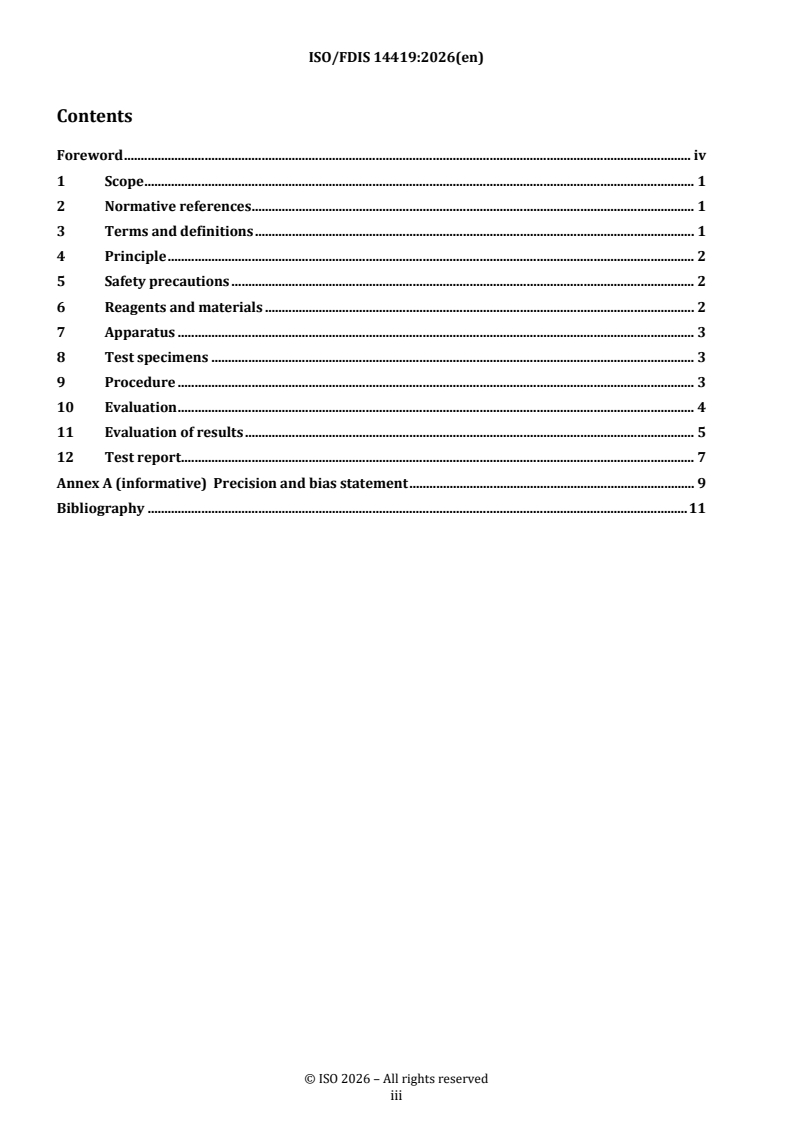
Contents Page
Foreword .iv
1 Scope . 1
2 Normative references . 1
3 Terms and definitions . 1
4 Principle . 2
5 Safety precautions. 2
6 Reagents and materials . 2
7 Apparatus . 3
8 Test specimens . 3
9 Procedure . 3
10 Evaluation . 4
11 Evaluation of results . 4
12 Test report . 5
Annex A (informative) Precision and bias statement . 6
Bibliography . 7
iii
Foreword
ISO (the International Organization for Standardization) is a worldwide federation of national standards
bodies (ISO member bodies). The work of preparing International Standards is normally carried out through
ISO technical committees. Each member body interested in a subject for which a technical committee
has been established has the right to be represented on that committee. International organizations,
governmental and non-governmental, in liaison with ISO, also take part in the work. ISO collaborates closely
with the International Electrotechnical Commission (IEC) on all matters of electrotechnical standardization.
The procedures used to develop this document and those intended for its further maintenance are described
in the ISO/IEC Directives, Part 1. In particular, the different approval criteria needed for the different types
of ISO document should be noted. This document was drafted in accordance with the editorial rules of the
ISO/IEC Directives, Part 2 (see www.iso.org/directives).
ISO draws attention to the possibility that the implementation of this document may involve the use of (a)
patent(s). ISO takes no position concerning the evidence, validity or applicability of any claimed patent
rights in respect thereof. As of the date of publication of this document, ISO had not received notice of (a)
patent(s) which may be required to implement this document. However, implementers are cautioned that
this may not represent the latest information, which may be obtained from the patent database available at
www.iso.org/patents. ISO shall not be held responsible for identifying any or all such patent rights.
Any trade name used in this document is information given for the convenience of users and does not
constitute an endorsement.
For an explanation of the voluntary nature of standards, the meaning of ISO specific terms and expressions
related to conformity assessment, as well as information about ISO's adherence to the World Trade
Organization (WTO) principles in the Technical Barriers to Trade (TBT), see www.iso.org/iso/foreword.html.
This document was prepared by Technical Committee ISO/TC 38, Textiles, Subcommittee SC 2, Cleansing,
finishing and water resistance tests, in collaboration with the European Committee for Standardization
(CEN) Technical Committee CEN/TC 248, Textiles and textile products, in accordance with the Agreement on
technical cooperation between ISO and CEN (Vienna Agreement).
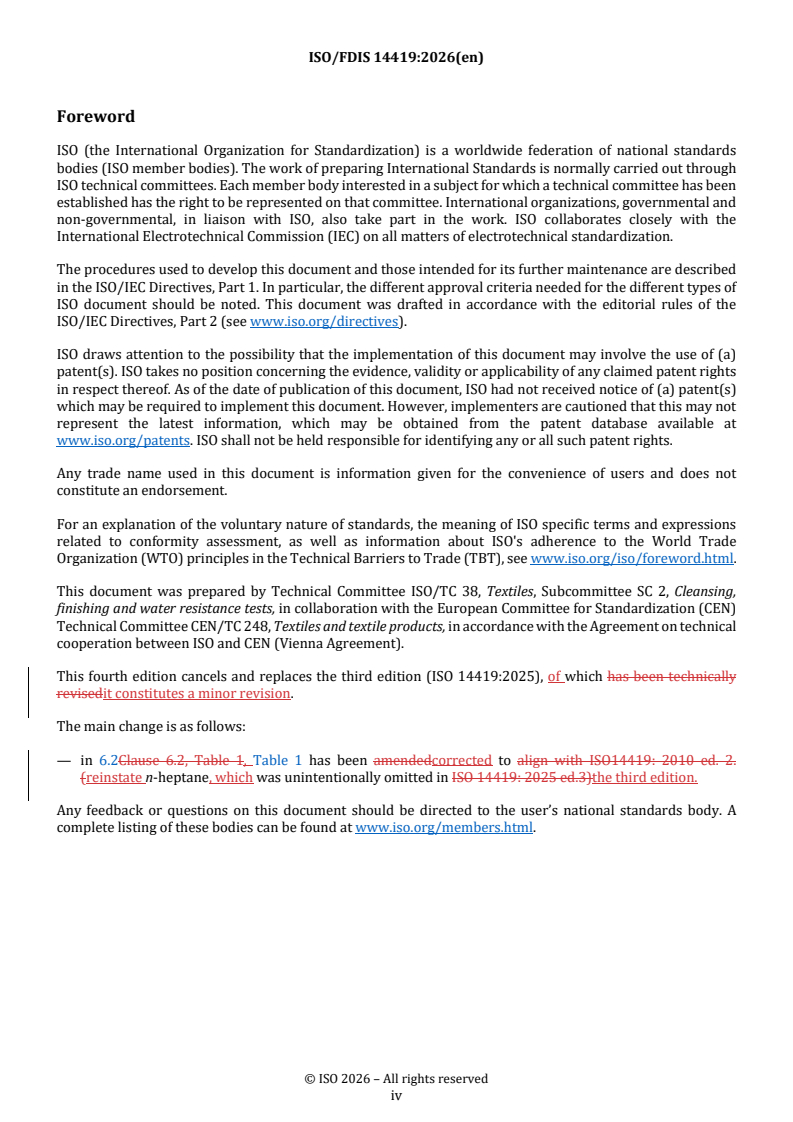
This fourth edition cancels and replaces the third edition (ISO 14419:2025), of which it constitutes a minor
revision.
The main change is as follows:
— in 6.2, Table 1 has been corrected to reinstate n-heptane, which was unintentionally omitted in the third
edition.
Any feedback or questions on this document should be directed to the user’s national standards body. A
complete listing of these bodies can be found at www.iso.org/members.html.
iv
FINAL DRAFT International Standard ISO/FDIS 14419:2026(en)
Textiles — Oil repellency — Hydrocarbon resistance test
1 Scope
This document specifies a method for the evaluation of a substrate's resistance to absorption of a selected
series of liquid hydrocarbons of different surface tensions.
This document provides guidance to oil stain resistance. It can provide a rough index of oil stain resistance
as, generally, the higher the oil repellency grade, the better resistance to staining by oily materials, especially
liquid oil substances. This is particularly true when comparing various finishes for a given substrate. This
document can also be used to determine if washing and/or drycleaning treatments have any adverse effect
on the oil repellency characteristics of a substrate.
[1] [2] [3]
NOTE 1 Washing and drycleaning treatment procedures are described in ISO 6330 , ISO 3175-1 , ISO 3175-2 ,
[4] [5] [6] [7]
ISO 3175-3 , ISO 3175-4 , ISO 3175-5 and ISO 3175-6 .
This document is not intended to give an absolute measure of the resistance of the substrate to staining
by all oily materials. Other factors, such as composition and viscosity of the oily substances, substrate
construction, fibre type, dyes and other finishing agents, also influence stain resistance. This document is
not intended to estimate the resistance to penetration of the substrate by oil-based chemicals.
[1]
NOTE 2 For the evaluation of the resistance to penetration of the substrate by oil-based chemicals, see ISO 6330 .
2 Normative references
The following documents are referred to in the text in such a way that some or all of their content constitutes
requirements of this document. For dated references, only the edition cited applies. For undated references,
the latest edition of the referenced document (including any amendments) applies.
ISO 139, Textiles — Standard atmospheres for conditioning and testing
3 Terms and definitions
For the purposes of this document, the following terms and definitions apply.
ISO and IEC maintain terminology databases for use in standardization at the following addresses:
— ISO Online browsing platform: available at https:// www .iso .org/ obp
— IEC Electropedia: available at https:// www .electropedia .org/
3.1
grade, noun
symbol for any step of a multistep standard reference scale for a quality characteristic
Note 1 to entry: The grade is assigned to test specimens exhibiting a degree of the quality comparable to that step of
the standard reference scale.
3.2
oil repellency, noun
characteristic of a fabric whereby it resists absorption of oily liquids
4 Principle
Drops of standard test liquids, consisting of a selected series of hydrocarbons with different surface tensions,
are placed on the substrate surface and then observed for absorption, wicking and contact angle. The oil
repellency grade is the highest numbered test liquid which is not absorbed by the substrate surface.
5 Safety precautions
WARNING — These safety precautions are for information purposes only. The precautions
are ancillary to the testing procedures and are not intended to be all inclusive. It is the user's
responsibility to use safe and proper techniques in handling materials in this document. The
manufacturers should be consulted for specific detail such as material safety data sheets and other
manufacturer's recommendations.
5.1 Good laboratory practices should be followed. Wear safety glasses and impervious gloves when
handling test liquids in all laboratory areas.
5.2 Some of the hydrocarbons specified in this document are flammable. Keep away from heat, sparks and
open flame. Use with adequate ventilation. Avoid prolonged breathing of vapour or contact with skin. Do not
take internally.
6 Reagents and materials
6.1 All reagents shall be of a suitable analytical grade. Ensure the standard test liquids are used and
stored at a t
...
ISO/DISFDIS 14419
ISO/TC 38/SC 2
Secretariat: SAC
Date: 2026-09-0228
Textiles — Oil repellency — Hydrocarbon resistance test
Textiles — Oléofugation — Essai de résistance aux hydrocarbures
DISFDIS stage
TTTThhhhiiiissss d d d drrrraftaftaftaft i i i issss s s s suuuubbbbmmmmiiiittttttttedededed t t t toooo a pa pa pa pararararallel vallel vallel vallel vooootttte e e e iiiinnnn I I I ISSSSOOOO,,,, C C C CEEEENNNN.
All rights reserved. Unless otherwise specified,
This ISO publication is protected by copyright and is owned by ISO and/or its licensors.
The content of this ISO publication is provided under licence, not sold. Use is subject to the applicable licence terms issued
by ISO, an ISO member body, or an authorized third-party distributor.
Except as required in the context of its for implementation or expressly permitted by a separate licence, no part of this
ISO publication may be reproduced or utilized otherwise, distributed, modified, used, or made available in any form or
by any means, – electronic or mechanical, including photocopying, scanning, recording, or posting on internal or external
digital platforms.
Any use beyond the internet or an intranet, without prior written permission. Permission can be requested from either
ISO at the address below or ISO’s member body in the countryscope of the requestergranted rights is prohibited and may
result in legal action.
ISO copyright office
CP 401 • CH. de Blandonnet 8
CH-1214 Vernier, Geneva
Phone: + 41 22 749 01 11
E-mailEmail: copyright@iso.org
Website: www.iso.org
Published in Switzerland
ii
Contents
Foreword . iv
1 Scope . 1
2 Normative references . 1
3 Terms and definitions . 1
4 Principle . 2
5 Safety precautions . 2
6 Reagents and materials . 2
7 Apparatus . 3
8 Test specimens . 3
9 Procedure . 3
10 Evaluation . 4
11 Evaluation of results . 5
12 Test report . 7
Annex A (informative) Precision and bias statement . 9
Bibliography . 11
iii
Foreword
ISO (the International Organization for Standardization) is a worldwide federation of national standards
bodies (ISO member bodies). The work of preparing International Standards is normally carried out through
ISO technical committees. Each member body interested in a subject for which a technical committee has been
established has the right to be represented on that committee. International organizations, governmental and
non-governmental, in liaison with ISO, also take part in the work. ISO collaborates closely with the
International Electrotechnical Commission (IEC) on all matters of electrotechnical standardization.
The procedures used to develop this document and those intended for its further maintenance are described
in the ISO/IEC Directives, Part 1. In particular, the different approval criteria needed for the different types of
ISO document should be noted. This document was drafted in accordance with the editorial rules of the
ISO/IEC Directives, Part 2 (see www.iso.org/directives).
ISO draws attention to the possibility that the implementation of this document may involve the use of (a)
patent(s). ISO takes no position concerning the evidence, validity or applicability of any claimed patent rights
in respect thereof. As of the date of publication of this document, ISO had not received notice of (a) patent(s)
which may be required to implement this document. However, implementers are cautioned that this may not
represent the latest information, which may be obtained from the patent database available at
www.iso.org/patents. ISO shall not be held responsible for identifying any or all such patent rights.
Any trade name used in this document is information given for the convenience of users and does not
constitute an endorsement.
For an explanation of the voluntary nature of standards, the meaning of ISO specific terms and expressions
related to conformity assessment, as well as information about ISO's adherence to the World Trade
Organization (WTO) principles in the Technical Barriers to Trade (TBT), see www.iso.org/iso/foreword.html.
This document was prepared by Technical Committee ISO/TC 38, Textiles, Subcommittee SC 2, Cleansing,
finishing and water resistance tests, in collaboration with the European Committee for Standardization (CEN)
Technical Committee CEN/TC 248, Textiles and textile products, in accordance with the Agreement on technical
cooperation between ISO and CEN (Vienna Agreement).
This fourth edition cancels and replaces the third edition (ISO 14419:2025), of which has been technically
revisedit constitutes a minor revision.
The main change is as follows:
— in 6.2Clause 6.2, Table 1, Table 1 has been amendedcorrected to align with ISO14419: 2010 ed. 2.
(reinstate n-heptane, which was unintentionally omitted in ISO 14419: 2025 ed.3)the third edition.
Any feedback or questions on this document should be directed to the user’s national standards body. A
complete listing of these bodies can be found at www.iso.org/members.html.
iv
Textiles — Oil repellency — Hydrocarbon resistance test
1 Scope
This document specifies a method for the evaluation of a substrate's resistance to absorption of a selected
series of liquid hydrocarbons of different surface tensions.
This document provides guidance to oil stain resistance. It can provide a rough index of oil stain resistance as,
generally, the higher the oil repellency grade, the better resistance to staining by oily materials, especially
liquid oil substances. This is particularly true when comparing various finishes for a given substrate. This
document can also be used to determine if washing and/or drycleaning treatments have any adverse effect on
the oil repellency characteristics of a substrate.
[1] [2] [3]
NOTE 1 Washing and drycleaning treatment procedures are described in ISO 6330 , ISO 3175-1 , ISO 3175-2 ,
[4] [5] [6] [7]
ISO 3175-3 , ISO 3175-4 , ISO 3175-5 and ISO 3175-6 ISO 6330 and ISO 3175 (all parts), respectively.
This document is not intended to give an absolute measure of the resistance of the substrate to staining by all
oily materials. Other factors, such as composition and viscosity of the oily substances, substrate construction,
fibre type, dyes and other finishing agents, also influence stain resistance. This document is not intended to
estimate the resistance to penetration of the substrate by oil-based chemicals.
NOTE 2 For the evaluation of the resistance to penetration of the substrate by oil-based chemicals, see ISO
[1]
6330 ISO 6530.
2 Normative references
There are no normative references in this document.
The following documents are referred to in the text in such a way that some or all of their content constitutes
requirements of this document. For dated references, only the edition cited applies. For undated references,
the latest edition of the referenced document (including any amendments) applies.
ISO 139, Textiles — Standard atmospheres for conditioning and testing
3 Terms and definitions
For the purposes of this document, the following terms and definitions apply.
ISO and IEC maintain terminology databases for use in standardization at the following addresses:
— ISO Online browsing platform: available at https://www.iso.org/obp
— IEC Electropedia: available at https://www.electropedia.org/
3.1
grade, noun
symbol for any step of a multistep standard reference scale for a quality characteristic
Note 1 to entry: The grade is assigned to test specimens exhibiting a degree of the quality comparable to that step of the
standard reference scale.
3.2
oil repellency, noun
characteristic of a fabric whereby it resists absorption of oily liquids
4 Principle
Drops of standard test liquids, consisting of a selected series of hydrocarbons with different surface tensions,
are placed on the substrate surface and then observed for absorption, wicking and contact angle. The oil
repellency grade is the highest numbered test liquid which is not absorbed by the substrate surface.
5 Safety precautions
WARNING — These safety precautions are for information purposes only. The precautions are
ancillary to the testing procedures and are not intended to be all inclusive. It is the user's
responsibility to use safe and proper techniques in handling materials in this document. The
manufacturers should be consulted for specific detail such as material safety data sheets and other
manufacturer's recommendations.
5.1
Good laboratory practices should be followed. Wear safety glasses and impervious gloves when handling test
liquids in all laboratory areas.
5.2
Some of the hydrocarbons specified in this document are flammable. Keep away from heat, sparks and open
flame. Use with adequate ventilation. Avoid prolonged breathing of vapour or contact with skin. Do not take
internally.
6 Reagents and materials
6.1
All reagents shall be of a suitable analytical grade. Ensure the standard test liquids are used and stored at a
temperature of (20 ± 2) °C. All reagents and standard test liquids have a maximum shelf life of three years.
6.2
Test liquids, prepared and numbered according to Table 1. The purity of test liquids affects surface tension
of the liquid. Use only analytical grades of test liquids.
6.3
1)
White mineral oil, CAS Registry Number® (CAS RN®) 8042-47-5.
Table 1 — Standard test liquids
Density Surface tension
Oil test liquid
Composition
number
kg/l N/m at 25 °C
None (fails with white mineral oil) 0 — —
White mineral oil 1 0,84 to 0,87 0,031 5
65:35 white mineral oil:
2 0,82 0,029 6
n-hexadecane by volume
1)
CAS Registry Number® (CAS RN®) is a trademark of the American Chemical Society (ACS). This information is given
for the convenience of users of this document and does not constitute an endorsement by ISO of the product named.
Equivalent products may be used if they can be shown to lead to the same results.
Density Surface tension
Oil test liquid
Composition
number
kg/l N/m at 25 °C
n-hexadecane 3 0,77 0,027 3
n-tetradecane 4 0,76 0,026 4
n-dodecane 5 0,75 0,024 7
n-decane 6 0,73 0,023 5
n-octane 7 0,70 0,021 4
n-hepta
...
PROJET FINAL
Norme
internationale
ISO/TC 38/SC 2
Textiles — Oléofugation — Essai de
Secrétariat: SAC
résistance aux hydrocarbures
Début de vote:
Textiles — Oil repellency — Hydrocarbon resistance test 2026-10-12
Vote clos le:
2027-01-04
LES DESTINATAIRES DU PRÉSENT PROJET SONT
INVITÉS À PRÉSENTER, AVEC LEURS OBSERVATIONS,
NOTIFICATION DES DROITS DE PROPRIÉTÉ DONT ILS
AURAIENT ÉVENTUELLEMENT CONNAISSANCE ET À
FOURNIR UNE DOCUMENTATION EXPLICATIVE.
OUTRE LE FAIT D’ÊTRE EXAMINÉS POUR
ÉTABLIR S’ILS SONT ACCEPTABLES À DES FINS
INDUSTRIELLES, TECHNOLOGIQUES ET COM-MERCIALES,
AINSI QUE DU POINT DE VUE DES UTILISATEURS, LES
PROJETS DE NORMES
TRAITEMENT PARALLÈLE ISO/CEN
INTERNATIONALES DOIVENT PARFOIS ÊTRE CONSIDÉRÉS
DU POINT DE VUE DE LEUR POSSI BILITÉ DE DEVENIR DES
NORMES POUVANT
SERVIR DE RÉFÉRENCE DANS LA RÉGLEMENTATION
NATIONALE.
Numéro de référence
PROJET FINAL
Norme
internationale
ISO/TC 38/SC 2
Textiles — Oléofugation — Essai de
Secrétariat: SAC
résistance aux hydrocarbures
Début de vote:
Textiles — Oil repellency — Hydrocarbon resistance test
2026-10-12
Vote clos le:
2027-01-04
DOCUMENT PROTÉGÉ PAR COPYRIGHT
© ISO 2026
LES DESTINATAIRES DU PRÉSENT PROJET SONT
Tous droits réservés.
INVITÉS À PRÉSENTER, AVEC LEURS OBSERVATIONS,
NOTIFICATION DES DROITS DE PROPRIÉTÉ DONT ILS
La présente publication de l’ISO est protégée par le droit d’auteur et demeure la propriété de l’ISO et/ou de ses concédants de
AURAIENT ÉVENTUELLEMENT CONNAISSANCE ET À
licence.
FOURNIR UNE DOCUMENTATION EXPLICATIVE.
Le contenu de la présente publication de l’ISO est fourni sous licence, et n’est pas vendu. Son utilisation est soumise aux conditions
OUTRE LE FAIT D’ÊTRE EXAMINÉS POUR
ÉTABLIR S’ILS SONT ACCEPTABLES À DES FINS
de licence applicables définies par l’ISO, un organisme membre de l’ISO, ou un distributeur tiers agréé.
INDUSTRIELLES, TECHNOLOGIQUES ET COM-MERCIALES,
Sous réserve des besoins liés à sa mise en œuvre ou d’une autorisation expresse prévue aux termes d’une licence distincte, aucune
AINSI QUE DU POINT DE VUE DES UTILISATEURS, LES
partie de la présente publication de l’ISO ne peut être reproduite, distribuée, modifiée, utilisée ou mise à disposition sous quelque PROJETS DE NORMES
TRAITEMENT PARALLÈLE ISO/CEN
INTERNATIONALES DOIVENT PARFOIS ÊTRE CONSIDÉRÉS
forme ou par quelque moyen que ce soit – électronique ou mécanique, y compris la photocopie, la numérisation, l’enregistrement
DU POINT DE VUE DE LEUR POSSI BILITÉ DE DEVENIR DES
ou la publication sur des plateformes numériques internes ou externes.
NORMES POUVANT
SERVIR DE RÉFÉRENCE DANS LA RÉGLEMENTATION
Toute utilisation hors du champ d’application des droits accordés est interdite et peut donner lieu à des poursuites judiciaires.
NATIONALE.
ISO copyright office
Case postale 401 • CH-1214 Vernier, Genève
Tél.: +41 22 749 01 11
E-mail: copyright@iso.org
Web: www.iso.org
Publié en Suisse
Numéro de référence
ii
Sommaire Page
Avant propos .iv
1 Domaine d'application . 1
2 Références normatives . 1
3 Termes et définitions . 1
4 Principe. 2
5 Précautions de sécurité . 2
6 Réactifs et matériaux . 2
7 Appareillage . 3
8 Éprouvettes. 3
9 Mode opératoire . 4
10 Évaluation . 4
11 Évaluation des résultats . 5
12 Rapport d'essai . 6
Annexe A (informative) Fidélité et erreurs systématiques . 7
Bibliographie . 9
iii
Avant propos
L'ISO (Organisation internationale de normalisation) est une fédération mondiale d'organismes nationaux
de normalisation (comités membres de l'ISO). L'élaboration des Normes internationales est en général
confiée aux comités techniques de l'ISO. Chaque comité membre intéressé par une étude a le droit de faire
partie du comité technique créé à cet effet. Les organisations internationales, gouvernementales et non
gouvernementales, en liaison avec l'ISO participent également aux travaux. L'ISO collabore étroitement avec
la Commission électrotechnique internationale (IEC) en ce qui concerne la normalisation électrotechnique.
Les procédures utilisées pour élaborer le présent document et celles destinées à sa mise à jour sont
décrites dans les Directives ISO/IEC, Partie 1. Il convient, en particulier, de prendre note des différents
critères d'approbation requis pour les différents types de documents ISO. Le présent document a
été rédigé conformément aux règles de rédaction données dans les Directives ISO/IEC, Partie 2 (voir
www.iso.org/directives).
L'ISO attire l'attention sur le fait que la mise en application du présent document peut entraîner l'utilisation
d'un ou de plusieurs brevets. L'ISO ne prend pas position quant à la preuve, à la validité et à l'applicabilité de
tout droit de brevet revendiqué à cet égard. À la date de publication du présent document, l'ISO n'avait pas
reçu notification qu'un ou plusieurs brevets pouvaient être nécessaires à sa mise en application. Toutefois,
il y a lieu d'avertir les responsables de la mise en application du présent document que des informations
plus récentes sont susceptibles de figurer dans la base de données de brevets, disponible à l'adresse
www.iso.org/brevets. L'ISO ne saurait être tenue pour responsable de ne pas avoir identifié tout ou partie de
tels droits de brevet.
Les appellations commerciales éventuellement mentionnées dans le présent document sont données pour
information, par souci de commodité, à l'intention des utilisateurs et ne sauraient constituer un engagement.
Pour une explication de la nature volontaire des normes, la signification des termes et expressions
spécifiques de l'ISO liés à l'évaluation de la conformité, ou pour toute information au sujet de l'adhésion de
l'ISO aux principes de l'Organisation mondiale du commerce (OMC) concernant les obstacles techniques au
commerce (OTC), voir www.iso.org/avant-propos.
Le présent document a été élaboré par le comité technique ISO/TC 38, Textiles, sous-comité SC 2, Méthodes
d'entretien, de finition et de résistance à l'eau, en collaboration avec le comité technique CEN/TC 248, Textiles
et produits textiles, du Comité européen de normalisation (CEN) conformément à l'Accord de coopération
technique entre l'ISO et le CEN (Accord de Vienne).
Cette quatrième édition annule et remplace la troisième édition (ISO 14419:2025), dont elle constitue une
révision mineure.
La principale modification est la suivante:
— au 6.2, correction du Tableau 1 pout réintroduire le n-heptane qui avait été involontairement omis de la
troisième édition.
Il convient que l'utilisateur adresse tout retour d'information ou toute question concernant le présent
document à l'organisme national de normalisation de son pays. Une liste exhaustive desdits organismes se
trouve à l'adresse www.iso.org/fr/members.html.
iv
PROJET FINAL Norme internationale ISO/FDIS 14419:2026(fr)
Textiles — Oléofugation — Essai de résistance aux
hydrocarbures
1 Domaine d'application
Le présent document spécifie une méthode d'évaluation de la résistance d'un substrat à la pénétration par
une série d'hydrocarbures liquides sélectionnés présentant des tensions de surface différentes.
Le présent document fournit des recommandations relatives à la détermination de la résistance aux taches
d'huile. Il peut servir d'indice approximatif de la résistance aux taches d'huile dans la mesure où, de manière
générale, la résistance au tachage par des matériaux huileux, en particulier des substances huileuses
liquides, est d'autant plus grande que la classe d'oléofugation est élevée. Cela se vérifie en particulier lors de
la comparaison des divers apprêts ou finissages d'un substrat donné. Le présent document peut également
être utilisé pour déterminer si les traitements de lavage et/ou de nettoyage à sec ont des effets défavorables
sur les caractéristiques d'oléofugation d'un substrat.
NOTE 1 Des traitements appropriés de lavage et de nettoyage à sec sont décrits dans
[1] [2] [3] [4] [5] [6] [7]
l'ISO 6330, l'ISO 3175-1, l'ISO 3175-2, l'ISO 3175-3, l'ISO 3175-4, l'ISO 3175-5 et l'ISO 3175-6 .
Le présent document n'a pas pour objet de fournir une mesure absolue de la résistance des substrats au
tachage par tous les matériaux huileux. D'autres facteurs, tels que la composition et la viscosité des
substances huileuses, la conception des substrats, le type de fibre, les colorants et autres agents d'apprêt
ou de finissage, influent également sur la résistance aux taches. Le présent document n'est pas destiné à
l'évaluation de la résistance du substrat à la pénétration par des produits chimiques à base d'huile.
NOTE 2 Pour l'évaluation de la résistance d'un substrat à la pénétration par des produits chimiques à base d'huile,
[1]
voir l'ISO 6330 .
2 Références normatives
Les documents suivants sont cités dans le texte de sorte qu'ils constituent, pour tout ou partie de leur
contenu, des exigences du présent document. Pour les références datées, seule l'édition citée s'applique. Pour
les références non datées, la dernière édition du document de référence s'applique (y compris les éventuels
amendements).
ISO 139, Textiles — Atmosphères normales de conditionnement et d'essai
3 Termes et définitions
Pour les besoins du présent document, les termes et définitions suivants s'appliquent.
L'ISO et l'IEC tiennent à jour des bases de données terminologiques destinées à être utilisées en normalisation,
consultables aux adresses suivantes:
— ISO Online browsing platform: disponible à l'adresse https:// www .iso .org/ obp
— IEC Electropedia: disponible à l'adresse https:// www .electropedia .org/
3.1
classe, nom
valeur que peut prendre n'importe quel échelon d'une échelle de référence normalisée pour les
caractéristiques liées à la qualité
Note 1 à l'article: Cette valeur est attribuée aux éprouvettes présentant un degré de qualité comparable à l'échelon de
l'échelle de référence normalisée.
3.2
oléofugation, nom
aptitude d'une étoffe à résister à la pénétration par des liquides à base d'huile
4 Principe
Des gouttes de liquides d'essai normalisés, issus d'une série d'hydrocarbures sélectionnés présentant des
tensions de surface différentes, sont déposées à la surface du substrat. La pénétration des gouttes, l'effet
de mèche et l'angle de contact sont ensuite observés. La classe d'oléofugation du substrat correspond au
numéro de liquide d'essai le plus élevé parmi les liquides d'essai n'ayant pas été absorbés par le substrat.
5 Précautions de sécurité
AVERTISSEMENT — Ces précautions de sécurité sont données à titre d'information uniquement. Elles
s'ajoutent aux modes opératoires d'essai et ne sont pas censées couvrir tous les risques. Il incombe
à l'utilisateur d'appliquer des techniques sûres et appropriées lors de la manipulation des produits
indiqués dans le présent document. Il convient de s'adresser aux fabricants afin de se procurer les
informations spécifiques, telles que les fiches de données de sécurité et autres recommandations.
5.1 Il convient de respecter les bonnes pratiques de laboratoire. Porter des lunettes de sécurité et des
gants imperméables lors de la manipulation des liquides d'essai partout dans le laboratoire.
5.2 Certains des hydrocarbures spécifiés dans le présent document sont inflammables. Les conserver à
l'abri de la chaleur, des étincelles et des flammes nues. Les utiliser dans un environnement suffisamment
ventilé. Éviter l'inhalation prolongée d'émanations d'hydrocarbures ou tout contact avec la peau. Ne pas
ingérer.
6 Réactifs et matériaux
6.1 Tous les réactifs doivent être de qualité analytique appropriée. S'assurer que les liquides d'essai
normalisés sont utilisés et conservés à une température de (20 ± 2) °C. Tous les réactifs et tous les liquides
d'essai normalisés ont une durée maximale de conservation de trois ans.
6.2 Liquides d'essai, préparés et numérotés conformément au Tableau 1. La pureté des liquides d'essai
a une influence sur la tension de surface du liquide. Utiliser uniquement des liquides d'essai de qualité
analytique.
1)
6.3 Huile minérale blanche, numéro de registre CAS® (CAS RN®) 8042-47-5.
Tableau 1 — Liquides d'essai normalisés
Numéro du liquide
Masse volumique Tension de surface
Composition d'essai à base
kg/
...