

ISO/PRF 10146
(Main)Crosslinked polyethylene (PE-X) and crosslinked medium density polyethylene (PE-MDX) — Effect of time and temperature on expected strength
- Abstract
This document specifies the minimum values for expected strength as a function of time and temperature in the form of reference lines, for use in calculations on crosslinked polyethylene (PE-X) pipes and crosslinked medium density polyethylene (PE-MDX) pipes. NOTE 1 This document is applicable for pipes with the minimum level of crosslinking after production in accordance with Clause 4. NOTE 2 The density range for medium density polyethylene is 926 kg/m3 to 940 kg/m3 in accordance with ISO 17855-1:2014[2].
- Status
- Not Published
- Technical Committee
- ISO/TC 138/SC 5 - General properties of pipes, fittings and valves of plastic materials and their accessories -- Test methods and basic specifications
- Drafting Committee
- ISO/TC 138/SC 5/WG 5 - Polyolefin pipes
- Current Stage
- 5020 - FDIS ballot initiated: 2 months. Proof sent to secretariat
- Start Date
- 30-Oct-2026
- Completion Date
- 31-Oct-2026
Buy Documents
ISO/PRF 10146 - Crosslinked polyethylene (PE-X) and crosslinked medium density polyethylene (PE-MDX) — Effect of time and temperature on expected strength
REDLINE ISO/PRF 10146 - Crosslinked polyethylene (PE-X) and crosslinked medium density polyethylene (PE-MDX) — Effect of time and temperature on expected strength
Relations
- Effective Date
- 07-Jan-2025
Buy Documents
ISO/PRF 10146 - Crosslinked polyethylene (PE-X) and crosslinked medium density polyethylene (PE-MDX) — Effect of time and temperature on expected strength
REDLINE ISO/PRF 10146 - Crosslinked polyethylene (PE-X) and crosslinked medium density polyethylene (PE-MDX) — Effect of time and temperature on expected strength
Get Certified
Connect with accredited certification bodies for this standard

Institut za varilstvo d.o.o. (Welding Institute)
Slovenia's leading welding institute since 1952. ISO 3834, EN 1090, pressure equipment certification, NDT personnel, welder qualification. Only IIW Au
Sponsored listings
Frequently Asked Questions
ISO/PRF 10146 is a draft published by the International Organization for Standardization (ISO). Its full title is "Crosslinked polyethylene (PE-X) and crosslinked medium density polyethylene (PE-MDX) — Effect of time and temperature on expected strength". This standard covers: This document specifies the minimum values for expected strength as a function of time and temperature in the form of reference lines, for use in calculations on crosslinked polyethylene (PE-X) pipes and crosslinked medium density polyethylene (PE-MDX) pipes. NOTE 1 This document is applicable for pipes with the minimum level of crosslinking after production in accordance with Clause 4. NOTE 2 The density range for medium density polyethylene is 926 kg/m3 to 940 kg/m3 in accordance with ISO 17855-1:2014[2].
This document specifies the minimum values for expected strength as a function of time and temperature in the form of reference lines, for use in calculations on crosslinked polyethylene (PE-X) pipes and crosslinked medium density polyethylene (PE-MDX) pipes. NOTE 1 This document is applicable for pipes with the minimum level of crosslinking after production in accordance with Clause 4. NOTE 2 The density range for medium density polyethylene is 926 kg/m3 to 940 kg/m3 in accordance with ISO 17855-1:2014[2].
ISO/PRF 10146 is classified under the following ICS (International Classification for Standards) categories: 23.040.20 - Plastics pipes. The ICS classification helps identify the subject area and facilitates finding related standards.
ISO/PRF 10146 has the following relationships with other standards: It is inter standard links to ISO 10146:2019. Understanding these relationships helps ensure you are using the most current and applicable version of the standard.
ISO/PRF 10146 is available in PDF format for immediate download after purchase. The document can be added to your cart and obtained through the secure checkout process. Digital delivery ensures instant access to the complete standard document.
Standards Content (Sample)
International
Standard
ISO 10146
Third edition
Crosslinked polyethylene (PE-X)
and crosslinked medium density
polyethylene (PE-MDX) — Effect of
time and temperature on expected
strength
Tubes en polyéthylène réticulé (PE-X et PE-MDX) — Influence du
temps et de la température sur la résistance espérée
PROOF/ÉPREUVE
Reference number
ISO 10146:2026(en) © ISO 2026
ISO 10146:2026(en)
© ISO 2026
All rights reserved.
This ISO publication is protected by copyright and is owned by ISO and/or its licensors.
The content of this ISO publication is provided under licence, not sold. Use is subject to the applicable licence terms issued by ISO,
an ISO member body, or an authorized third-party distributor.
Except as required for implementation or expressly permitted by a separate licence, no part of this ISO publication may be
reproduced, distributed, modified, used, or made available in any form or by any means – electronic or mechanical, including
photocopying, scanning, recording, or posting on internal or external digital platforms.
Any use beyond the scope of the granted rights is prohibited and may result in legal action.
ISO copyright office
CP 401 • CH-1214 Vernier, Geneva
Phone: +41 22 749 01 11
Email: copyright@iso.org
Website: www.iso.org
Published in Switzerland
PROOF/ÉPREUVE
ii
ISO 10146:2026(en)
Contents Page
Foreword .iv
Introduction .v
1 Scope . 1
2 Normative references . 1
3 Terms and definitions . 1
4 Characteristics . 2
5 Basic formulae . 2
6 Expected strength . 3
6.1 Extrapolation limits .3
6.2 Graphical representation .4
6.3 Tabulated values .6
7 Demonstrating conformance . 7
8 Derivation of wall thickness . . 7
Annex A (normative) Demonstrating conformance to the reference lines . 8
Annex B (informative) Derivation of S values . 9
calc, max
Bibliography .12
PROOF/ÉPREUVE
iii
ISO 10146:2026(en)
Foreword
ISO (the International Organization for Standardization) is a worldwide federation of national standards
bodies (ISO member bodies). The work of preparing International Standards is normally carried out through
ISO technical committees. Each member body interested in a subject for which a technical committee
has been established has the right to be represented on that committee. International organizations,
governmental and non-governmental, in liaison with ISO, also take part in the work. ISO collaborates closely
with the International Electrotechnical Commission (IEC) on all matters of electrotechnical standardization.
The procedures used to develop this document and those intended for its further maintenance are described
in the ISO/IEC Directives, Part 1. In particular, the different approval criteria needed for the different types
of ISO document should be noted. This document was drafted in accordance with the editorial rules of the
ISO/IEC Directives, Part 2 (see www.iso.org/directives).
ISO draws attention to the possibility that the implementation of this document may involve the use of (a)
patent(s). ISO takes no position concerning the evidence, validity or applicability of any claimed patent
rights in respect thereof. As of the date of publication of this document, ISO had not received notice of (a)
patent(s) which may be required to implement this document. However, implementers are cautioned that
this may not represent the latest information, which may be obtained from the patent database available at
www.iso.org/patents. ISO shall not be held responsible for identifying any or all such patent rights.
Any trade name used in this document is information given for the convenience of users and does not
constitute an endorsement.
For an explanation of the voluntary nature of standards, the meaning of ISO specific terms and expressions
related to conformity assessment, as well as information about ISO's adherence to the World Trade
Organization (WTO) principles in the Technical Barriers to Trade (TBT), see www.iso.org/iso/foreword.html.
This document was prepared by Technical Committee ISO/TC 138, Plastics pipes, fittings and valves for the
transport of fluids, Subcommittee SC 5, General properties of pipes, fittings and valves of plastic materials and
their accessories —Test methods and basic specifications.
This third edition cancels and replaces the second edition (ISO 10146:2019), which has been technically
revised.
The main changes are as follows:
— Annex A, which describes the procedure to demonstrate conformance to this document, has been
modified;
— Annex B has been added to describe the principles of dimensioning of piping components.
Any feedback or questions on this document should be directed to the user’s national standards body. A
complete listing of these bodies can be found at www.iso.org/members.html.
PROOF/ÉPREUVE
iv
ISO 10146:2026(en)
Introduction
Since the early 1960s, polyethylene has been used in a wide range of applications, in particular for pressure
piping. For normal polyethylene materials, there is a limitation in the application temperature, meaning this
material is typically not suitable for hot and cold-water installations.
With the development of the crosslinking technique, this temperature limitation could be overcome, and the
polyethylene material became suitable also for hot and cold pressure piping applications.
The following International Standards dealing with PE-X in plastics and multilayer piping systems for hot
and cold water installations have been published:
— ISO 15875 series, Plastics piping systems for hot and cold-water installations — Crosslinked polyethylene
(PE-X)
— ISO 21003 series, Multilayer piping systems for hot and cold-water installations inside buildings
PROOF/ÉPREUVE
v
International Standard ISO 10146:2026(en)
Crosslinked polyethylene (PE-X) and crosslinked medium
density polyethylene (PE-MDX) — Effect of time and
temperature on expected strength
1 Scope
This document specifies the minimum values for expected strength as a function of time and temperature in
the form of reference lines, for use in calculations on crosslinked polyethylene (PE-X) pipes and crosslinked
medium density polyethylene (PE-MDX) pipes.
This document is applicable for pipes with the minimum level of crosslinking after production in accordance
with Clause 4.
NOTE The density range for medium density polyethylene is 926 kg/m3 to 940 kg/m3 in accordance with
ISO 17855-1.
2 Normative references
The following documents are referred to in the text in such a way that some or all of their content constitutes
requirements of this document. For dated references, only the edition cited applies. For undated references,
the latest edition of the referenced document (including any amendments) applies.
ISO 9080:2012, Plastics piping and ducting systems — Determination of the long-term hydrostatic strength of
thermoplastics materials in pipe form by extrapolation
ISO 10147, Pipes and fittings made of crosslinked polyethylene (PE-X) — Estimation of the degree of crosslinking
by determination of the gel content
3 Terms and definitions
For the purposes of this document, the following terms and definitions apply.
ISO and IEC maintain terminology databases for use in standardization at the following addresses:
— ISO Online browsing platform: available at https:// www .iso .org/ obp
— IEC Electropedia: available at https:// www .electropedia .org/
3.1
reference line
generic description of the minimum long-term hydrostatic strength to be expected from a particular
polymer
Note 1 to entry: Reference lines are not intended to be characteristic of a specific grade or of material from a specific
supplier.
Note 2 to entry: The lines are described by a mathematical formula which permits interpolation and extrapolation in
an unambiguous way within the applicable temperature and time ranges.
PROOF/ÉPREUVE
ISO 10146:2026(en)
4 Characteristics
Prior to testing to demonstrate conformance to the reference lines given in this document, the pipes shall
meet the following minimum degree of crosslinking as given in Table 1 and as measured in accordance with
ISO 10147.
Table 1 — Requirements for degree of crosslinking
Crosslinking Requirement Characteristics Test method
process
Degree of
a
crosslinking
Peroxide ≥70 % According to ISO 10147
PE-Xa, PE-MDXa ISO 10147
Silane ≥65 %
PE-Xb, PE-MDXb
Electron beam ≥60 %
PE-Xc, PE-MDXc
UV light initiated ≥70 %
PE-Xe, PE-MDXe
a
Reference [6] indicates a maximum degree of crosslinking
5 Basic formulae
The reference lines described by Formula (1) are applicable for temperatures between 10 °C and 95 °C.
log t = A + B/T + C log σ + (D/T) log σ (1)
10 10 10
where
...
ISO/DISPRF 10146:2026(en)
ISO/TC 138/SC 5/WG5
Secretariat: NEN
Date: 2025-11-192026-10-29
Crosslinked polyethylene (PE-X) and crosslinked medium density
polyethylene (PE-MDX) — Effect of time and temperature on
expected strength
Tubes en polyéthylène réticulé (PE-X et PE-MDX) -- — Influence du temps et de la température sur la résistance
espérée
© PROOF
ISO/DISPRF 10146:2026(en)
All rights reserved. Unless otherwise specified,
This ISO publication is protected by copyright and is owned by ISO and/or its licensors.
The content of this ISO publication is provided under licence, not sold. Use is subject to the applicable licence terms issued
by ISO, an ISO member body, or an authorized third-party distributor.
Except as required in the context of its for implementation or expressly permitted by a separate licence, no part of this
ISO publication may be reproduced or utilized otherwise, distributed, modified, used, or made available in any form or
by any means, – electronic or mechanical, including photocopying, scanning, recording, or posting on internal or external
digital platforms.
Any use beyond the internet or an intranet, without prior written permission. Permission can be requested from either
ISO at the address below or ISO’s member body in the countryscope of the requestergranted rights is prohibited and may
result in legal action.
ISO copyright office
CP 401 • Ch. de Blandonnet 8
CH-1214 Vernier, Geneva
Phone: + 41 22 749 01 11
E-mailEmail: copyright@iso.org
Website: www.iso.org
Published in Switzerland
iii
ISO/DISPRF 10146:20252026(en)
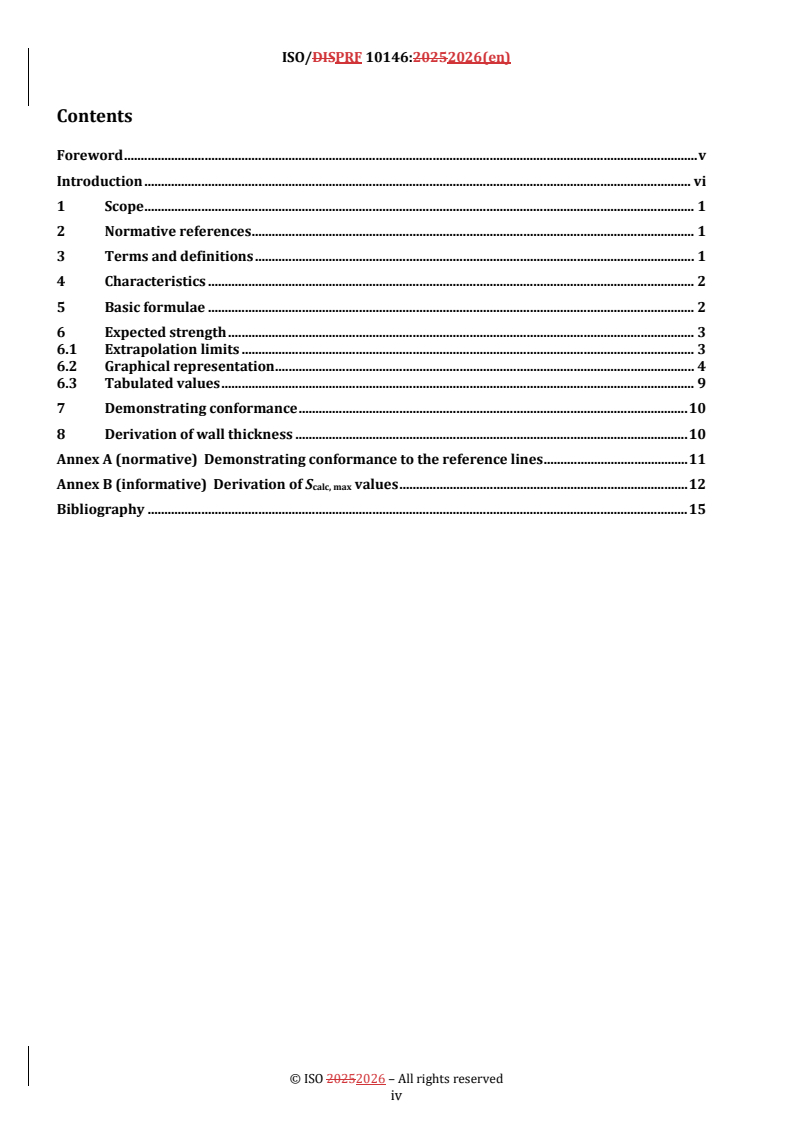
Contents
Foreword . v
Introduction . vi
1 Scope . 1
2 Normative references . 1
3 Terms and definitions . 1
4 Characteristics . 2
5 Basic formulae . 2
6 Expected strength . 3
6.1 Extrapolation limits . 3
6.2 Graphical representation . 4
6.3 Tabulated values . 9
7 Demonstrating conformance . 10
8 Derivation of wall thickness . 10
Annex A (normative) Demonstrating conformance to the reference lines . 11
Annex B (informative) Derivation of S values . 12
calc, max
Bibliography . 15
iv
ISO/DISPRF 10146:2026(en)
Foreword
ISO (the International Organization for Standardization) is a worldwide federation of national standards
bodies (ISO member bodies). The work of preparing International Standards is normally carried out through
ISO technical committees. Each member body interested in a subject for which a technical committee has been
established has the right to be represented on that committee. International organizations, governmental and
non-governmental, in liaison with ISO, also take part in the work. ISO collaborates closely with the
International Electrotechnical Commission (IEC) on all matters of electrotechnical standardization.
The procedures used to develop this document and those intended for its further maintenance are described
in the ISO/IEC Directives, Part 1. In particular, the different approval criteria needed for the different types of
ISO document should be noted. This document was drafted in accordance with the editorial rules of the
ISO/IEC Directives, Part 2 (see www.iso.org/directives).
ISO draws attention to the possibility that the implementation of this document may involve the use of (a)
patent(s). ISO takes no position concerning the evidence, validity or applicability of any claimed patent rights
in respect thereof. As of the date of publication of this document, ISO had not received notice of (a) patent(s)
which may be required to implement this document. However, implementers are cautioned that this may not
represent the latest information, which may be obtained from the patent database available at
www.iso.org/patents. ISO shall not be held responsible for identifying any or all such patent rights.
Any trade name used in this document is information given for the convenience of users and does not
constitute an endorsement.
For an explanation of the voluntary nature of standards, the meaning of ISO specific terms and expressions
related to conformity assessment, as well as information about ISO's adherence to the World Trade
Organization (WTO) principles in the Technical Barriers to Trade (TBT), see www.iso.org/iso/foreword.html.
This document was prepared by Technical Committee ISO/TC 138, (Plastics pipes, fittings and valves for the
transport of fluids),, Subcommittee SC 5, (General properties of pipes, fittings and valves of plastic materials and
their accessories —Test methods and basic specifications).
This third edition cancels and replaces the second edition (ISO 10146:2019), which has been technically
revised. The main changes compared to the previous edition are as follows:
— The main changes are as follows:
— Annex Anormative Annex A,, which describes the procedure to demonstrate conformance to this
document, has been modified.;
— Annex B— An informative Annex B has been added, which describes to describe the principles of
dimensioning of piping components.
Any feedback or questions on this document should be directed to the user’s national standards body. A
complete listing of these bodies can be found at www.iso.org/members.html.
v
ISO/DISPRF 10146:20252026(en)
Introduction
Since the early 1960 years, Polyethylene1960s, polyethylene has been used in a wide range of applications, in
particular for pressure piping. For normal Polyethylenepolyethylene materials, there is a limitation in the
application temperature, meaning this material is typically not suitable for hot and cold-water installations.
With the development of the crosslinking technique, this temperature limitation could be overcome, and the
Polyethylenepolyethylene material became suitable also for hot and cold pressure piping applications.
At the date of publication of this document, theThe following International Standards dealing with PE-X in
plastics and multilayer piping systems for hot and cold water installations have been published:
— — ISO 15875 series, Plastics piping systems for hot and cold-water installations — Crosslinked polyethylene
(PE-X)
— — ISO 21003 series, Multilayer piping systems for hot and cold-water installations inside buildings
vi
DRAFT International Standard ISO/DIS 10146:2026(en)
Crosslinked polyethylene (PE-X) and crosslinked medium density
polyethylene (PE-MDX) — Effect of time and temperature on expected
strength
1 Scope
This document specifies the minimum values for expected strength as a function of time and temperature in
the form of reference lines, for use in calculations on crosslinked polyethylene (PE-X) pipes and crosslinked
medium density polyethylene (PE-MDX) pipes.
This document is applicable for pipes with the minimum level of crosslinking after production in accordance
with Clause 4Clause 4.
NOTE The density range for medium density polyethylene is 926 kg/m3 to 940 kg/m3 in accordance with ISO
17855-1.
2 Normative references
The following documents are referred to in the text in such a way that some or all of their content constitutes
requirements of this document. For dated references, only the edition cited applies. For undated references,
the latest edition of the referenced document (including any amendments) applies.
ISO 9080:2012, Plastics piping and ducting systems — Determination of the long-term hydrostatic strength of
thermoplastics materials in pipe form by extrapolation
ISO 10147, Pipes and fittings made of crosslinked polyethylene (PE-X) — Estimation of the degree of crosslinking
by determination of the gel content
3 Terms and definitions
For the purposes of this document, the following terms and definitions apply.
ISO and IEC maintain terminology databases for use in standardization at the following addresses:
— — ISO Online browsing platform: available at https://www.iso.org/obp
— — IEC Electropedia: available at https://www.electropedia.org/
3.1 3.1
reference line
generic description of the minimum long-term hydrostatic strength to be expected from a particular polymer.
Note 1 to entry: Reference lines are not intended to be considered as being characteristic of a specific grade or of material
from a specific supplier.
ISO/CDPRF 10146:20252026(en)
Note 2 to entry: The lines are described by a mathematical formula which permits interpolation and extrapolation in an
unambiguous way within the applicable temperature and time ranges.
4 Characteristics
Prior to testing to demonstrate conformance to the reference lines given in this document, the pipes shall meet
the following minimum degree of crosslinking as given in Table 1Table 1 and as measured in accordance with
ISO 10147.
Table 1 — Requirements for degree of crosslinking
Crosslinking Requirement Characteristics Test method
process
Degree of
a
crosslinking
Peroxide ≥70 % According to ISO 10147
PE-Xa, PE-MDXa ISO 10147
Silane ≥65 %
PE-Xb, PE-MDXb
Electron beam ≥60 %
PE-Xc, PE-MDXc
UV light initiated ≥70 %
PE-Xe, PE-MDXe
[6]
a Reference [6] indicates a maximum degree of crosslinking
.
5 Basic formulae
The reference lines described by Formula (1)Formula (1) are applicable for temperatures between 10 °C and
95 °C.
log t = A + B/T + C log σ + (D/T) log σ (1)
10 10 10
where
t is the time, in h;
T is the temperature, in K;
σ is the hoop stress, in MPa.
For PE-X:
A = – 105,861 8
B = 57 895,49
C = – 24,799 7
D = – 18 506,15
i.e. : log t = – 105,861 8 + 57 895,49/T -24,799 7 log σ – (18 506,15/T) log σ
10 10 10
For PE-MDX
ISO/DISPRF 10146:2026(en)
A = – 129,108 9
B = 58 914,15
C = 20,630 6
D = – 26 934,09
i.e. : log t = – 129,108 9 + 58 914,15/T +20,630 6 log σ – (26 934,09/T) log σ
10 10
...