

ISO 20565-2:2008
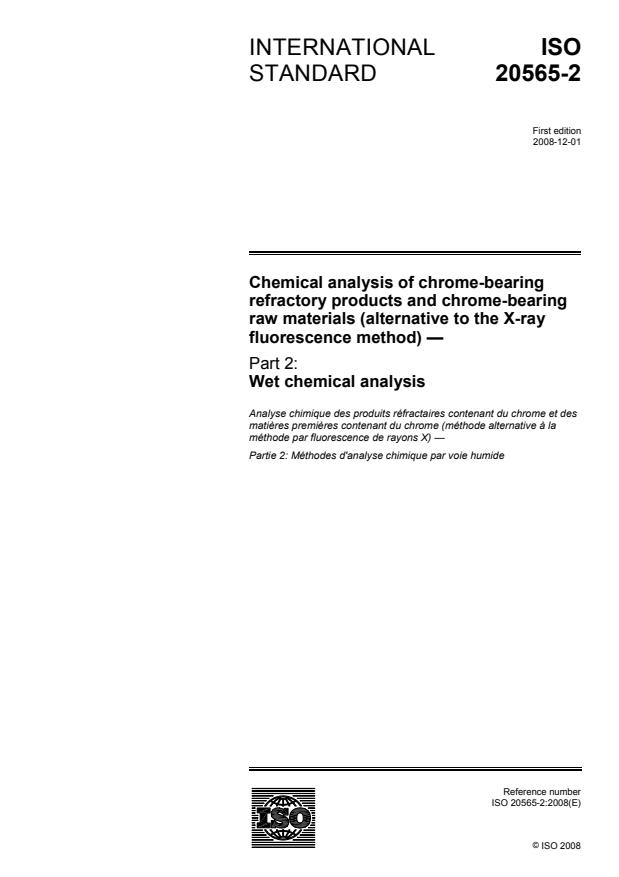
(Main)Chemical analysis of chrome-bearing refractory products and chrome-bearing raw materials (alternative to the X-ray fluorescence method) — Part 2: Wet chemical analysis
General Information
- Abstract
ISO 20565-2:2008 specifies traditional (“wet process”) methods for the chemical analysis of chrome-bearing refractory products and raw materials.
- Status
- Published
- Publication Date
- 24-Nov-2008
- Technical Committee
- ISO/TC 33 - Refractories
- Drafting Committee
- ISO/TC 33 - Refractories
- Current Stage
- 9093 - International Standard confirmed
- Start Date
- 31-Mar-2023
- Completion Date
- 29-Aug-2026
Buy Documents
ISO 20565-2:2008 - Chemical analysis of chrome-bearing refractory products and chrome-bearing raw materials (alternative to the X-ray fluorescence method) — Part 2: Wet chemical analysis Released:11/25/2008
ISO 20565-2:2008 - Analyse chimique des produits réfractaires contenant du chrome et des matieres premieres contenant du chrome (méthode alternative a la méthode par fluorescence de rayons X) — Partie 2: Méthodes d'analyse chimique par voie humide Released:11/25/2008
Overview - ISO 20565-2:2008 (Wet chemical analysis)
ISO 20565-2:2008 specifies traditional "wet process" analytical methods for the chemical analysis of chrome-bearing refractory products and chrome-bearing raw materials as an alternative to X‑ray fluorescence (XRF). It sets out reagent procedures, titrimetric and colorimetric tests, spectrophotometric measurements and calibration/blanking requirements for routine laboratory determination of major and minor oxide components. The part complements ISO 20565‑1 (apparatus, reagents and dissolution) and ISO 20565‑3 (FAAS/ICP‑AES).
Key topics and technical requirements
- Scope and applicability: Methods are applicable to components within specified ranges (Table 1), e.g. MgO 15–85%, Cr2O3 2–60%, Al2O3 2–30%, SiO2 0.5–10%, Fe2O3 0.5–25%, plus TiO2, MnO, CaO, Na2O, K2O, ZrO2, P2O5 and LOI.
- Silicon(IV) oxide (SiO2): Two colorimetric approaches - combined coagulation/dehydration with the molybdenum‑blue reaction (and a dedicated molybdenum‑blue method). Includes calibration, blank tests and absorbance measurement at 650 nm.
- Aluminium oxide (Al2O3): Two separation/titrimetric options - CyDTA‑zinc back‑titrimetric method (cation‑exchange separation) and cupferron extraction followed by CyDTA back‑titration; procedures include pH control, complexation, and titration end‑point detection with xylenol orange.
- Other determinands and methods:
- Fe2O3 (total iron as Fe2O3), TiO2, MnO, CaO, MgO - classical wet chemistry/titrimetric routes.
- Na2O and K2O - flame photometry / flame spectrophotometry.
- Cr2O3 - dedicated wet chemical determination.
- ZrO2 - xylenol orange absorption spectroscopy.
- P2O5 - molybdenum blue method for phosphate.
- Quality controls: Calibration graphs, blank tests, replicate absorbance checks, and specified aliquot volumes and reagent volumes are required to ensure accuracy and repeatability.
Applications and users
- Intended for industrial and laboratory quality control of refractories and raw materials where XRF is not available or as a confirmatory alternative.
- Primary users:
- Refractory manufacturers and raw‑material suppliers
- Metallurgical plants and ceramic producers
- Chemical and materials testing laboratories
- Standards and conformity assessment bodies
- Practical benefits: low‑cost instrumentation compared with XRF/ICP, established wet‑chemistry techniques for routine compositional analysis and contractual testing.
Related standards
- ISO 20565‑1:2008 - Apparatus, reagents, dissolution and gravimetric silica
- ISO 20565‑3:2008 - FAAS and ICP‑AES methods (instrumental alternatives)
- ISO 26845:2008 - General requirements for wet chemical analysis, AAS and ICP‑AES methods
Keywords: ISO 20565-2:2008, wet chemical analysis, chrome-bearing refractory products, chrome-bearing raw materials, molybdenum blue, CyDTA, cupferron, flame photometry, ZrO2 xylenol orange.
Relations
- Effective Date
- 09-Feb-2026
- Effective Date
- 09-Feb-2026
- Effective Date
- 09-Feb-2026
- Effective Date
- 12-Feb-2026
Buy Documents
ISO 20565-2:2008 - Chemical analysis of chrome-bearing refractory products and chrome-bearing raw materials (alternative to the X-ray fluorescence method) — Part 2: Wet chemical analysis Released:11/25/2008
ISO 20565-2:2008 - Analyse chimique des produits réfractaires contenant du chrome et des matieres premieres contenant du chrome (méthode alternative a la méthode par fluorescence de rayons X) — Partie 2: Méthodes d'analyse chimique par voie humide Released:11/25/2008
Frequently Asked Questions
ISO 20565-2:2008 is a standard published by the International Organization for Standardization (ISO). Its full title is "Chemical analysis of chrome-bearing refractory products and chrome-bearing raw materials (alternative to the X-ray fluorescence method) — Part 2: Wet chemical analysis". This standard covers: ISO 20565-2:2008 specifies traditional (“wet process”) methods for the chemical analysis of chrome-bearing refractory products and raw materials.
ISO 20565-2:2008 specifies traditional (“wet process”) methods for the chemical analysis of chrome-bearing refractory products and raw materials.
ISO 20565-2:2008 is classified under the following ICS (International Classification for Standards) categories: 81.080 - Refractories. The ICS classification helps identify the subject area and facilitates finding related standards.
ISO 20565-2:2008 has the following relationships with other standards: It is inter standard links to EN ISO 21068-3:2024, EN ISO 21068-3:2008, EN ISO 1927-3:2012, EN ISO 20565-2:2008. Understanding these relationships helps ensure you are using the most current and applicable version of the standard.
ISO 20565-2:2008 is available in PDF format for immediate download after purchase. The document can be added to your cart and obtained through the secure checkout process. Digital delivery ensures instant access to the complete standard document.
Standards Content (Sample)
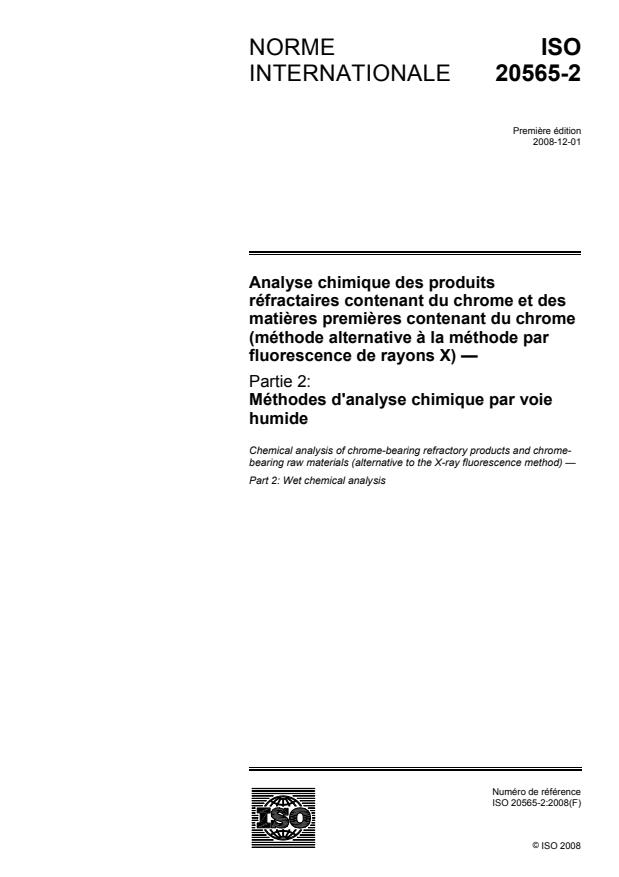
INTERNATIONAL ISO
STANDARD 20565-2
First edition
2008-12-01
Chemical analysis of chrome-bearing
refractory products and chrome-bearing
raw materials (alternative to the X-ray
fluorescence method) —
Part 2:
Wet chemical analysis
Analyse chimique des produits réfractaires contenant du chrome et des
matières premières contenant du chrome (méthode alternative à la
méthode par fluorescence de rayons X) —
Partie 2: Méthodes d'analyse chimique par voie humide
Reference number
©
ISO 2008
PDF disclaimer
This PDF file may contain embedded typefaces. In accordance with Adobe's licensing policy, this file may be printed or viewed but
shall not be edited unless the typefaces which are embedded are licensed to and installed on the computer performing the editing. In
downloading this file, parties accept therein the responsibility of not infringing Adobe's licensing policy. The ISO Central Secretariat
accepts no liability in this area.
Adobe is a trademark of Adobe Systems Incorporated.
Details of the software products used to create this PDF file can be found in the General Info relative to the file; the PDF-creation
parameters were optimized for printing. Every care has been taken to ensure that the file is suitable for use by ISO member bodies. In
the unlikely event that a problem relating to it is found, please inform the Central Secretariat at the address given below.
© ISO 2008
All rights reserved. Unless otherwise specified, no part of this publication may be reproduced or utilized in any form or by any means,
electronic or mechanical, including photocopying and microfilm, without permission in writing from either ISO at the address below or
ISO's member body in the country of the requester.
ISO copyright office
Case postale 56 • CH-1211 Geneva 20
Tel. + 41 22 749 01 11
Fax + 41 22 749 09 47
E-mail copyright@iso.org
Web www.iso.org
Published in Switzerland
ii © ISO 2008 – All rights reserved
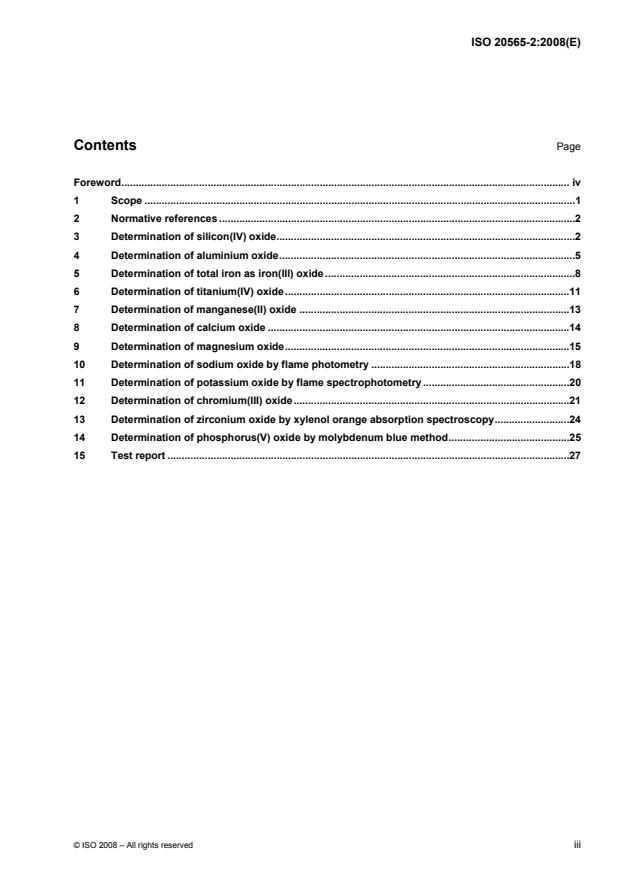
Contents Page
Foreword. iv
1 Scope .1
2 Normative references .2
3 Determination of silicon(IV) oxide.2
4 Determination of aluminium oxide.5
5 Determination of total iron as iron(III) oxide .8
6 Determination of titanium(IV) oxide.11
7 Determination of manganese(II) oxide .13
8 Determination of calcium oxide .14
9 Determination of magnesium oxide.15
10 Determination of sodium oxide by flame photometry .18
11 Determination of potassium oxide by flame spectrophotometry .20
12 Determination of chromium(III) oxide.21
13 Determination of zirconium oxide by xylenol orange absorption spectroscopy.24
14 Determination of phosphorus(V) oxide by molybdenum blue method.25
15 Test report .27
Foreword
ISO (the International Organization for Standardization) is a worldwide federation of national standards bodies
(ISO member bodies). The work of preparing International Standards is normally carried out through ISO
technical committees. Each member body interested in a subject for which a technical committee has been
established has the right to be represented on that committee. International organizations, governmental and
non-governmental, in liaison with ISO, also take part in the work. ISO collaborates closely with the
International Electrotechnical Commission (IEC) on all matters of electrotechnical standardization.
International Standards are drafted in accordance with the rules given in the ISO/IEC Directives, Part 2.
The main task of technical committees is to prepare International Standards. Draft International Standards
adopted by the technical committees are circulated to the member bodies for voting. Publication as an
International Standard requires approval by at least 75 % of the member bodies casting a vote.
Attention is drawn to the possibility that some of the elements of this document may be the subject of patent
rights. ISO shall not be held responsible for identifying any or all such patent rights.
ISO 20565-2 was prepared by Technical Committee ISO/TC 33, Refractories, in collaboration with Technical
Committee CEN/TC 187, Refractory products and materials.
ISO 20565 consists of the following parts, under the general title Chemical analysis of chrome-bearing
refractory products and chrome-bearing raw materials (alternative to the X-ray fluorescence method):
⎯ Part 1: Apparatus, reagents, dissolution and determination of gravimetric silica
⎯ Part 2: Wet chemical analysis
⎯ Part 3: Flame atomic absorption spectrometry (FAAS) and inductively coupled plasma atomic emission
spectrometry (ICP-AES)
iv © ISO 2008 – All rights reserved
INTERNATIONAL STANDARD ISO 20565-2:2008(E)
Chemical analysis of chrome-bearing refractory products and
chrome-bearing raw materials (alternative to the X-ray
fluorescence method) —
Part 2:
Wet chemical analysis
1 Scope
This part of ISO 20565 specifies traditional (“wet process”) methods for the chemical analysis of chrome-
bearing refractory products and raw materials.
It is applicable to components within the ranges of determination given in Table 1.
Table 1 — Range of determination (% by mass)
Component Range
SiO
0,5 to 10
Al O
2 to 30
2 3
Fe O
0,5 to 25
2 3
TiO
0,01 to 1
MnO 0,01 to 1
CaO 0,01 to 3
MgO 15 to 85
Na O
0,01 to 1
K O
0,01 to 1
Cr O
2 to 60
2 3
ZrO
0,01 to 0,5
P O
0,01 to 5
2 5
LOI
−0,5 to 5
NOTE These values are after the loss on ignition (LOI) has been
taken into account.
2 Normative references
The following referenced documents are indispensable for the application of this document. For dated
references, only the edition cited applies. For undated references, the latest edition of the referenced
document (including any amendments) applies.
ISO 20565-1:2008, Chemical analysis of chrome-bearing refractory products and chrome-bearing raw
materials (alternative to the X-ray fluorescence method) — Part 1: Apparatus, reagents, dissolution and
determination of gravimetric silica
ISO 26845:2008, Chemical analysis of refractories — General requirements for wet chemical analysis, atomic
absorption spectrometry (AAS) and inductively compled plasma atomic emission spectromety (ICP-AES)
methods
3 Determination of silicon(IV) oxide
3.1 General
Determine the silicon(IV) oxide content using one of the following methods.
a) Combined use of the dehydration or the coagulation and molybdenum blue methods
This method is applied to samples consisting of more than 4 % by mass of silicon(IV) oxide.
b) Molybdenum blue method
This method is applied to samples consisting of less than 10 % by mass of silicon(IV) oxide.
3.2 Combined use of the coagulation and molybdenum blue methods
3.2.1 Principle
An aliquot portion of the stock solution (S1) (see ISO 20565-1), after pH adjustment, is treated with
ammonium molybdate and the silicomolybdate is reduced to yield molybdenum blue, the absorbance of which
is measured.
The sum of this residual silicon(IV) oxide in solution plus the mass of silicon(IV) oxide determined in
ISO 20565-1:2008, 9.2.2.3.3, gives the total silicon(IV) oxide content.
3.2.2 Procedure
This determination should be commenced with little delay after the stock solution (S1) is prepared, as
prolonged standing may allow polymerization of silica to occur leading to low results.
Transfer 10 ml of stock solution (S1) (see ISO 20565-1) to a 100 ml plastic beaker, add 2 ml of hydrofluoric
acid (1+9) and mix with a plastic rod. Allow to stand for 10 min and add 50 ml of boric acid solution. Add 2 ml
of ammonium molybdate solution while mixing at a temperature of 25 °C and allow to stand for 10 min. Add
5 ml of L (+)-tartaric acid solution while stirring and, after 1 min, add 2 ml of L (+)-ascorbic acid solution.
Transfer the solution to a 100 ml volumetric flask, dilute to the mark with water, mix and allow to stand for
60 min.
Measure the absorbance of the solution in a 10 mm cell at a wavelength of 650 nm against water as a
reference.
2 © ISO 2008 – All rights reserved
3.2.3 Plotting calibration graph
Transfer 0 ml, 2 ml, 4 ml, 6 ml, 8 ml and 10 ml aliquot portions of diluted standard silicon(IV) oxide solution
(0 mg to 0,4 mg as silicon(IV) oxide) to separate 100 ml plastic beakers and add to each 10 ml of blank
solution (B1) (see ISO 20565-1). Treat these solutions and measure the absorbance as given in 3.2.2, and
plot the absorbances against the amounts of silicon(IV) oxide. Prepare the calibration graph by adjusting the
curve so that it passes through the point of origin.
3.2.4 Blank test
Using blank solution (B1), carry out the procedure given in 3.2.2.
3.2.5 Calculation
Calculate the mass fraction of silicon(IV) oxide, w , expressed as a percentage, using Equation (1) with
SiO
the absorbances obtained in 3.2.2 and 3.2.4 and the calibration in 3.2.3.
mm−+m−m×
()()
12 s b
w=×100 (1)
SiO
m
where
m is the mass from ISO 20565-1, in grams (g);
m is the mass from ISO 20565-1, in grams (g);
m is the mass of silicon(IV) oxide in the aliquot portion of stock solution (S1) as applicable, in grams (g);
s
m is the mass of silicon(IV) oxide in the aliquot portion of blank solution (B1) as applicable, in grams (g);
b
m is the mass of the test portion from ISO 20565-1, in grams (g).
3.3 Molybdenum blue method
3.3.1 Principle
An aliquot portion of the stock solution (S′1) (see ISO 20565-1), after pH adjustment, is treated with
ammonium molybdate and the silicomolybdate is reduced to yield molybdenum blue, the absorbance of which
is measured.
3.3.2 Procedure
Transfer precisely an aliquot portion of stock solution (S′1) (to two 100 ml plastic beakers and add to each an
aliquot portion of blank solution obtained from 3.3.3. Add to each beaker 2 ml of hydrofluoric acid (1+9), mix
with a plastic rod and allow to stand for 10 min. Add 50 ml of boric acid solution, dilute to 80 ml with water.
Add 5 ml of ammonium molybdate solution while mixing at a temperature of 25 °C and allow to stand for
10 min. Add 5 ml of L (+)-tartaric acid solution while stirring and, after 1 min, add 10 ml of L (+)-ascorbic acid
solution. Transfer each solution to a 200 ml volumetric flask, dilute to the mark with water and mix. Allow to
stand for 60 min and measure the absorbance of the solutions in a 10 mm cell at a wavelength of 650 nm
against water as a reference. Take the mean of the two measurements.
NOTE Aliquot volumes of stock solution and blank solution (B′1) are shown in Table 2, corresponding to the content
of silicon(IV) oxide in the sample.
When the difference of the two absorbance measurements is greater than 0,005, repeat the procedure in
3.3.2. When measurements of the same sample with around 1,0 absorbance are repeated, it is necessary for
the spectrophotometer to show the differences within 0,002.
Table 2 — Aliquot volumes of stock and blank solutions
Mass fraction Aliquot portion Aliquot portion
of silicon(IV) oxide
of stock solution (S′1) of blank solution (B′1)
%
ml ml
< 2 20 0
2 to 4 10 10
4 to 10 5 15
3.3.3 Blank test
Using the blank solution (B′1) (see ISO 20565-1), follow the procedure given in 3.3.2. The volume of the
aliquot portion of blank solution is the same as that for the corresponding stock solution.
3.3.4 Plotting of calibration graph
Transfer 0 ml, 5 ml, 10 ml, 15 ml, 20 ml and 25 ml aliquot portions of diluted standard silicon(IV) oxide solution
[0 mg to 1 mg as silicon(IV) oxide] to separate 100 ml plastic beakers and add to each 20 ml of blank solution
(B′1) (see ISO 20565-1). Treat these solutions and measure the absorbance in accordance with the
procedure for addition of hydrofluoric acid (1+9) in 3.3.2. Plot the absorbance against the amounts of
silicon(IV) oxide and prepare the calibration graph by adjusting the curve so that it passes through the point of
origin.
3.3.5 Calculation
Calculate the mass fraction of silicon(IV) oxide, w , expressed as a percentage, using Equation (2) with
SiO
the amount of silicon(IV) oxide derived from the absorbance measurements obtained in 3.3.2 and 3.3.3 and
the calibration in 3.3.4.
mm− 250
sb
w=××100 (2)
SiO
mV
where
m is the mass of silicon(IV) oxide in the aliquot portion of stock solution (S′1), in grams (g);
s
m is the mass of silicon(IV) oxide in the aliquot portion of blank solution (B′1), in grams (g);
b
V is the aliquot volume of stock solution (S′1), in millilitres (ml);
m is the mass of the test portion, in grams (g).
4 © ISO 2008 – All rights reserved
4 Determination of aluminium oxide
4.1 General
Determine the aluminium oxide content using one of the following methods:
a) cation-exchange separation — CyDTA-zinc back-titrimetric method (see 4.2);
b) cupferron extraction separation — CyDTA-zinc back-titrimetric method (see 4.3).
4.2 Cation-exchange separation — (1,2-Cyclohexylenenitrilo)tetraacetic acid zinc [CyDTA-
zinc] back-titrimetric method
4.2.1 Principle
An aliquot portion of stock solution (SE-a) is transferred. Excess CyDTA solution is added to it. A chelate
compound of aluminium CyDTA is formed by adjusting the pH with ammonia solution. The pH is further
adjusted by the addition of hexamethylenetetramine. The amount of remaining CyDTA is determined by back-
titration with zinc standard volumetric solution using xylenol orange as an indicator. The content of aluminium
oxide is calculated by adjusting the content of titanium(IV) oxide.
4.2.2 Procedure
4.2.2.1 Transfer precisely an aliquot portion of stock solution (SE-a) (see ISO 20565-1 and the following
paragraph) to a 300 ml beaker. Add an amount of 0,01 mol/l CyDTA solution, in accordance with Table 4, and
dilute to 100 ml with water. Add 1 g of hexamethylenetetramine and a drop of methyl orange solution as an
indicator. Drop in ammonia water (1+1) and ammonia solution (1+9) of up to pH 3 until it indicates a slightly
orange colour (see the paragraph directly below Table 3). Allow to stand for 5 min.
In Table 3, the aliquot volume of stock solution (SE-a) is shown. It depends on the volume of the aliquot
portion of stock solution (S5) used in ISO 20565-1.
Table 3 — Aliquot volume of stock solution (SE-a)
Aliquot volume of stock solution (S5) Aliquot volume of stock solution (SE-a)
ml ml
100 40
50 80
If ammonia solution is added to excess, add hydrochloric acid (1+1) until the colour is changed to red, then
adjust in the same manner.
NOTE The volume of 0,01 mol/l of CyDTA solution added depends on the mass fraction of aluminium oxide as
shown in Table 4.
Table 4 — Aliquot volume of 0,01 mol/l CyDTA solution
Mass fraction of aluminium oxide Volume of 0,01 mol/l CyDTA solution
% ml
< 5 10
5 to 10 20
10 to 15 30
15 to 20 40
20 to 30 50
4.2.2.2 Add 5 g of hexamethylenetetramine of pH 5,5 to 5,8, add 4 or 5 drops of xylenol orange solution
as an indicator and titrate with 0,01 mol/l zinc standard volumetric solution. Titrate while mixing gently and
when the colour changes from yellow to the first appearance of a permanent reddish colour, consider this as
the end point.
4.2.3 Blank test
Using the blank solution (BE-a) (see ISO 20565-1), follow the procedure given in 4.2.2. The volumes of the
aliquot portion of blank solution (BE-a) and 0,01 mol/l CyDTA solution are the same as those for the
corresponding stock solution (SE-a).
4.2.4 Calculation
Calculate the mass fraction of aluminium oxide, w , expressed as a percentage, using Equation (3).
Al O
(VV−×) F× 0,000 509 8 100 250
ww=×××100−× 0,638 (3)
Al O TiO
23 2
m 40 100
where
V is the volume of 0,01 mol/l zinc standard volumetric solution in 4.2.3, in millilitres (ml);
V is the volume of 0,01 mol/l zinc standard volumetric solution in 4.2.2.2, in millilitres (ml);
F is the factor of 0,01 mol/l zinc standard volumetric solution;
m is the mass of the test portion (see ISO 20565-1), in grams (g);
w is the mass fraction of titanium(IV) oxide determined in 6.2.5 or 6.3.5, expressed as a percentage.
TiO
4.3 Cupferron extraction separation — (1,2-Cyclohexylenenitrilo)tetraacetic acid zinc
[CyDTA-zinc] back-titrimetric method
4.3.1 Principle
An aliquot portion of the stock solution (S6) (see ISO 20565-1) is cleaned up using first diethyldicarbonate and
then cupferron in a separating funnel. To the resulting solution an excess of CyDTA is added, then back-
titrated with a standard zinc solution.
6 © ISO 2008 – All rights reserved
4.3.2 Procedure
4.3.2.1 Transfer 100 ml of the stock solution (S6) to the 500 ml separating funnel. Add the ammonia solution
drop by drop until the solution is faintly alkaline to bromophenol blue. Re-acidify with dilute hydrochloric acid
(1+3) and add an extra 4 ml. Add 20 ml of chloroform and 10 ml of sodium diethyldithiocarbamate solution.
Stopper the funnel and shake vigorously. Release the pressure in the funnel by carefully removing the stopper
and rinse the stopper and neck of the funnel with water. Allow the layers to separate and withdraw the
chloroform layer.
If an emulsion has formed, it will be necessary to add a few drops of hydrochloric acid and reshake.
Add 10 ml portions of chloroform and 5 ml portions of the sodium diethyldithiocarbamate and repeat the
extraction until a coloured precipitate (brown or pink) is no longer formed. Wash the aqueous phase with 20 ml
of chloroform to remove iron and manganese.
4.3.2.2 Add 25 ml of the hydrochloric acid, concentrated, 36 % by mass, followed by 2 ml to 3 ml of cupferron
solution and 20 ml of chloroform. Stopper the funnel and shake vigorously. Remove the stopper and rinse the
stopper and neck of the funnel with water. Allow the layers to separate and withdraw the chloroform layer.
Repeat the extraction with three 10 ml portions of chloroform to remove traces of cupferron and sodium
diethyldithiocarbamate. Run the aqueous phase from the separating funnel to a 1 l conical flask. Add a few
drops of bromophenol blue indicator, followed by the ammonia solution until the solution is just alkaline. Re-
acidify quickly with the concentrated hydrochloric acid, add an extra 5 to 6 drops and cool the flask in running
water.
4.3.2.3 Ensure that the solution is cold. Add CyDTA standard solution (0,05 M approximately) to produce an
excess of a few millilitres over the expected amount (1 ml = 1,275 % Al O ). Add ammonium acetate buffer
2 3
solution until the indicator turns blue, followed by an extra 15 ml. Add a volume of ethanol equal to the total
volume of the solution, then add 20 ml of the hydroxyammonium chloride solution and 1 ml to 2 ml of the
dithizone indicator. Titrate with zinc standard solution (0,05 M) from green to the first appearance of a
permanent pink colour.
NOTE The end point is often improved by the addition of a little naphthol green solution to eliminate any early
formation of pink colour that might have formed in the solution on the addition of the indicator.
4.3.3 Calculation
Calculate the mass fraction of aluminium oxide, w , expressed as a percentage, using Equation (4).
Al O
(VF×−V×F )× 0,001 019 6 250
11 2 2
w=××100 (4)
Al O
m 100
where
V is the volume of the 0,05 mol/l CyDTA standard solution in 4.3.2.3, in millilitres (ml);
F is the factor of the 0,05 mol/l CyDTA standard solution;
V is the volume of 0,05 mol/l zinc standard solution used in the back-titration in 4.3.2.3,
in millilitres (ml);
F is the factor of 0,05 mol/l zinc standard solution;
m is the mass of the test portion (see ISO 20565-1), in grams (g).
5 Determination of total iron as iron(III) oxide
5.1 General
Determine the iron(III) oxide content using one of the following methods.
a) 1,10-Phenanthroline absorption method using stock solution (S6) or (S′6) (see ISO 20565-1)
This method is applied to samples consisting of less than 15 % by mass of iron(III) oxide (see 5.2).
b) 1,10-Phenanthroline absorption method using stock solution (SE-b) (see ISO 20565-1)
This method is applied to samples consisting of less than 15 % by mass of iron(III) oxide (see 5.3).
c) CyDTA-Zinc back-titrimetric method
This method is applied to samples consisting of 10 % by mass or more of iron(III) oxide (see 5.4).
5.2 1,10-Phenanthroline absorption method using stock solution (S6) or (S′6)
5.2.1 Principle
An aliquot portion of the stock solution (S6) (see ISO 20565-1) is reduced with hydroxylamine chloride to
iron(II) oxide, coloured with 1,10 ortho-phenanthroline and its absorbance measured at 510 nm.
5.2.2 Procedure
5.2.2.1 Dilute 25,0 ml of the stock solution (S6) (see ISO 20565-1) with water to 500 ml in a volumetric flask
and mix. Transfer 25 ml of this diluted solution to a 100 ml volumetric flask and add 2 ml of the
hydroxyammonium chloride solution followed by 5 ml of the phenanthroline solution. Add the ammonium
acetate solution until a pink colour forms, then add an extra 2 ml. Allow to stand for 15 min, dilute the solution
with water to 100 ml and mix. Use a spectrophotometer to measure the optical density of the solution against
water in 10 mm cells at 510 nm.
NOTE The use of a filter-type absorptiometer is not appropriate to this test.
5.2.2.2 Add ammonium acetate solution to stabilize the colour. Ensure that the colour is stable from 15 min to
75 min. Determine the iron(II) oxide content of the solution by reference to a calibration graph.
NOTE The dilution of the “stock” solution quoted will cover the range from 0 % to 20 % Fe O by mass. For iron
2 3
mass fractions considerably below 20 % Fe O , a decreased dilution of the “stock” solution needs to be made. The aliquot
2 3
portion of the solution should not be diluted once the colour has developed.
5.2.3 Blank test
Using blank solution (B6) (see ISO 20565-1), carry out the procedure given in 5.2.2. The volume of the aliquot
portion of blank solution is the same as those for the corresponding stock solution.
5.2.4 Plotting of calibration graph
Transfer a range from 0 ml to 15,0 ml aliquot portions of the diluted iron(III) oxide standard solution [0 mg to
0,6 mg as iron(III) oxide] to separate 250 ml volumetric flasks. Treat these solutions in accordance with 5.2.2.1
and measure the absorbance against the reference solution. Plot the relation between the absorbance and the
mass of iron(III) oxide. Prepare the calibration graph by adjusting the curve so that it passes through the point
of origin.
8 © ISO 2008 – All rights reserved
5.2.5 Calculation
Calculate the mass fraction of iron(III) oxide, w , expressed as a percentage, using Equation (5), using
Fe O
the amount of iron(III) oxide which is derived from the absorbance obtained in 5.2.2.2 and 5.2.3 and the
calibration in 5.2.4.
mm−
100 500
sb
w =×× (5)
Fe O
m 25 25
where
m is the mass of iron(III) oxide in the aliquot portion of stock solution (S6), in grams (g);
s
m is the mass of iron(III) oxide in the aliquot portion of blank solution (B6), in grams (g);
b
m is the mass of the test portion (see ISO 20565-1), in grams (g).
5.3 1,10-Phenanthroline absorption method using stock solution (SE-b)
5.3.1 Principle
Stock solution (SE-b) (see ISO 20565-1) is transferred and the iron is reduced with L (+)-ascorbic acid.
1,10-Phenanthroline chloride is added and the pH is adjusted by adding ammonium acetate when the colour
of iron develops. The absorbance is measured.
5.3.2 Procedure
5.3.2.1 Transfer precisely an appropriate aliquot portion obtained by the procedure used for stock
solution (SE-b) (see ISO 20565-1) to two 250 ml volumetric flasks, respectively. Add 5 ml of L (+)-ascorbic
acid solution to each while shaking. Add 25 ml of 1,10-phenanthroline chloride solution and 10 ml of
ammonium acetate solution. Dilute to the mark with water and allow to stand for 30 min.
In Table 5, an aliquot volume of stock solution (SE-b) is shown. It depends on the volume of the aliquot portion
(see ISO 20565-1:2008, Table 2) and the mass fraction of iron(III) oxide in the sample.
Table 5 — Aliquot volume of stock solution (SE-b)
Mass fraction Aliquot volume of stock solution (SE-b) taken in ISO 20565-1
of iron(III) oxide
100 ml 50 ml
%
20 40
< 8
> 8 10 20
5.3.2.2 Transfer a portion of the solution obtained in 5.3.2.1 to two absorption cells. Measure the
absorbance of each solution at the wavelength of 510 nm against water, and calculate the mean of the
measured values.
5.3.3 Blank test
Using blank solution (BE-b) (see ISO 20565-1), carry out the procedure in accordance with 5.3.2. The volume
of the aliquot portion of blank solution is the same as that for the corresponding stock solution.
5.3.4 Plotting of calibration graph
Transfer a range of 0 ml to 40,0 ml aliquot portions of the diluted iron(III) oxide standard solution [0 mg to
1,6 mg as iron(III) oxide] to several 250 ml volumetric flasks. Treat these solutions in accordance with 5.3.2.1
and measure the absorbance against the reference solution. Plot the relation between the absorbance and
mass of iron(III) oxide. Prepare the calibration graph by adjusting the curve so that it passes through the point
of origin.
5.3.5 Calculation
Calculate the mass fraction of iron(III) oxide, w , expressed as a percentage, using Equation (6), using
Fe O
the amount of iron(III) oxide which is derived from the absorbance obtained in 5.3.2.2 and 5.3.3 and the
calibration in 5.3.4.
mm−
250 100
sb
w =×××100 (6)
Fe O
mV V
where
m is the mass of iron(III) oxide in the aliquot portion of stock solution (SE-b), in grams (g);
s
m is the mass of iron(III) oxide in the aliquot portion of blank solution (BE-b), in grams (g);
b
V is the volume of the aliquot portion taken for stock solution (SE-b), in millilitres (ml);
V is the volume of aliquot portion taken for stock solution (SE-b), in grams (g);
m is the mass of the test portion described in ISO 20565-1, in grams (g).
5.4 (1,2-Cyclohexylenenitrilo)tetraacetic acid-zinc [CyDTA*-zinc] back-titrimetric method
5.4.1 Principle
An appropriate amount of CyDTA solution is added to an aliquot portion of stock solution (SE-b). A chelate
compound of iron CyDTA is formed by adjusting the pH with ammonia water. The pH is further adjusted by
addition of hexamethylenetetramine. The amount of remaining CyDTA is determined by back-titration with zinc
standard volumetric solution using xylenol orange as an indicator.
5.4.2 Procedure
5.4.2.1 Transfer precisely an appropriate volume of stock solution (SE-b) (see ISO 20565-1) to a 300 ml
beaker, add a precisely known amount of 0,01 mol/l of CyDTA solution and dilute to 100 ml with water.
In the case of 100 ml of the aliquot portion (in ISO 20565-1), use 50 ml of stock solution (SE-b).
In the case of 50 ml of the aliquot portion (in ISO 20565-1), use the entire stock solution (SE-b).
5.4.2.2 Use a volume of 0,01 mol/l of CyDTA solution, added depending on the content percentages of
iron(III) oxide, as shown in Table 6.
5.4.2.3 Carry out titration in accordance with 4.2.2.2 and add 2 g of hexamethylenetetramine.
10 © ISO 2008 – All rights reserved
Table 6 — Volume of 0,01 mol/l CyDTA solution
Mass fraction of iron(III) oxide Volume of 0,01 mol/l CyDTA solution
% ml
10 to 15 20
15 to 20 30
20 to 25 40
5.4.3 Blank test
Treat the blank solution (BE-b) (see ISO 20565-1) and carry out the procedure in accordance with 5.3.3. Use
the same volumes of the aliquot portion of blank solution (BE-b) and 0,01 mol/l CyDTA solution as those for
the corresponding stock solution (SE-b).
5.4.4 Calculation
Calculate the mass fraction of iron(III) oxide, w , expressed as a percentage, using Equation (7).
Fe O
(VV−×) F× 0,000 798 5
100 250
w=×××100 (7)
Fe O
m 50 100
where
V is the volume of 0,01 mol/l zinc standard volumetric solution in 5.4.3, in millilitres (ml);
V is the volume of 0,01 mol/l zinc standard volumetric solution in 5.4.2, in millilitres (ml);
F is the factor of 0,01 mol/l zinc standard volumetric solution;
m is the mass of the test portion (see ISO 20565-1), in grams (g).
6 Determination of titanium(IV) oxide
6.1 General
The titanium(IV) oxide determination method is carried out using one of the following two methods:
a) diantipyrylmethane (DAM) method (see 6.2);
b) hydrogen peroxide method (see 6.3).
6.2 Diantipyrylmethane (DAM) method
6.2.1 Principle
Stock solution (S1) or (S′1) (see ISO 20565-1) is transferred. After the adjustment of hydrochloric acidity, iron
is reduced with the addition of L (+)-ascorbic acid. The titanium is coloured by the DAM and the absorbance is
measured.
6.2.2 Procedure
6.2.2.1 Transfer precisely 20 ml of stock solution (S1) (see ISO 20565-1) or (S′1) (see ISO 20565-1) to a
50 ml volumetric flask. Add 5 ml of hydrochloric acid (1+1) and 5 ml of L (+)-ascorbic acid and allow to stand
for 1 min. Add 15 ml of DAM solution, shake the flask, dilute to the mark with water and allow to stand for
90 min.
6.2.2.2 Transfer precisely 20 ml of stock solution (S1) or (S′1) to a 50 ml volumetric flask. Add 5 ml of
hydrochloric acid (1+1) and 5 ml of L (+)-ascorbic acid and dilute to the mark with water.
6.2.2.3 Measure the absorbance of the solution obtained in 6.2.2.1 or 6.2.2.2 in a 10 mm cell at the
wavelength of 390 nm against water. Obtain the absorbance difference of the solutions obtained in 6.2.2.1
and 6.2.2.2.
6.2.3 Blank test
Using blank solution (B1) (see ISO 20565-1) or (B′1) (see ISO 20565-1), carry out the procedure described in
6.2.2. Use blank test solution (B1) corresponding to stock solution (S1) and blank test solution (B′1)
corresponding to stock solution (S′1).
6.2.4 Plotting of calibration graph
Transfer 0 ml, 5 ml, 15 ml and 20 ml aliquot portions of diluted titanium(IV) oxide standard solution
(0,01 mg/ml) [0 mg to 0,2 mg as titanium(IV) oxide] to separate 50 ml volumetric flasks and treat these
solutions as in 6.2.2.1. Plot the relation between the absorbance and the amount of titanium(IV) oxide.
Prepare the calibration graph by adjusting the curve so that it passes through the point of origin.
6.2.5 Calculation
Calculate the mass fraction of titanium(IV) oxide, w , expressed as a percentage, using Equation (8) with
TiO
the amount of titanium(IV) oxide derived from the absorbance obtained in 6.2.2.2 and 6.2.3 and the calibration
in 6.2.4.
mm− 250
sb
w 10=××0 (8)
TiO
m 20
where
m is the mass of titanium(IV) oxide in the aliquot portion of stock solution (S1) or (S′1), in grams (g);
s
m is the mass of titanium(IV) oxide in the aliquot portion of blank solution (B1) or (B′1), in grams (g);
b
m is the mass of the test portion used to prepare solution (S1 or S'1) in ISO 20565-1, in grams (g).
6.3 Hydrogen peroxide method
6.3.1 Principle
An aliquot portion is bleached with phosphoric acid, coloured with hydrogen peroxide and its absorbance
measured at 398 nm
6.3.2 Procedure
6.3.2.1 Transfer 20 ml of the stock solution (S6) (see ISO 20565-1) to each of the two 50 ml volumetric
flasks A and B. To each flask, add 10 ml of dilute phosphoric acid (2+3) and, to flask A only, add 10 ml of the
hydrogen peroxide solution.
12 © ISO 2008 – All rights reserved
6.3.2.2 Dilute the solution in each flask with water to 50 ml and shake well. Measure A against B in
40 mm cells at 398 nm, or by using a colour filter or filter of similar band-pass in a suitable instrument. Ensure
that the colour is stable from 5 min until 24 h after the addition of the hydrogen peroxide solution. Determine
the titanium content of the solution by reference to a calibration graph.
6.3.3 Blank test
Using blank solution (B6) (see ISO 20565-1), carry out the procedure described in 6.3.2.
6.3.4 Plotting of calibration graph
Transfer 0 ml, 5 ml, 15 ml and 20 ml aliquot portions of diluted titanium(IV) oxide standard solution (0,2 mg/ml)
[0 mg to 4 mg as titanium(IV) oxide] to separate 50 ml volumetric flasks. To each flask, add 10 ml of dilute
phosphoric acid (2+3) and 10 ml of the hydrogen peroxide solution. Dilute the solution in each flask with water
to 50 ml and shake well. Plot the relation between the absorbance and the amount of titanium(IV) oxide.
Prepare the calibration graph by adjusting the curve so that it passes through the point of origin.
6.3.5 Calculation
Calculate the mass fraction of titanium(IV) oxide, w , expressed as a percentage, using Equation (9) with
TiO
the amount of titanium(IV) oxide derived from the absorbance obtained in 6.3.2.2 and 6.3.3 and the calibration
in 6.3.4.
mm− 500
sb
w 100=×× (9)
TiO
m 20
where
m is the mass of titanium(IV) oxide in the aliquot portion of stock solution (S6), in grams (g);
s
m is the mass of titanium(IV) oxide in the aliquot portion of blank solution (B6), in grams (g);
b
m is the mass of the test portion (see ISO 20565-1), in grams (g).
7 Determination of manganese(II) oxide
7.1 Principle
An aliquot portion of the stock solution (S6) prepared for titanium(IV) oxide is treated with sulfuric and nitric
acid to destroy the resin, coloured by oxidation to permanganate with potassium periodate and its absorbance
measured at 524 nm.
7.2 Procedure
7.2.1 Transfer 50 ml of the stock solution (S6), (see ISO 20565-1) to a 250 ml beaker. Add 10 ml of dilute
sulfuric acid (1+1), 10 ml of dilute nitric acid (1+1) and heat on a water bath until evaporated to destroy traces
of resin. Allow to cool, add 20 ml of nitric acid, concentrated, 70 % by mass, 10 ml of dilute phosphoric acid
(1+9) and 50 ml of water. Boil to dissolve the salts and to remove nitrous fumes, filtering if necessary. Add
0,5 g of potassium periodate, boil until the colour develops and then boil for a further 2 min. Transfer to a
steam bath for 10 min. Allow to cool and transfer to a 100 ml volumetric flask. Dilute the solution with water to
100 ml and mix.
7.2.2 Measure the absorbance of the solution against water in 40 mm cells at 524 nm, or by using a colour
filter or filter of similar band-pass in a suitable instrument. Determine the manganese oxide content of the
solution by reference to a calibration graph.
7.3 Blank test
Using blank solution (B6) (see ISO 20565-1), carry out the procedure described in 7.2.
7.4 Plotting of calibration graph
Transfer 0 ml (as reference), 5 ml, 10 ml, 15 ml, 20 ml and 25 ml aliquot portions of the diluted manganese(II)
oxide standard solution (MnO 0,04 mg/ml) [0 mg to 1,00 mg as manganese(II) oxide] to 250 ml beakers. Treat
each of these as in 7.2.1. Then measure the absorbance against the reference solution. Plot the relation
between the absorbance and the mass of manganese(II) oxide. Prepare the calibration graph by adjusting the
curve so that it passes through the point of origin.
7.5 Calculation
Calculate the mass fraction of manganese(II) oxide, w , expressed as a percentage, using Equation (10)
MnO
with the amount of manganese(II) oxide that is derived from the absorbance in 7.2.1 and 7.3, and the
calibration in 7.4.
mm− 500
sb
w=××100 (10)
MnO
m 50
where
m is the mass of manganese(II) oxide in the aliquot portion of stock solution (S6), in grams (g);
s
m is the mass of manganese(II) oxide in the aliquot portion of blank solution (B6), in grams (g);
b
m is the mass of the test portion (see ISO 20565-1), in grams (g).
8 Determination of calcium oxide
8.1 Principle
Excess EGTA [ethylene glycol-O,O′-bis(2-aminoethyl)-N,N,N′,N′-tetraacetic acid] is added to an aliquot
portion of the stock solution (S6). The MgO is precipitated out with potassium hydroxide solution and a
precipitating agent. After making up to volume, an aliquot portion is back-titrated with calcium oxide standard
solution.
8.2 Procedure
Transfer 100 ml of the stock solution (S6) to a 250 ml separating funnel. Add 5 ml of dilute triethanolamine
(1+1), 5,0 ml of EGTA standard solution (approximately 0,05 mol/l) and dilute with water to 150 ml. Add the
potassium hydroxide solution until no further precipitation takes place, then add 10 ml in excess, followed by
10 ml of the Magflok solution (20 g/l). Dilute with water to 250 ml, shake and allow to stand for 10 min. Filter
through a 150 mm dry coarse filter paper into a dry beaker. Add 200 ml of the filtrate using a pipette into a
500 ml conical flask and add 15 ml of the potassium hydroxide solution. Add approximately 0,03 g of screened
calcein indicator and titrate with the calcium oxide standard solution (CaO 1 mg/ml) until the first appearance
of a green fluorescence. Carry out the titration in good daylight but not in direct sunlight.
8.3 Calculation
Calculate the mass fraction of calcium oxide, w , expressed as a percentage, using Equation (11).
CaO
0,002 804××5 FF− ×V 500 250
w=×××100 (11)
CaO
m 100 200
14 © ISO 2008 – All rights reserved
where
0,002 804 is the mass of calcium oxide equivalent to 1 ml of 0,05 mol/l EGTA standard solution, in
grams (g);
F is the factor of 0,05 mol/l EGTA standard solution;
F is the factor of calcium oxide standard solution (CaO 1 mg/ml);
V is the volume of calcium oxide standard solution (CaO 1 mg/ml) needed for titration, in
millilitres (ml);
m is the mass of the test portion used to prepare (S6) (see ISO 20565-1), in grams (g).
9 Determination of magnesium oxide
9.1 General
The magnesium oxide determination method is carried out in accordance with either one of the following two
methods:
a) EDTA titration method (see 9.2);
b) CyDTA titration method (see 9.3).
9.2 Ethylenediamine-N,N,N′,N′-tetraacetic acid [EDTA] titration method
9.2.1 Principle
Ammonia solution is added to an aliquot portion of stock solution (SE-c) and it is filtered.
2,2′,2′′-nitrilotriethanol and buffer is added to the filtrate. Potassium cyanide is added to it and the content of
calcium oxide and magnesium oxide is determined by EDTA (ethylenediaminetetraacetic acid) titration using
Eriochrome Black T as an indicator, and is corrected by the content of calcium oxide obtained in Clause 8.
The precipitate is dissolved in hydrochloric acid and the content of the residual magnesium oxide is
determined by ICP-AES.
9.2.2 Procedure
9.2.2.1 Transfer 50 ml of stock solution (SE-c) (see ISO 20565-1) to a 200 ml beaker. Heat on a water
bath and concentrate to 20 ml by evaporation. Add 1 ml of iron(III) chloride solution and one drop of methyl
red solution as an indicator. Add ammonia solution (1+1) until the colour changes to yellow and immediately
add hydrochloric acid (1+3) dropwise until the colour changes to red. Cover with a watch glass, heat to boiling
and add ammonia water (1+9) dropwise. Add 10 excess drops of ammonia water (1+9), cover with a watch
glass and boil for 1 min. Heat on a water bath for 15 min.
9.2.2.2 Filter using filter paper (medium-pore) and wash twice with hot ammonium chloride solution.
Collect the filtrate and washings in a 300 ml beaker.
9.2.2.3 Dilute the solution from 9.2.2.2 to 200 ml with water. Add 5 ml of 2,2′,2″-nitrilotriethanol (1+1),
10 ml of buffer (pH 10) and 3 or 4 drops of Eriochrome Black T as an indicator. Titrate the stirred solution with
0,02 mol/l EDTA solution. Carry out titration gently while mixing and when the colour changes from reddish
purple to blue, consider this as being the end point.
NOTE The judgement of the end point is easier if the titration is carried out on milk-white glass or a plastic plate with
light transmission by tungsten lamp.
9.2.2.4 Transfer the precipitate prepared in 9.2.2.2 to the original 200 ml beaker by using a small amount
of water. Add 20 ml of hydrochloric acid (1+3) and dissolve completely by heating. Put this solution into the
filter paper used in 9.2.2.2 and dissolve the remaining precipitate in it. Wash the beaker and the filter paper,
transfer the filtrate and washings to a 200 ml volumetric flask and dilute to the mark with water.
9.2.2.5 Spray a portion of the solution prepared in 9.2.2.4 into the Ar plasma flame of an ICP-AE
spectrometer and measure the emission intensities of magnesium at wavelengths of 279,55 nm.
NOTE AAS can be used. In this case, gather the solution prepared in 9.2.2.4 in a 100 ml volumetric flask, add 10 ml
of lanthanum solution and dilute to the mark with water. Spray a portion of this solution into a flame of dinitrogen oxide-
acetylene, or, air-acetylene, and measure the absorbance of magnesium at the wavelength of 285,2 nm.
9.2.3 Blank test
Carry out the procedure described in 9.2.2 with the blank solution (BE-c) (see ISO 20565-1).
9.2.4 Plotting of calibration graph
Transfer 0 ml, 2,0 ml, 4,0 ml, 6,0 ml, 8,0 ml and 10,0 ml of each diluted standard solution (0 mg to 1 mg as
magnesium oxide) to six separate 200 ml volumetric flasks, add 20 ml of hydrochloric acid (1+3), respectively,
and dilute to the mark with water. Treat these solutions in accordance with 9.2.2.5, plot the relation between
the emission intensity and magnesium oxide and prepare the calibration graph by adjusting the curve so that it
passes through the point of origin.
NOTE If AAS is applied in 9.2.2.5, prepare a solution series for calibration by adding the reagent in 9.2.2.5, 1 ml of
iron(III) chloride solution and 10 ml of lanthanum solution. Carry out the procedure in the Note to 9.2.2.5 for solution for
calibration and plot the relation between the absorbance and magnesium oxide. Prepare the calibration graph by adjusting
the curve so that it passes through the point of origin.
9.2.5 Calculation
Calculate the mass fraction of magnesium oxide, w , expressed as a percentage, using Equation (12) with
MgO
the mass of magnesium oxide d
...
NORME ISO
INTERNATIONALE 20565-2
Première édition
2008-12-01
Analyse chimique des produits
réfractaires contenant du chrome et des
matières premières contenant du chrome
(méthode alternative à la méthode par
fluorescence de rayons X) —
Partie 2:
Méthodes d'analyse chimique par voie
humide
Chemical analysis of chrome-bearing refractory products and chrome-
bearing raw materials (alternative to the X-ray fluorescence method) —
Part 2: Wet chemical analysis
Numéro de référence
©
ISO 2008
PDF – Exonération de responsabilité
Le présent fichier PDF peut contenir des polices de caractères intégrées. Conformément aux conditions de licence d'Adobe, ce fichier
peut être imprimé ou visualisé, mais ne doit pas être modifié à moins que l'ordinateur employé à cet effet ne bénéficie d'une licence
autorisant l'utilisation de ces polices et que celles-ci y soient installées. Lors du téléchargement de ce fichier, les parties concernées
acceptent de fait la responsabilité de ne pas enfreindre les conditions de licence d'Adobe. Le Secrétariat central de l'ISO décline toute
responsabilité en la matière.
Adobe est une marque déposée d'Adobe Systems Incorporated.
Les détails relatifs aux produits logiciels utilisés pour la création du présent fichier PDF sont disponibles dans la rubrique General Info
du fichier; les paramètres de création PDF ont été optimisés pour l'impression. Toutes les mesures ont été prises pour garantir
l'exploitation de ce fichier par les comités membres de l'ISO. Dans le cas peu probable où surviendrait un problème d'utilisation,
veuillez en informer le Secrétariat central à l'adresse donnée ci-dessous.
DOCUMENT PROTÉGÉ PAR COPYRIGHT
© ISO 2008
Droits de reproduction réservés. Sauf prescription différente, aucune partie de cette publication ne peut être reproduite ni utilisée sous
quelque forme que ce soit et par aucun procédé, électronique ou mécanique, y compris la photocopie et les microfilms, sans l'accord écrit
de l'ISO à l'adresse ci-après ou du comité membre de l'ISO dans le pays du demandeur.
ISO copyright office
Case postale 56 • CH-1211 Geneva 20
Tel. + 41 22 749 01 11
Fax + 41 22 749 09 47
E-mail copyright@iso.org
Web www.iso.org
Publié en Suisse
ii © ISO 2008 – Tous droits réservés
Sommaire Page
Avant-propos. iv
1 Domaine d'application.1
2 Références normatives .2
3 Dosage de l'oxyde de silicium(IV).2
4 Dosage de l'oxyde d'aluminium .5
5 Dosage du fer total sous forme d'oxyde de fer(III).8
6 Dosage de l'oxyde de titane(IV).11
7 Dosage de l'oxyde de manganèse(II).14
8 Dosage de l'oxyde de calcium.15
9 Dosage de l'oxyde de magnésium .15
10 Dosage de l'oxyde de sodium par photométrie de flamme.18
11 Dosage de l'oxyde de potassium par spectrophotométrie de flamme .20
12 Dosage de l'oxyde de chrome(III).21
13 Dosage de l'oxyde de zirconium par spectroscopie d'absorption à l'orangé de xylénol .24
14 Dosage de l'oxyde de phosphore(V) par la méthode au bleu de molybdène.26
15 Rapport d’essai.27
Avant-propos
L'ISO (Organisation internationale de normalisation) est une fédération mondiale d'organismes nationaux de
normalisation (comités membres de l'ISO). L'élaboration des Normes internationales est en général confiée
aux comités techniques de l'ISO. Chaque comité membre intéressé par une étude a le droit de faire partie du
comité technique créé à cet effet. Les organisations internationales, gouvernementales et non
gouvernementales, en liaison avec l'ISO participent également aux travaux. L'ISO collabore étroitement avec
la Commission électrotechnique internationale (CEI) en ce qui concerne la normalisation électrotechnique.
Les Normes internationales sont rédigées conformément aux règles données dans les Directives ISO/CEI,
Partie 2.
La tâche principale des comités techniques est d'élaborer les Normes internationales. Les projets de Normes
internationales adoptés par les comités techniques sont soumis aux comités membres pour vote. Leur
publication comme Normes internationales requiert l'approbation de 75 % au moins des comités membres
votants.
L'attention est appelée sur le fait que certains des éléments du présent document peuvent faire l'objet de
droits de propriété intellectuelle ou de droits analogues. L'ISO ne saurait être tenue pour responsable de ne
pas avoir identifié de tels droits de propriété et averti de leur existence.
L'ISO 20565-2 a été élaborée par le comité technique ISO/TC 33, Matériaux réfractaires, en collaboration
avec le comité technique CEN/TC 187, Produits et matériaux réfractaires.
L'ISO 20565 comprend les parties suivantes, présentées sous le titre général Analyse chimique des produits
réfractaires contenant du chrome et des matières premières contenant du chrome (méthode alternative à la
méthode par fluorescence de rayons X):
⎯ Partie 1: Appareillage, réactifs, mise en solution et détermination de la teneur en silice par gravimétrie
⎯ Partie 2: Méthodes d’analyse chimique par voie humide
⎯ Partie 3: Méthodes par spectrométrie d'absorption atomique dans la flamme (FAAS) et spectrométrie
d'émission atomique avec plasma induit par haute fréquence (ICP-AES)
iv © ISO 2008 – Tous droits réservés
NORME INTERNATIONALE ISO 20565-2:2008(F)
Analyse chimique des produits réfractaires contenant du
chrome et des matières premières contenant du chrome
(méthode alternative à la méthode par fluorescence de
rayons X) —
Partie 2:
Méthodes d'analyse chimique par voie humide
1 Domaine d'application
La présente partie de l’ISO 20565 spécifie des méthodes traditionnelles («par voie humide») pour l'analyse
chimique des produits réfractaires contenant du chrome et des matières premières contenant du chrome.
Elle s'applique aux plages de détermination indiquées dans le Tableau 1.
Tableau 1 — Plages de détermination, en fraction massique exprimée en %
Constituant Plage
SiO
0,5 à 10
Al O
2 à 30
2 3
Fe O
0,5 à 25
2 3
TiO
0,01 à 1
MnO 0,01 à 1
CaO 0,01 à 3
MgO 15 à 85
Na O
0,01 à 1
K O
0,01 à 1
Cr O
2 à 60
2 3
ZrO
0,01 à 0,5
P O
0,01 à 5
2 5
LOI (perte au feu) −0,5 à 5
NOTE Ces valeurs sont à considérer après la détermination de la
perte au feu.
2 Références normatives
Les documents de référence suivants sont indispensables pour l'application du présent document. Pour les
références datées, seule l'édition citée s'applique. Pour les références non datées, la dernière édition du
document de référence s'applique (y compris les éventuels amendements).
ISO 20565-1, Analyse chimique des produits réfractaires contenant du chrome et des matières premières
contenant du chrome (méthode alternative à la méthode par fluorescence de rayons X) — Partie 1:
Appareillage, réactifs, mise en solution et détermination de la teneur en silice par gravimétrie
ISO 26845, Analyse chimique des matériaux réfractaires — Exigences générales pour les méthodes
d'analyse chimique par voie humide, par spectrométrie d'absorption atomique (AAS) et par spectrométrie
d'émission atomique avec plasma induit par haute fréquence (ICP-AES)
3 Dosage de l'oxyde de silicium(IV)
3.1 Généralités
Le dosage de l'oxyde de silicium(IV) est effectué en utilisant l'une des méthodes suivantes.
a) Utilisation combinée de la méthode de déshydratation ou de coagulation et de la méthode au bleu de
molybdène
Cette méthode est appliquée à des échantillons contenant plus de 4 % en masse d'oxyde de silicium(IV).
b) Méthode au bleu de molybdène
Cette méthode est appliquée à des échantillons contenant moins de 10 % en masse d'oxyde de
silicium(IV).
3.2 Utilisation combinée de la méthode de coagulation et de la méthode au bleu de
molybdène
3.2.1 Principe
Une partie aliquote de la solution (S1) (voir l'ISO 20565-1), après ajustement du pH, est traitée au molybdate
d'ammonium et le silicomolybdate est réduit pour obtenir le bleu de molybdène dont l'absorbance est
mesurée.
La somme de cet oxyde de silicium(IV) résiduel en solution plus la masse d'oxyde de silicium(IV) déterminée
de l’ISO 20565-1, dans 9.2.2.3.3, donne la teneur totale en oxyde de silicium(IV).
3.2.2 Mode opératoire
Il convient de commencer ce dosage peu de temps après la préparation de la solution (S1) car, en cas
d'attente prolongée, la silice peut se polymériser et entraîner des résultats médiocres.
Introduire 10 ml de solution (S1) (voir l'ISO 20565-1) dans un bécher en matière plastique de 100 ml, ajouter
2 ml d'acide fluorhydrique (1+9) et mélanger à l'aide d'une baguette en matière plastique. Laisser reposer
10 min et ajouter 50 ml de solution d'acide borique. Ajouter 2 ml de solution de molybdate d'ammonium tout
en mélangeant à une température de 25 °C et laisser reposer 10 min. Ajouter 5 ml de solution d'acide L(+)-
tartrique, toujours en agitant et, après 1 min, ajouter 2 ml de solution d'acide L(+)-ascorbique. Transvaser la
solution dans une fiole jaugée de 100 ml, diluer dans de l'eau jusqu'au trait, mélanger et laisser reposer
60 min.
2 © ISO 2008 – Tous droits réservés
Mesurer l'absorbance de la solution dans une cuve de 10 mm à une longueur d'onde de 650 nm, par rapport à
l'eau, comme référence.
3.2.3 Traçage de la courbe d'étalonnage
Introduire 0 ml, 2 ml, 4 ml, 6 ml, 8 ml et 10 ml de parties aliquotes de la solution étalon diluée d'oxyde
silicium(IV) [0 mg à 0,4 mg sous forme d'oxyde de silicium(IV)] dans une série de béchers de 100 ml en
matière plastique et ajouter à chacun d'eux 10 ml de solution témoin (B1) (voir l'ISO 20565-1). Traiter ces
solutions et mesurer l'absorbance selon le mode opératoire décrit en 3.2.2, et tracer une représentation
graphique de l'absorbance et des quantités d'oxyde de silicium(IV). Préparer la courbe d'étalonnage en
l'ajustant de façon qu'elle passe par l'origine.
3.2.4 Essai à blanc
Suivre le mode opératoire décrit en 3.2.2 en utilisant la solution témoin (B1).
3.2.5 Calcul
Calculer la fraction massique d’oxyde de silicium(IV), w , en pourcentage, à l'aide de l'Équation (1), à
SiO
partir des absorbances obtenues selon les modes opératoires décrits en 3.2.2 et 3.2.4, et du traçage de la
courbe d'étalonnage réalisé en 3.2.3.
mm−+m−m×
()()
12 s b
w=×100 (1)
SiO
m
où
m est la masse, en grammes (g), indiquée dans l'ISO 20565-1;
m est la masse, en grammes (g), indiquée dans l'ISO 20565-1;
m est la masse, en grammes (g), de l'oxyde de silicium(IV) dans la partie aliquote de la solution (S1)
s
selon le cas;
m est la masse, en grammes (g), de l'oxyde de silicium(IV) dans la partie aliquote de la solution témoin
b
(B1) selon le cas;
m est la masse, en grammes (g), de la prise d'essai indiquée dans l'ISO 20565-1.
3.3 Méthode au bleu de molybdène
3.3.1 Principe
Une partie aliquote de la solution (S′1) (voir l'ISO 20565-1), après ajustement du pH, est traitée au molybdate
d'ammonium et le silicomolybdate est réduit pour obtenir le bleu de molybdène dont l'absorbance est
mesurée.
3.3.2 Mode opératoire
Introduire avec précision une partie aliquote de la solution (S′1) dans deux béchers de 100 ml en matière
plastique et ajouter à chacun d'eux une partie aliquote de la solution témoin obtenue en 3.3.3. Ajouter à
chaque bécher 2 ml d'acide fluorhydrique (1+9), mélanger à l'aide d'une baguette en matière plastique et
laisser reposer 10 min. Ajouter 50 ml de solution d'acide borique, diluer à 80 ml dans de l'eau. Ajouter 5 ml de
solution de molybdate d'ammonium tout en mélangeant à une température de 25 °C et laisser reposer 10 min.
Ajouter 5 ml de solution d'acide L(+)-tartrique, en agitant et, après 1 min, ajouter 10 ml de solution d'acide
L(+)-ascorbique. Transvaser chaque solution dans une fiole jaugée de 200 ml, diluer dans de l'eau jusqu'au
trait et mélanger. Laisser reposer 60 min et mesurer l'absorbance des solutions dans une cuve de 10 mm à
une longueur d'onde de 650 nm par rapport à l'eau. Prendre la moyenne des deux mesures.
NOTE Des volumes de parties aliquotes de la solution étalon et de la solution témoin (B′1) sont indiqués dans le
Tableau 2; ils correspondent à la teneur en oxyde de silicium(IV) dans l'échantillon.
Lorsque la différence entre les deux mesures d'absorbance est supérieure à 0,005, il convient de répéter le
mode opératoire décrit en 3.3.2. Lorsque des mesures du même échantillon avec une absorbance située
autour de 1,0 sont répétées, il est nécessaire que les différences indiquées par le spectrophotomètre soient
de l'ordre de 0,002.
Tableau 2 — Volume aliquote de la solution mère et de la solution témoin
Fraction massique d'oxyde Partie aliquote de la solution Partie aliquote de la solution
de silicium(IV) (S′1) témoin (B′1)
% ml ml
< 2 20 0
2 à 4 10 10
4 à 10 5 15
3.3.3 Essai à blanc
Suivre le mode opératoire décrit en 3.3.2 en utilisant la solution témoin (B′1) (voir l'ISO 20565-1). Le volume
de la partie aliquote de la solution témoin est le même que celui de la solution étalon correspondante.
3.3.4 Traçage de la courbe d'étalonnage
Introduire des parties aliquotes de 0 ml, 5 ml, 10 ml, 15 ml, 20 ml et 25 ml de solution étalon diluée d'oxyde de
silicium(IV) [0 mg à 1 mg sous forme d'oxyde de silicium(IV)] dans une série de béchers de 100 ml en matière
plastique et ajouter à chacun d'eux 20 ml de solution témoin (B′1) (voir l’ISO 20565-1). Traiter ces solutions et
mesurer l'absorbance en suivant le mode opératoire concernant l'ajout d'acide fluorhydrique (1+9) décrit en
3.3.2. Tracer une représentation graphique de l'absorbance et de la quantité d'oxyde de silicium(IV) et
préparer la courbe d'étalonnage en l'ajustant de façon qu'elle passe par l'origine.
3.3.5 Calcul
Calculer la fraction massique d'oxyde de silicium(IV), w , en pourcentage, à l'aide de l'Équation (2), à
SiO
partir de la quantité d'oxyde de silicium(IV) dérivée des mesures d'absorbance obtenues en 3.3.2 et 3.3.3, et
de l'étalonnage réalisé en 3.3.4.
mm− 250
sb
w =× ×100 (2)
SiO
mV
où
m est la masse , en grammes (g), de l'oxyde de silicium(IV) dans la partie aliquote de la solution mère
s
(S′1);
m est la masse, en grammes (g), de l'oxyde de silicium(IV) dans la partie aliquote de la solution témoin
b
(B′1);
V est le volume de la partie aliquote, en millilitres (ml), de la solution (S′1);
m est la masse, en grammes (g), de la prise d'essai.
4 © ISO 2008 – Tous droits réservés
4 Dosage de l'oxyde d'aluminium
4.1 Généralités
Le dosage de l'oxyde d'aluminium est effectué en utilisant l'une des méthodes suivantes:
a) Séparation par colonne de résine échangeuse de cations, puis titrage en retour de l'acide trans-1,2-
cyclohexanediamine-N,N,N′,N′-tétracétique (hydrate) (CyDTA) par le zinc (4.2);
b) Séparation par le cupferron, puis titrage en retour du CyDTA par le zinc (4.3).
4.2 Séparation par colonne de résine échangeuse de cations et titrage en retour du CyDTA
par le zinc
4.2.1 Principe
Une partie aliquote de la solution (SE-a) est transvasée. Une solution en excès de CyDTA lui est ajoutée. Un
composé chélaté de CyDTA et d'aluminium est formé en ajustant le pH avec de l'eau ammoniacale. Le pH est
ensuite ajusté par ajout d'hexaméthylènetétramine. La quantité de CyDTA restant est déterminée par titrage
en retour avec la solution étalon de zinc, en utilisant le xylénol orange comme indicateur. La teneur en oxyde
d'aluminium est calculée en ajustant la teneur en oxyde de titane(IV).
4.2.2 Mode opératoire
4.2.2.1 Introduire avec précision une partie aliquote de la solution (SE-a) (voir l'ISO 20565-1 et l’alinéa
suivant) dans un bécher de 300 ml. Ajouter une quantité de solution de CyDTA à 0,01 mol/l, conformément au
Tableau 4, et diluer à 100 ml dans de l'eau. Ajouter 1 g d'hexaméthylènetétramine et une goutte de solution
de méthyle orange comme indicateur. Verser de l'eau ammoniacale (1+1) et de l'eau ammoniacale (1+9)
jusqu'à ce que le pH soit égal à 3 et que la solution prenne une couleur légèrement orange (voir alinéa
immédiatement après le Tableau 3). Laisser reposer 5 min.
Un volume aliquote de solution (SE-a) est indiqué dans le Tableau 3. Ce volume dépend du volume de la
partie aliquote de la solution (S5) utilisée dans l'ISO 20565-1.
Tableau 3 — Volume aliquote de la solution (SE-a)
Volume aliquote de la solution (S5) Volume aliquote de la solution (SE-a)
ml ml
100 40
50 80
Si la solution d'ammoniaque est ajoutée en excès, ajouter de l'acide chlorhydrique (1+1) jusqu'à ce que la
couleur vire au rouge, puis ajuster en procédant de la même manière.
NOTE Le volume de solution de CyDTA à 0,01 mol/l ajouté dépend de la teneur en pourcentage d'oxyde d'aluminium
indiquée dans le Tableau 4.
Tableau 4 — Volume aliquote de la solution CyDTA de 0,01 mol/l
Fraction massique d'oxyde d’aluminium Volume de la solution CyDTA de 0,01 mol/l
% ml
< 5
5 à 10 20
10 à 15 30
15 à 20 40
20 à 30 50
4.2.2.2 Ajouter 5 g d'hexaméthylènetétramine, ayant un pH compris entre 5,5 et 5,8, ajouter 4 ou
5 gouttes de solution de xylénol orange comme indicateur et titrer avec 0,01 mol/l de solution volumétrique
étalon de zinc. Effectuer soigneusement le titrage en mélangeant; dès que la couleur passe du jaune à une
couleur rougeâtre permanente, considérer qu'il s'agit du point de virage.
4.2.3 Essai à blanc
Transvaser la solution témoin (BE-a) (voir l'ISO 20565-1) et suivre le mode opératoire décrit en 4.2.2. Les
volumes de la partie aliquote de la solution témoin (BE-a) et de la solution de CyDTA à 0,01 mol/ml sont
identiques à ceux de la solution correspondante (SE-a).
4.2.4 Calcul
Calculer la fraction massique d’oxyde d'aluminium, w , en pourcentage, dans l'échantillon, à l'aide de
Al O
l'Équation (3).
(VV−×)F× 0,000 509 8
100 250
ww=×××100−× 0,638 (3)
Al O TiO
23 2
m 40 100
où
V est le volume, en millilitres (ml), de la solution volumétrique étalon de zinc à 0,01 mol/l indiquée
en 4.2.3;
V est le volume, en millilitres (ml), de la solution volumétrique étalon de zinc à 0,01 mol/l indiquée
en 4.2.2.2;
F est le facteur de la solution volumétrique étalon de zinc à 0,01 mol/l;
m est la masse, en grammes (g), de la prise d'essai (voir l'ISO 20565-1);
w est la fraction massique d'oxyde de titane(IV), déterminée en 6.2.5 ou 6.3.5, exprimée en
TiO
pourcentage en masse.
4.3 Séparation par le cupferron et titrage en retour du CyDTA par le zinc
4.3.1 Principe
Une partie aliquote de la solution (S6) (voir l'ISO 20565-1) est nettoyée en utilisant d'abord le carbonate de
diéthyle, puis le cupferron dans un entonnoir séparateur. Un excès de CyDTA est ajouté à la solution
résultante qui est ensuite titrée en retour avec une solution étalon de zinc.
6 © ISO 2008 – Tous droits réservés
4.3.2 Mode opératoire
4.3.2.1 Introduire 100 ml de solution (S6) dans l'entonnoir séparateur de 500 ml. Ajouter, goutte à goutte,
la solution d'ammoniaque jusqu'à ce que la solution indique une légère alcalinité au bleu de bromophénol.
Réacidifier avec l'acide chlorhydrique dilué (1+3) et ajouter 4 ml supplémentaires. Ajouter 20 ml de
chloroforme et 10 ml de solution de diéthyldithiocarbamate de sodium. Boucher l'entonnoir et agiter
vigoureusement. Libérer la pression dans l'entonnoir en retirant le bouchon avec précaution, puis rincer le
bouchon et le col de l'entonnoir à l'eau. Laisser les couches se séparer et retirer la couche de chloroforme.
Si une émulsion s'est formée, il faudra ajouter quelques gouttes d'acide chlorhydrique et agiter une nouvelle
fois.
Ajouter des parties de 10 ml de chloroforme et des parties de 5 ml de diéthyldithiocarbamate de sodium et
répéter l'extraction jusqu'à ce qu'il n'y ait plus de formation d'un précipité coloré (brun ou rose). Laver la phase
aqueuse avec 20 ml de chloroforme pour éliminer le fer et le manganèse.
4.3.2.2 Ajouter 25 ml d'acide chlorhydrique concentré, 36 % en masse, puis ajouter 2 ml à 3 ml de
solution de cupferron et 20 ml de chloroforme. Boucher l'entonnoir et agiter vigoureusement. Retirer le
bouchon de l'entonnoir et rincer le bouchon et le col de l'entonnoir à l'eau. Laisser les couches se séparer et
retirer la couche de chloroforme. Répéter l'extraction avec trois parties de 10 ml de chloroforme pour éliminer
les traces de cupferron et de diéthyldithiocarbamate de sodium. Transvaser la phase aqueuse de l'entonnoir
de séparation dans une fiole conique de 1 litre. Ajouter quelques gouttes de bleu de bromophénol comme
indicateur, puis ajouter la solution d'ammoniaque jusqu'à ce que la solution devienne à peine alcaline.
Réacidifier rapidement avec l'acide chlorhydrique concentré, ajouter cinq ou six gouttes supplémentaires et
refroidir la fiole sous l'eau courante.
4.3.2.3 S'assurer que la solution est froide. Ajouter la solution étalon de CyDTA (0,05 M environ) pour
obtenir quelques millilitres de plus que la quantité prévue (1 ml = 1,275 % d'Al O ). Ajouter la solution tampon
2 3
d'acétate d'ammonium jusqu'à ce que l'indicateur vire au bleu, puis ajouter 15 ml supplémentaires. Ajouter un
volume d'éthanol égal au volume total de la solution, puis ajouter 20 ml de solution de chlorure
d'hydroxyammonium et 1 à 2 ml de dithizone comme indicateur. Titrer avec la solution étalon de zinc (0,05 M)
jusqu'à ce que la solution vire pour la première fois du vert à une couleur rose permanente.
NOTE Le point de virage est souvent amélioré par l'ajout d'une petite quantité de solution de naphtol vert pour
éliminer toute coloration rose qui aurait pu apparaître dans la solution au moment de l'ajout de l'indicateur.
4.3.3 Calcul
Calculer la fraction massique d'oxyde d'aluminium, w , en pourcentage, à l'aide de l'Équation (4):
Al O
(VF×−V×F )× 0,001 019 6 250
11 2 2
w=××100 (4)
Al O
m 100
où
V est le volume, en millilitres (ml), de la solution étalon de CyDTA à 0,05 mol/l indiquée en 4.3.2.3;
F est le facteur de la solution étalon de CyDTA à 0,05 mol/l;
V est le volume, en millilitres (ml), de la solution étalon de zinc à 0,05 mol/l utilisée lors du titrage en
retour décrit en 4.3.2.3;
F est le facteur de la solution étalon de zinc à 0,05 mol/l;
m est la masse, en grammes (g), de la prise d'essai (voir l'ISO 20565-1).
5 Dosage du fer total sous forme d'oxyde de fer(III)
5.1 Généralités
Le dosage de l'oxyde de fer(III) est effectué en utilisant l'une des méthodes suivantes:
a) méthode d'absorption à la 1,10-phénanthroline utilisant la solution (S6) ou (S′6) (voir l'ISO 20565-1)
Cette méthode est appliquée à des échantillons dont la teneur en oxyde de fer(III) est inférieure à 15 %
de la masse (5.2);
b) méthode d'absorption à la 1,10-phénanthroline utilisant la solution (SE-b) (voir l'ISO 20565-1)
Cette méthode est appliquée à des échantillons dont la teneur en oxyde de fer(III) est inférieure à 15 %
de la masse (5.3);
c) méthode titrimétrique en retour au CyDTA-zinc
Cette méthode est appliquée à des échantillons ayant une teneur en oxyde de fer(III) égale ou supérieure
à 10 % en masse (5.4).
5.2 Méthode d'absorption à la 1,10-phénanthroline utilisant la solution (S6) ou (S′6)
5.2.1 Principe
Une partie aliquote de la solution (S6) (voir l'ISO 20565-1) est réduite par le chlorure d'hydroxylamine en
oxyde de fer(II), colorée avec la 1,10 ortho-phénanthroline et son absorbance est mesurée à 510 nm.
5.2.2 Mode opératoire
5.2.2.1 Diluer 25,0 ml de solution mère (S6) (voir l'ISO 20565-1) à 500 ml dans de l'eau dans une fiole
jaugée et mélanger. Transvaser 25 ml de cette solution diluée dans une fiole jaugée de 100 ml, puis
ajouter 2 ml de solution de chlorure d'hydroxyammonium et 5 ml de solution de phénanthroline. Ajouter la
solution d'acétate d'ammonium jusqu'à l'apparition d'une couleur rose, puis ajouter 2 ml supplémentaires.
Laisser reposer 15 min, diluer la solution à 100 ml dans de l'eau et mélanger. Utiliser un spectrophotomètre
pour mesurer la densité optique de la solution par rapport à l'eau dans une cuve de 10 mm à 510 nm.
NOTE L'utilisation d'un absorptiomètre à filtre n'est pas appropriée pour cet essai.
5.2.2.2 Ajouter une solution d'acétate d'ammonium pour stabiliser la couleur. S'assurer que la couleur est
stable de 15 min à 75 min. Déterminer la teneur de la solution en oxyde de fer(II) par référence à une courbe
d'étalonnage.
NOTE La dilution de la solution mentionnée couvrira la plage allant de 0 % à 20 % de Fe O en masse. Pour des
2 3
fractions massique en fer très inférieures à 20 % de Fe O , il est nécessaire de diminuer la dilution de la solution. Une
2 3
fois la couleur apparue, il n'est plus permis de diluer une partie aliquote de la solution.
5.2.3 Essai à blanc
À l'aide de la solution témoin (B6) (voir l'ISO 20565-1), suivre le mode opératoire décrit en 5.2.2. Le volume
de la partie aliquote de la solution témoin est le même que celui de la solution mère correspondante.
5.2.4 Traçage de la courbe d'étalonnage
Introduire des parties aliquotes allant de 0 ml à 15,0 ml de la solution étalon diluée d'oxyde de fer(III) [de 0 mg
à 0,6 mg sous forme d'oxyde de fer(III)] dans une série de fioles jaugées de 250 ml. Traiter ces solutions
comme indiqué en 5.2.2.1 et mesurer l'absorbance par rapport à la solution de référence. Tracer une
8 © ISO 2008 – Tous droits réservés
représentation graphique de l'absorbance et de la masse de l'oxyde de fer(III). Préparer la courbe
d'étalonnage en l'ajustant de façon qu'elle passe par l'origine.
5.2.5 Calcul
Calculer la fraction massique d'oxyde de fer(III), w , en pourcentage, à l'aide de l'Équation (5), à partir
Fe O
de la quantité d'oxyde de fer(III) dérivée des mesures d'absorbance obtenues en 5.2.2.2 et en 5.2.3, et de
l'étalonnage réalisé en 5.2.4.
mm− 100 500
sb
w =×× (5)
Fe O
m 25 25
où
m est la masse, en grammes (g), de l'oxyde de fer(III) dans la partie aliquote de la solution (S6);
s
m est la masse, en grammes (g), de l'oxyde de fer(III) dans la partie aliquote de la solution témoin (B6);
b
m est la masse, en grammes (g), de la prise d'essai (voir l'ISO 20565-1).
5.3 Méthode d'absorption à la 1,10-phénanthroline utilisant la solution (SE-b)
5.3.1 Principe
La solution (SE-b) (voir l'ISO 20565-1) est transvasée et le fer est réduit avec de l'acide L(+)-ascorbique. Le
chlorure de 1,10-phénanthroline est ajouté et le pH est ajusté en ajoutant de l'acétate d'ammonium lorsque la
couleur du fer apparaît. L'absorbance est mesurée.
5.3.2 Mode opératoire
5.3.2.1 Introduire avec précision une partie aliquote appropriée obtenue selon le mode opératoire utilisé
pour la solution (SE-b) (voir l'ISO 20565-1), dans deux fioles jaugées de 250 ml respectivement. Ajouter 5 ml
de solution d'acide L(+)-ascorbique dans chaque fiole, tout en agitant. Ajouter 25 ml de solution de chlorure de
1,10-phénanthroline et 10 ml de solution d'acétate d'ammonium. Diluer dans de l'eau jusqu'au trait et laisser
reposer 30 min.
Un volume aliquote de solution (SE-b) est indiqué dans le Tableau 5. Ce volume dépend du volume d'une
partie aliquote (voir l’ISO 20565-1:2008, Tableau 2) et de la fraction massique, en pourcentage, d'oxyde de
fer(III) dans l'échantillon.
Tableau 5 — Volume aliquote de la solution (SE-b)
Fraction massique d'oxyde Volume aliquote de la solution (SE-b)
de fer(III) indiqué dans l’ISO 20565-1
%
100 ml 50 ml
< 8 20 40
10 20
> 8
5.3.2.2 Introduire une partie de la solution obtenue en 5.3.2.1 dans deux cuves d'absorption. Mesurer
respectivement l'absorbance de chaque solution à la longueur d'onde de 510 nm par rapport à l'eau et
calculer la moyenne des valeurs mesurées.
5.3.3 Essai à blanc
À l'aide de la solution témoin (BE-b) (voir l’ISO 20565-1), suivre le mode opératoire décrit en 5.3.2. Le volume
de la partie aliquote de la solution témoin est le même que celui de la solution étalon correspondante.
5.3.4 Traçage de la courbe d'étalonnage
Introduire des parties aliquotes allant de 0 ml à 40,0 ml de la solution étalon diluée d'oxyde de fer(III) [de 0 mg
à 1,6 mg sous forme d'oxyde de fer(III)] dans une série de fioles jaugées de 250 ml. Traiter ces solutions
comme indiqué en 5.3.2.1 et mesurer l'absorbance par rapport à la solution de référence. Tracer une
représentation graphique de l'absorbance et de la masse de l'oxyde de fer(III). Préparer la courbe
d'étalonnage en l'ajustant de façon qu'elle passe par l'origine.
5.3.5 Calcul
Calculer la fraction massique d'oxyde de fer(III), w , en pourcentage, à l'aide de l'Équation (6), à partir
Fe O
de la quantité d'oxyde de fer(III) dérivée des mesures d'absorbance obtenues en 5.3.2.2 et 5.3.3, et de
l'étalonnage réalisé en 5.3.4.
mm−
250 100
sb
w =×××100 (6)
Fe O
mV V
où
m est la masse, en grammes (g), de l'oxyde de fer(III) dans la partie aliquote de la solution (SE-b);
s
m est la masse, en grammes (g), de l'oxyde de fer(III) dans la partie aliquote de la solution témoin
b
(BE-b);
V est le volume, en millilitres (ml), de la partie aliquote prélevée pour la solution (SE-b);
V est le volume, en millilitres (ml), d'une partie aliquote prélevée pour la solution (SE-b);
m est la masse, en grammes (g), de la prise d'essai décrite dans l'ISO 20565-1.
5.4 Méthode titrimétrique en retour à l'acide (1,2-cyclohexylènenitrilo)tétracétique-zinc
[CyDTA*-zinc]
5.4.1 Principe
Une quantité appropriée de la solution de CyDTA est ajoutée à une partie aliquote de la solution (SE-b). Un
composé chélaté de CyDTA et de fer est formé en ajustant le pH avec de l'eau ammoniacale. Le pH est
ensuite ajusté en ajoutant de l'hexaméthylènetétramine. La quantité de CyDTA restant est déterminée par
titrage en retour avec la solution étalon de zinc, en utilisant de l'orangé de xylénol comme indicateur.
5.4.2 Mode opératoire
5.4.2.1 Introduire avec précision un volume approprié de solution (SE-b) (voir l'ISO 20565-1) dans un
bécher de 300 ml, ajouter une quantité connue avec précision de solution de CyDTA à 0,01 mol/l et diluer à
100 ml dans de l'eau.
S'il s'agit de la partie aliquote de 100 ml indiquée dans l'ISO 20565-1, utiliser 50 ml de solution (SE-b).
S'il s'agit de la partie aliquote de 50 ml indiquée dans l'ISO 20565-1, utiliser la totalité de la solution (SE-b).
10 © ISO 2008 – Tous droits réservés
5.4.2.2 Utiliser un volume de la solution de CyDTA à 0,01 mol/l ajouté en fonction de la teneur en
pourcentage en oxyde de fer(III) indiquée dans le Tableau 6.
5.4.2.3 Effectuer le titrage en suivant le mode opératoire décrit en 4.2.2.2 et ajouter 2 g
d'hexaméthylènetétramine.
Tableau 6 — Volume de la solution de CyDTA de 0,01 mol/l
Fraction massique d’oxyde de fer(III) Volume de la solution CyDTA de 0,01 mol
% ml
10 à 15 20
15 à 20 30
20 à 25 40
5.4.3 Essai à blanc
Transvaser la solution témoin (BE-b) (voir l'ISO 20565-1) et suivre le mode opératoire décrit en 5.3.3. Utiliser
les mêmes volumes de la partie aliquote de la solution témoin (BE-b) et de la solution de CyDTA
à 0,01 mol/ml que ceux de la solution correspondante (SE-b).
5.4.4 Calcul
Calculer la fraction massique d'oxyde de fer(III), w , en pourcentage, en utilisant l'Équation (7).
Fe O
(VV−×)F× 0,000 798 5
100 250
w=×××100 (7)
Fe O
m 50 100
où
V est le volume, en millilitres (ml), de la solution étalon de zinc à 0,01 mol/l indiquée en 5.4.3;
V est le volume, en millilitres (ml), de la solution étalon de zinc à 0,01 mol/l indiquée en 5.4.2;
F est le facteur de la solution étalon de zinc à 0,01 mol/l;
m est la masse, en grammes (g), de la prise d'essai (voir l'ISO 20565-1).
6 Dosage de l'oxyde de titane(IV)
6.1 Généralités
Le dosage de l'oxyde de titane(IV) est effectué en utilisant l'une des deux méthodes suivantes:
a) méthode au di-antipyrylméthane (DAM) (6.2);
b) méthode au peroxyde d'hydrogène (6.3).
6.2 Méthode au di-antipyrylméthane (DAM)
6.2.1 Principe
La solution (S1) ou (S′1) (voir l’ISO 20565-1) est transvasée. Après ajustement du pH avec de l'acide
chlorhydrique, le fer est réduit en ajoutant de l'acide L(+)-ascorbique. Le titane est coloré par le DAM et
l'absorbance est mesurée.
6.2.2 Mode opératoire
6.2.2.1 Introduire précisément 20 ml de solution (S1) (voir l'ISO 20565-1) ou (S′1) (voir l'ISO 20565-1)
dans une fiole jaugée de 50 ml. Ajouter 5 ml d'acide chlorhydrique (1+1) et 5 ml d'acide L(+)-ascorbique, et
laisser reposer 1 min. Ajouter 15 ml de solution de DAM, agiter la fiole, diluer dans de l'eau jusqu'au trait et
laisser reposer 90 min.
6.2.2.2 Introduire précisément 20 ml de solution (S1) ou (S′1) dans une fiole jaugée de 50 ml. Ajouter
5 ml d'acide chlorhydrique (1+1) et 5 ml d'acide L(+)-ascorbique et diluer dans de l'eau jusqu'au trait.
6.2.2.3 Mesurer l'absorbance de la solution obtenue en 6.2.2.1 ou 6.2.2.2 dans une cuve de 10 mm à la
longueur d'onde de 390 nm, par rapport à l'eau. Déterminer la différence d'absorbance entre les solutions
obtenues en 6.2.2.1 et 6.2.2.2.
6.2.3 Essai à blanc
En utilisant la solution témoin (B1) (voir l'ISO 20565-1) ou (B′1) (voir l'ISO 20565-1), suivre le mode opératoire
décrit en 6.2.2. Utiliser la solution d'essai à blanc (B1) correspondant à la solution (S1) et la solution d'essai à
blanc (B′1) correspondant à la solution (S′1).
6.2.4 Traçage de la courbe d'étalonnage
Transvaser des parties aliquotes de 0 ml, 5 ml, 15 ml et 20 ml de la solution étalon diluée d'oxyde de
titane(IV) (0,01 mg/ml) [0 mg à 0,2 mg sous forme d'oxyde de titane(IV)] dans une série de fioles jaugées de
50 ml et traiter ces solutions comme indiqué en 6.2.2.1. Tracer une représentation de l'absorbance et de la
quantité d'oxyde de titane(IV). Préparer la courbe d'étalonnage en l'ajustant de façon qu'elle passe par
l'origine.
6.2.5 Calcul
Calculer la fraction massique d'oxyde de titane(IV), w , en pourcentage, à l'aide de l'Équation (8), à partir
TiO
de la quantité d'oxyde de titane(IV) dérivée des mesures d'absorbance obtenues en 6.2.2.2 et 6.2.3, et de
l'étalonnage réalisé en 6.2.4.
mm−
sb
w 100=×× (8)
TiO
m 20
où
m est la masse, en grammes (g), de l'oxyde de titane(IV) dans la partie aliquote de la solution (S1) ou
s
(S′1);
m est la masse, en grammes (g), de l'oxyde de titane(IV) dans la partie aliquote de la solution témoin
b
(B1) ou (B′1);
m est la masse, en grammes (g), de la prise d'essai décrite (S1 ou S′1) dans l'ISO 20565-1.
12 © ISO 2008 – Tous droits réservés
6.3 Méthode au peroxyde d'hydrogène
6.3.1 Principe
Une partie aliquote est décolorée avec de l'acide phosphorique, colorée avec du peroxyde d'hydrogène et son
absorbance est mesurée à 398 nm.
6.3.2 Mode opératoire
6.3.2.1 Introduire 20 ml de solution (S6) (voir l'ISO 20565-1) dans chacune des deux fioles jaugées de
50 ml A et B. Dans chaque fiole, ajouter 10 ml d'acide phosphorique dilué (2+3) et, dans la fiole A
uniquement, ajouter 10 ml de solution de peroxyde d'hydrogène.
6.3.2.2 Diluer la solution dans chaque fiole à 50 ml dans de l'eau et bien agiter. Mesurer A par rapport à
B dans des cuves de 40 mm à 398 nm, ou en utilisant un filtre coloré ou un filtre ayant une bande passante
similaire, dans un appareil de mesure approprié. S'assurer que la couleur est stable, de 5 min à 24 h après
l'ajout de la solution de peroxyde d'hydrogène. Déterminer la teneur en titane de la solution, par référence à
une courbe d'étalonnage.
6.3.3 Essai à blanc
À l'aide de la solution témoin (B6) (voir l'ISO 20565-1), suivre le mode opératoire décrit en 6.3.2.
6.3.4 Traçage de la courbe d'étalonnage
Transvaser des parties aliquotes de 0 ml, 5 ml, 15 ml et 20 ml de la solution étalon diluée d'oxyde de
titane(IV) (0,2 mg/ml) [0 mg à 4 mg sous forme d'oxyde de titane(IV)] dans plusieurs fioles jaugées de 50 ml.
Dans chaque fiole, ajouter 10 ml d'acide phosphorique dilué (2+3) et 10 ml de solution de peroxyde
d'hydrogène. Diluer la solution dans chaque fiole à 50 ml dans de l'eau et bien agiter. Tracer une
représentation de l'absorbance et de la quantité d'oxyde de titane(IV). Préparer la courbe d'étalonnage en
l'ajustant de façon qu'elle passe par l'origine.
6.3.5 Calcul
Calculer la fraction massique d'oxyde de titane(IV), w , en pourcentage, à l'aide de l'Équation (9), à partir
TiO
de la quantité d'oxyde de titane(IV) dérivée des mesures d'absorbance obtenues en 6.3.2.2 et 6.3.3, et de
l'étalonnage réalisé en 6.2.4.
mm− 500
sb
w 100=×× (9)
TiO
m 20
où
m est la masse, en grammes (g), de l'oxyde de titane(IV) dans la partie aliquote de la solution (S6);
s
m est la masse, en grammes (g), de l'oxyde de titane(IV) dans la partie aliquote de la solution témoin
b
(B6);
m est la masse, en grammes (g), de la prise d'essai (voir l'ISO 20565-1).
7 Dosage de l'oxyde de manganèse(II)
7.1 Principe
Une partie aliquote de la solution (S6) préparée pour l'oxyde de titane(V) est traitée par l'acide sulfurique et
l'acide nitrique pour détruire la résine, colorée par oxydation en permanganate en présence de periodate de
potassium, et son absorbance mesurée à 524 nm.
7.2 Mode opératoire
7.2.1 Introduire 50 ml de solution (S6), (voir l'ISO 20565-1) dans un bécher de 250 ml. Ajouter 10 ml d'acide
sulfurique dilué (1+1), 10 ml d'acide nitrique dilué (1+1) et chauffer au bain-marie jusqu'à évaporation pour
éliminer les traces de résine. Laisser refroidir, ajouter 20 ml d'acide nitrique concentré, 70 % en masse, 10 ml
d'acide phosphorique dilué (1+9) et 50 ml d'eau. Faire bouillir pour dissoudre les sels et éliminer les vapeurs
nitreuses, en filtrant si nécessaire. Ajouter 0,5 g de periodate de potassium, faire bouillir jusqu'à l'apparition de
la couleur, puis faire bouillir encore pendant 2 min. Placer dans un bain-marie bouillant pendant 10 min.
Laisser refroidir et transvaser dans une fiole jaugée de 100 ml. Diluer la solution à 100 ml dans de l'eau et
mélanger.
7.2.2 Mesurer l'absorbance de la solution par rapport à l'eau dans des cuves de 40 mm à 524 nm, ou en
utilisant un filtre coloré ou un filtre ayant une bande passante similaire dans un appareil de mesure approprié.
Déterminer la teneur en oxyde de manganèse de la solution, par référence à une courbe d'étalonnage.
7.3 Essai à blanc
À l'aide de la solution témoin (B6) (voir l'ISO 20565-1), suivre le mode opératoire décrit en 7.2.
7.4 Traçage de la courbe d'étalonnage
Dans des béchers de 250 ml, transvaser 0 ml (volume témoin), 5 ml, 10 ml, 15 ml, 20 ml et 25 ml de parties
aliquotes de la solution étalon diluée d'oxyde de manganèse(II) (MnO à 0,04 mg/ml) [0 à 1,00 mg sous forme
d'oxyde de manganèse(II)]. Traiter chacune d'elles comme indiqué en 7.2.1. Puis mesurer l'absorbance par
rapport à la solution de référence. Tracer une représentation graphique de l'absorbance et de la masse de
l'oxyde de manganèse(II). Préparer la courbe d'étalonnage en l'ajustant de façon qu'elle passe par l'origine.
7.5 Calcul
Calculer la fraction massique d'oxyde de manganèse(II), w , en pourcentage, à l'aide de l'Équation (10), à
MnO
partir de la quantité d'oxyde de manganèse(II) dérivée des mesures d'absorbance obtenues en 7.2.1 et 7.3, et
de l'étalonnage réalisé en 7.4.
mm− 500
sb
w=××100 (10)
MnO
m 50
où
m est la masse, en grammes (g), de l'oxyde de manganèse(II) dans la partie aliquote de la solution
s
(S6);
m est la masse, en grammes (g), de l'oxyde de manganèse(II) dans la partie aliquote de la solution
b
témoin (B6);
m est la masse, en grammes (g), de la prise d'essai (voir l'ISO 20565-1).
14 © ISO 2008 – Tous droits réservés
8 Dosage de l'oxyde de calcium
8.1 Principe
Un excès d'EGTA (acide d'éthylène glycol-O,O'-bis(2-aminoéthyl)-N,N,N′,N′-tétracétique) est ajouté à une
partie aliquote de la solution (S6). L'oxyde de magnésium est précipité avec une solution d'hydroxyde de
potassium et un agent précipitant. Une fois complétée au volume, une partie aliquote est titrée en retour avec
la solution étalon d'oxyde de calcium.
8.2 Mode opératoire
Introduire 100 ml de solution (S6) dans un entonnoir séparateur de 250 ml. Ajouter 5 ml de triéthanolamine
(1+1) diluée, 5,0 ml de solution étalon d'EGTA (environ 0,05 mol/l) et diluer à 150 ml dans de l'eau. Ajouter la
solution d'hydroxyde de potassium jusqu'à ce qu'il n'y ait plus aucune précipitation, puis ajouter un excès de
10 ml suivi de 10 ml de solution Magflok (20 g/l). Diluer à 250 ml dans de l'eau, agiter et laisser reposer
10 min. Filtrer à travers un papier-filtre grossier sec dans un bécher sec. À l'aide d'une pipette, ajouter 200 ml
de filtrat dans une fiole conique de 500 ml et ajouter 15 ml de solution d'hydroxyde de potassium. Ajouter
environ 0,03 g d'indicateur à base de calcéine tamisée et titrer avec la solution étalon d'oxyde de calcium
(CaO à 1 mg/ml) jusqu'à la première apparition d'une fluorescence verte. Effectuer le titrage à la lumière du
jour, mais pas en plein soleil.
8.3 Calcul
Calculer la fraction massique d'oxyde de calcium, w , en pourcentage, à l'aide de l'Équation (11).
CaO
0,002 804××5FF− ×V 500 250
w=×××100 (11)
CaO
m 100 200
où
0,002 804 est la masse d'oxyde de calcium, en grammes (g), équivalant à 1 ml de solution étalon
d'EGTA à 0,05 mol/l;
est le facteur de la solution étalon d'EGTA à 0,05 mol/l;
F
F est le facteur de la solution étalon d'oxyde de calcium (CaO à 1 mg/ml);
V est le volume, en millilitres (ml), de la solution étalon d'oxyde de calcium (CaO à 1 mg/ml),
requis pour le titrage;
m est la masse, en grammes (g), de la prise d'essai utilisée pour préparer (S6) (voir
l’ISO 20565-1).
9 Dosage de l'oxyde de magnésium
9.1 Généralités
Le dosage de l'oxyde de magnésium est effectué en utilisant l'une des deux méthodes suivantes:
a) méthode de titrage à l'EDTA (voir 9.2);
b) méthode de titrage au CyDTA (voir 9.3).
9.2 Méthode de titrage à l'acide éthylène glycol-
...