

ISO 6791:1981
(Main)Carbonaceous materials for the production of aluminium — Pitch for electrodes — Determination of contents of quinoline-insoluble material
General Information
- Abstract
Specifies a conventional gravimetric method for the determination. A test portion ist reated with quinoline in a beaker at 70 to 80 °C for 15 to 20 min. Then the dissolved test portion and the residue are brought to a Hartley funnel fitted with a filter pad, and are filtered. The washed and dried residue on the filter pad is weighed.
- Status
- Published
- Publication Date
- 31-Oct-1981
- Technical Committee
- ISO/TC 226 - Materials for the production of primary aluminium
- Drafting Committee
- ISO/TC 226 - Materials for the production of primary aluminium
- Current Stage
- 9092 - International Standard to be revised
- Start Date
- 06-Oct-2023
- Completion Date
- 29-Aug-2026
Buy Documents
ISO 6791:1981 - Carbonaceous materials for the production of aluminium — Pitch for electrodes — Determination of contents of quinoline-insoluble material Released:11/1/1981
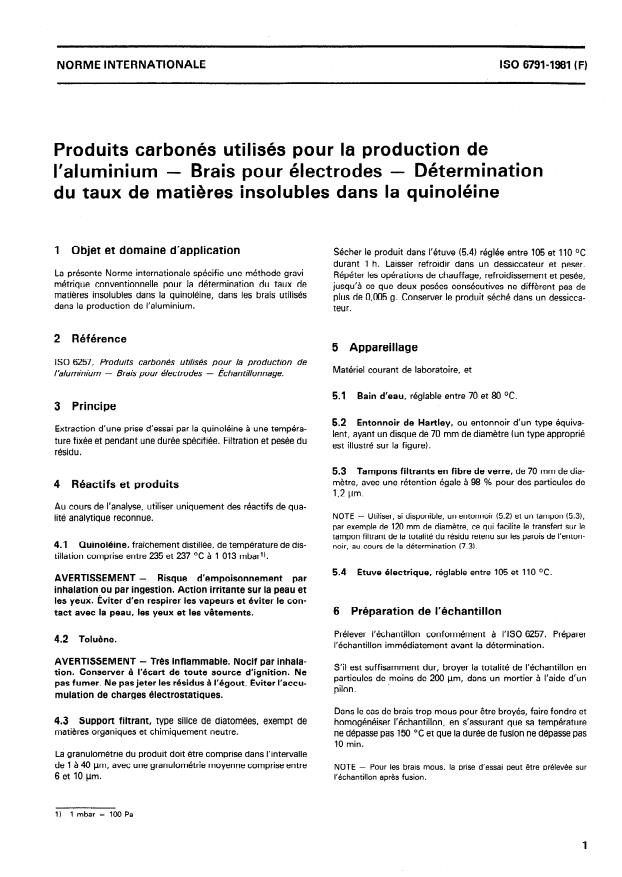
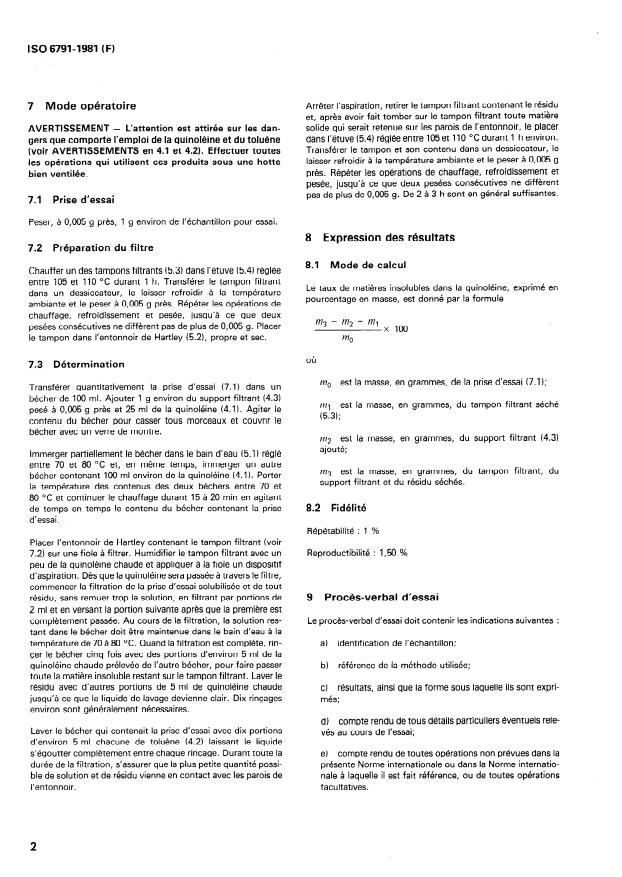
ISO 6791:1981 - Produits carbonés utilisés pour la production de l'aluminium — Brais pour électrodes — Détermination du taux de matieres insolubles dans la quinoléine Released:11/1/1981
ISO 6791:1981 - Produits carbonés utilisés pour la production de l'aluminium — Brais pour électrodes — Détermination du taux de matieres insolubles dans la quinoléine Released:11/1/1981
Overview
ISO 6791:1981 specifies a conventional gravimetric method to determine the content of quinoline‑insoluble material in pitch for electrodes used in aluminium production. The standard describes sample preparation, extraction with quinoline, filtration through a Hartley funnel fitted with a glass‑fiber filter pad, washing, drying and weighing of the insoluble residue to calculate the percentage insolubles. It is intended for quality control and specification testing of carbonaceous electrode pitches.
Key Topics and Technical Requirements
Scope: Determination of quinoline‑insoluble material in carbonaceous pitches for aluminium electrodes.
Sample prep
- Dry sample at 105–110 °C for 1 h, cool in a desiccator and weigh.
- If hard, grind to particles < 200 µm; for soft pitches, melt/homogenize (≤150 °C, ≤10 min).
- Recommended product particle size: 1–40 µm (mean 6–10 µm).
Reagents
- Quinoline (freshly distilled; bp ~235–237 °C) and toluene (for rinsing).
- Use analytical‑grade reagents.
Apparatus
- Water bath maintained at 70–80 °C.
- Hartley funnel (≈70 mm disk) or equivalent and glass‑fiber filter pads (70 mm, ≈98% retention at ~1.2 µm).
- Oven for drying at 105–110 °C; balance to 0.005 g.
Procedure
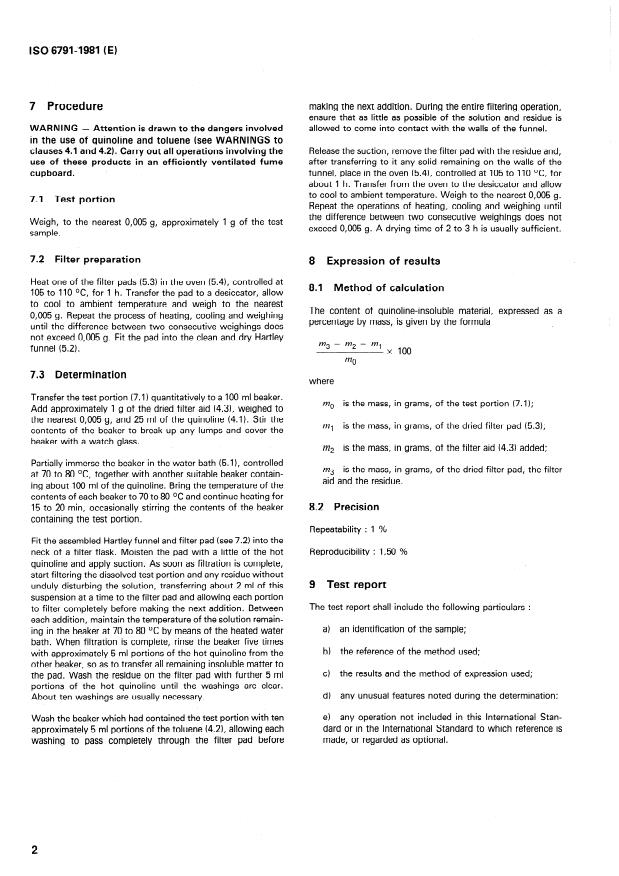
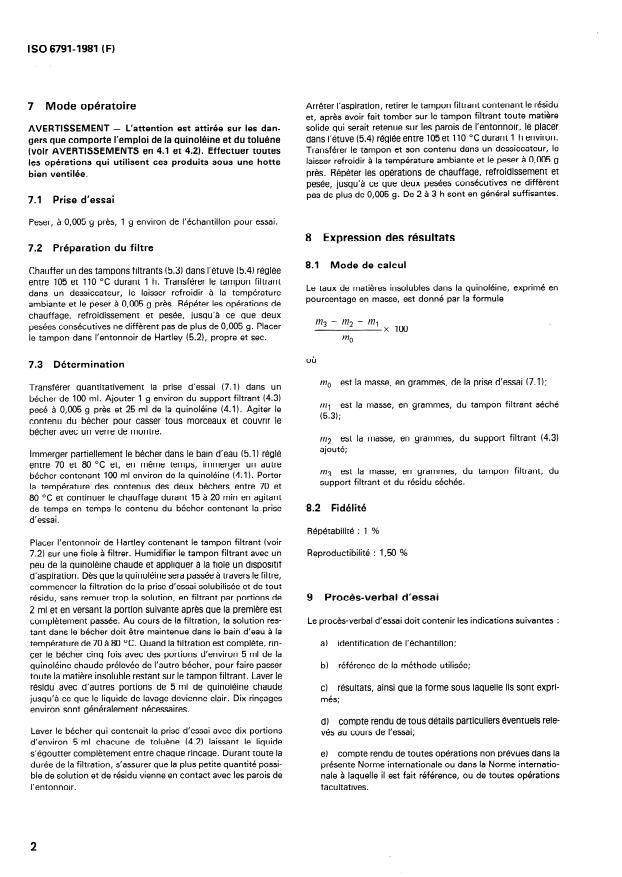
- Transfer ~1 g test portion to a beaker with ~1 g diatomaceous support and 25 ml quinoline.
- Heat at 70–80 °C for 15–20 min with occasional stirring.
- Filter hot through the prepared filter pad, wash the funnel and residue with hot quinoline (multiple ~5 ml rinses until clear), then rinse the beaker residues with toluene (ten 5 ml rinses).
- Dry filter + residue at 105–110 °C, cool in desiccator, weigh to 0.005 g; repeat drying/weighing until two consecutive weights agree within 0.005 g.
Calculation
- Percent insoluble = (mass of dried filter+residue − mass of filter − mass of added support) ÷ mass of test portion × 100.
Performance data
- Reported repeatability ~1% (as per the standard); reproducibility value is given in the document.
Safety: Quinoline is toxic/irritant; toluene is highly flammable-conduct all operations in a well‑ventilated fume hood.
Applications and Users
- Quality control laboratories at aluminium smelters and electrode manufacturers.
- R&D and materials characterization groups assessing carbonaceous materials, electrode pitches and binder performance.
- Third‑party testing labs providing compliance and specification testing for suppliers and customers.
- Regulatory or procurement teams specifying pitch properties for electrode performance.
Related Standards
- ISO 6257 (sampling and preparation of carbonaceous products for aluminium electrode pitches) is referenced for sampling procedures.
- ISO 6791 was developed under ISO/TC 47 (Chemistry) and has supporting approval from IUPAC.
Keywords: ISO 6791:1981, quinoline‑insoluble, pitch for electrodes, carbonaceous materials, aluminium production, gravimetric method, Hartley funnel, filter pad, quinoline, toluene.
Relations
- Effective Date
- 25-Aug-2026
- Effective Date
- 25-Aug-2026
- Effective Date
- 25-Aug-2026
- Effective Date
- 04-Nov-2023
Buy Documents
ISO 6791:1981 - Carbonaceous materials for the production of aluminium — Pitch for electrodes — Determination of contents of quinoline-insoluble material Released:11/1/1981
ISO 6791:1981 - Produits carbonés utilisés pour la production de l'aluminium — Brais pour électrodes — Détermination du taux de matieres insolubles dans la quinoléine Released:11/1/1981
ISO 6791:1981 - Produits carbonés utilisés pour la production de l'aluminium — Brais pour électrodes — Détermination du taux de matieres insolubles dans la quinoléine Released:11/1/1981
Get Certified
Connect with accredited certification bodies for this standard

ECOCERT
Organic and sustainability certification.

Eurofins Food Testing Global
Global leader in food, environment, and pharmaceutical product testing.

Intertek Bangladesh
Intertek certification and testing services in Bangladesh.
Sponsored listings
Frequently Asked Questions
ISO 6791:1981 is a standard published by the International Organization for Standardization (ISO). Its full title is "Carbonaceous materials for the production of aluminium — Pitch for electrodes — Determination of contents of quinoline-insoluble material". This standard covers: Specifies a conventional gravimetric method for the determination. A test portion ist reated with quinoline in a beaker at 70 to 80 °C for 15 to 20 min. Then the dissolved test portion and the residue are brought to a Hartley funnel fitted with a filter pad, and are filtered. The washed and dried residue on the filter pad is weighed.
Specifies a conventional gravimetric method for the determination. A test portion ist reated with quinoline in a beaker at 70 to 80 °C for 15 to 20 min. Then the dissolved test portion and the residue are brought to a Hartley funnel fitted with a filter pad, and are filtered. The washed and dried residue on the filter pad is weighed.
ISO 6791:1981 is classified under the following ICS (International Classification for Standards) categories: 71.100.10 - Materials for aluminium production. The ICS classification helps identify the subject area and facilitates finding related standards.
ISO 6791:1981 has the following relationships with other standards: It is inter standard links to EN 14263:2003, EN 14639:2005, EN 14264:2003, ISO/PRF 6791. Understanding these relationships helps ensure you are using the most current and applicable version of the standard.
ISO 6791:1981 is available in PDF format for immediate download after purchase. The document can be added to your cart and obtained through the secure checkout process. Digital delivery ensures instant access to the complete standard document.
Standards Content (Sample)
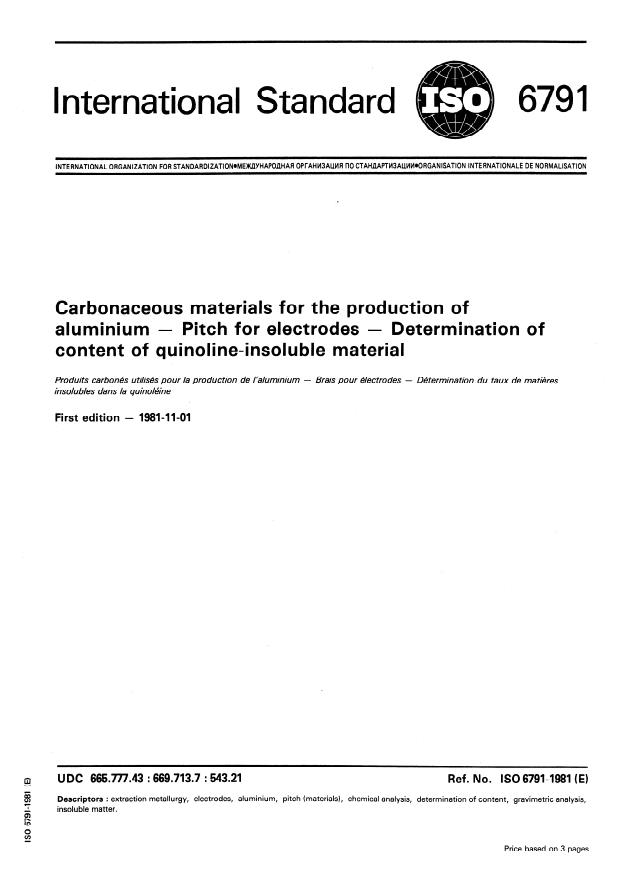
International Standard
INTERNATIONAL ORGANIZATION FOR STANDARDIZATIONWE)I(LIYHAPO~HAF OPrAHM3ALWlR IlO CTAH~APTM3ALWl.ORGANISATION INTERNATIONALE DE NORMALISATION
Carbonaceous materials for the production of
aluminium - Pitch for electrodes - Determination of
content of quinoline-insoluble material
Produits carbonh utilis6s pour Ia production de l’aluminium - Brais pour Qectrodes -
Dhtermination du taux de matikres
insolubles dans Ia guinolelne
First edition - 1981-11-01
UDC 665.777.43 : 669.713.7 : 543.21
z Ref. No. ISO6791-1981 (E)
Descriptors : extraction metailurgy, electrodes, aluminium, pitch (material& Chemical analysis, determination of content, gravimetric analysis,
insoluble matter.
Price based on 3 pages
Foreword
ISO (the International Organization for Standardization) is a worldwide federation of
national Standards institutes (ISO member bedies). The work of developing lnter-
national Standards is carried out through ISO technical committees. Every member
body interested in a subject for which a technical committee has been set up has the
right to be represented on that committee. International organizations, governmental
and non-governmental, in liaison with ISO, also take part in the work.
Draft International Standards adopted by the technical committees are circulated to
the member bodies for approval before their acceptance as International Standards by
the ISO Council.
International Standard ISO 6791 was developed by Technical Committee ISO/TC 47,
Chemistry, and was circulated to the member bodies in December 1979.
lt has been approved by the member bodies of the following countries :
Egypt, Arab Rep. of Romania
Australia .
Austria France South Africa, Rep. of
Sweden
Belgium Germany, F. R.
Hungary Switzerland
B razil
Thailand
Bulgaria Italy
United Kingdom
Canada Korea, Rep. of
Poland USSR
China
Czechoslovakia Portugal
expressed disapproval of the document on
The member body of the following country
technical grounds
Netherlands
This International Standard has also been approved by the International Union of Pure
and Applied Chemistry (IUPAC).
0 International Organkation for Standardkation, 1981
Printed in Switzerland
ISO 67914981 (E)
INTERNATIONAL STANDARD
Carbonaceous materials for the production of
Pitch for electrodes - Determination of
aluminium -
content of quinoline-insoluble material
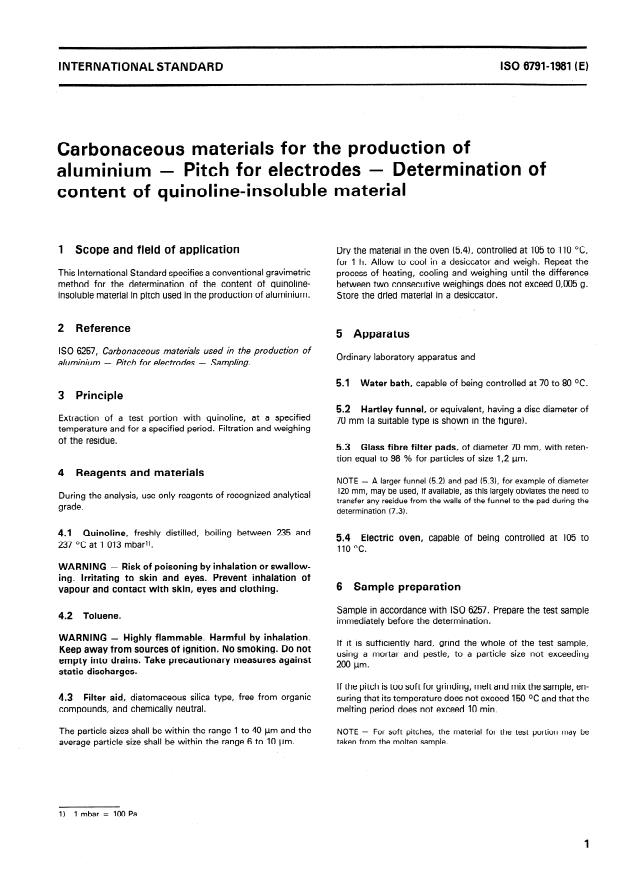
1 Scope and field of application Dry the material in the oven (5.41, controlled at 105 to 110 OC,
for 1 h. Allow to cool in a desiccator and weigh. Repeat the
process of heating, cooling and weighing until the differente
This International Standard specifies a conventional gravimetric
method for the determination of the content of quinoline- between two consecutive weighings does not exceed 0,005 g.
insoluble material in pitch used in the production of aluminium. Store the dried material in a desiccator.
2 Reference
5 Apparatus
ISO 6257, Carbonaceous materials used in the production of
Ordinary laboratory apparatus and
aluminium - Pitch for electrodes - Sampling.
5.1 Water bath, capable of being controlled at 70 to 80 OC.
3 Principle
5.2 Hartley funnel, or equivalent, having a disc diameter of
Extraction of a test Portion with quinoline, at a specified
70 mm (a suitable type is shown in the figure).
temperature and for a specified period. Filtration and weighing
of the residue.
5.3 Glass fibre filter pads, of diameter 70 mm, with reten-
tion equal to 98 % for particles of size 1,2 Pm.
4 Reagents and materials
NOTE - A iarger funnel (5.2) and pad (5.3), for example of diameter
120 mm, may be used, if available, as this largely obviates the need to
During the analysis, use only reagents of recognized analytical
transfer any residue from the Walls of the funnel to the pad during the
grade.
determination (7.3).
4.1 Quinoline, freshly distilled, boiling between 235 and
5.4 Electric oven, capable of being controlled at 105 to
237 OC at 1 013 mbarl).
110 OC.
WARNING - Risk of poisoning by inhalation or swallow-
ing. Irritating to skin and eyes. Prevent inhalation of
6 Sample preparation
vapour and contact with skin, eyes and clothing.
Sample in accordance with ISO 6257. Prepare the test Sample
4.2 Toluene.
immediately before the determination.
WARNING - Highly flammable. Harmful by inhalation.
If it is sufficiently hard, grind the whole of the test Sample,
Keep away from sources of ignition. No Smoking. DO not
using a mortar and pestle, to a particle size not exceeding
empty into drains. Take precautionary measures against
200 pm.
static discharges.
If the pitch is too soft for grinding, melt and mix the Sample, en-
4.3 Filter aid, diatomaceous silica type, free from organic suring that its temperature does not exceed 150 OC and that the
compounds, and chemically neutral. melting period does not exceed IO min.
The particle sizes shall be within the range 1 to 40 Pm and the NOTE -
...
Norme internationale
INTERNATIONAL ORGANIZATION FOR STANDARDIZATION.MEX,QYHAPO~HAR OPl-AHM3Al&4fl fl0 CTAH~APTM3A~l4lMORGANISATlON INTERNATIONALE DE NORMALISATION
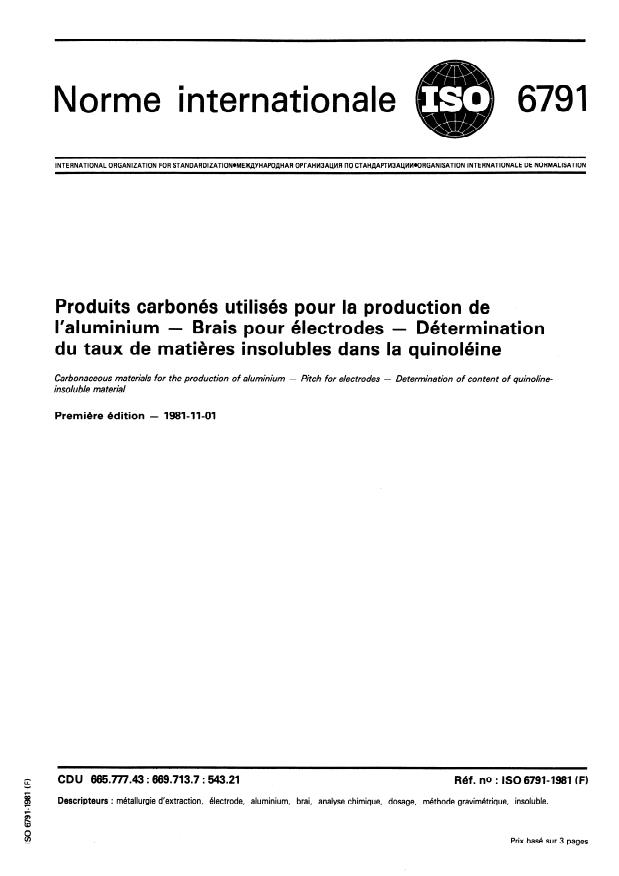
Produits carbonés utilisés pour la production de
l’aluminium - Brais pour électrodes - Détermination
du taux de matières insolubles dans la quinoléine
Carbonaceous materials for the production of aluminium - Pitch for electrodes - Determination of content of quinoline-
insoluble material
Première édition - 1981-11-01
CDU 665777.43 : 669.713.7 : 543.21
Réf. no : ISO 6791-1961 (F)
Descripteurs : métallurgie d’extraction, électrode, aluminium, brai, analyse chimique, dosage, méthode gravimétrique, insoluble.
Prix basé sur 3 pages
Avant-propos
L’ISO (Organisation internationale de normalisation) est une fédération mondiale
d’organismes nationaux de normalisation (comités membres de I’ISO). L’élaboration
des Normes internationales est confiée aux comités techniques de I’ISO. Chaque
comité membre intéressé par une étude a le droit de faire partie du comité technique
correspondant. Les organisations internationales, gouvernementales et non gouverne-
mentales, en liaison avec I’ISO, participent également aux travaux.
Les projets de Normes internationales adoptés par les comités techniques soumis
aux comités membres pour approbation, avant leur acceptation comme Normes inter-
nationales par le Conseil de I’ISO.
La Norme internationale ISO 6791 a été élaborée par le comité technique ISO/TC 47,
Chimie, et a été soumise aux comités membres en décembre 1979.
Les comités membres des pays suivants l’ont approuvée :
t
Afrique du Sud, Rép. d’ Chine Roumanie
Allemagne, R. F. Corée, Rép. de l Royaume-Uni
Égypte, Rép. arabe d’ Suède
Australie
Autriche France Suisse
Hongrie Tchécoslovaquie
Belgique
B rési I Italie Thaïlande
Bulgarie Pologne URSS
Portugal
Canada
Le comité membre du pays suivant l’a désapprouvée pour des raisons techniques :
Pays- Bas
Cette Norme internationale a également été approuvée par l’Union internationale de
chimie pure et appliquée (UICPA).
0 Organisation internationale de normalisation, 1981
Imprimé en Suisse
ISO 6791-1981 (F)
NORME INTERNATIONALE
Produits carbonés utilisés pour la production de
l’aluminium - Brais pour électrodes - Détermination
du taux de matières insolubles dans la quinoléine
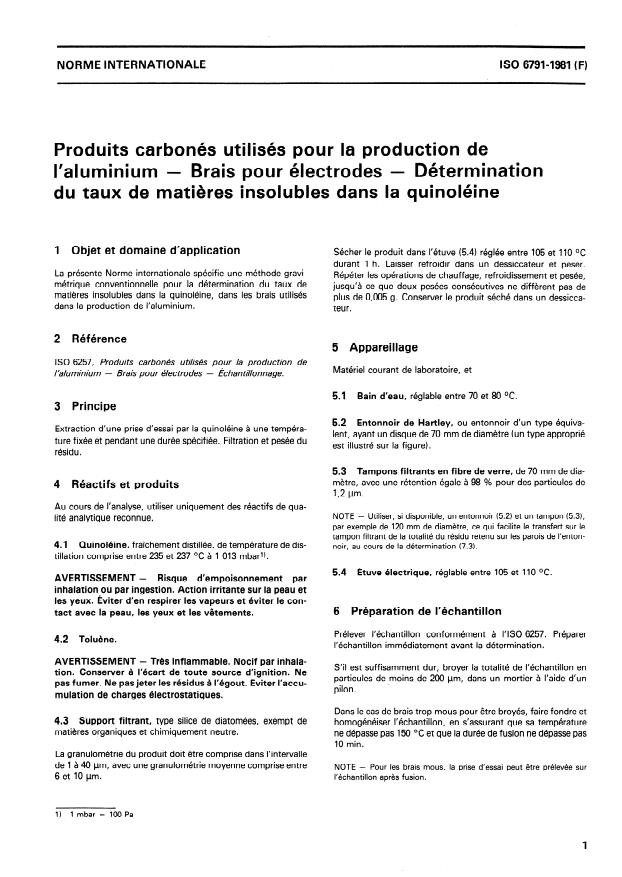
1 Objet et domaine d’application Sécher le produit dans l’étuve (5.4) réglée entre 105 et 110 OC
durant 1 h. Laisser refroidir dans un dessiccateur et peser.
La présente Norme internationale spécifie une méthode gravi- Répéter les opérations de chauffage, refroidissement et pesée,
métrique conventionnelle pour la détermination du taux de
jusqu’à ce que deux pesées consécutives ne diffèrent pas de
matières insolubles dans la quinoléine, dans les brais utilisés
plus de 0,005 g. Conserver le produit séché dans un dessicca-
dans la production de l’aluminium.
teur.
2 Référence
5 Appareillage
ISO 6257, Produits carbonés utilisés pour la production de
Matériel courant de laboratoire, et
l’aluminium - Brais pour électrodes - &antJlonnage.
5.1 Bain d’eau, réglable entre 70 et 80 OC.
3 Principe
5.2 Entonnoir de Hartley, ou entonnoir d’un type équiva-
Extraction d’une prise d’essai par la quinoléine à une tempéra-
lent, ayant un disque de 70 mm de diamètre (un type approprié
ture fixée et pendant une durée spécifiée. Filtration et pesée du
est illustré sur la figure).
résidu.
5.3 Tampons filtrants en fibre de verre, de 70 mm de dia-
mètre, avec une rétention égale à 98 % pour des particules de
4 Réactifs et produits
1,2 pm.
Au cours de l’analyse, utiliser uniquement des réactifs de qua-
NOTE - Utiliser, si disponible, un entonnoir (5.2) et un tampon (5.31,
lité analytique reconnue.
par exemple de 120 mm de diamètre, ce qui facilite le transfert sur le
tampon filtrant de la totalité du résidu retenu sur les parois de I’enton-
4.1 Quinoleine, fraîchement distillée, de température de dis- noir, au cours de la détermination (7.3).
tillation comprise entre 235 et 237 OC à 1 013 mbarl).
5.4 Étuve électrique, réglable entre 105 et 110 OC.
AVERTISSEMENT - Risque d’empoisonnement par
inhalation ou par ingestion. Action irritante sur la peau et
les yeux. Éviter d’en respirer les vapeurs et éviter le con-
6 Préparation de l’échantillon
tact avec la peau, les yeux et les vêtements.
Prélever l’échantillon conformément à I’ISO 6257. Préparer
4.2 Toluène.
l’échantillon immédiatement avant la détermination.
AVERTISSEMENT - Très inflammable. Nocif par inhala-
S’il est suffisamment dur, broyer la totalité de l’échantillon en
tion. Conserver à l’écart de toute source d’ignition. Ne
particules de moins de 200 pm, dans un mortier à l’aide d’un
pas fumer. Ne pas jeter les résidus à l’égout. Éviter I’accu-
pilon. *
mulation de charges électrostatiques.
Dans le cas de brais trop mous pour être broyés, faire fondre et
4.3 Support filtrant, type silice de diatomées, exempt de homogénéiser l’échantillon, en s’assurant que sa température
matières organiques et chimiquement neutre. ne dépasse pas 150 OC et que la durée de fusion ne dépasse pas
10 min.
La granulométrie du produit doit être comprise dans l’intervalle
de 1 à 40 prn, ave
...
Norme internationale
INTERNATIONAL ORGANIZATION FOR STANDARDIZATION.MEX,QYHAPO~HAR OPl-AHM3Al&4fl fl0 CTAH~APTM3A~l4lMORGANISATlON INTERNATIONALE DE NORMALISATION
Produits carbonés utilisés pour la production de
l’aluminium - Brais pour électrodes - Détermination
du taux de matières insolubles dans la quinoléine
Carbonaceous materials for the production of aluminium - Pitch for electrodes - Determination of content of quinoline-
insoluble material
Première édition - 1981-11-01
CDU 665777.43 : 669.713.7 : 543.21
Réf. no : ISO 6791-1961 (F)
Descripteurs : métallurgie d’extraction, électrode, aluminium, brai, analyse chimique, dosage, méthode gravimétrique, insoluble.
Prix basé sur 3 pages
Avant-propos
L’ISO (Organisation internationale de normalisation) est une fédération mondiale
d’organismes nationaux de normalisation (comités membres de I’ISO). L’élaboration
des Normes internationales est confiée aux comités techniques de I’ISO. Chaque
comité membre intéressé par une étude a le droit de faire partie du comité technique
correspondant. Les organisations internationales, gouvernementales et non gouverne-
mentales, en liaison avec I’ISO, participent également aux travaux.
Les projets de Normes internationales adoptés par les comités techniques soumis
aux comités membres pour approbation, avant leur acceptation comme Normes inter-
nationales par le Conseil de I’ISO.
La Norme internationale ISO 6791 a été élaborée par le comité technique ISO/TC 47,
Chimie, et a été soumise aux comités membres en décembre 1979.
Les comités membres des pays suivants l’ont approuvée :
t
Afrique du Sud, Rép. d’ Chine Roumanie
Allemagne, R. F. Corée, Rép. de l Royaume-Uni
Égypte, Rép. arabe d’ Suède
Australie
Autriche France Suisse
Hongrie Tchécoslovaquie
Belgique
B rési I Italie Thaïlande
Bulgarie Pologne URSS
Portugal
Canada
Le comité membre du pays suivant l’a désapprouvée pour des raisons techniques :
Pays- Bas
Cette Norme internationale a également été approuvée par l’Union internationale de
chimie pure et appliquée (UICPA).
0 Organisation internationale de normalisation, 1981
Imprimé en Suisse
ISO 6791-1981 (F)
NORME INTERNATIONALE
Produits carbonés utilisés pour la production de
l’aluminium - Brais pour électrodes - Détermination
du taux de matières insolubles dans la quinoléine
1 Objet et domaine d’application Sécher le produit dans l’étuve (5.4) réglée entre 105 et 110 OC
durant 1 h. Laisser refroidir dans un dessiccateur et peser.
La présente Norme internationale spécifie une méthode gravi- Répéter les opérations de chauffage, refroidissement et pesée,
métrique conventionnelle pour la détermination du taux de
jusqu’à ce que deux pesées consécutives ne diffèrent pas de
matières insolubles dans la quinoléine, dans les brais utilisés
plus de 0,005 g. Conserver le produit séché dans un dessicca-
dans la production de l’aluminium.
teur.
2 Référence
5 Appareillage
ISO 6257, Produits carbonés utilisés pour la production de
Matériel courant de laboratoire, et
l’aluminium - Brais pour électrodes - &antJlonnage.
5.1 Bain d’eau, réglable entre 70 et 80 OC.
3 Principe
5.2 Entonnoir de Hartley, ou entonnoir d’un type équiva-
Extraction d’une prise d’essai par la quinoléine à une tempéra-
lent, ayant un disque de 70 mm de diamètre (un type approprié
ture fixée et pendant une durée spécifiée. Filtration et pesée du
est illustré sur la figure).
résidu.
5.3 Tampons filtrants en fibre de verre, de 70 mm de dia-
mètre, avec une rétention égale à 98 % pour des particules de
4 Réactifs et produits
1,2 pm.
Au cours de l’analyse, utiliser uniquement des réactifs de qua-
NOTE - Utiliser, si disponible, un entonnoir (5.2) et un tampon (5.31,
lité analytique reconnue.
par exemple de 120 mm de diamètre, ce qui facilite le transfert sur le
tampon filtrant de la totalité du résidu retenu sur les parois de I’enton-
4.1 Quinoleine, fraîchement distillée, de température de dis- noir, au cours de la détermination (7.3).
tillation comprise entre 235 et 237 OC à 1 013 mbarl).
5.4 Étuve électrique, réglable entre 105 et 110 OC.
AVERTISSEMENT - Risque d’empoisonnement par
inhalation ou par ingestion. Action irritante sur la peau et
les yeux. Éviter d’en respirer les vapeurs et éviter le con-
6 Préparation de l’échantillon
tact avec la peau, les yeux et les vêtements.
Prélever l’échantillon conformément à I’ISO 6257. Préparer
4.2 Toluène.
l’échantillon immédiatement avant la détermination.
AVERTISSEMENT - Très inflammable. Nocif par inhala-
S’il est suffisamment dur, broyer la totalité de l’échantillon en
tion. Conserver à l’écart de toute source d’ignition. Ne
particules de moins de 200 pm, dans un mortier à l’aide d’un
pas fumer. Ne pas jeter les résidus à l’égout. Éviter I’accu-
pilon. *
mulation de charges électrostatiques.
Dans le cas de brais trop mous pour être broyés, faire fondre et
4.3 Support filtrant, type silice de diatomées, exempt de homogénéiser l’échantillon, en s’assurant que sa température
matières organiques et chimiquement neutre. ne dépasse pas 150 OC et que la durée de fusion ne dépasse pas
10 min.
La granulométrie du produit doit être comprise dans l’intervalle
de 1 à 40 prn, ave
...