

ISO 6376:2026
(Main)Carbonaceous materials for the production of aluminium — Pitch for electrodes — Determination of content of toluene-insoluble material
- Abstract
This document specifies a gravimetric method for the determination of the content of toluene-insoluble material in pitch used for the production of aluminium.
- Status
- Published
- Publication Date
- 11-Nov-2026
- Technical Committee
- ISO/TC 226 - Materials for the production of primary aluminium
- Drafting Committee
- ISO/TC 226/WG 1 - Carbonaceous binders, including pitch
- Current Stage
- 6060 - International Standard published
- Start Date
- 12-Nov-2026
- Completion Date
- 12-Nov-2026
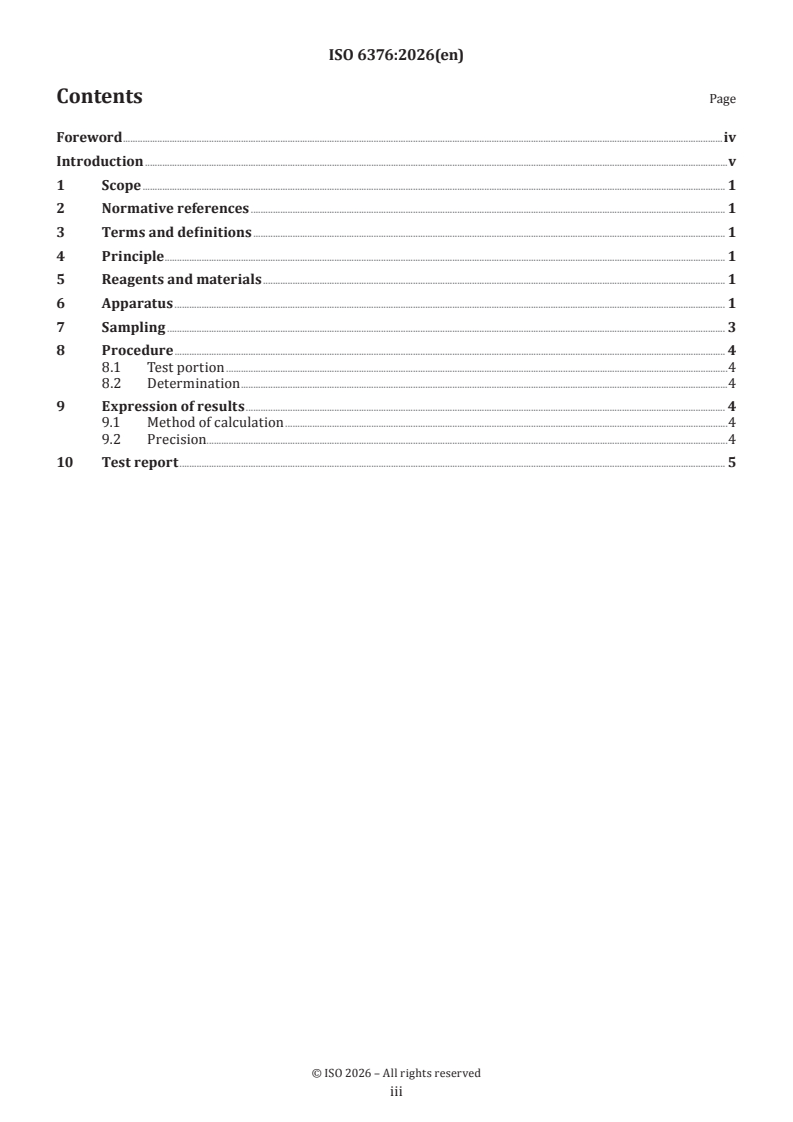
ISO 6376:2026, published by ISO, specifies a gravimetric method for determining the content of toluene-insoluble material in pitch for electrodes used in aluminium production. It is intended for laboratories and technical teams that need a consistent way to measure how much of a pitch sample remains insoluble after boiling in toluene.
What does ISO 6376 specify?
ISO 6376:2026 specifies a test method for pitch for electrodes based on weighing the fraction that does not dissolve in toluene. The document is organized into clauses on scope, normative references, principle, reagents and materials, apparatus, sampling, procedure, expression of results, precision, and test report.
The method is used to compare pitches on the basis of their insoluble content, which is a practical indicator for material assessment in aluminium production.
What are the key requirements of ISO 6376?
ISO 6376:2026 requires a defined laboratory workflow so that different users measure the same property in the same way. The main points are the sample handling, the boiling and filtration step, the drying and weighing step, and the way the result is reported.
Sampling and test portion
Clause 7 says sampling is carried out in accordance with ISO 6257. Hard pitches are crushed and ground so they pass a 212 µm sieve, while soft pitches are used as received. Clause 8.1 then calls for about 1 g of sample, weighed to the nearest 0.001 g. In practice, this means the sample must be prepared in a controlled way before the actual measurement starts.
Reagents, safety, and apparatus
Clause 5 requires reagents of recognized analytical grade. The method uses toluene and acetone, and the document warns that both are highly flammable and harmful by inhalation, so the work has to be done with proper ventilation and fire precautions.
Clause 6 specifies the essential equipment: a 500 ml conical flask, a reflux condenser, a glass filter crucible with sintered glass disc porosity grade P16, a Hartley funnel or equivalent, and an oven controlled between 105 °C and 110 °C. These details matter because the physical set-up affects how well the insoluble fraction is recovered.
Determination and drying
Clause 8.2 directs the analyst to heat the test portion with 100 ml ± 2 ml of toluene under reflux for 30 min ± 2 min, with occasional swirling. The hot mixture is then filtered immediately through a dried and weighed crucible, the flask is rinsed repeatedly with toluene until the filtrate is colourless, and the residue is washed with acetone.
The crucible and residue are then dried for about 1 h at 105 °C to 110 °C, cooled in a desiccator, and weighed again. In practice, this is the core measurement step: the result comes from the mass left on the crucible.
Calculation, precision, and reporting
Clause 9 expresses the result as a percentage by mass from the masses of the test portion, the empty crucible, and the crucible plus insoluble residue. Clause 9.2 gives precision values of 0.5 % repeatability and 1.0 % reproducibility, which help users judge whether results from the same lab or different labs are close enough.
Clause 10 requires the report to identify the sample, cite ISO 6376:2026, give the test date, state the result and calculation reference, and note any deviations or unusual observations.
What terms does ISO 6376 define?
ISO 6376:2026 uses a few practical terms central to the method.
- Gravimetric method - a method that determines a property by weighing material before and after treatment.
- Test portion - the measured portion of sample used for the determination, about 1 g here.
- Toluene-insoluble material - the fraction that remains undissolved after boiling the pitch in toluene and filtering.
- Repeatability - closeness of results obtained under the same conditions in one laboratory.
- Reproducibility - closeness of results obtained by different laboratories.
- Filtrate - the liquid that passes through the filter crucible during the separation step.
- Hard pitches - pitches that are prepared by crushing and grinding before testing.
- Soft pitches - pitches that are tested as received.
Who uses ISO 6376?
ISO 6376:2026 is used by laboratories testing carbonaceous materials for aluminium production, especially pitch for electrodes. It is also relevant to quality managers, process engineers, and buyers who need a standard test result for incoming material control, product comparison, or dispute resolution.
What changed in ISO 6376 from the previous edition?
ISO 6376:2026 is the second edition and replaces ISO 6376:1980. The document states that the main changes are added analysis procedure details to help run the analysis, corrected text to formal SI formatting, and an updated test report description.
Which standards are used with ISO 6376?
ISO 6376:2026 cites ISO 6257, Carbonaceous materials used in the production of aluminium - Pitch for electrodes - Sampling. ISO 6257 provides the sampling procedure that feeds the test method in ISO 6376.
What does the ISO 6376 document contain?
ISO 6376:2026 contains a full test method with the principle, reagent list, apparatus requirements, sampling instructions, detailed procedure, calculation formula, precision statement, and reporting requirements. It also includes Figure 1 with the details of the Hartley funnel used in the filtration step.
The procedure is written as a practical laboratory sequence, from preparing the crucible to refluxing in toluene, filtering, washing with acetone, drying, and weighing. The document also includes a safety warning section for the solvents used, which is important for laboratory handling and ventilation planning.
Relations
- Effective Date
- 04-Nov-2023
Get Certified
Connect with accredited certification bodies for this standard

ECOCERT
Organic and sustainability certification.

Eurofins Food Testing Global
Global leader in food, environment, and pharmaceutical product testing.

Intertek Bangladesh
Intertek certification and testing services in Bangladesh.
Sponsored listings
Frequently Asked Questions
ISO 6376:2026 is a standard published by the International Organization for Standardization (ISO). Its full title is "Carbonaceous materials for the production of aluminium — Pitch for electrodes — Determination of content of toluene-insoluble material". This standard covers: This document specifies a gravimetric method for the determination of the content of toluene-insoluble material in pitch used for the production of aluminium.
This document specifies a gravimetric method for the determination of the content of toluene-insoluble material in pitch used for the production of aluminium.
ISO 6376:2026 is classified under the following ICS (International Classification for Standards) categories: 71.100.10 - Materials for aluminium production. The ICS classification helps identify the subject area and facilitates finding related standards.
ISO 6376:2026 has the following relationships with other standards: It is inter standard links to ISO 6376:1980. Understanding these relationships helps ensure you are using the most current and applicable version of the standard.
ISO 6376:2026 is available in PDF format for immediate download after purchase. The document can be added to your cart and obtained through the secure checkout process. Digital delivery ensures instant access to the complete standard document.
Standards Content (Sample)
International
Standard
ISO 6376
Second edition
Carbonaceous materials for the
2026-11
production of aluminium — Pitch
for electrodes — Determination
of content of toluene-insoluble
material
Produits carbonés utilisés pour la production de l'aluminium —
Brais pour électrodes — Détermination du taux des matières
insolubles dans le toluène
Reference number
© ISO 2026
All rights reserved.
This ISO publication is protected by copyright and is owned by ISO and/or its licensors.
The content of this ISO publication is provided under licence, not sold. Use is subject to the applicable licence terms issued by ISO,
an ISO member body, or an authorized third-party distributor.
Except as required for implementation or expressly permitted by a separate licence, no part of this ISO publication may be
reproduced, distributed, modified, used, or made available in any form or by any means – electronic or mechanical, including
photocopying, scanning, recording, or posting on internal or external digital platforms.
Any use beyond the scope of the granted rights is prohibited and may result in legal action.
ISO copyright office
CP 401 • CH-1214 Vernier, Geneva
Phone: +41 22 749 01 11
Email: copyright@iso.org
Website: www.iso.org
Published in Switzerland
ii
Contents Page
Foreword .iv
Introduction .v
1 Scope . 1
2 Normative references . 1
3 Terms and definitions . 1
4 Principle . 1
5 Reagents and materials . 1
6 Apparatus . 1
7 Sampling . 3
8 Procedure . 4
8.1 Test portion .4
8.2 Determination .4
9 Expression of results . 4
9.1 Method of calculation .4
9.2 Precision . . .4
10 Test report . 5
iii
Foreword
ISO (the International Organization for Standardization) is a worldwide federation of national standards
bodies (ISO member bodies). The work of preparing International Standards is normally carried out through
ISO technical committees. Each member body interested in a subject for which a technical committee
has been established has the right to be represented on that committee. International organizations,
governmental and non-governmental, in liaison with ISO, also take part in the work. ISO collaborates closely
with the International Electrotechnical Commission (IEC) on all matters of electrotechnical standardization.
The procedures used to develop this document and those intended for its further maintenance are described
in the ISO/IEC Directives, Part 1. In particular, the different approval criteria needed for the different types
of ISO document should be noted. This document was drafted in accordance with the editorial rules of the
ISO/IEC Directives, Part 2 (see www.iso.org/directives).
ISO draws attention to the possibility that the implementation of this document may involve the use of (a)
patent(s). ISO takes no position concerning the evidence, validity or applicability of any claimed patent
rights in respect thereof. As of the date of publication of this document, ISO had not received notice of (a)
patent(s) which may be required to implement this document. However, implementers are cautioned that
this may not represent the latest information, which may be obtained from the patent database available at
www.iso.org/patents. ISO shall not be held responsible for identifying any or all such patent rights.
Any trade name used in this document is information given for the convenience of users and does not
constitute an endorsement.
For an explanation of the voluntary nature of standards, the meaning of ISO specific terms and expressions
related to conformity assessment, as well as information about ISO's adherence to the World Trade
Organization (WTO) principles in the Technical Barriers to Trade (TBT), see www.iso.org/iso/foreword.html.
This document was prepared by Technical Committee ISO/TC 226, Materials for the production of primary
aluminium.
This second edition can
...