

ISO 3517:2012
(Main)Essential oil of neroli (Citrus aurantium L., syn. Citrus amara Link, syn. Citrus bigaradia Loisel, syn. Citrus vulgaris Risso)
General Information
- Abstract
ISO 3517:2012 specifies certain characteristics of the essential oil of neroli (Citrus aurantium L., syn. Citrus amara Link, syn. Citrus bigaradia Loisel, syn. Citrus vulgaris Risso), cultivated principally in Tunisia, Morocco, and Egypt, in order to facilitate assessment of its quality.
- Status
- Published
- Publication Date
- 30-Jul-2012
- Technical Committee
- ISO/TC 54 - Essential oils
- Drafting Committee
- ISO/TC 54 - Essential oils
- Current Stage
- 9093 - International Standard confirmed
- Start Date
- 10-Mar-2023
- Completion Date
- 29-Aug-2026
Buy Documents

ISO 3517:2012 - Essential oil of neroli (Citrus aurantium L., syn. Citrus amara Link, syn. Citrus bigaradia Loisel, syn. Citrus vulgaris Risso) Released:7/31/2012


ISO 3517:2012 - Huile essentielle de néroli bigaradier (Citrus aurantium L., syn. Citrus amara Link, syn. Citrus bigaradia Loisel, syn. Citrus vulgaris Risso) Released:7/31/2012
Overview
ISO 3517:2012 specifies characteristics and test methods to assess the quality of neroli essential oil (Citrus aurantium) - traditionally cultivated in Tunisia, Morocco and Egypt. The standard defines physical, chemical and chromatographic criteria to help producers, laboratories and buyers verify authenticity, detect adulteration and ensure consistent product quality.
Key topics and requirements
The standard sets mandatory requirements and reference test methods for neroli essential oil, including:
- Appearance, colour and odour
- Clear mobile liquid; pale yellow to amber with slight blue fluorescence; fresh orange-blossom aroma.
- Physical constants
- Relative density at 20 °C: Tunisia/Morocco 0.863–0.876; Egypt 0.870–0.880.
- Refractive index at 20 °C: Tunisia/Morocco 1.464–1.474; Egypt 1.465–1.472.
- Optical rotation at 20 °C: Tunisia/Morocco +2° to +12°; Egypt +2° to +11°.
- Miscibility and acidity
- Miscibility: ≤ 3.5 volumes of 85% ethanol to dissolve 1 volume of oil.
- Acid value: maximum 2.
- Chromatographic profile (normative)
- Gas chromatography required (ISO 11024). The standard lists representative components with min/max percentages for Tunisia/Morocco and Egypt. Major components include:
- Linalool: 26.0–48.0% (Tunisia/Morocco), 26.0–55.0% (Egypt)
- Linalyl acetate: 1.5–15.0% (Tunisia/Morocco), 3.0–20.0% (Egypt)
- Limonene: 9.0–18.0% (Tunisia/Morocco), 7.0–17.0% (Egypt)
- β-Pinene, geraniol, nerol and others are listed with specific ranges.
- Gas chromatography required (ISO 11024). The standard lists representative components with min/max percentages for Tunisia/Morocco and Egypt. Major components include:
- Chirality
- Enantiomeric limits given (e.g., S-(+)-linalyl acetate < 5%) - analysis per ISO 22972.
- Flashpoint
- Indicative value provided (+61 °C) for safety/transport guidance (informative).
Other procedural details: sampling per ISO 212 (minimum final sample 30 ml), and packaging/labeling per ISO/TR 210 and ISO/TR 211.
Applications and users
ISO 3517:2012 is used by:
- Essential oil producers and distillers in North Africa and exporters to global markets
- Quality control and analytical laboratories performing GC and chiral analyses
- Perfume, cosmetics and flavor houses specifying raw material quality
- Traders, buyers and procurement teams verifying batch conformity and origin
- Regulators, customs and safety officers (flashpoint and labeling guidance)
Practical uses include batch acceptance testing, supplier qualification, adulteration detection, product specification drafting, and safety documentation for transport.
Related standards
Key referenced documents used for methods and handling:
- ISO 11024, ISO 22972, ISO 279, ISO 280, ISO 592, ISO 875, ISO 1242, ISO 212, ISO/TR 210, ISO/TR 211, ISO/TR 11018, ISO/TR 21092
Keywords: ISO 3517:2012, neroli essential oil, Citrus aurantium, chromatographic profile, essential oil quality assessment, linalool, linalyl acetate.
Relations
- Effective Date
- 10-Jan-2009
Buy Documents
ISO 3517:2012 - Essential oil of neroli (Citrus aurantium L., syn. Citrus amara Link, syn. Citrus bigaradia Loisel, syn. Citrus vulgaris Risso) Released:7/31/2012
ISO 3517:2012 - Huile essentielle de néroli bigaradier (Citrus aurantium L., syn. Citrus amara Link, syn. Citrus bigaradia Loisel, syn. Citrus vulgaris Risso) Released:7/31/2012
Get Certified
Connect with accredited certification bodies for this standard

ECOCERT
Organic and sustainability certification.

Eurofins Food Testing Global
Global leader in food, environment, and pharmaceutical product testing.

Intertek Bangladesh
Intertek certification and testing services in Bangladesh.
Sponsored listings
Frequently Asked Questions
ISO 3517:2012 is a standard published by the International Organization for Standardization (ISO). Its full title is "Essential oil of neroli (Citrus aurantium L., syn. Citrus amara Link, syn. Citrus bigaradia Loisel, syn. Citrus vulgaris Risso)". This standard covers: ISO 3517:2012 specifies certain characteristics of the essential oil of neroli (Citrus aurantium L., syn. Citrus amara Link, syn. Citrus bigaradia Loisel, syn. Citrus vulgaris Risso), cultivated principally in Tunisia, Morocco, and Egypt, in order to facilitate assessment of its quality.
ISO 3517:2012 specifies certain characteristics of the essential oil of neroli (Citrus aurantium L., syn. Citrus amara Link, syn. Citrus bigaradia Loisel, syn. Citrus vulgaris Risso), cultivated principally in Tunisia, Morocco, and Egypt, in order to facilitate assessment of its quality.
ISO 3517:2012 is classified under the following ICS (International Classification for Standards) categories: 71.100.60 - Essential oils. The ICS classification helps identify the subject area and facilitates finding related standards.
ISO 3517:2012 has the following relationships with other standards: It is inter standard links to ISO 3517:2002. Understanding these relationships helps ensure you are using the most current and applicable version of the standard.
ISO 3517:2012 is available in PDF format for immediate download after purchase. The document can be added to your cart and obtained through the secure checkout process. Digital delivery ensures instant access to the complete standard document.
Standards Content (Sample)
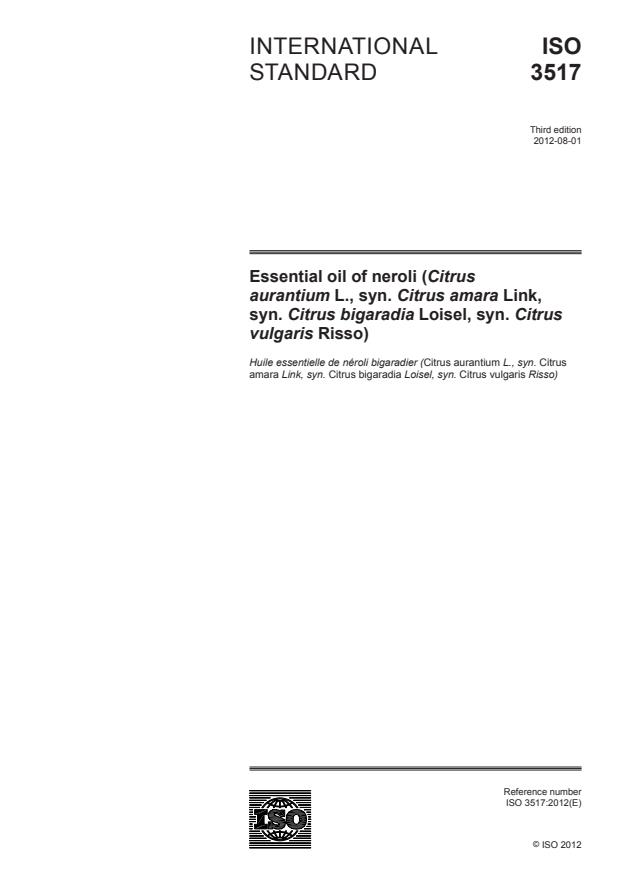
INTERNATIONAL ISO
STANDARD 3517
Third edition
2012-08-01
Essential oil of neroli (Citrus
aurantium L., syn. Citrus amara Link,
syn. Citrus bigaradia Loisel, syn. Citrus
vulgaris Risso)
Huile essentielle de néroli bigaradier (Citrus aurantium L., syn. Citrus
amara Link, syn. Citrus bigaradia Loisel, syn. Citrus vulgaris Risso)
Reference number
©
ISO 2012
All rights reserved. Unless otherwise specified, no part of this publication may be reproduced or utilized in any form or by any means,
electronic or mechanical, including photocopying and microfilm, without permission in writing from either ISO at the address below or ISO’s
member body in the country of the requester.
ISO copyright office
Case postale 56 • CH-1211 Geneva 20
Tel. + 41 22 749 01 11
Fax + 41 22 749 09 47
E-mail copyright@iso.org
Web www.iso.org
Published in Switzerland
ii © ISO 2012 – All rights reserved
Contents Page
Foreword .iv
1 Scope . 1
2 Normative references . 1
3 Terms and definitions . 1
4 Requirements . 1
4.1 Appearance . 1
4.2 Colour . 2
4.3 Odour . 2
4.4 Relative density at 20 °C, d . 2
4.5 Refractive index at 20 °C . 2
4.6 Optical rotation at 20 °C . 2
4.7 Miscibility with 85 % volume fraction ethanol at 20 °C . 2
4.8 Acid value . 2
4.9 Chromatographic profile . 2
4.10 Chirality . 2
4.11 Flashpoint . 2
5 Sampling . 3
6 Test methods . 3
6.1 Relative density at 20 °C, d . 3
6.2 Refractive index at 20 °C . 3
6.3 Optical rotation at 20 °C . 3
6.4 Miscibility in ethanol, 85 % volume fraction at 20 °C . 3
6.5 Acid value . 4
6.6 Chromatographic profile . 4
6.7 Chirality . 4
7 Packaging, labelling and marking . 4
Annex A (informative) Typical chromatograms of the analysis by gas chromatography of the essential
oil of neroli (Citrus aurantium L., syn. Citrus amara Link, syn. Citrus bigaradia Loisel, syn.
Citrus vulgaris Risso) . 5
Annex B (informative) Flashpoint . 8
Annex C (informative) Chirality . 9
Bibliography .10
Foreword
ISO (the International Organization for Standardization) is a worldwide federation of national standards bodies
(ISO member bodies). The work of preparing International Standards is normally carried out through ISO
technical committees. Each member body interested in a subject for which a technical committee has been
established has the right to be represented on that committee. International organizations, governmental and
non-governmental, in liaison with ISO, also take part in the work. ISO collaborates closely with the International
Electrotechnical Commission (IEC) on all matters of electrotechnical standardization.
International Standards are drafted in accordance with the rules given in the ISO/IEC Directives, Part 2.
The main task of technical committees is to prepare International Standards. Draft International Standards
adopted by the technical committees are circulated to the member bodies for voting. Publication as an
International Standard requires approval by at least 75 % of the member bodies casting a vote.
Attention is drawn to the possibility that some of the elements of this document may be the subject of patent
rights. ISO shall not be held responsible for identifying any or all such patent rights.
ISO 3517 was prepared by Technical Committee ISO/TC 54, Essential oils.
This third edition cancels and replaces the second edition (ISO 3517:2002), which has been technically revised.
iv © ISO 2012 – All rights reserved
INTERNATIONAL STANDARD ISO 3517:2012(E)
Essential oil of neroli (Citrus aurantium L., syn. Citrus amara
Link, syn. Citrus bigaradia Loisel, syn. Citrus vulgaris Risso)
1 Scope
This International Standard specifies certain characteristics of the essential oil of neroli (Citrus aurantium L.,
syn. Citrus amara Link, syn. Citrus bigaradia Loisel, syn. Citrus vulgaris Risso), cultivated principally in Tunisia,
Morocco, and Egypt, in order to facilitate assessment of its quality.
2 Normative references
The following referenced documents are indispensable for the application of this document. For dated
references, only the edition cited applies. For undated references, the latest edition of the referenced document
(including any amendments) applies.
ISO/TR 210, Essential oils — General rules for packaging, conditioning and storage
ISO/TR 211, Essential oils — General rules for labelling and marking of containers
ISO 212, Essential oils — Sampling
ISO 279, Essential oils — Determination of relative density at 20 °C — Reference method
ISO 280, Essential oils — Determination of refractive index
ISO 592, Essential oils — Determination of optical rotation
IS
...
NORME ISO
INTERNATIONALE 3517
Troisième édition
2012-08-01
Huile essentielle de néroli bigaradier
(Citrus aurantium L., syn. Citrus amara
Link, syn. Citrus bigaradia Loisel, syn.
Citrus vulgaris Risso)
Essential oil of neroli (Citrus aurantium L., syn. Citrus amara Link, syn.
Citrus bigaradia Loisel, syn. Citrus vulgaris Risso)
Numéro de référence
©
ISO 2012
DOCUMENT PROTÉGÉ PAR COPYRIGHT
Droits de reproduction réservés. Sauf prescription différente, aucune partie de cette publication ne peut être reproduite ni utilisée sous
quelque forme que ce soit et par aucun procédé, électronique ou mécanique, y compris la photocopie et les microfilms, sans l’accord écrit
de l’ISO à l’adresse ci-après ou du comité membre de l’ISO dans le pays du demandeur.
ISO copyright office
Case postale 56 • CH-1211 Geneva 20
Tel. + 41 22 749 01 11
Fax + 41 22 749 09 47
E-mail copyright@iso.org
Web www.iso.org
Publié en Suisse
ii © ISO 2012 – Tous droits réservés
Sommaire Page
Avant-propos .iv
1 Domaine d’application . 1
2 Références normatives . 1
3 Termes et définitions . 1
4 Exigences . 2
4.1 Aspect . 2
4.2 Couleur . 2
4.3 Odeur . 2
4.4 Densité relative à 20 °C, d . 2
4.5 Indice de réfraction à 20 °C . 2
4.6 Pouvoir rotatoire à 20 °C . 2
4.7 Miscibilité à l’éthanol à 85 % (fraction volumique) à 20 °C . 2
4.8 Indice d’acide . 2
4.9 Profil chromatographique . 2
4.10 Chiralité . 2
4.11 Point d’éclair . 2
5 Échantillonnage . 3
6 Méthodes d’essai . 3
6.1 Densité relative à 20 °C, d . 3
6.2 Indice de réfraction à 20 °C . 3
6.3 Pouvoir rotatoire à 20 °C . 3
6.4 Miscibilité à l’éthanol à 85 % (fraction volumique) à 20 °C . 3
6.5 Indice d’acide . 4
6.6 Profil chromatographique . 4
6.7 Chiralité . 4
7 Emballage, étiquetage et marquage . 4
Annexe A (informative) Chromatogrammes types de l’analyse par chromatographie en phase gazeuse
de l’huile essentielle de néroli bigaradier (Citrus aurantium L., syn. Citrus amara Link, syn.
Citrus bigaradia Loisel, syn. Citrus vulgaris Risso) . 5
Annexe B (informative) Point d’éclair. 8
Annexe C (informative) Chiralité . 9
Bibliographie .10
Avant-propos
L’ISO (Organisation internationale de normalisation) est une fédération mondiale d’organismes nationaux de
normalisation (comités membres de l’ISO). L’élaboration des Normes internationales est en général confiée aux
comités techniques de l’ISO. Chaque comité membre intéressé par une étude a le droit de faire partie du comité
technique créé à cet effet. Les organisations internationales, gouvernementales et non gouvernementales,
en liaison avec l’ISO participent également aux travaux. L’ISO collabore étroitement avec la Commission
électrotechnique internationale (CEI) en ce qui concerne la normalisation électrotechnique.
Les Normes internationales sont rédigées conformément aux règles données dans les Directives ISO/CEI, Partie 2.
La tâche principale des comités techniques est d’élaborer les Normes internationales. Les projets de Normes
internationales adoptés par les comités techniques sont soumis aux comités membres pour vote. Leur publication
comme Normes internationales requiert l’approbation de 75 % au moins des comités membres votants.
L’attention est appelée sur le fait que certains des éléments du présent document peuvent faire l’objet de droits
de propriété intellectuelle ou de droits analogues. L’ISO ne saurait être tenue pour responsable de ne pas avoir
identifié de tels droits de propriété et averti de leur existence.
L’ISO 3517 a été élaborée par le comité technique ISO/TC 54, Huiles essentielles.
Cette troisième édition annule et remplace la deuxième édition (ISO 3517:2002), qui a fait l’objet d’une
révision technique.
iv © ISO 2012 – Tous droits réservés
NORME INTERNATIONALE ISO 3517:2012(F)
Huile essentielle de néroli bigaradier (Citrus aurantium L., syn.
Citrus amara Link, syn. Citrus bigaradia Loisel, syn. Citrus
vulgaris Risso)
1 Domaine d’application
La présente Norme internationale spécifie certaines caractéristiques de l’huile essentielle de néroli bigaradier,
ou huile essentielle de fleurs d’oranger bigaradier (Citrus aurantium L., syn. Citrus amara Link, syn. Citrus
bigaradia Loisel, syn. Citrus vulgaris Risso), principalement cultivé en Tunisie, au Maroc et en Égypte, destinées
à faciliter l’appréciation de sa qualité.
2 Références normatives
Les documents de référence suivants sont indispensables pour l’application du présent document. Pour les
références datées, seule l’édition citée s’applique. Pour les références non datées, la dernière édition du
document de référence s’applique (y compris les éventuels amendements).
ISO/TR 210, Huiles essentielles — Règles générales d’emballage, de conditionnement et de stockage
ISO/TR 211, Huiles essentielles — Règles générales d’étiquetage et de marquage des récipients
ISO 212, Huiles essentielles — Échantillonnage
ISO 279, Huiles essentielles — Détermination de la densité relative à 20 °C — Méthode de référence
ISO 280, Huiles essentielles — Détermination de l’indice de réfraction
ISO 592, Huiles essentielles — Détermination du pouvoir rotatoire
ISO 875, Huiles essentielles — Évaluation de la miscibilité à l’éthanol
ISO 1242, Huiles essentielles — Détermination de l’indice d’acide
ISO 11024 (toutes les parties), Huiles essentielles — Directives générales concernant les profils
chromatographiques
ISO 22972, Huiles
...