

ISO 6376:1980
(Main)Carbonaceous materials for the production of aluminium — Pitch for electrodes — Determination of content of toluene-insoluble material
General Information
- Abstract
Specifies a gravimetric method, the principle of which consists in weighing the fraction of a test portion of pitch which is insoluble in toluene after boiling for a specified period.
- Status
- Published
- Publication Date
- 31-Oct-1980
- Technical Committee
- ISO/TC 226 - Materials for the production of primary aluminium
- Drafting Committee
- ISO/TC 226 - Materials for the production of primary aluminium
- Current Stage
- 9092 - International Standard to be revised
- Start Date
- 06-Oct-2023
- Completion Date
- 29-Aug-2026
Buy Documents
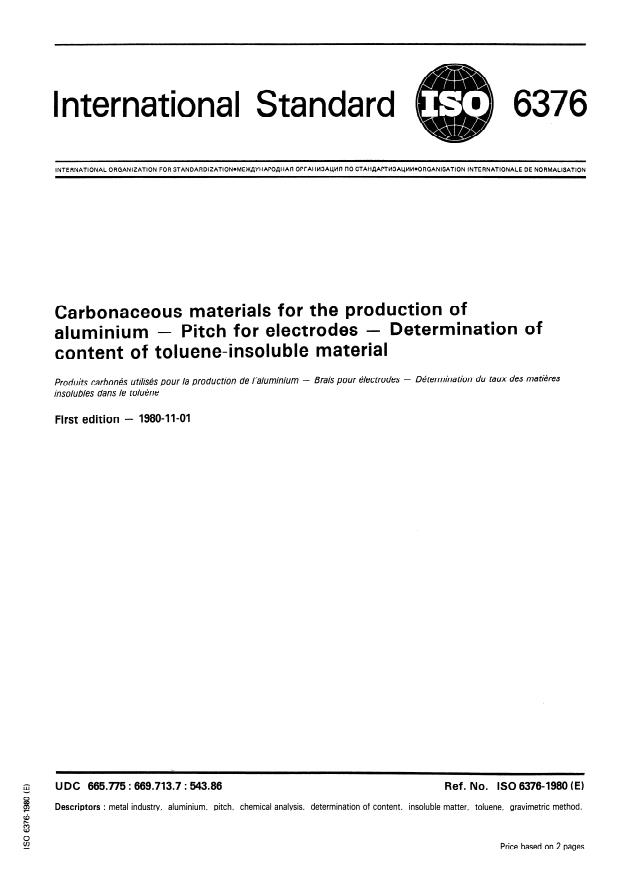
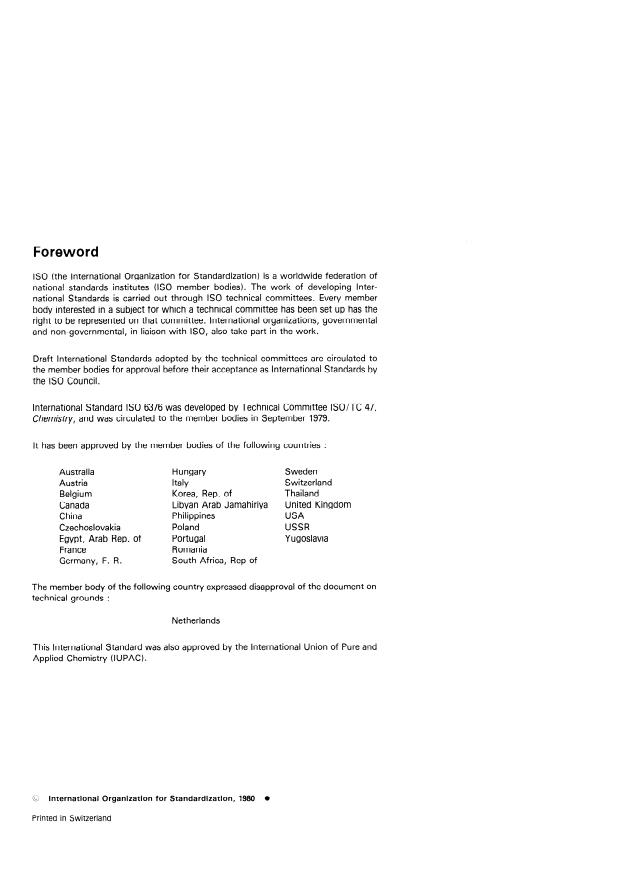
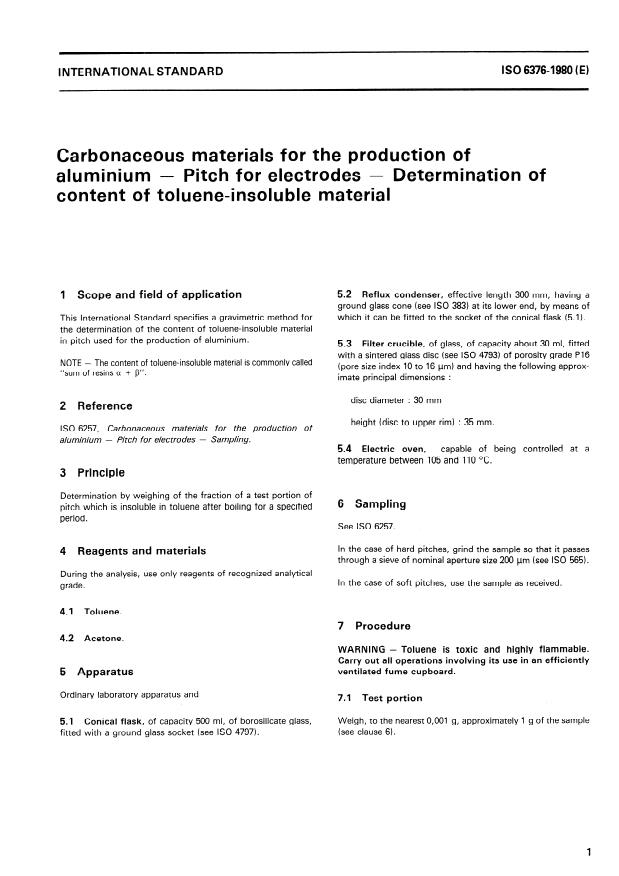

ISO 6376:1980 - Carbonaceous materials for the production of aluminium — Pitch for electrodes — Determination of content of toluene-insoluble material Released:11/1/1980
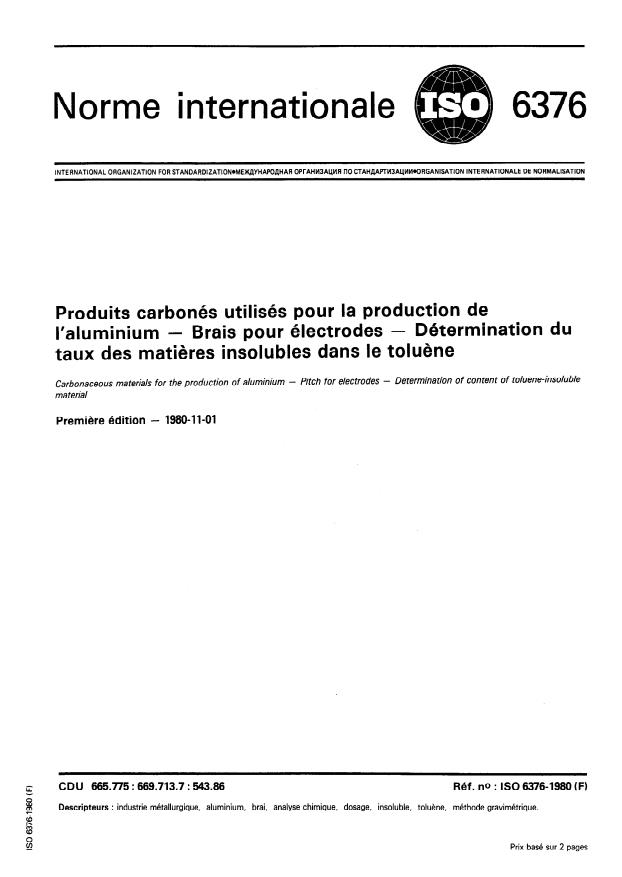

ISO 6376:1980 - Produits carbonés utilisés pour la production de l'aluminium — Brais pour électrodes — Détermination du taux des matieres insolubles dans le toluene Released:11/1/1980
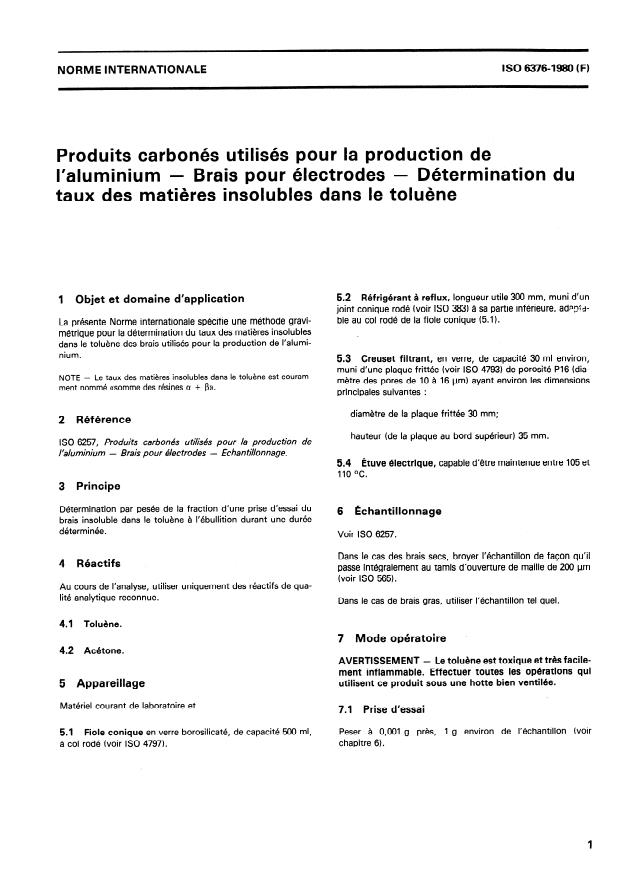

ISO 6376:1980 - Produits carbonés utilisés pour la production de l'aluminium — Brais pour électrodes — Détermination du taux des matieres insolubles dans le toluene Released:11/1/1980
Overview
ISO 6376:1980 specifies a gravimetric method for determining the content of toluene‑insoluble material in electrode pitch used in the production of aluminium. The standard defines a practical laboratory procedure: dissolve a measured test portion of pitch in hot toluene, reflux for a specified time, collect and dry the insoluble fraction, and express the result as a percentage by mass. ISO 6376 was developed by ISO/TC 47 (Chemistry) and is also approved by IUPAC.
Key topics and technical requirements
- Scope: Measurement of toluene‑insoluble content in carbonaceous pitch for aluminium electrodes.
- Principle: Gravimetric determination of the insoluble fraction after boiling in toluene.
- Sample preparation:
- Hard pitches: grind to pass a 200 µm sieve (see ISO 565).
- Soft pitches: use as received.
- Reagents: Analytical‑grade toluene and acetone. Safety warning: toluene is toxic and highly flammable-perform in a fume cupboard.
- Apparatus:
- 500 ml conical flask with ground glass socket.
- Reflux condenser (effective length ~300 mm).
- Glass filter crucible with sintered glass disc (porosity grade P16, disc ~30 mm).
- Electric oven controllable at 105–110 °C.
- Procedure essentials:
- Test portion ≈ 1 g (weighed to 0.001 g).
- Add ~100 ml hot (~80 °C) toluene, dissolve and reflux for about 30 minutes.
- Filter under gentle suction, rinse with hot toluene and acetone to remove soluble residues.
- Dry the crucible and residue ~1 hour at 105–110 °C, cool in a desiccator and weigh.
- Result calculation: Percentage of toluene‑insoluble material = (mass of dried insoluble residue ÷ mass of test portion) × 100.
- Precision: Repeatability ~0.5% ; reproducibility ~1%.
Applications and users
ISO 6376:1980 is used by:
- Quality control laboratories in aluminium smelting and electrode manufacturing.
- Suppliers of carbonaceous materials (pitch producers) validating resin content.
- Research and development teams studying pitch formulations and electrode performance. Practical uses include verifying pitch composition, monitoring production consistency, and ensuring feedstock meets specifications for anode and electrode manufacture.
Related standards
- ISO 6257 - Sampling of pitch for electrodes.
- ISO 565 - Sieving methods (particle size preparation).
- ISO 383, ISO 4793, ISO 4797 - referenced for apparatus and glassware details.
Keywords: ISO 6376:1980, carbonaceous materials, pitch for electrodes, toluene‑insoluble, gravimetric method, aluminium production, electrode pitch, determination of insoluble material.
Relations
- Effective Date
- 25-Aug-2026
- Effective Date
- 25-Aug-2026
- Effective Date
- 25-Aug-2026
- Effective Date
- 04-Nov-2023
Buy Documents
ISO 6376:1980 - Carbonaceous materials for the production of aluminium — Pitch for electrodes — Determination of content of toluene-insoluble material Released:11/1/1980
ISO 6376:1980 - Produits carbonés utilisés pour la production de l'aluminium — Brais pour électrodes — Détermination du taux des matieres insolubles dans le toluene Released:11/1/1980
ISO 6376:1980 - Produits carbonés utilisés pour la production de l'aluminium — Brais pour électrodes — Détermination du taux des matieres insolubles dans le toluene Released:11/1/1980
Get Certified
Connect with accredited certification bodies for this standard

ECOCERT
Organic and sustainability certification.

Eurofins Food Testing Global
Global leader in food, environment, and pharmaceutical product testing.

Intertek Bangladesh
Intertek certification and testing services in Bangladesh.
Sponsored listings
Frequently Asked Questions
ISO 6376:1980 is a standard published by the International Organization for Standardization (ISO). Its full title is "Carbonaceous materials for the production of aluminium — Pitch for electrodes — Determination of content of toluene-insoluble material". This standard covers: Specifies a gravimetric method, the principle of which consists in weighing the fraction of a test portion of pitch which is insoluble in toluene after boiling for a specified period.
Specifies a gravimetric method, the principle of which consists in weighing the fraction of a test portion of pitch which is insoluble in toluene after boiling for a specified period.
ISO 6376:1980 is classified under the following ICS (International Classification for Standards) categories: 71.100.10 - Materials for aluminium production. The ICS classification helps identify the subject area and facilitates finding related standards.
ISO 6376:1980 has the following relationships with other standards: It is inter standard links to EN 14263:2003, EN 14639:2005, EN 14264:2003, ISO/PRF 6376. Understanding these relationships helps ensure you are using the most current and applicable version of the standard.
ISO 6376:1980 is available in PDF format for immediate download after purchase. The document can be added to your cart and obtained through the secure checkout process. Digital delivery ensures instant access to the complete standard document.
Standards Content (Sample)
International Standard
INTERNATIONAL ORGANIZATION FOR STANDARDIZATION.MEIKJJYHAPO~HAfl OPrAHM3ALWIR l-i0 CTAH~APTkI3AL&Wl@ORGANISATlON INTERNATIONALE DE NORMALISATION
Carbonaceous materials for the production of
Pitch for electrodes - Determination of
aluminium -
content of .toluene-insoluble material
Determination du taux des matikes
Produits carbonh utilish pour Ia production de lfaluminium - Brais pour klectrodes -
insolubles dans Ie tolukne
First edition - 1980-11-01
UDC 665.775 : 669.713.7 : 543.86
Ref. No. ISO 63764980 (EI
Descriptors :
metal industry, aluminium, pitch, Chemical analysis, determination of content, insoluble matter, toluene, gravimetric method.
Price based on 2 pages
Foreword
ISO (the International Organization for Standardization) is a worldwide federation of
national Standards institutes (ISO member bodies). The work of developing Inter-
national Standards is carried out through ISO technical committees. Every member
body interested in a subject for which a technical committee has been set up has the
right to be represented on that committee. International organizations, governmental
and non-governmental, in liaison with ISO, also take part in the work.
Draft International Standards adopted by the technical committees are circulated to
the member bodies for approval before their acceptance as International Standards by
the ISO Council.
International Standard ISO 6376 was developed by Technical Committee ISO/TC 47,
Chemistry, and was circulated to the member bodies in September 1979.
lt has been approved by the member bodies of the following countries :
Australia Hungary Sweden
Italy Switzerland
Austria
Belgium Korea, Rep. of Thailand
Canada Libyan Arab Jamahiriya United Kingdom
China Philippines USA
Czechoslovakia Poland USSR
Portugal Y ugoslavia
Egypt, Arab Rep. of
France Romania
Germany, F. R. South Africa, Rep of
The member body of the following country expressed disapproval of the documen t on
tech nical grounds
Netherlands
This International Standard was also approved by the International Union of Pure and
Applied Chemistry (IUPAC).
G international Organkation for Standardkation, 1980
Printed in Switzerland
ISO 6376-1980 (El)
INTERNATIONALSTANDARD
Carbonaceous materials for the production of
aluminium - Pitch for electrodes - Determination of
content of toluene-insoluble material
5.2 Reflux condenser, effective length 300 mm, having a
1 Scope and field of application
ground glass cone (sec ISO 383) at its lower end, by means of
which it tan be fitted to the socket of the conical flask (5.1).
This International Standard specifies a gravimetric method for
the determination of the content of toluene-insoluble material
in pitch used for the production of aluminium.
5.3 Filter crucible, of glass, of capacity about 30 ml, fitted
with a sintered glass disc (see ISO 4793) of porosity grade Pl6
NOTE - The content of toluene-insoluble material is commonly called
(Pore size index 10 to 16 Fm) and having the following approx-
“sum of resins cx + ß”.
imate principal dimensions :
disc diameter : 30 mm
2 Reference
height (disc to upper rim) : 35 mm.
ISO 6257, Carbonaceous materials for the production of
aluminium - Pitch for electrodes - Sampling.
5.4 Electric oven, capable of being controlled at a
temperature between 105 and 110 OC.
3 Principle
Determination by weighing of the fraction of a test Portion of
6 Sampling
pitch which is i
...
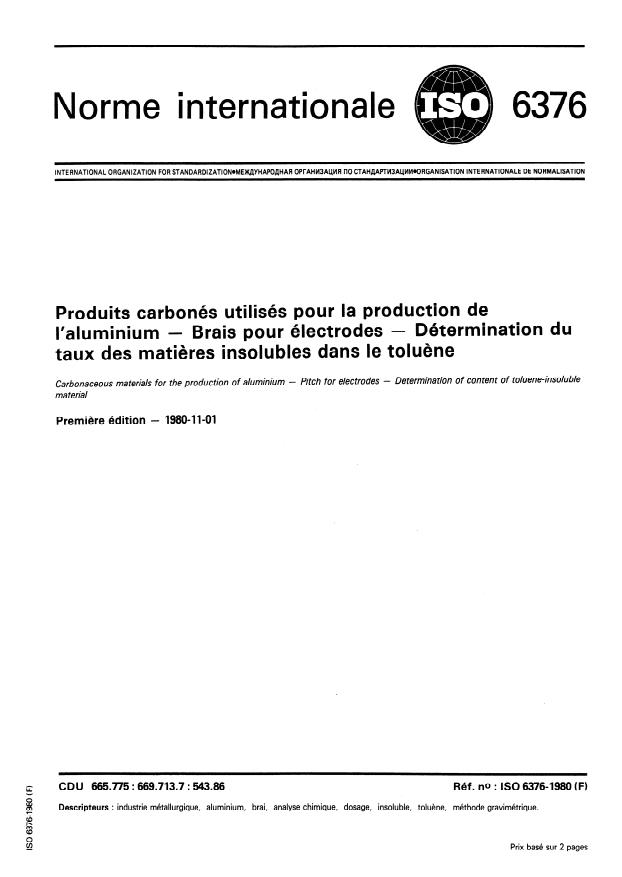
Norme internationale
INTERNATIONAL ORGANIZATION FOR STANDARDIZATlONWlE~YHAPO~HAR OPI-AHM3ALWlR fl0 CTAH~APTM3A~l4l4.ORGANISATlON INTERNATIONALE DE NORMALISATION
Produits carbonés utilisés pour la production de
Brais pour électrodes - Détermination du
l’aluminium -
taux des matières insolubles dans le toluène
Determina tion of content of toluene-insoluble
Carbonaceous materials for the production of aluminium - Pitch for electrodes -
ma terial
Première édition - 1980-l l-01
CDU 665.775 : 669.713.7 : 543.86
Réf. no : ISO 63764980 (F)
Descripteurs : industrie métallurgique, aluminium, brai, analyse chimique, dosage, insoluble, toluène, méthode gravimétrique.
Prix basé sur 2 pages
Avant-propos
L’ISO (Organisation internationale de normalisation) est une fédération mondiale
d’organismes nationaux de normalisation (comités membres de I’ISO). L’élaboration
des Normes internationales est confiée aux comités techniques de I’ISO. Chaque
comité membre intéressé par une étude a le droit de faire partie du comité technique
correspondant. Les organisations internationales, gouvernementales et non gouverne-
mentales, en liaison avec I’ISO, participent également aux travaux.
Les projets de Normes internationales adoptés par les comités techniques sont soumis
aux comités membres pour approbation, avant leur acceptation comme Normes inter-
nationales par le Conseil de I’ISO.
La Norme internationale ISO 6376 a été élaborée par le comité technique ISO/TC 47,
Chimie, et a été soumise aux comités membres en septembre 1979.
Les comités membres des pays suivants l’ont approuvée :
Afrique du Sud, Rép. d’
France Suède
Allemagne, R.F. Hongrie Suisse
Australie Italie Tchécoslovaquie
Autriche Jamahiriya arabe libyenne Thailande
Belgique Philippines URSS
Pologne
Canada USA
Chine Portugal Yougoslavie
Corée, Rép. de Roumanie
Royaume-Uni
Égypte, Rép. arabe d’
Le comité membre du pays suivant l’a désapprouvée pour des raisons techniques :
Pays- Bas
Cette Norme internationale a été également
approuvée par l’Union internationale de
chimie pure et appliquée (U ICPA)
0 Organisation internationale de normalisation, 1980
Imprimé en Suisse
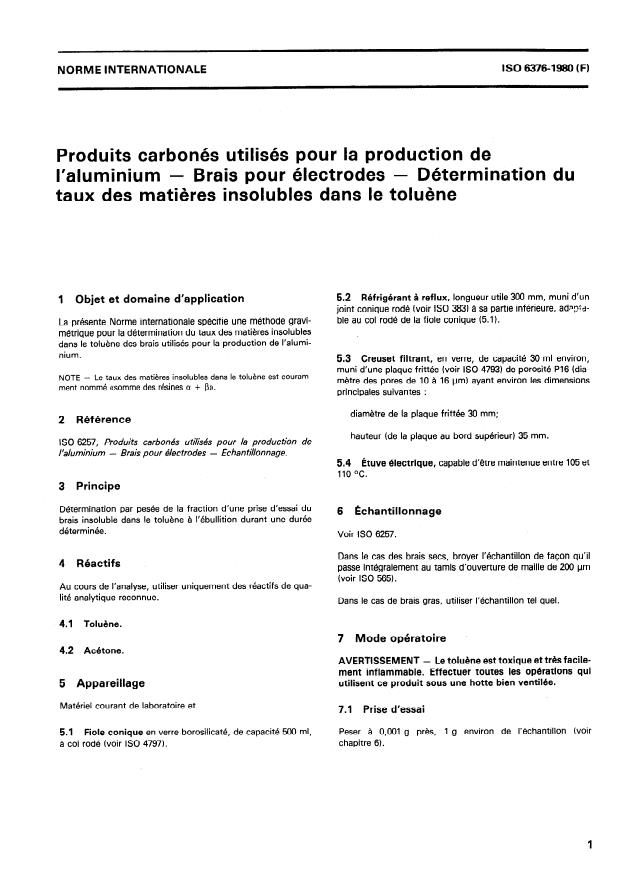
NORME INTERNATIONALE ISO 6376-1980 (FI
Produits carbonés utilisés pour la production de
l’aluminium - Brais pour électrodes - Détermination du
taux des matières insolubles dans le toluène
5.2 Réfrigérant à reflux, longueur utile 300 mm, muni d’un
1 Objet et domaine d’application
joint conique rodé (voir ISO 383) à sa partie inférieure, ad??!+
ble au col rodé de la fiole conique (5.1).
La présente Norme internationale spécifie une méthode gravi-
métrique pour la détermination du taux des matières insolubles
dans le toluène des brais utilisés pour la production de I’alumi-
nium.
5.3 Creuset filtrant, en verre, de capacité 30 ml environ,
muni d’une plaque frittée (voir ISO 4793) de porosité P16 (dia-
NOTE - Le taux des matiéres insolubles dans le toluène est couram-
mètre des pores de 10 à 16 prn) ayant environ les dimensions
ment nommé «somme des résines cc + BD.
principales suivantes :
diamètre de la plaque frittée 30 mm;
2 Référence
hauteur (de la plaque au bord supérieur) 35 mm.
ISO 6257, Produits carbonés utilisés pour la production de
l’aluminium
- Brais pour électrodes - ichantillonnage.
5.4 Étuve électrique, capable d’être maintenue entre 105 et
110 OC.
3 Principe
Détermination par pesée de la fraction d’une prise d’essai du
6 Échantillonnage
brais insoluble dans le toluène à l’ébullition durant une durée
...
Norme internationale
INTERNATIONAL ORGANIZATION FOR STANDARDIZATlONWlE~YHAPO~HAR OPI-AHM3ALWlR fl0 CTAH~APTM3A~l4l4.ORGANISATlON INTERNATIONALE DE NORMALISATION
Produits carbonés utilisés pour la production de
Brais pour électrodes - Détermination du
l’aluminium -
taux des matières insolubles dans le toluène
Determina tion of content of toluene-insoluble
Carbonaceous materials for the production of aluminium - Pitch for electrodes -
ma terial
Première édition - 1980-l l-01
CDU 665.775 : 669.713.7 : 543.86
Réf. no : ISO 63764980 (F)
Descripteurs : industrie métallurgique, aluminium, brai, analyse chimique, dosage, insoluble, toluène, méthode gravimétrique.
Prix basé sur 2 pages
Avant-propos
L’ISO (Organisation internationale de normalisation) est une fédération mondiale
d’organismes nationaux de normalisation (comités membres de I’ISO). L’élaboration
des Normes internationales est confiée aux comités techniques de I’ISO. Chaque
comité membre intéressé par une étude a le droit de faire partie du comité technique
correspondant. Les organisations internationales, gouvernementales et non gouverne-
mentales, en liaison avec I’ISO, participent également aux travaux.
Les projets de Normes internationales adoptés par les comités techniques sont soumis
aux comités membres pour approbation, avant leur acceptation comme Normes inter-
nationales par le Conseil de I’ISO.
La Norme internationale ISO 6376 a été élaborée par le comité technique ISO/TC 47,
Chimie, et a été soumise aux comités membres en septembre 1979.
Les comités membres des pays suivants l’ont approuvée :
Afrique du Sud, Rép. d’
France Suède
Allemagne, R.F. Hongrie Suisse
Australie Italie Tchécoslovaquie
Autriche Jamahiriya arabe libyenne Thailande
Belgique Philippines URSS
Pologne
Canada USA
Chine Portugal Yougoslavie
Corée, Rép. de Roumanie
Royaume-Uni
Égypte, Rép. arabe d’
Le comité membre du pays suivant l’a désapprouvée pour des raisons techniques :
Pays- Bas
Cette Norme internationale a été également
approuvée par l’Union internationale de
chimie pure et appliquée (U ICPA)
0 Organisation internationale de normalisation, 1980
Imprimé en Suisse
NORME INTERNATIONALE ISO 6376-1980 (FI
Produits carbonés utilisés pour la production de
l’aluminium - Brais pour électrodes - Détermination du
taux des matières insolubles dans le toluène
5.2 Réfrigérant à reflux, longueur utile 300 mm, muni d’un
1 Objet et domaine d’application
joint conique rodé (voir ISO 383) à sa partie inférieure, ad??!+
ble au col rodé de la fiole conique (5.1).
La présente Norme internationale spécifie une méthode gravi-
métrique pour la détermination du taux des matières insolubles
dans le toluène des brais utilisés pour la production de I’alumi-
nium.
5.3 Creuset filtrant, en verre, de capacité 30 ml environ,
muni d’une plaque frittée (voir ISO 4793) de porosité P16 (dia-
NOTE - Le taux des matiéres insolubles dans le toluène est couram-
mètre des pores de 10 à 16 prn) ayant environ les dimensions
ment nommé «somme des résines cc + BD.
principales suivantes :
diamètre de la plaque frittée 30 mm;
2 Référence
hauteur (de la plaque au bord supérieur) 35 mm.
ISO 6257, Produits carbonés utilisés pour la production de
l’aluminium
- Brais pour électrodes - ichantillonnage.
5.4 Étuve électrique, capable d’être maintenue entre 105 et
110 OC.
3 Principe
Détermination par pesée de la fraction d’une prise d’essai du
6 Échantillonnage
brais insoluble dans le toluène à l’ébullition durant une durée
...