

ISO/TS 25198
(Main)Traditional Chinese medicine — Sample preparation methods for smoke density test of smokeless moxibustion device
- Abstract
This document provides sample preparation method and provide test result of smoke density test for smokeless moxibustion devices specified in the Annex B of ISO 21366 General requirements for smokeless moxibustion devices. This document contains sample preparation methods in accordance with the shape of smokeless moxibustion device and smoke density of moxa wool, carbonized moxa wool and smokeless moxibustion device products.
- Status
- Not Published
- Technical Committee
- ISO/TC 249 - Traditional Chinese medicine
- Current Stage
- 6000 - International Standard under publication
- Start Date
- 01-Sep-2026
- Completion Date
- 10-Oct-2026
Buy Documents
ISO/DTS 25198 - Traditional Chinese medicine — Sample preparation methods for smoke density test of smokeless moxibustion device
REDLINE ISO/DTS 25198 - Traditional Chinese medicine — Sample preparation methods for smoke density test of smokeless moxibustion device
ISO/TS 25198 is an ISO technical specification for preparing specimens for the smoke density test of smokeless moxibustion devices. It is written for use with the smoke density test framework in ISO 21366 and gives preparation methods for moxa floss, carbonized moxa floss, and smokeless moxibustion device products. For laboratories and manufacturers, it shows how to form comparable test specimens so smoke density results can be measured on the same basis.
What does ISO/TS 25198 specify?
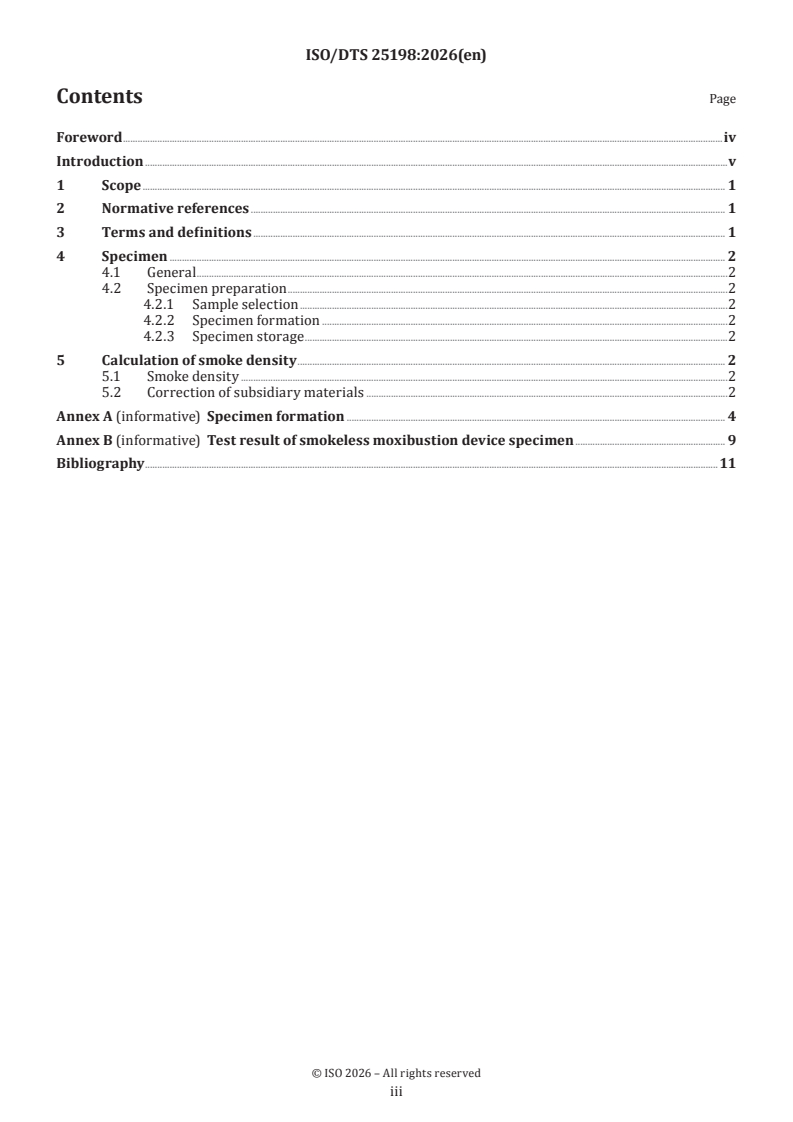
ISO/TS 25198 specifies how to prepare specimens for smoke density testing of smokeless moxibustion devices. The document is organized into Scope, Normative references, Terms and definitions, Specimen, Calculation of smoke density, two informative annexes, and a bibliography.
| Annex | What it covers |
|---|---|
| Annex A | Specimen formation examples |
| Annex B | Test result of smokeless moxibustion device specimen |
The scope ties the document to the smokeless moxibustion devices covered in Annex B of ISO 21366 and to sample preparation by device shape. In practice, this means the document is about preparing the test article, not describing the full smoke density test method itself.
What are the key requirements of ISO/TS 25198?
ISO/TS 25198 focuses on representative sampling, specimen forming, conditioning before test, and correcting the measured smoke density when subsidiary materials are used.
- Clause 4.1 - General: test samples shall be prepared according to the shape or size of each product. This matters because different device forms need different specimen handling if the smoke result is to reflect the actual product.
- Clause 4.2.1 - Sample selection: a smoke density test requires at least 5 specimens. Each specimen is made from a composite sample taken from at least 10 primary packages, or from material selected over 10 different days if taken from the manufacturing line. This helps avoid testing a non-representative sample.
- Clause 4.2.2 - Specimen formation: the specimen is formed to 75 mm by 75 mm, with depth not more than 25 mm. If glue, paper, or other subsidiary materials are needed, an equivalent amount of those materials is tested separately. This is what allows later correction for the support materials.
- Clause 4.2.3 - Specimen storage: prepared specimens are stored for at least 72 hours in a controlled environment at 18 °C to 24 °C and relative humidity below 40 %. This conditioning reduces variation caused by moisture and handling.
- Clause 5.1 - Smoke density: smoke density is calculated using the formulas in ISO 21366 Annex B. In practice, the same calculation basis is used so results can be compared with the parent standard.
- Clause 5.2 - Correction of subsidiary materials: the effect of subsidiary materials is removed using the stated correction formula. This matters when glue or paper contributes smoke and would otherwise distort the result for the combustion material itself.
- Annex A - Specimen formation: Annex A gives formation examples for moxa floss, carbonized moxa floss, and smokeless moxibustion device types 1, 2, and 3. It is practical guidance for building the specimen to the required shape.
What terms does ISO/TS 25198 define?
ISO/TS 25198 formally defines three terms in Clause 3 and uses two specimen-preparation terms throughout the document.
- moxibustion device - an apparatus that uses moxa floss as the main combustion material and is intended for single or repeated use, including the accessories needed for normal use.
- smokeless moxibustion device - a variant of a moxibustion device intended to reduce smoke and bad odour by changing the main combustion material.
- smoke density (aerosol density) - an operational measure of particulates per volume used in smoke testing, expressed through the test parameters named in the definition.
- specimen - the prepared test sample formed from the product material before smoke density testing.
- subsidiary materials - added materials such as glue or paper used to form the specimen and later corrected out of the result.
Who uses ISO/TS 25198?
ISO/TS 25198 is used by manufacturers and product developers of smokeless moxibustion devices, test laboratories running smoke density measurements, and quality managers checking how specimens are prepared. It is also relevant to buyers and technical reviewers who need to understand whether a test report was made from a specimen prepared in a consistent way. The document sits in the Traditional Chinese medicine device area and supports work linked to ISO 21366.
Which standards are used with ISO/TS 25198?
- ISO 21366 - the referenced standard for smokeless moxibustion devices; its Annex B provides the smoke density calculation basis used here.
- ISO 18666:2021 - source of the definition of moxibustion device used in Clause 3.
- ISO 7240-1:2025 - source of the definition of smoke density used in Clause 3.
What does the ISO/TS 25198 document contain?
ISO/TS 25198 contains specimen-preparation guidance for different product shapes, plus calculation and correction steps for smoke density. Annex A gives illustrated examples of specimen formation, including mould-based preparation and device-specific preparation for types 1 to 3. Annex B gives example test results for moxa floss, carbonized moxa floss, subsidiary materials, and specimens 1 to 4. The document also includes a table of results and figures showing how the specimens are formed and assembled.
Buy Documents
ISO/DTS 25198 - Traditional Chinese medicine — Sample preparation methods for smoke density test of smokeless moxibustion device
REDLINE ISO/DTS 25198 - Traditional Chinese medicine — Sample preparation methods for smoke density test of smokeless moxibustion device
Get Certified
Connect with accredited certification bodies for this standard

BSI Group
BSI (British Standards Institution) is the business standards company that helps organizations make excellence a habit.

TÜV Rheinland
TÜV Rheinland is a leading international provider of technical services.

TÜV SÜD
TÜV SÜD is a trusted partner of choice for safety, security and sustainability solutions.
Sponsored listings
Frequently Asked Questions
ISO/TS 25198 is a draft published by the International Organization for Standardization (ISO). Its full title is "Traditional Chinese medicine — Sample preparation methods for smoke density test of smokeless moxibustion device". This standard covers: This document provides sample preparation method and provide test result of smoke density test for smokeless moxibustion devices specified in the Annex B of ISO 21366 General requirements for smokeless moxibustion devices. This document contains sample preparation methods in accordance with the shape of smokeless moxibustion device and smoke density of moxa wool, carbonized moxa wool and smokeless moxibustion device products.
This document provides sample preparation method and provide test result of smoke density test for smokeless moxibustion devices specified in the Annex B of ISO 21366 General requirements for smokeless moxibustion devices. This document contains sample preparation methods in accordance with the shape of smokeless moxibustion device and smoke density of moxa wool, carbonized moxa wool and smokeless moxibustion device products.
ISO/TS 25198 is classified under the following ICS (International Classification for Standards) categories: 11.040.99 - Other medical equipment. The ICS classification helps identify the subject area and facilitates finding related standards.
ISO/TS 25198 is available in PDF format for immediate download after purchase. The document can be added to your cart and obtained through the secure checkout process. Digital delivery ensures instant access to the complete standard document.
Standards Content (Sample)
FINAL DRAFT
Technical
Specification
ISO/DTS 25198
ISO/TC 249/SC 1
Traditional Chinese medicine —
Secretariat: SAC
Sample preparation methods for
Voting begins on:
smoke density test of smokeless
2026-07-06
moxibustion device
Voting terminates on:
2026-08-31
RECIPIENTS OF THIS DRAFT ARE INVITED TO SUBMIT,
WITH THEIR COMMENTS, NOTIFICATION OF ANY
RELEVANT PATENT RIGHTS OF WHICH THEY ARE AWARE
AND TO PROVIDE SUPPOR TING DOCUMENTATION.
IN ADDITION TO THEIR EVALUATION AS
BEING ACCEPTABLE FOR INDUSTRIAL, TECHNO
LOGICAL, COMMERCIAL AND USER PURPOSES, DRAFT
INTERNATIONAL STANDARDS MAY ON OCCASION HAVE
TO BE CONSIDERED IN THE LIGHT OF THEIR POTENTIAL
TO BECOME STAN DARDS TO WHICH REFERENCE MAY BE
MADE IN NATIONAL REGULATIONS.
Reference number
ISO/DTS 25198:2026(en) © ISO 2026
FINAL DRAFT
ISO/DTS 25198:2026(en)
Technical
Specification
ISO/DTS 25198
ISO/TC 249/SC 1
Traditional Chinese medicine —
Secretariat: SAC
Sample preparation methods for
Voting begins on:
smoke density test of smokeless
moxibustion device
Voting terminates on:
RECIPIENTS OF THIS DRAFT ARE INVITED TO SUBMIT,
WITH THEIR COMMENTS, NOTIFICATION OF ANY
RELEVANT PATENT RIGHTS OF WHICH THEY ARE AWARE
AND TO PROVIDE SUPPOR TING DOCUMENTATION.
© ISO 2026
IN ADDITION TO THEIR EVALUATION AS
All rights reserved. Unless otherwise specified, or required in the context of its implementation, no part of this publication may
BEING ACCEPTABLE FOR INDUSTRIAL, TECHNO
LOGICAL, COMMERCIAL AND USER PURPOSES, DRAFT
be reproduced or utilized otherwise in any form or by any means, electronic or mechanical, including photocopying, or posting on
INTERNATIONAL STANDARDS MAY ON OCCASION HAVE
the internet or an intranet, without prior written permission. Permission can be requested from either ISO at the address below
TO BE CONSIDERED IN THE LIGHT OF THEIR POTENTIAL
or ISO’s member body in the country of the requester.
TO BECOME STAN DARDS TO WHICH REFERENCE MAY BE
MADE IN NATIONAL REGULATIONS.
ISO copyright office
CP 401 • Ch. de Blandonnet 8
CH-1214 Vernier, Geneva
Phone: +41 22 749 01 11
Email: copyright@iso.org
Website: www.iso.org
Published in Switzerland Reference number
ISO/DTS 25198:2026(en) © ISO 2026
ii
ISO/DTS 25198:2026(en)
Contents Page
Foreword .iv
Introduction .v
1 Scope . 1
2 Normative references . 1
3 Terms and definitions . 1
4 Specimen . 2
4.1 General .2
4.2 Specimen preparation .2
4.2.1 Sample selection .2
4.2.2 Specimen formation .2
4.2.3 Specimen storage .2
5 Calculation of smoke density . 2
5.1 Smoke density .2
5.2 Correction of subsidiary materials .2
Annex A (informative) Specimen formation . 4
Annex B (informative) Test result of smokeless moxibustion device specimen . 9
Bibliography .11
iii
ISO/DTS 25198:2026(en)
Foreword
ISO (the International Organization for Standardization) is a worldwide federation of national standards
bodies (ISO member bodies). The work of preparing International Standards is normally carried out through
ISO technical committees. Each member body interested in a subject for which a technical committee
has been established has the right to be represented on that committee. International organizations,
governmental and non-governmental, in liaison with ISO, also take part in the work. ISO collaborates closely
with the International Electrotechnical Commission (IEC) on all matters of electrotechnical standardization.
The procedures used to develop this document and those intended for its further maintenance are described
in the ISO/IEC Directives, Part 1. In particular, the different approval criteria needed for the different types
of ISO document should be noted. This document was drafted in accordance with the editorial rules of the
ISO/IEC Directives, Part 2 (see www.iso.org/directives).
ISO draws attention to the possibility that the implementation of this document may involve the use of (a)
patent(s). ISO takes no position concerning the evidence, validity or applicability of any claimed patent
rights in respect thereof. As of the date of publication of this document, ISO had not received notice of (a)
patent(s) which may be required to implement this document. However, implementers are cautioned that
this may not represent the latest information, which may be obtained from the patent database available at
www.iso.org/patents. ISO shall not be held responsible for identifying any or all such patent rights.
Any trade name used in this document is information given for the convenience of users and does not
constitute an endorsement.
For an explanation of the voluntary nature of standards, the meaning of ISO specific terms and expressions
related to conformity assessment, as well as information about ISO's adherence to the World Trade
Organization (WTO) principles in the Technical Barriers to Trade (TBT), see www.iso.org/iso/foreword.html.
This document was prepared by Technical Committee ISO/TC 249, Traditional medicine, Subcommittee SC1,
Traditional Chinese medicine.
Any feedback or questions on this document should be directed to the user’s national standards body. A
complete listing of these bodies can be found at www.iso.org/members.html.
iv
ISO/DTS 25198:2026(en)
Introduction
Moxibustion is one of the major traditional medical therapies which is used worldwide despite the limitations
of smoke. Smokeless moxibustion is an emerging form of moxibustion therapy. However, smokeless
moxibustion devices have different forms or additional components and thus require guidelines for testing.
ISO 21366 has been developed to improve the quality and safety of moxibustion treatments using smokeless
moxibustion devices, especially in regard to the biocompatibility with the human body and indoor air
quality. ISO 25198 defines detailed test methods and sample preparation methods for the various forms of
moxibustion devices.
v
FINAL DRAFT Technical Specification ISO/DTS 25198:2026(en)
Traditional Chinese medicine — Sample preparation methods
for smoke density test of smokeless moxibustion device
1 Scope
This document provides sample preparation methods according to the shape of the smokeless moxibustion
device for the application of the smoke density test for smokeless moxibustion devices specified in
ISO 21366:2023, Annex B.
Also, this document provides the test results of smoke density of moxa floss, carbonized moxa floss and
smokeless moxibustion device products as an information, in Annex B.
2 Normative references
The following documents are referred to in the text in such a way that some or all of their content constitutes
requirements of this document. For dated references, only the edition cited applies. For undated references,
the latest edition of the referenced document (including any amendments) applies.
ISO 21366:2019, Traditional Chinese medicine — General requirements for smokeless moxibustion devices
3 Terms and definitions
For the purposes of this document, the following terms and definitions apply.
ISO and IEC maintain terminological databases for use in standardization at the following addresses:
— ISO Online browsing platform: available at https:// www .iso .org/ obp
— IEC Electropedia: available at https:// www .electropedia .org/
3.1
moxibustion device
apparatus that uses moxa floss as the main combustion material and intended for single or repeated usage
EXAMPLE Moxibustion with tube is a type of moxibustion device, such as a short moxa roll with a cardboard base
and a moxa tube (made of cardboard) that is single-use and developed as an alternative to direct moxibustion.
Note 1 to entry: Moxibustion devices include those accessories as defined by the manufacturers that are necessary to
enable the normal use of the moxibustion device.
[SOURCE: ISO 18666:2021, 3.1]
3.2
smokeless moxibustion device
variant of the moxibustion device (3.1) aiming to reduce the smoke and bad odour caused by combustion by
process of changing main combustio
...
Style Definition
...
Style Definition
...
Style Definition
...
ISO/DTS 25198
Style Definition
...
ISO/TC 249/SC 1
Style Definition
...
Style Definition
Secretariat: SAC .
Style Definition
...
Date: 2026-06-22
Style Definition
...
Style Definition
...
Style Definition
...
Style Definition
...
Style Definition
...
Style Definition
Traditional chineseChinese medicine —Method of sample Sample .
Style Definition
preparation methods for smoke density test of smokeless .
Style Definition
moxibustion device .
Style Definition
...
Style Definition
...
Style Definition
...
Style Definition
...
Style Definition
...
Style Definition
...
Style Definition
...
Style Definition
...
Style Definition
...
Style Definition
...
Style Definition
...
Style Definition
...
Style Definition
...
Style Definition
...
Style Definition
...
Style Definition
...
Style Definition
...
Style Definition
...
Style Definition
...
Style Definition
...
Style Definition
...
Style Definition
...
Style Definition
...
Style Definition
...
Style Definition
...
Style Definition
...
Style Definition
...
Style Definition
...
Style Definition
...
Style Definition
...
Style Definition
...
Style Definition
...
Style Definition
...
Style Definition
...
Style Definition
...
Style Definition
...
Style Definition
...
Style Definition
...
Style Definition
...
Style Definition
...
Style Definition
...
Style Definition
...
St l D fi iti
ISO/DTS 25198:(en)
All rights reserved. Unless otherwise specified, or required in the context of its implementation, no part of this publication
may be reproduced or utilized otherwise in any form or by any means, electronic or mechanical, including photocopying,
or posting on the internet or an intranet, without prior written permission. Permission can be requested from either ISO
at the address below or ISO’s member body in the country of the requester.
ISO copyright office
CP 401 • Ch. de Blandonnet 8
CH-1214 Vernier, Geneva
Phone: + 41 22 749 01 11
E-mail: copyright@iso.org
Website: www.iso.org
Published in Switzerland
ii
ISO/DTS 25198:(en)
Contents
Foreword . iv
Introduction . v
1 Scope . 1
2 Normative references . 1
3 Terms and definitions . 1
4 Specimen . 2
4.1 General . 2
4.2 Specimen preparation . 2
5 Calculation of smoke density . 3
5.1 Smoke density . 3
5.2 Correction of subsidiary materials . 3
Annex A (informative) Specimen formation . 4
Annex B (informative) Test result of smokeless moxibustion device specimen . 13
Bibliography . 15
iii
ISO/DTS 25198:(en)
Formatted: Font color: Auto
Foreword
Formatted: Adjust space between Latin and Asian text,
ISO (the International Organization for Standardization) is a worldwide federation of national standards
Adjust space between Asian text and numbers
bodies (ISO member bodies). The work of preparing International Standards is normally carried out through
ISO technical committees. Each member body interested in a subject for which a technical committee has been
established has the right to be represented on that committee. International organizations, governmental and
non-governmental, in liaison with ISO, also take part in the work. ISO collaborates closely with the
International Electrotechnical Commission (IEC) on all matters of electrotechnical standardization.
The procedures used to develop this document and those intended for its further maintenance are described
in the ISO/IEC Directives, Part 1. In particular, the different approval criteria needed for the different types of
ISO documentsdocument should be noted. This document was drafted in accordance with the editorial rules Formatted: Font color: Auto
of the ISO/IEC Directives, Part 2 (see www.iso.org/directiveswww.iso.org/directives).
Formatted: Font color: Auto
Attention is drawnISO draws attention to the possibility that some of the elementsimplementation of this Formatted: Font color: Auto
document may beinvolve the subjectuse of (a) patent(s). ISO takes no position concerning the evidence,
Formatted: Font color: Auto
validity or applicability of any claimed patent rights. in respect thereof. As of the date of publication of this
Formatted: Font color: Auto
document, ISO had not received notice of (a) patent(s) which may be required to implement this document.
However, implementers are cautioned that this may not represent the latest information, which may be
Formatted: Font color: Auto
obtained from the patent database available at www.iso.org/patents. ISO shall not be held responsible for
Formatted: Font color: Auto
identifying any or all such patent rights. Details of any patent rights identified during the development of the
Formatted: Font color: Auto
document will be in the Introduction and/or on the ISO list of patent declarations received (see
www.iso.org/patents).
Formatted: Font color: Auto
Formatted: Font color: Auto
Any trade name used in this document is information given for the convenience of users and does not
constitute an endorsement.
For an explanation of the voluntary nature of standards, the meaning of ISO specific terms and expressions
related to conformity assessment, as well as information about ISO's adherence to the World Trade
Organization (WTO) principles in the Technical Barriers to Trade (TBT) see www.iso.org/iso/foreword.html),
see www.iso.org/iso/foreword.html. Formatted: Font color: Auto, English (United Kingdom)
Formatted: Font color: Auto
This document was prepared by Technical Committee ISO/TC 249, Traditional medicine, Subcommittee SC1,
Formatted: Font: Not Italic, Font color: Auto
Traditional Chinese medicine.
Formatted: Font color: Auto
Any feedback or questions on this document should be directed to the user’s national standards body. A
Formatted: Font color: Auto, English (United Kingdom)
complete listing of these bodies can be found at www.iso.org/members.htmlwww.iso.org/members.html.
Formatted: Adjust space between Latin and Asian text,
Adjust space between Asian text and numbers
Formatted: Font color: Auto, English (United Kingdom)
Formatted: Font color: Auto
iv
ISO/DTS 25198:(en)
Introduction
Moxibustion is one of the major traditional medical therapies which is usingused worldwide despite the Formatted: Font color: Auto
limitationlimitations of smoke. Smokeless moxibustion is an emerging form of moxibustion therapy. However,
Formatted: Font color: Auto
smokeless moxibustion devices have different forms or additional components and thus, it requires guideline
require guidelines for testing of smokeless moxibustion devices. Formatted: Font color: Auto
Formatted: Font color: Auto
ISO 21366 has been developed to improve the quality and safety of moxibustion treatments using smokeless
moxibustion devices, especially in regardsregard to the biocompatibility with the human body and indoor air
Formatted: Font color: Auto
quality. ISO 25198 defines detailed test methods and sample preparation methods for the various forms of
moxibustion devices. Formatted: Font color: Auto
v
Formatted
...
Formatted
...
ISO/DTS 25198:(en)
Formatted
...
Formatted
...
Formatted
...
Formatted
Traditional Chinese medicine — Method of sample — Sample
...
Formatted
preparation methods for smoke density test of smokeless .
Formatted
...
moxibustion device
Formatted
...
1 Scope
Formatted
...
Formatted
...
This document provides sample preparation method and provide test result ofmethods according to the shape
of the smokeless moxibustion device for the application of the smoke density test for smokeless moxibustion Formatted
...
devices specified in the Annex B of ISO 21366 General requirements for smokeless moxibustion devices:2023,
Formatted
...
Annex B.
Formatted
...
ThisAlso, this document contains sample preparation methods in accordance with the shape of smokeless
Formatted
...
moxibustion device, andprovides the test resultresults of smoke density of moxa floss, carbonized moxa floss
Formatted
...
and smokeless moxibustion device products. as an information, in Annex B.
Formatted
...
Formatted
...
Formatted
...
32 Normative references
Formatted
...
The following documents are referred to in the text in such a way that some or all of their content constitutes
Formatted
...
requirements of this document. For dated references, only the edition cited applies. For undated references,
Formatted
...
the latest edition of the referenced document (including any amendments) applies.
Formatted
...
Formatted
...
Formatted
ISO 21366; :2019, Traditional Chinese medicine — General requirements for smokeless moxibustion devices .
Formatted
...
Formatted
...
Formatted
53 Terms and definitions .
Formatted
...
For the purposes of this document, the following terms and definitions apply.
Formatted
...
ISO and IEC maintain terminological databases for use in standardization at the following addresses: Formatted
...
Formatted
...
— — ISO Online browsing platform: available at https://www.iso.org/obphttps://www.iso.org/obp
Formatted
...
— — IEC Electropedia: available at http://www.electropedia.org/https://www.electropedia.org/
Formatted
...
Formatted
...
Formatted
...
3.1 3.1
Formatted
...
moxibustion device
Formatted
...
apparatus that uses moxa floss as the main combustion material and intended for single or repeated usage
Formatted
...
EXAMPLE Moxibustion with tube is a type of moxibustion device, such as a short moxa roll with a cardboard base
Formatted
...
and a moxa tube (made of cardboard) that is single-use and developed as an alternative to direct moxibustion.
Formatted
...
Note 1 to entry: Moxibustion device includesdevices include those accessories as defined by the
Formatted
...
manufacturers that are necessary to enable the normal use of the moxibustion device.
Formatted
...
[SOURCE: ISO 18666:2021, 3.1]
Formatted
...
Formatted
...
Formatted
...
© ISO 2018 2026 – All rights reserved
Formatted
...
Formatted
...
Formatted
...
ISO #####-#:####(X/DTS 25198:(en)
Formatted: HeaderCentered, Line spacing: single
3.2 3.2
Formatted: Font color: Auto
smokeless moxibustion device
A variant of the moxibustion device (3.1)(3.1) aiming to reduce the smoke and bad odour caused by combustion Formatted: Font color: Auto
by processingprocess of changing main combustion material.
Formatted: Font color: Auto
Note 1 to entry: Carbonized moxa floss, carbonized mugwort leaves or other carbonized materials
Formatted: Font color: Auto
maycan be used as the main combustion material.
Note 2 to entry: Not all moxibustion devices use moxa floss and the intended use is not definitional.
Formatted: Font color: Auto
3.3 3.3
Formatted: Font color: Auto
smoke density (aerosol density)
Formatted: Font color: Auto
number of particulates per volume as described operationally by one of two parameters:
— — m, an absorbance index, used in the testing of smoke detectors using scattered or transmitted light; Formatted: Font: Italic, Font color: Auto
— — y, a dimensionless variable, used in the testing of smoke detectors using ionization Formatted: Font: Italic, Font color: Auto
Note 1 to entry: These parameters are not concentrations sensu stricto,in the strict sense but represent Formatted: Font color: Auto
values which are proportional to the concentration and have been shown to function in lieu of a true concentration value
for the purposes of these tests.
[SOURCE: ISO 7240-1:2014, 2.1.5]-1:2025, 3.5, modified —"amount" revised to "number" in definition, and
Formatted: Default Paragraph Font, Font color: Auto
Note 1 to entry modified.]
Formatted: Font color: Auto
Formatted: Adjust space between Latin and Asian text,
Adjust space between Asian text and numbers
74 Specimen
Formatted: Adjust space between Latin and Asian text,
Adjust space between Asian text and numbers, Tab stops:
7.14.1 General Not at 0.71 cm
Formatted: Font color: Auto
Test samples shall be prepared in accordance inwith the shape or size of each productsproduct.
Formatted: Adjust space between Latin and Asian text,
Adjust space between Asian text and numbers, Tab stops:
7.24.2 Specimen preparation
Not at 0.71 cm
7.2.14.2.1 Sample selection
Formatted: Adjust space between Latin and Asian text,
Adjust space between Asian text and numbers, Tab stops:
SmokeA smoke density test requires at least 5 specimen andspecimens. Sufficient samples shall be selected
Not at 0.71 cm + 0.99 cm + 1.27 cm
enough to form 5 specimenspecimens specified in 4.2.2 in accordance with the size and shape of each
Formatted: Font color: Auto
productsproduct. Each specimen shall be made by samplesconsist of a composite sample collected from at
Formatted: Font color: Auto
least 10 primary packagepackages. If the samples were selected in the manufacturing line, samples shall be
selected over 10 different days.
Formatted: Adjust space between Latin and Asian text,
Adjust space between Asian text and numbers, Tab stops:
7.2.24.2.2 Specimen formation
Not at 0.71 cm + 0.99 cm + 1.27 cm
Formatted: Font color: Auto
For the smoke density test, samplethe specimen shall be formed in the size of 75 × mm × 75 mm mm in width
and length and the depth of the sample shall not be overmore than 25 mm. AThe formation of the sample may Formatted: Font color: Auto
require subsidiary materials (e.g. glue or paper) and in this case, the sameAn equivalent amount of subsidiary
Formatted: Font color: Auto
materials used in forming the test sample shall be tested.
Formatted: Adjust space between Latin and Asian text,
Adjust space between Asian text and numbers, Tab stops:
separately. For further exampleexamples of sample formation, see Annex AAnnex A.
Not at 0.71 cm + 0.99 cm + 1.27 cm
7.2.34.2.3 Specimen storage
Formatted: Font color: Auto
Formatted: Font: 11 pt
Formed samplesPrepared specimens shall be stored in thea controlled environment for more thanat least 72
Formatted: FooterPageNumber, Space Before: 0 pt, Line
hours before the test h prior to testing.
spacing: single, Tab stops: Not at 17.2 cm
2 © ISO #### 2026 – All rights reserved
ISO/DTS 25198:(en)
Formatted: HeaderCentered, Left, Line spacing: single
Specimens shall be stored under the following controlled conditions:
-— A temperature : fromof 18 °C to 24 °C, Formatted: Font color: Auto
Formatted: List Continue 1, No bullets or numbering, Tab
-— relative humidity: of less than 40 % %.
stops: Not at 0.71 cm
Formatted: Font color: Auto
95 Calculation of smoke density Formatted: Font color: Auto
Formatted: Adjust space between Latin and Asian text,
9.15.1 Smoke density
Adjust space between Asian text and numbers
1)
Calculation of smoke density followsshall follow the formulas in the B.4, Annex B, ISO 21366. (Test: — ,
Formatted: Font color: Auto
Annex B.4. For the test result, see Annex B)Annex B, Table B.1.
Formatted: Body Text
Formatted: Font color: Auto
9.25.2 Correction of subsidiary materials
Formatted: Font color: Auto
The effect of subsidiary materials shall be removedcorrected if it wasthey were used while forming the
Formatted: Adjust space between Latin and Asian text,
specimen. The formula for correct the effect fromof subsidiary materials is as following;shall be corrected
Adjust space between Asian text and numbers, Tab stops:
using Formula (1):
Not at 0.71 cm
𝐴𝐴 Formatted: Font color: Auto
𝑠𝑠
𝐷𝐷 =𝐷𝐷 −𝐷𝐷 ( )
𝑎𝑎 𝑚𝑚 𝑝𝑝
𝐴𝐴
𝑐𝑐 Formatted: Body Text
Formatted: Font color: Auto
𝐴𝐴
s
𝐷𝐷 =𝐷𝐷 −𝐷𝐷 ( ) (1)
a m p
𝐴𝐴
c
where Formatted: Font color: Auto
Formatted: where_keep-with-next, Adjust space between
Da is the corrected real smoke density
Latin and Asian text, Adjust space between Asian text and
Dm is the smoke density measured from the specimen with subsidiary materials
numbers
Dp is the smoke density measured from the subsidiary materials
Formatted: Font color: Auto
A is the amount of subsidiary materials used in the specimen
s
Formatted: Equation Legend, Indent: First line: 0 ch
A is the amount of subsidiary materials used for the smoke density measurement
c
Formatted: Font color: Auto
Formatted: Font color: Auto
Formatted: Font color: Auto
Formatted: Font color: Auto
Formatted: Font: 10 pt, English (United Kingdom)
Formatted: Font: 11 pt
1)
Formatted: FooterPageNumber, Space Before: 0 pt, Tab
Under preparation. Stage at time of publication: ISO/FDIS 21366:2026.
stops: Not at 17.2 cm
© ISO 2018 2026 – All rights reserved
Formatted
...
Formatted
...
ISO #####-#:####(X/DTS 25198:(en)
Formatted
...
Formatted
...
Formatted
...
Annex A
Formatted
...
(informative)
Formatted
...
Formatted
Specimen formation .
For
...