

ISO/TS 22358:2026
(Main)Traditional Chinese medicine — Procedure for reporting indoor air quality when combusting moxibustion devices
- Abstract
This document aims to provide a procedure for reporting indoor air quality when combusting moxibustion devices. It is intended for use in business-to-business (B to B) transactions, subject to mutual agreement between parties. This document specifies the steps for preparing reports that compare indoor concentration values of target pollutants generated when combusting moxibustion device with international, regional, or national ambient and indoor air quality regulations, standards, or guideline values. This document does not apply to moxibustion devices that do not involve combustion of moxibustion material, such as electric heating moxibustion equipment covered in ISO 21292:2020 and infrared moxibustion-like instruments covered in ISO 20493:2018.
- Status
- Published
- Publication Date
- 13-Oct-2026
- Technical Committee
- ISO/TC 249 - Traditional Chinese medicine
- Current Stage
- 6060 - International Standard published
- Start Date
- 14-Oct-2026
- Completion Date
- 14-Oct-2026
ISO/TS 22358:2026 is an ISO Technical Specification from ISO on how to report indoor air quality when combusting moxibustion devices. It is written for business-to-business (B to B) transactions and gives a procedure for comparing indoor concentrations of target pollutants with applicable ambient and indoor air quality regulations, standards, or guideline values. In practice, it helps intermediaries and manufacturers prepare the request, test, calculation, and report documents for combustion-based moxibustion products.
What does ISO/TS 22358:2026 specify?
ISO/TS 22358:2026 specifies a reporting procedure for indoor air quality when moxibustion devices use combustion. It is intended for use only by mutual agreement between the parties in B to B transactions, and it focuses on indoor concentration values derived from combustion products.
The scope excludes moxibustion devices that do not involve combustion of moxibustion material, including electric heating moxibustion equipment covered in ISO 21292:2020 and infrared moxibustion-like instruments covered in ISO 20493:2018.
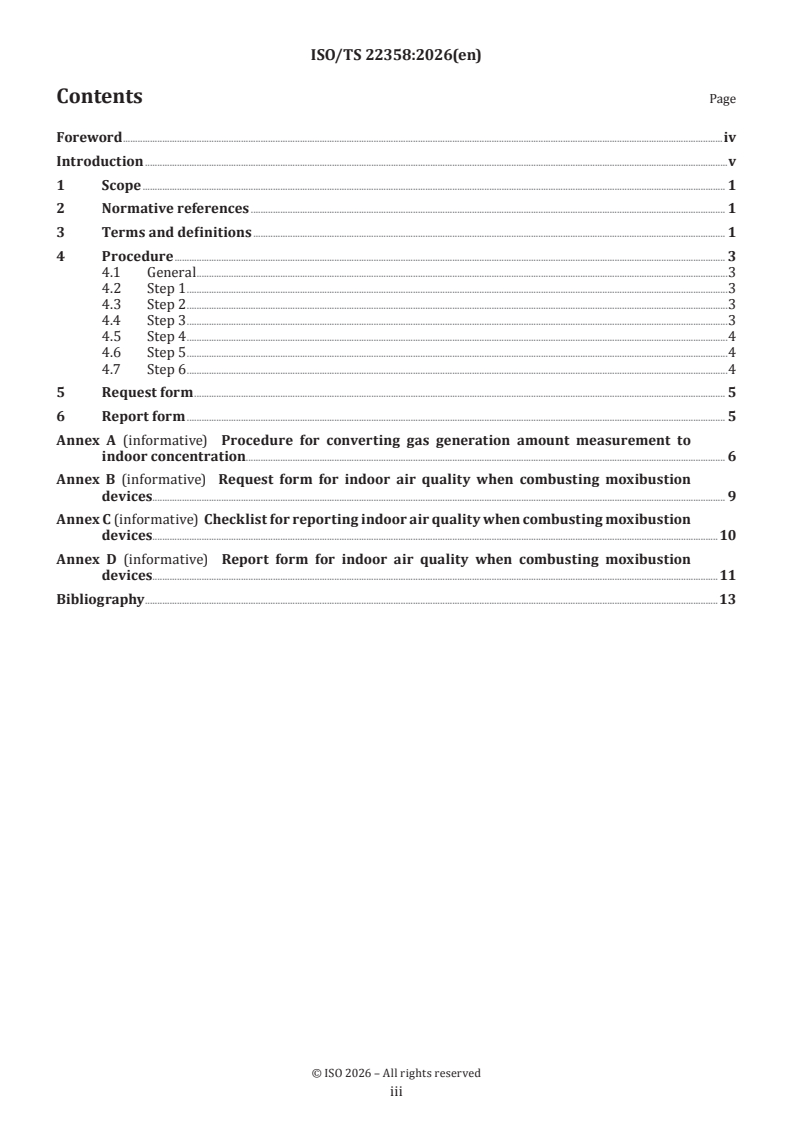
The document is organized into six clauses and four informative annexes.
| Annex | What it covers |
|---|---|
| Annex A | Procedure for converting gas generation amount measurement to indoor concentration |
| Annex B | Request form for indoor air quality when combusting moxibustion devices |
| Annex C | Checklist for reporting indoor air quality when combusting moxibustion devices |
| Annex D | Report form for indoor air quality when combusting moxibustion devices |
What are the key requirements of ISO/TS 22358:2026?
Request and reporting workflow
ISO/TS 22358:2026 sets out a six-step workflow in Clause 4. The process starts with a request from an intermediary and ends with a report that records the test, the calculation, and the comparison with the applicable air quality values.
- Step 1, Clause 4.2 - In B to B trade, the intermediary may send a request form to the manufacturer to ask for an indoor air quality report. In practice, this starts the formal exchange and defines the device, pollutants, and exposure scenario to be assessed.
- Step 2, Clause 4.3 - The manufacturer receives the request and carries out the reporting process. Annex C provides a checklist that can be used to track receipt, test status, analysis, and delivery.
- Step 5, Clause 4.6 - Mitigation measures are decided by agreement between the intermediary and the manufacturer. In practice, this is where the parties decide whether ventilation or other measures are needed if the calculated indoor concentration is too high.
- Step 6, Clause 4.7 - The results from the test, conversion, and any mitigation step are written into the report form. This makes the outcome usable for customer communication and internal records.
Testing, pollutants, and calculation
ISO/TS 22358:2026 requires a combustion test in a test chamber to measure pollutant generation, then conversion of the measured emissions into indoor concentrations. The document is built around comparing calculated indoor values with air quality values that apply to the intended use situation.
- Clause 4.4 - The combustion test quantifies target pollutants in the emitted combustion gases. The quantitative analysis is to follow ISO 21366 or another method shown to be equally suitable, so the method has to match the pollutant and the device.
- Carbon monoxide (CO) and nitrogen dioxide (NO2) - Test methods are to follow ISO 15011-2. This matters because these pollutants are measured with a specific laboratory method rather than a generic smoke observation.
- Total volatile organic compounds (TVOCs) - Test methods are to follow ISO 16000-6. This allows comparison of VOC-related emissions using an indoor-air method.
- Aldehydes - Test methods are to follow ISO 16000-3. This is important when formaldehyde and related carbonyl compounds are part of the assessment.
- Clause 4.4.3 - The quantity of pollutants released is calculated per sample mass. In practice, the manufacturer needs both the measured pollutant amount and the combusted sample amount.
- Clause 4.5 and Annex A - The measured values are converted into indoor concentrations using the procedure in Annex A, or another equally suitable method. The conversion has to use the exposure scenario, including room volume, ventilation rate, and exposure time, because those factors change the calculated indoor level.
Request form and report form content
ISO/TS 22358:2026 also specifies what information belongs in the request and report documents.
- Clause 5 - The request form includes client information, request date, desired reporting date, type and name of the moxibustion device, target pollutants, applicable regulations, standards, or guidelines, exposure scenario, and appendix. The clause notes that items a) through g) are required and h) is optional.
- Clause 6 - The report form includes client name, reporting date, test date, device identification, target pollutants, test method, calculation process and exposure scenario, comparison results, ventilation rate to ensure safety, appendix, and the name and signature of the person who conducted the test. The clause notes that items a) through h) and k) are required, while i) and j) are optional.
What terms does ISO/TS 22358:2026 define?
- Indoor air quality - The characteristics of air inside a building, described through odour, physical parameters, and chemical and biological pollutants.
- Moxa floss - A cotton-like material made from mugwort leaves and used for moxibustion.
- Combustion - An exothermic reaction between a substance and an oxidizing agent.
- Combustion product - Solid, liquid, or gaseous material resulting from combustion, including ash, soot, char, or fire effluent.
- Moxibustion device - An apparatus that uses moxa floss as the main combustible material and is intended for single or repeated use.
- Smokeless moxibustion device - A moxibustion device intended to reduce smoke and odour from combustion.
- Ventilation rate - The air volume per unit time at which outdoor air enters a building or enclosed space.
- Intermediary - A commercial party that provides services to customers, suppliers, or authorities within the supply chain.
Who uses ISO/TS 22358:2026?
ISO/TS 22358:2026 is used by moxibustion device manufacturers, intermediaries, and testing organizations that need a documented way to report indoor air quality for combustion-based products. It is also relevant to quality managers, regulatory staff, and buyers who need to compare device emissions against indoor air quality values in the target market.
The document is aimed at Traditional Chinese medicine supply chains where indoor use and combustion emissions both matter. It supports product reporting, request handling, laboratory testing, and comparison against air quality criteria in B to B transactions.
Which standards are used with ISO/TS 22358:2026?
| Standard | What it contributes |
|---|---|
| ISO 21366 | General requirements for smokeless moxibustion devices, and a test-method reference in Clause 4.4.2 |
| ISO 15011-2 | Test methods for carbon monoxide (CO) and nitrogen dioxide (NO2) |
| ISO 16000-6 | Test method for total volatile organic compounds (TVOCs) |
| ISO 16000-3 | Test method for aldehydes and other carbonyl compounds |
| ISO 21292:2020 | Identifies electric heating moxibustion equipment as outside the scope of this document |
| ISO 20493:2018 | Identifies infrared moxibustion-like instruments as outside the scope of this document |
| ISO 16000-40:2019 | Source standard for the term indoor air quality |
| ISO 18666:2021 | Source standard for terms such as moxa floss, moxibustion device, and moxibustion material |
| ISO 13943:2023 | Source standard for combustion-related terminology |
| ISO 20338:2019 | Source standard for combustible material terminology |
| ISO 24533-2:2022 | Source standard for the term intermediary |
| ISO 472:2013 | Source standard for the term exposure time |
| ISO 16814:2008 | Source standard for the term ventilation rate |
What does the ISO/TS 22358:2026 document contain?
ISO/TS 22358:2026 contains a step-by-step reporting procedure, two document templates, a checklist, and a calculation annex. Annex A shows how measured gas generation can be converted into indoor concentration, including a simplified case without ventilation and a case that includes ventilation and time-dependent concentration changes.
Annex B gives a request form template, Annex C gives a checklist for handling the request and test process, and Annex D gives a report form template with sample fields for the test method, exposure scenario, comparison result, and ventilation-rate statement. These parts are meant to support practical reporting, testing, and internal review rather than to replace local legal or regulatory requirements.
Get Certified
Connect with accredited certification bodies for this standard

BSI Group
BSI (British Standards Institution) is the business standards company that helps organizations make excellence a habit.

TÜV Rheinland
TÜV Rheinland is a leading international provider of technical services.

TÜV SÜD
TÜV SÜD is a trusted partner of choice for safety, security and sustainability solutions.
Sponsored listings
Frequently Asked Questions
ISO/TS 22358:2026 is a technical specification published by the International Organization for Standardization (ISO). Its full title is "Traditional Chinese medicine — Procedure for reporting indoor air quality when combusting moxibustion devices". This standard covers: This document aims to provide a procedure for reporting indoor air quality when combusting moxibustion devices. It is intended for use in business-to-business (B to B) transactions, subject to mutual agreement between parties. This document specifies the steps for preparing reports that compare indoor concentration values of target pollutants generated when combusting moxibustion device with international, regional, or national ambient and indoor air quality regulations, standards, or guideline values. This document does not apply to moxibustion devices that do not involve combustion of moxibustion material, such as electric heating moxibustion equipment covered in ISO 21292:2020 and infrared moxibustion-like instruments covered in ISO 20493:2018.
This document aims to provide a procedure for reporting indoor air quality when combusting moxibustion devices. It is intended for use in business-to-business (B to B) transactions, subject to mutual agreement between parties. This document specifies the steps for preparing reports that compare indoor concentration values of target pollutants generated when combusting moxibustion device with international, regional, or national ambient and indoor air quality regulations, standards, or guideline values. This document does not apply to moxibustion devices that do not involve combustion of moxibustion material, such as electric heating moxibustion equipment covered in ISO 21292:2020 and infrared moxibustion-like instruments covered in ISO 20493:2018.
ISO/TS 22358:2026 is classified under the following ICS (International Classification for Standards) categories: 11.040.99 - Other medical equipment; 13.040.20 - Ambient atmospheres. The ICS classification helps identify the subject area and facilitates finding related standards.
ISO/TS 22358:2026 is available in PDF format for immediate download after purchase. The document can be added to your cart and obtained through the secure checkout process. Digital delivery ensures instant access to the complete standard document.
Standards Content (Sample)
Technical
Specification
ISO/TS 22358
First edition
Traditional Chinese medicine —
2026-10
Procedure for reporting indoor
air quality when combusting
moxibustion devices
Médecine traditionnelle chinoise — Mode opératoire pour
consigner la qualité de l’air intérieur lors de la combustion de
dispositifs de moxibustion
Reference number
© ISO 2026
All rights reserved.
This ISO publication is protected by copyright and is owned by ISO and/or its licensors.
The content of this ISO publication is provided under licence, not sold. Use is subject to the applicable licence terms issued by ISO,
an ISO member body, or an authorized third-party distributor.
Except as required for implementation or expressly permitted by a separate licence, no part of this ISO publication may be
reproduced, distributed, modified, used, or made available in any form or by any means – electronic or mechanical, including
photocopying, scanning, recording, or posting on internal or external digital platforms.
Any use beyond the scope of the granted rights is prohibited and may result in legal action.
ISO copyright office
CP 401 • CH-1214 Vernier, Geneva
Phone: +41 22 749 01 11
Email: copyright@iso.org
Website: www.iso.org
Published in Switzerland
ii
Contents Page
Foreword .iv
Introduction .v
1 Scope . 1
2 Normative references . 1
3 Terms and definitions . 1
4 Procedure . 3
4.1 General .3
4.2 Step 1 .3
4.3 Step 2 .3
4.4 Step 3 .3
4.5 Step 4 .4
4.6 Step 5 .4
4.7 Step 6 .4
5 Request form . 5
6 Report form . 5
Annex A (informative) Procedure for converting gas generation amount measurement to
indoor concentration. 6
Annex B (informative) Request form for indoor air quality when combusting moxibustion
devices. 9
Annex C (informative) Checklist for reporting indoor air quality when combusting moxibustion
devices.10
Annex D (informative) Report form for indoor air quality when combusting moxibustion
devices.11
Bibliography .13
iii
Foreword
ISO (the International Organization for Standardization) is a worldwide federation of national standards
bodies (ISO member bodies). The work of preparing International Standards is normally carried out through
ISO technical committees. Each member body interested in a subject for which a technical committee
has been established has the right to be represented on that committee. International organizations,
governmental and non-governmental, in liaison with ISO, also take part in the work. ISO collaborates closely
with the International Electrotechnical Commission (IEC) on all matters of electrotechnical standardization.
The procedures used to develop this document and those intended for its further maintenance are described
in the ISO/IEC Directives, Part 1. In particular, the different approval criteria needed for the different types
of ISO documents should be noted. This document was drafted in accordance with the editorial rules of the
ISO/IEC Directives, Part 2 (see www.iso.org/directives).
ISO draws attention to the possibility that the implementation of this document may involve the use of (a)
patent(s). ISO takes no position concerning the evidence, validity or applicability of any claimed patent
rights in respect thereof. As of the date of publication of this document, ISO had not received notice of (a)
patent(s) which may be required to implement this document. However, implementers are cautioned that
this may not represent the latest information, which may be obtained from the patent database available at
www.iso.org/patents. ISO shall not be held responsible for identifying any or all such patent rights.
Any trade name used in this document is information given for the convenience of users and does not
constitute an endorsement.
For an explanation of the voluntary nature of standards, the meaning of ISO specific terms and expressions
related to conformity assessment, as well as information about ISO's adherence to the World Trade
Organization (WTO) principles in the Technical Barriers to Trade (TBT), see www.iso.org/iso/foreword.html.
This document was prepared by Technical Committee ISO/TC 249, Traditional medicine, Subcommittee SC 1,
Traditional Chinese medicine.
Any feedback or questions on this document should be directed to the user’s national standards body. A
complete listing of these bodies can be found at www.iso.org/members.html.
iv
Introduction
Traditional moxibustion methods use the heat of combustion of moxa floss to maintain and promote
human health and to treat diseases. At the same time, however, combustion products are generated during
moxibustion treatment.
Meanwhile, there has been increased awareness and concerns about indoor air pollution caused by
chemicals in recent years. Therefore, people have come to avoid exposure to smoke and its by-products from
combustion.
There is a demand to provide information to protect people from the health effects of air pollutants by using
indoor air quality as a measure that quantifies the chemicals in the air inside a building.
Currently, standards have been established for the amounts of pollutants in the air, and procedures are
being implemented to protect human health from air pollution. Ambient air pollution refers to air pollution
found outdoors, while indoor air pollution occurs inside buildings and structures. Both are harmful to
human health and share many commonalities, but there are also differences in environmental conditions
and pollution sources. For chemicals used in moxibustion devices, which are primarily used indoors, indoor
air quality is based on the indoor environment.
To determine the chemical substances emitted from a product, a testing method using a chamber system, i.e.
the chamber method, is generally used to measure the amount of chemical substances emitted per product
mass or per usage time. However, because various standard and guideline values represent chemical
substance concentrations in the ambient as well as indoor air, it is not possible to directly compare the
emission amounts obtained using the chamber method with these standard values to evaluate the impact of
chemical substances emitted from a product in the indoor environment.
Therefore, a calculation procedure is required to convert the emission amount of the target pollutants into
an indoor air concentration value underdefined usage conditions (e.g. Space volume, ventilation rate, usage
time, etc.) and to compare this value with applicable standard or guideline values. This document specifies
this calculation procedure to evaluate the impact of pollutants generated when combusting moxibustion
devices in an indoor environment.
v
Technical Specification ISO/TS 22358:2026(en)
Traditional Chinese medicine — Procedure for reporting
indoor air quality when combusting moxibustion devices
1 Scope
This document aims to provide a procedure for reporting indoor air quality when combusting moxibustion
devices. It is intended for use in business-to-business (B to B) transactions, subject to mutual agreement
between parties. This document specifies the steps for preparing reports that compare indoor concentration
values of target pollutants generated when combusting moxibustion device with international, regional, or
national ambient and indoor air quality regulations, standards, or guideline values.
This document does not apply to moxibustion devices that do not involve combustion of moxibustion material,
such as electric heating moxibustion equipment covered in ISO 21292:2020 and infrared moxibustion-like
instruments covered in ISO 20493:2018.
2 Normative references
The following documents referred in the text in that some or all of their content constitutes requirements of
this document. For dated references, only the edition cited applies. For undated references, the latest edition
of the referenced document (including any amendments) applies.
ISO 15011-2, Health and safety in welding and allied processes — Laboratory method for sampling fume and
gases — Part 2: Determination of the emission rates of carbon monoxide (CO), carbon dioxide (CO ), nitrogen
monoxide (NO) and nitrogen dioxide (NO ) during arc welding, cutting and gouging
ISO 16000-3, Indoor air — Part 3: Determination of formaldehyde and other carbonyl compounds in indoor and
test chamber air — Active sampling method
ISO 16000-6, Indoor air — Part 6: Determination of organic compounds (VVOC, VOC, SVOC) in indoor and test
chamber air by active sampling on sorbent tubes, thermal desorption and gas chromatography using MS or MS
FID
ISO 21366, Traditional Chinese medicine — General requirements for smokeless moxibustion devices
3 Terms and definitions
For the purposes of this document, the following terms and definitions apply.
ISO and IEC maintain terminology databases for use in standardization at the following addresses:
— ISO Online browsing platform: available at https:// www .iso .org/ obp
— IEC Electropedia: available at https:// www .electropedia .org
3.1
indoor air quality
characteristics of air environment inside a building, described in terms of odour, physical parameters,
chemical and biological pollutants
Note 1 to entry: Indoor air quality is directly related to the ventilation rate, air distribution patterns, and pollution
sources.
Note 2 to entry: Indoor air quality is important in ensuring human health, olfactory comfort, and perceived comfort.
Note 3 to entry: Adapted from ISO 16813:2006, 3.21. The definition has been simplified to refer to a building in general,
versus only non-industrial buildings, and the non-essential, but relevant, characteristics are now referenced in notes.
[SOURCE: ISO 16000-40:2019, 3.24, modified — "quality of air" replaced by "characteristics of air".]
3.2
moxa floss
cotton-like material for moxibustion made from mugwort leaves
[SOURCE: ISO 18666:2021, 3.5]
3.3
combustion
exothermic reaction of a substance with an oxidizing agent
Note 1 to entry: An oxidizing agent is a substance capable of causing oxidation. Combustion is a form of oxidation.
[SOURCE: ISO 13943:2023, 3.62, modified — Note 1 to entry revised.]
3.4
combustion product
solid, liquid, and gaseous material resulting from combustion (3.3)
Note 1 to entry: Combustion products can include fire effluent, ash, char, clinker, and/or soot.
Note 2 to entry: Combustion products in this document denote substances generated from the combustible materials
as a heat source and the materials of the moxibustion device itself.
[SOURCE: ISO 13943:2023, 3.64, modified — "product of combustion" removed, and Note 2 to entry added.]
3.5
combustible material
material capable of combustion (3.3) or being ignited
[SOURCE: ISO 20338:2019, 3.3, modified — Note 1 to entry removed.]
3.6
moxibustion device
apparatus that uses moxa floss (3.2) as the main combustible material (3.5) and is intended for single or
repeated use
EXAMPLE Moxibustion with tube, such as a short moxa roll with a cardboard base and a moxa tube (made of
cardboard) that is single-use and developed as an alternative to direct moxibustion.
[SOURCE: ISO 18666:2021, 3.1, modified — Note 1 to entry removed.]
3.7
moxibustion material
combustible material (3.5) comprising mainly moxa floss (3.2) and used in moxibustion
[SOURCE: ISO 18666:2021, 3.2]
3.8
body of moxibustion device
part of the moxibustion device (3.6) that is used to hold moxibustion materials (3.7) and remains on or over
the human body throughout the moxibustion process
[SOURCE: ISO 18666:2021, 3.3]
...