


ISO 19643
(Main)Meat and meat products - Determination of nitrite and nitrate content - Continuous flow analysis (CFA) method
Meat and meat products - Determination of nitrite and nitrate content - Continuous flow analysis (CFA) method
This document specifies the determination of nitrite and nitrate content by continuous flow analysis (CFA) method in meat, poultry and their products.
Viande et produits à base de viande — Détermination des teneurs en nitrites et nitrates — Méthode par analyse en flux continu (CFA)
General Information
- Status
- Not Published
- Technical Committee
- ISO/TC 34/SC 6 - Meat, poultry, fish, eggs and their products
- Drafting Committee
- ISO/TC 34/SC 6 - Meat, poultry, fish, eggs and their products
- Current Stage
- 6000 - International Standard under publication
- Start Date
- 04-Dec-2025
- Completion Date
- 13-Dec-2025
Overview
ISO 19643 - Meat and meat products: Determination of nitrite and nitrate content - Continuous flow analysis (CFA) method specifies a laboratory procedure for measuring nitrite and nitrate in meat, poultry and their products using automated continuous flow analysis. The method uses a cadmium-reduction step to convert nitrate to nitrite, followed by diazotization and colorimetric detection of the resulting azo dye at 540 nm. ISO 19643 covers reagents, apparatus, sample pretreatment, extraction, calibration, calculation of results and precision considerations.
Key topics and technical requirements
- Scope: Applies to meat, poultry and processed meat products for determination of nitrite and nitrate by CFA.
- Analytical principle: Buffering/dialysis → cadmium reduction of nitrate to nitrite → diazotization with sulfanilamide → coupling with naphthalene ethylenediamine hydrochloride → spectrophotometric detection at 540 nm.
- Reagents: Specifies analytical-grade reagents (e.g., potassium ferrocyanide, zinc acetate, borax, Brij-35, ammonium chloride/EDTA buffer at pH 8.5, sulfanilamide chromogenic solution) and preparation of nitrite/nitrate standard solutions and calibration ranges.
- Apparatus: Continuous flow analyser with automatic sampler/injector/dialyser, flow-through detection cell (540 nm), cadmium column or ring (granulated copper–cadmium), homogenizer, volumetric glassware and analytical balance.
- Sample handling: Homogenization, extraction (borax + hot water), protein precipitation (potassium ferrocyanide + zinc acetate), filtration and prompt analysis (filtrate stability guidance).
- Calibration & calculation: Use of calibration curves (standard solutions) and expression of results as mg/kg (calculated as sodium nitrite/sodium nitrate). Formulae and blank correction procedures are specified.
- Quality checks: Cadmium reduction capacity must be checked with a nitrate working standard each batch; regenerate or replace cadmium column when reduction falls below the specified performance (document indicates a 10% threshold).
- Precision & limits: The standard contains sections on precision and detection limit; validation data and analyzer flow diagrams are provided in informative annexes.
Applications and users
ISO 19643 is intended for:
- Food and analytical laboratories performing routine or regulatory testing of nitrite/nitrate in meat and poultry.
- Meat processors and quality assurance teams monitoring curing agents and residual nitrite/nitrate.
- Regulators and food safety authorities enforcing maximum limits and verifying labeling claims.
- Research labs studying nitrite/nitrate behavior in meat processing.
Benefits: automated CFA enables higher throughput and reproducibility compared with manual methods, suitable for large sample volumes and routine monitoring.
Related standards
- ISO 3696 - Water for analytical laboratory use
- ISO 1042, ISO 648, ISO 835 - Laboratory glassware specifications
- CAC/GL 50-2004 - Recommended sampling methods for food testing
Keywords: ISO 19643, continuous flow analysis, CFA, nitrite nitrate determination, meat testing, cadmium reduction, spectrophotometry, food laboratory standard.
ISO/FDIS 19643 - Meat and meat products — Determination of nitrite and nitrate content — Continuous flow analysis (CFA) method Released:9/24/2025
REDLINE ISO/FDIS 19643 - Meat and meat products — Determination of nitrite and nitrate content — Continuous flow analysis (CFA) method Released:9/24/2025
Frequently Asked Questions
ISO 19643 is a draft published by the International Organization for Standardization (ISO). Its full title is "Meat and meat products - Determination of nitrite and nitrate content - Continuous flow analysis (CFA) method". This standard covers: This document specifies the determination of nitrite and nitrate content by continuous flow analysis (CFA) method in meat, poultry and their products.
This document specifies the determination of nitrite and nitrate content by continuous flow analysis (CFA) method in meat, poultry and their products.
ISO 19643 is classified under the following ICS (International Classification for Standards) categories: 67.120.10 - Meat and meat products. The ICS classification helps identify the subject area and facilitates finding related standards.
You can purchase ISO 19643 directly from iTeh Standards. The document is available in PDF format and is delivered instantly after payment. Add the standard to your cart and complete the secure checkout process. iTeh Standards is an authorized distributor of ISO standards.
Standards Content (Sample)
FINAL DRAFT
International
Standard
ISO/FDIS 19643
ISO/TC 34/SC 6
Meat and meat products —
Secretariat: SAC
Determination of nitrite and nitrate
Voting begins on:
content — Continuous flow analysis
2025-10-08
(CFA) method
Voting terminates on:
2025-12-03
RECIPIENTS OF THIS DRAFT ARE INVITED TO SUBMIT,
WITH THEIR COMMENTS, NOTIFICATION OF ANY
RELEVANT PATENT RIGHTS OF WHICH THEY ARE AWARE
AND TO PROVIDE SUPPOR TING DOCUMENTATION.
IN ADDITION TO THEIR EVALUATION AS
BEING ACCEPTABLE FOR INDUSTRIAL, TECHNO
LOGICAL, COMMERCIAL AND USER PURPOSES, DRAFT
INTERNATIONAL STANDARDS MAY ON OCCASION HAVE
TO BE CONSIDERED IN THE LIGHT OF THEIR POTENTIAL
TO BECOME STAN DARDS TO WHICH REFERENCE MAY BE
MADE IN NATIONAL REGULATIONS.
Reference number
ISO/FDIS 19643:2025(en) © ISO 2025
FINAL DRAFT
ISO/FDIS 19643:2025(en)
International
Standard
ISO/FDIS 19643
ISO/TC 34/SC 6
Meat and meat products —
Secretariat: SAC
Determination of nitrite and nitrate
Voting begins on:
content — Continuous flow analysis
(CFA) method
Voting terminates on:
RECIPIENTS OF THIS DRAFT ARE INVITED TO SUBMIT,
WITH THEIR COMMENTS, NOTIFICATION OF ANY
RELEVANT PATENT RIGHTS OF WHICH THEY ARE AWARE
AND TO PROVIDE SUPPOR TING DOCUMENTATION.
© ISO 2025
IN ADDITION TO THEIR EVALUATION AS
All rights reserved. Unless otherwise specified, or required in the context of its implementation, no part of this publication may
BEING ACCEPTABLE FOR INDUSTRIAL, TECHNO
LOGICAL, COMMERCIAL AND USER PURPOSES, DRAFT
be reproduced or utilized otherwise in any form or by any means, electronic or mechanical, including photocopying, or posting on
INTERNATIONAL STANDARDS MAY ON OCCASION HAVE
the internet or an intranet, without prior written permission. Permission can be requested from either ISO at the address below
TO BE CONSIDERED IN THE LIGHT OF THEIR POTENTIAL
or ISO’s member body in the country of the requester.
TO BECOME STAN DARDS TO WHICH REFERENCE MAY BE
MADE IN NATIONAL REGULATIONS.
ISO copyright office
CP 401 • Ch. de Blandonnet 8
CH-1214 Vernier, Geneva
Phone: +41 22 749 01 11
Email: copyright@iso.org
Website: www.iso.org
Published in Switzerland Reference number
ISO/FDIS 19643:2025(en) © ISO 2025
ii
ISO/FDIS 19643:2025(en)
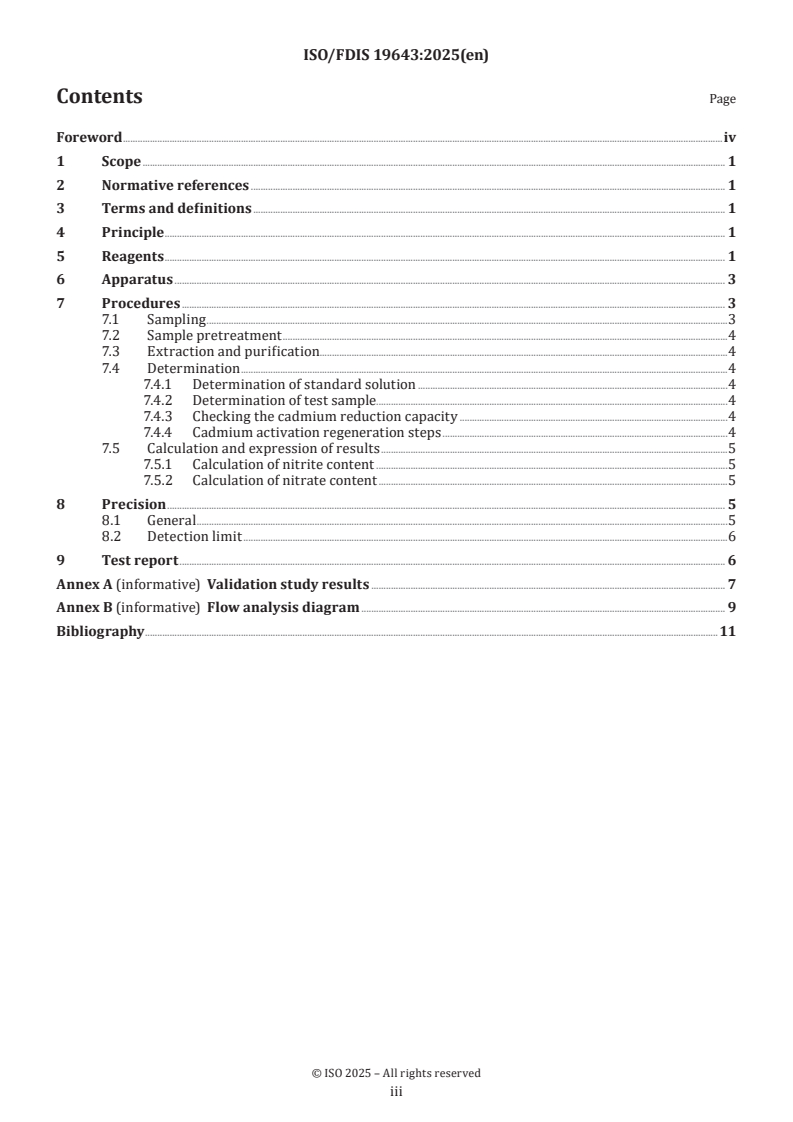
Contents Page
Foreword .iv
1 Scope . 1
2 Normative references . 1
3 Terms and definitions . 1
4 Principle . 1
5 Reagents . 1
6 Apparatus . 3
7 Procedures . 3
7.1 Sampling .3
7.2 Sample pretreatment .4
7.3 Extraction and purification.4
7.4 Determination .4
7.4.1 Determination of standard solution .4
7.4.2 Determination of test sample.4
7.4.3 Checking the cadmium reduction capacity .4
7.4.4 Cadmium activation regeneration steps .4
7.5 Calculation and expression of results .5
7.5.1 Calculation of nitrite content .5
7.5.2 Calculation of nitrate content .5
8 Precision . 5
8.1 General .5
8.2 Detection limit .6
9 Test report . 6
Annex A (informative) Validation study results . 7
Annex B (informative) Flow analysis diagram . 9
Bibliography .11
iii
ISO/FDIS 19643:2025(en)
Foreword
ISO (the International Organization for Standardization) is a worldwide federation of national standards
bodies (ISO member bodies). The work of preparing International Standards is normally carried out through
ISO technical committees. Each member body interested in a subject for which a technical committee
has been established has the right to be represented on that committee. International organizations,
governmental and non-governmental, in liaison with ISO, also take part in the work. ISO collaborates closely
with the International Electrotechnical Commission (IEC) on all matters of electrotechnical standardization.
The procedures used to develop this document and those intended for its further maintenance are described
in the ISO/IEC Directives, Part 1. In particular, the different approval criteria needed for the different types
of ISO document should be noted. This document was drafted in accordance with the editorial rules of the
ISO/IEC Directives, Part 2 (see www.iso.org/directives).
ISO draws attention to the possibility that the implementation of this document may involve the use of (a)
patent(s). ISO takes no position concerning the evidence, validity or applicability of any claimed patent
rights in respect thereof. As of the date of publication of this document, ISO had not received notice of (a)
patent(s) which may be required to implement this document. However, implementers are cautioned that
this may not represent the latest information, which may be obtained from the patent database available at
www.iso.org/patents. ISO shall not be held responsible for identifying any or all such patent rights.
Any trade name used in this document is information given for the convenience of users and does not
constitute an endorsement.
For an explanation of the voluntary nature of standards, the meaning of ISO specific terms and expressions
related to conformity assessment, as well as information about ISO’s adherence to the World Trade
Organization (WTO) principles in the Technical Barriers to Trade (TBT), see www.iso.org/iso/foreword.html.
This document was prepared by ISO/TC 34, Food products, Subcommittee SC 6, Meat, poultry, fish, eggs and
their products.
Any feedback or questions on this document should be directed to the user’s national standards body. A
complete listing of these bodies can be found at www.iso.org/members.html.
iv
FINAL DRAFT International Standard ISO/FDIS 19643:2025(en)
Meat and meat products — Determination of nitrite and
nitrate content — Continuous flow analysis (CFA) method
1 Scope
This document specifies the determination of nitrite and nitrate content by continuous flow analysis (CFA)
method in meat, poultry and their products.
2 Normative references
The following documents are referred to in the text in such a way that some or all of their content constitutes
requirements of this document. For dated references, only the edition cited applies. For undated references,
the latest edition of the referenced document (including any amendments) applies.
ISO 648, Laboratory glassware — Single-volume pipettes
ISO 835:2007, Laboratory glassware — Graduated pipettes
ISO 1042, Laboratory glassware — One-mark volumetric flasks
ISO 3696, Water for analytical laboratory use — Specification and test methods
3 Terms and definitions
No terms and definitions are listed in this document.
ISO and IEC maintain terminology databases for use in standardization at the following addresses:
— ISO Online browsing platform: available at https:// www .iso .org/ obp
— IEC Electropedia: available at https:// www .electropedia .org/
4 Principle
The protein precipitation and fat of the sample are removed under weak acidic conditions. The sample
solution is separated by using the flow analyser through the membrane separator.
The automated determination of nitrate and nitrite is based on the cadmium reduction method. The sample
is buffered at pH 8,5 and subsequently dialyzed. It is then passed through a cadmium column or ring
containing granulated copper-cadmium, which reduces nitrate to nitrite. The total concentration of nitrite
(which includes both the original nitrite present and that reduced from nitrate) is determined through
diazotization with sulfanilamide, followed by coupling with naphthalene ethylenediamine hydrochloride.
This reaction forms a highly coloured azo dye, which is measured spectrophotometrically at 540 nm.
Standard nitrite solutions are determined by the same procedure. The nitrite and nitrate content is
calculated by comparing the reading obtained from the test portion with that of the standard solution.
5 Reagents
Use only reagents of recognized analytical grade, unless otherwise specified. Water shall be of at least grade
1 in accordance with ISO 3696.
ISO/FDIS 19643:2025(en)
5.1 Potassium ferrocyanide solution (K Fe(CN) ·3H O): dissolve 106,0 g of potassium ferrocyanide in
4 6 2
water, dilute to 1 000 ml and mix well.
5.2 Zinc acetate solution (220 g/l): weigh 220,0 g of zinc acetate, add 30 ml glacial acetic acid to dissolve
and dilute to 1 000 ml with water.
5.3 Saturated borax solution (50 g/l): weigh 50,0 g of sodium borate and dissolve in 1 000 ml hot water
and place for cooling.
5.4 Brij-35 solution (30 %): weigh 30,0 g of polyoxyethylene lauryl ether and dissolve in 100 ml water.
5.5 Ammonium chloride buffer solution (R1): weigh 85,0 g of ammonium chloride and 1,0 g of ethylene
diamine tetraacetic acid disodium salt EDTA(Na EDTA·2H O). Dissolve in 800 ml water, mix evenly, adjust
2 2
the pH value to 8,5 ± 0,1 with ammonia (ρ(NH ·H O) = 0,90 g/ml) and fix the volume with water to 1 000 ml.
3 2
The solution is stable for one month when stored in the dark at a temperature of 0 °C to 4 °C.
5.6 Sulfanilamide chromogenic solution (R2): add 100,0 ml of phosphoric acid (ρ(H PO ) = 1,69 g/
3 4
ml) into 600 ml water and cool to room temperature. Then add 10,0 g of sulfonamide (C H N O S), 1,0 g
6 8 2 2
of naphthalene ethylenediamine hydrochloride (C H N ·2HCl) and 1 ml of Brij-35 solution (5.4), stir until
12 14 2
completely dissolved and fix the volume to 1 000 ml with water. The solution is stable for one week when
stored in the dark at a temperature of 0 °C to 4 °C.
1)
5.7 Sodium nitrite (NaNO , CAS Registry Number : 7632-00-0), standard reagent. Alternatively, a
sodium nitrite standard solution with a reference material certificate may be used. ®
5.8 Sodium nitrate (NaNO , CAS RN : 7631-99-4), standard reagent. Alternatively, a sodium nitrate
standard solution with a reference material certificate may be used.
5.9 Nitrite standard stock solution 200 μg/ml, calculated
...
ISO/FDIS 19643:2025(en)
ISO/TC 34/SC 6
Secretariat: SAC
Date: 2025-09-03
Meat and meat products — Determination of nitrite and nitrate
content — Continuous flow analysis (CFA) method
FDIS stage
ISO/FDIS 19643:2025(en)
All rights reserved. Unless otherwise specified, or required in the context of its implementation, no part of this publication
may be reproduced or utilized otherwise in any form or by any means, electronic or mechanical, including photocopying,
or posting on the internet or an intranet, without prior written permission. Permission can be requested from either ISO
at the address below or ISO’s member body in the country of the requester.
ISO copyright office
CP 401 • Ch. de Blandonnet 8
CH-1214 Vernier, Geneva
Phone: + 41 22 749 01 11
E-mail: copyright@iso.org
Website: www.iso.org
Published in Switzerland
ii
ISO/FDIS 19643:2025(en)
Contents
Foreword . iv
1 Scope . 1
2 Normative references . 1
3 Terms and definitions . 1
4 Principle . 1
5 Reagents . 1
6 Apparatus . 3
7 Procedures . 3
7.1 Sampling . 3
7.2 Sample pretreatment . 3
7.3 Extraction and purification . 4
7.4 Determination . 4
7.5 Calculation and expression of results . 4
8 Precision . 5
8.1 General . 5
8.2 Detection limit . 6
9 Test report . 6
Annex A (informative) Validation study results . 7
Annex B (informative) Flow analysis diagram . 9
Bibliography . 12
iii
ISO/FDIS 19643:2025(en)
Foreword
ISO (the International Organization for Standardization) is a worldwide federation of national standards
bodies (ISO member bodies). The work of preparing International Standards is normally carried out through
ISO technical committees. Each member body interested in a subject for which a technical committee has been
established has the right to be represented on that committee. International organizations, governmental and
non-governmental, in liaison with ISO, also take part in the work. ISO collaborates closely with the
International Electrotechnical Commission (IEC) on all matters of electrotechnical standardization.
The procedures used to develop this document and those intended for its further maintenance are described
in the ISO/IEC Directives, Part 1. In particular, the different approval criteria needed for the different types of
ISO document should be noted. This document was drafted in accordance with the editorial rules of the
ISO/IEC Directives, Part 2 (see www.iso.org/directives).
ISO draws attention to the possibility that the implementation of this document may involve the use of (a)
patent(s). ISO takes no position concerning the evidence, validity or applicability of any claimed patent rights
in respect thereof. As of the date of publication of this document, ISO had not received notice of (a) patent(s)
which may be required to implement this document. However, implementers are cautioned that this may not
represent the latest information, which may be obtained from the patent database available at
www.iso.org/patents. ISO shall not be held responsible for identifying any or all such patent rights.
Any trade name used in this document is information given for the convenience of users and does not
constitute an endorsement.
For an explanation of the voluntary nature of standards, the meaning of ISO specific terms and expressions
related to conformity assessment, as well as information about ISO’s adherence to the World Trade
Organization (WTO) principles in the Technical Barriers to Trade (TBT), see www.iso.org/iso/foreword.html.
This document was prepared by ISO/TC 34, Food products, Subcommittee SC 6, Meat, poultry, fish, eggs and
their products.
Any feedback or questions on this document should be directed to the user’s national standards body. A
complete listing of these bodies can be found at www.iso.org/members.html.
iv
Meat and meat products — Determination of nitrite and nitrate
content — Continuous flow analysis (CFA) method
1 Scope
This document specifies the determination of nitrite and nitrate content by continuous flow analysis (CFA)
method in meat, poultry and their products.
2 Normative references
The following documents are referred to in the text in such a way that some or all of their content constitutes
requirements of this document. For dated references, only the edition cited applies. For undated references,
the latest edition of the referenced document (including any amendments) applies.
ISO 648, Laboratory glassware — Single-volume pipettes
ISO 835:2007, Laboratory glassware — Graduated pipettes
ISO 1042, Laboratory glassware — One-mark volumetric flasks
ISO 3696, Water for analytical laboratory use — Specification and test methods
3 Terms and definitions
No terms and definitions are listed in this document.
ISO and IEC maintain terminology databases for use in standardization at the following addresses:
— ISO Online browsing platform: available at https://www.iso.org/obp
— IEC Electropedia: available at https://www.electropedia.org/
4 Principle
The protein precipitation and fat of the sample are removed under weak acidic conditions. The sample
solution is separated by using the flow analyser through the membrane separator.
The automated determination of nitrate and nitrite is based on the cadmium reduction method. The sample is
buffered at pH 8,5 and subsequently dialyzed. It is then passed through a cadmium column or ring containing
granulated copper-cadmium, which reduces nitrate to nitrite. The total concentration of nitrite (which
includes both the original nitrite present and that reduced from nitrate) is determined through diazotization
with sulfanilamide, followed by coupling with naphthalene ethylenediamine hydrochloride. This reaction
forms a highly coloured azo dye, which is measured spectrophotometrically at 540 nm.
Standard nitrite solutions are determined by the same procedure. The nitrite and nitrate content is calculated
by comparing the reading obtained from the test portion with that of the standard solution.
5 Reagents
Use only reagents of recognized analytical grade, unless otherwise specified. Water shall be of at least grade 1
in accordance with ISO 3696.
5.1 Potassium ferrocyanide solution (K Fe(CN) ·3H O): dissolve 106,0 g of potassium ferrocyanide in
4 6 2
water, dilute to 1 000 ml and mix well.
ISO/FDIS 19643:2025(en)
5.2 Zinc acetate solution (220 g/l): weigh 220,0 g of zinc acetate, add 30 ml glacial acetic acid to dissolve
and dilute to 1 000 ml with water.
5.3 Saturated borax solution (50 g/l): weigh 50,0 g of sodium borate and dissolve in 1 000 ml hot water
and place for cooling.
5.4 Brij-35 solution (30 %): weigh 30,0 g of polyoxyethylene lauryl ether and dissolve in 100 ml water.
5.5 Ammonium chloride buffer solution (R1): weigh 85,0 g of ammonium chloride and 1,0 g of ethylene
EDTA·2H O). Dissolve in 800 ml water, mix evenly, adjust the
diamine tetraacetic acid disodium salt EDTA(Na
2 2
pH value to 8,5 ± 0,1 with ammonia (ρ(NH ·H O) = 0,90 g/ml) and fix the volume with water to 1 000 ml. The
3 2
solution is stable for one month when stored in the dark at a temperature of 0 °C to 4 °C.
5.6 Sulfanilamide chromogenic solution (R2): add 100,0 ml of phosphoric acid (ρ(H PO ) = 1,69 g/ml)
3 4
into 600 ml water and cool to room temperature. Then add 10,0 g of sulfonamide (C H N O S), 1,0 g of
6 8 2 2
naphthalene ethylenediamine hydrochloride (C H N ·2HCl) and 1 ml of Brij-35 solution (5.4), stir until
12 14 2
completely dissolved and fix the volume to 1 000 ml with water. The solution is stable for one week when
stored in the dark at a temperature of 0 °C to 4 °C.
1)
5.7 Sodium nitrite (NaNO , CAS Registry Number : 7632-00-0), standard reagent. Alternatively, a
sodium nitrite standard solution with a reference material certificate may be used. ®
5.8 Sodium nitrate (NaNO , CAS RN : 7631-99-4), standard reagent. Alternatively, a sodium nitrate
standard solution with a reference material certificate may be used.
5.9 Nitrite standard stock solution 200 μg/ml, calculated as sodium nitrite: dry an amount of sodium
nitrite in the oven set at 110 °C to 120 °C for 2 h. Dissolve 0,100 g of the dry sodium nitrite in water in a 500 ml
volumetric flask, dilute to the mark with water and mix. The solution is stable for six months when stored in
the dark at a temperature of 0 °C to 4 °C.
5.10 Nitrate standard stock solution 200 μg/ml, calculated as sodium nitrate: dry an amount of sodium
nitrate in the oven set at 110 °C to 120 °C for 2 h. Dissolve 0,123 2 g of the dry sodium nitrate in water in a
500 ml volumetric flask, dilute to the mark with water and mix. The solution is stable for six months when
stored in the dark at a temperature of 0 °C to 4 °C.
5.11 Nitrite standard working solution 5,0 μg/ml, calculated as sodium nitrite, mg/l: pipette 2,5 ml of
nitrite standard stock solution into a 100 ml volumetric flask, dilute to the mark with water and mix.
5.12 Nitrate standard working solution 5,0 μg/ml, calculated as sodium nitrate mg/l: pipette 2,5 ml of
nitrate standard stock solution into a 100 ml volumetric flask, dilute to the mark with water and mix.
5.13 Nitrite standard calibration solution: prepare a series of sodium nitrite calibration solutions with
increasing concentration of nitrite by pipetting into seven 50 ml volumetric flasks 0,0 ml, 0,25 ml, 0,50 ml,
1,00 ml, 3,00 ml, 5,00 ml and 10,0 ml of nitrite standard working solution (5.11). Dilute each solution to the
50 ml mark with water and mix. The concentration of sodium nitrite (calculated as sodium nitrite) is 0,0 mg/l,
0,025 mg/l, 0,05 mg/l, 0,10 mg/l, 0,30 mg/l, 0,50 mg/l and 1,0 mg/l, respectively.
5.14 Nitrate standard calibration solution: prepare a series of sodium nitrate calibration solutions with
increasing concentration of nitrate by pipetting into seven 50 ml volumetric flasks 0,0 ml, 2,50 ml, 5,00 ml,
10,0 ml, 15,0 ml, 25,0 ml and 50,0 ml of nitrate standard working solution (5.12). Dilute each solution to the
50 ml mark with water and mix. The concentration of sodium nitrite (calculated as sodium nitrate) is 0,0 mg/l,
0,25 mg/l, 0,50 mg/l, 1,00 mg/l, 1,50 mg/l, 2,50 mg/l and 5,00 mg/l, respectively.
1)
CAS Registry Number® is a trademark of the American Chemical Society (ACS). This information is given for
...
Questions, Comments and Discussion
Ask us and Technical Secretary will try to provide an answer. You can facilitate discussion about the standard in here.
Loading comments...