

ISO 17293-1:2014
(Main)Surface active agents — Determination of chloroacetic acid (chloroacetate) in surfactants — Part 1: HPLC method
General Information
- Abstract
ISO 17283-1:2014 specifies a method for the determination of monochloroacetic acid (monochloroacetate) and dichloroacetic acid (dichloroacetate) in surfactants by HPLC method. The method applies for anionic surfactants such as alkyl (phenyl) ethoxylated carboxylate (AEC) or amphoteric surfactants such as alkyl imidazoline carboxylate, alkyl dimethyl betaine, and fatty acetyl propyl dimethyl betaine. The limit of detection (LOD) is ≤0,3 µg/ml for monochloroacetic acid and ≤0,2 µg/ml for dichloroacetic acid; the limit of quantification (LOQ) is ≤1,0 µg/ml for monochloroacetic acid and ≤0,75 µg/ml for dichloroacetic acid (using a standard solution). The LOD, at 5 g of sample weight, is ≤6 mg/kg for monochloroacetic acid and ≤4 mg/kg for dichloroacetic acid; and the LOQ is ≤20 mg/kg for monochloroacetic acid and ≤15 mg/kg for dichloroacetic acid.
- Status
- Published
- Publication Date
- 18-Mar-2014
- Technical Committee
- ISO/TC 91 - Surface active agents
- Drafting Committee
- ISO/TC 91 - Surface active agents
- Current Stage
- 9092 - International Standard to be revised
- Start Date
- 14-Mar-2025
- Completion Date
- 29-Aug-2026
Overview
ISO 17293-1:2014 specifies an HPLC method for the determination of chloroacetic acids (chloroacetates) - specifically monochloroacetic acid and dichloroacetic acid - in surfactant products. The standard applies to a range of anionic surfactants (e.g., alkyl (phenyl) ethoxylated carboxylates, AEC) and amphoteric surfactants (e.g., alkyl imidazoline carboxylate, alkyl dimethyl betaine and fatty acetyl propyl dimethyl betaine). It describes sample preparation, chromatographic conditions, calibration, quantification limits and precision expectations for reliable analytical testing.
Key Topics
- Analytes covered: monochloroacetic acid (monochloroacetate) and dichloroacetic acid (dichloroacetate).
- Analytical technique: high-performance liquid chromatography (HPLC) with UV detection (typical detection at 214 nm).
- Column & mobile phase: analysis uses a C‑bonded silicone gel column (5 µm, 250 × 4.6 mm) and a mobile phase prepared from acetonitrile and water with added phosphoric acid; conditions (flow 1.0 ml/min, injection 20 µl, room temperature) are provided as validated parameters.
- Calibration: external standard calibration with prepared standard solutions; linearity requirement R ≥ 0.999.
- Sensitivity:
- LOD (standard solution): ≤ 0.3 µg/ml (monochloroacetic), ≤ 0.2 µg/ml (dichloroacetic).
- LOQ (standard solution): ≤ 1.0 µg/ml (monochloroacetic), ≤ 0.75 µg/ml (dichloroacetic).
- At 5 g sample: LOD ≤ 6 mg/kg (mono) and ≤ 4 mg/kg (di); LOQ ≤ 20 mg/kg (mono) and ≤ 15 mg/kg (di).
- Sample prep notes: dissolve sample in mobile phase, adjust pH to match mobile phase with diluted HCl, filter prior to injection. For betaine-type samples, an informative annex describes a cation-exchange cleanup to remove interfering peaks.
- Precision expectations: repeatability r ~10% (≥50 mg/kg) or 15% (<50 mg/kg); reproducibility R ≈ 40%.
Applications
Who uses ISO 17293-1:2014:
- Quality control and R&D laboratories in detergent, personal care and chemical manufacturing for monitoring chloroacetate impurities.
- Regulatory and compliance testing to confirm product safety and meet limits on chloroacetic acid contamination.
- Environmental and analytical contract labs performing routine surfactant analysis.
Practical benefits include standardized HPLC parameters, defined LOD/LOQ for trace-level monitoring, and documented sample cleanup for problematic matrices (e.g., betaines).
Related Standards
- ISO 17293-2 - Surface active agents - Determination of chloroacetic acid in surfactants - Part 2: ionic chromatographic method.
- Normative references within the standard: ISO 607 (sample division), ISO 3696 (water for analytical use), ISO 5725-2 (precision assessment).
Keywords: ISO 17293-1:2014, HPLC method, chloroacetic acid, chloroacetate, monochloroacetic acid, dichloroacetic acid, surfactants, anionic surfactants, betaine, LOD, LOQ, analytical method.
Get Certified
Connect with accredited certification bodies for this standard

ECOCERT
Organic and sustainability certification.

Eurofins Food Testing Global
Global leader in food, environment, and pharmaceutical product testing.

Intertek Bangladesh
Intertek certification and testing services in Bangladesh.
Sponsored listings
Frequently Asked Questions
ISO 17293-1:2014 is a standard published by the International Organization for Standardization (ISO). Its full title is "Surface active agents — Determination of chloroacetic acid (chloroacetate) in surfactants — Part 1: HPLC method". This standard covers: ISO 17283-1:2014 specifies a method for the determination of monochloroacetic acid (monochloroacetate) and dichloroacetic acid (dichloroacetate) in surfactants by HPLC method. The method applies for anionic surfactants such as alkyl (phenyl) ethoxylated carboxylate (AEC) or amphoteric surfactants such as alkyl imidazoline carboxylate, alkyl dimethyl betaine, and fatty acetyl propyl dimethyl betaine. The limit of detection (LOD) is ≤0,3 µg/ml for monochloroacetic acid and ≤0,2 µg/ml for dichloroacetic acid; the limit of quantification (LOQ) is ≤1,0 µg/ml for monochloroacetic acid and ≤0,75 µg/ml for dichloroacetic acid (using a standard solution). The LOD, at 5 g of sample weight, is ≤6 mg/kg for monochloroacetic acid and ≤4 mg/kg for dichloroacetic acid; and the LOQ is ≤20 mg/kg for monochloroacetic acid and ≤15 mg/kg for dichloroacetic acid.
ISO 17283-1:2014 specifies a method for the determination of monochloroacetic acid (monochloroacetate) and dichloroacetic acid (dichloroacetate) in surfactants by HPLC method. The method applies for anionic surfactants such as alkyl (phenyl) ethoxylated carboxylate (AEC) or amphoteric surfactants such as alkyl imidazoline carboxylate, alkyl dimethyl betaine, and fatty acetyl propyl dimethyl betaine. The limit of detection (LOD) is ≤0,3 µg/ml for monochloroacetic acid and ≤0,2 µg/ml for dichloroacetic acid; the limit of quantification (LOQ) is ≤1,0 µg/ml for monochloroacetic acid and ≤0,75 µg/ml for dichloroacetic acid (using a standard solution). The LOD, at 5 g of sample weight, is ≤6 mg/kg for monochloroacetic acid and ≤4 mg/kg for dichloroacetic acid; and the LOQ is ≤20 mg/kg for monochloroacetic acid and ≤15 mg/kg for dichloroacetic acid.
ISO 17293-1:2014 is classified under the following ICS (International Classification for Standards) categories: 71.100.40 - Surface active agents. The ICS classification helps identify the subject area and facilitates finding related standards.
ISO 17293-1:2014 is available in PDF format for immediate download after purchase. The document can be added to your cart and obtained through the secure checkout process. Digital delivery ensures instant access to the complete standard document.
Standards Content (Sample)
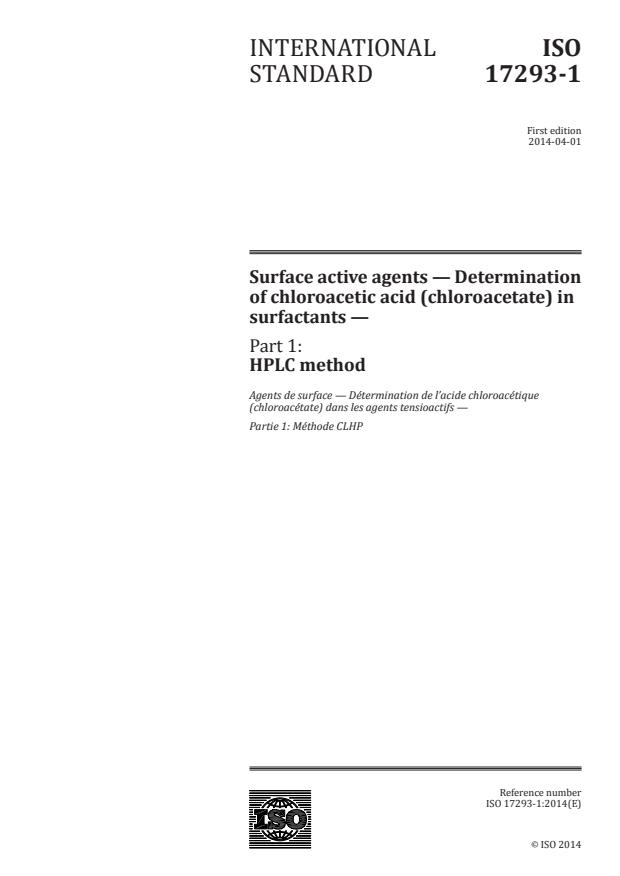
INTERNATIONAL ISO
STANDARD 17293-1
First edition
2014-04-01
Surface active agents — Determination
of chloroacetic acid (chloroacetate) in
surfactants —
Part 1:
HPLC method
Agents de surface — Détermination de l’acide chloroacétique
(chloroacétate) dans les agents tensioactifs —
Partie 1: Méthode CLHP
Reference number
©
ISO 2014
© ISO 2014
All rights reserved. Unless otherwise specified, no part of this publication may be reproduced or utilized otherwise in any form
or by any means, electronic or mechanical, including photocopying, or posting on the internet or an intranet, without prior
written permission. Permission can be requested from either ISO at the address below or ISO’s member body in the country of
the requester.
ISO copyright office
Case postale 56 • CH-1211 Geneva 20
Tel. + 41 22 749 01 11
Fax + 41 22 749 09 47
E-mail copyright@iso.org
Web www.iso.org
Published in Switzerland
ii © ISO 2014 – All rights reserved
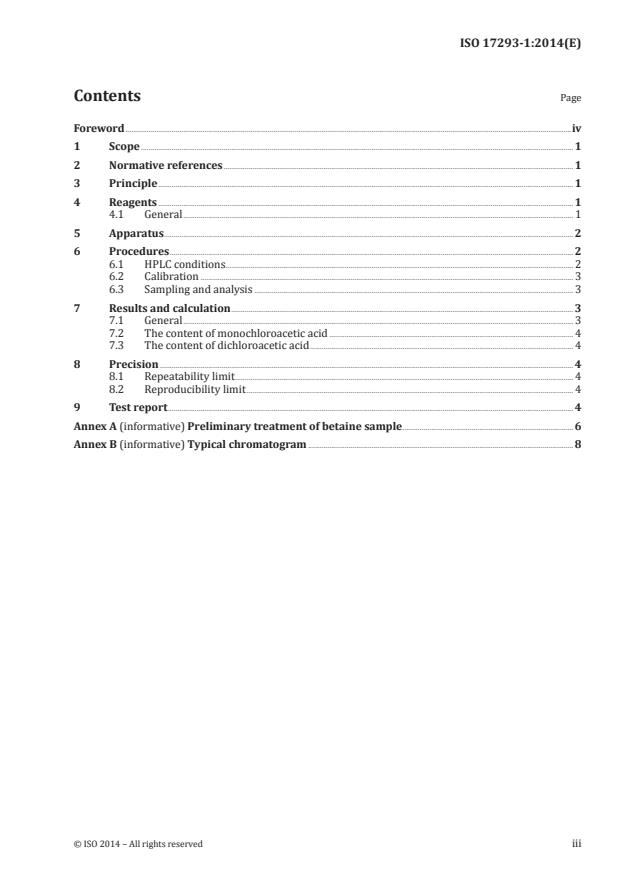
Contents Page
Foreword .iv
1 Scope . 1
2 Normative references . 1
3 Principle . 1
4 Reagents . 1
4.1 General . 1
5 Apparatus . 2
6 Procedures . 2
6.1 HPLC conditions . 2
6.2 Calibration . 3
6.3 Sampling and analysis . 3
7 Results and calculation . 3
7.1 General . 3
7.2 The content of monochloroacetic acid . 4
7.3 The content of dichloroacetic acid . 4
8 Precision . 4
8.1 Repeatability limit . 4
8.2 Reproducibility limit . 4
9 Test report . 4
Annex A (informative) Preliminary treatment of betaine sample . 6
Annex B (informative) Typical chromatogram . 8
Foreword
ISO (the International Organization for Standardization) is a worldwide federation of national standards
bodies (ISO member bodies). The work of preparing International Standards is normally carried out
through ISO technical committees. Each member body interested in a subject for which a technical
committee has been established has the right to be represented on that committee. International
organizations, governmental and non-governmental, in liaison with ISO, also take part in the work.
ISO collaborates closely with the International Electrotechnical Commission (IEC) on all matters of
electrotechnical standardization.
The procedures used to develop this document and those intended for its further maintenance are
described in the ISO/IEC Directives, Part 1. In particular the different approval criteria needed for the
different types of ISO documents should be noted. This document was drafted in accordance with the
editorial rules of the ISO/IEC Directives, Part 2 (see www.iso.org/directives).
Attention is drawn to the possibility that some of the elements of this document may be the subject of
patent rights. ISO shall not be held responsible for identifying any or all such patent rights. Details of
any patent rights identified during the development of the document will be in the Introduction and/or
on the ISO list of patent declarations received (see www.iso.org/patents).
Any trade name used in this document is information given for the convenience of users and does not
constitute an endorsement.
For an explanation on the meaning of ISO specific terms and expressions related to conformity
assessment, as well as information about ISO’s adherence to the WTO principles in the Technical Barriers
to Trade (TBT) see the following URL: Foreword - Supplementary information
The committee responsible for this document is ISO/TC 91, Surface active agents.
ISO 17293 consists of the following parts, under the general title Surface active agents — Determination
of chloroacetic acid (chloroacetate) in surfactants:
— Part 1: HPLC method
— Part 2: Ionic chromatographic method
iv © ISO 2014 – All rights reserved
INTERNATIONAL STANDARD ISO 17293-1:2014(E)
Surface active agents — Determination of chloroacetic acid
(chloroacetate) in surfactants —
Part 1:
HPLC method
1 Scope
This part of ISO 17293 specifies a method for the determination of monochloroacetic acid
(monochloroacetate) and dichloroacetic acid (dichloroacetate) in surfactants by HPLC method.
The method applies for anionic surfactants such as alkyl (phenyl) ethoxylated carboxylate (AEC) or
amphoteric surfactants such as alkyl imidazoline carboxylate, alkyl dimethyl betaine, and fatty acetyl
propyl dimethyl betaine.
The limit of detection (LOD) is ≤0,3 µg/ml for monochloroacetic acid and ≤0,2 µg/ml for dichloroacetic
acid; the limit of quantification (LOQ) is ≤1,0 µg/ml for monochloroacetic acid and ≤0,75 µg/ml for
dichloroacetic acid (using a standard solution).
The LOD, at 5 g of sample weight, is ≤6 mg/kg for monochloroacetic acid and ≤4 mg/kg for dichloroacetic
acid; and the LOQ is ≤20 mg/kg for monochloroacetic acid and ≤15 mg/kg for dichloroacetic acid.
2 Normative references
The following documents, in whole or in part, are normatively referenced in this document and are
indispensable for its application. For dated references, only the edition cited applies. For undated
references, the latest edition of the referenced document (including any amendments) applies.
ISO 607, Surface active agents and detergents — Methods of sample division
ISO 3696, Water for analytical laboratory use — Specification and test methods
ISO 5725-2, Accuracy (trueness and precision) of measurement methods and results — Part 2: Basic method
for the determination of repeatability and reproducibility of a standard measurement method
3 Principle
The sample is dissolved in the mobile phase in order to analyse by high performance liquid chromatography
(HPLC). After injection, it flows through a C -bonded silicone gel column. The monochloroacetic acid
(monochloroacetate) and dichloroacetic acid (dichloroacetate) are separated in the column
...