

ISO/DTS 24854-1
(Main)Intelligent transport systems — Facilities layer services — Part 1: Architecture
- Abstract
This document specifies the architecture and concepts of ITS facilities layer services, and respective general requirements.
- Status
- Not Published
- Technical Committee
- ISO/TC 204 - Intelligent transport systems
- Drafting Committee
- ISO/TC 204/WG 18 - Cooperative systems
- Current Stage
- 5020 - FDIS ballot initiated: 2 months. Proof sent to secretariat
- Start Date
- 08-Sep-2026
- Completion Date
- 08-Sep-2026
Buy Documents


ISO/DTS 24854-1 - Intelligent transport systems — Facilities layer services — Part 1: Architecture
REDLINE ISO/DTS 24854-1 - Intelligent transport systems — Facilities layer services — Part 1: Architecture
ISO/DTS 24854-1 is an ISO document on intelligent transport systems (ITS) facilities layer services, Part 1: Architecture. It specifies the architecture and concepts of ITS facilities layer services and the general requirements that apply to them. It is written for engineers, system architects, and implementers who need a common facilities-layer model before using the more specific parts of the ISO 24854 series.
What does ISO/DTS 24854-1 specify?
ISO/DTS 24854-1 specifies the architecture and concepts of ITS facilities layer services, together with their general requirements. In practice, it explains how facilities sit in the ITS station and communication architecture and how they support ITS applications and ITS station management.
The document is organized into these main parts:
- Clause 1 - Scope
- Clause 2 - Normative references
- Clause 3 - Terms and definitions
- Clause 4 - General, including overview, architecture, capabilities, and usage examples
- Clause 5 - Requirements
- Annex A - Normative ASN.1 definitions
Annex A provides the formal ASN.1 material that supports implementation and machine-readable exchange.
What are the key requirements of ISO/DTS 24854-1?
ISO/DTS 24854-1 focuses on a common architecture, a shared identifier scheme, and formal ASN.1 definitions. The requirements are mostly about how facilities-layer services are identified and how the standard package is implemented consistently.
Architecture and role of the facilities layer
Clause 4 describes ITS facilities as services in the ITS-S facilities layer, which covers OSI layers 5 through 7 in the simplified ITS architecture. These services support ITS-S application processes and ITS-SU management. In practice, this tells implementers where facilities functions belong and why multiple applications can reuse them.
What the facilities layer does
Clause 4.3 lists typical facilities-layer actions such as managing received data, publishing data, subscribing to data, selecting a communication profile, choosing a destination and protocol stack, announcing services, and handling time, position, security material, and compression. This matters because an ITS-SU can combine several of these functions instead of building them into every application separately.
Capability identification
Clause 4.3 and Table 1 assign each facilities-layer capability a unique FacProtID value. One identifier is reserved for the unknown, not applicable, or any case. In practice, this gives a common way to identify the capability being used in messages and management exchanges.
Named facilities and their roles
Clause 4.3 links the architecture to named facilities such as the Communication Profile Handler (CPH), Content Subscription Handler (CSH), Facilities Services Handler (FSH), message sets, segmentation, FSAP, LDM, PVT, remote management, IIC, CoAP, CAM, DENM, and DSRC message sets. For readers, this means the part is an architectural map for the rest of the series and for related external specifications.
General requirements and registration
Clause 5.1 requires the ASN.1 definitions to be as specified in Annex A. Clause 5.2 states that FacProtID values are registered in the ISO/TC 204 Registry of Intelligent Transport System Items (RITSI), with new values managed by ISO/TC 204/AG 2. This is important when assigning identifiers in implementations or in companion specifications.
ASN.1 and electronic definitions
Annex A defines the ASN.1 module ITSfacilities-0-0 for general facility-layer capability management. It also says the electronic ASN.1 file prevails if there is any inconsistency, and it uses PER encoding when no other encoding is stated. That gives implementers a formal definition for coding, exchange, and conformance-oriented implementation work.
What terms does ISO/DTS 24854-1 define?
- ITS-S facilities layer - The part of the ITS station architecture where facilities services operate, spanning OSI layers 5 to 7 in this document’s model.
- ITS-SU (ITS station unit) - The ITS station unit that hosts applications and facilities and may also be managed through facilities services.
- ITS-S-AP (ITS-S application process) - An application process in an ITS-SU that uses facilities services to perform ITS functions.
- FacProtID - The ASN.1 identifier used to identify a facilities-layer capability.
- CPH (Communication Profile Handler) - The capability that checks and applies the relevant ITS-S communication profile for transmitted facilities data.
- CSH (Content Subscription Handler) - The capability that manages subscriptions to published data objects for ITS-S application processes.
- FSH (Facilities Services Handler) - The capability that applies facilities services such as security, time stamping, geostamping, and compression.
- ASN.1 - Abstract Syntax Notation One, the formal notation used for the module in Annex A.
Who uses ISO/DTS 24854-1?
ISO/DTS 24854-1 is used by ITS system architects, software developers, equipment vendors, and standards writers working on ITS station functionality. It is relevant to those defining or integrating facilities-layer services such as communication management, content subscription, message handling, security processing, and segmentation.
It also matters to engineers and quality or integration teams who need to map a capability to a FacProtID, check how a facility fits into the ITS station architecture, or implement the ASN.1 definitions in Annex A.
Which standards are used with ISO/DTS 24854-1?
ISO/DTS 24854-1 relies on a small set of foundational and companion standards:
- ISO 17423 - provides application requirements and objectives used in the surrounding ITS context.
- ISO 21217 - gives the ITS station and communication architecture that this part builds on.
- ISO 24102-6 - provides ITS station management context, including path and flow management and the ITS-S capability concept.
- ISO/IEC 8825-2 - specifies PER encoding rules used for ASN.1 when no other encoding is given.
- ISO/IEC 8824-1 - provides the basic ASN.1 notation used for the normative module in Annex A.
- ISO/TS 24854-2, -3, -4, -5, -6 - define the related facilities-layer parts for CPH, CSH, FSH, message sets, and segmentation.
What does the ISO/DTS 24854-1 document contain?
ISO/DTS 24854-1 contains an overview of ITS facilities, an architectural description, examples of how facilities are used, and general requirements for implementation. Clause 4 gives the conceptual model and Table 1 lists known facilities-layer capabilities and their references.
Annex A contains the normative ASN.1 module for facilities-layer capability management. It also points to the electronic ASN.1 file and provides a SHA-256 digest for integrity verification, which is useful when implementing the machine-readable definitions.
Buy Documents
ISO/DTS 24854-1 - Intelligent transport systems — Facilities layer services — Part 1: Architecture
REDLINE ISO/DTS 24854-1 - Intelligent transport systems — Facilities layer services — Part 1: Architecture
Get Certified
Connect with accredited certification bodies for this standard

BSI Group
BSI (British Standards Institution) is the business standards company that helps organizations make excellence a habit.

NYCE
Mexican standards and certification body.
Sponsored listings
Frequently Asked Questions
ISO/DTS 24854-1 is a draft published by the International Organization for Standardization (ISO). Its full title is "Intelligent transport systems — Facilities layer services — Part 1: Architecture". This standard covers: This document specifies the architecture and concepts of ITS facilities layer services, and respective general requirements.
This document specifies the architecture and concepts of ITS facilities layer services, and respective general requirements.
ISO/DTS 24854-1 is classified under the following ICS (International Classification for Standards) categories: 35.240.60 - IT applications in transport. The ICS classification helps identify the subject area and facilitates finding related standards.
ISO/DTS 24854-1 is available in PDF format for immediate download after purchase. The document can be added to your cart and obtained through the secure checkout process. Digital delivery ensures instant access to the complete standard document.
Standards Content (Sample)
FINAL DRAFT
Technical
Specification
ISO/TC 204
Intelligent transport systems —
Secretariat: ANSI
Facilities layer services —
Voting begins on:
2026-09-08
Part 1:
Architecture
Voting terminates on:
2026-11-03
Systèmes de transport intelligents - Services de la couche des
fonctionnalités —
Partie 1: Architecture
RECIPIENTS OF THIS DRAFT ARE INVITED TO SUBMIT,
WITH THEIR COMMENTS, NOTIFICATION OF ANY
RELEVANT PATENT RIGHTS OF WHICH THEY ARE AWARE
AND TO PROVIDE SUPPOR TING DOCUMENTATION.
IN ADDITION TO THEIR EVALUATION AS
BEING ACCEPTABLE FOR INDUSTRIAL, TECHNO-
LOGICAL, COMMERCIAL AND USER PURPOSES, DRAFT
INTERNATIONAL STANDARDS MAY ON OCCASION HAVE
TO BE CONSIDERED IN THE LIGHT OF THEIR POTENTIAL
TO BECOME STAN DARDS TO WHICH REFERENCE MAY BE
MADE IN NATIONAL REGULATIONS.
Reference number
FINAL DRAFT
Technical
Specification
ISO/TC 204
Intelligent transport systems —
Secretariat: ANSI
Facilities layer services —
Voting begins on:
Part 1:
Architecture
Voting terminates on:
Systèmes de transport intelligents - Services de la couche des
fonctionnalités —
Partie 1: Architecture
RECIPIENTS OF THIS DRAFT ARE INVITED TO SUBMIT,
WITH THEIR COMMENTS, NOTIFICATION OF ANY
RELEVANT PATENT RIGHTS OF WHICH THEY ARE AWARE
AND TO PROVIDE SUPPOR TING DOCUMENTATION.
© ISO 2026
IN ADDITION TO THEIR EVALUATION AS
All rights reserved. Unless otherwise specified, or required in the context of its implementation, no part of this publication may
BEING ACCEPTABLE FOR INDUSTRIAL, TECHNO-
LOGICAL, COMMERCIAL AND USER PURPOSES, DRAFT
be reproduced or utilized otherwise in any form or by any means, electronic or mechanical, including photocopying, or posting on
INTERNATIONAL STANDARDS MAY ON OCCASION HAVE
the internet or an intranet, without prior written permission. Permission can be requested from either ISO at the address below
TO BE CONSIDERED IN THE LIGHT OF THEIR POTENTIAL
or ISO’s member body in the country of the requester.
TO BECOME STAN DARDS TO WHICH REFERENCE MAY BE
MADE IN NATIONAL REGULATIONS.
ISO copyright office
CP 401 • Ch. de Blandonnet 8
CH-1214 Vernier, Geneva
Phone: +41 22 749 01 11
Email: copyright@iso.org
Website: www.iso.org
Published in Switzerland Reference number
ii
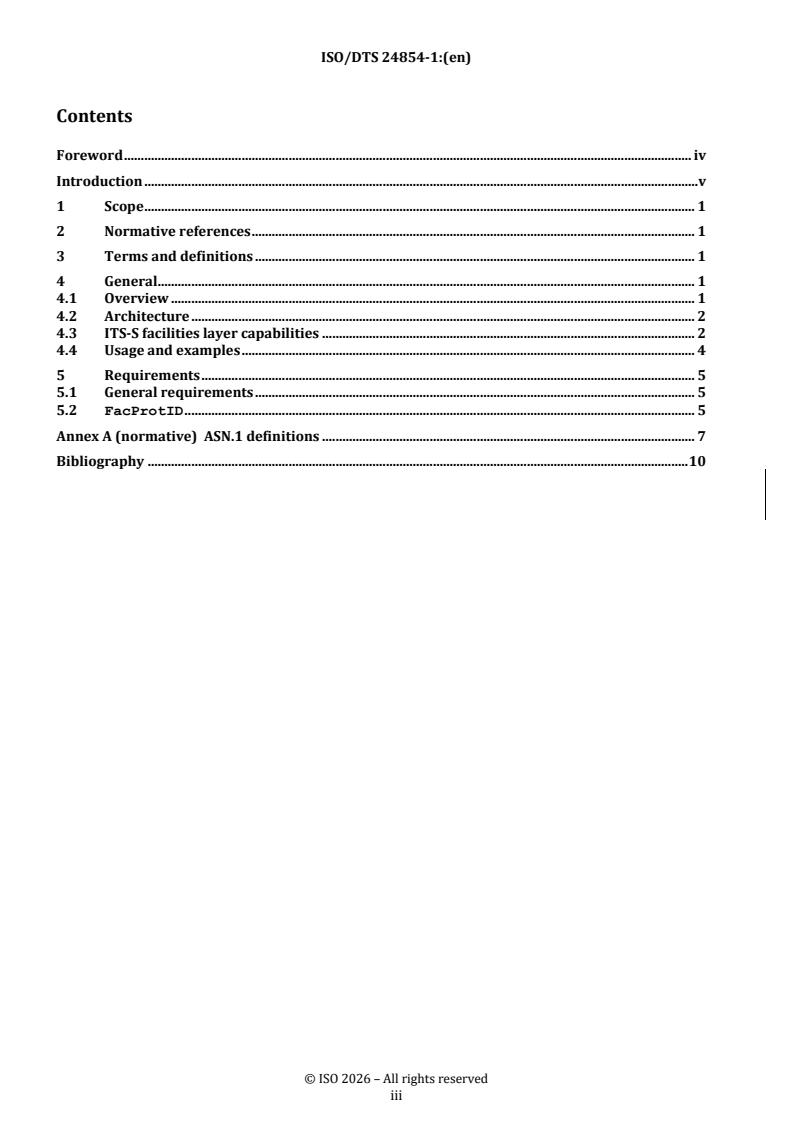
Contents Page
Foreword .iv
Introduction .v
1 Scope . 1
2 Normative references . 1
3 Terms and definitions . 1
4 General . 1
4.1 Overview .1
4.2 Architecture .2
4.3 ITS-S facilities layer capabilities .2
4.4 Usage and examples .4
4.4.1 CAM .4
4.4.2 CPH .4
4.4.3 CSH .4
4.4.4 FSH .5
4.4.5 ITS message sets .5
4.4.6 Segmentation .5
5 Requirements . 5
5.1 General requirements .5
5.2 FacProtID .5
Annex A (normative) ASN.1 definitions . . 6
Bibliography . 8
iii
Foreword
ISO (the International Organization for Standardization) is a worldwide federation of national standards
bodies (ISO member bodies). The work of preparing International Standards is normally carried out through
ISO technical committees. Each member body interested in a subject for which a technical committee
has been established has the right to be represented on that committee. International organizations,
governmental and non-governmental, in liaison with ISO, also take part in the work. ISO collaborates closely
with the International Electrotechnical Commission (IEC) on all matters of electrotechnical standardization.
The procedures used to develop this document and those intended for its further maintenance are described
in the ISO/IEC Directives, Part 1. In particular, the different approval criteria needed for the different types
of ISO document should be noted. This document was drafted in accordance with the editorial rules of the
ISO/IEC Directives, Part 2 (see www.iso.org/directives).
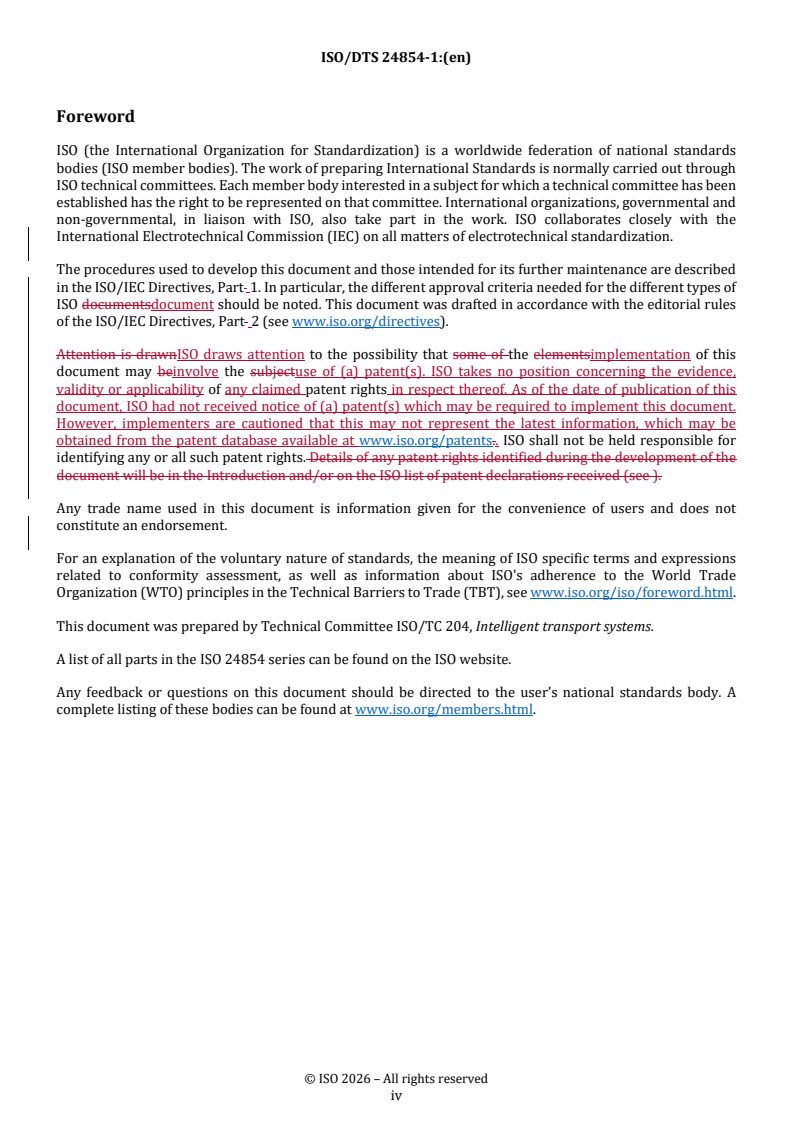
ISO draws attention to the possibility that the implementation of this document may involve the use of (a)
patent(s). ISO takes no position concerning the evidence, validity or applicability of any claimed patent
rights in respect thereof. As of the date of publication of this document, ISO had not received notice of (a)
patent(s) which may be required to implement this document. However, implementers are cautioned that
this may not represent the latest information, which may be obtained from the patent database available at
www.iso.org/patents. ISO shall not be held responsible for identifying any or all such patent rights.
Any trade name used in this document is information given for the convenience of users and does not
constitute an endorsement.
For an explanation of the voluntary nature of standards, the meaning of ISO specific terms and expressions
related to conformity assessment, as well as information about ISO's adherence to the World Trade
Organization (WTO) principles in the Technical Barriers to Trade (TBT), see www.iso.org/iso/foreword.html.
This document was prepared by Technical Committee ISO/TC 204, Intelligent transport systems.
A list of all parts in the ISO 24854 series can be found on the ISO website.
Any feedback or questions on this document should be directed to the user’s national standards body. A
complete listing of these bodies can be found at www.iso.org/members.html.
iv
Introduction
This ISO 24854 series is about ITS facilities for application support, information support and communication
support, i.e., features allocated in the ITS-S facilities layer. The terminology used in this document assumes
the ITS station and communication architecture specified in ISO 21217. Knowledge of ISO 21217 is a pre-
requisite for easy understanding of terms used in this document. Nevertheless, the concept of ITS facilities
basically could also be applied in other station contexts used for Intelligent Transport Systems (ITS).
The ITS facilities layer provides a collection of ITS-S capabilities (see ISO 24102-6), which are referred to
as ITS-S facilities services or simply as ITS facilities. These ITS facilities are instantiated by ITS-S facilities
applications. The set of ITS facilities provides a toolkit facilitating the specification of standards and the
development of ITS applications.
The availability of such ITS facilities can simplify the development of applications thereby decreasing
development costs and application complexity. Furthermore, it allows applications to make use of upgrades
to such services seamlessly.
ITS facilities can
— be elements of the communication protocol stack, supporting ITS-S applications,
— be elements of the communication protocol stack, providing features missing at the lower communication
layers,
— be source of information for local and remote ITS-S applications,
— be destination of information from remote ITS station units (ITS-SUs) and ITS station communication
units (ITS-SCUs) of the same ITS-SU, and
— contribute to the management of ITS-SUs.
To serve these purposes,
— ISO/TS 24854-1, i.e. this document, provides an architectural introduction to facilities and generally
applicable normative requirements;
— ISO/TS 24854-2 specifies the ‘communication management facility’ “Communication Profile Handler”
(CPH);
— ISO/TS 24854-3 specifies the ‘data management facility’ “Content Subscription Handler” (CSH);
— ISO/TS 24854-4 specifies the ‘ITS-S application support’ facility “Facilities Services Handler” (FSH);
— ISO/TS 24854-5 specifies “ITS message sets”.
This document specifies a common architecture for ITS facilities layer services of which the details are
specified in other parts of the ISO 24854 series. This architecture is embedded in the ITS station and
communication architecture specified in ISO 21217.
v
FINAL DRAFT Technical Specification ISO/DTS 24854-1:2026(en)
Intelligent transport systems — Facilities layer services —
Part 1:
Architecture
1 Scope
This document introduces the architecture and concepts of ITS facilities layer services, and provides
respective general requirements.
2 Normative references
The following documents are referred to in the text in such a way that some or all of their content constitutes
requirements of this document. For dated references, only the edition cited applies. For undated references,
the latest edition of the referenced document (including any amendments) applies.
ISO 17423, Intelligent transport systems — Application requirements and objectives
ISO 21217, Intelligent transport systems — Station and communication architecture
ISO 24102-6, Intelligent transport systems — Communications access for land mobiles (CALM) — ITS station
management — Part 6: Path and flow management
ISO/IEC 8825-2, Information technology — ASN.1 encoding rules — Part 2: Specification of Packed Encoding
Rules (PER)
3 Terms and definitions
For the purposes of this document, the terms and definitions given in ISO 21217, ISO 24102-6, ISO 17423
apply.
ISO and IEC maintain terminology databases for use in standardization at the following addresses:
— ISO Online browsing platform: available at https:// www .iso .org/ obp
— IEC Electropedia: available at https:// www .electropedia .org/
4 General
4.1 Overview
This clause provides informative presentations on ITS facilities. Normative requirements are specified in
Clause 5. ASN.1 specifications are specified in Annex A.
The ITS-S facilities layer provides a collection of ITS-S capabilities (see ISO 24102-6), which are referred to
as ITS-S facilities services or simply as ITS facilities. In this document, ITS-S capabilities located in the ITS-S
facilities layer are referred to as ITS facilities.
Facilities provide support for ITS-S application processes and for the management of an ITS-SU.
There can be different collections of facilities in ITS-SUs dependent on the intended usage of a specific ITS-
SU.
The architecture of ITS facilities is presented in 4.2.
A list of known ITS facilities (ITS capabilities) is presented in 4.3.
The usage of selected ITS facilities is exemplified in 4.4.
4.2 Architecture
The presentation of the architecture of ITS facilities in this document is based on the general ITS architecture
specified in ISO 21217 and on architectural presentations in ISO 24102-6.
[18]
NOTE The ETSI standard ETSI TS 102 894-1 provides a view on classification of facilities which is not adopted
in the ISO 24854 series. ETSI TS 102 894-1 is not maintained further at ETSI, and it is not applicable for this document.
4.3 ITS-S facilities layer capabilities
ITS-SUs generally host a number of applications that instantiate various ITS-related services. These
applications, in turn, make use of ITS-S services to perform their functions. A number of these ITS-S services
reside in the ITS-S facilities layer which comprises the OSI layers 5 through 7 (session, presentation, and
application layers, respectively), and can be invoked by many applications. Examples of actions that are
commonly performed in the ITS-S facilities layer, or are triggered by the ITS-S facilities layer for performance
in the ITS-S security entity or the ITS-S management entity, include:
— management of data received from surrounding ITS-S SUs;
— publication of available data to peer ITS-S SUs;
— subscription to the reception of specific data transmitted by peer ITS-S SUs;
— determination of the most appropriate communication profile;
— determination of a network address of the destination(s) identified by e.g. a name (group name), a URL
or a geographic location;
— determination of a communication protocol stack to be used to reach the destination(s);
— announcement of available services to surrounding ITS-S SUs;
— determination of precise position, speed and time;
— addition of a time-stamp to the payload at the source;
— addition of a geo-stamp to the payload at the source;
— addition of a speed-stamp to the payload at the source;
— addition of non-repudiation material to the payload at the source and assessing the correctness of the
payload at the destination;
— addition of authentication material (a certificate) to the payload at the source and authentication of the
source at the destination;
— encryption of the payload at the source and decryption at the destination;
— compression of the payload at
...
ISO/TC 204
Secretariat: ANSI
Date: 2026-06-26xx
Intelligent transport systems — Facilities layer services — —
Part 1:
Architecture
Systèmes de transport intelligents - Services de la couche des fonctionnalités —
Partie 1: Architecture
All rights reserved. Unless otherwise specified, or required in the context of its implementation, no part of this publication
may be reproduced or utilized otherwise in any form or by any means, electronic or mechanical, including photocopying,
or posting on the internet or an intranet, without prior written permission. Permission can be requested from either ISO
at the address below or ISO’s member body in the country of the requester.
ISO copyright office
CP 401 • Ch. de Blandonnet 8
CH-1214 Vernier, Geneva
Phone: + 41 22 749 01 11
EmailE-mail: copyright@iso.org
Website: www.iso.org
Published in Switzerland
ii
Contents
Foreword . iv
Introduction . v
1 Scope . 1
2 Normative references . 1
3 Terms and definitions . 1
4 General . 1
4.1 Overview . 1
4.2 Architecture . 2
4.3 ITS-S facilities layer capabilities . 2
4.4 Usage and examples . 4
5 Requirements . 5
5.1 General requirements . 5
5.2 FacProtID . 5
Annex A (normative) ASN.1 definitions . 7
Bibliography . 10
iii
Foreword
ISO (the International Organization for Standardization) is a worldwide federation of national standards
bodies (ISO member bodies). The work of preparing International Standards is normally carried out through
ISO technical committees. Each member body interested in a subject for which a technical committee has been
established has the right to be represented on that committee. International organizations, governmental and
non-governmental, in liaison with ISO, also take part in the work. ISO collaborates closely with the
International Electrotechnical Commission (IEC) on all matters of electrotechnical standardization.
The procedures used to develop this document and those intended for its further maintenance are described
in the ISO/IEC Directives, Part 1. In particular, the different approval criteria needed for the different types of
ISO documentsdocument should be noted. This document was drafted in accordance with the editorial rules
of the ISO/IEC Directives, Part 2 (see www.iso.org/directives).
Attention is drawnISO draws attention to the possibility that some of the elementsimplementation of this
document may beinvolve the subjectuse of (a) patent(s). ISO takes no position concerning the evidence,
validity or applicability of any claimed patent rights in respect thereof. As of the date of publication of this
document, ISO had not received notice of (a) patent(s) which may be required to implement this document.
However, implementers are cautioned that this may not represent the latest information, which may be
obtained from the patent database available at www.iso.org/patents. ISO shall not be held responsible for
identifying any or all such patent rights. Details of any patent rights identified during the development of the
document will be in the Introduction and/or on the ISO list of patent declarations received (see ).
Any trade name used in this document is information given for the convenience of users and does not
constitute an endorsement.
For an explanation of the voluntary nature of standards, the meaning of ISO specific terms and expressions
related to conformity assessment, as well as information about ISO's adherence to the World Trade
Organization (WTO) principles in the Technical Barriers to Trade (TBT), see www.iso.org/iso/foreword.html.
This document was prepared by Technical Committee ISO/TC 204, Intelligent transport systems.
A list of all parts in the ISO 24854 series can be found on the ISO website.
Any feedback or questions on this document should be directed to the user’s national standards body. A
complete listing of these bodies can be found at www.iso.org/members.html.
iv
Introduction
This ISO 24854 series is about ITS facilities for application support, information support and communication
support, i.e., features allocated in the ITS-S facilities layer. The terminology used in this document assumes the
ITS station and communication architecture specified in ISO 21217. Knowledge of ISO 21217 is a pre-requisite
for easy understanding of terms used in this document. Nevertheless, the concept of ITS facilities basically
could also be applied in other station contexts used for Intelligent Transport Systems (ITS).
The ITS facilities layer provides a collection of ITS-S capabilities (see ISO 24102-6), which are referred to as
ITS-S facilities services or simply as ITS facilities. These ITS facilities are instantiated by ITS-S facilities
applications. The set of ITS facilities provides a toolkit facilitating the specification of standards and the
development of ITS applications.
The availability of such ITS facilities can simplify the development of applications thereby decreasing
development costs and application complexity. Furthermore, it allows applications to make use of upgrades
to such services seamlessly.
ITS facilities can
— — be elements of the communication protocol stack, supporting ITS-S applications;,
— — be elements of the communication protocol stack, providing features missing at the lower
communication layers;,
— — be source of information for local and remote ITS-S applications;,
— — be destination of information from remote ITS station units (ITS-SUs) and ITS station communication
units (ITS-SCUs) of the same ITS-SU;, and
— — contribute to the management of ITS-SUs.
To serve these purposes,
— — ISO/TS 24854-1, i.e. this document, provides an architectural introduction to facilities and generally
applicable normative requirements;
— — ISO/TS 24854-2 specifies the ‘communication management facility’ “Communication Profile Handler”
(CPH);
— — ISO/TS 24854-3 specifies the ‘data management facility’ “Content Subscription Handler” (CSH);
— — ISO/TS 24854-4 specifies the ‘ITS-S application support’ facility “Facilities Services Handler” (FSH);
— — ISO/TS 24854-5 specifies “ITS message sets”;”.
— — ISO/TS 24854-6 specifies a segmentation feature at the ITS-S facilities layer allowing to generate
numbered segments of a uniquely identified message of which each segment fits into a single frame of a
given access technology.
This document specifies a common architecture for ITS facilities layer services of which the details are
specified in other parts of this multi-part document.the ISO 24854 series. This architecture is embedded in the
ITS station and communication architecture specified in ISO 21217.
v
Intelligent transport systems — Facilities layer services — Part 1:
Architecture —
Part 1:
Architecture
1 Scope
This document introduces the architecture and concepts of ITS facilities layer services, and provides
respective general requirements.
2 Normative references
The following documents are referred to in the text in such a way that some or all of their content constitutes
requirements of this document. For dated references, only the edition cited applies. For undated references,
the latest edition of the referenced document (including any amendments) applies.
ISO 17423, Intelligent transport systems — Application requirements and objectives
ISO 21217, Intelligent transport systems — Station and communication architecture
ISO 24102--6, Intelligent transport systems — Communications access for land mobiles (CALM) — ITS station
management — Part 6: Path and flow management
ISO 17423, Intelligent transport systems — Application requirements and objectives
ISO/IEC 8825--2, Information technology — ASN.1 encoding rules — Part 2: Specification of Packed Encoding
Rules (PER))
3 Terms and definitions
For the purposes of this document, the terms and definitions given in ISO 21217, ISO 24102-6, ISO 17423
apply.
ISO and IEC maintain terminology databases for use in standardization at the following addresses:
— — ISO Online browsing platform: available at https://www.iso.org/obp
— — IEC Electropedia: available at https://www.electropedia.org/
4 General
4.1 Overview
This clause provides informative presentations on ITS facilities. Normative requirements are specified in
Clause 5clause 5. ASN.1 specifications are specified in Annex Athe normative Annex A.
The ITS-S facilities layer provides a collection of ITS-S capabilities (see ISO 24102-6), which are referred to as
ITS-S facilities services or simply as ITS facilities. In this document, ITS-S capabilities located in the ITS-S
facilities layer are referred to as ITS facilities.
Facilities provide support for ITS-S application processes and for the management of an ITS-SU.
There can be different collections of facilities in ITS-SUs dependent on the intended usage of a specific ITS-SU.
The architecture of ITS facilities is presented in 4.2section 4.2.
A list of known ITS facilities (ITS capabilities) is presented in 4.3section 4.3.
The usage of selected ITS facilities is exemplified in 4.4section 4.4.
4.2 Architecture
The presentation of the architecture of ITS facilities in this document is based on the general ITS architecture
[5]
specified in ISO 21217 and on architectural presentations in ISO/TS 24102-6 .
[18][18]
Note: NOTE The ETSI standard ETSI TS 102 894-1 provides a view on classification of facilities which is not
adopted in the ISO 24854 series. ETSI TS 102 894-1 is not maintained further at ETSI, and it is not applicable for this
document.
4.3 ITS-S facilities layer capabilities
ITS-SUs generally host a number of applications that instantiate various ITS-related services. These
applications, in turn, make use of ITS-S services to perform their functions. A number of these ITS-S services
reside in the ITS-S facilities layer which comprises the OSI layers 5 through 7 (session, presentation, and
application layers, respectively), and can be invoked by many applications. Examples of actions that are
commonly performed in the ITS-S facilities layer, or are triggered by the ITS-S facilities layer for performance
in the ITS-S security entity or the ITS-S management entity, include:
— — management of data received from surrounding ITS-S SUs;
— — publication of available data to peer ITS-S SUs;
— — subscription to the reception of specific data transmitted by peer ITS-S SUs;
— — determination of the most appropriate communication profile;
— — determination of a network address of the destination(s) identified by e.g. a name (group name), a URL
or a geographic location;
— — determination of a communication protocol stack to be used to reach the destination(s);
— — announcement of available services to surrounding ITS-S SUs;
— — determination of precise position, speed and time;
— — addition of a time-stamp to the payload at the source;
— — addition of a geo-stamp to the payload at the source;
— — addition of a speed-stamp to the payload at the source;
— — addition of non-repudiation material to the payload at the source and assessing the correctness of the
payload at the destination;
— — addition of authentication material (a certificate) to the payload at the source and authentication of
the source at the destination;
— — encryption of the payload at the source and decryption at the destination;
— — compression of the payload at the source and decompression at the destination.
Table 1Table 1 presents ITS-S facilities layer services by reference to the respective standard and a short
description. Each ITS-S facilities layer capability is uniquely identified by a facility layer protocol identifier of
ASN.1 type FacProtID; see also ISO 24102-6.
Table 1 — ITS facility layer capabilities
ID Standard Standard title and short description
FacProt
reference
ID
number
0 ISO/TS Intelligent transport systems — Facilities layer services — Part 1: Architecture
24854-1
The value zero of the facilities layer protocol ID refers to a protocol identified as
unknown, not applicable, or any one. This can be used in protocols.
1 ISO/TS Intelligent transport systems — Facilities layer services — Part 2: Communication
[13][1]
24854-2 profile handler
The communication profile handler (CPH) is a management ITS-S capability of the
ITS-S facilities layer that is used to process ITS-S facilities layer service data units
(ITS-FSDUs) / )/application data units (ADUs), transmitted by an ITS-S application
process (ITS-S-AP). It checks whether there is a valid ITS-S communication profile
(ITS-SCP) corresponding to the ITS-S flow identifier associated with the ITS-FSDU.
The CPH causes the appropriate actions to be performed according to the
parameters of the ITS-SCP, including the transmission to the facilities services
handler (FSH) if the ITS-S AP requested the use of IS-S generic facility layer services.
2 ISO/TS Intelligent transport systems — Facilities layer services — Part 3: Content subscription
[14][2]
24854-3 handler
The content subscription handler (CSH) is an ITS-S capability of the ITS-S facilities
layer. This functionality is used to manage the subscription of instances of ITS-S
application processes to the reception of published data objects. Data objects are
identified by a DataObject identifier and are formatted according to the dictionary to
which they belong. As a result of a successful subscription, published data objects
transmitted in messages processed by the ITS-S facilities layer are passed to all ITS-
S-APs subscribed to the reception of such data objects.
3 ISO/TS Intelligent transport systems — Facilities layer services — Part 4: Facilities service
[15][3]
24854-4 handler
The facilities
...