

ISO/TR 12786:2026
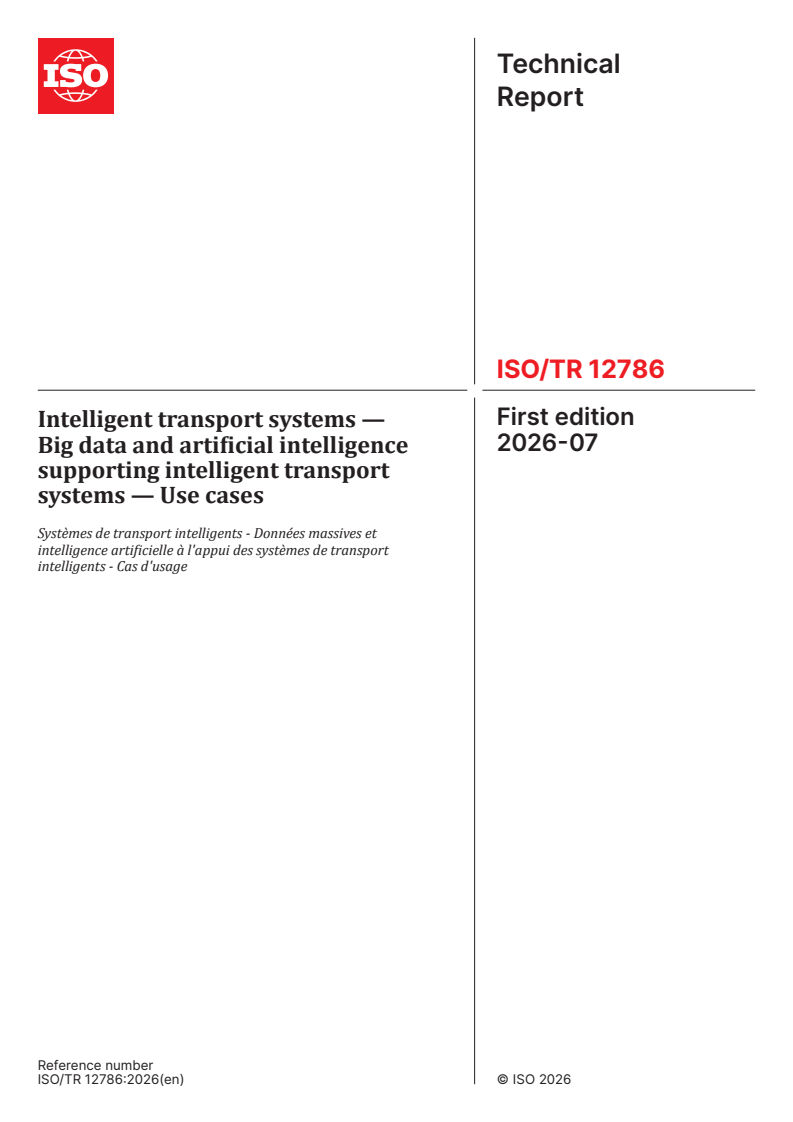
(Main)Intelligent transport systems — Big data and artificial intelligence supporting intelligent transport systems — Use cases
- Abstract
This document provides a collection of use cases specific to the domain of intelligent transport systems that take advantage of big data technologies and artificial intelligence (AI) techniques.
- Status
- Published
- Publication Date
- 19-Jul-2026
- Technical Committee
- ISO/TC 204 - Intelligent transport systems
- Drafting Committee
- ISO/TC 204 - Intelligent transport systems
- Current Stage
- 6060 - International Standard published
- Start Date
- 20-Jul-2026
- Completion Date
- 20-Jul-2026

ISO/TR 12786:2026 is an ISO Technical Report on intelligent transport systems (ITS). It collects use cases where big data technologies and artificial intelligence (AI) support ITS, and it is written for people who need to understand possible applications, data characteristics, challenges and stakeholders before designing or assessing a solution.
What does ISO/TR 12786:2026 specify?
ISO/TR 12786:2026 specifies a collection of ITS use cases that take advantage of big data technologies and AI techniques. The report is organized as a context-setting overview, a discussion of challenges, a set of selected use cases, and two informative annexes that support collecting and compiling additional cases.
The document is arranged as follows:
- Clause 1 gives the scope.
- Clause 2 lists the normative references section.
- Clause 3 defines the terms used throughout the report.
- Clause 4 lists abbreviated terms.
- Clause 5 explains ITS, road safety, big data and AI in the ITS context.
- Clause 6 discusses challenges, risk and data-related concerns.
- Clause 7 presents selected ITS-specific use cases.
- Annexes A and B provide the structured use-case compilation and the collection template.
| Annex | What it covers |
|---|---|
| Annex A | Informative compilation of the ITS-specific use cases |
| Annex B | Informative template used to collect ITS-specific use cases |
What are the key points of ISO/TR 12786:2026?
ISO/TR 12786:2026 is mainly a technical overview and use-case catalogue. It does not set out product conformance rules; instead, it helps readers understand where big data and AI can fit into ITS, what data and technical conditions matter, and what risks come with each kind of application.
Clause 5 sets the technical context
Clause 5 explains ITS, its service domains and main stakeholders, then relates them to road safety, big data and AI. It also describes key characteristics of ITS-specific uses of big data and AI, including scenario settings, technical characteristics, data characteristics, stakeholders, and the difference between classic models and AI models. In practice, this helps a reader compare a proposed ITS solution with the kinds of deployments covered by the report.
Clause 6 frames the main challenges
Clause 6 groups the challenges around adoption barriers, responsibility and governance, risk, and data issues. It highlights safety, controllability, security, privacy protection, verifiability, transparency and explainability, then adds data availability, quality, interoperability, unwanted bias and fairness. For an engineer or buyer, this is the part that supports early risk review, data readiness checks and governance discussions.
Clause 6 also gives concrete barrier categories
Table 5 summarizes cross-cutting barriers such as acceptance, bias, computing power, data needs, ethics and equity, generalizability, hardware compatibility, liability, obsolescence, opacity, privacy, risk aversion and talent/workforce. These categories matter because they show why some ITS AI ideas are hard to deploy even when the underlying model looks promising.
Clause 6 links risk to operating context
The report explains risk as a spectrum and relates it to the type of action, the time and space of operation, the degree of automation, supervision, human safety impact, ethical relevance and transparency. In practice, this helps readers judge whether a use case is mainly advisory, operational or safety-critical, and what level of oversight it needs.
Clause 7 presents a broad use-case set
Clause 7 lists 30 ITS-specific use cases, including congestion prediction, traffic signal control, real-time traffic signal optimization, automated driving bus information support, crowd-sourced AI dataset generation, V2X reliability checks, video analytics for infrastructure repairs, federated learning, road-incident recognition, queue length estimation, multimodal corridor management, asset monitoring, work zone management, crash and emergency detection, predictive maintenance, distracted driver behaviour detection, environmental mapping and assistive robotics. This breadth matters because it gives readers examples across traffic operations, public transport, infrastructure, safety and automation.
Annexes A and B support collection and comparison
Annex A compiles the use cases in a structured format, and Annex B gives the template used to collect them. That structure is useful when an organization wants to document its own case in the same way, compare multiple candidate applications, or build a consistent portfolio of ITS AI opportunities.
What terms does ISO/TR 12786:2026 define?
- Artificial intelligence (AI) - The report uses AI for the research and development of mechanisms and applications of AI systems.
- AI system - An engineered system that generates outputs such as content, forecasts, recommendations or decisions for human-defined objectives.
- AI algorithm - A sequence of AI-related operations used to perform a specific task in an ITS context.
- Big data - Extensive datasets marked by volume, variety, velocity and/or variability that need scalable technology for efficient storage, manipulation, management and analysis.
- Big data technology - A platform, tool or software component used to capture, process, analyse and visualize potentially large datasets in a reasonable timeframe.
- Safe system approach - The body of knowledge and practice based on the principle that there is no acceptable level of death or serious injury on the roads.
- Spectrum of risk - The degree to which risk varies across ITS and AI use cases.
- Trustworthiness - The ability to meet stakeholder expectations in a verifiable way.
Who uses ISO/TR 12786:2026?
ISO/TR 12786:2026 is relevant to transport authorities, road operators, infrastructure owner/operators, public transport organizations, automated driving bus service providers, vehicle and equipment suppliers, telecom and connectivity providers, and AI or data analytics teams working on ITS. It is also useful for buyers and integrators who need to scope data sources, identify risks, and decide whether a use case is suitable for an AI or big data approach.
The report is especially helpful when a team needs to:
- identify candidate ITS applications for AI or big data
- compare classic models with AI-based approaches
- document stakeholders, data characteristics and technical constraints
- review safety, privacy, transparency and governance issues
- structure a use-case submission using the Annex B template
Which standards are used with ISO/TR 12786:2026?
The report cites several standards that provide the background for its definitions and risk discussion:
- ISO/IEC 22989 - supplies AI concepts and terminology used throughout the report.
- ISO/IEC 20546 - supports the definition and framing of big data.
- ISO/IEC 23053 - provides a framework for AI systems using machine learning (ML).
- ISO/IEC TR 20547-1 and ISO/IEC TR 20547-2 - support the big data reference architecture and use-case framing.
- ISO/IEC 23894 - provides guidance on AI risk management.
- ISO 31000 - supports the general risk-management perspective used in Clause 6.
- ISO 21734-1 and ISO 21734-3 - are referenced for the automated driving bus use case.
- ISO 21448 - informs the safety discussion around safety of the intended functionality.
- ISO/IEC 27001, ISO/SAE 21434, ISO/IEC 29100 and ISO/IEC 27018 - support information security, cybersecurity and privacy topics.
What does the ISO/TR 12786:2026 document contain?
ISO/TR 12786:2026 contains a contextual introduction to ITS, big data and AI, followed by a structured discussion of challenges and selected use cases. Its key content objects are the use-case summaries in Clause 7, the barrier summary in Table 5, the challenge summary in Table 6, the use-case list in Table 7, and the informative compilation and template in Annexes A and B.
For practical work, the document is most useful when a team is designing an ITS solution, testing an AI-enabled concept, reviewing safety and privacy concerns, or preparing a use-case description for internal review or stakeholder discussion. It gives enough structure to compare cases, record data needs and spot the main deployment issues early.
Get Certified
Connect with accredited certification bodies for this standard

BSI Group
BSI (British Standards Institution) is the business standards company that helps organizations make excellence a habit.

Great Wall Tianjin Quality Assurance Center
Established 1993, first batch to receive national accreditation with IAF recognition.
Hong Kong Quality Assurance Agency (HKQAA)
Hong Kong's leading certification body.
Sponsored listings
Frequently Asked Questions
ISO/TR 12786:2026 is a technical report published by the International Organization for Standardization (ISO). Its full title is "Intelligent transport systems — Big data and artificial intelligence supporting intelligent transport systems — Use cases". This standard covers: This document provides a collection of use cases specific to the domain of intelligent transport systems that take advantage of big data technologies and artificial intelligence (AI) techniques.
This document provides a collection of use cases specific to the domain of intelligent transport systems that take advantage of big data technologies and artificial intelligence (AI) techniques.
ISO/TR 12786:2026 is classified under the following ICS (International Classification for Standards) categories: 03.220.01 - Transport in general; 35.240.60 - IT applications in transport. The ICS classification helps identify the subject area and facilitates finding related standards.
ISO/TR 12786:2026 is available in PDF format for immediate download after purchase. The document can be added to your cart and obtained through the secure checkout process. Digital delivery ensures instant access to the complete standard document.
Standards Content (Sample)
Technical
Report
ISO/TR 12786
First edition
Intelligent transport systems —
2026-07
Big data and artificial intelligence
supporting intelligent transport
systems — Use cases
Systèmes de transport intelligents - Données massives et
intelligence artificielle à l'appui des systèmes de transport
intelligents - Cas d'usage
Reference number
© ISO 2026
All rights reserved. Unless otherwise specified, or required in the context of its implementation, no part of this publication may
be reproduced or utilized otherwise in any form or by any means, electronic or mechanical, including photocopying, or posting on
the internet or an intranet, without prior written permission. Permission can be requested from either ISO at the address below
or ISO’s member body in the country of the requester.
ISO copyright office
CP 401 • Ch. de Blandonnet 8
CH-1214 Vernier, Geneva
Phone: +41 22 749 01 11
Email: copyright@iso.org
Website: www.iso.org
Published in Switzerland
ii
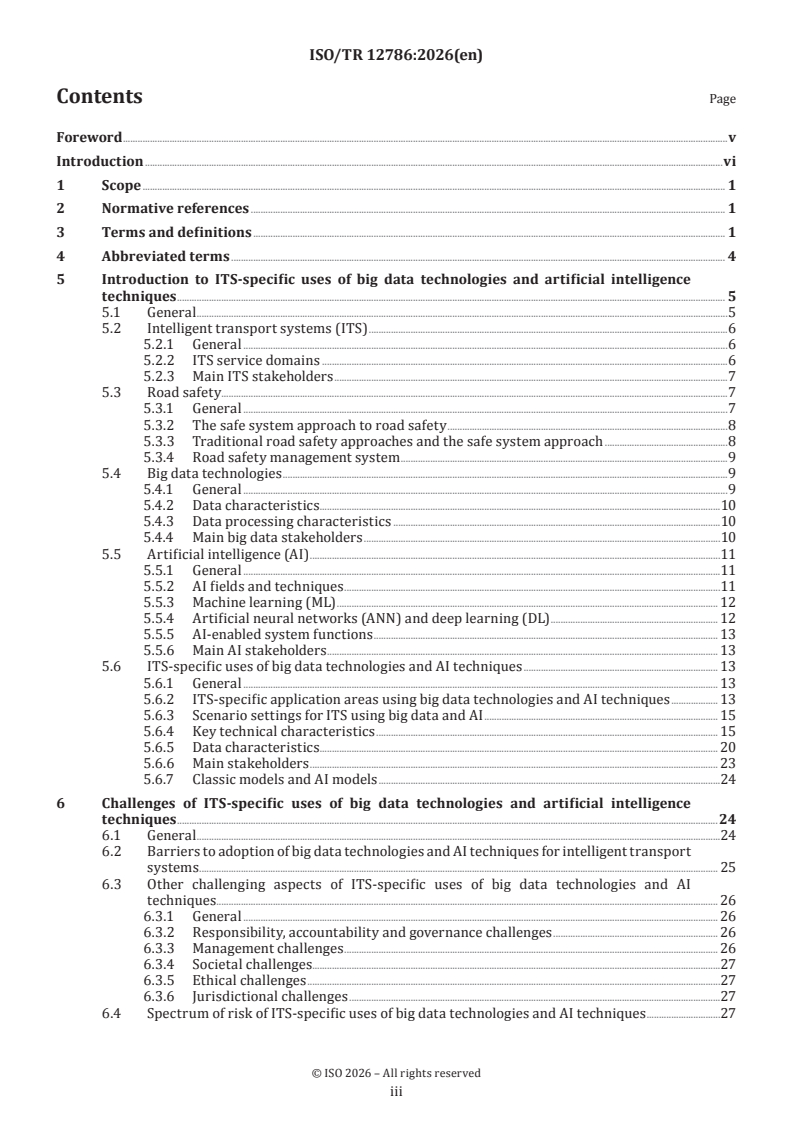
Contents Page
Foreword .v
Introduction .vi
1 Scope . 1
2 Normative references . 1
3 Terms and definitions . 1
4 Abbreviated terms . 4
5 Introduction to ITS-specific uses of big data technologies and artificial intelligence
techniques . 5
5.1 General .5
5.2 Intelligent transport systems (ITS) .6
5.2.1 General .6
5.2.2 ITS service domains .6
5.2.3 Main ITS stakeholders .7
5.3 Road safety.7
5.3.1 General .7
5.3.2 The safe system approach to road safety .8
5.3.3 Traditional road safety approaches and the safe system approach .8
5.3.4 Road safety management system .9
5.4 Big data technologies .9
5.4.1 General .9
5.4.2 Data characteristics . .10
5.4.3 Data processing characteristics .10
5.4.4 Main big data stakeholders .10
5.5 Artificial intelligence (AI) .11
5.5.1 General .11
5.5.2 AI fields and techniques .11
5.5.3 Machine learning (ML) . 12
5.5.4 Artificial neural networks (ANN) and deep learning (DL) . 12
5.5.5 AI-enabled system functions . 13
5.5.6 Main AI stakeholders . 13
5.6 ITS-specific uses of big data technologies and AI techniques . 13
5.6.1 General . 13
5.6.2 ITS-specific application areas using big data technologies and AI techniques . 13
5.6.3 Scenario settings for ITS using big data and AI . 15
5.6.4 Key technical characteristics . 15
5.6.5 Data characteristics . . 20
5.6.6 Main stakeholders . 23
5.6.7 Classic models and AI models .24
6 Challenges of ITS-specific uses of big data technologies and artificial intelligence
techniques .24
6.1 General .24
6.2 Barriers to adoption of big data technologies and AI techniques for intelligent transport
systems . 25
6.3 Other challenging aspects of ITS-specific uses of big data technologies and AI
techniques . . 26
6.3.1 General . 26
6.3.2 Responsibility, accountability and governance challenges . 26
6.3.3 Management challenges . 26
6.3.4 Societal challenges.27
6.3.5 Ethical challenges .27
6.3.6 Jurisdictional challenges .27
6.4 Spectrum of risk of ITS-specific uses of big data technologies and AI techniques .27
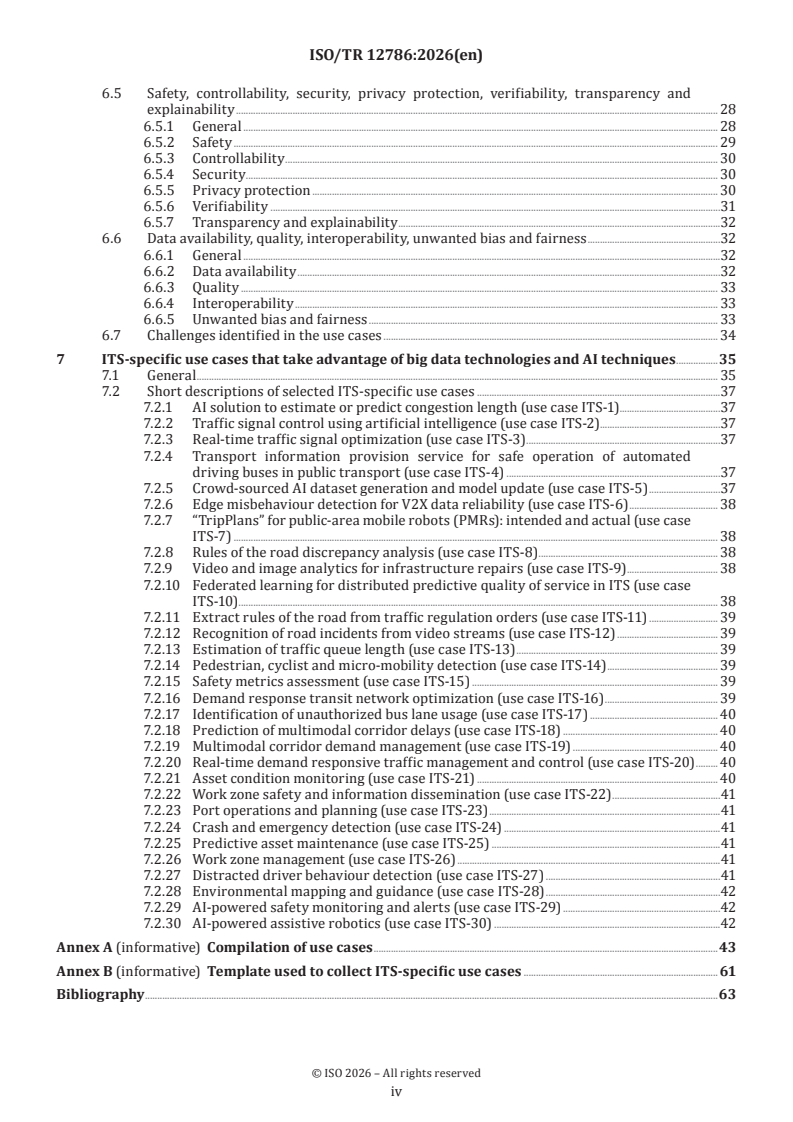
iii
6.5 Safety, controllability, security, privacy protection, verifiability, transparency and
explainability . 28
6.5.1 General . 28
6.5.2 Safety . 29
6.5.3 Controllability . 30
6.5.4 Security . . . 30
6.5.5 Privacy protection . 30
6.5.6 Verifiability .31
6.5.7 Transparency and explainability .32
6.6 Data availability, quality, interoperability, unwanted bias and fairness .32
6.6.1 General .32
6.6.2 Data availability .32
6.6.3 Quality . 33
6.6.4 Interoperability . 33
6.6.5 Unwanted bias and fairness . 33
6.7 Challenges identified in the use cases . 34
7 ITS-specific use cases that take advantage of big data technologies and AI techniques .35
7.1 General . 35
7.2 Short descriptions of selected ITS-specific use cases .37
7.2.1 AI solution to estimate or predict congestion length (use case ITS-1) . .37
7.2.2 Traffic signal control using artificial intelligence (use case ITS-2).37
7.2.3 Real-time traffic signal optimization (use case ITS-3) .37
7.2.4 Transport information provision service for safe operation of automated
driving buses in public transport (use case ITS-4) .37
7.2.5 Crowd-sourced AI dataset generation and model update (use case ITS-5) .37
7.2.6 Edge misbehaviour detection for V2X data reliability (use case ITS-6) . 38
7.2.7 “TripPlans” for public-area mobile robots (PMRs): intended and actual (use case
ITS-7) . 38
7.2.8 Rules of the road discrepancy analysis (use case ITS-8) . 38
7.2.9 Video and image analytics for infrastructure repairs (use case ITS-9) . 38
7.2.10 Federated learning for distributed predictive quality of service in ITS (use case
ITS-10) . . 38
7.2.11 Extract rules of the road from traffic regulation orders (use case ITS-11) . 39
7.2.12 Recognition of road incidents from video streams (use case ITS-12) . 39
7.2.13 Estimation of traffic queue length (use case ITS-13) . 39
7.2.14 Pedestrian, cyclist and micro-mobility detection (use case ITS-14) . 39
7.2.15 Safety metrics assessment (use case ITS-15) . 39
7.2.16 Demand response transit network optimization (use case ITS-16) . 39
7.2.17 Identification of unauthorized bus lane usage (use case ITS-17) . 40
7.2.18 Prediction of multimodal corridor delays (use case ITS-18) . 40
7.2.19 Multimodal corridor demand management (use case ITS-19) . 40
7.2.20 Real-time demand responsive traffic management and control (use case ITS-20) . 40
7.2.21 Asset condition monitoring (use case ITS-21) . 40
7.2.22 Work zone safety and information dissemination (use case ITS-22) .41
7.2.23 Port operations and planning (use case ITS-23) .41
7.2.24 Crash and emergency detection (use case ITS-24) .41
7.2.25 Predictive asset maintenance (use case ITS-25) .41
7.2.26 Work zone management (use case ITS-26) .41
7.2.27 Distracted driver behaviour detection (use case ITS-27) .41
7.2.28 Environmental mapping and guidance (use case ITS-28) .42
7.2.29 AI-powered safety monitoring and alerts (use case ITS-29) .42
7.2.30 AI-powered assistive robotics (use case ITS-30) .42
Annex A (informative) Compilation of use cases .43
Annex B (informative) Template used to collect ITS-specific use cases . 61
Bibliography .63
iv
Foreword
ISO (the International Organization for Standardization) is a worldwide federation of national standards
bodies (ISO member bodies). The work of preparing International Standards is normally carried out through
ISO technical committees. Each member body interested in a subject for which a technical committee
has been established has the right to be represented on that committee. International organizations,
governmental and non-governmental, in liaison with ISO, also take part in the work. ISO collaborates closely
with the International Electrotechnical Commission (IEC) on all matters of electrotechnical standardization.
The procedures used to develop this document and those intended for its further maintenance are described
in the ISO/IEC Directives, Part 1. In particular, the different approval criteria needed for the different types
of ISO document should be noted. This document was drafted in accordance with the editorial rules of the
ISO/IEC Directives, Part 2 (see www.iso.org/directives).
ISO draws attention to the possibility that the implementation of this document may involve the use of (a)
patent(s). ISO takes no position concerning the evidence, validity or applicability of any claimed patent
rights in respect thereof. As of the date of publication of this document, ISO had not received notice of (a)
patent(s) which may be required to implement this document. However, implementers are cautioned that
this may not represent the latest information, which may be obtained from the patent database available at
www.iso.org/patents. ISO shall not be held responsible for identifying any or all such patent rights.
Any trade name used in this document is information given for the convenience of users and does not
constitute an endorsement.
For an explanation of the voluntary nature of standards, the meaning of ISO specific terms and expressions
related to conformity assessment, as well as information about ISO's adherence to the World Trade
Organization (WTO) principles in the Technical Barriers to Trade (TBT), see www.iso.org/iso/foreword.html.
This document was prepared by Technical Committee ISO/TC 204, Intelligent transport systems.
Any feedback or questions on this document should be directed to the user’s national standards body. A
complete listing of these bodies can be found at www.iso.org/members.html.
v
Introduction
The term "big data" refers to extensive datasets that require specialized technologies and techniques for
their processing and realization of value due to their characteristics in terms of volume, variety, velocity and
variability (see ISO/IEC 22989 and ISO/IEC 20546).
Technologies have been developed specifically to enable the distributed processing of large datasets
using clusters of computers while using simple programming models. Additionally, storage and database
technologies have been developed specifically to manage and organize large volumes of data, even when
composed of multiple large datasets.
As defined in ISO/IEC 22989 and ISO/IEC 23053, artificial intelligence (AI) systems, in general, are
engineered systems that generate outputs such as content, forecasts, recommendations or decisions for a
given set of human-defined objectives.
AI covers a wide range of technologies that reflect different approaches for dealing with these complex
objects. Big data has many uses within the context of AI systems, and it is an enabler of many such systems,
in particular for machine learning (ML) and deep learning (DL).
This document focuses on use cases specific to intelligent transport systems that take advantage of big data
technologies and AI techniques.
NOTE 1 ISO/IEC 22989 raises the issue of using terms such as “intelligent”, “intelligence” and “artificial intelligence”,
which can anthropomorphize AI systems. The use of these terms can be misleading.
NOTE 2 Much of the content of this document originates from other ISO/IEC standards, as well as reports produced
by a wide variety of entities with ties to AI, ML and transportation. For references to documents attributed to the
United States Department of Transportation (USDOT), permission has been granted to use content as shown herein.
For all other cases, content is referenced by quotes and paraphrases are avoided, with readers encouraged to seek out
the referenced sources for more detailed information.
NOTE 3 The contents of this document are closely tied to the provider’s intellectual property. Experts in AI and big
data can derive specific models based on data types, required confidence, tolerances and combinations. Use cases are
for informational purposes only.
vi
Technical Report ISO/TR 12786:2026(en)
Intelligent transport systems — Big data and artificial
intelligence supporting intelligent transport systems — Use
cases
1 Scope
This document provides a collection of use cases specific to the domain of intelligent transport systems that
take advantage of big data technologies and artificial intelligence (AI) techniques.
2 Normative references
There are no normative references in this document.
3 Terms and definitions
For the purposes of this document, the following terms and definitions apply.
ISO and IEC maintain terminology databases for use in standardization at the following addresses:
— ISO Online browsing platform: available at https:// www .iso .org/ obp
— IEC Electropedia: available at https:// www .electropedia .org/
3.1
artificial intelligence
AI
research and development of mechanisms and applications of artificial intelligence systems (3.5)
Note 1 to entry: Research and development can take place across any number of fields such as computer science, data
science, humanities, mathematics and natural sciences.
[SOURCE: ISO/IEC 22989:2022, 3.1.3]
3.2
artificial intelligence algorithm
AI algorithm
sequence of artificial intelligence (3.1) related operations for performing a
specific task
Note 1 to entry: Rule-based algorithms use inputs and parameters, which are generally determined based on expert
knowledge, to determine outputs.
Note 2 to entry: Machine learning algorithms use example inputs and outputs (if available) to determine model
parameters.
Note 3 to entry: Rule-based and machine learning-based algorithms differ in how they are created or trained.
3.3
artificial intelligence application
AI application
software application with artificial intelligence (3.1) related functional
characteristics that operates in a context with its stakeholders’ interrelated activities to deliver an intended
result
Note 1 to entry: The term "application" is generally used when referring to a component of software that can be
executed. It consists of one or more components, modules or subsystems.
3.4
artificial intelligence method
AI method
artificial intelligence (3.1) related problem-solving process
Note 1 to entry: The term "process" refers to a set of interrelated or interacting activities that transforms inputs into
outputs.
Note 2 to entry: Machine learning (ML) methods can be classified into three approaches: supervised ML, unsupervised
ML, and reinforcement ML.
Note 3 to entry: Conventional computing methods are generally applied to find precise and rigorous solutions to
problems.
EXAMPLE ML employs a set of statistical methods to find patterns in existing data and to then use patterns to
make predictions on production data.
3.5
artificial intelligence system
AI system
engineered system that generates outputs such as content, forecasts, recommendations or decisions for a
given set of human-defined objectives
Note 1 to entry: The engineered system can use various techniques and approaches related to “artificial intelligence”
(3.1) to develop a model to represent data, knowledge, processes, etc., which can be used to conduct tasks.
Note 2 to entry: AI systems are designed to operate with varying levels of automation.
[SOURCE: ISO/IEC 22989:2022, 3.1.4]
3.6
artificial intelligence technique
AI technique
set of artificial intelligence (3.1) related methods, tools and skills required to
carry out a specific activity
Note 1 to entry: AI techniques include knowledge discovery and pattern recognition.
3.7
big data
extensive datasets – primarily in the data characteristics of volume, variety, velocity, and/or variability –
that require a scalable technology for efficient storage, manipulation, management, and analysis
Note 1 to entry: Big data is commonly used in many different ways, for example as the name of the scalable technology
used to handle big data extensive datasets.
[SOURCE: ISO/IEC 20546:2019, 3.1.2]
availability
property of being accessible and usable on demand by an authorized entity
[SOURCE: ISO/IEC 27000:2018, 3.7]
3.9
big data application
software application with big data (3.7) related functional characteristics
that operates in a context with its stakeholders’ interrelated activities to deliver an intended result
Note 1 to entry: The term "application" is generally used when referring to a component of software that can be
executed. It consists of one or more components, modules or subsystems.
3.10
big data technology
platform, tool or software component used to capture, process, analyse and
visualize potentially large datasets in a reasonable timeframe
3.11
computer vision
capability of a functional unit to acquire, process and interpret data representing images or video
Note 1 to entry: Computer vision involves the use of sensors to create a digital image of a visual scene. This can include
images, such as images that capture wavelengths beyond those of visible light, such as infrared imaging.
[SOURCE: ISO/IEC 22989:2022, 3.7.1]
3.12
deep learning
DL
approach to creating rich hierarchical representations through the training of
neural networks with many hidden layers
Note 1 to entry: DL is a subset of machine learning (ML).
[SOURCE: ISO/IEC 22989:2022, 3.4.4, modified — admitted term "deep neural network learning" has been
removed.]
3.13
reliability
property of having consistent intended behaviour and results
[SOURCE: ISO/IEC 27000:2018, 3.55, modified — the word "having" has been added to the definition.]
3.14
resilience
ability of a system to recover operational condition quickly following an incident
[SOURCE: ISO/IEC 22989:2022, 3.5.10]
3.15
robustness
ability of a system to maintain its level of performance under any circumstances
[SOURCE: ISO/IEC 22989:2022, 3.5.12]
3.16
safe system approach
body of knowledge and practice that stems from the principle that there is no acceptable level
of death or serious injury on the roads
3.17
spectrum of risk
degree to which risk varies
3.18
trustworthiness
ability to meet stakeholder expectations in a verifiable (3.19) way
[SOURCE: ISO/IEC 22989:2022, 3.5.16, modified — Notes 1 – 3 to entry have been removed.]
3.19
verifiable
can be checked for correctness by a person or tool
[SOURCE: ISO/IEC/IEEE 15289:2019, 3.1.29]
4 Abbreviated terms
ADAS advanced driver assistance system
ADB automated driving bus
ADS automated driving system
AI artificial intelligence
AMQP Advanced Message Queuing Protocol
ANN artificial neural network
ASIL automotive safety integrity level
ATSPM automated traffic signal performance measure
BSM basic safety message
CCTV closed-circuit television
CPM Collective Perception Message
DDT dynamic driving task
DL deep learning
DSS Decision Support Systems
E/E/PE electrical/electronic/programmable electronic
EEM emergency event message
EUC equipment under control
GNSS global navigation satellite system
GUI graphical user interface
HARA hazard analysis and risk assessment
HAZMAT hazardous materials
IMU inertial measurement unit
IOO infrastructure owner/operators
IoT internet of things
ISMS Information Security Management Systems
IT information technology
ITS intelligent transport system
KPI key performance indicator
LTE long term evolution
MEC mobile edge computing
METR management of electronic traffic regulations
ML machine learning
MNO mobile network operator
MQTT Message Queue Telemetry Transport
NLP natural language processing
NN neural network
OBU on-board unit
ODD operational design domain
OEM (automotive) original equipment manufacturer
PII personally identifiable information
PMR public-area mobile robot
QoS quality of service
ROI region of interest
SLAM simultaneous localization and mapping
SOTIF safety of the intended functionality
SDGs sustainable development goals
UN United Nations
V2X vehicle-to-everything
VR virtual reality
WHO World Health Organization
5 Introduction to ITS-specific uses of big data technologies and artificial intelligence
techniques
5.1 General
ISO/TS 14812 defines an intelligent transport system (ITS) as a “system comprised of information,
communication, sensor and control technologies, that is designed to benefit a surface transport system”. A
brief overview of ITS, ITS service domains and main ITS stakeholders is provided in 5.2.
In the context of ITS-specific uses of big data technologies and AI techniques, road safety is paramount. This
critical topic is discussed in 5.3.
Big data technologies have become important because organizations have increased the breadth and depth
of data collection, and therefore require specialized technologies and techniques to gain insights into, for
example, the facts that produced the data. A brief overview of big data technologies and characteristics is
provided in 5.4 (see also ISO/IEC 22989).
AI techniques are increasingly applied in various sectors using information technology (IT). A brief overview
of AI techniques is provided in 5.5.
Key characteristics of ITS-specific uses of big data technologies and AI techniques are presented in 5.6.
Clause 6 identifies key challenges of ITS-specific uses of big data technologies and AI techniques.
Clause 7 provides short descriptions of a selection of ITS-specific use cases that take advantage of the
application of big data technologies and AI techniques.
Annex A contains a structured compilation of the ITS-specific use cases submitted by interested parties
using the template presented in Annex B.
The field of artificial intelligence is changing rapidly, as evidenced by the widespread use of generative AI,
the proliferation of large language models (LLMs) and deployment of data centres dedicated to AI processing.
It is possible that evolution and revolutionary breakthroughs will continue to occur, and apply in varying
degrees to ITS use cases; the purpose of this report is simply to identify use cases that can potentially
leverage existing or future AI and big data-related technologies.
5.2 Intelligent transport systems (ITS)
5.2.1 General
Intelligent transport systems represent information, communication, and control systems in the field of
urban and rural surface transportation, including intermodal and multimodal aspects thereof, traveller
information, traffic management, public transport, commercial transport, emergency services, and
commercial services. In-vehicle transport information and control systems are excluded.
Benefits of ITS potentially include, but are not limited to, increased safety, sustainability, efficiency, and
comfort (see ISO/TS 14812).
5.2.2 ITS service domains
ITS includes eleven broad areas of services. Ten of these are defined in ISO 14813-1 in the context of ITS
service domains, which are application areas that include similar or complementary ITS services provided
to ITS users:
— Traveller Information
— Traffic Management and Operations
— Vehicle Services
— Freight Transport
— Public Transport
— Emergency Services
— Payment for Transport Related Services
— Weather and Environmental Conditions Monitoring
— Disaster Response Management and Coordination
— Performance Management
The eleventh area of interest is Cooperative-ITS (C-ITS), a subset of ITS where information is shared among
ITS stations (as defined in ISO 21217) in a manner that enables its use by multiple ITS services (see the
ISO 17465 series for more information on the concepts behind C-ITS).
5.2.3 Main ITS stakeholders
ISO/IEC 22989 defines a stakeholder as any individual, group or organization that can affect, be affected by,
or perceive itself to be affected by a decision or activity. A representative taxonomy of ITS stakeholders can
be found in the ISO 24315 series on the management of electronic traffic regulations. The ISO 24315 series
is considered to be the most relevant document series in this context because it has followed a rigorous
systems engineering process, leveraging well established processes in the area of stakeholder
engagement (as described in key systems engineering standards, in particular ISO/IEC/IEEE 15288 and
ISO/IEC/IEEE 42010). According to ISO/TR 24315-2, ITS stakeholders include:
— Transport users (e.g. vehicle drivers, vulnerable road users)
— Transport infrastructure operators (e.g. traffic engineers, toll road operators, parking facility operators)
— Maintenance and construction personnel (e.g. road crews, maintenance managers)
— Transport service operators (e.g. public transport agencies, delivery companies, ride sourcing
— companies)
— Transport entity owners (e.g. municipalities, campus owners, fleet managers)
— Enforcement personnel (e.g. law enforcement, lawyers, insurance companies)
— Manufacturers and developers (e.g. motor vehicle manufacturers, pathway robot manufacturers, ADS-
equipped vehicle developers)
— Technology specialists (e.g. ADS-equipped vehicle experts, location perception experts, video image
processing experts)
— Information support entities (e.g. map providers, navigation providers, traveller information providers)
— Advocates (e.g. safety advocates, environmental advocates, disability rights advocates).
5.3 Road safety
5.3.1 General
Intelligent transport system needs are constantly evolving, but road safety remains paramount, as road
accidents kill more than 1,3 million people worldwide each year and cause approximately 50 million injuries,
according to the World Health Organization (WHO) and the United Nations (UN).
Improving road safety is now recognized as a global challenge. The UN General Assembly therefore
[9]
unanimously adopted Resolution 74/299 to launch the Second Decade of Action for Road Safety 2021–2030
with the explicit target of reducing road deaths and injuries by at least 50 % during this period. This action
[10]
is in addition to the UN 2030 Agenda for Sustainable Development, which already includes Sustainable
Development Goals (SDGs) and targets related to road safety.
[8]
To support the implementation of the Second Decade of Action for Road Safety 2021–2030, a Global Plan
has been developed by the WHO and the UN Regional Commissions. This Global Plan calls on governments
and stakeholders to implement an integrated safe system approach that squarely positions road safety as a
key driver of sustainable development.
According to this Global Plan, intelligent transport systems can contribute to the achievement of the UN's
objectives. The question of how big data technologies and AI techniques can help intelligent transport
[11]
systems meet the new challenges remains open. However, a report from OECD/ITF suggests that these
technologies hold significant promise.
For example, AI techniques aim to contribute to the proactive management of road networks, with the goal
of improving road safety in at least two ways.
— First, through sensors and systems such as computer vision, AI helps to collect and label data on
infrastructure condition and traffic events over an entire road network.
— Secondly, thanks to predictive models, an AI system can learn to identify the locations where the risk of
an accident is highest before an accident occurs.
5.3.2 The safe system approach to road safety
[12] [13]
According to OECD/ITF and PIARC, the safe system approach is a holistic approach to road safety,
based on an ethical position that it can never be acceptable for people to be seriously injured or killed on a
road network.
The safe system approach acknowledges that humans inevitably make mistakes, and that all parts of the
transport system can help prevent a fatal outcome, for example, in the event of a collision.
In a Safe System, those who design, build, manage and use roads and vehicles, and provide post-crash care,
all have a shared responsibility. Vehicle design, road geometry and traffic rules reflect the human body’s
known limits in withstanding crash forces. Roads and streets are “forgiving”, for example by protecting
road users from impact forces that exceed the limits of human tolerance to injury. Vehicles protect both their
occupants and vulnerable road users. Supportive technologies, such as intelligent transport systems, are a
key action area.
[11]
In addition, an OECD/ITF report proposes a framework for implementing the safe system approach to
road safety. This framework is structured around three dimensions:
a) Five key components of a safe system (institutional governance, shared responsibility, holistic approach,
preventing exposure to large forces and preventing road-user errors);
b) Six pillars of road safety (road-safety management, safe roads, safe vehicles, safe speeds, safe road-user
behaviour and post-crash care); and
c) Three stages of development of any safe system intervention (i.e. emerging, advancing and mature
stages).
This framework seeks to correct the impression that road user error is at the heart of the problem.
Preventing road-user errors is the finishing touch of the safe system approach rather that its primary focus.
5.3.3 Traditional road safety approaches and the safe system approach
In a safe system, the planning approaches are proactive, identifying risk factors in all parts of the system and
[11]
seeking to address them before serious harm occurs. The safe system approach puts particular emphasis
on building a safe road system, rather than fixing crash accumulation spots.
For instance, rather than trying to eliminate all traffic crashes, the safe system approach focuses on
those crashes that result in fatal or serious injuries, and as a goal seeks to eliminate all such injuries,
while traditional road safety metrics focus on reductions. Traditional road safety tends toward reactive,
incremental approaches, while the safe system approach favours using a systematic approach to proactively
target and treat risk, and recognizes that people inevitably make mistakes, but that responsibility ought to
be shared by all involved parties (i.e. individuals, system designers), and that elements of any system ought
to be combined in such a way as to enhance protections and minimize the impact of a single element failure.
NOTE It is not yet possible to predict when automation will (or will be able to) surpass the ability of a human
driver.
5.3.4 Road safety management system
[13]
According to PIARC, an effective road safety management system covers three linked elements,
periodically reviewed against successful international practice.
a) Institutional management functions: the foundation of an effective road safety management system.
Government agencies with primary road safety responsibilities primarily deliver institutional
management functions. These functions are also provided through partnerships between the
government, civil society and businesses, ensuring alignment with national and organizational goals
and targets.
b) Road safety interventions, which focus on the implementation of evidence-based approaches to reduce
exposure to risk, prevent serious injury or death, and mitigate injury severity when crashes do occur
and reduce consequences of injury.
c) Results (outcomes and outputs), which involves measuring results and setting targets for final outcomes,
intermediate outcomes and outputs.
NOTE ISO 39001 is designed to assist organizations in integrating road safety into their
...