

ISO 1018:2023
(Main)Coal — Determination of moisture-holding capacity
General Information
- Abstract
This document makes reference to ASTM D1412 as a method of determining the moisture-holding capacity of coal.
- Status
- Published
- Publication Date
- 26-Nov-2023
- Technical Committee
- ISO/TC 27/SC 5 - Methods of analysis
- Drafting Committee
- ISO/TC 27/SC 5 - Methods of analysis
- Current Stage
- 6060 - International Standard published
- Start Date
- 27-Nov-2023
- Due Date
- 20-Nov-2024
- Completion Date
- 27-Nov-2023
Overview
ISO 1018:2023 - Coal - Determination of moisture-holding capacity defines a reference method for measuring the moisture-holding capacity of coal. The document references ASTM D1412 and specifies the principle, sampling references and reporting format rather than repeating the full ASTM procedure. The standard clarifies that full moisture-holding capacity relates to coal in equilibrium with a saturated water-vapour atmosphere; practically, the determination is carried out at 96–97% relative humidity and 30 °C.
Key topics and technical requirements
- Referenced method: Uses ASTM D1412 (Equilibrium Moisture of Coal at 96–97% RH and 30 °C) as the test method to be followed for details of apparatus, conditioning and calculation.
- Sampling: Samples must be collected in accordance with the ISO sampling standards applicable to the situation (see Related standards).
- Sample conditioning:
- Determination is performed on wetted and unwetted coal; wetted coal is prepared by immersion in water and removal of excess surface water.
- Coal is brought to equilibrium over a saturated potassium sulfate solution (K2SO4) at 30 °C to obtain the target relative humidity.
- Conditioning is carried out under reduced pressure to assist equilibration.
- Drying and reporting:
- After conditioning, samples are dried to constant mass at 105 °C.
- Moisture-holding capacity is reported as a percent mass fraction of the conditioned moist coal.
- Scope note: The 2023 third edition broadened the title and scope to explicitly cover coal in line with the referenced ASTM method.
Applications
- Correcting calorific value and energy content to a moist mineral matter-free basis for fuel evaluation and commercial transactions.
- Coal classification and rank assessment by laboratories and quality-control units.
- Comparative testing for fuel procurement, blending decisions and combustion performance modelling.
- Research into coal sorption behaviour and storage/transport moisture management.
Who uses this standard
- Analytical and commercial coal testing laboratories
- Power generation and utility fuel analysts
- Coal producers, traders and procurement teams
- Industrial users managing fuel quality, storage and handling
- Researchers studying coal moisture sorption and fuel properties
Related standards
- ASTM D1412 - Standard Test Method for Equilibrium Moisture of Coal at 96 to 97 Percent Relative Humidity and 30 °C (referenced for test details)
- ISO 13909 - Coal and coke - Mechanical sampling
- ISO 14180 - Coal - Guidance on the sampling of coal seams
- ISO 18283 - Coal and coke - Manual sampling
ISO 1018:2023 is a concise ISO reference that ensures consistency in reporting coal moisture-holding capacity by directing users to the established ASTM method and recognized ISO sampling practices.
Relations
- Effective Date
- 27-May-2023
Get Certified
Connect with accredited certification bodies for this standard

Bureau Veritas Chile
Bureau Veritas certification services in Chile.
Bureau Veritas Peru
Bureau Veritas certification services in Peru.
BVQI Peru
Bureau Veritas certification in Peru.
Sponsored listings
Frequently Asked Questions
ISO 1018:2023 is a standard published by the International Organization for Standardization (ISO). Its full title is "Coal — Determination of moisture-holding capacity". This standard covers: This document makes reference to ASTM D1412 as a method of determining the moisture-holding capacity of coal.
This document makes reference to ASTM D1412 as a method of determining the moisture-holding capacity of coal.
ISO 1018:2023 is classified under the following ICS (International Classification for Standards) categories: 73.040 - Coals. The ICS classification helps identify the subject area and facilitates finding related standards.
ISO 1018:2023 has the following relationships with other standards: It is inter standard links to ISO 1018:2019. Understanding these relationships helps ensure you are using the most current and applicable version of the standard.
ISO 1018:2023 is available in PDF format for immediate download after purchase. The document can be added to your cart and obtained through the secure checkout process. Digital delivery ensures instant access to the complete standard document.
Standards Content (Sample)
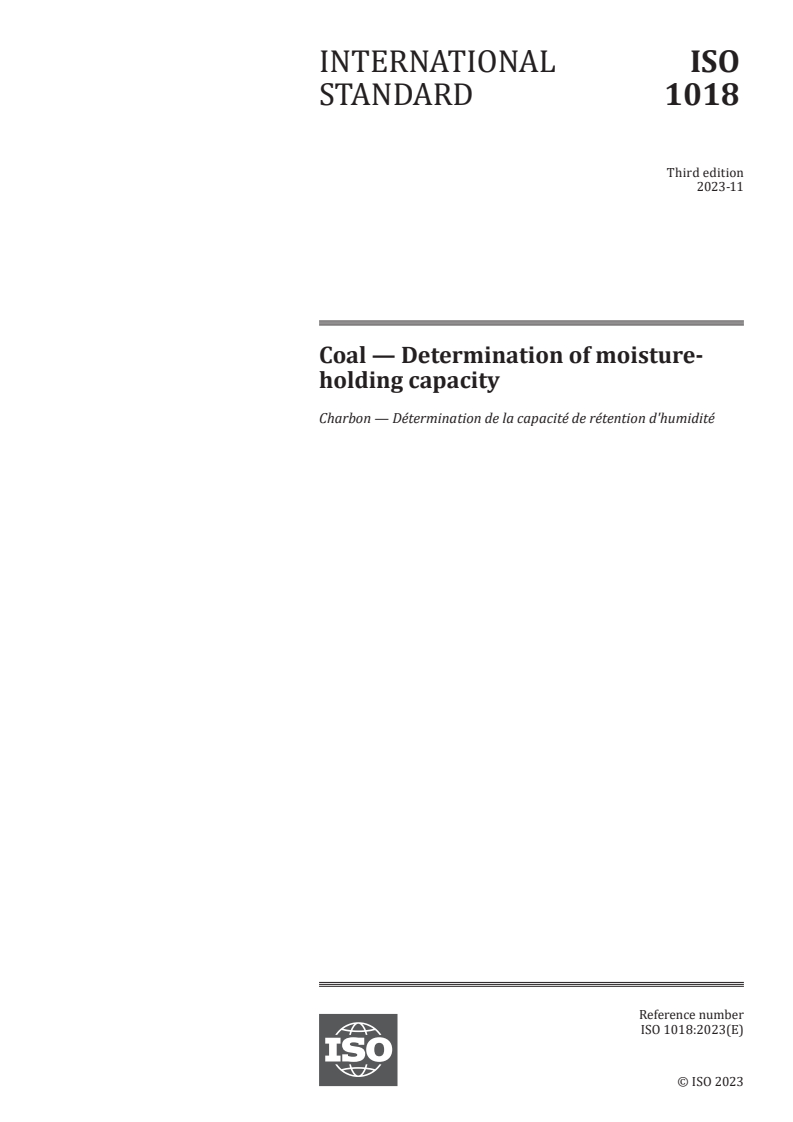
INTERNATIONAL ISO
STANDARD 1018
Third edition
2023-11
Coal — Determination of moisture-
holding capacity
Charbon — Détermination de la capacité de rétention d'humidité
Reference number
© ISO 2023
All rights reserved. Unless otherwise specified, or required in the context of its implementation, no part of this publication may
be reproduced or utilized otherwise in any form or by any means, electronic or mechanical, including photocopying, or posting on
the internet or an intranet, without prior written permission. Permission can be requested from either ISO at the address below
or ISO’s member body in the country of the requester.
ISO copyright office
CP 401 • Ch. de Blandonnet 8
CH-1214 Vernier, Geneva
Phone: +41 22 749 01 11
Email: copyright@iso.org
Website: www.iso.org
Published in Switzerland
ii
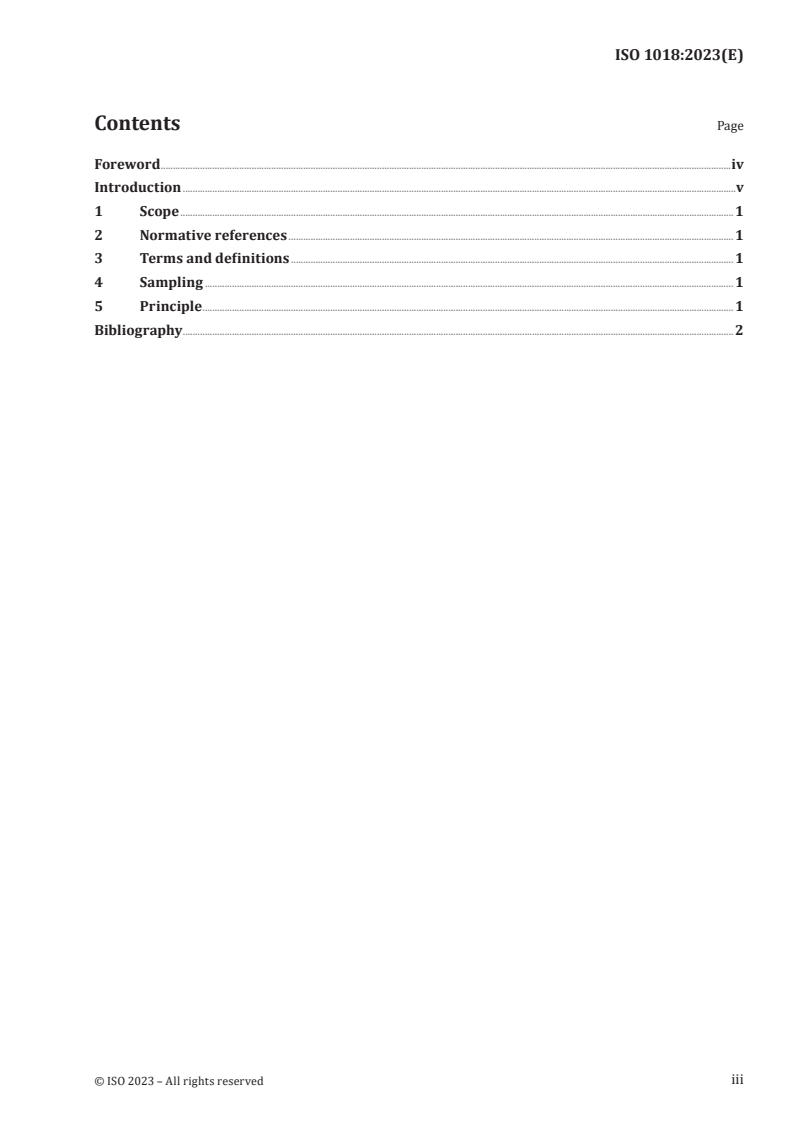
Contents Page
Foreword .iv
Introduction .v
1 Scope . 1
2 Normative references . 1
3 Terms and definitions . 1
4 Sampling . 1
5 Principle . 1
Bibliography . 2
iii
Foreword
ISO (the International Organization for Standardization) is a worldwide federation of national standards
bodies (ISO member bodies). The work of preparing International Standards is normally carried out
through ISO technical committees. Each member body interested in a subject for which a technical
committee has been established has the right to be represented on that committee. International
organizations, governmental and non-governmental, in liaison with ISO, also take part in the work.
ISO collaborates closely with the International Electrotechnical Commission (IEC) on all matters of
electrotechnical standardization.
The procedures used to develop this document and those intended for its further maintenance are
described in the ISO/IEC Directives, Part 1. In particular, the different approval criteria needed for the
different types of ISO documents should be noted. This document was drafted in accordance with the
editorial rules of the ISO/IEC Directives, Part 2 (see www.iso.org/directives).
ISO draws attention to the possibility that the implementation of this document may involve the use
of (a) patent(s). ISO takes no position concerning the evidence, validity or applicability of any claimed
patent rights i
...