

ISO/IEC 10918-4:2024
(Main)Information technology — Digital compression and coding of continuous-tone still images — Part 4: APPn markers
General Information
- Abstract
This document provides definitions for JPEG application specific markers found in Rec. ITU‑T T.81 | ISO/IEC 10918-1 and Rec. ITU-T T.84 | ISO/IEC 10918-3.
- Status
- Published
- Publication Date
- 16-May-2024
- Current Stage
- 6060 - International Standard published
- Start Date
- 17-May-2024
- Due Date
- 02-Mar-2024
- Completion Date
- 17-May-2024
Overview
ISO/IEC 10918-4:2024 is the international standard for the definitions of application-specific markers (APPn markers) used in the JPEG image compression format. Developed by ISO and IEC, this standard provides authoritative guidance and definitions that are essential for developers, manufacturers, and integrators working with JPEG-encoded continuous-tone still images. The primary scope of ISO/IEC 10918-4 is to document and standardize the use and interpretation of APPn markers, as defined in ISO/IEC 10918-1 and ISO/IEC 10918-3, ensuring reliable application-specific extensions and data embedding in JPEG files.
APPn markers are crucial for adding customized information and metadata to JPEG images, enabling functionalities such as color management, device-specific information, image thumbnails, embedded copyright data, and interoperability between different imaging systems.
Key Topics
- APPn Marker Structure: Defines the syntax and semantics for APP0 to APP15 marker segments within the JPEG format, enabling the embedding of application-specific data.
- Reserved Marker Identification: Details reserved combinations of marker codes and identifier strings to prevent conflicts and ensure consistent interpretation across applications.
- Metadata Embedding: Allows storage of various types of metadata, such as Exif (Exchangeable Image File Format), ICC profiles, JFIF (JPEG File Interchange Format), XMP (Extensible Metadata Platform), and more.
- Interoperability: Encourages consistent handling of application-specific markers to promote seamless interchange of JPEG images between diverse imaging environments.
- Implementation Guidelines: Provides recommendations for parser design, including skipping unrecognized markers and preserving data for future compatibility.
Applications
ISO/IEC 10918-4:2024 plays a vital role in multiple digital imaging workflows:
- Digital Cameras and Smartphones: Device manufacturers use APPn markers for storing proprietary metadata such as Exif information, camera settings, or manufacturer-specific fields in captured JPEG images.
- Image Editing Software: Programs like Photoshop and GraphicConverter rely on APPn segments for embedding resource blocks, color management profiles (ICC), and descriptive metadata (e.g., Adobe CM, IPCT).
- Color Management: ICC profiles embedded via APP2 markers facilitate accurate color interpretation and printing across different devices and platforms.
- Digital Asset Management: Libraries and platforms extract and manage metadata from APPn markers for advanced search, organization, and workflow automation.
- Web Publishing: APPn markers support streamlined integration with web services, ensuring extra information like image thumbnails and comments is preserved during file transfers and online publishing.
Related Standards
The following standards are closely associated with ISO/IEC 10918-4:2024 and are frequently referenced in digital image processing and JPEG file handling:
- ISO/IEC 10918-1 (ITU-T T.81): Digital compression and coding of continuous-tone still images - Requirements and guidelines (JPEG baseline & extensions).
- ISO/IEC 10918-3 (ITU-T T.84): Extensions to JPEG for advanced features such as multi picture and metadata.
- ISO/IEC 10918-5 (ITU-T T.871): JPEG File Interchange Format (JFIF) for cross-platform image exchange.
- ISO 15076-1: Color management based on ICC profiles for consistent color reproduction.
- ISO 16684-1: Extensible Metadata Platform (XMP) for structured image metadata.
- ISO/IEC 10646-1: Universal character set support for identifier strings in marker segments.
- ISO/IEC 18477 and 19566-5: JPEG extensions and universal metadata formats for enriched image functionality.
Practical Value
Adhering to ISO/IEC 10918-4:2024 enables:
- Standardized metadata handling in JPEG images for improved data integrity and compatibility.
- Enhanced imaging solutions that leverage APPn markers for device-specific features and advanced workflows.
- Increased interoperability of digital images across different hardware, software, and online platforms.
- Sustainable development of imaging applications that accommodate evolving metadata standards and practices.
By following this standard, organizations and developers ensure reliable, future-ready JPEG implementations capable of robust metadata management and seamless application integration.
Relations
- Effective Date
- 24-Sep-2022
- Effective Date
- 24-Sep-2022
Get Certified
Connect with accredited certification bodies for this standard

BSI Group
BSI (British Standards Institution) is the business standards company that helps organizations make excellence a habit.

NYCE
Mexican standards and certification body.
Sponsored listings
Frequently Asked Questions
ISO/IEC 10918-4:2024 is a standard published by the International Organization for Standardization (ISO). Its full title is "Information technology — Digital compression and coding of continuous-tone still images — Part 4: APPn markers". This standard covers: This document provides definitions for JPEG application specific markers found in Rec. ITU‑T T.81 | ISO/IEC 10918-1 and Rec. ITU-T T.84 | ISO/IEC 10918-3.
This document provides definitions for JPEG application specific markers found in Rec. ITU‑T T.81 | ISO/IEC 10918-1 and Rec. ITU-T T.84 | ISO/IEC 10918-3.
ISO/IEC 10918-4:2024 is classified under the following ICS (International Classification for Standards) categories: 35.040.30 - Coding of graphical and photographical information. The ICS classification helps identify the subject area and facilitates finding related standards.
ISO/IEC 10918-4:2024 has the following relationships with other standards: It is inter standard links to ISO/IEC 10918-4:1999/Amd 1:2013, ISO/IEC 10918-4:1999. Understanding these relationships helps ensure you are using the most current and applicable version of the standard.
ISO/IEC 10918-4:2024 is available in PDF format for immediate download after purchase. The document can be added to your cart and obtained through the secure checkout process. Digital delivery ensures instant access to the complete standard document.
Standards Content (Sample)
International
Standard
ISO/IEC 10918-4
Second edition
Information technology — Digital
2024-05
compression and coding of
continuous-tone still images —
Part 4:
APPn markers
Technologies de l'information — Compression numérique et
codage des images fixes à modelé continu —
Partie 4: Marqueurs APPn
Reference number
© ISO/IEC 2024
All rights reserved. Unless otherwise specified, or required in the context of its implementation, no part of this publication may
be reproduced or utilized otherwise in any form or by any means, electronic or mechanical, including photocopying, or posting on
the internet or an intranet, without prior written permission. Permission can be requested from either ISO at the address below
or ISO’s member body in the country of the requester.
ISO copyright office
CP 401 • Ch. de Blandonnet 8
CH-1214 Vernier, Geneva
Phone: +41 22 749 01 11
Email: copyright@iso.org
Website: www.iso.org
Published in Switzerland
© ISO/IEC 2024 – All rights reserved
ii
Foreword
ISO (the International Organization for Standardization) and IEC (the International Electrotechnical
Commission) form the specialized system for worldwide standardization. National bodies that are members
of ISO or IEC participate in the development of International Standards through technical committees
established by the respective organization to deal with particular fields of technical activity. ISO and IEC
technical committees collaborate in fields of mutual interest. Other international organizations, governmental
and non-governmental, in liaison with ISO and IEC, also take part in the work.
The procedures used to develop this document and those intended for its further maintenance are described
in the ISO/IEC Directives, Part 1. In particular, the different approval criteria needed for the different types of
document should be noted.
ISO and IEC draw attention to the possibility that the implementation of this document may involve the use of
(a) patent(s). ISO and IEC take no position concerning the evidence, validity or applicability of any claimed
patent rights in respect thereof. As of the date of publication of this document, ISO and IEC had not received
notice of (a) patent(s) which may be required to implement this document. However, implementers are
cautioned that this may not represent the latest information, which may be obtained from the patent database
available at www.iso.org/patents and https://patents.iec.ch. ISO and IEC shall not be held responsible for
identifying any or all such patent rights.
Any trade name used in this document is information given for the convenience of users and does not
constitute an endorsement.
For an explanation of the voluntary nature of standards, the meaning of ISO specific terms and expressions
related to conformity assessment, as well as information about ISO's adherence to the World Trade
Organization (WTO) principles in the Technical Barriers to Trade (TBT) see www.iso.org/iso/foreword.html.
In the IEC, see www.iec.ch/understanding-standards.
This document was prepared by ITU-T (as ITU-T Rec T.86) and drafted in accordance with its editorial rules,
in collaboration with Joint Technical Committee ISO/IEC JTC 1, Information technology, Subcommittee SC 29,
Coding of audio, picture, multimedia and hypermedia information.
This second edition cancels and replaces the first edition (ISO/IEC 10918-4:1999), which has been technically
revised. It also incorporates the Amendment ISO/IEC 10918-4:1999/Amd 1:2013.
The main changes are as follows:
— cancels the provisions concerning the registration authority processes originally defined in the first
edition.
A list of all parts in the ISO/IEC 10918 series can be found on the ISO and IEC websites.
Any feedback or questions on this document should be directed to the user’s national standards body. A
complete listing of these bodies can be found at www.iso.org/members.html and www.iec.ch/national-
committees.
© ISO/IEC 2024 – All rights reserved
iii
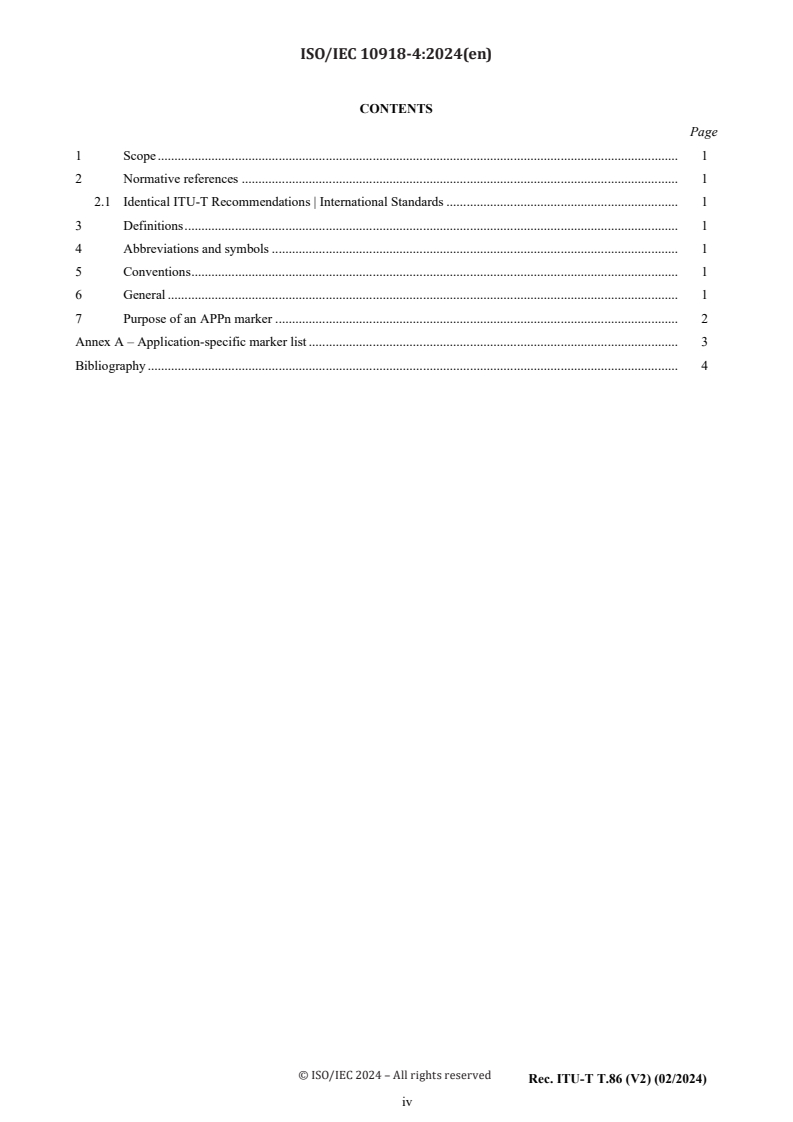
CONTENTS
Page
1 Scope . 1
2 Normative references . 1
2.1 Identical ITU-T Recommendations | International Standards . 1
3 Definitions . 1
4 Abbreviations and symbols . 1
5 Conventions . 1
6 General . 1
7 Purpose of an APPn marker . 2
Annex A – Application-specific marker list . 3
Bibliography . 4
© ISO/IEC 2024 – All rights reserved
Rec. ITU-T T.86 (V2) (02/2024)
iv
INTERNATIONAL STANDARD
ITU-T RECOMMENDATION
Information technology – Digital compression and coding of continuous-tone still images:
APPn markers
1 Scope
This Recommendation | International Standard provides definitions for JPEG application specific markers found in
Rec. ITU-T T.81 | ISO/IEC 10918-1 and Rec. ITU-T T.84 | ISO/IEC 10918-3.
2 Normative references
The following Recommendations and International Standards contain provisions which, through references in this text,
constitute provisions of this Recommendation | International Standard. At the time of publication, the editions indicated
were valid. All Recommendations and Standards are subject to revision, and parties to agreements based on this
Recommendation | International Standard are encouraged to investigate the possibility of applying the most recent edition
of the Recommendations and Standards listed below. Members of IEC and ISO maintain registers of currently valid
International Standards. The Telecommunication Standardization Bureau of the ITU maintains a list of currently valid
ITU-T Recommendations.
2.1 Identical ITU-T Recommendations | International Standards
– Recommendation ITU-T T.81 | ISO/IEC 10918-1, Information technology – Digital compression and
coding of continuous-tone still images: Requirements and guidelines.
– Recommendation ITU-T T.84 | ISO/IEC 10918-3, Information technology – Digital compression and
coding of continuous-tone still images: Extensions.
3 Definitions
The definitions used in Rec. ITU-T T.81 | ISO/IEC 10918-1, R
...