

ISO 9348:2026
(Main)Textiles — Determination of the anti-contamination propensity of fabrics to particulate matter — Digital measurement method
- Abstract
This document specifies the digital measurement method for the determination of the anti-contamination of fabrics. This method is applicable to woven fabrics which have or have not been given an anti-contamination to particulate matter finish. It is especially suitable for measuring apparel fabrics. It is not intended for use in fabrics that react to UV light or allow particulate matter to penetrate into the structure of the fabric. It is not applied to fabrics for personal protective equipment. NOTE 1 Particulate matter (PM) is solid particles suspended in ambient air defined in ISO 16890-1. NOTE 2 In woven fabrics, particulate matter (PM) adheres to the fabric surface due to electrostatic or surface properties. In knitted and nonwoven fabrics, PM penetrates into the fabric structure, following a different mechanism. The conditions and procedures outlined in this test method are designed to ensure reproducibility and precision specifically when applied to woven fabrics.
- Status
- Published
- Publication Date
- 21-May-2026
- Current Stage
- 6060 - International Standard published
- Start Date
- 22-May-2026
- Due Date
- 16-Mar-2026
- Completion Date
- 22-May-2026
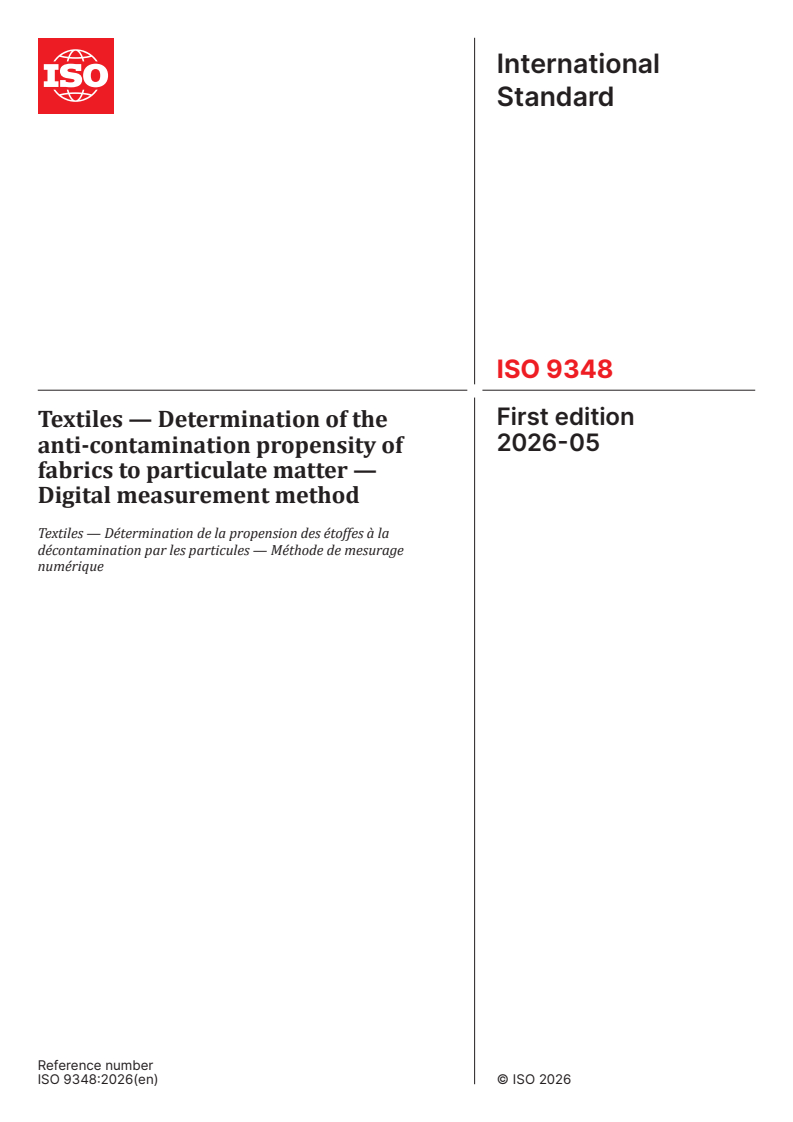
ISO 9348:2026 is an International Standard from ISO for measuring the anti-contamination propensity of fabrics to particulate matter using a digital measurement method. It sets out a tumble-and-imaging test for woven fabrics, including fabrics with or without an anti-contamination to particulate matter finish, and is aimed especially at apparel fabrics. It is written for evaluating how much particulate matter remains on the fabric surface after the test.
What does ISO 9348:2026 specify?
ISO 9348:2026 specifies a digital method for determining the anti-contamination of fabrics to particulate matter. In practice, it gives a repeatable way to compare woven fabrics under the same tumble, lighting and image-analysis conditions.
The document applies to woven fabrics with or without an anti-contamination to particulate matter finish. It is not intended for fabrics that react to UV light, fabrics that let particulate matter penetrate into the structure, or fabrics for personal protective equipment.
The document is organized into:
- Clause 1 - Scope
- Clause 2 - Normative references
- Clause 3 - Terms and definitions
- Clause 4 - Principle
- Clause 5 - Apparatus and material
- Clause 6 - Conditioning and testing atmosphere
- Clause 7 - Preparation of test
- Clause 8 - Procedure
- Clause 9 - Assessment
- Clause 10 - Test report
- Annex A - Informative guidance on the test particle
What are the key requirements of ISO 9348:2026?
ISO 9348:2026 requires a defined tumble test, controlled conditioning, and digital image analysis of the tested specimen. The important point for users is that the method depends on keeping the mechanical and optical setup consistent so results can be compared between tests and laboratories.
Test setup and apparatus
Clause 5 specifies a cubic rotary testing box lined with cork, a specimen canister, acetyl balls, a balance, a viewing cabinet, and a digital camera. The rotary box runs at a controlled speed, and the camera must capture fine particle detail at 2.5 μm/pixel. In practice, this means the laboratory needs equipment that can create the same mechanical action and the same image quality every time.
Conditioning and test atmosphere
Clause 6 ties the test atmosphere to ISO 139 and calls for controlled temperature and relative humidity. It also gives conditioning guidance for the test particle. This matters because fabric behavior and particle adhesion can change with ambient conditions.
Specimen preparation
Clause 7 requires three circular test specimens cut from the sample, each 80 mm in diameter, with the warp and weft yarns arranged randomly so they do not overlap. The canister is charged with 0.01 g of test particle and 30 acetyl balls, then closed with a PTFE ring and lid. This keeps the test charge and specimen arrangement consistent across trials.
Test procedure
Clause 8 requires each canister to be tumbled for 1,200 revolutions at 60 r/min in the rotary testing box. The test is performed on three canisters. For a user, this is the core exposure step that creates the particle adhesion pattern later measured by imaging.
Assessment by digital analysis
Clause 9 uses UV-illuminated image acquisition followed by image processing to subtract the pixels belonging to the test particle. The result is the anti-contamination performance to test particle, expressed as a percentage and then averaged across the specimens. In practice, the laboratory is measuring surface coverage by adhered particles, not a visual grade.
Test report
Clause 10 requires the report to identify the standard, the sample description, number of specimens, particle mass, number of revolutions, test date, assessment results, deviations, and unusual observations. This gives buyers, labs, and quality teams the information needed to compare results or investigate anomalies.
What terms does ISO 9348:2026 define?
- Particulate matter (PM) - solid particles suspended in ambient air, as defined in ISO 16890-1.
- Test particle - particulate matter that fluoresces under UV light so it can be seen and measured more easily.
- Anti-contamination performance to test particle - the ratio between adhered test-particle area and the whole assessed area of the specimen, expressed as a percentage.
- Ultraviolet (UV) light - the light used in the viewing cabinet to make the fluorescent test particle visible for image capture.
- Polytetrafluoroethylene (PTFE) - the ring material used to help seal the specimen on the canister and limit particle escape during the test.
Who uses ISO 9348:2026?
ISO 9348:2026 is used by textile testing laboratories, fabric manufacturers, and quality teams working with woven fabrics. It is relevant when comparing apparel fabrics with or without an anti-contamination finish, especially when a digital, image-based result is needed for product development, supplier qualification, or incoming inspection.
Which standards are used with ISO 9348:2026?
- ISO 139 - provides the standard atmosphere for conditioning and testing.
- ISO 16890-1 - defines particulate matter and underpins the PM terminology used in the document.
- ISO 12945-1 - is referenced for the rotary testing box concept noted in the apparatus description.
- ISO 13320 - supports the particle size analysis method mentioned in Annex A.
- IEC 62321-3-1 - supports the X-ray fluorescence screening method used in Annex A for chemical composition analysis.
- ISO 105-A11 - is listed in the bibliography as a related digital imaging reference for textile color fastness work.
What does the ISO 9348:2026 document contain?
ISO 9348:2026 contains the full test method, from apparatus specification through image-based result calculation. It includes a principle section, setup details for the rotary box and viewing cabinet, specimen preparation steps, and a digital assessment procedure with a calculation method for the final percentage result.
It also includes a test report section that lists the minimum reporting items. Annex A gives additional information on the test particle, including particle size distribution, chemical composition, and fluorescence characteristics.
Get Certified
Connect with accredited certification bodies for this standard

Control Union Certifications
Global certification for agriculture and sustainability.

Hohenstein Institut
Textile testing and certification.

Bureau Veritas Bangladesh
Bureau Veritas certification services in Bangladesh.
Sponsored listings
Frequently Asked Questions
ISO 9348:2026 is a standard published by the International Organization for Standardization (ISO). Its full title is "Textiles — Determination of the anti-contamination propensity of fabrics to particulate matter — Digital measurement method". This standard covers: This document specifies the digital measurement method for the determination of the anti-contamination of fabrics. This method is applicable to woven fabrics which have or have not been given an anti-contamination to particulate matter finish. It is especially suitable for measuring apparel fabrics. It is not intended for use in fabrics that react to UV light or allow particulate matter to penetrate into the structure of the fabric. It is not applied to fabrics for personal protective equipment. NOTE 1 Particulate matter (PM) is solid particles suspended in ambient air defined in ISO 16890-1. NOTE 2 In woven fabrics, particulate matter (PM) adheres to the fabric surface due to electrostatic or surface properties. In knitted and nonwoven fabrics, PM penetrates into the fabric structure, following a different mechanism. The conditions and procedures outlined in this test method are designed to ensure reproducibility and precision specifically when applied to woven fabrics.
This document specifies the digital measurement method for the determination of the anti-contamination of fabrics. This method is applicable to woven fabrics which have or have not been given an anti-contamination to particulate matter finish. It is especially suitable for measuring apparel fabrics. It is not intended for use in fabrics that react to UV light or allow particulate matter to penetrate into the structure of the fabric. It is not applied to fabrics for personal protective equipment. NOTE 1 Particulate matter (PM) is solid particles suspended in ambient air defined in ISO 16890-1. NOTE 2 In woven fabrics, particulate matter (PM) adheres to the fabric surface due to electrostatic or surface properties. In knitted and nonwoven fabrics, PM penetrates into the fabric structure, following a different mechanism. The conditions and procedures outlined in this test method are designed to ensure reproducibility and precision specifically when applied to woven fabrics.
ISO 9348:2026 is classified under the following ICS (International Classification for Standards) categories: 59.060.01 - Textile fibres in general; 61.020 - Clothes. The ICS classification helps identify the subject area and facilitates finding related standards.
ISO 9348:2026 is available in PDF format for immediate download after purchase. The document can be added to your cart and obtained through the secure checkout process. Digital delivery ensures instant access to the complete standard document.
Standards Content (Sample)
International
Standard
ISO 9348
First edition
Textiles — Determination of the
2026-05
anti-contamination propensity of
fabrics to particulate matter —
Digital measurement method
Textiles — Détermination de la propension des étoffes à la
décontamination par les particules — Méthode de mesurage
numérique
Reference number
© ISO 2026
All rights reserved. Unless otherwise specified, or required in the context of its implementation, no part of this publication may
be reproduced or utilized otherwise in any form or by any means, electronic or mechanical, including photocopying, or posting on
the internet or an intranet, without prior written permission. Permission can be requested from either ISO at the address below
or ISO’s member body in the country of the requester.
ISO copyright office
CP 401 • Ch. de Blandonnet 8
CH-1214 Vernier, Geneva
Phone: +41 22 749 01 11
Email: copyright@iso.org
Website: www.iso.org
Published in Switzerland
ii
Contents Page
Foreword .iv
Introduction .v
1 Scope . 1
2 Normative references . 1
3 Terms and definitions . 1
4 Principle . 2
5 Apparatus and material . 2
6 Conditioning and testing atmosphere. 4
6.1 Test particle conditioning .4
6.2 Test atmosphere and conditioning .4
7 Preparation of test . 4
7.1 Test specimens.4
7.2 Test specimen canister .4
8 Procedure . 5
9 Assessment . . 5
9.1 Image acquisition method .5
9.2 Image acquisition procedure .5
9.3 Image analysis.5
9.4 Calculation and expression of results .6
10 Test report . 6
Annex A (informative) Test particle . 7
Bibliography . 8
iii
Foreword
ISO (the International Organization for Standardization) is a worldwide federation of national standards
bodies (ISO member bodies). The work of preparing International Standards is normally carried out through
ISO technical committees. Each member body interested in a subject for which a technical committee
has been established has the right to be represented on that committee. International organizations,
governmental and non-governmental, in liaison with ISO, also take part in the work. ISO collaborates closely
with the International Electrotechnical Commission (IEC) on all matters of electrotechnical standardization.
The procedures used to develop this document and those intended for its further maintenance are described
in the ISO/IEC Directives, Part 1. In particular, the different approval criteria needed for the different types
of ISO document should be noted. This document was drafted in accordance with the editorial rules of the
ISO/IEC Directives, Part 2 (see www.iso.org/directives).
ISO draws attention to the possibility that the implementation of this document may involve the use of (a)
patent(s). ISO takes no position concerning the evidence, validity or applicability of any claimed patent
rights in respect thereof. As of the date of publication of this document, ISO had not received notice of (a)
patent(s) which may be required to implement this document. However, implementers are cautioned that
this may not represent the latest information, which may be obtained from the patent database available at
www.iso.org/patents. ISO shall not be held responsible for identifying any or all such patent rights.
Any trade name used in this document is information given for the convenience of users and does not
constitute an endorsement.
For an explanation of the voluntary nature of standards, the meaning of ISO specific terms and expressions
related to conformity assessment, as well as information about ISO's adherence to the World Trade
Organization (WTO) principles in the Technical Barriers to Trade (TBT), see www.iso.org/iso/foreword.html.
This document was prepared by Technical Committee ISO/TC 38, Textiles, Subcommittee SC 24, Conditioning
atmospheres and physical tests for textile fabrics.
Any feedback or questions on this document should be directed to the user’s national standards body. A
complete listing of these bodies can be found at www.iso.org/members.html.
iv
Introduction
In woven fabrics, particulate matter (PM) adheres to the fabric surface due to electrostatic or surface
properties. In knitted and nonwoven fabrics, PM penetrates into the fabric structure, following a
different mechanism. The conditions and procedures outlined in this test method are designed to ensure
reproducibility and precision specifically when applied to woven fabrics.
v
International Standard ISO 9348:2026(en)
Textiles — Determination of the anti-contamination
propensity of fabrics to particulate matter — Digital
measurement method
1 Scope
This document specifies the digital measurement method for the determination of the anti-contamination
of fabrics.
This method is applicable to woven fabrics which have or have not been given an anti-contamination to
particulate matter finish. It is especially suitable for measuring apparel fabrics. It is not intended for use in
fabrics that react to UV light or allow particulate matter to penetrate into the structure of the fabric. It is not
applied to fabrics for personal protective equipment.
NOTE 1 Particulate matter (PM) is solid particles suspended in ambient air defined in ISO 16890-1.
NOTE 2 In woven fabrics, particulate matter (PM) adheres to the fabric surface due to electrostatic or surface
properties. In knitted and nonwoven fabrics, PM penetrates into the fabric structure, following a different mechanism.
The conditions and procedures outlined in this test method are designed to ensure reproducibility and precision
specifically when applied to woven fabrics.
2 Normative references
The following documents are referred to in the text in such a way that some or all of their content constitutes
requirements of this document. For dated references, only the edition cited applies. For undated references,
the latest edition of the referenced document (including any amendments) applies.
ISO 139, Textiles — Standard atmospheres for conditioning and testing
3 Terms and de
...