

ISO/IEC FDIS 29500-4
(Main)Document description and processing languages — Office Open XML File Formats — Part 4: Transitional migration features
- Abstract
ISO/IEC 29500-4:2016 defines a set of XML vocabularies for representing word-processing documents, spreadsheets and presentations. On the one hand, the goal of ISO/IEC 29500 is to represent faithfully the existing corpus of word-processing documents, spreadsheets and presentations that have been produced by Microsoft Office applications (from Microsoft Office 97 to Microsoft Office 2008, inclusive). It also specifies requirements for Office Open XML consumers and producers. On the other hand, the goal is to facilitate extensibility and interoperability by enabling implementations by multiple vendors and on multiple platforms. ISO/IEC 29500-4:2016 defines features for backward-compatibility and that are useful for high-quality migration of existing binary documents to ISO/IEC 29500. These features are used only by documents of conformance class WML Transitional (§2.1), SML Transitional (§2.1), or PML Transitional (§2.1). These features are sometimes needed for high-quality migration of existing binary documents to ISO/IEC 29500.
- Status
- Not Published
- Technical Committee
- ISO/IEC JTC 1/SC 34 - Document description and processing languages
- Drafting Committee
- ISO/IEC JTC 1/SC 34 - Document description and processing languages
- Current Stage
- 5020 - FDIS ballot initiated: 2 months. Proof sent to secretariat
- Start Date
- 17-Aug-2026
- Completion Date
- 17-Aug-2026
ISO/IEC FDIS 29500-4 is a final draft International Standard from ISO/IEC for Office Open XML Part 4, Transitional migration features. It specifies legacy and backward-compatibility features for WordprocessingML, SpreadsheetML, PresentationML, DrawingML and shared MLs so existing binary Office documents can be migrated with higher fidelity, and it sets conformance expectations for applications that produce or consume Transitional documents.
What does ISO/IEC FDIS 29500-4 specify?
ISO/IEC FDIS 29500-4 specifies additions to and modifications of ISO/IEC 29500-1 for Office Open XML documents whose semantics, syntax and packaging satisfy the Office Open XML Transitional conformance class. The document is aimed at migration and interoperability work, especially when older documents need to keep their original appearance or behavior.
ISO/IEC FDIS 29500-4 is organized around conformance, shared transitional parts, the four main markup languages, reference material for each language, and schema annexes. The structure makes it practical to use as both a conformance guide and a detailed implementation reference.
| Annex | What it covers |
|---|---|
| Annex A | Normative schemas in W3C XML Schema form |
| Annex B | Informative schemas in RELAX NG form |
| Annex C | Informative accessibility best practices |
What are the key requirements of ISO/IEC FDIS 29500-4?
Conformance and packaging
ISO/IEC FDIS 29500-4 requires a Transitional document to be a package of conformance class OPC and to satisfy all constraints in the document. In practice, that means a producer or validator has to check both the package structure and the Transitional-specific markup rules.
Clause 7 also ties document conformance to the document category: Wordprocessing, Spreadsheet or Presentation. For implementers, this matters because a file may be Transitional only within one of those document families, not as a generic Office Open XML package.
Clause 7 further requires VML Drawing Parts to contain Markup Compatibility namespace markup and to validate against the VML schema after extensions are removed through the Markup Compatibility mechanisms. That matters when preserving old drawings, because extensions can be present, but the core VML content still has to be valid.
Application behavior
Clause 7.2 defines application conformance for both consumers and producers. A conforming consumer shall not reject conforming documents of at least one Transitional class, and a conforming producer shall be able to produce conforming documents of at least one Transitional class.
The same clause says that a conforming application shall process the information it supports in a way that is consistent with the semantic definitions in ISO/IEC 29500. In practice, a viewer, editor or back-end processor can support only part of the document model, but what it does support has to behave according to the standard.
Transitional shared parts and VML
Clause 8 allows a transitional implementation to support a VML Drawing Part. ISO/IEC FDIS 29500-4 uses this part type for an alternative image representation of objects in SpreadsheetML or PresentationML, and it is not allowed in WordprocessingML. That is important for preserving older drawings and embedded graphics during migration.
The VML Drawing Part has strict packaging rules. It is targetted by explicit relationships from specific PresentationML or SpreadsheetML parts, its root element is xml in the null namespace, and it shall be valid against vml-main.xsd before any MCE processing. For implementers, that means the part is treated as a legacy payload with a clear validation path.
WordprocessingML transitional features
Clause 9 lists WordprocessingML parts that have Transitional-specific relationship types, including Alternative Format Import, Comments, Document Settings, Endnotes, Footnotes, Header, Footer, Styles, Numbering Definitions, Mail Merge data sources and XSL transformation. This supports documents that rely on older Word behaviors and on migration aids such as imported chunks and mail merge sources.
Clause 14 is the main reference material for WordprocessingML transitional behavior. It covers paragraph and table behavior, fonts, numbering, annotations, settings, fields and hyperlinks, and many compatibility settings that preserve legacy layout and formatting behavior.
In practice, Clause 14 matters because it contains the compatibility switches used to reproduce older Word processing results. These cover things such as table wrapping, spacing, line breaking, printer metrics, font substitution, web-page saving, and other legacy layout choices that migration tools may need to honor.
Clause 14 also covers legacy field definitions and use of DOS file paths. That is relevant when converting older documents that rely on field codes or file references written in legacy formats.
SpreadsheetML transitional features
Clause 10 lists SpreadsheetML parts with Transitional-specific relationship types, including calculation chains, chartsheets, comments, connections, external workbook references, pivot tables, query tables, shared strings, styles, worksheets and workbook parts. Clause 10.3 also covers external workbook paths.
Clause 15 gives the SpreadsheetML reference material. It includes workbook and worksheet features, styles, pivot tables, external data connections, formulas, simple types and changed attributes, along with legacy drawing references and date conversion behavior.
For users, the practical effect is that spreadsheet migration can preserve linked data, sheet protection behavior, drawing references and date serial handling. That is important in workbooks that depend on external links, pivot data or older formula conventions.
PresentationML, DrawingML and shared MLs
Clauses 11 and 16 cover PresentationML Transitional features such as comments, masters, slide parts, HTML publish location, slide synchronization server location, web properties and embedded object handling. These are the parts used when older presentations need to keep web-publishing and slide-management behavior.
Clauses 12, 17 and 18 cover DrawingML Transitional behavior, including charts, diagrams, themes, legacy compatibility and changed attributes. This supports the graphics and chart structures used in migrated documents, slides and worksheets.
Clause 13 and Clause 20 cover shared MLs, including hyperlinks, embedded objects, images, audio, video, printer settings and extended or custom file properties. For implementers, these clauses are the bridge between document content and the shared parts that many Office Open XML packages reuse.
What terms does ISO/IEC FDIS 29500-4 define?
- DOS file path - An identifier for the name and possibly the location of a file in a legacy file system.
- VML - Vector Markup Language, the legacy markup used here for drawing content and alternative image representation.
- MCE - The Markup Compatibility mechanism used to process extensions before validation of applicable parts.
- WML Transitional - The Transitional conformance class for Wordprocessing documents.
- SML Transitional - The Transitional conformance class for Spreadsheet documents.
- PML Transitional - The Transitional conformance class for Presentation documents.
- Office Open XML Transitional - The document conformance class used for Transitional packages in this part of ISO/IEC 29500.
Who uses ISO/IEC FDIS 29500-4?
ISO/IEC FDIS 29500-4 is used by software vendors, document-engineering teams, and migration tool builders that need to read or write Transitional Office Open XML files. It is also used by teams responsible for interoperability testing, because the standard defines how legacy features should behave in consumers and producers.
In practice, the standard is relevant to word processors, spreadsheet applications, presentation software, archival and preservation systems, and back-end document processors. Quality managers and buyers use it to check whether a product supports the Transitional features needed for existing Office documents.
What changed in ISO/IEC FDIS 29500-4 from the previous edition?
ISO/IEC FDIS 29500-4 is the fifth edition and cancels and replaces ISO/IEC 29500-4:2016. The foreword states that it was technically revised.
The changes listed in the document are:
- Corrections and clarifications were made throughout, with no new functionality added.
- Some hanging paragraphs were moved into new introductory subclauses, which caused renumbering of some subclauses.
- Normative and bibliographical references were updated, added or removed where appropriate.
- Uses of BNF or EBNF were changed to ABNF.
- Clarifications and corrections were made to the separation between Strict and Transitional, and some content was moved from ISO/IEC 29500-1 into this part.
- Clause 2 and the Bibliography no longer include references listed in ISO/IEC 29500-1, which is itself a normative reference.
- The printed schemas in Annexes A and B were removed, with schemas available in digital form only.
- The annex Namespace Prefix Mapping in Examples was removed.
- The annex Accessibility best practices was added.
Which standards are used with ISO/IEC FDIS 29500-4?
ISO/IEC FDIS 29500-4 uses ISO/IEC 29500-1:2026 as its main companion standard. ISO/IEC 29500-1 provides the fundamentals and markup language reference, and Clause 4 says the Transitional part inherits its provisions unless stated otherwise.
ISO/IEC 29500-2 is used for OPC package conformance. Clause 7 makes OPC the package basis for Transitional document conformance.
ISO/IEC 29500-3 is used for Markup Compatibility processing. Clause 7 refers to MCE processing when validating parts, and Clause 7.1 requires VML Drawing Parts to be handled through those compatibility mechanisms.
The document also normatively references the Mailing Standards of the United States Postal Service, Domestic Mail Manual. It is named in the references as a source document used by the standard.
What does the ISO/IEC FDIS 29500-4 document contain?
ISO/IEC FDIS 29500-4 contains clause-by-clause reference material for Transitional Office Open XML features across WordprocessingML, SpreadsheetML, PresentationML, DrawingML, VML and shared MLs. It includes part names, relationship types, legacy settings, changed attributes, simple types, compatibility flags and field definitions used in migration and implementation.
The document also contains tables of contents for the major clauses, long lists of compatibility settings and language-specific reference sections, plus schema annexes and accessibility guidance. Annex A provides the normative W3C XML Schema set, Annex B provides RELAX NG schemas for reference, and Annex C gives accessibility best practices for Office Open XML implementations and their users.
For implementers, this is the part that supports validation, import/export logic, preservation of legacy behavior and conformance checking.
Relations
- Effective Date
- 17-Sep-2022
Get Certified
Connect with accredited certification bodies for this standard

BSI Group
BSI (British Standards Institution) is the business standards company that helps organizations make excellence a habit.

NYCE
Mexican standards and certification body.
Sponsored listings
Frequently Asked Questions
ISO/IEC FDIS 29500-4 is a draft published by the International Organization for Standardization (ISO). Its full title is "Document description and processing languages — Office Open XML File Formats — Part 4: Transitional migration features". This standard covers: ISO/IEC 29500-4:2016 defines a set of XML vocabularies for representing word-processing documents, spreadsheets and presentations. On the one hand, the goal of ISO/IEC 29500 is to represent faithfully the existing corpus of word-processing documents, spreadsheets and presentations that have been produced by Microsoft Office applications (from Microsoft Office 97 to Microsoft Office 2008, inclusive). It also specifies requirements for Office Open XML consumers and producers. On the other hand, the goal is to facilitate extensibility and interoperability by enabling implementations by multiple vendors and on multiple platforms. ISO/IEC 29500-4:2016 defines features for backward-compatibility and that are useful for high-quality migration of existing binary documents to ISO/IEC 29500. These features are used only by documents of conformance class WML Transitional (§2.1), SML Transitional (§2.1), or PML Transitional (§2.1). These features are sometimes needed for high-quality migration of existing binary documents to ISO/IEC 29500.
ISO/IEC 29500-4:2016 defines a set of XML vocabularies for representing word-processing documents, spreadsheets and presentations. On the one hand, the goal of ISO/IEC 29500 is to represent faithfully the existing corpus of word-processing documents, spreadsheets and presentations that have been produced by Microsoft Office applications (from Microsoft Office 97 to Microsoft Office 2008, inclusive). It also specifies requirements for Office Open XML consumers and producers. On the other hand, the goal is to facilitate extensibility and interoperability by enabling implementations by multiple vendors and on multiple platforms. ISO/IEC 29500-4:2016 defines features for backward-compatibility and that are useful for high-quality migration of existing binary documents to ISO/IEC 29500. These features are used only by documents of conformance class WML Transitional (§2.1), SML Transitional (§2.1), or PML Transitional (§2.1). These features are sometimes needed for high-quality migration of existing binary documents to ISO/IEC 29500.
ISO/IEC FDIS 29500-4 is classified under the following ICS (International Classification for Standards) categories: 35.060 - Languages used in information technology; 35.240.30 - IT applications in information, documentation and publishing. The ICS classification helps identify the subject area and facilitates finding related standards.
ISO/IEC FDIS 29500-4 has the following relationships with other standards: It is inter standard links to ISO/IEC 29500-4:2016. Understanding these relationships helps ensure you are using the most current and applicable version of the standard.
ISO/IEC FDIS 29500-4 is available in PDF format for immediate download after purchase. The document can be added to your cart and obtained through the secure checkout process. Digital delivery ensures instant access to the complete standard document.
Standards Content (Sample)
FINAL DRAFT
International
Standard
ISO/IEC
FDIS
29500-4
ISO/IEC JTC 1/SC 34
Document description and
Secretariat: JISC
processing languages — Office Open
Voting begins on:
XML File Formats —
2026-08-17
Part 4:
Voting terminates on:
2026-10-12
Transitional migration features
RECIPIENTS OF THIS DRAFT ARE INVITED TO SUBMIT,
WITH THEIR COMMENTS, NOTIFICATION OF ANY
RELEVANT PATENT RIGHTS OF WHICH THEY ARE AWARE
AND TO PROVIDE SUPPOR TING DOCUMENTATION.
IN ADDITION TO THEIR EVALUATION AS
BEING ACCEPTABLE FOR INDUSTRIAL, TECHNO
LOGICAL, COMMERCIAL AND USER PURPOSES, DRAFT
INTERNATIONAL STANDARDS MAY ON OCCASION HAVE
TO BE CONSIDERED IN THE LIGHT OF THEIR POTENTIAL
TO BECOME STAN DARDS TO WHICH REFERENCE MAY BE
MADE IN NATIONAL REGULATIONS.
Reference number
ISO/IEC FDIS 295004:2026(en) © ISO/IEC 2026
FINAL DRAFT
International
Standard
ISO/IEC
FDIS
29500-4
ISO/IEC JTC 1/SC 34
Document description and
Secretariat: JISC
processing languages — Office Open
Voting begins on:
XML File Formats —
Part 4:
Voting terminates on:
Transitional migration features
RECIPIENTS OF THIS DRAFT ARE INVITED TO SUBMIT,
WITH THEIR COMMENTS, NOTIFICATION OF ANY
RELEVANT PATENT RIGHTS OF WHICH THEY ARE AWARE
AND TO PROVIDE SUPPOR TING DOCUMENTATION.
© ISO/IEC 2026
IN ADDITION TO THEIR EVALUATION AS
All rights reserved. Unless otherwise specified, or required in the context of its implementation, no part of this publication may
BEING ACCEPTABLE FOR INDUSTRIAL, TECHNO
LOGICAL, COMMERCIAL AND USER PURPOSES, DRAFT
be reproduced or utilized otherwise in any form or by any means, electronic or mechanical, including photocopying, or posting on
INTERNATIONAL STANDARDS MAY ON OCCASION HAVE
the internet or an intranet, without prior written permission. Permission can be requested from either ISO at the address below
TO BE CONSIDERED IN THE LIGHT OF THEIR POTENTIAL
or ISO’s member body in the country of the requester.
TO BECOME STAN DARDS TO WHICH REFERENCE MAY BE
MADE IN NATIONAL REGULATIONS.
ISO copyright office
CP 401 • Ch. de Blandonnet 8
CH-1214 Vernier, Geneva
Phone: +41 22 749 01 11
Email: copyright@iso.org
Website: www.iso.org
Published in Switzerland Reference number
ISO/IEC FDIS 295004:2026(en) © ISO/IEC 2026
© ISO/IEC 2026 – All rights reserved
ii
ISO/IEC 29500-4:2026(en)
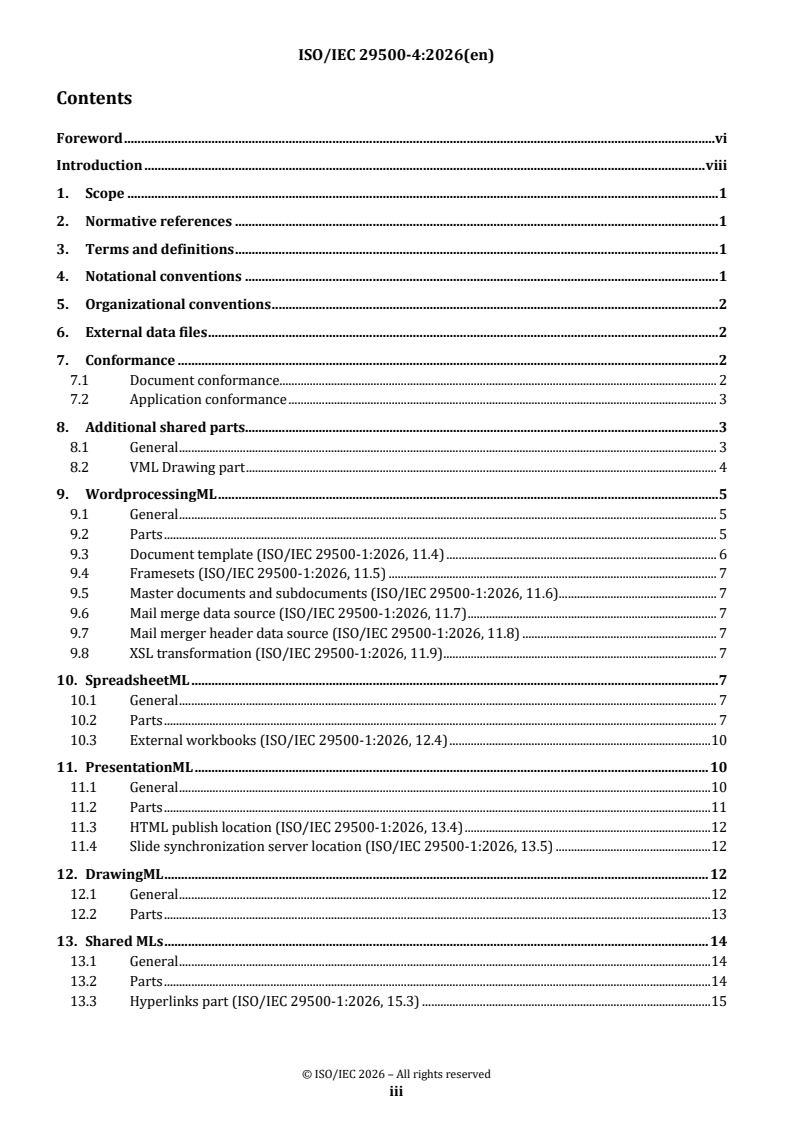
Contents
Foreword .vi
Introduction . viii
1. Scope . 1
2. Normative references . 1
3. Terms and definitions . 1
4. Notational conventions . 1
5. Organizational conventions . 2
6. External data files . 2
7. Conformance . 2
7.1 Document conformance. 2
7.2 Application conformance . 3
8. Additional shared parts. 3
8.1 General . 3
8.2 VML Drawing part . 4
9. WordprocessingML . 5
9.1 General . 5
9.2 Parts . 5
9.3 Document template (ISO/IEC 29500-1:2026, 11.4) . 6
9.4 Framesets (ISO/IEC 29500-1:2026, 11.5) . 7
9.5 Master documents and subdocuments (ISO/IEC 29500-1:2026, 11.6) . 7
9.6 Mail merge data source (ISO/IEC 29500-1:2026, 11.7) . 7
9.7 Mail merger header data source (ISO/IEC 29500-1:2026, 11.8) . 7
9.8 XSL transformation (ISO/IEC 29500-1:2026, 11.9) . 7
10. SpreadsheetML . 7
10.1 General . 7
10.2 Parts . 7
10.3 External workbooks (ISO/IEC 29500-1:2026, 12.4) . 10
11. PresentationML . 10
11.1 General . 10
11.2 Parts . 11
11.3 HTML publish location (ISO/IEC 29500-1:2026, 13.4) . 12
11.4 Slide synchronization server location (ISO/IEC 29500-1:2026, 13.5) . 12
12. DrawingML . 12
12.1 General . 12
12.2 Parts . 13
13. Shared MLs . 14
13.1 General . 14
13.2 Parts . 14
13.3 Hyperlinks part (ISO/IEC 29500-1:2026, 15.3) . 15
© ISO/IEC 2026 – All rights reserved
iii
ISO/IEC 29500-4:2026(en)
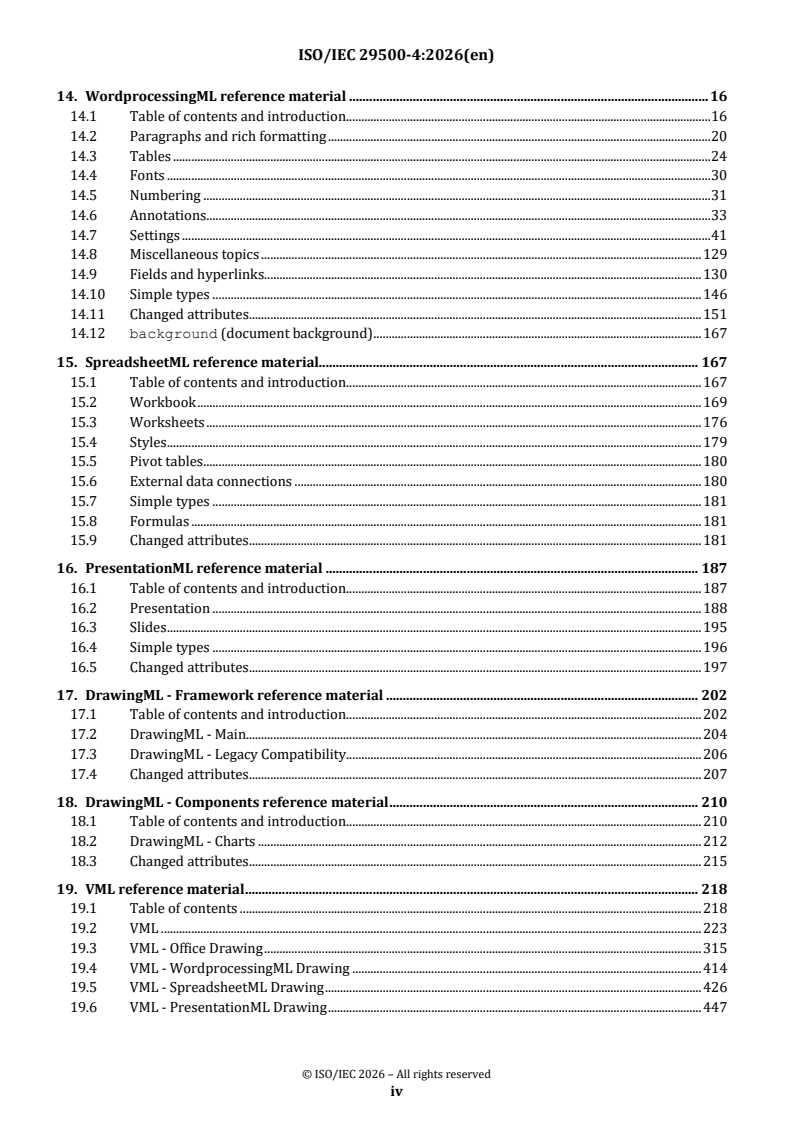
14. WordprocessingML reference material . 16
14.1 Table of contents and introduction . 16
14.2 Paragraphs and rich formatting . 20
14.3 Tables . 24
14.4 Fonts . 30
14.5 Numbering . 31
14.6 Annotations. 33
14.7 Settings . 41
14.8 Miscellaneous topics . 129
14.9 Fields and hyperlinks. 130
14.10 Simple types . 146
14.11 Changed attributes . 151
14.12 background (document background) . 167
15. SpreadsheetML reference material. 167
15.1 Table of contents and introduction . 167
15.2 Workbook . 169
15.3 Worksheets . 176
15.4 Styles . 179
15.5 Pivot tables . 180
15.6 External data connections . 180
15.7 Simple types . 181
15.8 Formulas . 181
15.9 Changed attributes . 181
16. PresentationML reference material . 187
16.1 Table of contents and introduction . 187
16.2 Presentation . 188
16.3 Slides . 195
16.4 Simple types . 196
16.5 Changed attributes . 197
17. DrawingML - Framework reference material . 202
17.1 Table of contents and introduction . 202
17.2 DrawingML - Main. 204
17.3 DrawingML - Legacy Compatibility . 206
17.4 Changed attributes . 207
18. DrawingML - Components reference material . 210
18.1 Table of contents and introduction . 210
18.2 DrawingML - Charts . 212
18.3 Changed attributes . 215
19. VML reference material . 218
19.1 Table of contents . 218
19.2 VML . 223
19.3 VML - Office Drawing . 315
19.4 VML - WordprocessingML Drawing . 414
19.5 VML - SpreadsheetML Drawing . 426
19.6 VML - PresentationML Drawing . 447
© ISO/IEC 2026 – All rights reserved
iv
ISO/IEC 29500-4:2026(en)
20. Shared MLs reference material . 449
20.1 Table of contents . 449
20.2 Shared simple types . 449
20.3 Extended properties (ISO/IEC 29500-1:2026, 22.2) . 453
20.4 Custom properties (ISO/IEC 29500-1:2026, 22.3) . 453
20.5 Changed attributes . 453
Annex A. (normative) Schemas – W3C XML schema . 454
Annex B. (informative) Schemas – RELAX NG . 456
Annex C. (informative) Accessibility best practices . 458
C.1 General . 458
C.2 Best practices for customers of Office Open XML implementations . 458
Bibliography. 459
© ISO/IEC 2026 – All rights reserved
v
ISO/IEC 29500-4:2026(en)
Foreword
ISO (the International Organization for Standardization) and IEC (the International Electrotechnical
Commission) form the specialized system for worldwide standardization. National bodies that are members
of ISO or IEC participate in the development of International Standards through technical committees
established by the respective organization to deal with particular fields of technical activity. ISO and IEC
technical committees collaborate in fields of mutual interest. Other international organizations,
governmental and non-governmental, in liaison with ISO and IEC, also take part in the work.
The procedures used to develop this document and those intended for its further maintenance are described
in the ISO/IEC Directives, Part 1. In particular, the different approval criteria needed for the different types
of documents should be noted. This document was drafted in accordance with the editorial rules of the
ISO/IEC Directives, Part 2 (see www.iso.org/directives or www.iec.ch/members_experts/refdocs).
ISO and IEC draw attention to the possibility that the implementation of this document may involve the use
of (a) patent(s). ISO and IEC take no position concerning the evidence, validity or applicability of any claimed
patent rights in respect thereof. As of the date of publication of this document, ISO and IEC had not received
notice of (a) patent(s) which may be required to implement this document. However, implementers are
cautioned that this may not represent the latest information, which may be obtained from the patent
database available at www.iso.org/patents and https://patents.iec.ch. ISO and IEC shall not be held
responsible for identifying any or all such patent rights.
Any trade name used in this document is information given for the convenience of users and does not
constitute an endorsement.
For an explanation of the voluntary nature of standards, the meaning of ISO specific terms and expressions
related to conformity assessment, as well as information about ISO's adherence to the World Trade
Organization (WTO) principles in the Technical Barriers to Trade (TBT) see
www.iso.org/iso/foreword.html. In the IEC, see www.iec.ch/understanding-standards.
This document was prepared by Joint Technical Committee ISO/IEC JTC 1, Information technology,
Subcommittee SC 34, Document description and processing languages.
This fifth edition cancels and replaces the fourth edition (ISO/IEC 29500-4:2016), which has been
technically revised.
The main changes are as follows:
— Corrections and clarifications have been made throughout the text, but no new functionality has been
added.
— Hanging paragraphs have been moved to new introductory subclauses at the top of the major
collecting clause or subclause, which caused renumbering of some subclauses.
— Where appropriate, normative and bibliographical references have been added, removed, or updated
to use undated or more recent versions.
— Uses of BNF or EBNF have been changed to ABNF.
— Clarifications and corrections have been made to separations between Strict and Transitional and
some content has been moved from ISO/IEC 29500-1 to this document.
— Clause 2 (Normative References) and the Bibliography no longer include references listed in ISO/IEC
29500-1, which is itself a normative reference.
— The printed schemas in Annexes A and B have been removed; schemas exist in digital form only.
— The following annex has been removed:
— Namespace Prefix Mapping in Examples
© ISO/IEC 2026 – All rights reserved
vi
ISO/IEC 29500-4:2026(en)
— The following annex has been added:
— Accessibility best practices
A list of all parts in the ISO/IEC 29500 series can be found on the ISO and IEC websites.
Any feedback or questions on this document should be directed to the user’s national standards body. A
complete listing of these bodies can be found at www.iso.org/members.html and www.iec.ch/national-
committees.
© ISO/IEC 2026 – All rights reserved
vii
ISO/IEC 29500-4:2026(en)
Introduction
The ISO/IEC 29500 series specifies a family of XML schemas, collectively called Office Open XML, which
define the XML vocabularies for word-processing, spreadsheet, and presentation documents, as well as the
packaging of documents that conform to these schemas.
The goal is to enable the implementation of the Office Open XML formats by the widest set of tools and
platforms, fostering interoperability across office productivity applications and line-of-business systems, as
well as to support and strengthen document archival and preservation, all in a way that is fully compatible
with the existing corpus of Microsoft® Office documents.
The intent of this document is to enable a transitional period during which existing binary documents being
migrated to ISO/IEC 29500 can make use of legacy features to preserve their fidelity, while noting that new
documents should not use them.
This document is normative but is not guaranteed to be included in future revisions of the ISO/IEC 29500
series.
In general, this document augments ISO/IEC 29500-1 and inherits the provisions of that document.
Exceptions to this are indicated explicitly.
Microsoft Office is the trademark of a product supplied by Microsoft Corporation. This information is given for the
convenience of users of this document and does not constitute an endorsement by ISO or IEC of the product named.
Equivalent products may be used if they can be shown to lead to the same results.
© ISO/IEC 2026 – All rights reserved
viii
ISO/IEC 29500-4:2026(en)
Document description and processing languages — Office
Open XML File Formats —
Part 4:
Transitional migration features
1. Scope
The goals of ISO/IEC 29500 are to represent faithfully the existing corpus of word-processing documents,
spreadsheets and presentations that have been produced by Microsoft Office applications, from Microsoft
Office 97 to Microsoft Office 2008, inclusive, and to facilitate extensibility and interoperability by enabling
implementations by multiple vendors and on multiple platforms.
This document specifies additions to and modifications to ISO/IEC 29500-1 for Office Open XML documents
that, in their semantics, syntax, and packaging, satisfy the requirements of conformance class Office Open
XML Transitional, as specified in Clause 7. This document also specifies requirements for Office Open XML
consumers and producers.
2. Normative references
The following documents are referred to in the text in such a way that some or all of their content constitutes
requirements of this document. For dated references, only the edition cited applies. For undated references,
the latest edition of the referenced document (including any amendments) applies.
ISO/IEC 29500-1:2026, Document description and processing languages — Office Open XML File Formats,
Part 1: Fundamentals and Markup Language Reference
UNITED STATES POSTAL SERVICE. Mailing Standards of the United States Postal Service, Domestic Mail
Manual. Online. Available from:
http://pe.usps.com/cpim/ftp/manuals/dmm300/Full/MailingStandards.pdf.
3. Terms and definitions
For the purposes of this document, the following terms and definitions apply.
ISO and IEC maintain terminology databases for use in standardization at the following addresses:
• ISO Online browsing platform: available at https://www.iso.org/obp
• IEC Electropedia: available at https://www.electropedia.org
3.1
DOS file path
identifier for the name and possibly location of a file in a legacy file system
4. Notational conventions
The following typographical conventions are used in this document:
• The first occurrence of a new term is written in italics. For example: "The text in this document is
divided into normative and informative categories."
© ISO/IEC 2026 – All rights reserved
ISO/IEC 29500-4:2026(en)
• The tag name of an XML element is written using a distinct style and typeface. For example: "The
bookmarkStart and bookmarkEnd elements specify …"
• The name of an XML attribute is written using a distinct style and typeface. For example: "The
dropCap attribute specifies …"
• The value of an XML attribute is written using a constant-width style. For example: "The attribute
value of auto specifies …"
• The qualified or unqualified name of a simple type, complex type, or base datatype is written using a
distinct style and typeface. For example: "The possible values for this attribute are defined by the
ST_HexColor simple type."
Tag names in code fragments are generally expressed as prefixed names. The main exception is that tag
names in SpreadsheetML examples are prefixless (see Clause 15). Attribute names in code fragments are
prefixless unless the name is declared to be in a specific namespace that is different to that of the parent
element’s tag name, except in WordprocessingML examples in which all attribute names are prefixed.
References to an attribute of an element are given in XPath style notation. For example: "The value of
w:pgMar/@w:left is …"
Unless stated otherwise in this document, the functionality defined in ISO/IEC 29500-1 is applicable to this
document. However, this document uses namespaces that are different from those used by ISO/IEC 29500-1.
As such, when examples in ISO/IEC 29500-1 are read in the context of this document, they should be
understood in the context of the corresponding namespaces in this document.
5. Organizational conventions
The primary table of contents does not list the full set of all subclauses in this document. Clauses and
subclauses with many further subclauses have their own tables of contents which list all subordinate items.
Examples, which are informative and do not contain requirements, are shown using the lead-in “EXAMPLE”
when separated from surrounding paragraphs and "For example, …" when inline with regular text.
The definitions of lists of items—such as attributes within elements, enumerated values within simple types,
and other information whose inline presentation is improved by a grid layout—are presented in a format
with the visual appearance of tables but are not designated as tables. Sets of information referenced from
other locations in this document are labeled as tables.
6. External data files
Normative requirements are prescribed in this document and the data files provided in electronic form, as
noted in the Annexes, and all are required to fully implement ISO/IEC 29500. For example, default values of
attributes and permissible contents of elements are specified in schemas only.
7. Conformance
7.1 Document conformance
A document of conformance class Office Open XML Transitional shall be a package of conformance class OPC,
as specified in ISO/IEC 29500-2, for which all the following shall hold:
• The document obeys all constraints specified in this document. As in ISO/IEC 29500-1, both normative
W3C XML Schema schemas and informative RELAX NG schemas are provided in Annex A and Error! R
eference source not found., respectively.
• The document is of category Wordprocessing, Spreadsheet, or Presentation. These categories are defined
in ISO/IEC 29500-1:2026, Clause 7.
© ISO/IEC 2026 – All rights reserved
ISO/IEC 29500-4:2026(en)
• VML Drawing Parts (see 8.1) contain markup in the Markup Compatibility namespace as specified in
ISO/IEC 29500-3. Any child elements of the root element of VMLDrawing Parts are valid against the VML
schema in the file specified in Annex A, after the removal of any extensions specified using the
mechanisms in ISO/IEC 29500-3. VML Drawing Parts obey all constraints specified in this document.
• The OPC Parts of the document listed in ISO/IEC 29500-1, 10.2 shall be valid after MCE processing as
specified in that subclause.
This document uses the following further terms to refer to documents of conformance class Office Open XML
Transitional:
• WML Transitional, if the document is of category Wordprocessing
• SML Transitional, if the document is of category Spreadsheet
• PML Transitional, if the document is of category Presentation
7.2 Application conformance
Application conformance incorporates both syntax and semantics.
• A conforming consumer shall not reject any conforming documents of at least one document
conformance class.
• A conforming producer shall be able to produce conforming documents of at least one document
conformance class.
• A conforming application shall treat the information in Office Open XML documents in a manner
consistent with the semantic definitions given in ISO/IEC 29500. An application's intended behavior
need not require that application to process all of the information in an Office Open XML document.
However, the information that it does process shall be processed in a manner that is consistent with
the semantic definitions given in ISO/IEC 29500.
This note illustrates the third bullet above. Conforming applications include a viewer, an editor, and a back-
end processor. Here is an illustration of how the third bullet applies to each of those examples:
• If a conforming viewer supports a given feature, then when it displays information using that feature,
it respects the semantics of that feature as described in the Standard.
• If a conforming editor supports a given feature, then when it provides its user with an interface for
manipulating information using that feature, it respects the semantics of that feature as described in
the Standard.
• If a conforming back-end processor supports a given feature, then when that processor transforms
or assembles information involving that feature, that processor respects the semantics of that feature
as described in the Standard.
This document defines the following application conformance classes:
• WML Transitional, if the application is a conforming application that is a consumer or producer of
documents having conformance class WML Transitional.
• SML Transitional, if the application is a conforming application that is a consumer or producer of
documents having conformance class SML Transitional.
• PML Transitional, if the application is a conforming application that is a consumer or producer of
documents having conformance class PML Transitional.
8. Additional shared parts
8.1 General
A transitional implementation can provide support for a VML Drawing Part, which is discussed below.
© ISO/IEC 2026 – All rights reserved
ISO/IEC 29500-4:2026(en)
8.2 VML Drawing part
Content application/vnd.openxmlformats-officedocument.vmlDrawing
Type:
Root not applicable
Namespace:
Source http://schemas.openxmlformats.org/officeDocument/2006/relationships/vmlDrawi
Relationship: ng
An instance of this part type contains markup in the Vector Markup Language (VML) syntax, which is used to
provide an alternative image representation of objects stored in a SpreadsheetML or PresentationML
document. An instance of this part type shall not appear within a WordprocessingML document.
A package is permitted to contain zero or more VML Drawing parts, each of which shall be the target of an
explicit relationship in a Handout Master part (ISO/IEC 29500-1:2026, 13.3.3), Notes Slide part (ISO/IEC
29500-1:2026, 13.3.5), Notes Master part (ISO/IEC 29500-1:2026, 13.3.4), Slide part (ISO/IEC 29500-
1:2026, 13.3.8), Slide Layout part (ISO/IEC 29500-1:2026, 13.3.9), or Slide Master part (ISO/IEC 29500-
1:2026, 13.3.10) in a PresentationML document; or a Dialogsheet part (ISO/IEC 29500-1:2026, 12.3.7) or
Worksheet part (ISO/IEC 29500-1:2026, 12.3.24) in a SpreadsheetML document.
For example, the following SpreadsheetML package-relationship item contains one relationship, for the VML
Drawing part stored in the ZIP item ./drawings/drawing1.vml:
Type="http://…/vmlDrawing" Target="./drawings/drawing1.vml"/>
The root element for a part of this content type shall be xml in the null namespace, encapsulating an
arbitrary amount of VML markup as defined by this document.
For example, consider the following VML Drawing part:
...
...
A VML Drawing part shall be located within the package containing the Relationships part (expressed
syntactically, the TargetMode attribute of the Relationship element shall be Internal).
A VML Drawing part is permitted to have explicit relationships to the following parts defined by this
document:
• Image (ISO/IEC 29500-1:2026, 15.2.14)
A VML Drawing part shall not have implicit or explicit relationships to any other part defined by this
document.
A VML Drawing part shall be valid against vml-main.xsd (Annex A). No MCE processing shall be applied
before this validation.
© ISO/IEC 2026 – All rights reserved
ISO/IEC 29500-4:2026(en)
9. WordprocessingML
9.1 General
The following parts, which are defined in subclauses within ISO/IEC 29500-1:2026, Clause 11, have different
source relationships and/or root namespaces when used in documents of the Transitional conformance
class:
9.2 Parts
9.2.1 Alternative Format Import part (ISO/IEC 29500-1:2026, 11.3.1)
Source http://schemas.openxmlformats.org/officeDocument/2006/relationships/aFChunk
Relationship:
9.2.2 Comments part (ISO/IEC 29500-1:2026, 11.3.2)
Root http://schemas.openxmlformats.org/wordprocessingml/2006/main
Namespace:
Source http://schemas.openxmlformats.org/officeDocument/2006/relationships/comment
Relationship: s
9.2.3 Document Settings part (ISO/IEC 29500-1:2026, 11.3.3)
Root http://schemas.openxmlformats.org/wordprocessingml/2006/main
Namespace:
Source http://schemas.openxmlformats.org/officeDocument/2006/relationships/settings
Relationship:
9.2.4 Endnotes part (ISO/IEC 29500-1:2026, 11.3.4)
Root http://schemas.openxmlformats.org/wordprocessingml/2006/main
Namespace:
Source http://schemas.openxmlformats.org/officeDocument/2006/relationships/endnotes
Relationship:
9.2.5 Font Table part (ISO/IEC 29500-1:2026, 11.3.5)
Root http://schemas.openxmlformats.org/wordprocessingml/2006/main
Namespace:
Source http://schemas.openxmlformats.org/officeDocument/2006/relationships/fontTable
Relationship:
9.2.6 Footer part (ISO/IEC 29500-1:2026, 11.3.6)
Root http://schemas.openxmlformats.org/wordprocessingml/2006/main
Namespace:
Source http://schemas.openxmlformats.org/officeDocument/2006/relationships/footer
Relationship:
9.2.7 Footnotes part (ISO/IEC 29500-1:2026, 11.3.7)
Root http://schemas.openxmlformats.org/wordprocessingml/2006/main
Namespace:
Source http://schemas.openxmlformats.org/officeDocument/2006/relationships/footnotes
Relationship:
© ISO/IEC 2026 – All rights reserved
ISO/IEC 29500-4:2026(en)
9.2.8 Glossary Document part (ISO/IEC 29500-1:2026, 11.3.8)
Root http://schemas.openxmlformats.org/wordprocessingml/2006/main
Namespace:
Source http://schemas.openxmlformats.org/officeDocument/2006/relationships/glossaryD
Relationship: ocument
9.2.9 Header part (ISO/IEC 29500-1:2026, 11.3.9)
Root http://schemas.openxmlformats.org/wordprocessingml/2006/main
Namespace:
Source http://schemas.openxmlformats.org/officeDocument/2006/relationships/header
Relationship:
9.2.10 Main Document part (ISO/IEC 29500-1:2026, 11.3.10)
Root http://schemas.openxmlformats.org/wordprocessingml/2006/main
Namespace:
Source http://schemas.openxmlformats.org/officeDocument/2006/relationships/officeDoc
Relationship: ument
9.2.11 Numbering Definitions part (ISO/IEC 29500-1:2026, 11.3.11)
Root http://schemas.openxmlformats.org/wordprocessingml/2006/main
Namespace:
Source http://schemas.openxmlformats.org/officeDocument/2006/relationships/numberin
Relationship: g
9.2.12 Style Definitions part (ISO/IEC 29500-1:2026, 11.3.12)
Root http://schemas.openxmlformats.org/wordprocessingml/2006/main
Namespace:
Source http://schemas.openxmlformats.org/officeDocument/2006/relationships/styles
Relationship:
9.2.13 Web Settings part (ISO/IEC 29500-1:2026, 11.3.13)
Root http://schemas.openxmlformats.org/wordprocessingml/2006/main
Namespace:
Source http://schemas.openxmlformats.org/officeDocument/2006/relationships/webSettin
Relationship: gs
9.2.14 Mail Merge Recipient Data part (ISO/IEC 29500-1:2026, 11.3.14)
Root http://schemas.openxmlformats.org/wordprocessingml/2006/main
Namespace:
Source http://schemas.openxmlformats.org/officeDocument/2006/relationships/recipient
Relationship: Data
9.3 Document template (ISO/IEC 29500-1:2026, 11.4)
Source http://schemas.openxmlformats.org/officeDocument/2006/relationships/attachedT
Relationship: emplate
© ISO/IEC 2026 – All rights reserved
ISO/IEC 29500-4:2026(en)
9.4 Framesets (ISO/IEC 29500-1:2026, 11.5)
Source http://schemas.openxmlformats.org/officeDocument/2006/relationships/frame
Relationship:
9.5 Master documents and subdocuments (ISO/IEC 29500-1:2026, 11.6)
Source http://schemas.openxmlformats.org/officeDocument/2006/relationships/subDocu
Relationship: ment
9.6 Mail merge data source (ISO/IEC 29500-1:2026, 11.7)
Source http://schemas.openxmlformats.org/officeDocument/2006/relationships/mailMerg
Relationship: eSource
9.7 Mail merger header data source (ISO/IEC 29500-1:2026, 11.8)
Source http://schemas.openxmlformats.org/officeDocument/2006/relationships/mailMerg
Relationship: eHeaderSource
9.8 XSL transformation (ISO/IEC 29500-1:2026, 11.9)
Source http://schemas.openxmlformats.org/officeDocument/2006/relationships/transform
Relationship:
10. SpreadsheetML
10.1 General
The following parts, which are defined in subclauses within ISO/IEC 29500-1:2026, Clause 12, have different
source relationships and/or root namespaces when used in documents of the Transitional conformance
class:
10.2 Parts
10.2.1 Calculation Chain part (ISO/IEC 29500-1:2026, 12.3.1)
Root http://schemas.openxmlformats.org/spreadsheetml/2006/main
Namespace:
Source http://schemas.openxmlformats.org/officeDocument/2006/relationships/calcChain
Relationship:
10.2.2 Chartsheet part (ISO/IEC 29500-1:2026, 12.3.2)
Root http://schemas.openxmlformats.org/spreadsheetml/2006/main
Namespace:
Source http://schemas.openxmlformats.org/officeDocument/2006/relationships/chartshee
Relationship: t
10.2.3 Comments part (ISO/IEC 29500-1:2026, 12.3.3)
Root http://schemas.openxmlformats.org/spreadsheetml/2006/main
Namespace:
Source http://schemas.openxmlformats.org/officeDocument/2006/relationships/comment
Relationship: s
© ISO/IEC 2026 – All rights reserved
ISO/IEC 29500-4:2026(en)
10.2.4 Connections part (ISO/IEC 29500-1:2026, 12.3.4)
Root http://schemas.openxmlformats.org/spreadsheetml/2006/main
Namespace:
Source http://schemas.openxmlformats.org/officeDocument/2006/relationships/connectio
Relationship: ns
10.2.5 Custom Property part (ISO/IEC 29500-1:2026, 12.3.5)
Root Not applicable
Namespace:
Source http://schemas.openxmlformats.org/officeDocument/2006/relationships/customPr
Relationship: operty
10.2.6 Custom XML Mappings part (ISO/IEC 29500-1:2026, 12.3.6)
Root http://schemas.openxmlformats.org/spreadsheetml/2006/main
Namespace:
Source http://schemas.openxmlformats.org/officeDocument/2006/relationships/xmlMaps
Relationship:
10.2.7 Dialogsheet part (ISO/IEC 29500-1:2026, 12.3.7)
Root http://schemas.openxmlformats.org/spreadsheetml/2006/main
Namespace:
Source http://schemas.openxmlformats.org/officeDocument/2006/relationships/dialogshe
Relationship: et
10.2.8 Drawing part (ISO/IEC 29500-1:2026, 12.3.8)
Root http://schemas.openxmlformats.org/drawingml/2006/spreadsheetDrawing
Namespace:
Source http://schemas.openxmlformats.org/officeDocument/2006/relationships/drawing
Relationship:
10.2.9 External Workbook References part (ISO/IEC 29500-1:2026, 12.3.9)
Root http://schemas.openxmlformats.org/spreadsheetml/2006/main
Namespace:
Source http://schemas.openxmlformats.org/officeDocument/2006/relationships/externalLi
Relationship: nk
10.2.10 Metadata part (ISO/IEC 29500-1:2026, 12.3.10)
Root http://schemas.openxmlformats.org/spreadsheetml/2006/main
Namespace:
Source http://schemas.openxmlformats.org/officeDocument/2006/relationships/sheetMet
Relationship: adata
10.2.11 Pivot Table part (ISO/IEC 29500-1:2026, 12.3.11)
Root http://schemas.openxmlformats.org/spreadsheetml/2006/main
Namespace:
© ISO/IEC 2026 – All rights reserved
ISO/IEC 29500-4:2026(en)
Source http://schemas.openxmlformats.org/officeDocument/2006/relationships/pivotTabl
Relationship: e
10.2.12 Pivot Table Cache Definition part (ISO/IEC 29500-1:2026, 12.3.12)
Root http://schemas.openxmlformats.org/spreadsheetml/2006/main
Namespace:
Source http://schemas.openxmlformats.org/officeDocument/2006/relationships/pivotCach
Relationship: eDefinition
10.2.13 Pivot Table Cache Records part (ISO/IEC 29500-1:2026, 12.3.13)
Root http://schemas.openxmlformats.org/spreadsheetml/
...