

ISO/IEC FDIS 29500-1
(Main)Document description and processing languages — Office Open XML File Formats — Part 1: Fundamentals and markup language reference
- Abstract
ISO/IEC 29500-1:2016 defines a set of XML vocabularies for representing word-processing documents, spreadsheets and presentations. On the one hand, the goal of ISO/IEC 29500 is to be capable of faithfully representing the pre-existing corpus of word-processing documents, spreadsheets and presentations that had been produced by the Microsoft Office applications (from Microsoft Office 97 to Microsoft Office 2008, inclusive) at the date of the creation of ISO/IEC 29500. It also specifies requirements for Office Open XML consumers and producers. On the other hand, the goal is to facilitate extensibility and interoperability by enabling implementations by multiple vendors and on multiple platforms. ISO/IEC 29500-1:2016 specifies concepts for documents and applications of both strict and transitional conformance.
- Status
- Not Published
- Technical Committee
- ISO/IEC JTC 1/SC 34 - Document description and processing languages
- Drafting Committee
- ISO/IEC JTC 1/SC 34 - Document description and processing languages
- Current Stage
- 5020 - FDIS ballot initiated: 2 months. Proof sent to secretariat
- Start Date
- 17-Aug-2026
- Completion Date
- 17-Aug-2026
ISO/IEC FDIS 29500-1 is an ISO/IEC draft International Standard for Office Open XML File Formats, Part 1: Fundamentals and markup language reference. ISO/IEC FDIS 29500-1 defines the XML vocabularies and packaging concepts used to represent word-processing documents, spreadsheets, and presentations. It also sets requirements for Office Open XML consumers and producers, with a focus on strict conformance, interoperability, and compatibility with the existing Microsoft Office document corpus.
What does ISO/IEC FDIS 29500-1 specify?
ISO/IEC FDIS 29500-1 specifies the core semantics, syntax, and packaging model for Office Open XML documents. It is organized from general foundations and conformance rules into the detailed markup families for WordprocessingML, SpreadsheetML, PresentationML, DrawingML, and shared features, followed by reference material and annexes.
The scope links two goals that matter in practice: faithfully representing existing documents and enabling implementations by multiple vendors and on multiple platforms. Clause 7 covers both strict and transitional conformance concepts, so implementers can see how the format is meant to be described and checked.
The document is organized into clauses 1 to 23 and annexes A to I.
| Annex | What it covers |
|---|---|
| Annex A | Schemas - W3C XML Schema |
| Annex B | Schemas - RELAX NG |
| Annex C | WordprocessingML page borders |
| Annex D | Predefined SpreadsheetML style definitions |
| Annex E | Example predefined DrawingML shape and text geometries |
| Annex F | Bidirectional support |
| Annex G | Accessibility best practices |
| Annex H | WordprocessingML page layout concepts |
| Annex I | DrawingML coordinate systems and transformations |
What are the key requirements of ISO/IEC FDIS 29500-1?
ISO/IEC FDIS 29500-1 is built around conformance, packaging, extensibility, and the detailed markup rules for the four main Office Open XML families. For implementers, the important point is not just what elements exist, but how packages are structured, how unknown content is handled, and how applications declare what they support.
Conformance and application descriptions
Clause 7 separates document conformance from application conformance. It also defines base, full, and additional application descriptions, plus interoperability guidelines.
In practice, this is the part to read when deciding whether a product can claim a given level of Office Open XML support. It tells a vendor, tester, or buyer how support should be described, not just how files should look.
Packages, parts, and relationships
Clauses 8 and 9 explain packages, parts, consumers, producers, and relationships. Clause 6 covers external data files, which matters when document content depends on resources outside the package.
Clause 9 also explains how Office Open XML uses the Open Packaging Conventions (OPC), including part addressing, fragments, unknown parts, invalid parts, trash items, unknown relationships, and interleaving. In practice, this is the rule set for reading, writing, and preserving the package structure correctly.
Markup compatibility and extensibility
Clause 10 covers Markup Compatibility and Extensibility (MCE). It discusses validity, MCE, and how applications behave when extensions are present.
This matters when a document contains markup a consumer does not understand. The intent is that software can keep files usable and preserve unfamiliar content instead of breaking the document.
The four markup families
Clauses 11 to 15 define the package structure and parts for the major content families:
- WordprocessingML - document body, styles, numbering, headers and footers, footnotes, endnotes, glossary documents, comments, and mail merge
- SpreadsheetML - workbook, worksheets, shared strings, tables, calculation chain, connections, pivot tables, formulas, and external workbooks
- PresentationML - presentation, slides, slide layouts, slide masters, notes, comments, animation, and synchronization data
- DrawingML - drawings, charts, diagrams, themes, and related drawing components
- Shared MLs - hyperlinks, properties, embedded objects, media, bibliography, math, and other shared parts
In practice, these clauses tell an implementer where each kind of content lives in the package and how the pieces fit together.
Detailed reference material
Clauses 17 to 23 give the detailed element and type reference. They cover the content model for WordprocessingML, SpreadsheetML, PresentationML, DrawingML, shared markup, and custom XML schema references.
This is the section a developer uses when mapping real document features such as styles, tables, formulas, slides, charts, or properties to the XML vocabulary. It is also the part most often used during validation, interoperability testing, and implementation work.
What terms does ISO/IEC FDIS 29500-1 define?
ISO/IEC FDIS 29500-1 defines the main working terms used throughout the standard.
- package - A ZIP archive conforming to the Open Packaging Conventions defined in ISO/IEC 29500-2.
- application - A consumer or producer.
- consumer - Software or a device that reads packages through a package implementer.
- producer - Software or a device that writes packages through a package implementer.
- Office Open XML document - A document represented as a package and formatted using WordprocessingML, SpreadsheetML, or PresentationML and their related markup languages.
- WordprocessingML - The set of conventions for representing an Office Open XML document in the Wordprocessing category.
- SpreadsheetML - The set of conventions for representing an Office Open XML document in the Spreadsheet category.
- PresentationML - The set of conventions for representing an Office Open XML document in the Presentation category.
Who uses ISO/IEC FDIS 29500-1?
ISO/IEC FDIS 29500-1 is used by developers and teams that create, read, validate, or preserve Office Open XML files.
Typical users include:
- Office suite and document editor developers
- Interoperability and conformance engineers
- Quality assurance and test teams
- Document management and archival system builders
- Integrators working with line-of-business systems
- Technical buyers and procurement teams checking file-format support
These users rely on the standard to decide how a product should package content, what conformance it can claim, and how to handle documents exchanged across platforms and vendors.
What changed in ISO/IEC FDIS 29500-1 from the previous edition?
ISO/IEC FDIS 29500-1 is the fifth edition and it cancels and replaces ISO/IEC 29500-1:2016. The foreword states that it has been technically revised.
The changes stated in the document are:
- Corrections and clarifications were made throughout, with no new functionality added
- Hanging paragraphs were moved into new introductory subclauses, which caused some renumbering
- Normative and bibliographical references were added, removed, or updated to use undated or newer versions where appropriate
- Uses of BNF or EBNF were changed to ABNF
- The separation between Strict and Transitional was clarified, and some content moved to ISO/IEC 29500-4
- Clause 3 was reorganized, and ML-specific glossaries were integrated into it
- Clause 10 was expanded and revised completely
- The printed schemas in Annexes A and B were removed, because the schemas exist in digital form only
- Annexes removed included Additional syntax constraints, Namespace prefix mapping in examples, WordprocessingML custom XML data extraction, Root element locations, Primer, and Differences between ISO/IEC 29500 and ECMA-376:2006
- Annexes added included WordprocessingML page layout and DrawingML coordinate systems and transformations
Which standards are used with ISO/IEC FDIS 29500-1?
ISO/IEC FDIS 29500-1 depends on several standards and companion parts for XML, packaging, character data, dates, identifiers, fonts, graphics, and compatibility behavior.
| Standard or part | What it contributes |
|---|---|
| ISO/IEC 29500-2:2021 | Open Packaging Conventions for packages and parts |
| ISO/IEC 29500-3:2015 | Markup Compatibility and Extensibility |
| ISO/IEC 29500-4 | Content referenced in the foreword as receiving material moved from this part |
| W3C XML 1.0 | Core XML syntax |
| W3C Namespaces in XML 1.0 | Namespace handling |
| W3C XML Schema Part 1 | Schema structures used for validation |
| Annex B RELAX NG | Alternative schema form for the schemas in the document |
| ISO 8601-1 and RFC 3339 | Date and time representations |
| RFC 3986 and RFC 3987 | URIs and IRIs |
| RFC 5234 and RFC 7405 | ABNF notation used in the revised syntax descriptions |
| ISO/IEC 14496-22 | Open Font Format |
| IEC 61966-2-1 | sRGB color space |
| ISO/IEC 60559:2020 | Floating-point arithmetic |
| Unicode Standard and Unicode Standard Annex #9 | Character handling and bidirectional text |
What does the ISO/IEC FDIS 29500-1 document contain?
ISO/IEC FDIS 29500-1 contains detailed reference material for implementing Office Open XML file handling. Clause 17 covers WordprocessingML topics such as paragraphs, tables, styles, numbering, headers and footers, footnotes and endnotes, glossary documents, annotations, mail merge, settings, fields, and simple types.
Clause 18 does the same for SpreadsheetML, including workbook and worksheet structure, shared strings, styles, metadata, pivot tables, external data connections, formulas, and shared workbook data. Clause 19 covers PresentationML, including presentation structure, slides, comments, animation, and slide synchronization data.
Clauses 20 and 21 provide the DrawingML framework and component reference material, including pictures, charts, chart drawings, and diagrams. Clause 22 gathers shared markup for math, file properties, bibliography, office document relationships, variant types, and shared simple types.
The annexes add schema listings, style definitions, example geometries, bidirectional support guidance, accessibility best practices, page layout concepts, and coordinate system and transformation material. Together, these sections support implementation, validation, compatibility testing, and document processing work.
Relations
- Effective Date
- 17-Sep-2022
Get Certified
Connect with accredited certification bodies for this standard

BSI Group
BSI (British Standards Institution) is the business standards company that helps organizations make excellence a habit.

NYCE
Mexican standards and certification body.
Sponsored listings
Frequently Asked Questions
ISO/IEC FDIS 29500-1 is a draft published by the International Organization for Standardization (ISO). Its full title is "Document description and processing languages — Office Open XML File Formats — Part 1: Fundamentals and markup language reference". This standard covers: ISO/IEC 29500-1:2016 defines a set of XML vocabularies for representing word-processing documents, spreadsheets and presentations. On the one hand, the goal of ISO/IEC 29500 is to be capable of faithfully representing the pre-existing corpus of word-processing documents, spreadsheets and presentations that had been produced by the Microsoft Office applications (from Microsoft Office 97 to Microsoft Office 2008, inclusive) at the date of the creation of ISO/IEC 29500. It also specifies requirements for Office Open XML consumers and producers. On the other hand, the goal is to facilitate extensibility and interoperability by enabling implementations by multiple vendors and on multiple platforms. ISO/IEC 29500-1:2016 specifies concepts for documents and applications of both strict and transitional conformance.
ISO/IEC 29500-1:2016 defines a set of XML vocabularies for representing word-processing documents, spreadsheets and presentations. On the one hand, the goal of ISO/IEC 29500 is to be capable of faithfully representing the pre-existing corpus of word-processing documents, spreadsheets and presentations that had been produced by the Microsoft Office applications (from Microsoft Office 97 to Microsoft Office 2008, inclusive) at the date of the creation of ISO/IEC 29500. It also specifies requirements for Office Open XML consumers and producers. On the other hand, the goal is to facilitate extensibility and interoperability by enabling implementations by multiple vendors and on multiple platforms. ISO/IEC 29500-1:2016 specifies concepts for documents and applications of both strict and transitional conformance.
ISO/IEC FDIS 29500-1 is classified under the following ICS (International Classification for Standards) categories: 35.060 - Languages used in information technology; 35.240.30 - IT applications in information, documentation and publishing. The ICS classification helps identify the subject area and facilitates finding related standards.
ISO/IEC FDIS 29500-1 has the following relationships with other standards: It is inter standard links to ISO/IEC 29500-1:2016. Understanding these relationships helps ensure you are using the most current and applicable version of the standard.
ISO/IEC FDIS 29500-1 is available in PDF format for immediate download after purchase. The document can be added to your cart and obtained through the secure checkout process. Digital delivery ensures instant access to the complete standard document.
Standards Content (Sample)
FINAL DRAFT
International
Standard
ISO/IEC
FDIS
29500-1
ISO/IEC JTC 1/SC 34
Document description and
Secretariat: JISC
processing languages — Office Open
Voting begins on:
XML File Formats —
2026-08-17
Part 1:
Voting terminates on:
2026-10-12
Fundamentals and markup
language reference
RECIPIENTS OF THIS DRAFT ARE INVITED TO SUBMIT,
WITH THEIR COMMENTS, NOTIFICATION OF ANY
RELEVANT PATENT RIGHTS OF WHICH THEY ARE AWARE
AND TO PROVIDE SUPPOR TING DOCUMENTATION.
IN ADDITION TO THEIR EVALUATION AS
BEING ACCEPTABLE FOR INDUSTRIAL, TECHNO
LOGICAL, COMMERCIAL AND USER PURPOSES, DRAFT
INTERNATIONAL STANDARDS MAY ON OCCASION HAVE
TO BE CONSIDERED IN THE LIGHT OF THEIR POTENTIAL
TO BECOME STAN DARDS TO WHICH REFERENCE MAY BE
MADE IN NATIONAL REGULATIONS.
Reference number
ISO/IEC FDIS 295001:2026(en) © ISO/IEC 2026
FINAL DRAFT
International
Standard
ISO/IEC
FDIS
29500-1
ISO/IEC JTC 1/SC 34
Document description and
Secretariat: JISC
processing languages — Office Open
Voting begins on:
XML File Formats —
Part 1:
Voting terminates on:
Fundamentals and markup
language reference
RECIPIENTS OF THIS DRAFT ARE INVITED TO SUBMIT,
WITH THEIR COMMENTS, NOTIFICATION OF ANY
RELEVANT PATENT RIGHTS OF WHICH THEY ARE AWARE
AND TO PROVIDE SUPPOR TING DOCUMENTATION.
© ISO/IEC 2026
IN ADDITION TO THEIR EVALUATION AS
All rights reserved. Unless otherwise specified, or required in the context of its implementation, no part of this publication may
BEING ACCEPTABLE FOR INDUSTRIAL, TECHNO
LOGICAL, COMMERCIAL AND USER PURPOSES, DRAFT
be reproduced or utilized otherwise in any form or by any means, electronic or mechanical, including photocopying, or posting on
INTERNATIONAL STANDARDS MAY ON OCCASION HAVE
the internet or an intranet, without prior written permission. Permission can be requested from either ISO at the address below
TO BE CONSIDERED IN THE LIGHT OF THEIR POTENTIAL
or ISO’s member body in the country of the requester.
TO BECOME STAN DARDS TO WHICH REFERENCE MAY BE
MADE IN NATIONAL REGULATIONS.
ISO copyright office
CP 401 • Ch. de Blandonnet 8
CH-1214 Vernier, Geneva
Phone: +41 22 749 01 11
Email: copyright@iso.org
Website: www.iso.org
Published in Switzerland Reference number
ISO/IEC FDIS 295001:2026(en) © ISO/IEC 2026
© ISO/IEC 2026 – All rights reserved
ii
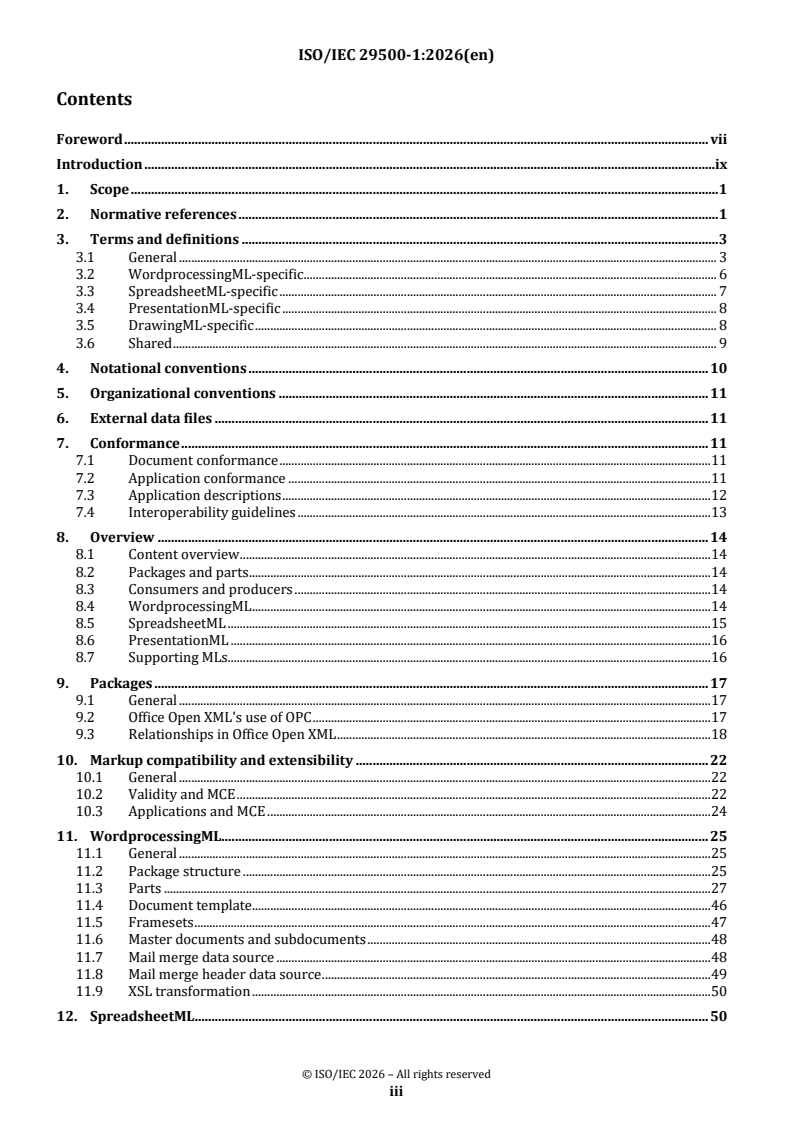
ISO/IEC 29500-1:2026(en)
Contents
Foreword . vii
Introduction .ix
1. Scope . 1
2. Normative references . 1
3. Terms and definitions . 3
3.1 General . 3
3.2 WordprocessingML-specific . 6
3.3 SpreadsheetML-specific . 7
3.4 PresentationML-specific . 8
3.5 DrawingML-specific . 8
3.6 Shared . 9
4. Notational conventions . 10
5. Organizational conventions . 11
6. External data files . 11
7. Conformance . 11
7.1 Document conformance . 11
7.2 Application conformance . 11
7.3 Application descriptions . 12
7.4 Interoperability guidelines . 13
8. Overview . 14
8.1 Content overview . 14
8.2 Packages and parts . 14
8.3 Consumers and producers . 14
8.4 WordprocessingML . 14
8.5 SpreadsheetML . 15
8.6 PresentationML . 16
8.7 Supporting MLs. 16
9. Packages . 17
9.1 General . 17
9.2 Office Open XML's use of OPC . 17
9.3 Relationships in Office Open XML . 18
10. Markup compatibility and extensibility . 22
10.1 General . 22
10.2 Validity and MCE . 22
10.3 Applications and MCE . 24
11. WordprocessingML. 25
11.1 General . 25
11.2 Package structure . 25
11.3 Parts . 27
11.4 Document template . 46
11.5 Framesets . 47
11.6 Master documents and subdocuments . 48
11.7 Mail merge data source . 48
11.8 Mail merge header data source . 49
11.9 XSL transformation . 50
12. SpreadsheetML . 50
© ISO/IEC 2026 – All rights reserved
iii
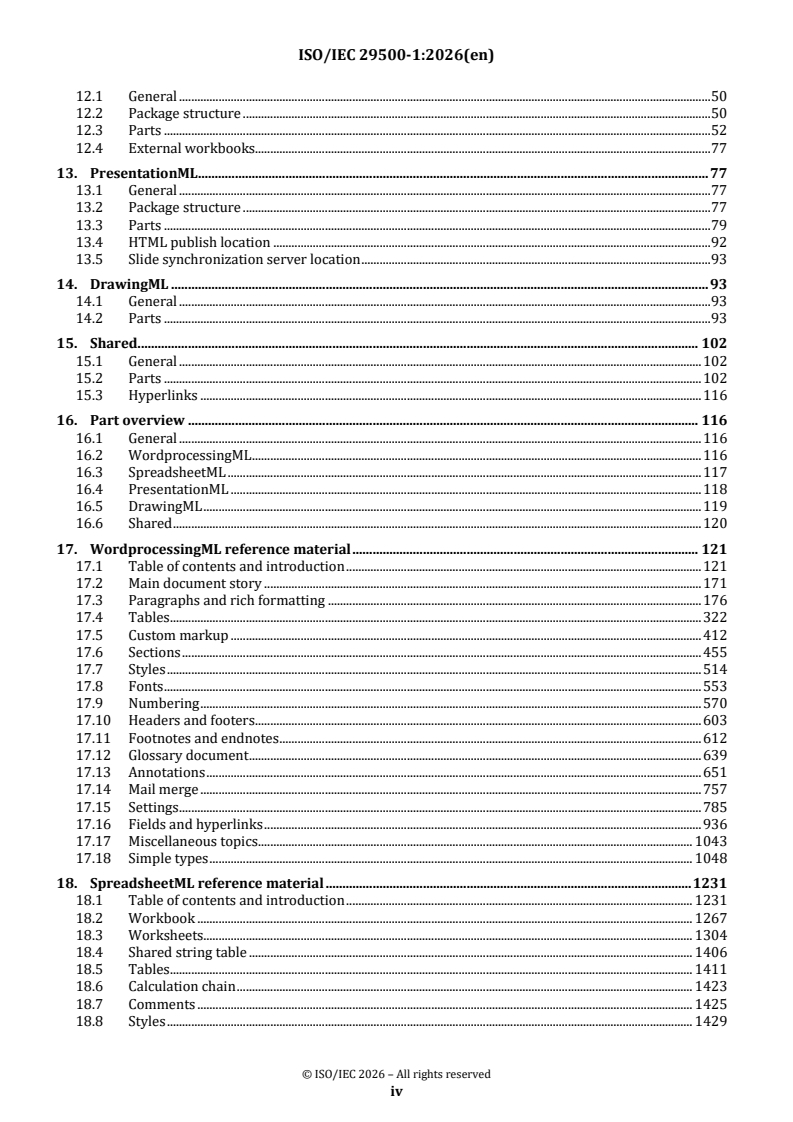
ISO/IEC 29500-1:2026(en)
12.1 General . 50
12.2 Package structure . 50
12.3 Parts . 52
12.4 External workbooks. 77
13. PresentationML . 77
13.1 General . 77
13.2 Package structure . 77
13.3 Parts . 79
13.4 HTML publish location . 92
13.5 Slide synchronization server location . 93
14. DrawingML . 93
14.1 General . 93
14.2 Parts . 93
15. Shared. 102
15.1 General . 102
15.2 Parts . 102
15.3 Hyperlinks . 116
16. Part overview . 116
16.1 General . 116
16.2 WordprocessingML . 116
16.3 SpreadsheetML . 117
16.4 PresentationML . 118
16.5 DrawingML . 119
16.6 Shared . 120
17. WordprocessingML reference material . 121
17.1 Table of contents and introduction . 121
17.2 Main document story . 171
17.3 Paragraphs and rich formatting . 176
17.4 Tables . 322
17.5 Custom markup . 412
17.6 Sections . 455
17.7 Styles . 514
17.8 Fonts . 553
17.9 Numbering . 570
17.10 Headers and footers . 603
17.11 Footnotes and endnotes . 612
17.12 Glossary document . 639
17.13 Annotations . 651
17.14 Mail merge . 757
17.15 Settings . 785
17.16 Fields and hyperlinks . 936
17.17 Miscellaneous topics . 1043
17.18 Simple types . 1048
18. SpreadsheetML reference material . 1231
18.1 Table of contents and introduction . 1231
18.2 Workbook . 1267
18.3 Worksheets. 1304
18.4 Shared string table . 1406
18.5 Tables . 1411
18.6 Calculation chain . 1423
18.7 Comments . 1425
18.8 Styles . 1429
© ISO/IEC 2026 – All rights reserved
iv
ISO/IEC 29500-1:2026(en)
18.9 Metadata . 1470
18.10 Pivot tables . 1481
18.11 Shared workbook data. 1597
18.12 QueryTable data . 1619
18.13 External data connections . 1625
18.14 Supplementary workbook data . 1641
18.15 Volatile dependencies . 1648
18.16 Custom XML mappings . 1650
18.17 Formulas . 1655
18.18 Simple types . 1925
19. PresentationML reference material . 1993
19.1 Table of contents and introduction . 1993
19.2 Presentation . 2000
19.3 Slides . 2028
19.4 Comments . 2059
19.5 Animation . 2062
19.6 Slide synchronization data . 2134
19.7 Simple types . 2135
20. DrawingML - Framework reference material . 2161
20.1 DrawingML - Main . 2161
20.2 DrawingML - Picture . 2440
20.3 DrawingML - Locked canvas . 2446
20.4 DrawingML - WordprocessingML Drawing . 2447
20.5 DrawingML - SpreadsheetML Drawing . 2492
21. DrawingML - Components reference material . 2514
21.1 DrawingML - Main . 2514
21.2 DrawingML - Charts . 2663
21.3 DrawingML - Chart Drawings . 2755
21.4 DrawingML - Diagrams. 2772
22. Shared MLs reference material . 2859
22.1 Math . 2859
22.2 Extended properties . 2954
22.3 Custom properties . 2959
22.4 Variant types . 2960
22.5 Custom XML data properties . 2969
22.6 Bibliography . 2972
22.7 Additional characteristics . 2997
22.8 Office document relationships . 3000
22.9 Shared simple types . 3001
23. Custom XML schema references . 3016
23.1 Table of contents and introduction . 3016
23.2 Elements . 3016
Annex A. (normative) Schemas – W3C XML Schema . 3019
Annex B. (informative) Schemas – RELAX NG . 3020
Annex C. (normative) WordprocessingML page borders . 3022
Annex D. (normative) Predefined SpreadsheetML style definitions . 3023
D.1 General . 3023
D.2 Built-in table styles . 3023
D.3 Built-in cell styles . 3077
D.4 Built-in PivotTable AutoFormats . 3080
© ISO/IEC 2026 – All rights reserved
v
ISO/IEC 29500-1:2026(en)
Annex E. (informative) Example predefined DrawingML shape and text geometries . 3096
Annex F. (informative) Bidirectional support . 3097
F.1 Introduction . 3097
F.2 Shared (WordprocessingML and DrawingML) . 3097
F.3 WordprocessingML . 3099
F.4 SpreadsheetML . 3101
F.5 PresentationML . 3102
F.6 DrawingML . 3103
F.7 The Unicode bidirectional algorithm and Office Open XML . 3103
Annex G. (informative) Accessibility best practices . 3106
G.1 General . 3106
G.2 The value of creating an accessible Office Open XML implementation . 3106
G.3 Needs by type of disability . 3106
G.4 Best practices for developers. 3108
G.5 Best practices for document and template authors . 3111
G.6 Best practices for customers of Office Open XML implementations . 3120
Annex H. (informative) WordprocessingML page layout concepts . 3129
H.1 Physical settings and logical settings . 3129
H.2 Margin, paper size, column, and gap . 3129
H.3 Document grid for East Asian languages . 3133
H.4 Using the document grid for character and line positioning for East Asian languages . 3136
Annex I. (informative) DrawingML coordinate systems and transformations . 3137
I.1 Introduction . 3137
I.2 Coordinate system . 3137
I.3 Shape transformations . 3137
I.4 Group transformations . 3140
I.5 Nesting transformations . 3143
I.6 Transformation matrices . 3143
Bibliography. 3145
© ISO/IEC 2026 – All rights reserved
vi
ISO/IEC 29500-1:2026(en)
Foreword
ISO (the International Organization for Standardization) and IEC (the International Electrotechnical
Commission) form the specialized system for worldwide standardization. National bodies that are members
of ISO or IEC participate in the development of International Standards through technical committees
established by the respective organization to deal with particular fields of technical activity. ISO and IEC
technical committees collaborate in fields of mutual interest. Other international organizations,
governmental and non-governmental, in liaison with ISO and IEC, also take part in the work.
The procedures used to develop this document and those intended for its further maintenance are described
in the ISO/IEC Directives, Part 1. In particular, the different approval criteria needed for the different types
of documents should be noted. This document was drafted in accordance with the editorial rules of the
ISO/IEC Directives, Part 2 (see www.iso.org/directives or www.iec.ch/members_experts/refdocs).
ISO and IEC draw attention to the possibility that the implementation of this document may involve the use
of (a) patent(s). ISO and IEC take no position concerning the evidence, validity or applicability of any claimed
patent rights in respect thereof. As of the date of publication of this document, ISO and IEC had not received
notice of (a) patent(s) which may be required to implement this document. However, implementers are
cautioned that this may not represent the latest information, which may be obtained from the patent
database available at www.iso.org/patents and https://patents.iec.ch. ISO and IEC shall not be held
responsible for identifying any or all such patent rights.
Any trade name used in this document is information given for the convenience of users and does not
constitute an endorsement.
For an explanation of the voluntary nature of standards, the meaning of ISO specific terms and expressions
related to conformity assessment, as well as information about ISO's adherence to the World Trade
Organization (WTO) principles in the Technical Barriers to Trade (TBT) see
www.iso.org/iso/foreword.html. In the IEC, see www.iec.ch/understanding-standards.
This document was prepared by Joint Technical Committee ISO/IEC JTC 1, Information technology,
Subcommittee SC 34, Document description and processing languages.
This fifth edition cancels and replaces the fourth edition (ISO/IEC 29500-1:2016), which has been
technically revised.
The main changes are as follows:
— Corrections and clarifications have been made throughout the text, but no new functionality has been
added.
— Hanging paragraphs have been moved to new introductory subclauses at the top of the major
collecting clause or subclause, which caused renumbering of some subclauses.
— Where appropriate, normative and bibliographical references have been added, removed, or updated
to use undated or more recent versions.
— Uses of BNF or EBNF have been changed to ABNF.
— Clarifications and corrections have been made to separations between Strict and Transitional and
some content has been moved from this document to ISO/IEC 29500-4.
— Clause 3 (Terms and definitions) has been revised by reorganizing terms into groups.
— Subclauses containing ML-specific glossaries of terms have been integrated into Clause 3.
— Clause 10 (Markup Compatibility and Extensibility) has been expanded and revised in its entirety.
— The printed schemas in Annexes A and B have been removed; schemas exist in digital form only.
— The following annexes have been removed:
— Additional syntax constraints
— Namespace prefix mapping in examples
— WordprocessingML custom XML data extraction
— Root element locations (This information has been merged into Clause 16.)
© ISO/IEC 2026 – All rights reserved
vii
ISO/IEC 29500-1:2026(en)
— Primer (Some information has been integrated into the main text or annexes.)
— Differences between ISO/IEC 29500 and ECMA-376:2006
— The following annexes have been added:
— WordprocessingML page layout
— DrawingML coordinate systems and transformations
A list of all parts in the ISO/IEC 29500 series can be found on the ISO and IEC websites.
Any feedback or questions on this document should be directed to the user’s national standards body. A
complete listing of these bodies can be found at www.iso.org/members.html and www.iec.ch/national-
committees.
© ISO/IEC 2026 – All rights reserved
viii
ISO/IEC 29500-1:2026(en)
Introduction
The ISO/IEC 29500 series specifies a family of XML schemas, collectively called Office Open XML, which
define the XML vocabularies for word-processing, spreadsheet, and presentation documents, as well as the
packaging of documents that conform to these schemas.
The goal is to enable the implementation of the Office Open XML formats by the widest set of tools and
platforms, fostering interoperability across office productivity applications and line-of-business systems, as
well as to support and strengthen document archival and preservation, all in a way that is fully compatible
with the existing corpus of Microsoft® Office documents.
Microsoft Office is the trademark of a product supplied by Microsoft Corporation. This information is given for the
convenience of users of this document and does not constitute an endorsement by ISO or IEC of the product named.
Equivalent products may be used if they can be shown to lead to the same results.
© ISO/IEC 2026 – All rights reserved
ix
ISO/IEC 29500-1:2026(en)
Document description and processing languages — Office
Open XML File Formats —
Part 1:
Fundamentals and markup language reference
1. Scope
The goals of ISO/IEC 29500 are to be capable of faithfully representing the pre-existing corpus of word-
processing documents, spreadsheets and presentations that had been produced by the Microsoft Office
applications, from Microsoft Office 97 to Microsoft Office 2008, inclusive, at the date of creation of ISO/IEC
29500 and to facilitate extensibility and interoperability by enabling implementations by multiple vendors
and on multiple platforms.
This document specifies the features of Office Open XML documents that, in their semantics, syntax, and
packaging, satisfy the requirements of conformance class Office Open XML Strict, as specified in Clause 7.
This document also specifies requirements for Office Open XML consumers and producers.
2. Normative references
The following documents are referred to in the text in such a way that some or all of their content constitutes
requirements of this document. For dated references, only the edition cited applies. For undated references,
the latest edition of the referenced document (including any amendments) applies.
ISO 8601-1, Date and time — Representations for information interchange — Part 1: Basic rules
ISO/IEC 8859-1, Information technology — 8-bit single-byte coded graphic character sets — Part 1: Latin
alphabet No. 1
ISO/IEC 9075-1, Information technology — Database languages — SQL — Part 1: Framework
(SQL/Framework)
ISO/IEC 9075-3:2023, Information technology — Database languages — SQL — Part 3: Call-Level Interface
(SQL/CLI)
ISO/IEC 10118-3, IT Security techniques — Hash-functions — Part 3: Dedicated hash-functions
ISO/IEC 14496-22, Information technology — Coding of audio-visual objects — Part 22: Open Font Format
ISO/IEC 29500-2:2021, Document description and processing languages — Office Open XML file formats – Part
2: Open packaging conventions
ISO/IEC 29500-3:2015, Information technology — Document description and processing languages — Office
Open XML File Formats – Part 3: Markup Compatibility and Extensibility
ISO/IEC 60559:2020, Information technology — Microprocessor Systems — Floating-Point arithmetic
IEC 61966-2-1, Multimedia systems and equipment — Colour measurement and management — Part 2-1:
Colour management — Default RGB colour space — sRGB
IANA (INTERNET ASSIGNED NAMES AUTHORITY). Media Types. Online. Edited by A. Melnikov, D. Miller, M.
Kucherawy. Available from: https://www.iana.org/assignments/media-types/media-types.xhtml.
IANA. Character Set Registrations. Online. Edited by M. Dürst. Available from:
https://www.iana.org/assignments/charset-reg/charset-reg.xhtml.
© ISO/IEC 2026 – All rights reserved
ISO/IEC 29500-1:2026(en)
IANA. Character Sets. Online. Edited by M. Dürst. Available from:
https://www.iana.org/assignments/character-sets/character-sets.xhtml.
IETF. BCP 47. Online. Available from: https://datatracker.ietf.org/doc/bcp47/.
IETF. RFC 1319: The MD2 Message-Digest Algorithm. Online. Edited by B. Kaliski. April 1992. Available from:
https://datatracker.ietf.org/doc/rfc1319/.
IETF. RFC 1320: The MD4 Message-Digest Algorithm. Online. Edited by R. Rivest. April 1992. Available from:
https://datatracker.ietf.org/doc/rfc1320/https://www.rfc-editor.org/rfc/rfc1320.
IETF. RFC 1321: The MD5 Message-Digest Algorithm. Online. Edited by R. Rivest. April 1992. Available from:
https://datatracker.ietf.org/doc/rfc1321/.
IETF. RFC 2046: Multipurpose Internet Mail Extensions (MIME) Part Two: Media Types. Online. Edited by N.
Freed, N. Borenstein. November 1996. Available from: https://datatracker.ietf.org/doc/rfc2046/.
IETF. RFC 2781: UTF-16, an encoding of ISO 10646. Online. Edited by P. Hoffman, F. Yergeau. February 2000.
Available from: https://datatracker.ietf.org/doc/rfc2781/.
IETF. RFC 3339: Date and Time on the Internet: Timestamps. Online. Edited by G. Klyne, C. Newman. July
2002. Available from: https://datatracker.ietf.org/doc/rfc3339/.
IETF. RFC 3986 (STD 66): Uniform Resource Identifier (URI): Generic Syntax. Online. Edited by T. Berners-Lee,
R. Fielding, L. Masinter. January 2005. Available from: https://datatracker.ietf.org/doc/rfc3986/.
IETF. RFC 3987: Internationalized Resource Identifiers (IRIs). Edited by M. Duerst and M. Suignard. IETF,
January 2005. Available from: https://datatracker.ietf.org/doc/rfc3987/.
IETF. RFC 5234 (STD 68): Augmented BNF for Syntax Specifications: ABNF. Online. Edited by D. Crocker, P.
Overell. January 2008. Available from: https://datatracker.ietf.org/doc/rfc5234/.
IETF. RFC 7405: Case-Sensitive String Support in ABNF. Online. Edited by P. Kyzivat. December 2014.
Available from: https://datatracker.ietf.org/doc/rfc7405/.
THE UNICODE CONSORTIUM. The Unicode Standard. Online. Available from:
https://www.unicode.org/standard/standard.html.
THE UNICODE CONSORTIUM. Unicode Standard Annex #9: Unicode Bidirectional Algorithm. Online. Edited
by M. Goregaokar, R. Leroy. Available from: https://www.unicode.org/reports/tr9/.
W3C. Cascading Style Sheets Level 2 Revision 1 (CSS 2.1). Online. Edited by B. Bos, T. Çelik, I. Hickson, H. W.
Lie. 7 June 2011. Available from: https://www.w3.org/TR/CSS2/.
W3C. Extensible Markup Language (XML) 1.0 (Fourth Edition). Online. Edited by T. Bray, J. Paoli, C. M.
Sperberg-McQueen, E. Maler, F. Yergeau. 16 August 2006. Availabl
...