

ISO/IEC 21228:2019
(Main)Information technology — Telecommunications and information exchange between systems — Coexistence mechanism for broadband powerline communication technologies
General Information
- Abstract
This document specifies the coexistence mechanism for various broadband powerline communication systems. By using the coexistence mechanism, possible harmful interference between different standard-based high-speed powerline communication systems can be avoided.
- Status
- Published
- Publication Date
- 23-May-2019
- Drafting Committee
- ISO/IEC JTC 1/SC 6/WG 1 - Physical and data link layers
- Current Stage
- 9093 - International Standard confirmed
- Start Date
- 23-May-2025
- Completion Date
- 29-Aug-2026
Buy Documents
ISO/IEC 21228:2019 - Information technology -- Telecommunications and information exchange between systems -- Coexistence mechanism for broadband powerline communication technologies
ISO/IEC 21228:2019 - Information technology — Telecommunications and information exchange between systems — Coexistence mechanism for broadband powerline communication technologies/24/2019
Overview
ISO/IEC 21228:2019 defines a coexistence mechanism for broadband powerline communication (PLC) technologies. The standard specifies a coexistence protocol (CP) that enables multiple, non‑interoperable high‑speed PLC systems to share the same powerline medium without causing harmful interference. It extends existing inter-system protocols to accommodate another in‑home system while preserving backward compatibility with IEEE Std 1901 ISP behavior.
Key topics and technical requirements
- Coexistence protocol (CP): Shares time‑domain and frequency‑domain resources between different broadband PLC systems. The CP is largely aligned with the IEEE 1901 inter‑system protocol (ISP) and ITU‑T G.9972 coexistence concepts.
- Resource sharing methods: Two primary multiplexing strategies are used:
- Time Domain Multiplex (TDM) - extended TDM resource allocation to support up to four non‑interoperable systems on the same powerline.
- Frequency Domain Multiplex (FDM) - alternative method for splitting spectral resources among systems.
- Extended TDM schemes:
- Utilizing TDM resources of an absent in‑home system (IH-A assumes the allocation of the first absent system in a fixed order IH‑W, IH‑O, IH‑G).
- Utilizing TDM resources of an access system when no access or absent in‑home systems exist.
- Compatibility and detection rules:
- IH‑A transmits ISP signals with a different periodicity (8×T) versus standard systems (4×T) so it can detect newly connected systems and relinquish resources accordingly.
- IH‑A uses phase vectors corresponding to the first absent in‑home system as specified in IEEE 1901 tables for synchronization.
Applications and practical value
- Prevents harmful interference in environments where multiple broadband PLC standards coexist (e.g., mixed deployments of IEEE 1901, ITU‑T G.hn, ISO/IEC 12139‑1).
- Enables reliable home networking and in‑premises broadband services over existing powerline infrastructure when devices from different standards operate nearby.
- Useful for system designers and implementers who need to ensure interoperability at the coexistence layer without changing underlying PHY/MAC implementations.
Who should use this standard
- PLC equipment manufacturers implementing multi‑standard coexistence.
- Network architects and integrators deploying in‑home or access PLC solutions.
- Standards developers and test laboratories validating coexistence behavior.
- Regulators and certification bodies assessing coexistence mitigation in shared powerline environments.
Related standards
- IEEE Std 1901-2010 (ISP and TDM/FDM coexistence)
- ISO/IEC 12139‑1 (High‑speed PLC MAC/PHY)
- ITU‑T G.9960 / G.9961 (G.hn family)
- ITU‑T G.9972:2010 (Coexistence mechanism for wireline home networking)
Keywords: ISO/IEC 21228:2019, coexistence mechanism, broadband powerline communication, PLC coexistence, time domain multiplex, frequency domain multiplex, IEEE 1901, G.hn, ISP, CP.
Buy Documents
ISO/IEC 21228:2019 - Information technology -- Telecommunications and information exchange between systems -- Coexistence mechanism for broadband powerline communication technologies
ISO/IEC 21228:2019 - Information technology — Telecommunications and information exchange between systems — Coexistence mechanism for broadband powerline communication technologies/24/2019
Get Certified
Connect with accredited certification bodies for this standard

BSI Group
BSI (British Standards Institution) is the business standards company that helps organizations make excellence a habit.

NYCE
Mexican standards and certification body.
Sponsored listings
Frequently Asked Questions
ISO/IEC 21228:2019 is a standard published by the International Organization for Standardization (ISO). Its full title is "Information technology — Telecommunications and information exchange between systems — Coexistence mechanism for broadband powerline communication technologies". This standard covers: This document specifies the coexistence mechanism for various broadband powerline communication systems. By using the coexistence mechanism, possible harmful interference between different standard-based high-speed powerline communication systems can be avoided.
This document specifies the coexistence mechanism for various broadband powerline communication systems. By using the coexistence mechanism, possible harmful interference between different standard-based high-speed powerline communication systems can be avoided.
ISO/IEC 21228:2019 is classified under the following ICS (International Classification for Standards) categories: 35.110 - Networking. The ICS classification helps identify the subject area and facilitates finding related standards.
ISO/IEC 21228:2019 is available in PDF format for immediate download after purchase. The document can be added to your cart and obtained through the secure checkout process. Digital delivery ensures instant access to the complete standard document.
Standards Content (Sample)
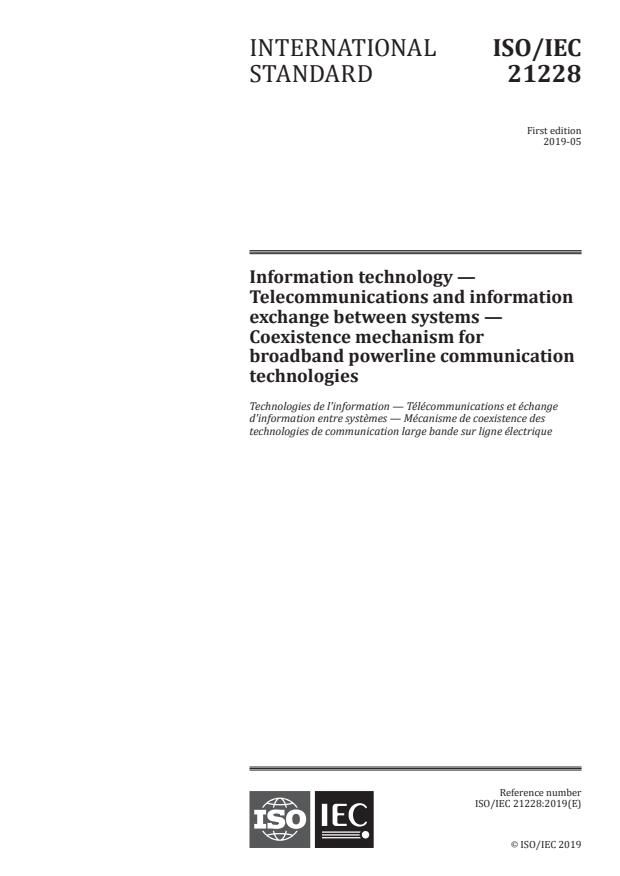
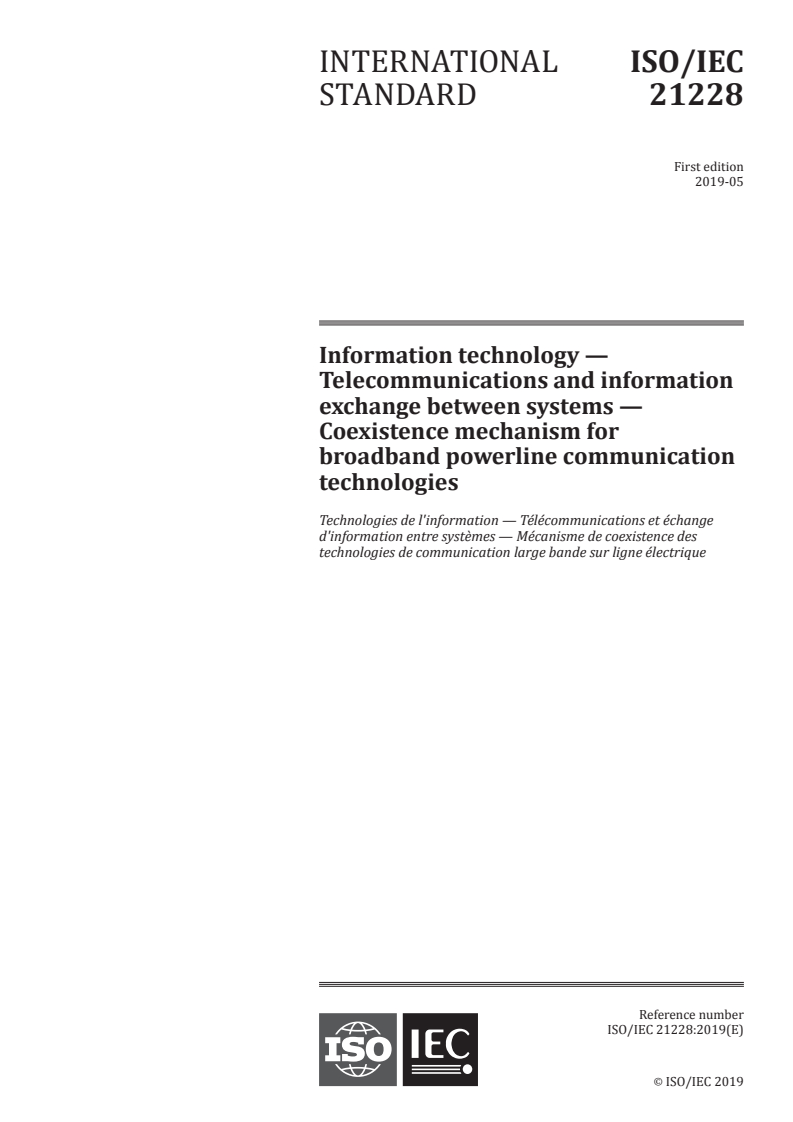
INTERNATIONAL ISO/IEC
STANDARD 21228
First edition
2019-05
Information technology —
Telecommunications and information
exchange between systems —
Coexistence mechanism for
broadband powerline communication
technologies
Technologies de l'information — Télécommunications et échange
d'information entre systèmes — Mécanisme de coexistence des
technologies de communication large bande sur ligne électrique
Reference number
©
ISO/IEC 2019
© ISO/IEC 2019
All rights reserved. Unless otherwise specified, or required in the context of its implementation, no part of this publication may
be reproduced or utilized otherwise in any form or by any means, electronic or mechanical, including photocopying, or posting
on the internet or an intranet, without prior written permission. Permission can be requested from either ISO at the address
below or ISO’s member body in the country of the requester.
ISO copyright office
CP 401 • Ch. de Blandonnet 8
CH-1214 Vernier, Geneva
Phone: +41 22 749 01 11
Fax: +41 22 749 09 47
Email: copyright@iso.org
Website: www.iso.org
Published in Switzerland
ii © ISO/IEC 2019 – All rights reserved
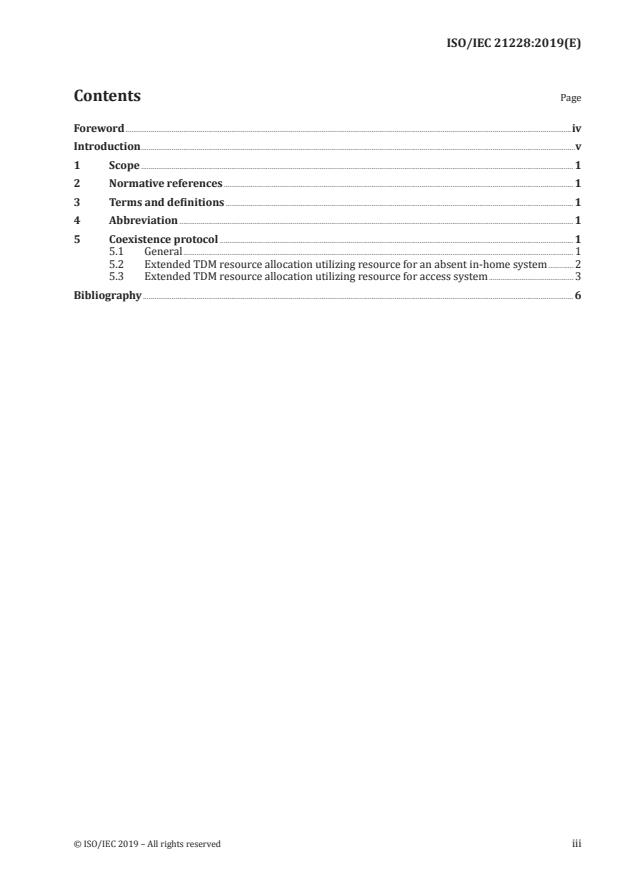
Contents Page
Foreword .iv
Introduction .v
1 Scope . 1
2 Normative references . 1
3 Terms and definitions . 1
4 Abbreviation . 1
5 Coexistence protocol . 1
5.1 General . 1
5.2 Extended TDM resource allocation utilizing resource for an absent in-home system . 2
5.3 Extended TDM resource allocation utilizing resource for access system . 3
Bibliography . 6
© ISO/IEC 2019 – All rights reserved iii
Foreword
ISO (the International Organization for Standardization) and IEC (the International Electrotechnical
Commission) form the specialized system for worldwide standardization. National bodies that
are members of ISO or IEC participate in the development of International Standards through
technical committees established by the respective organization to deal with particular fields of
technical activity. ISO and IEC technical committees collaborate in fields of mutual interest. Other
international organizations, governmental and non-governmental, in liaison with ISO and IEC, also
take part in the work.
The procedures used to develop this document and those intended for its further maintenance are
described in the ISO/IEC Directives, Part 1. In particular, the different approval criteria needed for
the different types of document should be noted. This document was drafted in accordance with the
editorial rules of the ISO/IEC Directives, Part 2 (see www .iso .org/directives).
Attention is drawn to the possibility that some of the elements of this document may be the subject
of patent rights. ISO and IEC shall not be held responsible for identifying any or all such patent
rights. Details of any patent rights identified during the development of the document will be in the
Introduction and/or on the ISO list of patent declarations received (see www .iso .org/patents) or the IEC
list of patent declarations received (see http: //patents .iec .ch).
Any trade name used in this document is information given for the convenience of users and does not
constitute an endorsement.
For an explanation of the voluntary nature of standards, the meaning of ISO specific terms and
expressions related to conformity assessment, as well as information about ISO's adherence to the
World Trade Organization (WTO) principles in the Technical Barriers to Trade (TBT) see www .iso
.org/iso/foreword .html.
This document was prepared by Joint Technical Committee ISO/IEC JTC 1, Information technology,
Subcommittee SC 6, Telecommunications and information exchange between systems.
Any feedback or questions on this document should be directed to the user’s national standards body. A
complete listing of these bodies can be found at www .iso .org/members .html.
iv © ISO/IEC 2019 – All rights reserved
Introduction
ISO/IEC 12139-1 was published in July 2009. There were also standardization activities on high speed
powerline communication in other standards development organizations; IEEE P1901 WG and ITU-T
SG15. IEEE Std 1901-2010 was approved in October 2010, and G.hn(G.9960/G.9961) consented in ITU-T
in June 2010.
Since powerline is a shared medium of frequency, the different-standard-devices which use powerline
could cause harmful interference to each other when used in the same vicinity. Therefore, it is important
to study harmonized coexistence to prevent possible harmful interference between devices that adopt
standards from different standards organizations.
An IEC SMB decision 135/18 in June 2009 requested that ISO/IEC JTC1/SC 6 initiate maintenance work
rapidly to solve any coexistence problems with the G.hn(G.9960) series of ITU-T Recommendations and
any other relevant standards from the IEC or elsewhere.
To solve the coexistence problem, ISO/IEC JTC1/SC 6 established a Study Group on High Speed PLC
Harmonization (SGPLC) among High Speed PLC International Standards at their meeting in January
2010. The final goal of SGPLC was to achieve harmonized coexistence not only between ISO/IEC 12139-
1 and ITU-T G.9960 but between ISO/IEC 12139-1 and IEEE Std 1901-2010. The study report was
presented and was approved for its results.
In this document, to guarantee backward compatibility with the ISP (Inter System Protocol) of IEEE Std
1901-2010, time domain multiplex general resource allocation is extended to support another non-
interoperable in-home system such as ISO/IEC 12139-1 based powerline communication system while the
maximum number of non-interoperable systems supported at the same time remains unchanged as four.
© ISO/IEC 2019 – All rights reserved v
INTERNATIONAL STANDARD ISO/IEC 21228:2019(E)
Information technology — Telecommunications and
information exchange between systems — Coexistence
mechanism for broadband powerline communication
technologies
1 Scope
This document specifies the coexistence mechanism for various broadband powerline communication
systems. By using the coexistence mechanism, possible harmful interference between different
standard-based high-speed powerline communication systems can be avoided.
2 Normative references
The following documents are referred to in the text in such a way that some or all of their content
constitutes requirements of this document. For dated references, only the edition cited applies. For
undated references, the latest edition of the referenced document (including any amendments) applies.
IEEE Std 1901-2010, IEEE Standard for Broadband over Power Line Networks: Medium Access Control and
Physical Layer Specifications
3 Terms and definitions
No terms and definitions are listed in this document.
ISO and IEC maintain terminological databases for use in standardization at the following addresses:
— IEC Electropedia: available at http: //www .electropedia .org/
— ISO Online browsing platform: available at http: //www .iso .org/obp
4 Abbreviation
CP coexistence protocol
FDM frequency domain multiplex
IH in-home
ISP inter-system protocol
TDM time domain multiplex
5 Coexistence protocol
5.1 General
This Clause s
...
INTERNATIONAL ISO/IEC
STANDARD 21228
First edition
2019-05
Information technology —
Telecommunications and information
exchange between systems —
Coexistence mechanism for
broadband powerline communication
technologies
Technologies de l'information — Télécommunications et échange
d'information entre systèmes — Mécanisme de coexistence des
technologies de communication large bande sur ligne électrique
Reference number
©
ISO/IEC 2019
© ISO/IEC 2019
All rights reserved. Unless otherwise specified, or required in the context of its implementation, no part of this publication may
be reproduced or utilized otherwise in any form or by any means, electronic or mechanical, including photocopying, or posting
on the internet or an intranet, without prior written permission. Permission can be requested from either ISO at the address
below or ISO’s member body in the country of the requester.
ISO copyright office
CP 401 • Ch. de Blandonnet 8
CH-1214 Vernier, Geneva
Phone: +41 22 749 01 11
Fax: +41 22 749 09 47
Email: copyright@iso.org
Website: www.iso.org
Published in Switzerland
ii © ISO/IEC 2019 – All rights reserved
Contents Page
Foreword .iv
Introduction .v
1 Scope . 1
2 Normative references . 1
3 Terms and definitions . 1
4 Abbreviation . 1
5 Coexistence protocol . 1
5.1 General . 1
5.2 Extended TDM resource allocation utilizing resource for an absent in-home system . 2
5.3 Extended TDM resource allocation utilizing resource for access system . 3
Bibliography . 6
© ISO/IEC 2019 – All rights reserved iii
Foreword
ISO (the International Organization for Standardization) and IEC (the International Electrotechnical
Commission) form the specialized system for worldwide standardization. National bodies that
are members of ISO or IEC participate in the development of International Standards through
technical committees established by the respective organization to deal with particular fields of
technical activity. ISO and IEC technical committees collaborate in fields of mutual interest. Other
international organizations, governmental and non-governmental, in liaison with ISO and IEC, also
take part in the work.
The procedures used to develop this document and those intended for its further maintenance are
described in the ISO/IEC Directives, Part 1. In particular, the different approval criteria needed for
the different types of document should be noted. This document was drafted in accordance with the
editorial rules of the ISO/IEC Directives, Part 2 (see www .iso .org/directives).
Attention is drawn to the possibility that some of the elements of this document may be the subject
of patent rights. ISO and IEC shall not be held responsible for identifying any or all such patent
rights. Details of any patent rights identified during the development of the document will be in the
Introduction and/or on the ISO list of patent declarations received (see www .iso .org/patents) or the IEC
list of patent declarations received (see http: //patents .iec .ch).
Any trade name used in this document is information given for the convenience of users and does not
constitute an endorsement.
For an explanation of the voluntary nature of standards, the meaning of ISO specific terms and
expressions related to conformity assessment, as well as information about ISO's adherence to the
World Trade Organization (WTO) principles in the Technical Barriers to Trade (TBT) see www .iso
.org/iso/foreword .html.
This document was prepared by Joint Technical Committee ISO/IEC JTC 1, Information technology,
Subcommittee SC 6, Telecommunications and information exchange between systems.
Any feedback or questions on this document should be directed to the user’s national standards body. A
complete listing of these bodies can be found at www .iso .org/members .html.
iv © ISO/IEC 2019 – All rights reserved
Introduction
ISO/IEC 12139-1 was published in July 2009. There were also standardization activities on high speed
powerline communication in other standards development organizations; IEEE P1901 WG and ITU-T
SG15. IEEE Std 1901-2010 was approved in October 2010, and G.hn(G.9960/G.9961) consented in ITU-T
in June 2010.
Since powerline is a shared medium of frequency, the different-standard-devices which use powerline
could cause harmful interference to each other when used in the same vicinity. Therefore, it is important
to study harmonized coexistence to prevent possible harmful interference between devices that adopt
standards from different standards organizations.
An IEC SMB decision 135/18 in June 2009 requested that ISO/IEC JTC1/SC 6 initiate maintenance work
rapidly to solve any coexistence problems with the G.hn(G.9960) series of ITU-T Recommendations and
any other relevant standards from the IEC or elsewhere.
To solve the coexistence problem, ISO/IEC JTC1/SC 6 established a Study Group on High Speed PLC
Harmonization (SGPLC) among High Speed PLC International Standards at their meeting in January
2010. The final goal of SGPLC was to achieve harmonized coexistence not only between ISO/IEC 12139-
1 and ITU-T G.9960 but between ISO/IEC 12139-1 and IEEE Std 1901-2010. The study report was
presented and was approved for its results.
In this document, to guarantee backward compatibility with the ISP (Inter System Protocol) of IEEE Std
1901-2010, time domain multiplex general resource allocation is extended to support another non-
interoperable in-home system such as ISO/IEC 12139-1 based powerline communication system while the
maximum number of non-interoperable systems supported at the same time remains unchanged as four.
© ISO/IEC 2019 – All rights reserved v
INTERNATIONAL STANDARD ISO/IEC 21228:2019(E)
Information technology — Telecommunications and
information exchange between systems — Coexistence
mechanism for broadband powerline communication
technologies
1 Scope
This document specifies the coexistence mechanism for various broadband powerline communication
systems. By using the coexistence mechanism, possible harmful interference between different
standard-based high-speed powerline communication systems can be avoided.
2 Normative references
The following documents are referred to in the text in such a way that some or all of their content
constitutes requirements of this document. For dated references, only the edition cited applies. For
undated references, the latest edition of the referenced document (including any amendments) applies.
IEEE Std 1901-2010, IEEE Standard for Broadband over Power Line Networks: Medium Access Control and
Physical Layer Specifications
3 Terms and definitions
No terms and definitions are listed in this document.
ISO and IEC maintain terminological databases for use in standardization at the following addresses:
— IEC Electropedia: available at http: //www .electropedia .org/
— ISO Online browsing platform: available at http: //www .iso .org/obp
4 Abbreviation
CP coexistence protocol
FDM frequency domain multiplex
IH in-home
ISP inter-system protocol
TDM time domain multiplex
5 Coexistence protocol
5.1 General
This Clause s
...