


ISO 279:1998
(Main)Essential oils — Determination of relative density at 20 °C — Reference method
Essential oils — Determination of relative density at 20 °C — Reference method
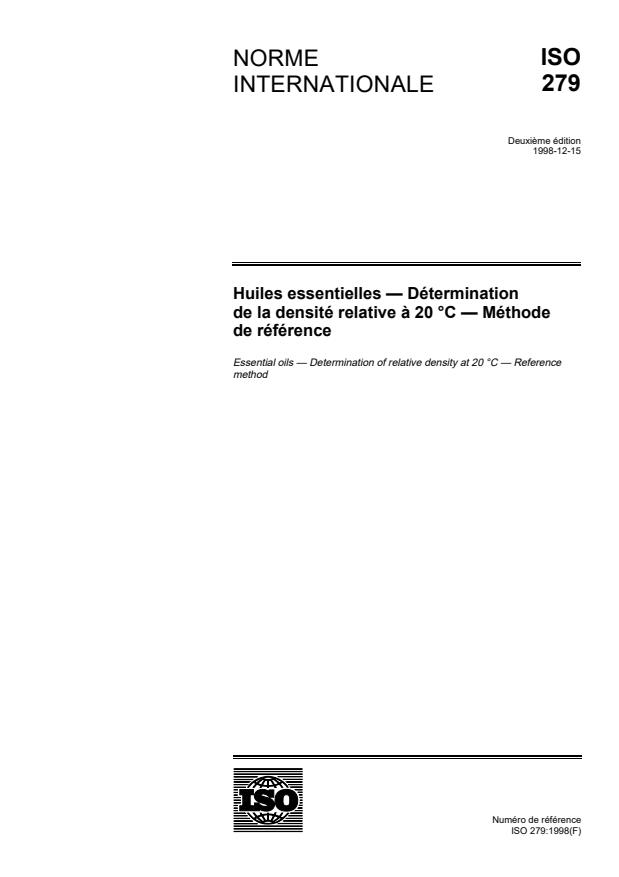
Huiles essentielles — Détermination de la densité relative à 20 °C — Méthode de référence
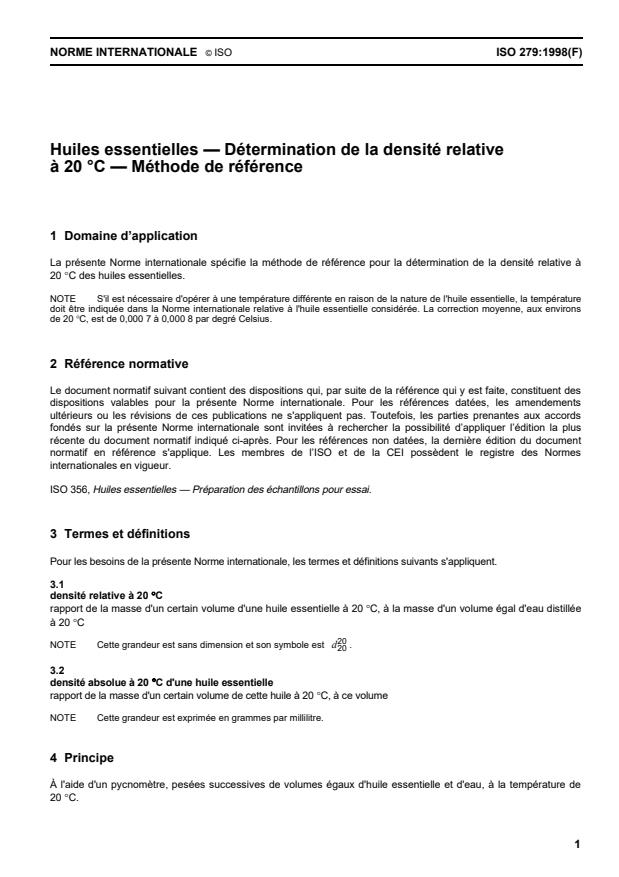
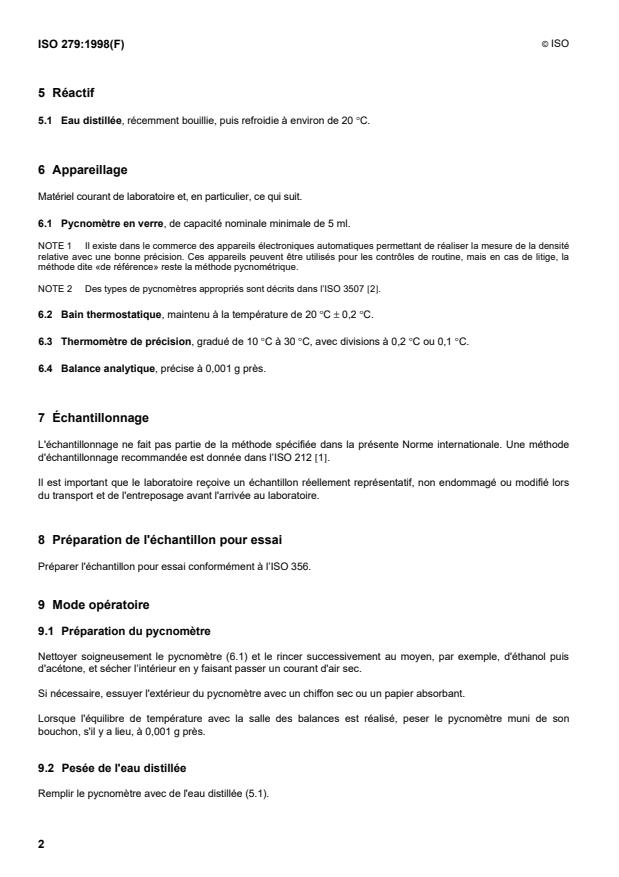
La présente Norme internationale spécifie la méthode de référence pour la détermination de la densité relative à 20 °C des huiles essentielles. NOTE S'il est nécessaire d'opérer à une température différente en raison de la nature de l'huile essentielle, la température doit être indiquée dans la Norme internationale relative à l'huile essentielle considérée. La correction moyenne, aux environs de 20 °C, est de 0,000 7 à 0,000 8 par degré Celsius.
General Information
- Status
- Published
- Publication Date
- 19-Dec-1998
- Technical Committee
- ISO/TC 54 - Essential oils
- Drafting Committee
- ISO/TC 54 - Essential oils
- Current Stage
- 9093 - International Standard confirmed
- Start Date
- 12-Jan-2026
- Completion Date
- 14-Feb-2026
Relations
- Revises
ISO 279:1981 - Essential oils — Determination of relative density at 20 degrees C (Reference method) - Effective Date
- 15-Apr-2008
Overview
ISO 279:1998 is an internationally recognized standard from the International Organization for Standardization (ISO) that specifies the reference method for the determination of relative density of essential oils at 20 °C. This method establishes a common procedure to ensure reproducibility and accuracy in quality control and product certification within the essential oils industry. Proper determination of relative density is fundamental for verifying the authenticity and quality of essential oils in both research and commercial settings.
Key Topics
- Relative Density at 20°C: This standard outlines the calculation of relative density-defined as the ratio of the mass of a given volume of oil at 20 °C to the mass of an equal volume of distilled water at the same temperature.
- Reference Method: The pyknometric method is the principal approach recommended for determining relative density. In disputes or for reference testing, this method must be used even if alternative (automated) instruments are available for routine checks.
- Equipment and Materials: Required apparatus include a glass pyknometer with at least 5 ml capacity, a water bath maintained at 20 °C ± 0.2 °C, a calibrated thermometer (10 °C to 30 °C range), and an analytical balance accurate to 0.001 g.
- Procedure:
- Cleaning and preparation of the pyknometer.
- Weighing procedures for the empty pyknometer, pyknometer with distilled water, and pyknometer with the essential oil sample.
- Calculating the relative density to three decimal places without air buoyancy correction.
Applications
ISO 279:1998 provides essential value across multiple contexts within the essential oils sector:
- Quality Assurance: By standardizing test procedures, manufacturers and suppliers can ensure the authenticity, purity, and consistency of essential oil batches, supporting customer trust.
- Product Certification: Compliance with ISO 279:1998 enhances product credibility and facilitates international trade by meeting universally accepted benchmarks.
- Research and Development: Analytical laboratories and R&D teams utilize this method for precise measurement, essential when creating formulations or verifying the integrity of raw materials.
- Regulatory Compliance: Regulatory agencies may require proof of testing via ISO 279:1998 to validate labeling claims and prevent adulteration.
- Dispute Resolution: Adoption of the reference pyknometer method provides a common ground for settling technical disagreements about product specifications or quality.
Related Standards
Organizations working with essential oils and relative density measurement should also be familiar with these key standards:
- ISO 356: Essential oils – Preparation of test samples
- Details sample preparation, ensuring consistency before relative density measurement.
- ISO 212: Essential oils – Sampling
- Specifies recommended methods for sampling to guarantee representative test results.
- ISO 3507: Laboratory glassware – Pyknometers
- Defines specifications for the pyknometers used in relative density determination, supporting standardized equipment usage.
Practical Considerations
- Sample Handling: Proper sampling (per ISO 212) and test sample preparation (according to ISO 356) are vital for accurate and reliable results.
- Temperature Control: Maintaining precise temperature during testing is critical, as small deviations can significantly affect measurement accuracy.
- Reporting: The test report must detail the method used, obtained results, any deviations from the standard procedure, and full sample identification.
By adhering to ISO 279:1998, stakeholders in the essential oils industry ensure high-quality products that meet global expectations, promote fair trade, and support scientific advancement. The methodology’s precision boosts consumer confidence and regulatory acceptance, reinforcing the importance of measurement standardization in international markets.
Buy Documents
ISO 279:1998 - Essential oils -- Determination of relative density at 20 degrees C -- Reference method
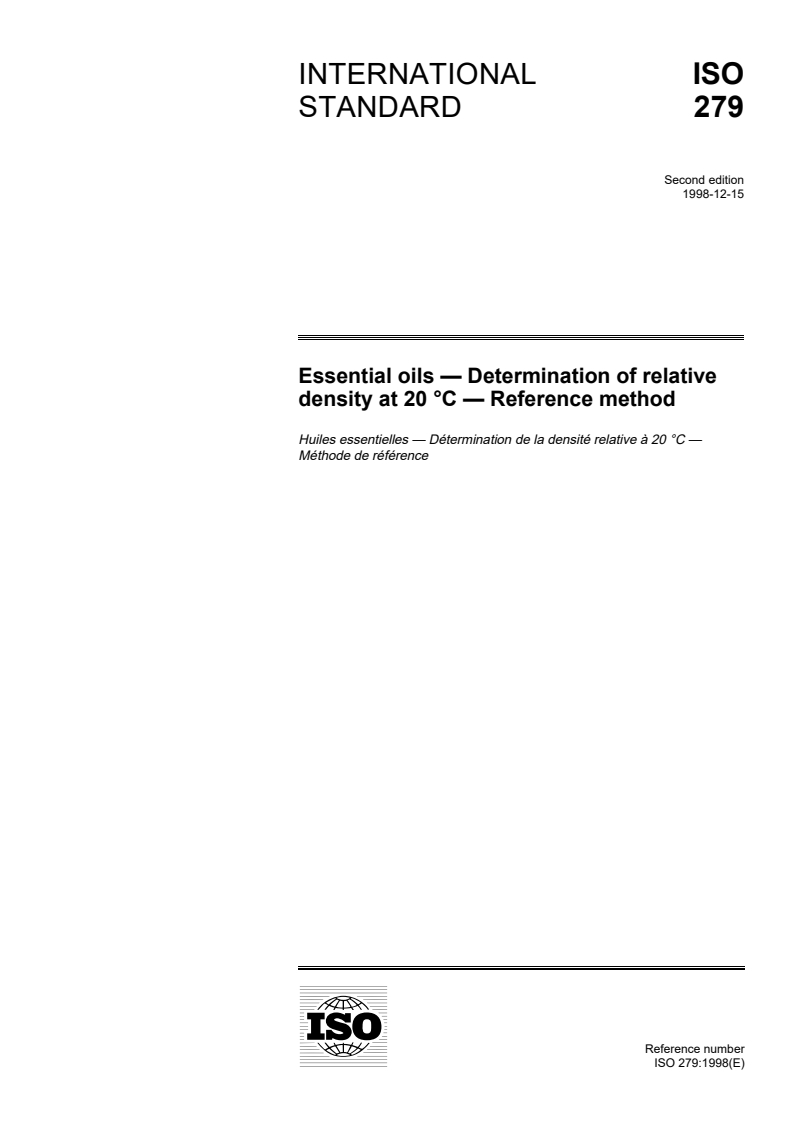
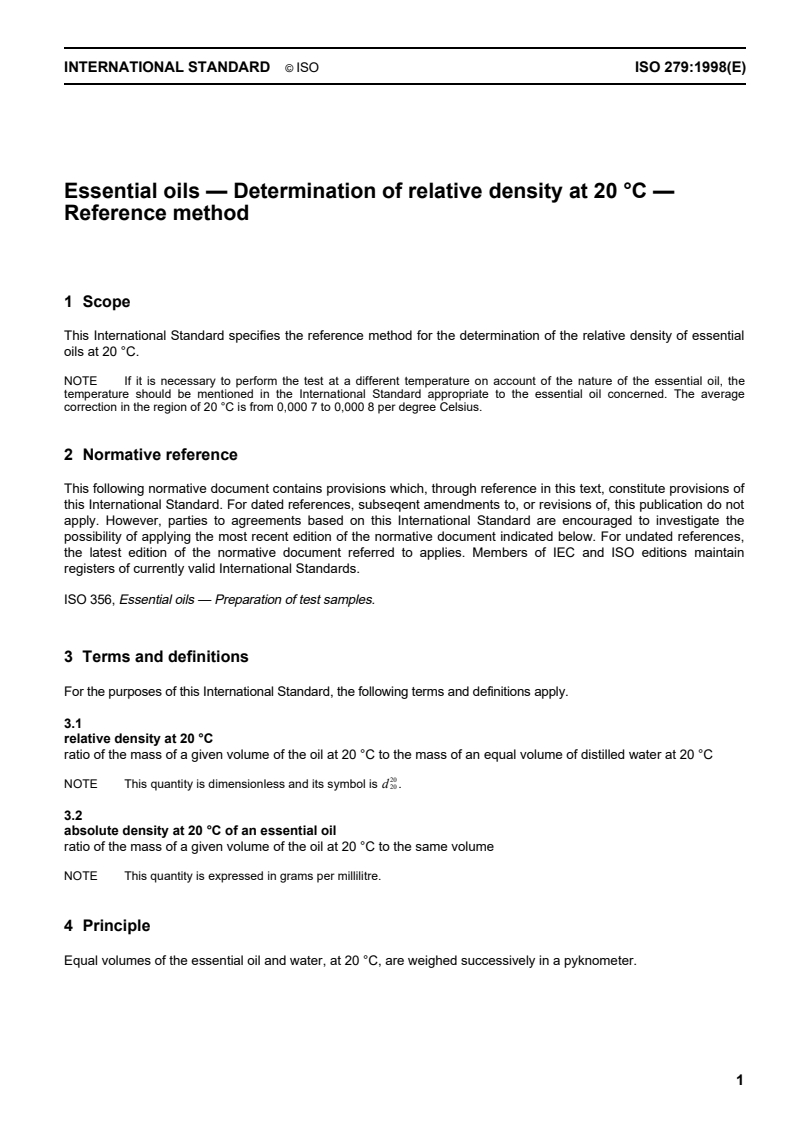
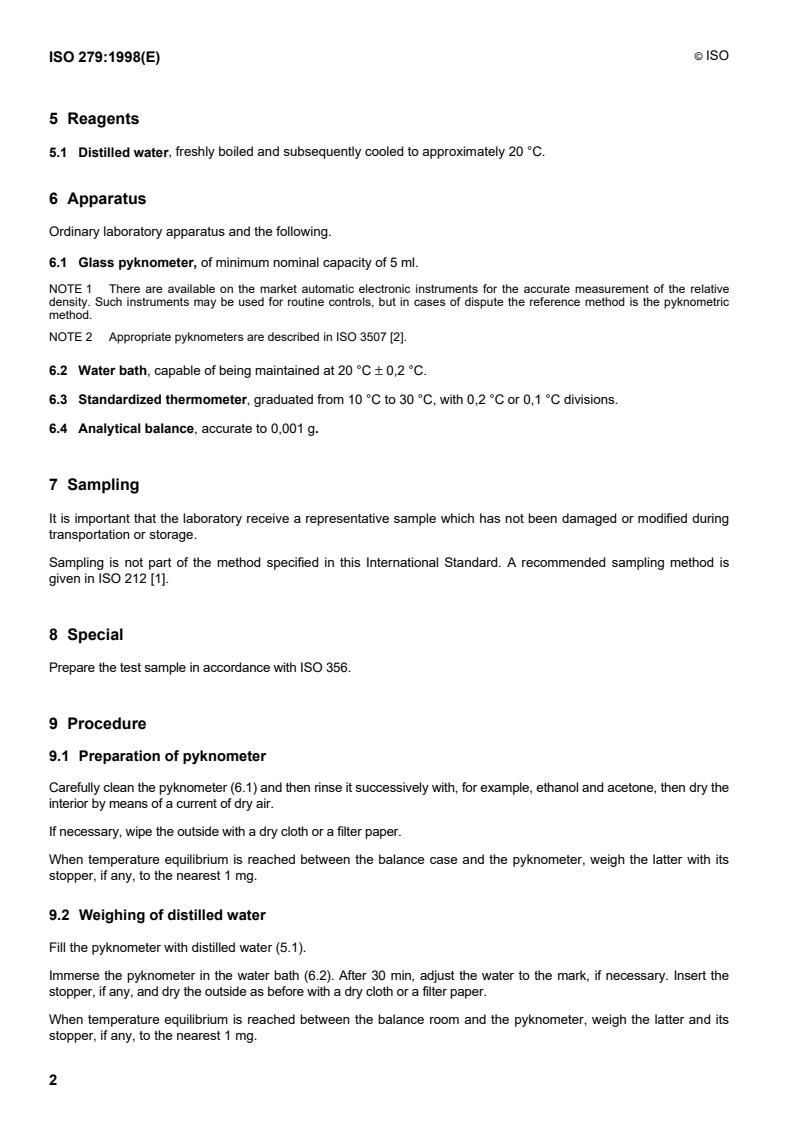
ISO 279:1998 - Essential oils — Determination of relative density at 20 °C — Reference method/20/1998
ISO 279:1998 - Huiles essentielles -- Détermination de la densité relative a 20 degrés C -- Méthode de référence
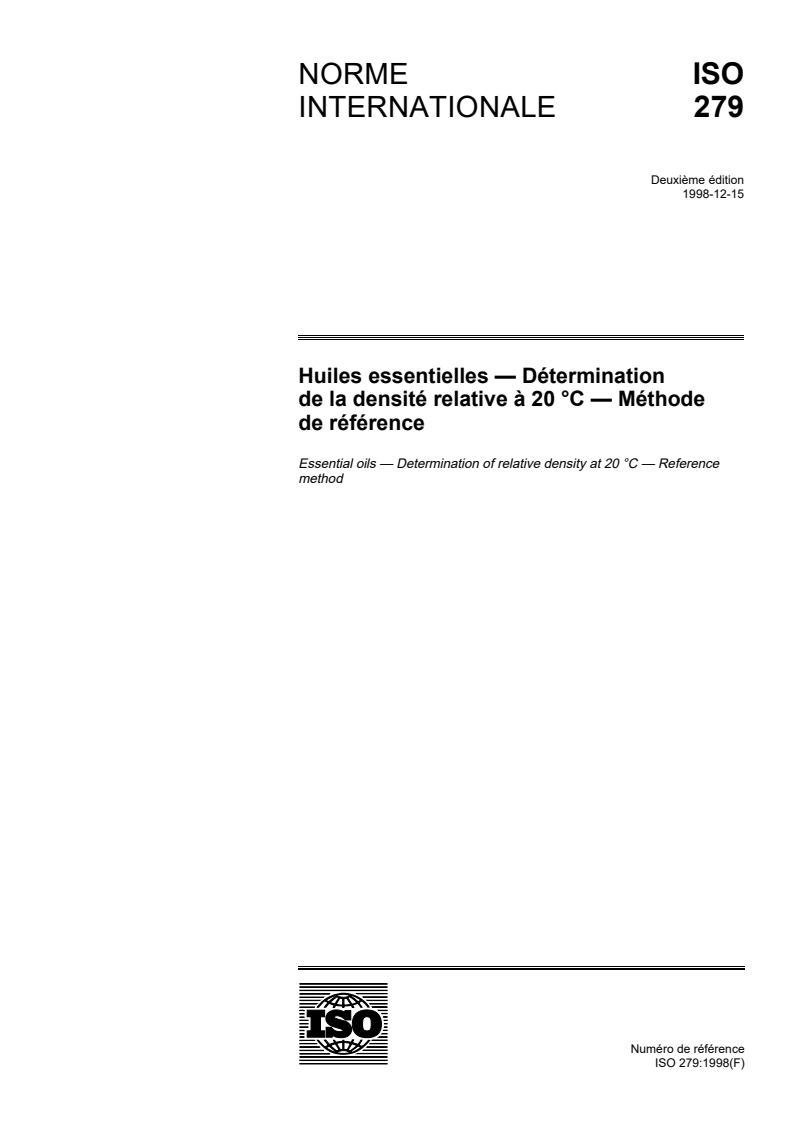
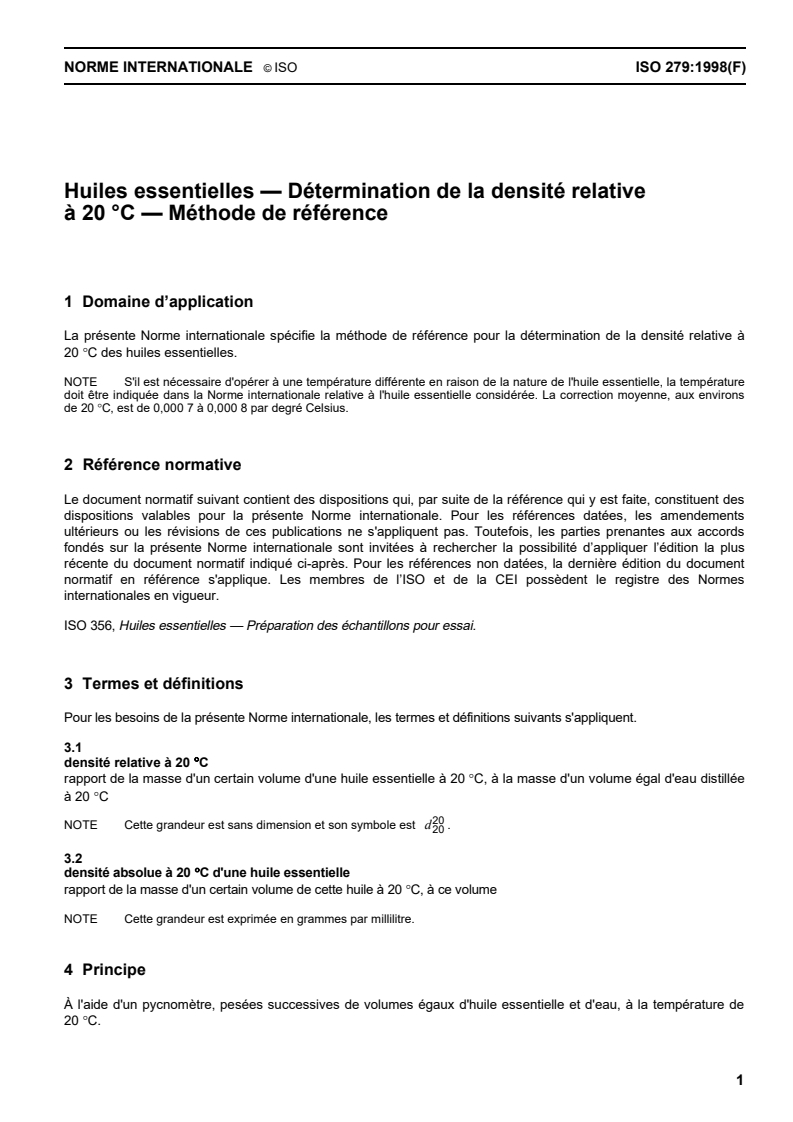
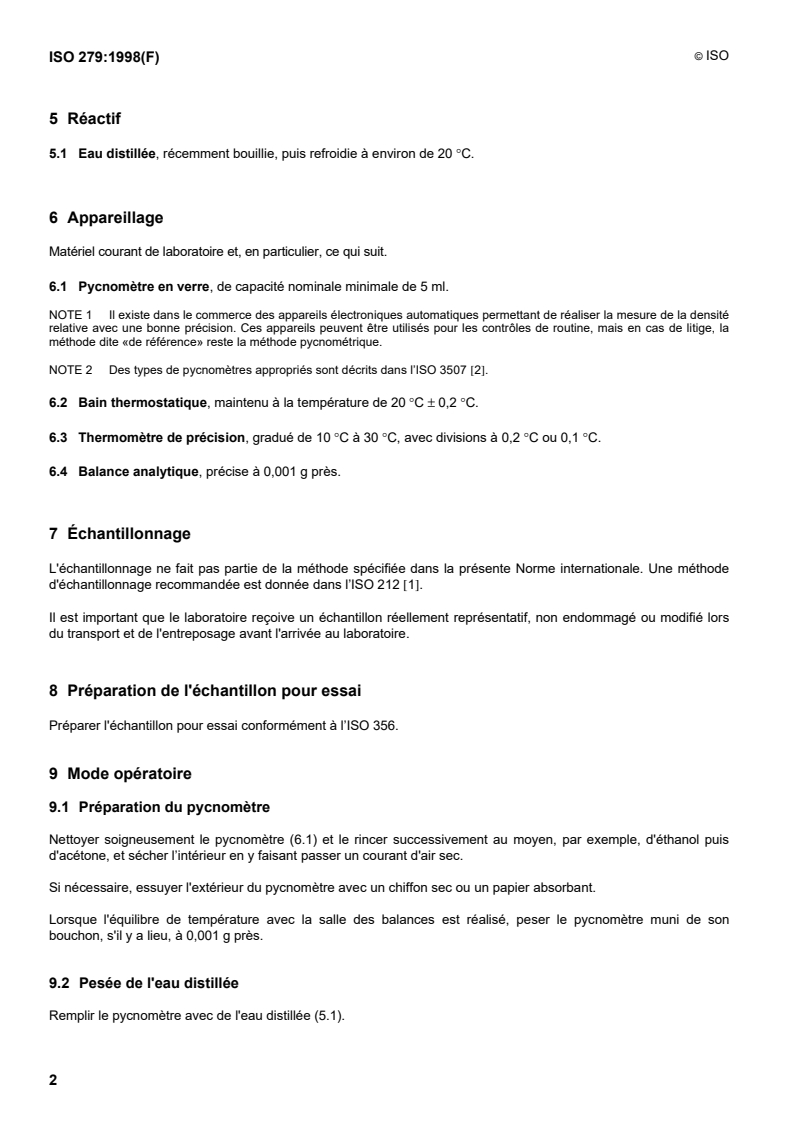
ISO 279:1998 - Huiles essentielles — Détermination de la densité relative à 20 °C — Méthode de référence/20/1998
Get Certified
Connect with accredited certification bodies for this standard

ECOCERT
Organic and sustainability certification.

Eurofins Food Testing Global
Global leader in food, environment, and pharmaceutical product testing.

Intertek Bangladesh
Intertek certification and testing services in Bangladesh.
Sponsored listings
Frequently Asked Questions
ISO 279:1998 is a standard published by the International Organization for Standardization (ISO). Its full title is "Essential oils — Determination of relative density at 20 °C — Reference method". This standard covers: La présente Norme internationale spécifie la méthode de référence pour la détermination de la densité relative à 20 °C des huiles essentielles. NOTE S'il est nécessaire d'opérer à une température différente en raison de la nature de l'huile essentielle, la température doit être indiquée dans la Norme internationale relative à l'huile essentielle considérée. La correction moyenne, aux environs de 20 °C, est de 0,000 7 à 0,000 8 par degré Celsius.
La présente Norme internationale spécifie la méthode de référence pour la détermination de la densité relative à 20 °C des huiles essentielles. NOTE S'il est nécessaire d'opérer à une température différente en raison de la nature de l'huile essentielle, la température doit être indiquée dans la Norme internationale relative à l'huile essentielle considérée. La correction moyenne, aux environs de 20 °C, est de 0,000 7 à 0,000 8 par degré Celsius.
ISO 279:1998 is classified under the following ICS (International Classification for Standards) categories: 71.100.60 - Essential oils. The ICS classification helps identify the subject area and facilitates finding related standards.
ISO 279:1998 has the following relationships with other standards: It is inter standard links to ISO 279:1981. Understanding these relationships helps ensure you are using the most current and applicable version of the standard.
ISO 279:1998 is available in PDF format for immediate download after purchase. The document can be added to your cart and obtained through the secure checkout process. Digital delivery ensures instant access to the complete standard document.
Standards Content (Sample)
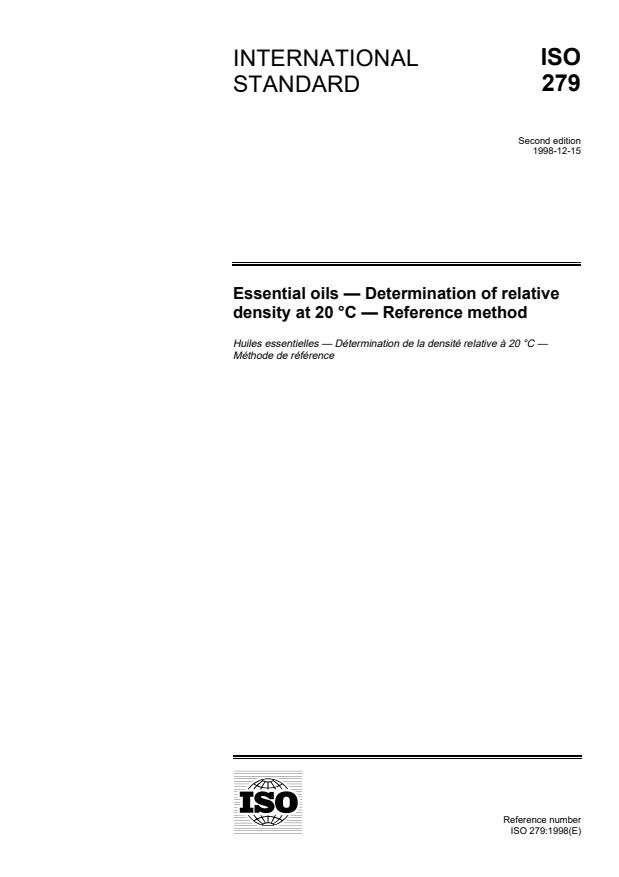
INTERNATIONAL ISO
STANDARD 279
Second edition
1998-12-15
Essential oils — Determination of relative
density at 20 °C — Reference method
Huiles essentielles — Détermination de la densité relative à 20 °C —
Méthode de référence
A
Reference number
ISO 279:1988(E)
Foreword
ISO (the International Organization for Standardization) is a worldwide federation of national standards bodies (ISO
member bodies). The work of preparing International Standards is normally carried out through ISO technical
committees. Each member body interested in a subject for which a technical committee has been established has
the right to be represented on that committee. International organizations, governmental and non-governmental, in
liaison with ISO, also take part in the work. ISO collaborates closely with the International Electrotechnical
Commission (IEC) on all matters of electrotechnical standardization.
International Standards are drafted in accordance with the rules given in the ISO/IEC Directives, Part 3.
Draft International Standards adopted by the technical committees are circulated to the member bodies for voting.
Publication as an International Standard requires approval by at least 75 % of the member bodies casting a vote.
International Standard ISO 279 was prepared by Technical Committee ISO/TC 54, Essential oils.
This second edition cancels and replaces the first edition (ISO 279:1981), which has been technically revised.
© ISO 1998
All rights reserved. Unless otherwise specified, no part of this publication may be reproduced or utilized in any form or by any means, electronic
or mechanical, including photocopying and microfilm, without permission in writing from the publisher.
International Organization for Standardization
Case postale 56 • CH-1211 Genève 20 • Switzerland
Internet iso@iso.ch
Printed in Switzerland
ii
INTERNATIONAL STANDARD © ISO ISO 279:1998(E)
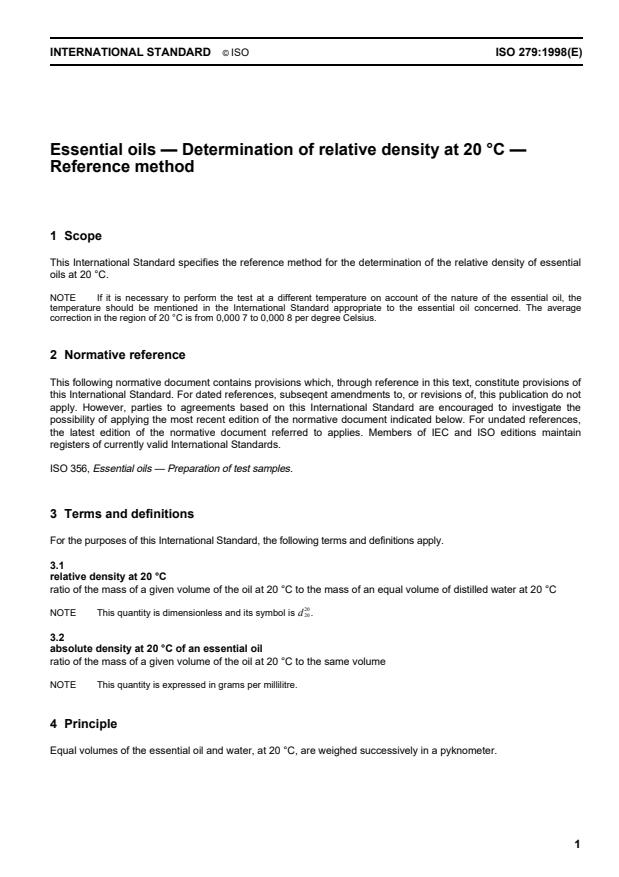
Essential oils — Determination of relative density at 20 °C —
Reference method
1 Scope
This International Standard specifies the reference method for the determination of the relative density of essential
oils at 20 °C.
NOTE If it is necessary to perform the test at a different temperature on account of the nature of the essential oil, the
temperature should be mentioned in the International Standard appropriate to the essential oil concerned. The average
correction in the region of 20 °C is from 0,000 7 to 0,000 8 per degree Celsius.
2 Normative reference
This following normative document contains provisions which, through reference in this text, constitute provisions of
this International Standard. For dated references, subseqent amendments to, or revisions of, this publication do not
apply. However, parties to agreements based on this International Standard are encouraged to investigate the
possibility of applying the most recent edition of the normative document indicated below. For undated references,
the latest edition of the normative document referred to applies. Members of IEC and ISO editions maintain
registers of currently valid International Standards.
ISO 356, Essential oils — Preparation of test samples.
3 Terms and definitions
For the purposes of this International Standard, the following terms and definitions apply.
3.1
relative density at 20 °C
ratio of the mass of a given volume of the oil at 20 °C to the mass of an equal volume of distilled water at 20 °C
NOTE This quantity is dimensionless and its symbol is d .
3.2
absolute density at 20 °C of an essential oil
ratio of the mass of a given volume of the oil at 20 °C to the same volume
NOTE This quantity is expressed in grams per millilitre.
4 Principle
Equal volumes of the essential oil and water, at 20 °C, are weighed successi
...
INTERNATIONAL ISO
STANDARD 279
Second edition
1998-12-15
Essential oils — Determination of relative
density at 20 °C — Reference method
Huiles essentielles — Détermination de la densité relative à 20 °C —
Méthode de référence
A
Reference number
ISO 279:1988(E)
Foreword
ISO (the International Organization for Standardization) is a worldwide federation of national standards bodies (ISO
member bodies). The work of preparing International Standards is normally carried out through ISO technical
committees. Each member body interested in a subject for which a technical committee has been established has
the right to be represented on that committee. International organizations, governmental and non-governmental, in
liaison with ISO, also take part in the work. ISO collaborates closely with the International Electrotechnical
Commission (IEC) on all matters of electrotechnical standardization.
International Standards are drafted in accordance with the rules given in the ISO/IEC Directives, Part 3.
Draft International Standards adopted by the technical committees are circulated to the member bodies for voting.
Publication as an International Standard requires approval by at least 75 % of the member bodies casting a vote.
International Standard ISO 279 was prepared by Technical Committee ISO/TC 54, Essential oils.
This second edition cancels and replaces the first edition (ISO 279:1981), which has been technically revised.
© ISO 1998
All rights reserved. Unless otherwise specified, no part of this publication may be reproduced or utilized in any form or by any means, electronic
or mechanical, including photocopying and microfilm, without permission in writing from the publisher.
International Organization for Standardization
Case postale 56 • CH-1211 Genève 20 • Switzerland
Internet iso@iso.ch
Printed in Switzerland
ii
INTERNATIONAL STANDARD © ISO ISO 279:1998(E)
Essential oils — Determination of relative density at 20 °C —
Reference method
1 Scope
This International Standard specifies the reference method for the determination of the relative density of essential
oils at 20 °C.
NOTE If it is necessary to perform the test at a different temperature on account of the nature of the essential oil, the
temperature should be mentioned in the International Standard appropriate to the essential oil concerned. The average
correction in the region of 20 °C is from 0,000 7 to 0,000 8 per degree Celsius.
2 Normative reference
This following normative document contains provisions which, through reference in this text, constitute provisions of
this International Standard. For dated references, subseqent amendments to, or revisions of, this publication do not
apply. However, parties to agreements based on this International Standard are encouraged to investigate the
possibility of applying the most recent edition of the normative document indicated below. For undated references,
the latest edition of the normative document referred to applies. Members of IEC and ISO editions maintain
registers of currently valid International Standards.
ISO 356, Essential oils — Preparation of test samples.
3 Terms and definitions
For the purposes of this International Standard, the following terms and definitions apply.
3.1
relative density at 20 °C
ratio of the mass of a given volume of the oil at 20 °C to the mass of an equal volume of distilled water at 20 °C
NOTE This quantity is dimensionless and its symbol is d .
3.2
absolute density at 20 °C of an essential oil
ratio of the mass of a given volume of the oil at 20 °C to the same volume
NOTE This quantity is expressed in grams per millilitre.
4 Principle
Equal volumes of the essential oil and water, at 20 °C, are weighed successi
...
NORME ISO
INTERNATIONALE 279
Deuxième édition
1998-12-15
Huiles essentielles — Détermination
de la densité relative à 20 °C — Méthode
de référence
Essential oils — Determination of relative density at 20 °C — Reference
method
AA
Numéro de référence
Avant-propos
L'ISO (Organisation internationale de normalisation) est une fédération mondiale d'organismes nationaux de
normalisation (comités membres de l'ISO). L'élaboration des Normes internationales est en général confiée aux
comités techniques de l'ISO. Chaque comité membre intéressé par une étude a le droit de faire partie du comité
technique créé à cet effet. Les organisations internationales, gouvernementales et non gouvernementales, en
liaison avec l'ISO participent également aux travaux. L'ISO collabore étroitement avec la Commission
électrotechnique internationale (CEI) en ce qui concerne la normalisation électrotechnique.
Les Normes internationales sont rédigées conformément aux règles données dans les Directives ISO/CEI, Partie 3.
Les projets de Normes internationales adoptés par les comités techniques sont soumis aux comités membres pour
vote. Leur publication comme Normes internationales requiert l'approbation de 75 % au moins des comités
membres votants.
La Norme internationale ISO 279 a été élaborée par le comité technique ISO/TC 54, Huiles essentielles.
Cette deuxième édition annule et remplace la première édition (ISO 279:1981), dont elle constitue une révision
technique.
© ISO 1998
Droits de reproduction réservés. Sauf prescription différente, aucune partie de cette publication ne peut être reproduite ni utilisée sous quelque
forme que ce soit et par aucun procédé, électronique ou mécanique, y compris la photocopie et les microfilms, sans l'accord écrit de l'éditeur.
Organisation internationale de normalisation
Case postale 56 • CH-1211 Genève 20 • Suisse
Internet iso@iso.ch
Imprimé en Suisse
ii
NORME INTERNATIONALE © ISO ISO 279:1998(F)
Huiles essentielles — Détermination de la densité relative
à 20 °C — Méthode de référence
1 Domaine d’application
La présente Norme internationale spécifie la méthode de référence pour la détermination de la densité relative à
20 °C des huiles essentielles.
NOTE S'il est nécessaire d'opérer à une température différente en raison de la nature de l'huile essentielle, la température
doit être indiquée dans la Norme internationale relative à l'huile essentielle considérée. La correction moyenne, aux environs
de 20 °C, est de 0,000 7 à 0,000 8 par degré Celsius.
2 Référence normative
Le document normatif suivant contient des dispositions qui, par suite de la référence qui y est faite, constituent des
dispositions valables pour la présente Norme internationale. Pour les références datées, les amendements
ultérieurs ou les révisions de ces publications ne s'appliquent pas. Toutefois, les parties prenantes aux accords
fondés sur la présente Norme internationale sont invitées à rechercher la possibilité d’appliquer l’édition la plus
récente du document normatif indiqué ci-après. Pour les références non datées, la dernière édition du document
normatif en référence s'applique. Les membres de l’ISO et de la CEI possèdent le registre des Normes
internationales en vigueur.
ISO 356, Huiles essentielles — Préparation des échantillons pour essai.
3 Termes et définitions
Pour les besoins de la présente Norme internationale, les termes et définitions suivants s'appliquent.
3.1
densité relative à 20 °C
rapport de la masse d'un certain volume d'une huile essentielle à 20 °C, à la masse d'un volume égal d'eau distillée
à 20 °C
d
NOTE Cette grandeur est sans dimension et son symbole est .
3.2
densité absolue à 20 °C d'une huile essentielle
rapport de la masse d'un certain volume de cette huile à 20 °C, à ce volume
NOTE Cette grandeur est exprimée en grammes par millilitre.
4 Principe
À l'aide d'un pycnomètre, pesées successives de volumes égaux d'huile essentielle et d'eau, à la température de
20 °C.
© ISO
5 Réactif
5.1 Eau
...
NORME ISO
INTERNATIONALE 279
Deuxième édition
1998-12-15
Huiles essentielles — Détermination
de la densité relative à 20 °C — Méthode
de référence
Essential oils — Determination of relative density at 20 °C — Reference
method
AA
Numéro de référence
Avant-propos
L'ISO (Organisation internationale de normalisation) est une fédération mondiale d'organismes nationaux de
normalisation (comités membres de l'ISO). L'élaboration des Normes internationales est en général confiée aux
comités techniques de l'ISO. Chaque comité membre intéressé par une étude a le droit de faire partie du comité
technique créé à cet effet. Les organisations internationales, gouvernementales et non gouvernementales, en
liaison avec l'ISO participent également aux travaux. L'ISO collabore étroitement avec la Commission
électrotechnique internationale (CEI) en ce qui concerne la normalisation électrotechnique.
Les Normes internationales sont rédigées conformément aux règles données dans les Directives ISO/CEI, Partie 3.
Les projets de Normes internationales adoptés par les comités techniques sont soumis aux comités membres pour
vote. Leur publication comme Normes internationales requiert l'approbation de 75 % au moins des comités
membres votants.
La Norme internationale ISO 279 a été élaborée par le comité technique ISO/TC 54, Huiles essentielles.
Cette deuxième édition annule et remplace la première édition (ISO 279:1981), dont elle constitue une révision
technique.
© ISO 1998
Droits de reproduction réservés. Sauf prescription différente, aucune partie de cette publication ne peut être reproduite ni utilisée sous quelque
forme que ce soit et par aucun procédé, électronique ou mécanique, y compris la photocopie et les microfilms, sans l'accord écrit de l'éditeur.
Organisation internationale de normalisation
Case postale 56 • CH-1211 Genève 20 • Suisse
Internet iso@iso.ch
Imprimé en Suisse
ii
NORME INTERNATIONALE © ISO ISO 279:1998(F)
Huiles essentielles — Détermination de la densité relative
à 20 °C — Méthode de référence
1 Domaine d’application
La présente Norme internationale spécifie la méthode de référence pour la détermination de la densité relative à
20 °C des huiles essentielles.
NOTE S'il est nécessaire d'opérer à une température différente en raison de la nature de l'huile essentielle, la température
doit être indiquée dans la Norme internationale relative à l'huile essentielle considérée. La correction moyenne, aux environs
de 20 °C, est de 0,000 7 à 0,000 8 par degré Celsius.
2 Référence normative
Le document normatif suivant contient des dispositions qui, par suite de la référence qui y est faite, constituent des
dispositions valables pour la présente Norme internationale. Pour les références datées, les amendements
ultérieurs ou les révisions de ces publications ne s'appliquent pas. Toutefois, les parties prenantes aux accords
fondés sur la présente Norme internationale sont invitées à rechercher la possibilité d’appliquer l’édition la plus
récente du document normatif indiqué ci-après. Pour les références non datées, la dernière édition du document
normatif en référence s'applique. Les membres de l’ISO et de la CEI possèdent le registre des Normes
internationales en vigueur.
ISO 356, Huiles essentielles — Préparation des échantillons pour essai.
3 Termes et définitions
Pour les besoins de la présente Norme internationale, les termes et définitions suivants s'appliquent.
3.1
densité relative à 20 °C
rapport de la masse d'un certain volume d'une huile essentielle à 20 °C, à la masse d'un volume égal d'eau distillée
à 20 °C
d
NOTE Cette grandeur est sans dimension et son symbole est .
3.2
densité absolue à 20 °C d'une huile essentielle
rapport de la masse d'un certain volume de cette huile à 20 °C, à ce volume
NOTE Cette grandeur est exprimée en grammes par millilitre.
4 Principe
À l'aide d'un pycnomètre, pesées successives de volumes égaux d'huile essentielle et d'eau, à la température de
20 °C.
© ISO
5 Réactif
5.1 Eau
...
Questions, Comments and Discussion
Ask us and Technical Secretary will try to provide an answer. You can facilitate discussion about the standard in here.
Loading comments...