

ISO/PRF 24644-1
(Main)Mass customization value chain management — Part 1: Framework
General Information
- Abstract
This document specifies a framework for mass customization value chain management, including the framework model, functions and information flow of mass customization. This document does not describe interoperability at a system level or interoperability throughout the life cycle in detail.
- Status
- Not Published
- Technical Committee
- ISO/TC 184/SC 5 - Interoperability, integration, and architectures for enterprise systems and automation applications
- Drafting Committee
- ISO/TC 184/SC 5/WG 14 - Mass customization
- Current Stage
- 5020 - FDIS ballot initiated: 2 months. Proof sent to secretariat
- Start Date
- 04-Sep-2026
- Completion Date
- 12-Sep-2026
Buy Documents


ISO/PRF 24644-1 - Mass customization value chain management — Part 1: Framework

REDLINE ISO/PRF 24644-1 - Mass customization value chain management — Part 1: Framework
Overview
ISO/PRF 24644-1: Mass customization value chain management – Part 1: Framework is an international standard developed by ISO Technical Committee 184, Subcommittee 5 (Automation systems and integration; Interoperability, integration, and architectures for enterprise systems and automation applications). This standard establishes a comprehensive framework for managing value chains in mass customization environments by defining the framework model, core functions, and key information flows required for effective mass customization. It does not cover system-level interoperability or address interoperability across the entire product lifecycle in detail.
As businesses increasingly adopt mass customization to meet individualized customer demands while maintaining production efficiency, ISO/PRF 24644-1 offers a structured approach to optimize value chain operations, minimize costs, and enhance customer experience.
Key Topics
- Framework Model: Outlines a two-dimensional structure combining system levels (equipment, control, workshop, enterprise, collaboration layers) and product lifecycle activities (interaction, R&D, marketing and sales, sourcing and planning, production, logistics, and service).
- Domain Division: Introduces three core domains:
- Concept-to-Order (CTO): Encompasses early customer interaction, product development, marketing, and sourcing.
- Order-to-Delivery (OTD): Covers production and logistics activities.
- Delivery-to-Service (DTS): Focuses on service, customer experience feedback, and product recycling.
- Functional Activities: Details seven primary activities essential to mass customization:
- Interaction (user engagement and demand collection)
- Research and Development (translating demands into custom product designs)
- Marketing and Sales (promoting and managing customized orders)
- Sourcing and Planning (procuring materials and scheduling production)
- Production (executing tailored manufacturing)
- Logistics (delivering customized products)
- Service (after-sales support, customer feedback, and value-added services)
- Information Flow: Emphasizes the importance of clear information exchange between activities and layers, enabling real-time responsiveness and adaptation throughout the value chain.
- Supporting Components: Includes Quality, Health, Safety, and Environment (QHSE) management and data management as foundational elements.
Applications
ISO/PRF 24644-1 is crucial for organizations aiming to implement or improve mass customization processes across diverse industries, helping to:
- Enhance Product Personalization: Enable flexible, user-driven customization of products and services while sustaining mass-production efficiency.
- Improve Operational Coordination: Standardize functional roles and data flow, ensuring alignment between departments (e.g., R&D, production, sales, and logistics).
- Optimize Resource Management: Reduce inventory-related costs and streamline procurement through accurate demand forecasting and responsive supply chain practices.
- Boost Customer Satisfaction: Empower customers to participate in product definition, monitor production progress, and provide feedback that informs product improvements.
- Facilitate Innovation: Support collaborative development, modular product design, and iterative product optimization based on real-time data from user interactions.
Typical implementation scenarios include consumer electronics, automotive, iron and steel, electrical, and reverse customization sectors, supporting scalable and agile response to market demands.
Related Standards
Organizations applying ISO/PRF 24644-1 may also find the following standards relevant for comprehensive value chain optimization and enterprise modelling:
- ISO 19439:2006 – Framework for enterprise modelling: foundational principles for defining enterprise activities and function views.
- ISO 19440:2020 – Process modelling concepts and constructs for enterprise modelling.
- ISO 15704:2019 – Requirements for enterprise-reference architectures and methodologies.
- IEC 62264-1:2013 – Models and terminology for integrating manufacturing operations and enterprise functions.
- ISO 22948:2020 – Value chain definitions and activities.
Together, these standards help organizations build robust, interoperable systems for mass customization management, supporting both strategic planning and operational execution.
Keywords: mass customization, value chain management, customization framework, information flow, enterprise modeling, production optimization, user-centric design, ISO standards, QHSE management, data management, supply chain standardization
Relations
- Effective Date
- 01-Feb-2025
Buy Documents
ISO/PRF 24644-1 - Mass customization value chain management — Part 1: Framework
REDLINE ISO/PRF 24644-1 - Mass customization value chain management — Part 1: Framework
Get Certified
Connect with accredited certification bodies for this standard

DVS-ZERT GmbH
German welding certification society.
CARES (UK Certification Authority for Reinforcing Steels)
UK certification for reinforcing steels and construction.
EWF/IIW (European/International Welding Federation)
International welding personnel certification.
Sponsored listings
Frequently Asked Questions
ISO/PRF 24644-1 is a draft published by the International Organization for Standardization (ISO). Its full title is "Mass customization value chain management — Part 1: Framework". This standard covers: This document specifies a framework for mass customization value chain management, including the framework model, functions and information flow of mass customization. This document does not describe interoperability at a system level or interoperability throughout the life cycle in detail.
This document specifies a framework for mass customization value chain management, including the framework model, functions and information flow of mass customization. This document does not describe interoperability at a system level or interoperability throughout the life cycle in detail.
ISO/PRF 24644-1 is classified under the following ICS (International Classification for Standards) categories: 25.040.40 - Industrial process measurement and control. The ICS classification helps identify the subject area and facilitates finding related standards.
ISO/PRF 24644-1 has the following relationships with other standards: It is inter standard links to ISO/PAS 24644-1:2023. Understanding these relationships helps ensure you are using the most current and applicable version of the standard.
ISO/PRF 24644-1 is available in PDF format for immediate download after purchase. The document can be added to your cart and obtained through the secure checkout process. Digital delivery ensures instant access to the complete standard document.
Standards Content (Sample)
International
Standard
ISO 24644-1
First edition
Mass customization value chain
2026-10
management —
Part 1:
Framework
Management de la chaîne de valeur de la personnalisation de
masse —
Partie 1: Cadre
PROOF/ÉPREUVE
Reference number
ISO 24644-1:2026(en) © ISO 2026
ISO 24644-1:2026(en)
© ISO 2026
All rights reserved. Unless otherwise specified, or required in the context of its implementation, no part of this publication may
be reproduced or utilized otherwise in any form or by any means, electronic or mechanical, including photocopying, or posting on
the internet or an intranet, without prior written permission. Permission can be requested from either ISO at the address below
or ISO’s member body in the country of the requester.
ISO copyright office
CP 401 • Ch. de Blandonnet 8
CH-1214 Vernier, Geneva
Phone: +41 22 749 01 11
Email: copyright@iso.org
Website: www.iso.org
Published in Switzerland
PROOF/ÉPREUVE
ii
ISO 24644-1:2026(en)
Contents Page
Foreword .iv
Introduction .v
1 Scope . 1
2 Normative references . 1
3 Terms and definitions . 1
4 Abbreviated terms . 2
5 Mass customization value chain management overview . 3
6 Framework model . 4
6.1 General description of the framework model .4
6.2 Framework model domain .5
7 Functional model . 7
7.1 Functional model notation .7
7.2 General description of functional model .8
7.3 Interaction .9
7.4 R&D .10
7.5 Marketing and sales . 12
7.6 Sourcing and planning . 13
7.7 Production .14
7.8 Logistics . . 15
7.9 Service .17
7.10 QHSE management .18
7.11 Data management .18
8 Information flow of mass customization .18
Annex A (informative) Mass customization value chain management — Consumer electronics
industry .21
Annex B (informative) Mass customization value chain management — Iron and steel industry .27
Annex C (informative) Mass customization value chain management — Electrical industry .29
Annex D (informative) Mass customization value chain management — Reverse customization .32
Annex E (informative) Mass customization value chain management — Automotive industry .35
Bibliography .37
PROOF/ÉPREUVE
iii
ISO 24644-1:2026(en)
Foreword
ISO (the International Organization for Standardization) is a worldwide federation of national standards
bodies (ISO member bodies). The work of preparing International Standards is normally carried out through
ISO technical committees. Each member body interested in a subject for which a technical committee
has been established has the right to be represented on that committee. International organizations,
governmental and non-governmental, in liaison with ISO, also take part in the work. ISO collaborates closely
with the International Electrotechnical Commission (IEC) on all matters of electrotechnical standardization.
The procedures used to develop this document and those intended for its further maintenance are described
in the ISO/IEC Directives, Part 1. In particular, the different approval criteria needed for the different types
of ISO document should be noted. This document was drafted in accordance with the editorial rules of the
ISO/IEC Directives, Part 2 (see www.iso.org/directives).
ISO draws attention to the possibility that the implementation of this document may involve the use of (a)
patent(s). ISO takes no position concerning the evidence, validity or applicability of any claimed patent
rights in respect thereof. As of the date of publication of this document, ISO had not received notice of (a)
patent(s) which may be required to implement this document. However, implementers are cautioned that
this may not represent the latest information, which may be obtained from the patent database available at
www.iso.org/patents. ISO shall not be held responsible for identifying any or all such patent rights.
Any trade name used in this document is information given for the convenience of users and does not
constitute an endorsement. For an explanation of the voluntary nature of standards, the meaning of ISO
specific terms and expressions related to conformity assessment, as well as information about ISO's
adherence to the World Trade Organization (WTO) principles in the Technical Barriers to Trade (TBT), see
www.iso.org/iso/foreword.html.
This document was prepared by Technical Committee ISO/TC 184, Automation systems and integration,
Subcommittee SC 5, Interoperability, integration, and architectures for enterprise systems and automation
applications.
This first edition cancels and replaces the first edition (ISO/PAS 24644-2:2023), which has been technically
revised.
The main changes are as follows:
— In Clause 7, Quality, Health, Safety, and Environment (QHSE) and data management have been added.
— In Clause 8, the intelligent interaction engine node has been added.
— Annex E has been added.
A list of all parts in the ISO 24644 series can be found on the ISO website.
Any feedback or questions on this document should be directed to the user’s national standards body. A
complete listing of these bodies can be found at www.iso.org/members.html.
PROOF/ÉPREUVE
iv
ISO 24644-1:2026(en)
Introduction
Alongside the generalization and popularization of Internet technologies, Internet of Things (IoT), flexible
manufacturing technologies and modern logistics, individualized customization services have become
embedded into all industrial and service sectors. Users can, by means of Internet platforms, determine and
customize their own products according to their own demands. Mass customization is becoming a new mode
in the manufacturing industry, and value chains will ultimately be driven by the users. Cooperation among
enterprises is required by using quick-response Internet platforms to provide a wide range of products and
services in small lots to satisfy the users with various individualized demands.
From the user’s perspective, when they directly interact with enterprises for customized products, they
also wish to participate in the creation process of their individualized product and to obtain or receive
information about the progress of the product.
From the enterprise perspective, mass customization will assist enterprises in realizing the real-time and
accurate understanding of the user’s demands. Customized products increase the premium value of products
for enterprises. Through accurately estimating a priori information from customized product demand and
requirements from the users, enterprises can reduce or eliminate inventory-related costs by appropriately
conducting large-scale procurement or production.
PROOF/ÉPREUVE
v
International Standard ISO 24644-1:2026(en)
Mass customization value chain management —
Part 1:
Framework
1 Scope
This document specifies a framework for mass customization value chain management, including the
framework model, functions and information flow of mass customization. This document does not describe
interoperability at a system level or interoperability throughout the life cycle in detail.
2 Normative references
There are no normative references in this document.
3 Terms and definitions
For the purposes of this document, the following terms and definitions apply.
ISO and IEC maintain terminological databases for use in standardization at the following addresses:
— ISO Online browsing platform: available at https:// www .iso .org/ obp
— IEC Electropedia: available at https:// www .electropedia .org/
3.1
domain, noun
functional area
[1]
[SOURCE: ISO 24097-1:2017 , 3.1.2, modified — “in a policy assertion” has been deleted from the definition.
The EXAMPLE has been deleted.]
3.2
information flow, noun
transfer of information from an information-source-object to an information-destination-object
[2]
[SOURCE: ISO/IEC 16500-1:1999 , 3.30]
3.3
interaction, noun
exchange of information between a user and a system via the human-system interface to achieve the
intended goal
[3]
[SOURCE: EN ISO 11064-5:2008 , 3.20, modified — the admitted term "dialogue" has been deleted.]
3.4
mass customization, noun
production mode that provides customized products and services according to the individualized demands
of users with the cost and efficiency in mass production
PROOF/ÉPREUVE
ISO 24644-1:2026(en)
3.5
user experience, noun
person's perceptions and responses resulting from the use and/or anticipated use of a product, system or
service
[4]
[SOURCE: ISO/IEC 30071-1:2019 , 3.1.6, modified — Notes 1 and 2 to entry have been deleted.]
3.6
value-added service, noun
service that is offered in addition to the core service in question thus creating additional value
[5]
[SOURCE: ISO 17573-2:2025 , 3.238]
3.7
value chain, noun
range of activities or parties that create or receive value in the form of products or services
[6]
[SOURCE: ISO 22948:2020 , 3.2.11]
3.8
product scheme, noun
product solutions designed according to user customization demands
3.9
social community, noun
collective organization where people with common interests, goals or values come together socially
Note 1 to entry: A social community can represent physical communities based on geographic areas, or online
communities such as social networking groups.
3.10
computer-aided X, noun
CAX, noun
comprehensive term for various computer-aided technologies such as CAD, CAM, CAE, CAPP, CIM, CAS, CAT,
CAI, etc.
3.11
intelligent interaction engine, noun
software integrating with enterprise systems, supporting information exchange between users and
enterprise systems to meet user needs or complete the intended task
4 Abbreviated terms
For the purposes of this document, the following abbreviated terms apply.
APS Advanced planning and scheduling
BOM Bill of material
B2B Business to business
CAX Computer aided X
CBL Collaboration layer
CTL Control layer
CP Configuration partner
CRM Customer relationship management
PROOF/ÉPREUVE
ISO 24644-1:2026(en)
CTO Configure-to-order
DTS Delivery-to-service
EML Equipment layer
EPL Enterprise layer
ERP Enterprise resource planning
EVI Early vendor involvement
FIFO First-in-first-out
MRP Material requirements planning
CTO Concept-to-order
OTD Order-to-delivery
PLM Product lifecycle management
QHSE Quality, health, safety, and environment
TMS Transportation management system
WMS Warehouse management system
WSL Workshop layer
5 Mass customization value chain management overview
For mass customization value chain management, the value activities of mass customization can be divided
into domains from the perspective of life cycle and system, and the contents of each activity and the
information transmitted between activities should be clearly defined. The framework of mass customization
value chain management consists of an activity interaction model, activity definitions, and identification of
general information flows. This document falls in the constructs of function view, according to the definition
[7]
of enterprise activity and function view in ISO 19439:2006 .
NOTE 1 ISO 19439 specifies that the function view is required to represent the business processes of the enterprise
domain, their functionality, behaviour, inputs and outputs. The function view is required to describe the assembly
of single processing steps as a collection of processes (business processes and enterprise activities) structured as a
network of activities reflecting their logical connection and interdependencies.
NOTE 2 ISO 19439 specifies that enterprise activity is all, or part, of process functionality that consists of
elementary tasks performed in the enterprise that consume inputs and allocate time and resources to produce
outputs.
With the definitions and concepts of enterprise activity and function view, the framework is generated
[7]
referring to the enterprise modelling concepts defined in ISO 19439:2006 , which fulfils the requirement
[8]
of ISO 15704:2019 5.3.3 and 6.5.1.3. Specifically, the framework corresponds with the domain
identification, concept definitions and requirements definition of the function view at the generic level as
[9]
shown in the dashed area of Figure 1. The modelling concepts are reused in ISO 19440:2020 , which builds
[7]
on ISO 19439:2006 , to identify and specify constructs necessary for users that model enterprises.
[7] [7]
NOTE 3 Figure 1 is excerpted from ISO 19439:2006 , and it is Figure 5 in ISO 19439:2006 .
PROOF/ÉPREUVE
ISO 24644-1:2026(en)
Figure 1 — Overview of the framework for enterprise modelling
6 Framework model
6.1 General description of the framework model
The framework model of mass customization consists of two dimensions, namely system level and life
cycle. The vertical axis in Figure 2 presents the system level, which includes equipment layer (EML),
control layer (CTL), workshop layer (WSL), enterprise layer (EPL) and collaboration layer (CBL) based on
[10]
IEC 62264-1:2013 . The horizontal axis in Figure 2 covers the whole life cycle of a product, which includes
seven activities: interaction, research and development (R&D), marketing and sales, sourcing and planning,
production, logistics and service.
System level in Figure 2 is divided into five layers according to the organizational structure related to
enterprise production activities, in which:
— Equipment layer (MEL) is applied by an enterprise to realize the actual physical process, and perceive
and operate it by means of sensor, instrument, machine, device, and other methods;
— Control layer (CTL) is used for handling information, and realizing the monitoring and controlling
physical process within an enterprise;
— Workshop layer (WSL) is applicable for realizing production management within a factory or a workshop;
— Enterprise layer (EPL) aims to realize enterprise oriented business management; and
PROOF/ÉPREUVE
ISO 24644-1:2026(en)
— Collaboration layer (CBL) is applied to realizing the interconnectivity and sharing of internal and external
information in an enterprise and the business coordination between enterprises.
Mass customization domains include concept-to-order (CTO) domain, order-to-delivery (OTD) domain, and
delivery-to-service (DTS) domain.
As shown in Figure 2, the CTO domain covers four activities from the life cycle, i.e., interaction, R&D,
marketing and sales, and sourcing and planning, and it contains WSL and CBL from the system level.
The OTD domain includes the production activity and logistic activity. In the production activity, it covers
the EML, CTL, WSL and EPL. In the logistics activity, it includes all five system layers.
The DTS domain covers the service activity from the life cycle, and contains the EPL and CBL from the
system level.
Key
domain
Figure 2 — Mass customization domains
6.2 Framework model domain
In the CTO domain, user demands should be focused on, product schemes is the output of the interaction
and R&D activities. User orders are generated through the marketing and sales activity. Enterprises arrange
a master production schedule according to the product scheme and the user orders, and find suitable
suppliers through the sourcing and planning activity to ensure commodity supply. The contents of a user
order include user basic information, customization information, expected delivery date and place, product
model, payment information, etc.
NOTE In this document, commodity includes raw material and purchasing parts from suppliers.
PROOF/ÉPREUVE
ISO 24644-1:2026(en)
In the interaction activity, enterprises collect user demands, and interact with users and ecosystem partners,
conduct user demands analysis and screening, and output customized demands. The interaction methods
include user interface, network (e.g. users’ interactions with enterprises via surfing the Internet by using
the platforms), social networking (e.g., users’ interaction with enterprises through the social media), web,
apps, etc.
In the R&D activity, enterprises conduct customized demands classification, assessment and transformation,
and output product solutions after simulation verification. If customized demands cannot be achieved,
enterprises should provide timely feedback to users.
In the marketing and sales activity, enterprises conduct product positioning and pricing, and this activity
should obtain user orders through precision marketing.
In the sourcing and planning activity, enterprises find suitable material suppliers for source searching
demands and procurement demands.
In the OTD domain, factories conduct the production activity to produce customized products, and deliver
them to users through the logistics activity.
In the production activity, factories arrange a detailed production plan according to the master production
schedule and material status (including material in stock or its expected arrival time), and workshops shall
execute manufacturing according to the detailed production plan.
In the logistics activity, enterprises arrange reasonable a delivery route and deliver the customized products
to the designated place at the appointed time through logistics management.
In the DTS domain, enterprises obtain user experience information through the service activity, and the
analysis of conduct online or offline diagnosis to get the status information of products, and this activity
should provide after-sales and value-added services for users. Enterprises should promote the recycling of
customized products.
The user experience information and new demands obtained from the DTS domain get the fed back to the
MTO domain and OTD domain to promote product optimization and iteration.
Figure 3 depicts mass customization domains, elements and functions, and information flow showing the
interaction between the users and domains, pictorially summarizing the dynamics of the CTO, OTD, and DTS
domains.
PROOF/ÉPREUVE
ISO 24644-1:2026(en)
Key
domain
function
information flow
element
Figure 3 — Mass customization domains and functions
7 Functional model
7.1 Functional model notation
Figure 4 provides a mass customization functional model. The notations used in Figure 4 and the interaction
workflow of seven activities (interaction, R&D, marketing and sales, sourcing and planning, production,
logistics and service) shown in Figure 5 to Figure 11 are described in Table 1.
PROOF/ÉPREUVE
ISO 24644-1:2026(en)
Table 1 — Notation used in functional model and workflow of seven activities
Symbol Name Definition
Any entity (e.g. person, group) who makes usage of either the custom-
users
ized services or products, or both.
A set of actions that consumes time and resources and whose perfor-
activity mance is necessary to achieve, or contribute to, the realization of one
or more outcomes.
input/output
Information which transfers into/out of workflow.
information
The representation of all information that is dealt within an informa-
database
tion system, taken together.
element A necessary or typical part of workflow.
Transfer of information from an information-source-object to an infor-
information flow
mation-destination-object.
7.2 General description of functional model
As shown in Figure 4, the mass customization functional model is a synthesis of user-centred functions
covering seven activities in the customization life cycle. In Figure 4, “Users” is shown at the centre; the
rectangle boxes in the perimeter represent the lifecycle activities; and the solid arrows represent the
information flow between “Users” and the activities and also between the adjacent activities. The activities
do not need to completely correspond to a department or departments of the enterprise. Different enterprises
may place one or more activities in different departments or with external entrusted third parties.
Mass customization enterprises need to establish a unified platform or system not only to support the
horizontal integration and interoperability of the seven activities, but also to acquire users’ immediate
and overall satisfaction from creativity to product development, production, delivery and service. In mass
customization, the relationship among activities is between multiple entities (e.g., corporative, enterprises
or departments), which may take the same role carrying out the same activity simultaneously, and they may
interact with another entity or a group of entities. The reason for taking the same role or the same activity
simultaneously is to meet a high demand of customized products in a short period of time.
To ensure the proper data is transmitted between different entities, the input and output of each activity
can be seen as the data which should be exchanged or accessed through a common interface from/to other
activities. The users of this document can build their own uniform semantic/format models of data and
interface accordingly, which can be helpful to establish an interoperable mass customization system.
NOTE The method of achieving interoperability in the functional model of mass customization is described in
[8]
ISO 15704:2019 .
QHSE (Quality, Health, Safety, and Environment) management and data management are fundamental
components of the mass customization functional model.
PROOF/ÉPREUVE
ISO 24644-1:2026(en)
Figure 4 — Functional model
7.3 Interaction
Interaction is an activity which specifies reciprocal actions, including recognizing information, making
inputs, making selections and receiving outputs, required by users to achieve a goal. The workflow of the
interaction activity is shown in Figure 5.
An interaction platform aggregates user resources (e.g., a multitude of user information collected from
the users via the interaction platform) by introducing the users being targeted for mass customization.
Then the platform categorizes the users to form social communities for demand interaction. In each social
community, experts, key opinion leaders, enterprises and resource parties should provide high-quality
and relevant topics for community discussion and also supply professional information for reference to the
community members. After demand interaction, the platform conducts demand analysis and screening from
the perspective of cost, outcome, scale, etc. Customized demands are the output of the interaction activity.
Meanwhile, the new product/service demands proposed by the users from the service activity are sent to
the interaction activity to be included in the demand interaction.
Through the repository and reuse of interaction data of different social communities, the platform achieves a
unified analysis and utilization of these data, such as the output of user profiles. The output of the customized
demand from the interaction activity should be transmitted to the R&D activity for demand creation.
PROOF/ÉPREUVE
ISO 24644-1:2026(en)
Figure 5 — Workflow of the interaction activity
7.4 R&D
R&D includes activities that enterprises undertake to innovate and introduce new products and services.
R&D defines the product scheme based on the customized demands and the resources, and then publishes
the product scheme to the marketing and sales activity and the sourcing and planning activity. The workflow
of the R&D activity is shown in Figure 6.
R&D, in the mass customization, refines the users' primary demand and transforms it into a quantifiable
demand. R&D then distributes the quantifiable demand to appropriate resource providers, including but not
limited to, technical resources, design resources and supplier resources corresponding to the quantifiable
demand classifications such as function, appearance, and module. The providers then design customized
products according to the quantifiable demand distributed to them, and the design is verified and optimized
through interactions with the users. Once the final design for the customized products is approved, modular
design, development and test processes should be carried out. Then, the customized product can be available
on the market.
The interactivity of the demand distribution and resource matching process should be considered while
implementing the mass customization system. Enterprises should build mechanisms for timely release of
the demand to the providers and collection of the response from the providers.
Modular design plays an important role in mass customization because it balances "mass production"
and "customized craft" by linking the customized demand to different process configurations or different
combinations of modules for productizing. On the one hand, consideration should be given in the module
design process to ensure that configurability will not affect product functionality. Consideration should
also be given as to whether or not the designed module can easily be used for large-scale production while
balancing customizability and cost.
PROOF/ÉPREUVE
ISO 24644-1:2026(en)
Moreover, the process data generated by R&D should be comprehensively recorded in a data store (e.g.,
R&D data repository and reuse) as reusable resources/knowledge base for possible process reengineering,
system upgrades or product iterations.
The customized demand, i.e., the input to R&D, is from the interaction activity. The customized products
produced by an approved design should be output to the marketing and sales activity, while the sourcing
and planning activity receives the source search demand and procurement demand from the R&D activity.
Figure 6 — Workflow of the R&D activity
PROOF/ÉPREUVE
ISO 24644-1:2026(en)
7.5 Marketing and sales
Marketing and sales represents the activity of informing users about a product, gaining their curiosity and
interest in it, and leading them to purchase it. The workflow of the marketing and sales is shown in Figure 7.
The information on the customized products, i.e., the output from R&D, is transmitted to the marketing and
sales activity for the product’s positioning and pricing. The customized products are promoted to target
users through precision marketing. The users who have an intention to purchase can select their choices
from the customized products. Upon placing orders and paying for the products, user orders should be
generated.
The product purchasing demand, i.e. the output from service, is transmitted to marketing and sales for
demand matching. If there is a matching product in the product library, the user places an order directly, and
then the purchase is completed when the user pays for the products. Otherwise, the demand information
will be transmitted to the interaction activity to drive a new round of interaction and R&D activities.
Through reutilizing the marketing and sales data in the repository, enterprises achieve unified analysis
of these data, such as membership management. After the user orders are generated, the marketing and
sales activity outputs the source search demand or procurement demand for the orders. This demand is
transmitted to the sourcing and planning activity for supplier sourcing.
PROOF/ÉPREUVE
ISO 24644-1:2026(en)
Figure 7 — Workflow of the marketing and sales activity
7.6 Sourcing and planning
The activities in R&D and marketing and sales trigger the master production scheduling. The workflow of
sourcing and planning is shown in Figure 8.
The procurement demand required for the user orders is released from the master production schedule.
Whether the available suppliers can meet the procurement demand should be evaluated. If available
suppliers cannot meet the procurement demand, new supplier source search demands are issued. New
suppliers respond to the demand, and then the suppliers should be evaluated. If the available suppliers can
meet the procurement demand, the demand is released to available suppliers for the demand interaction.
Purchasing mechanisms, including bidding mechanisms, are carried out during the supplier selection. The
suppliers deliver the commodity to the factory in the logistics activity.
The master production schedule, commodity in stock and their lead time from the sourcing and planning
activity is transmitted to the production activity. The sourcing and planning related data should be stored
and analysed to optimize this activity.
PROOF/ÉPREUVE
ISO 24644-1:2026(en)
Figure 8 — Workflow of the sourcing and planning activity
7.7 Production
The production activity executes the actual manufacturing process and interacts with the sourcing and
planning activity and the logistics activity. The workflow of Production is shown in Figure 9.
The master production schedule from the upstream, the material in stock and its lead time information
from the sourcing and planning activity are transmitted to the production activity. After the demand
and capacity are balanced by the scheduling system, a detailed production plan and a material demand
plan are automatically aligned to generate an executable master production plan. In the process of mass
customization, the master production schedule can be changed according to the users’ demand.
The suppliers produce and deliver the materials according to the material demand plan. The factory
produces products according to the executable production plan. Intelligent manufacturing technologies
(e.g. information technology and operational technology (IT & OT) integration, integration technology) may
be applied to increase production efficiency and flexibility. After the ordered products are rolled off the
production line, they are automatically moved and stored in a warehouse. As the products enter a warehouse
and are registered with a warehouse management system (WMS), the product information (e.g., product
PROOF/ÉPREUVE
ISO 24644-1:2026(en)
name, identification, location) is immediately transmitted to a logistics platform to begin the process of
product delivery.
Production data repository and reuse should be deployed to optimize the key indicators in the manufacturing
process, such as production efficiency, manufacturing costs and product quality.
Figure 9 — Workflow of the production activity
7.8 Logistics
Logistics in this document refers to off-site logistics, which includes planning, execution and control of the
movement and placement of materials, while on-site logistics is included as part of the production activity.
The workflow of logistics is shown in Figure 10.
The commodity supply information output from the sourcing and planning activity is transmitted to the
logistics activity for distribution. After the factory receives the commodity, the commodity delivery
information should be sent to the sourcing and planning activity.
The production activity outputs a customized product distribution order after completing the production
of the ordered products. The logistics activity generates a delivery schedule, including loading and vehicles’
route plans, etc., for customized products according to the individualized demands ordered by the users. The
delivery time to each delivery location in the route plan is estimated by using predictive algorithm engines,
real-time optimization by simulation engines, etc. The logistics activity obtains real-time delivery vehicle
PROOF/ÉPREUVE
ISO 24644-1:2026(en)
location data and real-time traffic information to update the delivery schedule, called an intelligent vehicle
scheduling, to improve the delivery efficiency and guarantee the arrival of the customized products on
schedule. The updated delivery time to each delivery location is also sent to the users at delivery locations.
The arrival of commodities information should be sent back to sourcing and planning activity.
Storing the logistics data in a repository for reuse is performed during the process of product distribution.
The logistics activity produces the arrival information of each customized product, and the arrival
information is transmitted to the service activity.
Figure 10 — Workflow of the logistics activity
PROOF/ÉPREUVE
ISO 24644-1:2026(en)
7.9 Service
Service refers to a series of activities, such as maintenance, product upgrading and value-added actions, that
should be provided by enterprises after product delivery. The workflow of the service activity is shown in
Figure 11.
After the completion of product delivery and with users' permission, the enterprise can conduct online
diagnostics and operation data analysis of the products, provide users with remote fault diagnoses and
usage suggestions, and execute remote preventive maintenance services according to users' customized
demands.
The enterprise should provide relevant after-sales services according to users’ service demands or the
subsequent events driven by the initial services. At the same time, through the collection and analysis of
product data and user service data, the enterprise should form product and service upgrade plans and feed
them back to the interaction activity in order to continuously upgrade customized products and optimize
customized services.
Enterprises should recommend or provide value-added customized services to users according to user
demands or product usage scenarios, or combine third-party resources to recommend or provide third-
party customized value-added services to the users.
Through the repository and reuse of service data after product deliveries, enterprises continuously update
their service modes and models to improve the users’ satisfaction.
Figure 11 — Workflow of the service activity
PROOF/ÉPREUVE
ISO 24644-1:2026(en)
7.10 QHSE management
QHSE management integrates processes and systems that ensure the highest standards of quality, health,
safety and environmental sustainability throughout the entire lifecycle of customized products.
Quality management within QHSE management focuses on maintaining and improving product standards
to meet customer expectations and regulatory requirements. It involves Quality Assurance (QA) to
establish systematic activities and processes to ensure that products meet defined quality standards,
and Quality Control (QC) to monitoring specific project results to ensure that they comply with relevant
quality standards, and identifying ways to eliminate causes of unsatisfactory performance. Continuous
improvement activities (e.g. lean production methods) should be implemented to ensure the reduction of
sources of waste that are common in a mass customization environment.
Health and safety management aims to protect the well-being of all stakeholders involved in the mass
customization process, including employees, customers, and the community. Key aspects include risk
assessment and management, identifying potential hazards, assessing the risks, and implementing
measures to mitigate these risks. Compliance with health and safety regulations, and specific regulations of
the industry (e.g. Good Manufacturing Practice for pharmaceutical production) is a process to ensure that
the variability introduced by customization does not provide risks in term of compliance.
Environmental management focuses on minimizing the environmental impact of mass customization
activities. This involves sustainable eco-friendly practices in design, sourcing, production, logistics, support,
and disposal. The evaluation of the potential environmental impacts of products and processes in the mass
customization scenario should identify and suggest the necessary adjustments to mitigate negative effects.
7.11 Data management
Data management underpins the entire mass customization framework by ensuring effective data
governance, integration, and utilization. It is crucial for achieving seamless interoperability and informed
decision-making across all processes. Data governance, data integration, data analytics and utilization
are elements to facilitate real-time decision-making. The mass customization framework should rely
on descriptive analytics, predictive analytics, and prescriptive analytics. All the rules and guidelines for
data usage, security, and privacy shall be defined in the mass customization environment, where all the
stakeholders face great variability in orders, scheduling, and material flows. Data formats and protocols can
potentially help the integration of data sources, inside and outside the single company, with a strong effort
on data encryption and access control.
8 Information flow of mass customization
The centre of mass customization is the users who participate in the activities of interaction, R&D, marketing
and sales, production, logistics, and service. Enterprises should establish an intelligent interaction engine
that integrates whole life cycle activities, and users can exchange information with each activity node of
mass customization through the intelligent interaction engine. The information flow of mass customization
between different activities is as shown in Figure 12, and it may include the following.
a) In the interaction activity, a user interacts with a mass customization product provider to initiate the
user’s concept discussion. Based on the user’s concept, one or more creative solutions related to the
product concepts should be shaped and iteratively adjusted according to the feedback of users. After the
creative solution, i.e., the concept design, is confirmed by the users, the solution shall be transmitted to
the R&D activity.
b) The R&D department develops product design plans based on creative solutions. The product design
scheme should be adjusted according to the users’ demand feedback and also according to its validation
by modelling and simulation (M&S). Finally, a bill of material (BOM) of a customized product shall be
developed.
c) User orders are generated by precision marketing. After the user places an order for payment, a user
order is created. The enterprise collects user data/information from the user orders and enters the
data/information to a membership management database.
PROOF/ÉPREUVE
ISO 24644-1:2026(en)
d) A master production schedule is derived from the user orders. After the master production schedule is
generated, it triggers the production activity of customized products.
e) The commodity purchase orders are generated by
...
Style Definition: Heading 1: Indent: Left: 0 cm, First
ISO/DISPRF 24644-1
line: 0 cm
ISO/TC 184/SC 5
Style Definition: Heading 2: Font: Bold, Indent: Left: 0
cm, First line: 0 cm
Secretariat: ANSI
Style Definition: Heading 3: Font: Bold, Indent: Left: 0
cm, First line: 0 cm
Date: 2026-05-1909-04
Style Definition: Heading 4: Font: Bold, Indent: Left: 0
cm, First line: 0 cm
Style Definition: Heading 5: Font: Bold, Indent: Left: 0
cm, First line: 0 cm
Style Definition: Heading 6: Font: Bold
Style Definition: IntroHeading1: Font: Bold, Indent:
Mass customization value chain management —
Left: 0 cm, First line: 0 cm
Style Definition: IntroHeading2: Font: Bold, Indent:
Left: 0 cm, First line: 0 cm
Style Definition
...
Style Definition
...
Style Definition
...
Part 1:
Style Definition: IntroHeading6
Style Definition: IntroHeading7
Framework Style Definition: IntroHeading8
Style Definition: IntroHeading9
Management de la chaîne de valeur de la personnalisation de masse —
Style Definition: ANNEX
Partie 1: Cadre
Style Definition: Key Text
Style Definition: Key Title
Style Definition: List Continue 1
Style Definition
...
Style Definition
...
Style Definition
...
Style Definition
...
Style Definition: TermNum6: Font: Bold
Style Definition: Body Text
DIS stage
Style Definition: boxedText
Style Definition: Boxed List Continue 1
Style Definition: boxedTitle
Style Definition: FooterCentered
Style Definition: FooterPageNumber
Style Definition: FooterPageRomanNumber
Style Definition: FooterCenteredContinued
Style Definition: TPS Markup Base
VVVVVVoooooottttttiiiiiing bng bng bng bng bng beeeeeegigigigigiginsnsnsnsnsns o o o o o on:n:n:n:n:n: 202 202 202 202 202 202555555------080808080808------212121212121
Formatted: French (France)
VoVoVoVoVoVotintintintintintingggggg t t t t t tererererererminminminminminminatatatatatateseseseseses o o o o o onnnnnn:::::: 222222000000222222555555------111111111111------131313131313
Formatted: French (France)
Formatted: French (France)
Formatted: French (France)
Formatted: French (France)
Formatted: English (United States)
Formatted: English (United States)
PROOF
ISO/DISPRF 24644-1:2026(en)
All rights reserved. Unless otherwise specified, or required in the context of its implementation, no part of this publication
may be reproduced or utilized otherwise in any form or by any means, electronic or mechanical, including photocopying,
or posting on the internet or an intranet, without prior written permission. Permission can be requested from either ISO
at the address below or ISO’s member body in the country of the requester.
ISO copyright office
CP 401 • Ch. de Blandonnet 8
CH-1214 Vernier, Geneva
Phone: + 41 22 749 01 11
Formatted: French (France)
E-mail: copyright@iso.org
Website: www.iso.org
Published in Switzerland
iii
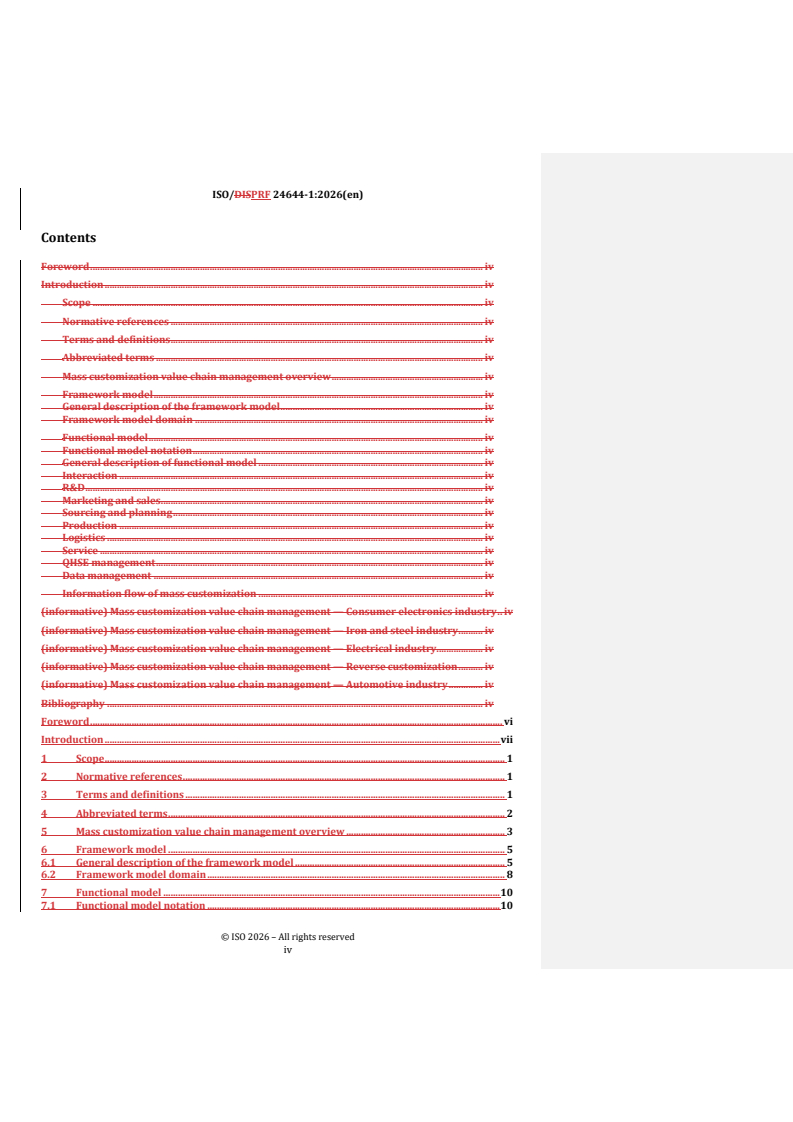
ISO/DISPRF 24644-1:2026(en)
Contents
Foreword . iv
Introduction . iv
Scope . iv
Normative references . iv
Terms and definitions . iv
Abbreviated terms . iv
Mass customization value chain management overview . iv
Framework model . iv
General description of the framework model . iv
Framework model domain . iv
Functional model . iv
Functional model notation . iv
General description of functional model . iv
Interaction . iv
R&D . iv
Marketing and sales . iv
Sourcing and planning . iv
Production . iv
Logistics . iv
Service . iv
QHSE management . iv
Data management . iv
Information flow of mass customization . iv
(informative) Mass customization value chain management — Consumer electronics industry . iv
(informative) Mass customization value chain management — Iron and steel industry . iv
(informative) Mass customization value chain management — Electrical industry . iv
(informative) Mass customization value chain management — Reverse customization . iv
(informative) Mass customization value chain management — Automotive industry . iv
Bibliography . iv
Foreword . vi
Introduction . vii
1 Scope . 1
2 Normative references . 1
3 Terms and definitions . 1
4 Abbreviated terms . 2
5 Mass customization value chain management overview . 3
6 Framework model . 5
6.1 General description of the framework model . 5
6.2 Framework model domain . 8
7 Functional model . 10
7.1 Functional model notation . 10
iv
ISO/DISPRF 24644-1:2026(en)
7.2 General description of functional model . 11
7.3 Interaction . 13
7.4 R&D . 15
7.5 Marketing and sales . 17
7.6 Sourcing and planning . 20
7.7 Production . 23
7.8 Logistics . 26
7.9 Service . 29
7.10 QHSE management . 32
7.11 Data management . 33
8 Information flow of mass customization . 33
Annex A (informative) Mass customization value chain management — Consumer electronics
industry . 37
Annex B (informative) Mass customization value chain management — Iron and steel industry45
Annex C (informative) Mass customization value chain management — Electrical industry . 50
Annex D (informative) Mass customization value chain management — Reverse customization54
Annex E (informative) Mass customization value chain management — Automotive industry . 57
Bibliography . 60
v
ISO/DISPRF 24644-1:2026(en)
Foreword
ISO (the International Organization for Standardization) is a worldwide federation of national standards
bodies (ISO member bodies). The work of preparing International Standards is normally carried out through
ISO technical committees. Each member body interested in a subject for which a technical committee has been
established has the right to be represented on that committee. International organizations, governmental and
non-governmental, in liaison with ISO, also take part in the work. ISO collaborates closely with the
International Electrotechnical Commission (IEC) on all matters of electrotechnical standardization.
The procedures used to develop this document and those intended for its further maintenance are described
in the ISO/IEC Directives, Part 1. In particular, the different approval criteria needed for the different types of
ISO documents document should be noted. This document was drafted in accordance with the editorial rules
of the ISO/IEC Directives, Part 2 (see www.iso.org/directives).
Field Code Changed
Attention is drawnISO draws attention to the possibility that some of the elementsimplementation of this
document may beinvolve the subjectuse of (a) patent(s). ISO takes no position concerning the evidence,
validity or applicability of any claimed patent rights. ISO in respect thereof. As of the date of publication of
this document, ISO had not received notice of (a) patent(s) which may be required to implement this
document. However, implementers are cautioned that this may not represent the latest information, which
may be obtained from the patent database available at www.iso.org/patents. ISO shall not be held responsible
for identifying any or all such patent rights. Details of any patent rights identified during the development of
the document will be in the Introduction and/or on the ISO list of patent declarations received (see
www.iso.org/patents).
Any trade name used in this document is information given for the convenience of users and does not
constitute an endorsement.
For an explanation of the voluntary nature of standards, the meaning of ISO specific terms and expressions
related to conformity assessment, as well as information about ISO's adherence to the World Trade
Organization (WTO) principles in the Technical Barriers to Trade (TBT), see
www.iso.org/iso/foreword.htmlwww.iso.org/iso/foreword.html.
This document was prepared by Technical Committee ISO/TC 184, Automation systems and integration,
Subcommittee SC 5, Interoperability, integration, and architectures for enterprise systems and automation
applications.
This first edition cancels and replaces the first edition (ISO/PAS 24644-2:2023), which has been technically
revised.
The main changes are as follows:
— In Clause 7, Quality, Health, Safety, and Environment (QHSE) and data management have been added.
— In Clause 8, the intelligent interaction engine node has been added.
— Annex E has been added.
A list of all parts in the ISO 24644 series can be found on the ISO website.
Any feedback or questions on this document should be directed to the user’s national standards body. A
complete listing of these bodies can be found at www.iso.org/members.html.
vi
ISO/DISPRF 24644-1:2026(en)
Introduction
Alongside the generalization and popularization of Internet technologies, Internet of Things (IoT), flexible
manufacturing technologies and modern logistics, individualized customization services have become
embedded into all industrial and service sectors. Users can, by means of Internet platforms, determine and
customize their own products according to their own demands. Mass customization is becoming a new mode
in the manufacturing industry, and value chains will ultimately be driven by the users. Cooperation among
enterprises is required by using quick-response Internet platforms to provide a wide range of products and
services in small lots to satisfy the users with various individualized demands.
From the user’s perspective, when they directly interact with enterprises for customized products, they also
wish to participate in the creation process of their individualized product and to obtain or receive information
about the progress of the product.
From the enterprise perspective, mass customization will assist enterprises in realizing the real-time and
accurate understanding of the user’s demands. Customized products increase the premium value of products
for enterprises. Through accurately estimating a priori information from customized product demand and
requirements from the users, enterprises can reduce or eliminate inventory-related costs by appropriately
conducting large-scale procurement or production.
vii
ISO/DISPRF 24644-1:2026(en)
Mass customization value chain management —
Part 1:
Framework
1 Scope
This document specifies a framework for mass customization value chain management, including the
framework model, functions and information flow of mass customization. This document does not describe
interoperability at a system level or interoperability throughout the life cycle in detail.
2 Normative references
There are no normative references in this document.
3 Terms and definitions
For the purposes of this document, the following terms and definitions apply.
ISO and IEC maintain terminological databases for use in standardization at the following addresses:
— ISO Online browsing platform: available at https://www.iso.org/obphttps://www.iso.org/obp
— IEC Electropedia: available at https://www.electropedia.org/https://www.electropedia.org/
3.1
domain, noun
functional area
[1]
[SOURCE: ISO 24097-1:2017,ISO 24097-1:2017 , 3.1.2, modified — “in a policy assertion” has been deleted
from the definition. The EXAMPLE has been deleted.]
3.2
information flow, noun
transfer of information from an information-source-object to an information-destination-object
[2]
[SOURCE: ISO/IEC 16500-1:1999,ISO/IEC 16500-1:1999 , 3.30]
3.3
interaction, noun
exchange of information between a user and a system via the human-system interface to achieve the intended
goal
[3]
[SOURCE: EN ISO 11064-5:2008,EN ISO 11064-5:2008 , 3.20, modified — the admitted term "dialogue" has
been deleted.]
3.4
mass customization, noun
production mode that provides customized products and services according to the individualized demands of
users with the cost and efficiency in mass production
ISO/DISPRF 24644-1:2026(en)
3.5
user experience, noun
person's perceptions and responses resulting from the use and/or anticipated use of a product, system or
service
[4]
[SOURCE: ISO/IEC 30071-1:2019,ISO/IEC 30071-1:2019 , 3.1.6, modified — Notes 1 and 2 to entry have
been deleted.]
3.6
value-added service, noun
service that is offered in addition to the core service in question thus creating additional value
[5]
[SOURCE: ISO 17573-2:2025,ISO 17573-2:2025 , 3.238]
3.7
value chain, noun
range of activities or parties that create or receive value in the form of products or services
[6]
[SOURCE: ISO 22948:2020,ISO 22948:2020 , 3.2.11]
3.8
product scheme, noun
product solutions designed according to user customization demands
3.9
social community, noun
collective organization where people with common interests, goals or values come together socially
Note 1 to entry: A social community can represent physical communities based on geographic areas, or online
communities such as social networking groups.
3.10
computer-aided X, noun
CAX, noun
comprehensive term for various computer-aided technologies such as CAD, CAM, CAE, CAPP, CIM, CAS, CAT,
CAI, etc.
3.11
intelligent interaction engine, noun
Softwaresoftware integrating with enterprise systems, supporting information exchange between users and
enterprise systems to meet user needs or complete the intended task
4 Abbreviated terms
For the purposes of this document, the following abbreviated terms apply.
APS Advanced Planningplanning and Schedulingscheduling
BOM Bill of Materialmaterial
B2B Business to Businessbusiness
CAX Computer Aidedaided X
CBL Collaboration layer
CTL Control layer
ISO/DISPRF 24644-1:2026(en)
CP Configuration Partnerpartner
CRM Customer Relationship Managementrelationship management
CTO Configure-to-Orderorder
DTS Delivery-to-Serviceservice
EML Equipment layer
EPL Enterprise layer
ERP Enterprise Resource Planningresource planning
EVI Early Vendor Involvementvendor involvement
FIFO First-In-First-Outin-first-out
MRP Material Requirements Planningrequirements planning
CTO Concept-to-Orderorder
OTD Order-to-Deliverydelivery
PLM Product Lifecycle Managementlifecycle management
QHSE Quality, Health, Safetyhealth, safety, and Environmentenvironment
TMS Transportation Management Systemmanagement system
WMS Warehouse Management Systemmanagement system
WSL Workshop layer
5 Mass customization value chain management overview
For mass customization value chain management, the value activities of mass customization can be divided
into domains from the perspective of life cycle and system, and the contents of each activity and the
information transmitted between activities should be clearly defined. The framework of mass customization
value chain management consists of an activity interaction model, activity definitions, and identification of
general information flows. This document falls in the constructs of function view, according to the definition
[7]
of enterprise activity and function view in ISO 19439:2006ISO 19439:2006 .
NOTE 1 ISO 19439 specifies that the function view is required to represent the business processes of the enterprise
domain, their functionality, behaviour, inputs and outputs. The function view is required to describe the assembly of
single processing steps as a collection of processes (business processes and enterprise activities) structured as a network
of activities reflecting their logical connection and interdependencies.
NOTE 2 ISO 19439 specifies that enterprise activity is all, or part, of process functionality that consists of elementary
tasks performed in the enterprise that consume inputs and allocate time and resources to produce outputs.
With the definitions and concepts of enterprise activity and function view, the framework is generated
[7]
referring to the enterprise modelling concepts defined in ISO 19439:2006,ISO 19439:2006 , which fulfils the
[8]
requirement of ISO 15704:2019ISO 15704:2019 5.3.3 and 6.5.1.3. Specifically, the framework corresponds
with the domain identification, concept definitions and requirements definition of the function view at the
generic level as shown in the dashed area of Figure 1. The modelling concepts are reused in ISO
[9] [7]
19440:2020,ISO 19440:2020 , which builds on ISO 19439:2006,ISO 19439:2006 , to identify and specify
constructs necessary for users that model enterprises.
[7]
NOTE 3 Figure 1 is excerpted from ISO 19439:2006,ISO 19439:2006 , and it is Figure 5 in ISO 19439:2006.ISO
[7]
19439:2006 .
ISO/DISPRF 24644-1:2026(en)
ISO/DISPRF 24644-1:2026(en)
Figure 1 — Overview of the framework for enterprise modelling
6 Framework model
6.1 General description of the framework model
The framework model of mass customization consists of two dimensions, namely system level and life cycle.
The vertical axis in Figure 2 presents the system level, which includes equipment layer (EML), control layer
(CTL), workshop layer (WSL), enterprise layer (EPL) and collaboration layer (CBL) based on IEC 62264-
[10]
1:2013.IEC 62264-1:2013 . The horizontal axis in Figure 2 covers the whole life cycle of a product, which
includes seven activities: interaction, research and development (R&D), marketing and sales, sourcing and
planning, production, logistics and service.
System level in Figure 2 is divided into five layers according to the organizational structure related to
enterprise production activities, in which:
— Equipment layer (MEL) is applied by an enterprise to realize the actual physical process, and perceive and
operate it by means of sensor, instrument, machine, device, and other methods;
— Control layer (CTL) is used for handling information, and realizing the monitoring and controlling physical
process within an enterprise;
— Workshop layer (WSL) is applicable for realizing production management within a factory or a workshop;
ISO/DISPRF 24644-1:2026(en)
— Enterprise layer (EPL) aims to realize enterprise oriented business management; and
— Collaboration layer (CBL) is applied to realizing the interconnectivity and sharing of internal and external
information in an enterprise and the business coordination between enterprises.
Mass customization domains include concept-to-order (CTO) domain, order-to-delivery (OTD) domain, and
delivery-to-service (DTS) domain.
As shown in Figure 2, the CTO domain covers four activities from the life cycle, i.e., interaction, R&D, marketing
and sales, and sourcing and planning, and it contains WSL and CBL from the system level.
The OTD domain includes the production activity and logistic activity. In the production activity, it covers the
EML, CTL, WSL and EPL. In the logistics activity, it includes all five system layers.
The DTS domain covers the service activity from the life cycle, and contains the EPL and CBL from the system
level.
ISO/DISPRF 24644-1:2026(en)
Key
domain
ISO/DISPRF 24644-1:2026(en)
Figure 2 — Mass customization domains
6.2 Framework model domain
In the CTO domain, user demands should be focused on, product schemes is the output of the interaction and
R&D activities. User orders are generated through the marketing and sales activity. Enterprises arrange a
master production schedule according to the product scheme and the user orders, and find suitable suppliers
through the sourcing and planning activity to ensure commodity supply. The contents of a user order include
user basic information, customization information, expected delivery date and place, product model, payment
information, etc.
NOTE In this document, commodity includes raw material and purchasing parts from suppliers.
In the interaction activity, enterprises collect user demands, and interact with users and ecosystem partners,
conduct user demands analysis and screening, and output customized demands. The interaction methods
include user interface, network (e.g. users’ interactions with enterprises via surfing the Internet by using the
platforms), social networking (e.g., users’ interaction with enterprises through the social media), web, apps,
etc.
In the R&D activity, enterprises conduct customized demands classification, assessment and transformation,
and output product solutions after simulation verification. If customized demands cannot be achieved,
enterprises should provide timely feedback to users.
In the marketing and sales activity, enterprises conduct product positioning and pricing, and this activity
should obtain user orders through precision marketing.
In the sourcing and planning activity, enterprises find suitable material suppliers for source searching
demands and procurement demands.
In the OTD domain, factories conduct the production activity to produce customized products, and deliver
them to users through the logistics activity.
In the production activity, factories arrange a detailed production plan according to the master production
schedule and material status (including material in stock or its expected arrival time), and workshops shall
execute manufacturing according to the detailed production plan.
In the logistics activity, enterprises arrange reasonable a delivery route and deliver the customized products
to the designated place at the appointed time through logistics management.
In the DTS domain, enterprises obtain user experience information through the service activity, and the
analysis of conduct online or offline diagnosis to get the status information of products, and this activity should
provide after-sales and value-added services for users. Enterprises should promote the recycling of
customized products.
The user experience information and new demands obtained from the DTS domain get the fed back to the
MTO domain and OTD domain to promote product optimization and iteration.
Figure 3 depicts mass customization domains, elements and functions, and information flow showing the
interaction between the users and domains, pictorially summarizing the dynamics of the CTO, OTD, and DTS
domains.
ISO/DISPRF 24644-1:2026(en)
ISO/DISPRF 24644-1:2026(en)
Key
domain
function
information flow
element
Figure 3 — Mass customization domains and functions
7 Functional model
7.1 Functional model notation
Figure 4 provides a mass customization functional model. The notations used in Figure 4 and the interaction
workflow of seven activities (interaction, R&D, marketing and sales, sourcing and planning, production,
logistics and service) shown in Figure 5 to Figure 11 are described in Table 1.
ISO/DISPRF 24644-1:2026(en)
Table 1 — Notation used in functional model and workflow of seven activities
Symbol Name Definition
Any entity (e.g. person, group) who makes usage of either the
users
customized services or products, or both.
A set of actions that consumes time and resources and whose
activity performance is necessary to achieve, or contribute to, the realization of
one or more outcomes.
input/output
Information which transfers into/out of workflow.
information
The representation of all information that is dealt within an
database
information system, taken together.
element A necessary or typical part of workflow.
Transfer of information from an information-source-object to an
information flow
information-destination-object.
7.2 General description of functional model
As shown in Figure 4, the mass customization functional model is a synthesis of user-centred functions
covering seven activities in the customization life cycle. In Figure 4, “Users” is shown at the centre; the
rectangle boxes in the perimeter represent the lifecycle activities; and the solid arrows represent the
information flow between “Users” and the activities and also between the adjacent activities. The activities do
not need to completely correspond to a department or departments of the enterprise. Different enterprises
may place one or more activities in different departments or with external entrusted third parties.
Mass customization enterprises need to establish a unified platform or system not only to support the
horizontal integration and interoperability of the seven activities, but also to acquire users’ immediate and
overall satisfaction from creativity to product development, production, delivery and service. In mass
customization, the relationship among activities is between multiple entities (e.g., corporative, enterprises or
departments), which may take the same role carrying out the same activity simultaneously, and they may
interact with another entity or a group of entities. The reason for taking the same role or the same activity
simultaneously is to meet a high demand of customized products in a short period of time.
To ensure the proper data is transmitted between different entities, the input and output of each activity can
be seen as the data which should be exchanged or accessed through a common interface from/to other
activities. The users of this document can build their own uniform semantic/format models of data and
interface accordingly, which can be helpful to establish an interoperable mass customization system.
NOTE The method of achieving interoperability in the functional model of mass customization is described in ISO
[8]
15704:2019.ISO 15704:2019 .
QHSE (Quality, Health, Safety, and Environment) management and data management are fundamental
components of the mass customization functional model.
ISO/DISPRF 24644-1:2026(en)
ISO/DISPRF 24644-1:2026(en)
Figure 4 — Functional model
7.3 Interaction
Interaction is an activity which specifies reciprocal actions, including recognizing information, making inputs,
making selections and receiving outputs, required by users to achieve a goal. The workflow of the interaction
activity is shown in Figure 5.
An interaction platform aggregates user resources (e.g., a multitude of user information collected from the
users via the interaction platform) by introducing the users being targeted for mass customization. Then the
platform categorizes the users to form social communities for demand interaction. In each social community,
experts, key opinion leaders, enterprises and resource parties should provide high-quality and relevant topics
for community discussion and also supply professional information for reference to the community members.
After demand interaction, the platform conducts demand analysis and screening from the perspective of cost,
outcome, scale, etc. Customized demands are the output of the interaction activity.
Meanwhile, the new product/service demands proposed by the users from the service activity are sent to the
interaction activity to be included in the demand interaction.
Through the repository and reuse of interaction data of different social communities, the platform achieves a
unified analysis and utilization of these data, such as the output of user profiles. The output of the customized
demand from the interaction activity should be transmitted to the R&D activity for demand creation.
ISO/DISPRF 24644-1:2026(en)
ISO/DISPRF 24644-1:2026(en)
Figure 5 — Workflow of the interaction activity
7.4 R&D
R&D includes activities that enterprises undertake to innovate and introduce new products and services. R&D
defines the product scheme based on the customized demands and the resources, and then publishes the
product scheme to the marketing and sales activity and the sourcing and planning activity. The workflow of
the R&D activity is shown in Figure 6.
R&D, in the mass customization, refines the users' primary demand and transforms it into a quantifiable
demand. R&D then distributes the quantifiable demand to appropriate resource providers, including but not
limited to, technical resources, design resources and supplier resources corresponding to the quantifiable
demand classifications such as function, appearance, and module. The providers then design customized
products according to the quantifiable demand distributed to them, and the design is verified and optimized
through interactions with the users. Once the final design for the customized products is approved, modular
design, development and test processes should be carried out. Then, the customized product can be available
on the market.
The interactivity of the demand distribution and resource matching process should be considered while
implementing the mass customization system. Enterprises should build mechanisms for timely release of the
demand to the providers and collection of the response from the providers.
Modular design plays an important role in mass customization because it balances "mass production" and
"customized craft" by linking the customized demand to different process configurations or different
combinations of modules for productizing. On the one hand, consideration should be given in the module
design process to ensure that configurability will not affect product functionality. Consideration should also
be given as to whether or not the designed module can easily be used for large-scale production while
balancing customizability and cost.
Moreover, the process data generated by R&D should be comprehensively recorded in a data store (e.g., R&D
data repository and reuse) as reusable resources/knowledge base for possible process reengineering, system
upgrades or product iterations.
The customized demand, i.e., the input to R&D, is from the interaction activity. The customized products
produced by an approved design should be output to the marketing and sales activity, while the sourcing and
planning activity receives the source search demand and procurement demand from the R&D activity.
ISO/DISPRF 24644-1:2026(en)
ISO/DISPRF 24644-1:2026(en)
Figure 6 — Workflow of the R&D activity
7.5 Marketing and sales
Marketing and sales represents the activity of informing users about a product, gaining their curiosity and
interest in it, and leading them to purchase it. The workflow of the marketing and sales is shown in Figure 7.
The information on the customized products, i.e., the output from R&D, is transmitted to the marketing and
sales activity for the product’s positioning and pricing. The customized products are promoted to target users
ISO/DISPRF 24644-1:2026(en)
through precision marketing. The users who have an intention to purchase can select their choices from the
customized products. Upon placing orders and paying for the products, user orders should be generated.
The product purchasing demand, i.e. the output from service, is transmitted to marketing and sales for demand
matching. If there is a matching product in the product library, the user places an order directly, and then the
purchase is completed when the user pays for the products. Otherwise, the demand information will be
transmitted to the interaction activity to drive a new round of interaction and R&D activities.
Through reutilizing the marketing and sales data in the repository, enterprises achieve unified analysis of
these data, such as membership management. After the user orders are generated, the marketing and sales
activity outputs the source search demand or procurement demand for the orders. This demand is transmitted
to the sourcing and planning activity for supplier sourcing.
ISO/DISPRF 24644-1:2026(en)
ISO/DISPRF 24644-1:2026(en)
Figure 7 — Workflow of the marketing and sales activity
7.6 Sourcing and planning
The activities in R&D and marketing and sales trigger the master production scheduling. The workflow of
sourcing and planning is shown in Figure 8.
The procurement demand required for the user orders is released from the master production schedule.
Whether the available suppliers can meet the procurement demand should be evaluated. If available suppliers
cannot meet the procurement demand, new supplier source search demands are issued. New suppliers
respond to the demand, and then the suppliers should be evaluated. If the available suppliers can meet the
procurement demand, the demand is released to available suppliers for the demand interaction. Purchasing
mechanisms, including bidding mechanisms, are carried out during the supplier selection. The suppliers
deliver the commodity to the factory in the logistics activity.
ISO/DISPRF 24644-1:2026(en)
The master production schedule, commodity in stock and their lead time from the sourcing and planning
activity is transmitted to the production activity. The sourcing and planning related data should be stored and
analysed to optimize this activity.
ISO/DISPRF 24644-1:2026(en)
ISO/DISPRF 24644-1:2026(en)
Figure 8 — Workflow of the sourcing and planning activity
7.7 Production
The production activity executes the actual manufacturing process and interacts with the sourcing and
planning activity and the logistics activity. The workflow of Production is shown in Figure 9.
The master production schedule from the upstream, the material in stock and its lead time information from
the sourcing and planning activity are transmitted to the production activity. After the demand and capacity
are balanced by the scheduling system, a detailed production plan and a material demand plan are
automatically aligned to generate an executable master production plan. In the process of mass customization,
the master production schedule can be changed according to the users’ demand.
The suppliers produce and deliver the materials according to the material demand plan. The factory produces
products according to the executable production plan. Intelligent manufacturing technologies (e.g.
information technology and operational technology (IT & OT) integration, integration technology) may be
applied to increase production efficiency and flexibility. After the ordered products are rolled off the
production line, they are automatically moved and stored in a warehouse. As the products enter a warehouse
and are registered with a warehouse management system (WMS), the product information (e.g., product
ISO/DISPRF 24644-1:2026(en)
name, identification, location) is immediately transmitted to a logistics platform to begin the process of
product delivery.
Production data repository and reuse should be deployed to optimize the key indicators in the manufacturing
process, such as production efficiency, manufacturing costs and product quality.
ISO/DISPRF 24644-1:2026(en)
ISO/DISPRF 24644-1:2026(en)
Figure 9 — Workflow of the production activity
7.8 Logistics
Logistics in this document refers to off-site logistics, which includes planning, execution and control of the
movement and placement of materials, while on-site logistics is included as part of the production activity.
The workflow of logistics is shown in Figure 10.
The commodity supply information output from the sourcing and planning activity is transmitted to the
logistics activity for distribution. After the factory receives the commodity, the commodity delivery
information should be sent to the sourcing and planning activity.
The production activity outputs a customized product distribution order after completing the production of
the ordered products. The logistics activity generates a delivery schedule, includ
...