

ISO 21870:2005
(Main)Rubber compounding ingredients — Carbon black — Determination of high-temperature loss on heating by thermogravimetry
General Information
- Abstract
ISO 21870:2005 describes a method for quantitative determination of the loss on heating (pyrolysis) of carbon black due to the elimination of volatile materials other than those liberated when heating to 125 °C (ISO 1126). The method is applicable to carbon black for the rubber industry. It serves to assess the decomposition of functional groups and adsorbed substances (e.g. hydrocarbons) present on the surface of the carbon black.
- Status
- Published
- Publication Date
- 11-Jan-2005
- Current Stage
- 9092 - International Standard to be revised
- Start Date
- 11-Dec-2023
- Completion Date
- 29-Aug-2026
Buy Documents

ISO 21870:2005 - Rubber compounding ingredients — Carbon black — Determination of high-temperature loss on heating by thermogravimetry Released:1/12/2005

ISO 21870:2005 - Ingrédients de mélange du caoutchouc — Noir de carbone — Détermination de la perte a la chaleur a haute température par thermogravimétrie Released:1/12/2005
Overview
ISO 21870:2005 specifies a thermogravimetric method for determining the high‑temperature loss on heating (pyrolysis) of carbon black used in rubber compounding. The method quantifies mass loss due to decomposition of functional groups and adsorbed substances (e.g., hydrocarbons) that are not removed by the low‑temperature volatile test in ISO 1126. Results support quality control, material specification and surface‑chemistry assessment of carbon black for the rubber industry.
Key topics and technical requirements
- Principle: Thermogravimetric analysis (TGA) of a known sample mass in an oxygen‑free (nitrogen) atmosphere; the mass change vs temperature (thermogram) provides volatile content and pyrolysis loss.
- Equipment: High‑precision thermobalance (microgram resolution), furnace to ~1 000 °C, temperature programmer (up to 50 °C/min capability), nitrogen supply with <10 ppm O2, flow control (typical 10–250 cm3/min; often ~100 cm3/min), data acquisition system.
- Sample and program specifics:
- Minimum sample mass: 5 mg.
- Initial preheat/stabilize at 40 °C.
- Heat to 125 °C at 20 °C/min, hold 15 min, record mass (volatile at 125 °C).
- Heat from 125 °C to 950 °C at 20 °C/min, hold at 950 °C until mass is constant (mass change <0.05% of initial mass over 15 min).
- Note: laboratories with limited instrumentation may use a lower final temperature (e.g., 800 °C) but must report this deviation; lower Tmax can slightly under‑estimate pyrolysis loss.
- Result expression: Report volatile content at 125 °C and pyrolysis loss (125→950 °C) as percent of initial mass, reported to 0.1% precision. ISO 21870 provides the calculation method for V (%) and P (%).
- Reporting requirements: Sample identification, reference to ISO 21870:2005, apparatus details, numerical results, any deviations from the procedure, anomalies, and test date.
Applications and users
ISO 21870:2005 is used for:
- Quality control of carbon black batches supplied to rubber and tyre manufacturers.
- R&D and materials development to assess surface treatments, adsorbates, or functional group stability.
- Supplier certification and acceptance testing for compounding ingredients.
- Failure analysis where surface‑bound contaminants or thermal instability may affect compound performance.
Typical users: rubber compounders, tyre makers, materials testing laboratories, carbon black producers, and standards/compliance teams.
Related standards
- ISO 1126 - determination of loss on heating at 125 °C (used alongside ISO 21870 to separate low‑temperature volatiles from high‑temperature pyrolysis loss).
- ISO/TC 45 - technical committee responsible for elastomers and related raw materials.
Keywords: ISO 21870:2005, carbon black, thermogravimetry, high‑temperature loss on heating, pyrolysis, rubber compounding, thermobalance, volatile materials.
Buy Documents
ISO 21870:2005 - Rubber compounding ingredients — Carbon black — Determination of high-temperature loss on heating by thermogravimetry Released:1/12/2005
ISO 21870:2005 - Ingrédients de mélange du caoutchouc — Noir de carbone — Détermination de la perte a la chaleur a haute température par thermogravimétrie Released:1/12/2005
Get Certified
Connect with accredited certification bodies for this standard

DIN CERTCO
DIN Group product certification.

Smithers Quality Assessments
US management systems and product certification.
Sponsored listings
Frequently Asked Questions
ISO 21870:2005 is a standard published by the International Organization for Standardization (ISO). Its full title is "Rubber compounding ingredients — Carbon black — Determination of high-temperature loss on heating by thermogravimetry". This standard covers: ISO 21870:2005 describes a method for quantitative determination of the loss on heating (pyrolysis) of carbon black due to the elimination of volatile materials other than those liberated when heating to 125 °C (ISO 1126). The method is applicable to carbon black for the rubber industry. It serves to assess the decomposition of functional groups and adsorbed substances (e.g. hydrocarbons) present on the surface of the carbon black.
ISO 21870:2005 describes a method for quantitative determination of the loss on heating (pyrolysis) of carbon black due to the elimination of volatile materials other than those liberated when heating to 125 °C (ISO 1126). The method is applicable to carbon black for the rubber industry. It serves to assess the decomposition of functional groups and adsorbed substances (e.g. hydrocarbons) present on the surface of the carbon black.
ISO 21870:2005 is classified under the following ICS (International Classification for Standards) categories: 83.040.20 - Rubber compounding ingredients. The ICS classification helps identify the subject area and facilitates finding related standards.
ISO 21870:2005 is available in PDF format for immediate download after purchase. The document can be added to your cart and obtained through the secure checkout process. Digital delivery ensures instant access to the complete standard document.
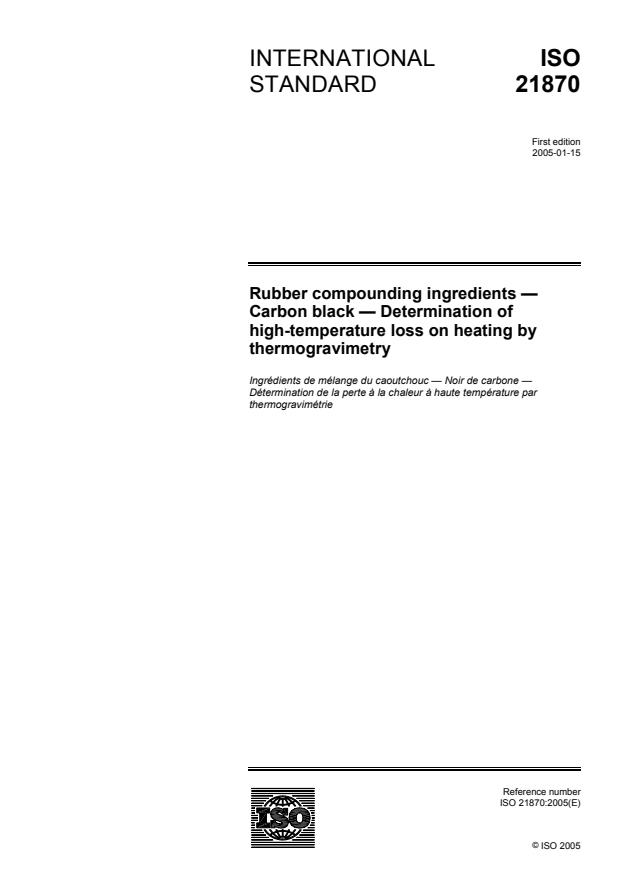
Standards Content (Sample)
INTERNATIONAL ISO
STANDARD 21870
First edition
2005-01-15
Rubber compounding ingredients —
Carbon black — Determination of
high-temperature loss on heating by
thermogravimetry
Ingrédients de mélange du caoutchouc — Noir de carbone —
Détermination de la perte à la chaleur à haute température par
thermogravimétrie
Reference number
©
ISO 2005
PDF disclaimer
This PDF file may contain embedded typefaces. In accordance with Adobe's licensing policy, this file may be printed or viewed but
shall not be edited unless the typefaces which are embedded are licensed to and installed on the computer performing the editing. In
downloading this file, parties accept therein the responsibility of not infringing Adobe's licensing policy. The ISO Central Secretariat
accepts no liability in this area.
Adobe is a trademark of Adobe Systems Incorporated.
Details of the software products used to create this PDF file can be found in the General Info relative to the file; the PDF-creation
parameters were optimized for printing. Every care has been taken to ensure that the file is suitable for use by ISO member bodies. In
the unlikely event that a problem relating to it is found, please inform the Central Secretariat at the address given below.
© ISO 2005
All rights reserved. Unless otherwise specified, no part of this publication may be reproduced or utilized in any form or by any means,
electronic or mechanical, including photocopying and microfilm, without permission in writing from either ISO at the address below or
ISO's member body in the country of the requester.
ISO copyright office
Case postale 56 • CH-1211 Geneva 20
Tel. + 41 22 749 01 11
Fax + 41 22 749 09 47
E-mail copyright@iso.org
Web www.iso.org
Published in Switzerland
ii © ISO 2005 – All rights reserved
Foreword
ISO (the International Organization for Standardization) is a worldwide federation of national standards bodies
(ISO member bodies). The work of preparing International Standards is normally carried out through ISO
technical committees. Each member body interested in a subject for which a technical committee has been
established has the right to be represented on that committee. International organizations, governmental and
non-governmental, in liaison with ISO, also take part in the work. ISO collaborates closely with the
International Electrotechnical Commission (IEC) on all matters of electrotechnical standardization.
International Standards are drafted in accordance with the rules given in the ISO/IEC Directives, Part 2.
The main task of technical committees is to prepare International Standards. Draft International Standards
adopted by the technical committees are circulated to the member bodies for voting. Publication as an
International Standard requires approval by at least 75 % of the member bodies casting a vote.
Attention is drawn to the possibility that some of the elements of this document may be the subject of patent
rights. ISO shall not be held responsible for identifying any or all such patent rights.
ISO 21870 was prepared by Technical Committee ISO/TC 45, Rubber and rubber products, Subcommittee
SC 3, Raw materials (including latex) for use in the rubber industry.
INTERNATIONAL STANDARD ISO 21870:2005(E)
Rubber compounding ingredients — Carbon black —
Determination of high-temperature loss on heating by
thermogravimetry
WARNING — Persons using this International Standard should be familiar with normal laboratory
practice. This standard does not purport to address all of the safety problems, if any, associated with
its use. It is the responsibility of the user to establish appropriate safety and health practices and to
ensure compliance with any national regulatory conditions.
1 Scope
This International Standard describes a method for quantitative determination of the loss on heating
(pyrolysis) of ca
...
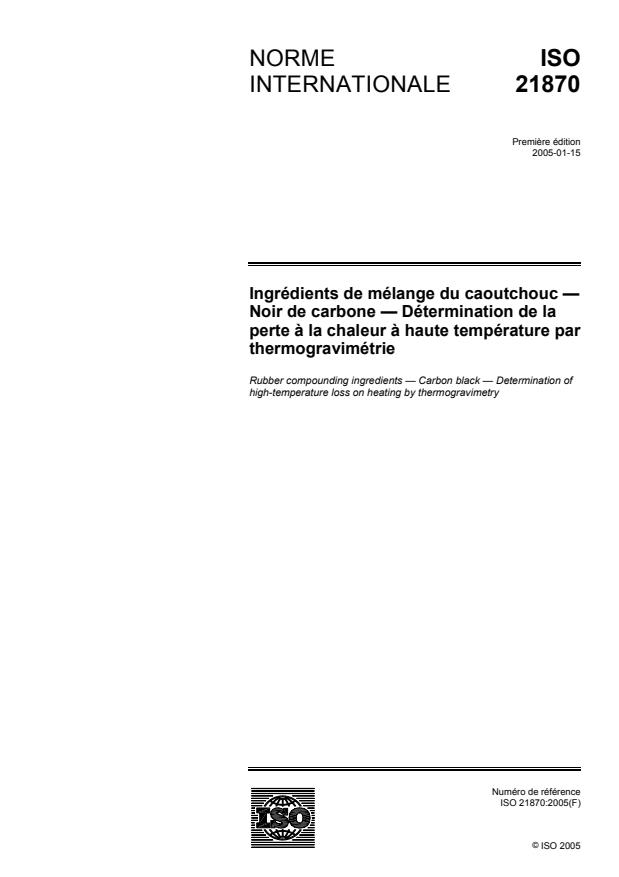
NORME ISO
INTERNATIONALE 21870
Première édition
2005-01-15
Ingrédients de mélange du caoutchouc —
Noir de carbone — Détermination de la
perte à la chaleur à haute température par
thermogravimétrie
Rubber compounding ingredients — Carbon black — Determination of
high-temperature loss on heating by thermogravimetry
Numéro de référence
©
ISO 2005
PDF – Exonération de responsabilité
Le présent fichier PDF peut contenir des polices de caractères intégrées. Conformément aux conditions de licence d'Adobe, ce fichier
peut être imprimé ou visualisé, mais ne doit pas être modifié à moins que l'ordinateur employé à cet effet ne bénéficie d'une licence
autorisant l'utilisation de ces polices et que celles-ci y soient installées. Lors du téléchargement de ce fichier, les parties concernées
acceptent de fait la responsabilité de ne pas enfreindre les conditions de licence d'Adobe. Le Secrétariat central de l'ISO décline toute
responsabilité en la matière.
Adobe est une marque déposée d'Adobe Systems Incorporated.
Les détails relatifs aux produits logiciels utilisés pour la création du présent fichier PDF sont disponibles dans la rubrique General Info
du fichier; les paramètres de création PDF ont été optimisés pour l'impression. Toutes les mesures ont été prises pour garantir
l'exploitation de ce fichier par les comités membres de l'ISO. Dans le cas peu probable où surviendrait un problème d'utilisation,
veuillez en informer le Secrétariat central à l'adresse donnée ci-dessous.
© ISO 2005
Droits de reproduction réservés. Sauf prescription différente, aucune partie de cette publication ne peut être reproduite ni utilisée sous
quelque forme que ce soit et par aucun procédé, électronique ou mécanique, y compris la photocopie et les microfilms, sans l'accord écrit
de l'ISO à l'adresse ci-après ou du comité membre de l'ISO dans le pays du demandeur.
ISO copyright office
Case postale 56 • CH-1211 Geneva 20
Tel. + 41 22 749 01 11
Fax. + 41 22 749 09 47
E-mail copyright@iso.org
Web www.iso.org
Publié en Suisse
ii © ISO 2005 – Tous droits réservés
Avant-propos
L'ISO (Organisation internationale de normalisation) est une fédération mondiale d'organismes nationaux de
normalisation (comités membres de l'ISO). L'élaboration des Normes internationales est en général confiée
aux comités techniques de l'ISO. Chaque comité membre intéressé par une étude a le droit de faire partie du
comité technique créé à cet effet. Les organisations internationales, gouvernementales et non
gouvernementales, en liaison avec l'ISO participent également aux travaux. L'ISO collabore étroitement avec
la Commission électrotechnique internationale (CEI) en ce qui concerne la normalisation électrotechnique.
Les Normes internationales sont rédigées conformément aux règles données dans les Directives ISO/CEI,
Partie 2.
La tâche principale des comités techniques est d'élaborer les Normes internationales. Les projets de Normes
internationales adoptés par les comités techniques sont soumis aux comités membres pour vote. Leur
publication comme Normes internationales requiert l'approbation de 75 % au moins des comités membres
votants.
L'attention est appelée sur le fait que certains des éléments du présent document peuvent faire l'objet de
droits de propriété intellectuelle ou de droits analogues. L'ISO ne saurait être tenue pour responsable de ne
pas avoir identifié de tels droits de propriété et averti de leur existence.
L'ISO 21870 a été élaborée par le comité technique ISO/TC 45, Élastomères et produits à base d'élastomères,
sous-comité SC 3, Matières premières (y compris le latex) à l'usage de l'industrie des élastomères.
NORME INTERNATIONALE ISO 21870:2005(F)
Ingrédients de mélange du caoutchouc — Noir de carbone —
Détermination de la perte à la chaleur à haute température par
thermogravimétrie
AVERTISSEMENT — Il convient que l'utilisateur de la présente Norme internationale connaisse bien
les pratiques courantes de laboratoire. La présente Norme internationale n'a pas pour but de traiter
tous les problèmes de sécurité qui sont, le cas échéant, liés à son utilisation. Il incombe à l'utilisateur
de la présente Norme internationale d'établir des pratiques appropriées en matière d'hygiène et de
sécurité, et de s'assurer de la conformité à la réglementation nationale en vigueur.
1 Domaine d'application
La présente Norme internationale décrit une méthode de détermination quantitative de la perte à la chaleur
(pyro
...