


ISO 105-C12:2024
(Main)Textiles - Tests for colour fastness - Part C12: Colour fastness to industrial laundering
Textiles - Tests for colour fastness - Part C12: Colour fastness to industrial laundering
This document specifies methods for determining the resistance of the colour of textiles of all kinds exposed to all forms of industrial laundering procedures.
Textiles — Essais de solidité des coloris — Partie C12: Solidité des coloris au lavage industriel
Le présent document spécifie des méthodes pour déterminer la solidité des coloris des textiles de toutes sortes exposés à toutes formes de modes opératoires de lavage industriel.
General Information
Relations
Overview
ISO 105-C12:2024 - Textiles - Tests for colour fastness - Part C12: Colour fastness to industrial laundering - specifies laboratory methods to determine how textile colours resist the chemical, thermal and mechanical stresses of industrial laundry procedures. Published as the second edition in 2024, this standard updates the 2004 edition and describes test conditions that approximate the effect of multiple industrial washes in a single accelerated cycle.
Key topics and requirements
- Scope: Applies to textiles of all kinds exposed to industrial laundering procedures.
- Test principle: Fabric specimens are laundered in contact with specified adjacent fabrics, rinsed and dried; colour change and staining are assessed by grey scales or instrumental methods.
- Test conditions:
- Four defined conditions, including one at (92 ± 2) °C (workwear) and three at (75 ± 2) °C (bed/table linen, corporate wear).
- Options for no bleach, hydrogen peroxide addition, or sodium perborate (or sodium percarbonate) + TAED to simulate peracetic acid bleaching.
- Reagents & materials:
- Industrial reference detergent (dispersed at 5 g/L in grade 3 water per ISO 3696).
- Sodium hydroxide addition (1 g/L) and pH adjustments (e.g., pH 12.0–12.5 without peroxide; pH 11.0–11.5 with peroxide).
- Hydrogen peroxide (30 %), TAED, sodium perborate tetrahydrate or sodium percarbonate (preference for percarbonate).
- Adjacent fabrics: multifibre TV or two single-fibre fabrics (cotton and polyester) per ISO 105 series.
- Apparatus & specimens:
- Rotating stainless-steel container device with mechanical action produced by rotation at (40 ± 2) min⁻¹ and steel balls (25 per folded specimen).
- Specimen preparation: folded 80 × 160 mm fabric bags containing steel balls; adjacent fabrics 80 × 100 mm.
- Assessment:
- Use ISO 105-A02/A03 grey scales or instrumental assessments (ISO 105-A04/A05) to report colour change and staining.
Applications and users
ISO 105-C12 is used to:
- Validate colour fastness to industrial laundering for workwear, hospitality textiles (bed and table linen), corporate uniforms and other commercial textiles.
- Support quality control, supplier acceptance criteria, product development and claims verification for textiles intended for industrial laundering. Primary users:
- Textile manufacturers and dyers
- Industrial laundries and laundry equipment manufacturers
- Independent test laboratories and conformity assessment bodies
- Specifiers for workwear, healthcare, hospitality and institutional linens
Related standards
- ISO 105 series: ISO 105-A01, A02, A03, A04, A05, C06, C08, C10, F02, F04, F10
- ISO 139 (conditioning atmospheres)
- ISO 3696 (water for analytical laboratory use)
Keywords: ISO 105-C12:2024, colour fastness, industrial laundering, textiles testing, ISO 105, multifibre adjacent fabric, hydrogen peroxide, sodium percarbonate, TAED, industrial laundry procedures.
Standards Content (Sample)
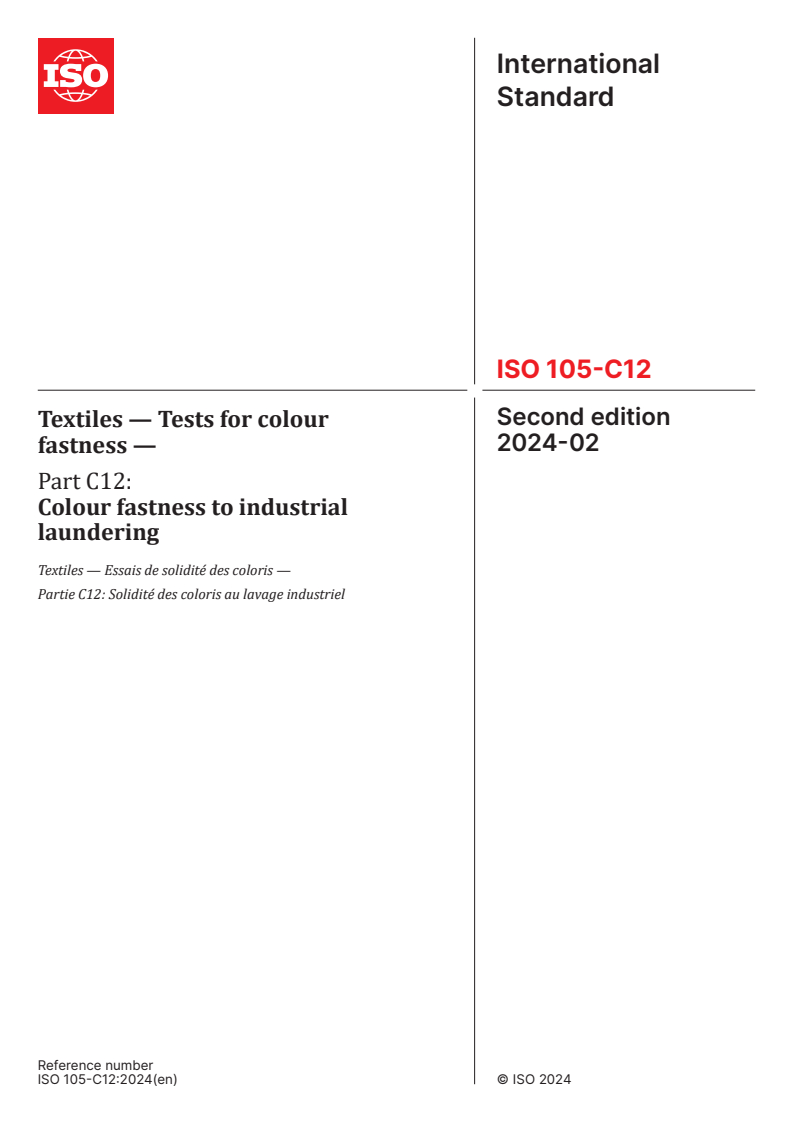
International
Standard
ISO 105-C12
Second edition
Textiles — Tests for colour
2024-02
fastness —
Part C12:
Colour fastness to industrial
laundering
Textiles — Essais de solidité des coloris —
Partie C12: Solidité des coloris au lavage industriel
Reference number
© ISO 2024
All rights reserved. Unless otherwise specified, or required in the context of its implementation, no part of this publication may
be reproduced or utilized otherwise in any form or by any means, electronic or mechanical, including photocopying, or posting on
the internet or an intranet, without prior written permission. Permission can be requested from either ISO at the address below
or ISO’s member body in the country of the requester.
ISO copyright office
CP 401 • Ch. de Blandonnet 8
CH-1214 Vernier, Geneva
Phone: +41 22 749 01 11
Email: copyright@iso.org
Website: www.iso.org
Published in Switzerland
ii
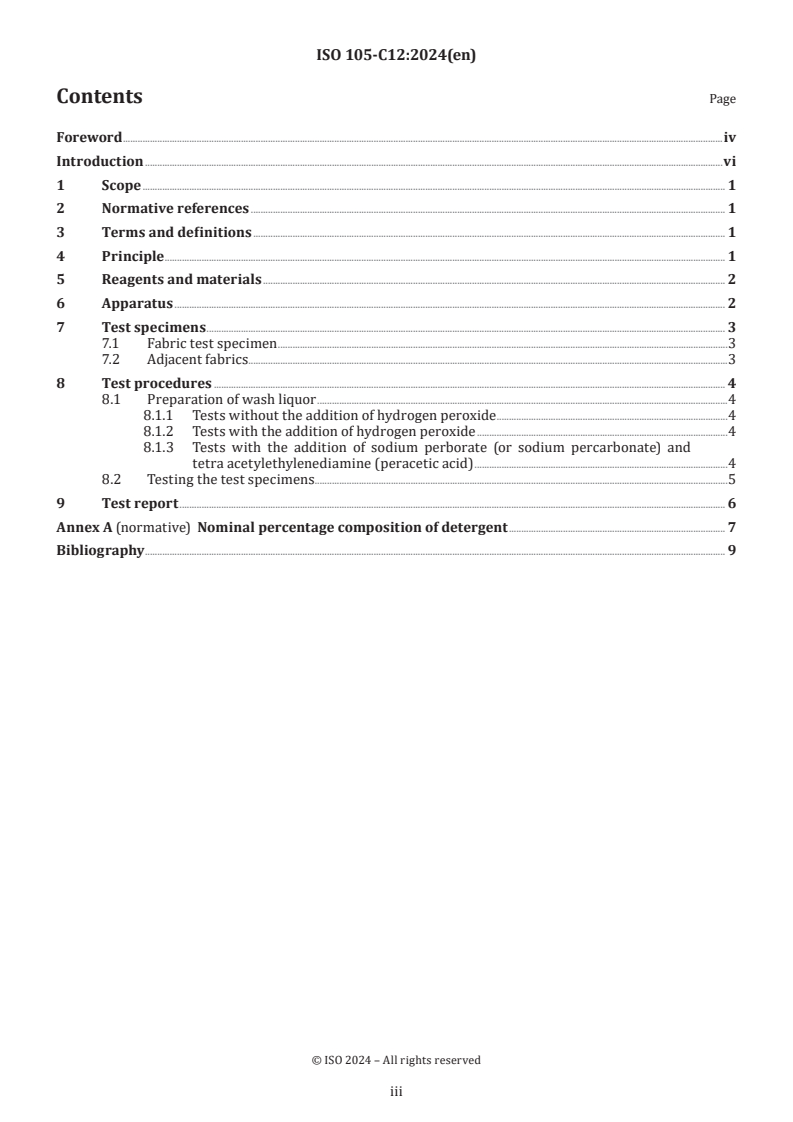
Contents Page
Foreword .iv
Introduction .vi
1 Scope . 1
2 Normative references . 1
3 Terms and definitions . 1
4 Principle . 1
5 Reagents and materials . 2
6 Apparatus . 2
7 Test specimens . 3
7.1 Fabric test specimen .3
7.2 Adjacent fabrics.3
8 Test procedures . 4
8.1 Preparation of wash liquor .4
8.1.1 Tests without the addition of hydrogen peroxide .4
8.1.2 Tests with the addition of hydrogen peroxide .4
8.1.3 Tests with the addition of sodium perborate (or sodium percarbonate) and
tetra acetylethylenediamine (peracetic acid) .4
8.2 Testing the test specimens . .5
9 Test report . 6
Annex A (normative) Nominal percentage composition of detergent . 7
Bibliography . 9
iii
Foreword
ISO (the International Organization for Standardization) is a worldwide federation of national standards
bodies (ISO member bodies). The work of preparing International Standards is normally carried out through
ISO technical committees. Each member body interested in a subject for which a technical committee
has been established has the right to be represented on that committee. International organizations,
governmental and non-governmental, in liaison with ISO, also take part in the work. ISO collaborates closely
with the International Electrotechnical Commission (IEC) on all matters of electrotechnical standardization.
The procedures used to develop this document and those intended for its further maintenance are described
in the ISO/IEC Directives, Part 1. In particular, the different approval criteria needed for the different types
of ISO document should be noted. This document was drafted in accordance with the editorial rules of the
ISO/IEC Directives, Part 2 (see www.iso.org/directives).
ISO draws attention to the possibility that the implementation of this document may involve the use of (a)
patent(s). ISO takes no position concerning the evidence, validity or applicability of any claimed patent
rights in respect thereof. As of the date of publication of this document, ISO had not received notice of (a)
patent(s) which may be required to implement this document. However, implementers are cautioned that
this may not represent the latest information, which may be obtained from the patent database available at
www.iso.org/patents. ISO shall not be held responsible for identifying any or all such patent rights.
Any trade name used in this document is information given for the convenience of users and does not
constitute an endorsement.
For an explanation of the voluntary nature of standards, the meaning of ISO specific terms and expressions
related to conformity assessment, as well as information about ISO's adherence to the World Trade
Organization (WTO) principles in the Technical Barriers to Trade (TBT), see www.iso.org/iso/foreword.html.
This document was prepared by Technical Committee ISO/TC 38, Textiles, Subcommittee SC 1, Tests for
coloured textiles and colorants, in collaboration with the European Committee for Standardization (CEN)
Technical Committee CEN/TC 248, Textiles and textile products, in accordance with the Agreement on
technical cooperation between ISO and CEN (Vienna Agreement).
This second edition cancels and replaces the first edition (ISO 105-C12:2004), which has been technically
revised.
The main changes are as follows:
— ISO 105-F:1985 was withdrawn and the test conditions of industrial laundering are seldom used for the
fabrics mainly made of delicate fibres (for example silk or wool), therefore ISO 105-C12:2004/Cor 1:2007
has not been suitable to be incorporated into this method;
— addition of ISO 3696 and replacement of ISO 105-A01:1994 with ISO 105-A01 in Clause 2;
— revision of clause title from “Reagents” to “Reagents and materials” in Clause 5 (Former Clause 4);
— addition of “Other suitable detergent can be used if agreed upon between interested parties.” in 5.1
(former 4.1);
— clarification that 30 % is mass fraction in 5.3 (former 4.3);
— addition of sodium percarbonate as an optional reagent in 5.6, 8.1.3, Table 1 and A.1 (former 4.6, 7.1.3,
Table 1 and A.1);
— replacement of “see 8.2 of ISO 105-A01:1994” with “in accordance with ISO 3696” in 5.7 (former 4.7);
— movement of “Adjacent fabrics” and “Grey scales” to the clause “Reagent and materials”;
— addition of the statement “using either a multifibre adjacent fabric or two single-fibre adjacent fabrics as
specified in ISO 105-A01.” in 5.8 (former 5.4);
iv
— deletion of “Condition the sample for 24 h before assessing to allow for temporary colour change caused
by heat.” in 6.6 (former 5.6);
— addition of “Balance, with a resolution of 0,01 g.” in Clause 6 (former Clause 5);
— addition of the dimension of the multifibre TV adjacent fabric as “80 mm × 100 mm” in 7.2 (former 6.2);
— revision of Figure 1;
— replacement of “mixer” with “mechanical stirrer” in 8.1 (former 7.1);
— replacement of “running tap water for 10 min” with “running tap water until being clean” and addition of
a NOTE to check the cleanness degree of the rinsed test specimen in 8.2.2 (former 7.2.2);
— revision of the requirement for conditioning the test specimen in 8.2 (former 7.2);
— improvement of the contents in Test report;
— revision of Annex A from “informative” to “normative”;
— improvement of the Formula (A.1);
— updating of the Bibliography.
A list of all parts in the ISO 105 series can be found on the ISO website.
Any feedback or questions on this document should be directed to the user’s national standards body. A
complete listing of these bodies can be found at www.iso.org/members.html.
v
Introduction
The test method in this document is intended to reflect the effect of comprehensive laundering during
industrial laundry procedures, as distinct from the domestic washing test methods as given in ISO 105-
C06, ISO 105-C08 and ISO 105-C10. Four test conditions are described, one at (92 ± 2) °C intended for the
evaluation of workwear and three, as given below, at (75 ± 2) °C, for the evaluation of bed and table linen and
corporate wear:
— without the addition of peroxy bleach compounds;
— with the addition of hydrogen peroxide (for the bleaching of white workwear with coloured trimmings);
— with the addition of sodium perborate tetrahydrate (or sodium percarbonate) and tetra-acetylethylene
diamine (TAED) (for the bleaching of white workwear with coloured trimmings).
NOTE The addition of TAED/perborate (or percarbonate) is a conveniently stable way of producing peracetic acid
in situ.
This test method does not reflect the effect of optical brightening agents.
This method and the single cycle test methods described in ISO 105-C06 and ISO 105-C08 might not
reproduce the effect of coloured fabrics treated with certain dye fixing agents and finishes after multiple (5
to 10) industrial washes.
vi
International Standard ISO 105-C12:2024(en)
Textiles — Tests for colour fastness —
Part C12:
Colour fastness to industrial laundering
1 Scope
This document specifies methods for determining the resistance of the colour of textiles of all kinds exposed
to all forms of industrial laundering procedures.
2 Normative references
The following documents are referred to in the text in such a way that some or all of their content constitutes
requirements of this document. For dated references, only the edition cited applies. For undated references,
the latest edition of the referenced document (including any amendments) applies.
ISO 105-A01, Textiles — Tests for colour fastness — Part A01: General principles of testing
ISO 105-A02, Textiles — Tests for colour fastness — Part A02: Grey scale for assessing change in colour
ISO 105-A03, Textiles — Tests for colour fastness — Part A03: Grey scale for assessing staining
ISO 105-A04, Textiles — Tests for colour fastness — Part A04: Method for the instrumental assessment of the
degree of staining of adjacent fabrics
ISO 105-A05, Textiles — Tests for colour fastness — Part A05: Instrumental assessment of change in colour for
determination of grey scale rating
ISO 105-F02, Textiles — Tests for colour fastness — Part F02: Specification for cotton and viscose adjacent
fabrics
ISO 105-F04, Textiles — Tests for colour fastness — Part F04: Specification for polyester adjacent fabric
ISO 105-F10, Textiles — Tests for colour fastness — Part F10: Specification for adjacent fabric: Multifibre
ISO 139, Textiles — Standard atmospheres for conditioning and testing
ISO 3696, Water for analytical laboratory use — Specification and test methods
3 Terms and definitions
No terms and definitions are listed in this document.
ISO and IEC maintain terminological databases for use in sta
...
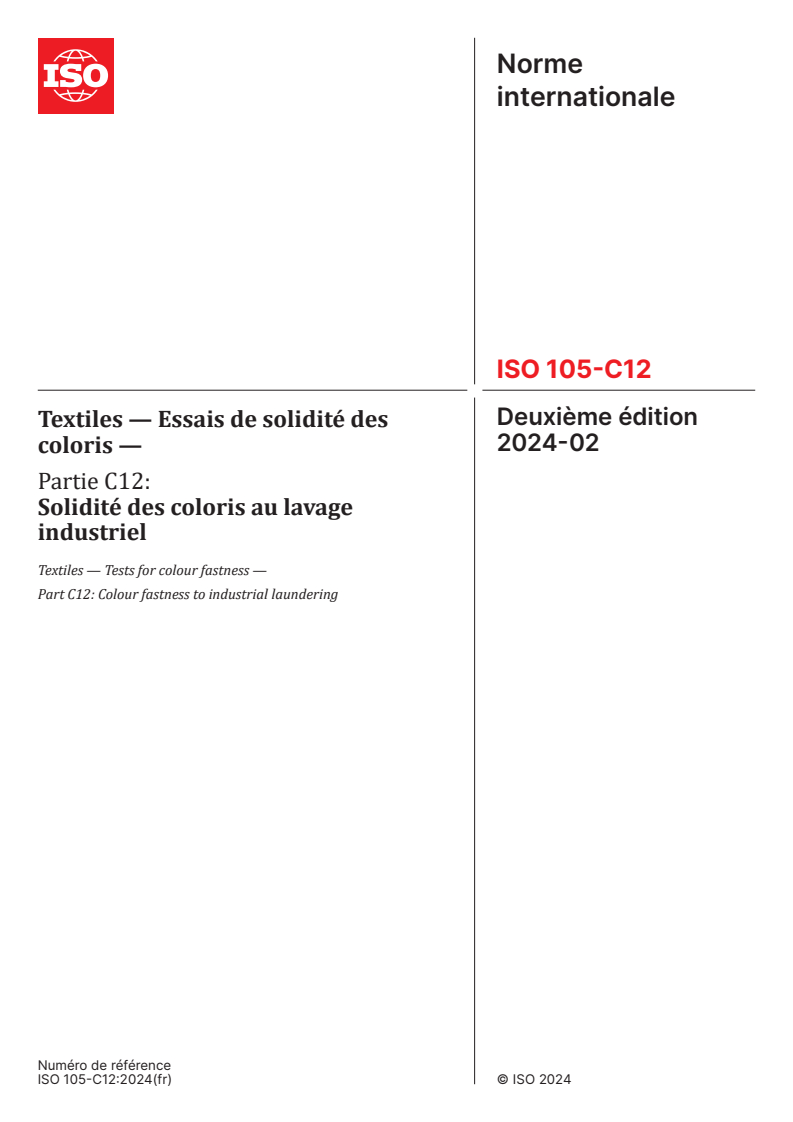
Norme
internationale
ISO 105-C12
Deuxième édition
Textiles — Essais de solidité des
2024-02
coloris —
Partie C12:
Solidité des coloris au lavage
industriel
Textiles — Tests for colour fastness —
Part C12: Colour fastness to industrial laundering
Numéro de référence
DOCUMENT PROTÉGÉ PAR COPYRIGHT
© ISO 2024
Tous droits réservés. Sauf prescription différente ou nécessité dans le contexte de sa mise en œuvre, aucune partie de cette
publication ne peut être reproduite ni utilisée sous quelque forme que ce soit et par aucun procédé, électronique ou mécanique,
y compris la photocopie, ou la diffusion sur l’internet ou sur un intranet, sans autorisation écrite préalable. Une autorisation peut
être demandée à l’ISO à l’adresse ci-après ou au comité membre de l’ISO dans le pays du demandeur.
ISO copyright office
Case postale 401 • Ch. de Blandonnet 8
CH-1214 Vernier, Genève
Tél.: +41 22 749 01 11
E-mail: copyright@iso.org
Web: www.iso.org
Publié en Suisse
ii
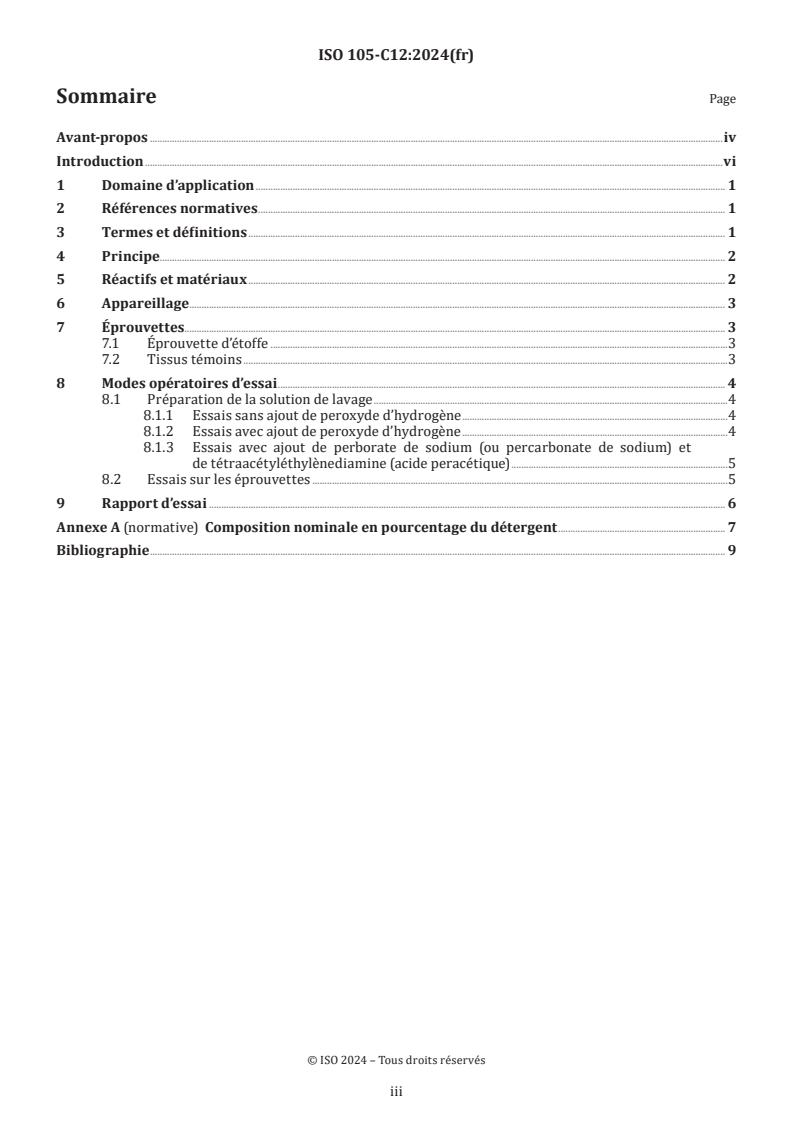
Sommaire Page
Avant-propos .iv
Introduction .vi
1 Domaine d’application . 1
2 Références normatives . 1
3 Termes et définitions . 1
4 Principe. 2
5 Réactifs et matériaux . 2
6 Appareillage . 3
7 Éprouvettes. 3
7.1 Éprouvette d’étoffe .3
7.2 Tissus témoins .3
8 Modes opératoires d’essai . 4
8.1 Préparation de la solution de lavage .4
8.1.1 Essais sans ajout de peroxyde d’hydrogène .4
8.1.2 Essais avec ajout de peroxyde d’hydrogène .4
8.1.3 Essais avec ajout de perborate de sodium (ou percarbonate de sodium) et
de tétraacétyléthylènediamine (acide peracétique) .5
8.2 Essais sur les éprouvettes .5
9 Rapport d’essai . 6
Annexe A (normative) Composition nominale en pourcentage du détergent . 7
Bibliographie . 9
iii
Avant-propos
L’ISO (Organisation internationale de normalisation) est une fédération mondiale d’organismes nationaux
de normalisation (comités membres de l’ISO). L’élaboration des Normes internationales est en général
confiée aux comités techniques de l’ISO. Chaque comité membre intéressé par une étude a le droit de faire
partie du comité technique créé à cet effet. Les organisations internationales, gouvernementales et non
gouvernementales, en liaison avec l’ISO participent également aux travaux. L’ISO collabore étroitement avec
la Commission électrotechnique internationale (IEC) en ce qui concerne la normalisation électrotechnique.
Les procédures utilisées pour élaborer le présent document et celles destinées à sa mise à jour sont
décrites dans les Directives ISO/IEC, Partie 1. Il convient, en particulier, de prendre note des différents
critères d’approbation requis pour les différents types de documents ISO. Le présent document
a été rédigé conformément aux règles de rédaction données dans les Directives ISO/IEC, Partie 2
(voir www.iso.org/directives).
L’ISO attire l’attention sur le fait que la mise en application du présent document peut entraîner l’utilisation
d’un ou de plusieurs brevets. L’ISO ne prend pas position quant à la preuve, à la validité et à l’applicabilité de
tout droit de propriété revendiqué à cet égard. À la date de publication du présent document, l’ISO n’avait pas
reçu notification qu’un ou plusieurs brevets pouvaient être nécessaires à sa mise en application. Toutefois,
il y a lieu d’avertir les responsables de la mise en application du présent document que des informations
plus récentes sont susceptibles de figurer dans la base de données de brevets, disponible à l’adresse
www.iso.org/brevets. L’ISO ne saurait être tenue pour responsable de ne pas avoir identifié de tels droits de
propriété et averti de leur existence.
Les appellations commerciales éventuellement mentionnées dans le présent document sont données pour
information, par souci de commodité, à l’intention des utilisateurs et ne sauraient constituer un engagement.
Pour une explication de la nature volontaire des normes, la signification des termes et expressions
spécifiques de l’ISO liés à l’évaluation de la conformité, ou pour toute information au sujet de l’adhésion de
l’ISO aux principes de l’Organisation mondiale du commerce (OMC) concernant les obstacles techniques au
commerce (OTC), voir www.iso.org/avant-propos.
Le présent document a été élaboré par le comité technique ISO/TC 38, Textiles, sous-comité SC 1, Essais des
textiles colorés et des colorants, en collaboration avec le comité technique CEN/TC 248, Textiles et produits
textiles, du Comité européen de normalisation (CEN), conformément à l’Accord de coopération technique
entre l’ISO et le CEN (Accord de Vienne).
Cette deuxième édition annule et remplace la première édition (ISO 105-C12:2004), qui a fait l’objet d’une
révision technique.
Les principales modifications sont les suivantes:
— l’ISO 105-F:1985 ayant été annulée et les conditions d’essai de lavage industriel étant rarement
utilisées pour les étoffes principalement composées de fibres délicates (la soie ou la laine par exemple),
il n’a pas semblé convenable d’incorporer l’ISO 105-C12:2004/Cor 1:2007 à cette méthode;
— l’ISO 3696 a été ajoutée et l’ISO 105-A01:1994 a été remplacée par l’ISO 105-A01 dans l’Article 2;
— le titre de l’Article 5 (anciennement Article 4) a été révisé, passant de «Réactifs» à «Réactifs et matériaux»;
— la phrase «Un autre détergent adapté peut être utilisé comme convenu entre les parties intéressées.» a
été ajoutée en 5.1 (anciennement 4.1);
— il a été clarifié que 30 % est une fraction massique en 5.3 (anciennement 4.3);
— le percarbonate de sodium a été ajouté comme réactif facultatif en 5.6, en 8.1.3, dans le Tableau 1 et en
A.1 (anciennement 4.6, 7.1.3, Tableau 1 et A.1);
— «voir l’ISO 105-A01:1994, 8.2» a été remplacé par «conforme à l’ISO 3696» en 5.7 (anciennement 4.7);
— «tissus témoins» et «échelles de gris» ont été déplacés vers l’article «Réactifs et matériaux»;
iv
— la mention «s’agissant soit d’un tissu témoin multifibre, soit de deux tissus témoins monofibres, tel que
spécifié dans l’ISO 105-A01.» a été ajoutée en 5.8 (anciennement 5.4);
— la phrase «Conditionner l’échantillon pendant 24 h avant de procéder à l’évaluation pour tenir compte de
la dégradation temporaire des couleurs due à la chaleur.» a été supprimée en 6.6 (anciennement 5.6);
— la phrase «Balance, avec une précision d’affichage de 0,01 g.» a été ajoutée dans l’Article 6 (anciennement
Article 5);
— les dimensions du tissu témoin multifibre TV, à savoir 80 mm × 100 mm, ont été ajoutées en 7.2
(anciennement 6.2);
— la Figure 1 a été révisée;
— le terme «agitateur» a été remplacé par «agitateur mécanique» en 8.1 (anciennement 7.1);
— «à l'eau courante froide pendant 10 min» a été remplacé par «dans de l’eau courante froide du robinet
jusqu’à ce qu’ils soient propres» et une NOTE a été ajoutée afin de vérifier le degré de propreté de
l’éprouvette rincée en 8.2.2 (anciennement 7.2.2);
— l’exigence relative au conditionnement de l’éprouvette en 8.2 (anciennement 7.2) a été révisée;
— le contenu du Rapport d’essai a été amélioré;
— l’Annexe A a été révisée, passant d’«informative» à «normative»;
— la Formule (A.1) a été améliorée;
— les références bibliographiques ont été mises à jour.
Une liste de toutes les parties de la série ISO 105 se trouve sur le site web de l’ISO.
Il convient que l’utilisateur adresse tout retour d’information ou toute question concernant le présent
document à l’organisme national de normalisation de son pays. Une liste exhaustive desdits organismes se
trouve à l’adresse www.iso.org/fr/members.html.
v
Introduction
La méthode d’essai du présent document a vocation à reproduire l’effet du lavage complet réalisé lors
des modes opératoires de lavage industriel, par opposition aux méthodes d’essai de lavage domestique
présentées dans l’ISO 105-C06, l’ISO 105-C08 et l’ISO 105-C10. Quatre conditions d’essai sont décrites, une à
(92 ± 2) °C pour l’évaluation des vêtements de travail et trois, comme indiqué ci-dessous, à (75 ± 2) °C pour
l’évaluation du linge de lit, du linge de table et des vêtements d’entreprise:
— sans ajout de composés de blanchiment au peroxyde;
— avec ajout de peroxyde d’hydrogène (pour le blanchiment des vêtements de travail blancs avec des
garnitures colorées);
— avec ajout de perborate de sodium tétrahydraté (ou percarbonate de sodium) et de
tétraacétyléthylènediamine (TAED) (pour le blanchiment des vêtements de travail blancs avec des
garnitures colorées).
NOTE L’ajout de TAED/perborate (ou percarbonate) constitue un moyen stable et pratique de produire de l’acide
peracétique in situ.
La présente méthode d’essai ne reproduit pas l’effet des agents azurants optiques.
Cette méthode et les méthodes d’essai à cycle unique décrites dans l’ISO 105-C06 et l’ISO 105-C08 pourraient
ne pas reproduire l’effet d’étoffes colorées traitées avec certains agents de fixation des colorants et apprêts
après plusieurs lavages industriels (5 à 10).
vi
Norme internationale ISO 105-C12:2024(fr)
Textiles — Essais de solidité des coloris —
Partie C12:
Solidité des coloris au lavage industriel
1 Domaine d’application
Le présent document spécifie des méthodes pour déterminer la solidité des coloris des textiles de toutes
sortes exposés à toutes formes de modes opératoires de lavage industriel.
2 Références normatives
Les documents suivants sont cités dans le texte de sorte qu’ils constituent, pour tout ou partie de leur
contenu, des exigences du présent document. Pour les références datées, seule l’édition citée s’applique. Pour
les références non datées, la dernière édition du document de référence s’applique (y compris les éventuels
amendements).
ISO 105-A01, Textiles — Essais de solidité des coloris — Partie A01: Principes généraux pour effectuer les essais
ISO 105-A02, Textiles — Essais de solidité des teintures — Partie A02: Échelle de gris pour l'évaluation des
dégradations
ISO 105-A03, Textiles — Essais de solidité des coloris — Partie A03: Échelle de gris pour l'évaluation des
dégorgements
ISO 105-A04, Textiles — Essais de solidité des teintures — Partie A04: Méthode instrumentale pour l'évaluation
du degré de dégorgement des tissus témoins
ISO 105-A05, Textiles — Essais de solidité des teintures — Partie A05: Évaluation instrumentale du changement
de couleur pour conversion en degrés de l'échelle de gris
ISO 105-F02, Textiles — Essais de solidité des teintures — Partie F02: Spécifications pour les tissus témoins en
coton et en viscose
ISO 105-F04, Textiles — Essais de solidité des teintures — Partie F04: Spécifications pour le tissu témoin en
polyester
ISO 105-F10, Textiles — Essais de solidité des teintures — Partie F10: Spécification pour le tissu témoin:
Multifibre
ISO 139, Textiles — Atmosphères normales de conditionnement et d'essai
ISO 3696, Eau pour laboratoire à usage analytique — Spécification et méthodes d'essai
3 Termes et définitions
Aucun terme n’est défini dans le présent document.
L’ISO et l’IEC tiennent à jour des bases de données terminologiques destinées à être utilisées en normalisation,
consultables aux adresses suivantes:
— ISO Online browsing platform: disponible à l’adresse https:// www .iso .org/ obp
...
Frequently Asked Questions
ISO 105-C12:2024 is a standard published by the International Organization for Standardization (ISO). Its full title is "Textiles - Tests for colour fastness - Part C12: Colour fastness to industrial laundering". This standard covers: This document specifies methods for determining the resistance of the colour of textiles of all kinds exposed to all forms of industrial laundering procedures.
This document specifies methods for determining the resistance of the colour of textiles of all kinds exposed to all forms of industrial laundering procedures.
ISO 105-C12:2024 is classified under the following ICS (International Classification for Standards) categories: 59.080.01 - Textiles in general. The ICS classification helps identify the subject area and facilitates finding related standards.
ISO 105-C12:2024 has the following relationships with other standards: It is inter standard links to ISO 105-C12:2004, ISO 105-C12:2004/Cor 1:2007. Understanding these relationships helps ensure you are using the most current and applicable version of the standard.
You can purchase ISO 105-C12:2024 directly from iTeh Standards. The document is available in PDF format and is delivered instantly after payment. Add the standard to your cart and complete the secure checkout process. iTeh Standards is an authorized distributor of ISO standards.
Questions, Comments and Discussion
Ask us and Technical Secretary will try to provide an answer. You can facilitate discussion about the standard in here.
Loading comments...