

ISO 25113:2010
(Main)Intelligent transport systems — Communications access for land mobiles (CALM) — Mobile wireless broadband using HC-SDMA
General Information
- Abstract
ISO 25113:2010 selects the options appropriate for CALM using mobile wireless broadband (MWB) techniques conforming to ATIS 0700004-2005 (HC-SDMA) air interface and protocol specification recommended by ITU-R M.1801 and specifies the management interface requirements. CALM links are required for quasi-continuous, prolonged and short communications between vehicles and the roadside, between vehicles, and between mobile equipment and fixed infrastructure points. Wherever practicable, ISO 25113:2010 has been developed by reference to suitable extant standards, adopted by selection. Required regional variations are provided. Application specific upper layers will not be included in ISO 25113:2010, but will be driven by application standards (which might not be technology specific).
- Status
- Published
- Publication Date
- 24-Feb-2010
- Technical Committee
- ISO/TC 204 - Intelligent transport systems
- Drafting Committee
- ISO/TC 204/WG 16 - Communications
- Current Stage
- 9060 - Close of review
- Completion Date
- 02-Sep-2028
Overview
ISO 25113:2010 - "Intelligent transport systems - Communications access for land mobiles (CALM) - Mobile wireless broadband using HC‑SDMA" - defines how CALM (Communications Access for Land Mobiles) systems use the ATIS HC‑SDMA air interface (ATIS 0700004‑2005, recommended by ITU‑R M.1801). The standard selects CALM options for mobile wireless broadband (MWB) and specifies management‑interface requirements to support quasi‑continuous, prolonged and short packet‑based communications for vehicle‑to‑infrastructure (V2I), vehicle‑to‑vehicle (V2V), and mobile equipment to fixed points.
Key topics and requirements
- Scope and conformance
- Requires compliance with local ATIS HC‑SDMA procedures and CALM architecture standards.
- Mandates interaction with CALM IPv6 networking, medium service access points and CALM management layers.
- CALM architecture & IPv6
- Operates within the CALM system architecture (media‑independent handover/MIH) and CALM IPv6 networking for IP connectivity.
- Session types
- Defines procedures for User‑Controlled, Continuous and Time‑Controlled sessions (referencing ISO 25111).
- Interface and medium management
- Interface manager and medium management follow ISO 24102 and ISO 25111 rules.
- Medium Access Control (MAC)
- MAC behavior and requirements are aligned with ISO 25111.
- HC‑SDMA MMAE service primitives
- Specifies the Medium Management Adaptation Entity (MMAE) primitives used between CALM and HC‑SDMA:
- MMAE‑SetParam.request / confirm - control actions (e.g., connect/disconnect).
- MMAE‑GetParam.request / confirm - query interface status and characteristics.
- MMAE‑Notify.indication - status notifications (connected/disconnected).
- Defines parameter fields (interfaceId, paramNumber, ifStatus, ifChar, result codes).
- Specifies the Medium Management Adaptation Entity (MMAE) primitives used between CALM and HC‑SDMA:
- Testing, labelling and IPR
- Includes test/conformance requirements and intellectual property declaration expectations.
Practical applications and users
ISO 25113:2010 is targeted at organizations building or deploying ITS communications that require high‑capacity mobile broadband over HC‑SDMA:
- Automotive OEMs and telematics module manufacturers implementing CALM‑compliant radios
- Wireless equipment vendors integrating ATIS HC‑SDMA air interfaces
- ITS system integrators and network operators enabling V2I, V2V, infotainment, video downloads, probe‑data collection, and traffic management
- Test laboratories and certification bodies validating CALM/HC‑SDMA conformance
- Regulators and planners assessing interoperability for ITS deployments
Note: application‑specific upper layers (e.g., ITS service protocols) are out of scope and driven by other application standards.
Related standards
- ISO 21217 - CALM architecture
- ISO 21210 - CALM IPv6 Networking
- ISO 21218 - CALM medium service access points
- ISO 24102 - CALM management
- ISO 25111 - CALM using public networks
- ATIS 0700004‑2005 - HC‑SDMA radio interface
- ITU‑R M.1801 - broadband wireless access radio interface recommendations
Keywords: ISO 25113:2010, CALM, HC‑SDMA, mobile wireless broadband, ITS, ATIS 0700004‑2005, MMAE, IPv6, medium access control, V2I, V2V.
Get Certified
Connect with accredited certification bodies for this standard

BSI Group
BSI (British Standards Institution) is the business standards company that helps organizations make excellence a habit.

Great Wall Tianjin Quality Assurance Center
Established 1993, first batch to receive national accreditation with IAF recognition.
Hong Kong Quality Assurance Agency (HKQAA)
Hong Kong's leading certification body.
Sponsored listings
Frequently Asked Questions
ISO 25113:2010 is a standard published by the International Organization for Standardization (ISO). Its full title is "Intelligent transport systems — Communications access for land mobiles (CALM) — Mobile wireless broadband using HC-SDMA". This standard covers: ISO 25113:2010 selects the options appropriate for CALM using mobile wireless broadband (MWB) techniques conforming to ATIS 0700004-2005 (HC-SDMA) air interface and protocol specification recommended by ITU-R M.1801 and specifies the management interface requirements. CALM links are required for quasi-continuous, prolonged and short communications between vehicles and the roadside, between vehicles, and between mobile equipment and fixed infrastructure points. Wherever practicable, ISO 25113:2010 has been developed by reference to suitable extant standards, adopted by selection. Required regional variations are provided. Application specific upper layers will not be included in ISO 25113:2010, but will be driven by application standards (which might not be technology specific).
ISO 25113:2010 selects the options appropriate for CALM using mobile wireless broadband (MWB) techniques conforming to ATIS 0700004-2005 (HC-SDMA) air interface and protocol specification recommended by ITU-R M.1801 and specifies the management interface requirements. CALM links are required for quasi-continuous, prolonged and short communications between vehicles and the roadside, between vehicles, and between mobile equipment and fixed infrastructure points. Wherever practicable, ISO 25113:2010 has been developed by reference to suitable extant standards, adopted by selection. Required regional variations are provided. Application specific upper layers will not be included in ISO 25113:2010, but will be driven by application standards (which might not be technology specific).
ISO 25113:2010 is classified under the following ICS (International Classification for Standards) categories: 03.220.01 - Transport in general; 35.240.60 - IT applications in transport. The ICS classification helps identify the subject area and facilitates finding related standards.
ISO 25113:2010 is available in PDF format for immediate download after purchase. The document can be added to your cart and obtained through the secure checkout process. Digital delivery ensures instant access to the complete standard document.
Standards Content (Sample)
INTERNATIONAL ISO
STANDARD 25113
First edition
2010-03-01
Intelligent transport systems —
Communications access for land mobiles
(CALM) — Mobile wireless broadband
using HC-SDMA
Systèmes intelligents de transport — Accès aux communications des
services mobiles terrestres (CALM) — Services mobiles à bande large
sans fil utilisant HC-SDMA
Reference number
©
ISO 2010
PDF disclaimer
This PDF file may contain embedded typefaces. In accordance with Adobe's licensing policy, this file may be printed or viewed but
shall not be edited unless the typefaces which are embedded are licensed to and installed on the computer performing the editing. In
downloading this file, parties accept therein the responsibility of not infringing Adobe's licensing policy. The ISO Central Secretariat
accepts no liability in this area.
Adobe is a trademark of Adobe Systems Incorporated.
Details of the software products used to create this PDF file can be found in the General Info relative to the file; the PDF-creation
parameters were optimized for printing. Every care has been taken to ensure that the file is suitable for use by ISO member bodies. In
the unlikely event that a problem relating to it is found, please inform the Central Secretariat at the address given below.
© ISO 2010
All rights reserved. Unless otherwise specified, no part of this publication may be reproduced or utilized in any form or by any means,
electronic or mechanical, including photocopying and microfilm, without permission in writing from either ISO at the address below or
ISO's member body in the country of the requester.
ISO copyright office
Case postale 56 • CH-1211 Geneva 20
Tel. + 41 22 749 01 11
Fax + 41 22 749 09 47
E-mail copyright@iso.org
Web www.iso.org
Published in Switzerland
ii © ISO 2010 – All rights reserved
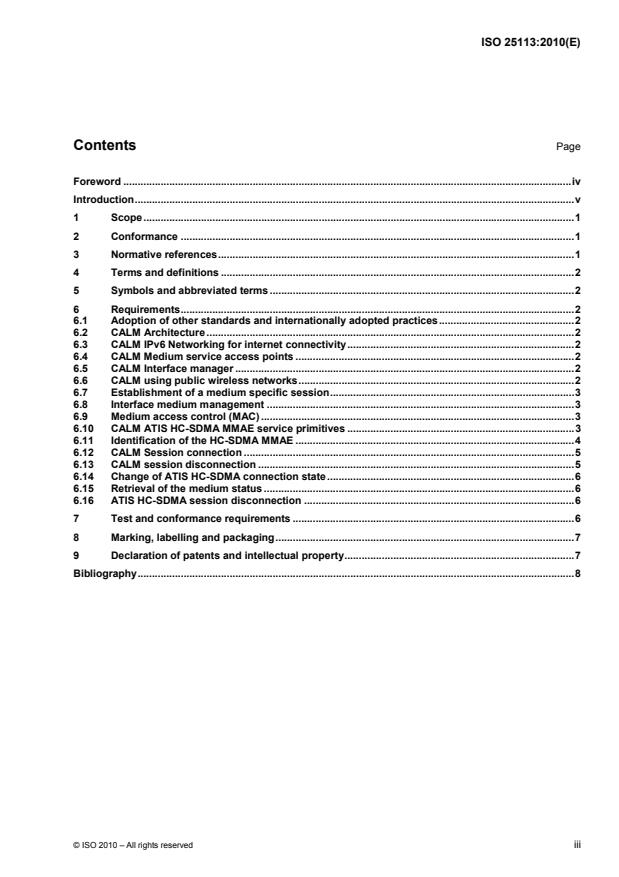
Contents Page
Foreword .iv
Introduction.v
1 Scope.1
2 Conformance .1
3 Normative references.1
4 Terms and definitions .2
5 Symbols and abbreviated terms .2
6 Requirements.2
6.1 Adoption of other standards and internationally adopted practices.2
6.2 CALM Architecture .2
6.3 CALM IPv6 Networking for internet connectivity.2
6.4 CALM Medium service access points .2
6.5 CALM Interface manager .2
6.6 CALM using public wireless networks.2
6.7 Establishment of a medium specific session.3
6.8 Interface medium management .3
6.9 Medium access control (MAC) .3
6.10 CALM ATIS HC-SDMA MMAE service primitives .3
6.11 Identification of the HC-SDMA MMAE .4
6.12 CALM Session connection .5
6.13 CALM session disconnection .5
6.14 Change of ATIS HC-SDMA connection state.6
6.15 Retrieval of the medium status .6
6.16 ATIS HC-SDMA session disconnection .6
7 Test and conformance requirements .6
8 Marking, labelling and packaging.7
9 Declaration of patents and intellectual property.7
Bibliography.8
Foreword
ISO (the International Organization for Standardization) is a worldwide federation of national standards bodies
(ISO member bodies). The work of preparing International Standards is normally carried out through ISO
technical committees. Each member body interested in a subject for which a technical committee has been
established has the right to be represented on that committee. International organizations, governmental and
non-governmental, in liaison with ISO, also take part in the work. ISO collaborates closely with the
International Electrotechnical Commission (IEC) on all matters of electrotechnical standardization.
International Standards are drafted in accordance with the rules given in the ISO/IEC Directives, Part 2.
The main task of technical committees is to prepare International Standards. Draft International Standards
adopted by the technical committees are circulated to the member bodies for voting. Publication as an
International Standard requires approval by at least 75 % of the member bodies casting a vote.
Attention is drawn to the possibility that some of the elements of this document may be the subject of patent
rights. ISO shall not be held responsible for identifying any or all such patent rights.
ISO 25113 was prepared by Technical Committee ISO/TC 204, Intelligent transport systems.
iv © ISO 2010 – All rights reserved
Introduction
This International Standard is part of a family of International Standards for CALM (Communications Access
for Land Mobiles) which specify a common architecture, network protocols and a set of air interface definitions
for wireless communications using a number of wireless media, including cellular 2nd generation, cellular 3rd
generation, 5 GHz, millimetre, infra-red communications, and mobile wireless broadband (MWB), over packet-
based networks. The CALM architecture is also designed to include short range, short duration, low latency
communication systems such as European dedicated short-range communications (DSRC) and North
American wireless access in vehicular environments (WAVE) based on IEEE 802.11. It is anticipated that
other air interfaces will be added in the future. Generally speaking, the CALM architecture is designed to
include air interfaces that provide some subset of point-to-point, vehicle-to-vehicle, and vehicle-to-point
communications over packet-based networks in the ITS sector. In particular, this International Standard
provides additional specifications which wireless devices adhering to the mobile wireless broadband
ATIS-0700004-2005 HC-SDMA standard must also meet to be CALM compliant.
The requirements for transmission of information over large distances using wireless technology are
functionally very different from the requirements for European DSRC. Large volumes of data are required for
purposes such as safety, traffic information and management, video downloads to vehicles for tourist
information and entertainment and navigation-system-updates. In order to support such services, mobile units
need to be able to communicate over longer ranges with access points or base stations, and the system must
be able to hand over sessions from one access point or base station to another. CALM standards are explicitly
designed to enable quasi-continuous data communications, as well as data communications of protracted
duration between vehicles and service providers, and between vehicles. It is important to note that the CALM
architecture is specifically designed to support packet-based communications; support for circuit-switched
communications is not included.
The fundamental advantage of the CALM concept over traditional systems is the ability to support media
independent handover (MIH), also referred to as heterogeneous handover, between the various media that
can be included in a CALM system. Selection policies are supported that include user preferences and media
capabilities in making decisions as to which media to use for a particular session, and when to handover
between media or between service providers on the same medium. These handover mechanisms are defined
within the CALM architecture International Standard (ISO 21217), the CALM IPv6 Networking International
Standard (ISO 21210), the CALM medium service access points International Standard (ISO 21218) and the
CALM communication and station management International Standard (ISO 24102). Handovers between
access points using the same technology and service provider use mechanisms that are defined within the
particular medium specific CALM Standard.
ITS applications that can be enhanced or are enabled by the CALM architecture include, among others, car-
to-car and point-to-multipoint safety messaging, collision avoidance, update of roadside telemetry and
messaging, probe data collection, general internet access, image and video transfer, infotainment, multimedia
multicast, traffic management, monitoring and enforcement in mobile situations, and route guidance.
For a general introduction to CALM architecture, refer to ISO 21217.
This International Standard provides definitions and procedures for the establishment and maintenance of an
ITS communications session within a CALM system environment using a medium communication in
accordance with ATIS HC-SDMA protocol specification.
INTERNATIONAL STANDARD ISO 25113:2010(E)
Intelligent transport systems — Communications access for
land mobiles (CALM) — Mobile wireless broadband using
HC-SDMA
1 Scope
This International Standard selects the options appropriate for CALM using mobile wireless broadband (MWB)
techniques conforming to ATIS 0700004-2005 (HC-SDMA) air interface and protocol specification
recommended by ITU-R M.1801 and specifies the management interface requirements.
CALM links are required for quasi-continuous, prolonged and short communications between vehicles and the
roadside, between vehicles, and between mobile equipment and fixed infrastructure points.
Wherever practicable, this International Standard has been developed by reference to suitable extant
standards, adopted by selection. Required regional variations are provided.
Application specific upper layers will not be included in this International Standard, but will be driven by
application standards (which might not be technology specific).
2 Conformance
In order to c
...