

ISO 5562:1983
(Main)Turmeric, whole or ground (powdered) — Specification
General Information
- Abstract
Covers the requirements for this spice, describes sampling, methods of test, and packing and marking. An annex includes recommendations relating to storage and transport conditions.
- Status
- Published
- Publication Date
- 30-Apr-1983
- Technical Committee
- ISO/TC 34/SC 7 - Spices, culinary herbs and condiments
- Drafting Committee
- ISO/TC 34/SC 7 - Spices, culinary herbs and condiments
- Current Stage
- 9092 - International Standard to be revised
- Start Date
- 15-Oct-2024
- Completion Date
- 29-Aug-2026
Buy Documents





ISO 5562:1983 - Turmeric, whole or ground (powdered) — Specification Released:5/1/1983


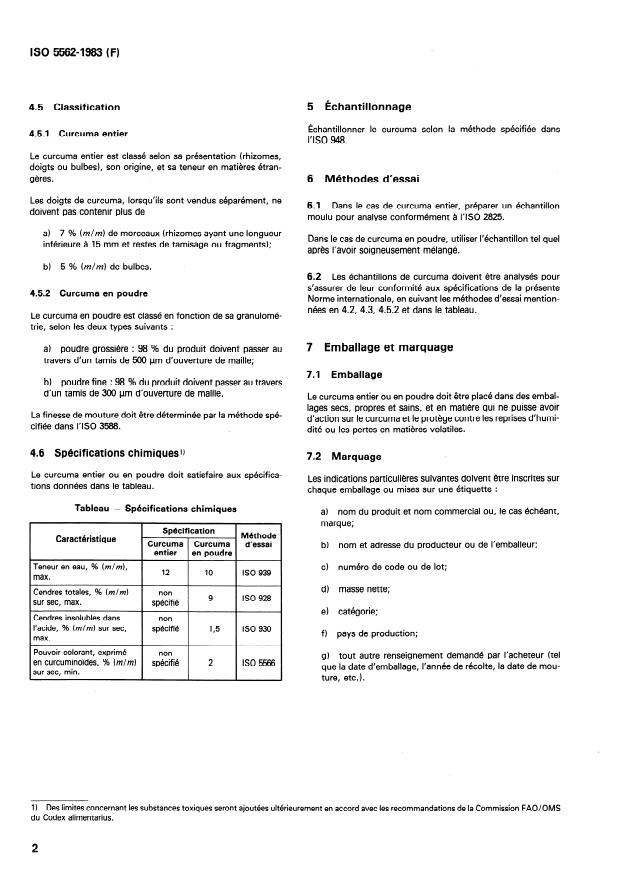
ISO 5562:1983 - Curcuma, entier ou en poudre — Spécifications Released:5/1/1983

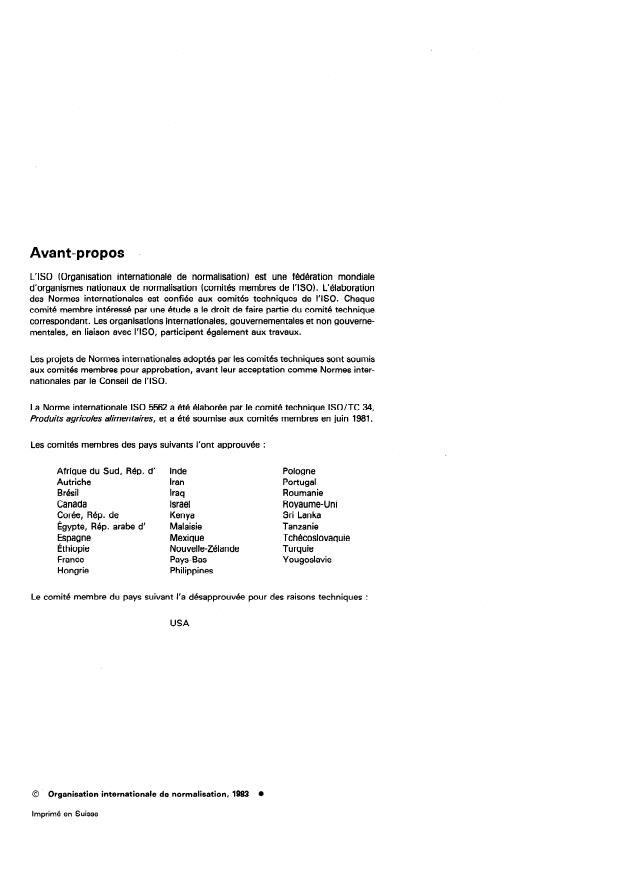

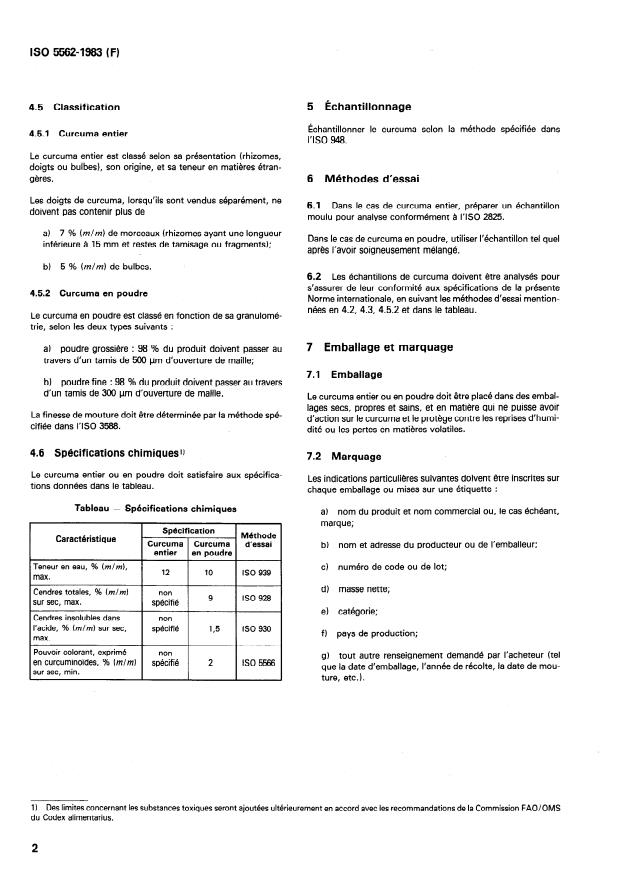
ISO 5562:1983 - Curcuma, entier ou en poudre — Spécifications Released:5/1/1983
Overview
ISO 5562:1983 specifies quality, testing, packing and marking requirements for turmeric, whole or ground (powdered). The standard covers sensory attributes (odour, flavour), freedom from contamination (insects, moulds, extraneous matter), grading by presentation and particle size, key chemical limits, sampling and test methods, plus an annex with practical recommendations for storage and transport.
Key topics and technical requirements
- Scope: Applies to cured rhizomes of Curcuma longa (whole bulbs/fingers) and ground turmeric powder.
- Organoleptic quality: Turmeric shall have the characteristic odour and flavour and be free from mustiness or foreign flavours.
- Freedom from infestation and filth:
- Whole turmeric: free from living insects and moulds; practically free from dead insects, fragments and rodent contamination (visible to naked eye or under magnification up to X10 - higher magnification must be reported).
- Ground turmeric: filth determined per ISO 1208.
- Extraneous matter:
- Whole turmeric: proportion of extraneous matter (chaff, leaves, stones, soil, other vegetable matter) shall not exceed 2% (m/m) as determined by ISO 927.
- Ground turmeric: must be free of morphologically extraneous matter (microscopic examination).
- Defective rhizomes: Shrivelled, internally damaged, hollow, scorched or porous rhizomes-defective proportion shall not exceed 5% (m/m).
- Grading:
- Whole: by presentation (rhizomes/fingers/bulbs), origin and extraneous matter content.
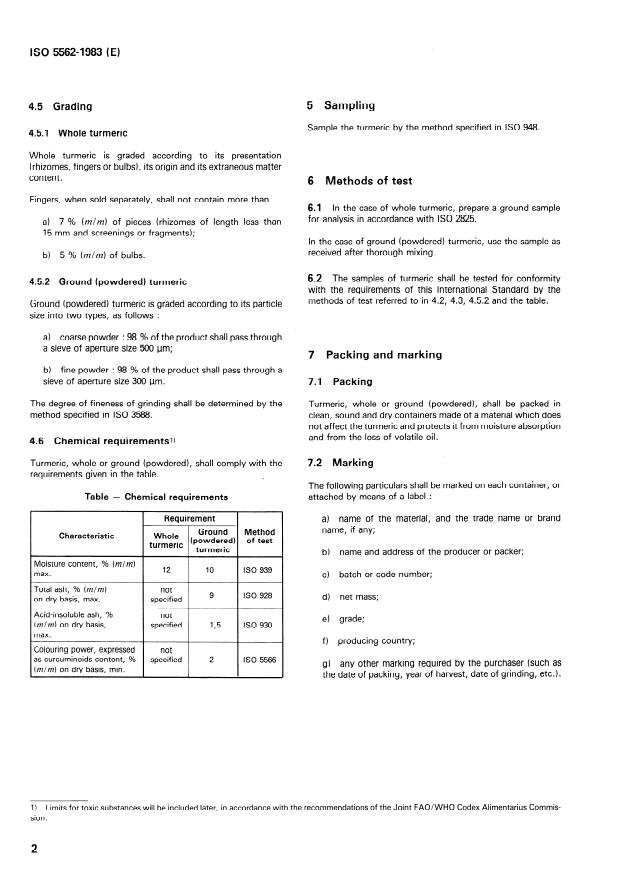
- Ground: by particle size - coarse powder: 98% through 500 µm sieve; fine powder: 98% through 300 µm sieve (ISO 3588).
- Chemical requirements (examples from table):
- Moisture content: maxima reported as 12% (whole) and 10% (ground) (ISO 939).
- Acid‑insoluble ash: maximum 1.5% on dry basis (ISO 930).
- Colouring power (curcuminoids): minimum 2% on dry basis (ISO 5566).
- (Total ash and future toxic substance limits to follow Codex/FAO-WHO recommendations.)
- Sampling & testing: Sampling per ISO 948; sample preparation ISO 2825; tests referenced throughout (ISO 927, 928, 930, 939, 1208, 3568/3588, 5566).
Applications and users
ISO 5562 is used for:
- Quality control and specification writing by turmeric producers, processors and packers
- Procurement and contract specifications for importers/exporters and traders
- Laboratory testing and quality assurance in food safety and analytical labs
- Regulatory agencies and standards bodies harmonizing spice standards
- Logistics and warehousing teams applying the annex guidance on storage and transport to protect colour, volatile oils and prevent infestation
Practical benefits include consistent product quality, clear acceptance criteria for trade, harmonised test methods for disputes, and guidance to minimise post‑harvest losses.
Related standards
Standards referenced in ISO 5562 (used for sampling and test methods):
- ISO 927, 928, 930, 939, 948, 1208, 2825, 3588, ISO 5566
Keywords: ISO 5562, turmeric specification, turmeric quality, spices standard, sampling, methods of test, packing, storage, transport, curcuminoids.
Buy Documents
ISO 5562:1983 - Turmeric, whole or ground (powdered) — Specification Released:5/1/1983
ISO 5562:1983 - Curcuma, entier ou en poudre — Spécifications Released:5/1/1983
ISO 5562:1983 - Curcuma, entier ou en poudre — Spécifications Released:5/1/1983
Get Certified
Connect with accredited certification bodies for this standard

BSI Group
BSI (British Standards Institution) is the business standards company that helps organizations make excellence a habit.

Bureau Veritas
Bureau Veritas is a world leader in laboratory testing, inspection and certification services.

DNV
DNV is an independent assurance and risk management provider.
Sponsored listings
Frequently Asked Questions
ISO 5562:1983 is a standard published by the International Organization for Standardization (ISO). Its full title is "Turmeric, whole or ground (powdered) — Specification". This standard covers: Covers the requirements for this spice, describes sampling, methods of test, and packing and marking. An annex includes recommendations relating to storage and transport conditions.
Covers the requirements for this spice, describes sampling, methods of test, and packing and marking. An annex includes recommendations relating to storage and transport conditions.
ISO 5562:1983 is classified under the following ICS (International Classification for Standards) categories: 67.220.10 - Spices and condiments. The ICS classification helps identify the subject area and facilitates finding related standards.
ISO 5562:1983 is available in PDF format for immediate download after purchase. The document can be added to your cart and obtained through the secure checkout process. Digital delivery ensures instant access to the complete standard document.
Standards Content (Sample)
SLOVENSKI STANDARD
01-junij-1997
Kurkuma, cela ali mleta (v prahu) - Specifikacija
Turmeric, whole or ground (powdered) -- Specification
Curcuma, entier ou en poudre -- Spécifications
Ta slovenski standard je istoveten z: ISO 5562:1983
ICS:
67.220.10 =DþLPEH Spices and condiments
2003-01.Slovenski inštitut za standardizacijo. Razmnoževanje celote ali delov tega standarda ni dovoljeno.
International Standard 5562
INTERNATIONAL ORGANIZATION FOR STANDARDIZATION.ME~YHAPO~HAR OPrAHH3AWlR fl0 CTAH~APTM3ALWWORGANISATION INTERNATIONALE DE NORMALISATION
Turmeric, whole or ground (powdered) - Specification
Curcuma, entier ou en poudre - Sptkifications
First edition - 1983-05-15
UDC 664.5 : 633.826
Ref. No. ISO 5562-1983 (E)
Descriptors : agricultural products, spices, turmeric, specifications, tests, packing, marking, storage, transportation.
Price based on 3 pages
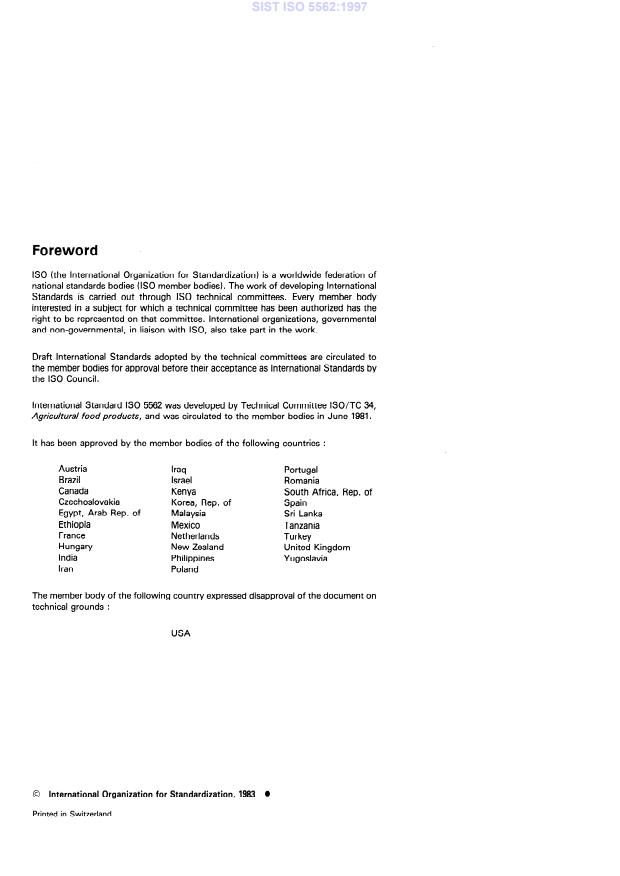
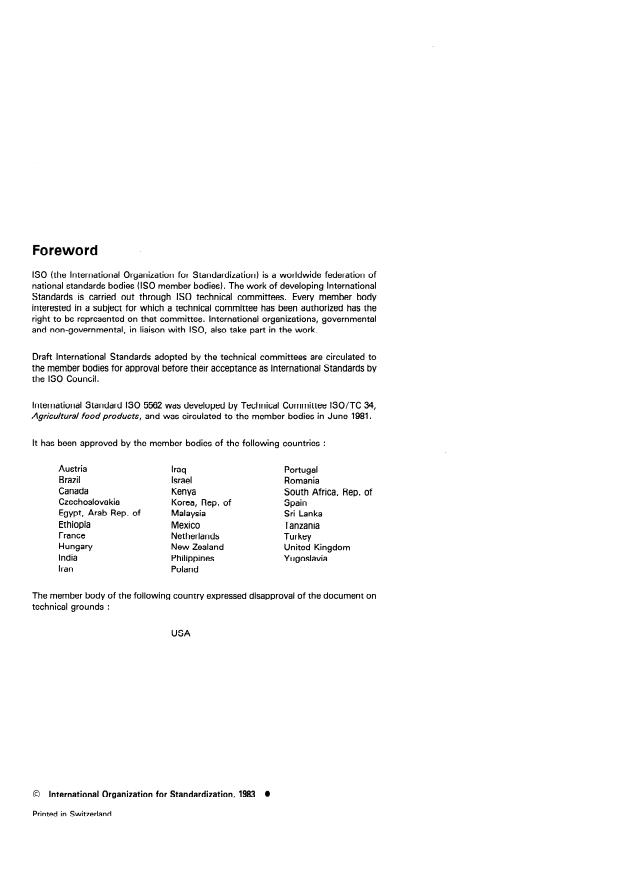
Foreword
ISO (the International Organization for Standardization) is a worldwide federation of
national Standards bodies (ISO member bedies). The work of developing International
Standards is carried out through ISO technical committees. Every member body
interested in a subject for which a technical committee has been authorized has the
right to be represented on that committee. International organizations, governmental
and non-governmental, in liaison with ISO, also take part in the work.
Draft International Standards adopted by the technical committees are circulated to
the member bodies for approval before their acceptance as International Standards by
the ISO Council.
International Standard ISO 5562 was developed by Technical Committee ISO/TC 34,
Agricultural food products, and was circulated to the member bodies in June 1981.
lt has been approved by the member bodies of the following countries :
Austria
Iraq Portugal
Brazil
Israel Romania
Canada Kenya South Africa, Rep. of
Czechoslovakia
Korea, Rep. of Spain
Egypt, Arab Rep. of Malaysia Sri Lanka
Ethiopia
Mexico Tanzania
France Netherlands
Turkey
Hungary New Zealand United Kingdom
India Philippines
Y ugoslavia
Iran Poland
member body of the following country of the document on
The expressed disapproval
tech nical gro unds
USA
0 International Organization for Standardization, 1983
Printed in Switzerland
ISO 5562-1983 (EI
INTERNATIONAL STANDARD
Turmeric, whole or ground (powdered) - Specification
4 Requirements
1 Scope and field of application
This International Standard specifies requirements for turmeric
4.1 Odour and flavour
(Curcuma longa Linnaeus), whole or ground (powdered).
Turmeric, whole or ground (powdered), shall have the
Recommendations relating to storage and transport conditions
characteristic odour and flavour of the spiee. lt shall be free
are given in the annex.
from mustiness or other foreign flavours.
2 References
4.2 Freedom from insects, moulds, etc.
ISO 927, Spices and condiments - Determination of ex-
Whole turmeric shall be free from living insects and moulds,
traneous matter con ten t. and shall be practically free from dead insects, insect fragments
and rodent contamination visible to the naked eye (corrected, if
I SO 928, Spices and condimen ts - Determination of total asb.
necessary, for abnormal Vision), with such magnification as
may be necessary in any particular case. lf the magnification
ISO 930, Spices and condiments - Determination of acid-
exceeds X 10, this fact shall be stated in the test report.
insoluble ash .
In the case of ground turmeric, filth shall be determined by the
ISO 939, Spices and condiments - Determination of moisture method specified in ISO 1208.
content - Entrainment method.
4.3 Extraneous matter
ISO 948, Spices and condiments - Sampling.
4.3.1 Whole turmeric
ISO 1208, Spices and condiments - Determination of filth.
Extraneous matter in whole turmeric includes :
ISO 2825, Spices and condiments - Preparation of a ground
Sample for analysis.
a) chaff, dried leaves, stones, particles of soil, dust and
mud, etc.;
ISO 3588, Spices and condiments - Determination of degree
of fineness of grinding - Hand sieving method.
b) all vegetable matter other than the rhizomes.
ISO 5566, Turmeric - Determination of colourin
...
International Standard 5562
INTERNATIONAL ORGANIZATION FOR STANDARDIZATION.ME~YHAPO~HAR OPrAHH3AWlR fl0 CTAH~APTM3ALWWORGANISATION INTERNATIONALE DE NORMALISATION
Turmeric, whole or ground (powdered) - Specification
Curcuma, entier ou en poudre - Sptkifications
First edition - 1983-05-15
UDC 664.5 : 633.826
Ref. No. ISO 5562-1983 (E)
Descriptors : agricultural products, spices, turmeric, specifications, tests, packing, marking, storage, transportation.
Price based on 3 pages
Foreword
ISO (the International Organization for Standardization) is a worldwide federation of
national Standards bodies (ISO member bedies). The work of developing International
Standards is carried out through ISO technical committees. Every member body
interested in a subject for which a technical committee has been authorized has the
right to be represented on that committee. International organizations, governmental
and non-governmental, in liaison with ISO, also take part in the work.
Draft International Standards adopted by the technical committees are circulated to
the member bodies for approval before their acceptance as International Standards by
the ISO Council.
International Standard ISO 5562 was developed by Technical Committee ISO/TC 34,
Agricultural food products, and was circulated to the member bodies in June 1981.
lt has been approved by the member bodies of the following countries :
Austria
Iraq Portugal
Brazil
Israel Romania
Canada Kenya South Africa, Rep. of
Czechoslovakia
Korea, Rep. of Spain
Egypt, Arab Rep. of Malaysia Sri Lanka
Ethiopia
Mexico Tanzania
France Netherlands
Turkey
Hungary New Zealand United Kingdom
India Philippines
Y ugoslavia
Iran Poland
member body of the following country of the document on
The expressed disapproval
tech nical gro unds
USA
0 International Organization for Standardization, 1983
Printed in Switzerland
ISO 5562-1983 (EI
INTERNATIONAL STANDARD
Turmeric, whole or ground (powdered) - Specification
4 Requirements
1 Scope and field of application
This International Standard specifies requirements for turmeric
4.1 Odour and flavour
(Curcuma longa Linnaeus), whole or ground (powdered).
Turmeric, whole or ground (powdered), shall have the
Recommendations relating to storage and transport conditions
characteristic odour and flavour of the spiee. lt shall be free
are given in the annex.
from mustiness or other foreign flavours.
2 References
4.2 Freedom from insects, moulds, etc.
ISO 927, Spices and condiments - Determination of ex-
Whole turmeric shall be free from living insects and moulds,
traneous matter con ten t. and shall be practically free from dead insects, insect fragments
and rodent contamination visible to the naked eye (corrected, if
I SO 928, Spices and condimen ts - Determination of total asb.
necessary, for abnormal Vision), with such magnification as
may be necessary in any particular case. lf the magnification
ISO 930, Spices and condiments - Determination of acid-
exceeds X 10, this fact shall be stated in the test report.
insoluble ash .
In the case of ground turmeric, filth shall be determined by the
ISO 939, Spices and condiments - Determination of moisture method specified in ISO 1208.
content - Entrainment method.
4.3 Extraneous matter
ISO 948, Spices and condiments - Sampling.
4.3.1 Whole turmeric
ISO 1208, Spices and condiments - Determination of filth.
Extraneous matter in whole turmeric includes :
ISO 2825, Spices and condiments - Preparation of a ground
Sample for analysis.
a) chaff, dried leaves, stones, particles of soil, dust and
mud, etc.;
ISO 3588, Spices and condiments - Determination of degree
of fineness of grinding - Hand sieving method.
b) all vegetable matter other than the rhizomes.
ISO 5566, Turmeric - Determination of colouring power -
The Proportion of extraneous matter, when determined by the
Spectrophotometric method.
method specified in ISO 927, shall not exceed 2 % (mlm).
3 Description
4.3.2 Ground (powdered) turmeric
Whole turmeric is constituted by cured primary or secondary
Ground (powdered) turmeric shall be examined by microscope.
rhizomes, called commercially bulbs or fingers, of Curcuma
lt shall not contain any morphologically ext
...
Norme internationale
INTERNATIONAL ORGANIZATION FOR STANDARDIZATlONWEIKAYHAPO~HAR OPTAHH3ALWR l-l0 CTAHP\APTH3AUMM~RGANISAtlON INTERNATIONALE DE NORMALISATION
Curcuma, entier ou en poudre - Spécifications
Turmeric, whole or ground (powdered) - Specification
Première édition - 1983-05-15
CDU 664.5: 633.826 Réf. no ISO5562-1983(F)
essai, emballage, marquage, entreposage, transport.
Descripteurs : produit agricole, épice, curcuma, spécification,
Prix basé sur 3 pages
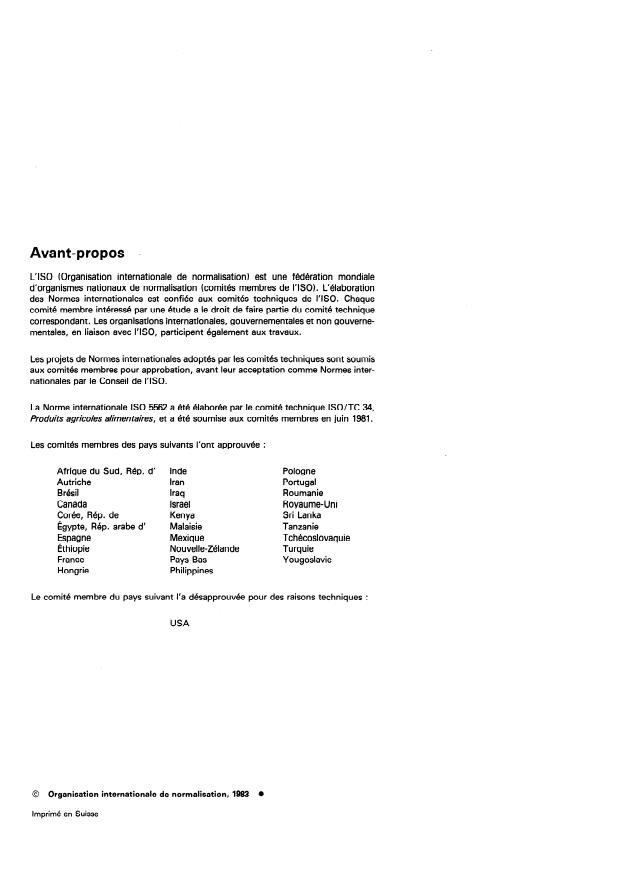
Avant-propos .
L’ISO (Organisation internationale de normalisation) est une fédération mondiale
d’organismes nationaux de normalisation (comités membres de I’ISO). L’élaboration
des Normes internationales est confiée aux comités techniques de I’ISO. Chaque
comité membre interesse par une étude a le droit de faire partie du comité technique
correspondant. Les organisations internationales, gouvernementales et non gouverne-
mentales, en liaison avec I’ISO, participent également aux travaux.
Les projets de Normes internationales adoptés par les comités techniques sont soumis
aux comités membres pour approbation, avant leur acceptation comme Normes inter-
nationales par le Conseil de I’ISO.
La Norme internationale ISO 5562 a été elaborée par le comité technique ISO/TC 34,
Produits agricoles alimentaires, et a été soumise aux comités membres en juin 1981.
Les comités membres des pays suivants l’ont approuvée :
Afrique du Sud, Rép. d’ Inde Pologne
Autriche Iran Portugal
Brésil Iraq Roumanie
Canada Israël Royaume-Uni
Corée, Rép. de Kenya Sri Lanka
Égypte, Rép. arabe d’ Malaisie Tanzanie
Espagne Mexique Tchécoslovaquie
Éthiopie Nouvelle-Zélande Turquie
France Pays-Bas Yougoslavie
Hongrie Philippines
Le comité membre du pays suivant l’a désapprouvée pour des raisons techniques :
USA
0 Organisation internationale de normalisation, 1983
Imprimé en Suisse
ISO 55624983 (FI
NORME INTERNATIONALE
Curcuma, entier ou en poudre - Spécifications
1 Objet et domaine d’application 4 Spécifications
La présente Norme internationale décrit les spécifications du
4.1 Odeur et flaveur
curcuma (Curcuma /onga Linnaeus), entier ou en poudre.
Le curcuma entier ou en poudre doit avoir une odeur et une fla-
Des recommandations relatives aux conditions d’entreposage
veur caractéristiques de l’épice. II doit être exempt d’odeur de
et de transport sont données dans l’annexe.
moisi ainsi que de flaveurs étrangères.
4.2 Absence d’insectes, de moisissures, etc.
2 Références
Le curcuma entier doit être exempt d’insectes vivants, de moi-
sissures, et pratiquement exempt d’insectes morts, de frag-
ISO 927, Epices - Determination de la teneur en matières
ments d’insectes et de contamination par des rongeurs visibles
étrangères.
à l’oeil nu (corrigé, si nécessaire, dans le cas d’une vision anor-
male) avec le grossissement pouvant s’avérer nécessaire dans
ISO 928, Epices - Détermination des cendres totales.
des cas particuliers. Si le grossissement est supérieur à X 10,
mention doit en être faite dans le procès-verbal d’essai.
ISO 930, Epices - Détermination des cendres insolubles dans
l’acide.
Dans le cas du curcuma en poudre, les impuretés doivent être
déterminées en utilisant la méthode spécifiée dans I’ISO 1208.
ISO 939, Épices - Détermination de la teneur en eau -
Methode par entraînement.
4.3 MatEres étrangères
- Échantillonnage.
ISO 948, Epices
4.3.1 Curcuma entier
- Détermination des impuretés.
ISO 1208, Épices
Les matiéres étrangères dans le curcuma entier comprennent :
ISO 2825, Épices - Préparation d’un échantillon moulu pour
analyse.
a) la paille, les feuilles séches, les pierres, les particules de
terre, la poussiére, la boue, etc.;
ISO 3588, Épices - Détermination du degré de finesse des
moutures - Méthode par tamisage manuel (Méthode de réfe-
b) toutes les parties de plantes autres que les rhizomes.
rente).
La proportion de ces matieres étrangéres, lorsqu’elle est déter-
ISO 5566, Curcuma - Détermination du pouvoir colorant -
mince selon la methode spécifiée dans I’ISO 927, ne doit pas
Methode spectrophotométrique.
excéder 2 % (mlm).
4.3.2 Curcuma en poudre
3 Description
Le curcuma en poudre doit faire l’objet d’un examen microsco-
pique. II ne doit pas contenir de matiéres étrangéres morpholo-
Le curcuma entier est constitué des rhizomes primaires ou
giques.
secondaires préparés du Curcuma longa Linnaeus, appelés
commercialement bulbes ou doigts.
4.4 Rhizomes dbfectueux
Les rhizomes doivent être secs, bien développés et avoir la
forme et la couleur caractéristiques de la variété
...