

ISO 24046:2026
(Main)Fine ceramics (advanced ceramics, advanced technical ceramics) — Methods of test for reinforcements — Determination of the tensile properties of resin-impregnated yarns
- Abstract
This document specifies a method for the determination of the tensile strength, tensile modulus of elasticity and strain at the maximum force of a resin-impregnated yarn specimen at ambient temperature. This method is applicable to yarns of ceramic fibres that are used as reinforcements in composite materials. The test results obtained by this method are applicable for quality control and comparison of the ceramic fibres. The outputs of this method are not comparable to the strength of filaments derived from tensile tests on dry tows specified in ISO 22459.
- Status
- Published
- Publication Date
- 02-Aug-2026
- Technical Committee
- ISO/TC 206 - Fine ceramics
- Drafting Committee
- ISO/TC 206/WG 4 - Composites
- Current Stage
- 6060 - International Standard published
- Start Date
- 03-Aug-2026
- Due Date
- 03-Oct-2026
- Completion Date
- 03-Aug-2026
ISO 24046:2026 is an International Standard published by ISO for testing resin-impregnated yarns made from ceramic fibres used as reinforcements in composite materials. It specifies a tensile test at ambient temperature to determine tensile strength, tensile modulus of elasticity, and strain at maximum force. The method is intended for quality control and comparison of ceramic fibres, and its results are not directly comparable with dry-tow filament strength values from ISO 22459.
What does ISO 24046:2026 specify?
ISO 24046:2026 specifies a tensile test method for resin-impregnated yarn specimens made from ceramic fibres. The document covers how to prepare the specimen, run the test at ambient temperature, calculate the results, and report them.
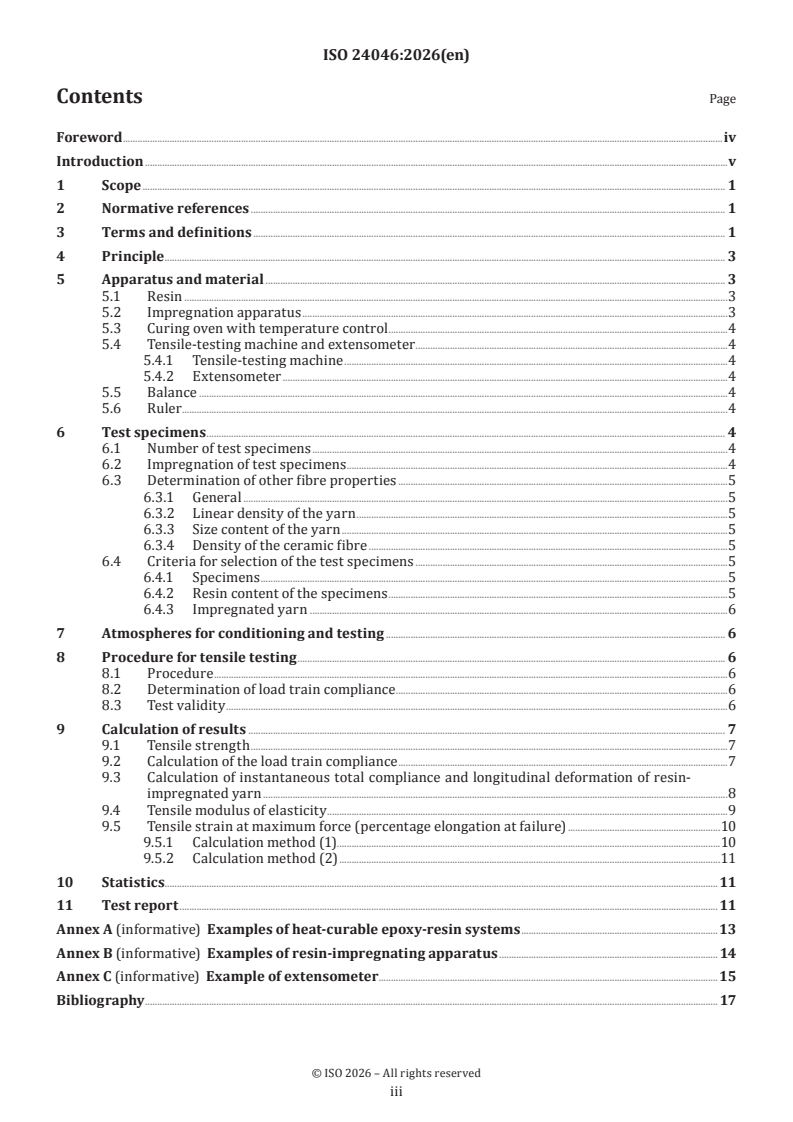
The standard is organized into Clauses 1 to 11:
- Scope
- Normative references
- Terms and definitions
- Principle
- Apparatus and material
- Test specimens
- Atmospheres for conditioning and testing
- Procedure for tensile testing
- Calculation of results
- Statistics
- Test report
It also includes three informative annexes that give examples of materials and equipment used with the method.
| Annex | What it covers |
|---|---|
| Annex A | Examples of heat-curable epoxy-resin systems |
| Annex B | Examples of resin-impregnating apparatus |
| Annex C | Example of extensometer |
What are the key requirements of ISO 24046:2026?
ISO 24046:2026 sets out a controlled tensile test in which a resin-impregnated ceramic-fibre yarn is pulled to failure at a constant displacement rate. In practice, the standard is focused on making the specimen, measuring deformation reliably, and turning the force-deformation data into comparable material properties.
Specimen preparation and resin choice
Clause 5 requires a resin that is compatible with the yarn sizing agent and fibre type, with sufficient flow to achieve uniform impregnation. The cured resin should fail at a much higher strain than the specimen so that the yarn, not the resin, governs the result. This matters because the test is intended to measure the fibre reinforcement, not an underperforming matrix.
Clause 6 requires enough specimens for five determinations, and damaged results are discarded and repeated on fresh specimens. The specimens must be straight, uniform, and free from broken filaments, resin droplets, and fibre misalignment. The resin content of the specimen must be in a defined range, and the yarn must be uniformly impregnated with no excess resin beads. In practice, this limits test-to-test scatter and helps the results reflect the fibre itself.
Conditioning, atmosphere, and machine setup
Clause 7 requires the apparatus and specimens to be kept under the same conditioning conditions during the test, with preferred ambient conditions given in the standard. Clause 8 requires a tensile-testing machine with a constant cross-head speed, aligned gripping, and suitable recording of force and displacement. If an extensometer is used, it must measure the specimen deformation directly and be light enough not to disturb the test. This is important because grip slip, bending, or machine compliance can distort the apparent modulus and strain.
Measuring deformation and correcting compliance
Clause 8 and Clause 9 distinguish two ways of measuring deformation:
- directly with an extensometer, or
- from grip displacement with a compliance correction.
When grip displacement is used, the standard requires determination of load train compliance so that machine, grip, and tab effects are removed from the specimen response. This matters in practice because the correction makes the measured deformation closer to the yarn’s actual elongation.
Calculated properties
Clause 9 defines how to calculate:
- tensile strength from the maximum tensile force and the dry yarn cross-sectional area,
- tensile modulus of elasticity from the slope of the force-deformation curve,
- tensile strain at maximum force by direct deformation measurement, by corrected grip displacement, or by a modulus-strength relationship for linear behaviour.
The standard says the force-deformation curve for resin-impregnated ceramic yarns is usually linear up to failure. That means the modulus is taken from the slope in the specified region of the curve, rather than from a general fit. For users, this means the raw test graph must be retained and interpreted in the way the standard requires.
Statistics and reporting
Clause 10 requires reporting the mean, standard deviation, and coefficient of variation for each measured value. Clause 11 requires the report to identify the yarn, give the yarn density data, state whether deformation came from an extensometer or compliance-corrected grip displacement, identify the strain calculation method, and record the test date and number of valid tests. In practice, this gives enough information to compare batches, review variability, and trace how the result was obtained.
What terms does ISO 24046:2026 define?
ISO 24046:2026 defines the terms needed to interpret the force, deformation, and geometry calculations used in the test.
- Gauge length - the initial distance between reference points on the specimen in the calibrated length; this is the length used for strain calculations.
- Longitudinal deformation - the change in gauge length caused by load; this is what the extensometer or compliance-corrected displacement is meant to capture.
- Maximum tensile force - the highest force reached at fracture; this is the key force value used for strength and strain calculations.
- Tensile strength - maximum tensile force divided by the initial total cross-sectional area of the dry yarn; this is the main strength result reported.
- Total compliance - the ratio of measured displacement to force during the test; this helps separate specimen deformation from machine effects.
- Load train compliance - the elongation of the load train excluding the specimen, divided by force; this is the correction used when grip displacement is measured.
- Tensile modulus of elasticity - the slope of the force-deformation curve divided by the initial total cross-sectional area of the dry yarn; this describes stiffness in tension.
- Tensile strain at maximum force - the strain value at the maximum tensile force; this shows how much the specimen elongated at failure.
Who uses ISO 24046:2026?
ISO 24046:2026 is used by fibre producers, composite material manufacturers, and test laboratories that work with ceramic fibres for reinforcement. The standard is especially relevant where ceramic matrix composites (CMCs) are used in demanding applications such as aerospace and high-temperature components.
In practice, users apply it for:
- quality control of ceramic fibre yarns,
- relative comparison between fibre batches or suppliers,
- development and verification of reinforcement materials,
- laboratory characterization of resin-impregnated yarns for CMC work.
Engineers and quality managers use the results to check consistency before the yarn is converted into composite parts. Buyers and suppliers can also use the method to compare reinforcement materials on a like-for-like basis.
What changed in ISO 24046:2026 from the previous edition?
ISO 24046:2026 is the second edition and it cancels and replaces ISO 24046:2022. The standard states that the main changes are:
- definitions 3.1, 3.2, 3.3, and 3.9 were corrected;
- Clause 9.4 and Clause 9.5 were revised to match the corrected terms and definitions.
Which standards are used with ISO 24046:2026?
ISO 24046:2026 cites four normative references that support the test method:
- ISO 1889 - used to determine the linear density of the yarn.
- ISO 7500-1 - used for calibration and verification of the tensile-testing machine force-measuring system.
- ISO 10119 - used to determine the density of the ceramic fibre.
- ISO 10548 - used to determine the size content of the yarn by method C.
The document also refers to ISO 22459 when noting that results from this method are not comparable with dry-tow filament strength values from that standard.
What does the ISO 24046:2026 document contain?
ISO 24046:2026 contains the full test workflow from specimen preparation through reporting. Clause 5 describes the resin, impregnation apparatus, curing oven, tensile-testing machine, extensometer, balance, and ruler needed for the method. Clause 6 gives the specimen preparation steps, the required companion measurements on linear density, size content, and fibre density, and the acceptance criteria for selecting valid specimens.
Clause 8 describes clamping, gauge-length measurement, loading rate, and the test-validity checks. Clause 9 provides the calculation path for tensile strength, compliance correction, tensile modulus of elasticity, and tensile strain at maximum force. Clause 10 gives the statistical treatment of valid results, and Clause 11 defines the contents of the test report. The annexes provide examples of epoxy-resin systems, impregnation equipment, and extensometer arrangements that help users set up the method in the laboratory.
Relations
- Effective Date
- 05-Oct-2024
Frequently Asked Questions
ISO 24046:2026 is a standard published by the International Organization for Standardization (ISO). Its full title is "Fine ceramics (advanced ceramics, advanced technical ceramics) — Methods of test for reinforcements — Determination of the tensile properties of resin-impregnated yarns". This standard covers: This document specifies a method for the determination of the tensile strength, tensile modulus of elasticity and strain at the maximum force of a resin-impregnated yarn specimen at ambient temperature. This method is applicable to yarns of ceramic fibres that are used as reinforcements in composite materials. The test results obtained by this method are applicable for quality control and comparison of the ceramic fibres. The outputs of this method are not comparable to the strength of filaments derived from tensile tests on dry tows specified in ISO 22459.
This document specifies a method for the determination of the tensile strength, tensile modulus of elasticity and strain at the maximum force of a resin-impregnated yarn specimen at ambient temperature. This method is applicable to yarns of ceramic fibres that are used as reinforcements in composite materials. The test results obtained by this method are applicable for quality control and comparison of the ceramic fibres. The outputs of this method are not comparable to the strength of filaments derived from tensile tests on dry tows specified in ISO 22459.
ISO 24046:2026 is classified under the following ICS (International Classification for Standards) categories: 81.060.30 - Advanced ceramics. The ICS classification helps identify the subject area and facilitates finding related standards.
ISO 24046:2026 has the following relationships with other standards: It is inter standard links to ISO 24046:2022. Understanding these relationships helps ensure you are using the most current and applicable version of the standard.
ISO 24046:2026 is available in PDF format for immediate download after purchase. The document can be added to your cart and obtained through the secure checkout process. Digital delivery ensures instant access to the complete standard document.
Standards Content (Sample)
International
Standard
ISO 24046
Second edition
Fine ceramics (advanced ceramics,
2026-08
advanced technical ceramics) —
Methods of test for reinforcements
— Determination of the tensile
properties of resin-impregnated
yarns
Céramiques techniques — Méthodes d'essai pour renforts —
Détermination des propriétés en traction des fils imprégnés de
résine
Reference number
© ISO 2026
All rights reserved. Unless otherwise specified, or required in the context of its implementation, no part of this publication may
be reproduced or utilized otherwise in any form or by any means, electronic or mechanical, including photocopying, or posting on
the internet or an intranet, without prior written permission. Permission can be requested from either ISO at the address below
or ISO’s member body in the country of the requester.
ISO copyright office
CP 401 • Ch. de Blandonnet 8
CH-1214 Vernier, Geneva
Phone: +41 22 749 01 11
Email: copyright@iso.org
Website: www.iso.org
Published in Switzerland
ii
Contents Page
Foreword .iv
Introduction .v
1 Scope . 1
2 Normative references . 1
3 Terms and definitions . 1
4 Principle . 3
5 Apparatus and material . 3
5.1 Resin .3
5.2 Impregnation apparatus .3
5.3 Curing oven with temperature control .4
5.4 Tensile-testing machine and extensometer .4
5.4.1 Tensile-testing machine .4
5.4.2 Extensometer .4
5.5 Balance .4
5.6 Ruler .4
6 Test specimens . 4
6.1 Number of test specimens .4
6.2 Impregnation of test specimens .4
6.3 Determination of other fibre properties .5
6.3.1 General .5
6.3.2 Linear density of the yarn .5
6.3.3 Size content of the yarn .5
6.3.4 Density of the ceramic fibre .5
6.4 Criteria for selection of the test specimens .5
6.4.1 Specimens .5
6.4.2 Resin content of the specimens .5
6.4.3 Impregnated yarn .6
7 Atmospheres for conditioning and testing . 6
8 Procedure for tensile testing . 6
8.1 Procedure .6
8.2 Determination of load train compliance .6
8.3 Test validity .6
9 Calculation of results . 7
9.1 Tensile strength .7
9.2 Calculation of the load train compliance .7
9.3 Calculation of instantaneous total compliance and longitudinal deformation of resin-
impregnated yarn .8
9.4 Tensile modulus of elasticity .9
9.5 Tensile strain at maximum force (percentage elongation at failure) .10
9.5.1 Calculation method (1).10
9.5.2 Calculation method (2) .11
10 Statistics . .11
11 Test report .11
Annex A (informative) Examples of heat-curable epoxy-resin systems .13
Annex B (informative) Examples of resin-impregnating apparatus . 14
Annex C (informative) Example of extensometer .15
Bibliography . 17
iii
Foreword
ISO (the International Organization for Standardization) is a worldwide federation of national standards
bodies (ISO member bodies). The work of preparing International Standards is normally carried out through
ISO technical committees. Each member body interested in a subject for which a technical committee
has been established has the right to be represented on that committee. International organizations,
governmental and non-governmental, in liaison with ISO, also take part in the work. ISO collaborates closely
with the International Electrotechnical Commission (IEC) on all matters of electrotechnical standardization.
The procedures used to develop this document and those intended for its further maintenance are described
in the ISO/IEC Directives, Part 1. In particular, the different approval criteria needed for the different types
of ISO document should be noted. This document was drafted in accordance with the editorial rules of the
ISO/IEC Directives, Part 2 (see www.iso.org/directives).
ISO draws attention to the possibility that the implementation of this document may involve the use of (a)
patent(s). ISO takes no position concerning the evidence, validity or applicability of any claimed patent
rights in respect thereof. As of the date of publication of this document, ISO had not received notice of (a)
patent(s) which may be required to implement this document. However, implementers are cautioned that
this may not represent the latest information, which may be obtained from the patent database available at
www.iso.org/patents. ISO shall not be held responsible for identifying any or all such patent rights.
Any trade name used in this document is information given for the convenience of users and does not
constitute an endorsement.
For an explanation of the voluntary nature of standards, the meaning of ISO specific terms and expressions
related to conformity assessment, as well as information about ISO's adherence to the World Trade
Organization (WTO) principles in the Technical Barriers to Trade (TBT), see www.iso.org/iso/foreword.html.
This document was prepared by Technical Committee ISO/TC 206, Fine ceramics.
This second edition cancels and replaces the first edition (ISO 24046:2022), which has been technically
revised.
The main changes are as follows:
— definitions 3.1, 3.2, 3.3, and 3.9 corrected;
— revision of 9.4 and 9.5 associated with the correction of terms and definitions.
Any feedback or questions on this document should be directed to the user’s national standards body. A
complete listing of these bodies can be found at www.iso.org/members.html.
iv
Introduction
Fine ceramics are widely used in various fields, such as machinery, electronics, chemistry, construction,
energy, aerospace and the nuclear industry, and in environmental applications. Fibre-reinforced ceramic
matrix composites (CMCs) have been the subject of extensive research and development. CMCs are
lightweight, have suitable chemical and thermal stability, and exhibit high strength, elastic modulus and
creep resistance. These composites have been applied in devices and components in the aerospace industry
and in high-temperature applications.
CMCs have been put to practical use as components in the jet engines of passenger planes and are also being
developed as components of gas turbines for electric power generation.
The reliability of CMCs is influenced by the properties of the reinforcing fibre. High reliability is particularly
important for jet engine parts. The mechanical properties of these fibres also require fixed values and
distribution.
This document establishes a method for the measurement of mechanical properties such as tensile strength,
elastic modulus and strain at the maximum force of a resin-impregnated yarn specimen prepared from the
reinforcing ceramic fibre in CMCs.
Fibre and CMC manufacturers can use this method to perform quality control and relative comparison of
ceramic fibres used as the reinforcement of CMCs.
v
International Standard ISO 24046:2026(en)
Fine ceramics (advanced ceramics, advanced technical
ceramics) — Methods of test for reinforcements —
Determination of the tensile properties of resin-impregnated
yarns
1 Scope
This document specifies a method for the determination of the tensile strength, tensile modulus of elasticity
and strain at the maximum force of a resin-impregnated yarn specimen at ambient temperature. This
method is applicable to yarns of ceramic fibres that are used as reinforcements in composite materials. The
test results obtained by this method are applicable for quality control and comparison of the ceramic fibres.
The outputs of this method are not comparable to the strength of filaments derived from tensile tests on dry
tows specified in ISO 22459.
2 Normative references
The following documents are referred to in the text in such a way that some or all of their content constitutes
requirements of this document. For dated references, only the edition cited applies. For undated references,
the latest edition of the referenced document (including any amendments) applies.
ISO 1889, Reinforcement yarns — Determination of linear density
ISO 7500-1, Metallic materials — Calibration and verification of static uniaxial testing machines — Part 1:
Tension/compression testing machines — Calibration and verification of the force-measuring system
ISO 10119, Carbon fibre — Determination of density
ISO 10548, Carbon fibre — Determination of size content
3 Terms and definitions
For the purposes of this document, the following terms and definitions apply.
ISO and IEC maintain terminology databases for use in standardization at the following addresses:
— ISO Online browsing platform: available at https:// www .iso .org/ obp
— IEC Electropedia: available at https:// www .electropedia .org/
3.1
gauge length
L
initial distance between reference points on the test specimen in the calibrated length
[SOURCE: ISO 19634:2017, 4, Table 2.]
3.2
longitudinal deformation
A
variation in the gauge length (3.1) caused by an applied load
Note 1 to entry: Variation is positive in tensile and negative in compressive test.
[SOURCE: ISO 19634:2017, 4, Table 3.]
3.3
maximum tensile force
F
m
maximum force at fracture
[SOURCE: ISO 19634:2017, 4, Table 3, modified — The words “during a test or” have been removed from the
definition.]
3.4
tensile strength
σ
f
maximum tensile force (3.3) divided by the initial total cross-sectional area of the dry yarn (3.8)
[SOURCE: ISO 19630:2017, 3.6, modified —The words “of the dry yarn” have been added to make the
definition specific.]
3.5
total compliance
C
t
ratio of the measured displacement to the corresponding force during the tensile test
[SOURCE: ISO 22459:2024, 3.4.1]
3.6
load train compliance
C
l
ratio of the load train elongation, excluding the specimen contribution, to the corresponding force during
the tensile test
[SOURCE: ISO 22459:2024, 3.4.2]
3.7
tensile modulus of elasticity
E
f
slope of the force–deformation curve divided by the initial total cross-sectional area of the dry yarn (3.8)
3.8
initial total cross-sectional area of the dry yarn
S
f
linear density of the dry yarn (3.10) divided by the density of the dry yarn (3.12)
[SOURCE: ISO 22459:2024, 3.2, modified — The words “of the dry yarn” have been added to make the term
specific.]
3.9
tensile strain at maximum force
ε
t,m
value of strain corresponding to the maximumtensile force (3.3)
[SOURCE: ISO 19634:2017, 4, Table 3.]
3.10
linear density of the dry yarn
T
tf
mass of the dry yarn without a sizing agent divided by its length
[SOURCE: ISO 1889:2009, 3.1, modified — The words “of the dry yarn" have been added to the term and
defined as the value of dry yarn without a sizing agent, and Note 1 to entry has been removed.]
3.11
linear density of the impregnated yarn
T
ti
mass of the test specimen divided by its length
3.12
density of the dry yarn
ρ
f
mass of the dry yarn without a sizing agent divided by its volume
4 Principle
A fibre yarn impregnated with an epoxy resin is used as the specimen. A tensile force is applied to the
specimen at a constant displacement rate by a suitable mechanical testing machine and grip system
until failure. The longitudinal deformation of resin-impregnated yarn is measured directly by using an
extensometer or is determined from the displacement between two grips using a compliance correction.
The correction takes into account the contributions of the loading train, the grips and the tabbing materials.
The tensile strength, tensile modulus of elasticity and the strain at maximum force are calculated from the
force–deformation relationship. For ceramic fibre yarns in epoxy matrix, the relation between force and
longitudinal deformation is linear and, hence, the tensile modulus of elasticity is calculated from the slope of
the force–deformation curve.
5 Apparatus and material
5.1 Resin
The impregnating resin shall be compatible with the sizing agent and the type of yarn. The viscosity of the
resin or resin solution shall be such that sufficient resin pick-up and uniform impregnation are achieved.
The failure strain of the cured resin should be at least twice as large, preferably more than three times as
large, as that of the specimen. In this respect, thermosetting epoxy-resin systems are suitable (see Table A.1
for an example) as is any formulation capable of giving test specimens that fulfil the requirements of this
document.
5.2 Impregnation apparatus
Test speci
...