

ISO 15733:2026
(Main)Fine ceramics (advanced ceramics, advanced technical ceramics) — Mechanical properties of ceramic composites at ambient temperature in air atmospheric pressure — Determination of tensile properties
- Abstract
This document specifies the conditions for determining the tensile properties (including tensile modulus, Poisson’s ratio, strength, strain at maximum force and fracture strain) of ceramic matrix composite materials with continuous fibre reinforcement at room temperature. This document applies to all ceramic matrix composites with a continuous fibre reinforcement, including unidirectional (1D), bi-directional (2D), and multi-directional (xD, with x > 2), reinforcement, loaded along a principal axis of reinforcement. NOTE In most cases, ceramic matrix composites to be used at high temperature in air are coated with an antioxidation coating.
- Status
- Published
- Publication Date
- 11-Jun-2026
- Technical Committee
- ISO/TC 206 - Fine ceramics
- Drafting Committee
- ISO/TC 206/WG 4 - Composites
- Current Stage
- 6060 - International Standard published
- Start Date
- 12-Jun-2026
- Due Date
- 08-Dec-2026
- Completion Date
- 12-Jun-2026
Buy Documents
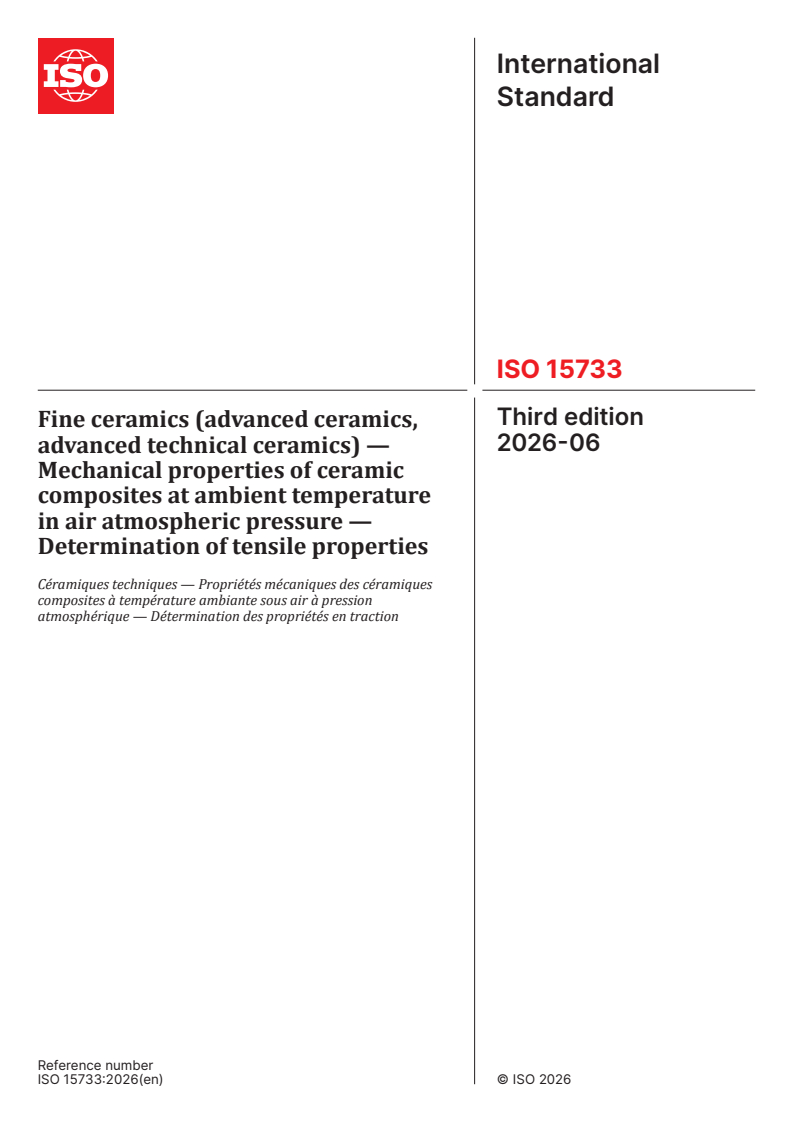
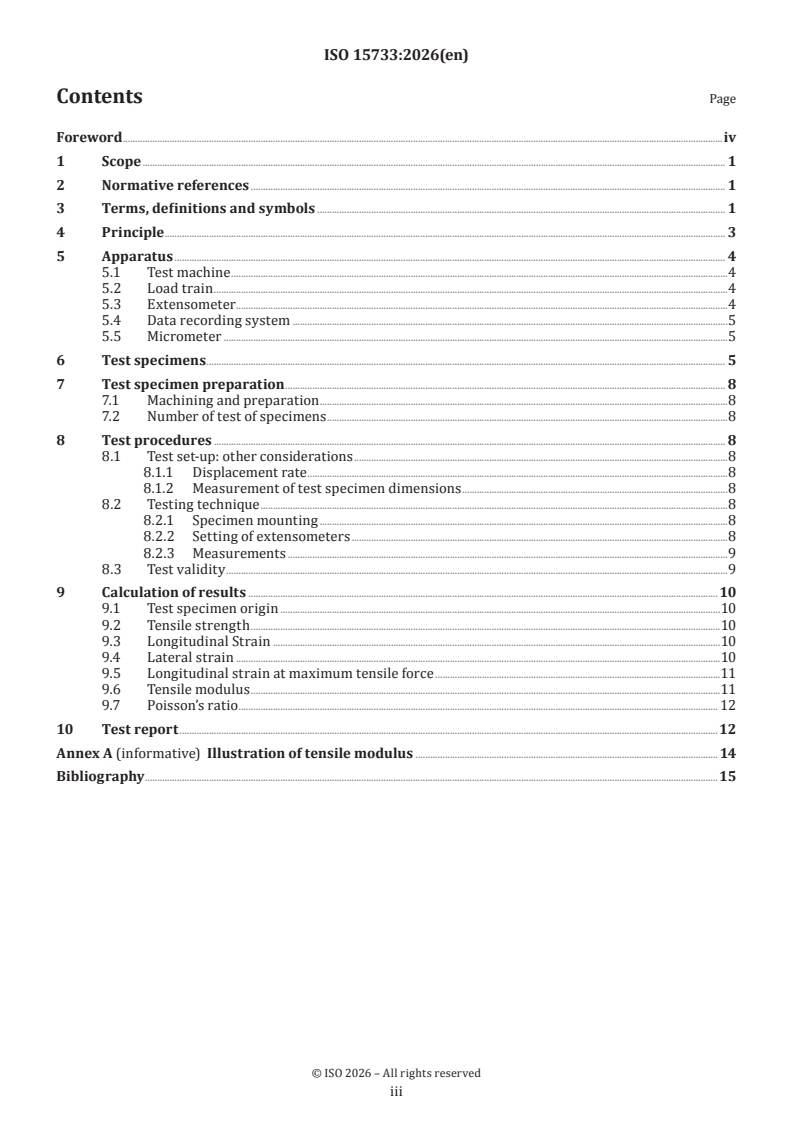
ISO 15733:2026 - Fine ceramics (advanced ceramics, advanced technical ceramics) — Mechanical properties of ceramic composites at ambient temperature in air atmospheric pressure — Determination of tensile properties
ISO 15733:2026 is an International Standard from ISO for measuring the tensile properties of ceramic matrix composite materials with continuous fibre reinforcement at ambient temperature in air atmospheric pressure. It specifies how to prepare specimens, run the tensile test, calculate tensile modulus, Poisson’s ratio, strength and fracture strain, and report the results for materials loaded along a principal axis of reinforcement.
What does ISO 15733:2026 specify?
ISO 15733:2026 covers the determination of tensile properties of ceramic matrix composite materials with continuous fibre reinforcement at room temperature. The standard applies to unidirectional (1D), bi-directional (2D), and multi-directional (xD, with x > 2) reinforcement, provided the load is applied along a principal reinforcement axis.
| Annex | What it covers |
|---|---|
| Annex A | Illustration of tensile modulus, including cases where the stress-strain curve is initially non-linear or linear from the origin |
The document is organized into scope, normative references, terms and symbols, principle, apparatus, test specimens, specimen preparation, test procedures, calculation of results, and test report. In practice, that means it gives a complete test method from specimen preparation through data reduction and reporting.
What are the key requirements of ISO 15733:2026?
ISO 15733:2026 requires a tensile test machine with a force-measuring system meeting grade 1 or better, a load train that aligns the specimen without bending or torsion, and suitable extensometry for small deformations. This matters because these composites are sensitive to misalignment and small-strain measurement errors.
Specimens and preparation
ISO 15733:2026 defines four specimen types, including as-fabricated, machined, straight-sided, and tabbed specimens. Type 2 is mainly for modulus determination and should not be used for strength measurement, while Type 3 uses metallic, composite, or polymeric tabs depending on the reinforcement architecture. Type 4 allows the same specimen designs used for high-temperature testing to be used at ambient temperature.
The specimen axis has to be aligned with the intended fibre-related loading direction during cutting and preparation. The standard also requires machining parameters that avoid damage to the material and that are documented.
Test execution and validity
ISO 15733:2026 requires constant crosshead displacement rate or constant deformation rate, with a rupture time of about 1 minute. Force and deformation are recorded simultaneously, and at least five valid test results are required for each condition.
The test is invalid if test conditions are not recorded, if the specimen slips, or if the extensometer slips. The document also explains how certain sudden changes in the force-deformation curve affect whether force data, deformation data, or both remain usable.
Calculation and reporting
ISO 15733:2026 covers tensile strength, longitudinal strain, lateral strain, strain at maximum tensile force, tensile modulus, and Poisson’s ratio. It also distinguishes between apparent and effective values, the latter using an effective cross-section area corrected for oxidation protection.
The test report has to include specimen identification, test conditions, the number of tests and valid results, force-deformation records, statistical results, correction factors used for effective area calculations, failure locations, and unusual observations. That gives enough traceability for quality control, material comparison, and qualification work.
What terms does ISO 15733:2026 define?
- Calibrated length - the part of the specimen with uniform, minimum cross-section area used for the measurement zone.
- Gauge length - the initial distance between reference points in the calibrated length.
- Effective cross-section area - the cross-sectional area corrected by a factor to account for coating.
- Tensile modulus - the slope of the initial linear part of the stress-strain curve at or near the origin.
- Poisson’s ratio - the negative ratio of lateral strain to axial strain under axial load.
- Longitudinal deformation - the increase in gauge length in the loading direction under tensile force.
- Lateral strain - the ratio of lateral deformation to lateral gauge length.
- DIC (digital image correlation) - an optical technique used to determine local deformations from displacement-field measurement.
Who uses ISO 15733:2026?
ISO 15733:2026 is used by testing laboratories, materials engineers, ceramic composite manufacturers, and quality managers who need comparable tensile data at ambient temperature. It is also relevant to buyers and specifiers who need to compare suppliers using the same measurement method and reporting format.
In practice, users apply it for material characterization, product development, incoming qualification, process control, and contract testing of ceramic matrix composites with continuous fibre reinforcement.
What changed in ISO 15733:2026 from the previous edition?
ISO 15733:2026 cancels and replaces ISO 15733:2015. The third edition extends the tensile property range to include tensile modulus, Poisson’s ratio, strength, fracture strain, and lateral deformations, and it updates test validity treatment for possible singularities in force-deformation curves. It also includes editorial changes.
Which standards are used with ISO 15733:2026?
- ISO 3611 - provides the metrological requirements for the micrometers used to measure specimen dimensions.
- ISO 7500-1:2018 - gives calibration and verification requirements for the force-measuring system of the tensile testing machine.
- ASTM E2208-02S-2018 - supports the estimation of strain from digital image correlation measurements.
- ISO 17161 - is cited for verifying specimen-machine misalignment.
- ISO 9513 - is cited for extensometer class guidance.
What does the ISO 15733:2026 document contain?
ISO 15733:2026 contains specimen geometries, dimensional tolerances, test setup guidance, extensometer installation requirements, validity checks, and result calculations for tensile testing of ceramic matrix composites. It also includes a worked illustration of tensile modulus behavior in Annex A, covering both initially non-linear and mostly linear stress-strain responses.
The document gives the information needed to set up the test, choose an appropriate specimen type, record the right measurements, and report results in a comparable way. That makes it useful both for laboratory execution and for interpreting supplier or qualification data.
Relations
- Effective Date
- 09-Dec-2023
Buy Documents
ISO 15733:2026 - Fine ceramics (advanced ceramics, advanced technical ceramics) — Mechanical properties of ceramic composites at ambient temperature in air atmospheric pressure — Determination of tensile properties
Frequently Asked Questions
ISO 15733:2026 is a standard published by the International Organization for Standardization (ISO). Its full title is "Fine ceramics (advanced ceramics, advanced technical ceramics) — Mechanical properties of ceramic composites at ambient temperature in air atmospheric pressure — Determination of tensile properties". This standard covers: This document specifies the conditions for determining the tensile properties (including tensile modulus, Poisson’s ratio, strength, strain at maximum force and fracture strain) of ceramic matrix composite materials with continuous fibre reinforcement at room temperature. This document applies to all ceramic matrix composites with a continuous fibre reinforcement, including unidirectional (1D), bi-directional (2D), and multi-directional (xD, with x > 2), reinforcement, loaded along a principal axis of reinforcement. NOTE In most cases, ceramic matrix composites to be used at high temperature in air are coated with an antioxidation coating.
This document specifies the conditions for determining the tensile properties (including tensile modulus, Poisson’s ratio, strength, strain at maximum force and fracture strain) of ceramic matrix composite materials with continuous fibre reinforcement at room temperature. This document applies to all ceramic matrix composites with a continuous fibre reinforcement, including unidirectional (1D), bi-directional (2D), and multi-directional (xD, with x > 2), reinforcement, loaded along a principal axis of reinforcement. NOTE In most cases, ceramic matrix composites to be used at high temperature in air are coated with an antioxidation coating.
ISO 15733:2026 is classified under the following ICS (International Classification for Standards) categories: 81.060.30 - Advanced ceramics. The ICS classification helps identify the subject area and facilitates finding related standards.
ISO 15733:2026 has the following relationships with other standards: It is inter standard links to ISO 15733:2015. Understanding these relationships helps ensure you are using the most current and applicable version of the standard.
ISO 15733:2026 is available in PDF format for immediate download after purchase. The document can be added to your cart and obtained through the secure checkout process. Digital delivery ensures instant access to the complete standard document.
Standards Content (Sample)
International
Standard
ISO 15733
Third edition
Fine ceramics (advanced ceramics,
2026-06
advanced technical ceramics) —
Mechanical properties of ceramic
composites at ambient temperature
in air atmospheric pressure —
Determination of tensile properties
Céramiques techniques — Propriétés mécaniques des céramiques
composites à température ambiante sous air à pression
atmosphérique — Détermination des propriétés en traction
Reference number
© ISO 2026
All rights reserved. Unless otherwise specified, or required in the context of its implementation, no part of this publication may
be reproduced or utilized otherwise in any form or by any means, electronic or mechanical, including photocopying, or posting on
the internet or an intranet, without prior written permission. Permission can be requested from either ISO at the address below
or ISO’s member body in the country of the requester.
ISO copyright office
CP 401 • Ch. de Blandonnet 8
CH-1214 Vernier, Geneva
Phone: +41 22 749 01 11
Email: copyright@iso.org
Website: www.iso.org
Published in Switzerland
ii
Contents Page
Foreword .iv
1 Scope . 1
2 Normative references . 1
3 Terms, definitions and symbols . 1
4 Principle . 3
5 Apparatus . 4
5.1 Test machine .4
5.2 Load train .4
5.3 Extensometer .4
5.4 Data recording system .5
5.5 Micrometer .5
6 Test specimens . 5
7 Test specimen preparation . 8
7.1 Machining and preparation .8
7.2 Number of test of specimens .8
8 Test procedures . 8
8.1 Test set-up: other considerations .8
8.1.1 Displacement rate .8
8.1.2 Measurement of test specimen dimensions .8
8.2 Testing technique .8
8.2.1 Specimen mounting .8
8.2.2 Setting of extensometers .8
8.2.3 Measurements .9
8.3 Test validity .9
9 Calculation of results . 10
9.1 Test specimen origin .10
9.2 Tensile strength .10
9.3 Longitudinal Strain .10
9.4 Lateral strain .10
9.5 Longitudinal strain at maximum tensile force .11
9.6 Tensile modulus .11
9.7 Poisson’s ratio . 12
10 Test report .12
Annex A (informative) Illustration of tensile modulus . 14
Bibliography .15
iii
Foreword
ISO (the International Organization for Standardization) is a worldwide federation of national standards
bodies (ISO member bodies). The work of preparing International Standards is normally carried out through
ISO technical committees. Each member body interested in a subject for which a technical committee
has been established has the right to be represented on that committee. International organizations,
governmental and non-governmental, in liaison with ISO, also take part in the work. ISO collaborates closely
with the International Electrotechnical Commission (IEC) on all matters of electrotechnical standardization.
The procedures used to develop this document and those intended for its further maintenance are described
in the ISO/IEC Directives, Part 1. In particular, the different approval criteria needed for the different types
of ISO document should be noted. This document was drafted in accordance with the editorial rules of the
ISO/IEC Directives, Part 2 (see www.iso.org/directives).
ISO draws attention to the possibility that the implementation of this document may involve the use of (a)
patent(s). ISO takes no position concerning the evidence, validity or applicability of any claimed patent
rights in respect thereof. As of the date of publication of this document, ISO had not received notice of (a)
patent(s) which may be required to implement this document. However, implementers are cautioned that
this may not represent the latest information, which may be obtained from the patent database available at
www.iso.org/patents. ISO shall not be held responsible for identifying any or all such patent rights.
Any trade name used in this document is information given for the convenience of users and does not
constitute an endorsement.
For an explanation of the voluntary nature of standards, the meaning of ISO specific terms and expressions
related to conformity assessment, as well as information about ISO's adherence to the World Trade
Organization (WTO) principles in the Technical Barriers to Trade (TBT), see www.iso.org/iso/foreword.html.
This document was prepared by Technical Committee ISO/TC 206, Fine ceramics.
This third edition cancels and replaces the second edition (ISO 15733:2015), which has been technically
revised.
The main changes are as follows:
— broader range of tensile properties: tensile modulus, Poisson’s ratio, strength, fracture strain, lateral
deformations;
— test validity: possible singularities of force-deformation curves;
— editorial changes.
Any feedback or questions on this document should be directed to the user’s national standards body. A
complete listing of these bodies can be found at www.iso.org/members.html.
iv
International Standard ISO 15733:2026(en)
Fine ceramics (advanced ceramics, advanced technical
ceramics) — Mechanical properties of ceramic composites
at ambient temperature in air atmospheric pressure —
Determination of tensile properties
1 Scope
This document specifies the conditions for determining the tensile properties (including tensile modulus,
Poisson’s ratio, strength, strain at maximum force and fracture strain) of ceramic matrix composite
materials with continuous fibre reinforcement at room temperature. This document applies to all ceramic
matrix composites with a continuous fibre reinforcement, including unidirectional (1D), bi-directional (2D),
and multi-directional (xD, with x > 2), reinforcement, loaded along a principal axis of reinforcement.
NOTE In most cases, ceramic matrix composites to be used at high temperature in air are coated with an
antioxidation coating.
2 Normative references
The following documents are referred to in the text in such a way that some or all of their content constitutes
requirements of this document. For dated references, only the edition cited applies. For undated references,
the latest edition of the referenced document (including any amendments) applies.
ISO 3611, Geometrical product specifications (GPS) — Dimensional measuring equipment — Design and
metrological characteristics of micrometers for external measurements
ISO 7500-1:2018, Metallic materials — Calibration and verification of static uniaxial testing machines — Part 1:
Tension/compression testing machines — Calibration and verification of the force-measuring system
ASTM E2208−02S–2018, Standard Guide for Evaluating Non-Contacting Optical Strain Measurement Systems
3 Terms, definitions and symbols
For the purposes of this document, the following terms and definitions apply.
ISO and IEC maintain terminology databases for use in standardization at the following addresses:
— ISO Online browsing platform: available at https:// www .iso .org/ obp
— IEC Electropedia: available at https:// www .electropedia .org/
3.1
calibrated length
l
part of the test specimen that has uniform and minimum cross-section area
3.2
gauge length
L
o
initial distance between reference points on the test specimen in the calibrated length (3.1)
3.3
lateral gauge length
L
gauge length in direction perpendicular to the specific direction of loading
3.4
initial cross-section area
S
o
cross-section area of the test specimen within the calibrated length before loading
3.5
effective cross-section area
S
o,eff
total area corrected by a factor, to account for the presence of a coating
3.6
longitudinal deformation
A
increase in the gauge length parallel to the load direction under a tensile force
Note 1 to entry: Longitudinal deformation refers to axial deformation
3.7
lateral deformation
A
change of the lateral gauge length in a direction perpendicular to the specific direction of loading
3.8
longitudinal deformation at maximum tensile force
A
m
value of deformation corresponding to the maximum tensile force
3.9
tensile strain
ε
ratio of deformation to initial gauge length defined as the ratio of longitudinal deformation/gauge length (A/
L )
3.10
tensile strain at maximum force
ε
m
value of strain corresponding to the maximum tensile force
3.11
fracture strain
strain at ultimate fracture of the test specimen
3.12
lateral strain
ε
ratio of lateral deformation to initial lateral gauge length defined as the ratio of lateral deformation/lateral
gauge length (A /L )
2 02
3.13
tensile stress
σ
ratio of the force carried by the test piece to the initial cross-section area (S )
o
3.14
effective tensile stress
σ
eff
ratio of the force carried by the test piece to the effective cross-section area (S )
o,eff
3.15
maximum tensile force
F
m
maximum force during a test
3.16
tensile strength
σ
m
ratio of the maximum tensile force to the initial cross-section area (S )
o
3.17
effective tensile strength
σ
m,eff
ratio of the maximum tensile force to the effective cross-section area
3.18
tensile modulus
E
slope of the initial linear section of the stress-strain curve, at or near the origin
Note 1 to entry: The linear part could not exist or not start at the origin. The different situations are then described in
Annex A.
Note 2 to entry: Two tensile moduli depending of initial cross-section area can be defined as follows.
3.18.1
apparent tensile modulus
E
app
slope of the linear part of the stress-strain curve at or near the origin when the apparent tensile stress is
used
3.18.2
effective tensile modulus
E
eff
slope of the linear part of the stress-strain curve at or near the origin when the effective tensile stress is
used
3.19
Poisson’s ratio
ν
negative of the ratio of lateral strain to axial strain in an axially stressed body
4 Principle
A test specimen of specified dimensions is loaded in tension. The test is performed at constant crosshead
displacement rate, or constant deformation rate. Force and deformations are measured and recorded
simultaneously. Either longitudinal or both longitudinal and lateral deformations are measured.
NOTE The use of constant stress rate gives a valid tensile curve only when the material behaves linearly up to
failure.
5 Apparatus
5.1 Test machine
The test machine shall be equipped with a system for measuring the force applied to the test specimen
conforming to grade 1 or better according to ISO
...