


ISO/IEC 23008-2:2017
(Main)Information technology — High efficiency coding and media delivery in heterogeneous environments — Part 2: High efficiency video coding
Information technology — High efficiency coding and media delivery in heterogeneous environments — Part 2: High efficiency video coding
ISO/IEC 23008-2 specifies high efficiency video coding.
Technologies de l'information — Codage à haute efficacité et livraison des medias dans des environnements hétérogènes — Partie 2: Codage vidéo à haute efficacité
General Information
- Status
- Withdrawn
- Publication Date
- 08-Oct-2017
- Withdrawal Date
- 08-Oct-2017
- Current Stage
- 9599 - Withdrawal of International Standard
- Start Date
- 28-Aug-2020
- Completion Date
- 12-Feb-2026
Relations
- Effective Date
- 11-Dec-2021
- Effective Date
- 09-May-2020
- Effective Date
- 25-Apr-2020
- Effective Date
- 24-Feb-2018
- Effective Date
- 05-Nov-2015
- Effective Date
- 05-Nov-2015



Get Certified
Connect with accredited certification bodies for this standard

BSI Group
BSI (British Standards Institution) is the business standards company that helps organizations make excellence a habit.

NYCE
Mexican standards and certification body.
Sponsored listings
Frequently Asked Questions
ISO/IEC 23008-2:2017 is a standard published by the International Organization for Standardization (ISO). Its full title is "Information technology — High efficiency coding and media delivery in heterogeneous environments — Part 2: High efficiency video coding". This standard covers: ISO/IEC 23008-2 specifies high efficiency video coding.
ISO/IEC 23008-2 specifies high efficiency video coding.
ISO/IEC 23008-2:2017 is classified under the following ICS (International Classification for Standards) categories: 35.040 - Information coding; 35.040.40 - Coding of audio, video, multimedia and hypermedia information. The ICS classification helps identify the subject area and facilitates finding related standards.
ISO/IEC 23008-2:2017 has the following relationships with other standards: It is inter standard links to ISO/IEC 23008-2:2017/Amd 3:2018, ISO/IEC 23008-2:2017/Amd 1:2018, ISO/IEC 23008-2:2017/Amd 2:2018, ISO/IEC 23008-2:2020, ISO/IEC 23008-2:2015, ISO/IEC 23008-2:2015/Amd 1:2015. Understanding these relationships helps ensure you are using the most current and applicable version of the standard.
ISO/IEC 23008-2:2017 is available in PDF format for immediate download after purchase. The document can be added to your cart and obtained through the secure checkout process. Digital delivery ensures instant access to the complete standard document.
Standards Content (Sample)
INTERNATIONAL ISO/IEC
STANDARD 23008-2
Third edition
2017-10
Information technology — High
efficiency coding and media delivery
in heterogeneous environments —
Part 2:
High efficiency video coding
Technologies de l’information — Codage à haute efficacité et livraison
des medias dans des environnements hétérogènes —
Partie 2: Codage vidéo à haute efficacité
Reference number
©
ISO/IEC 2017
© ISO/IEC 2017, Published in Switzerland
All rights reserved. Unless otherwise specified, no part of this publication may be reproduced or utilized otherwise in any form
or by any means, electronic or mechanical, including photocopying, or posting on the internet or an intranet, without prior
written permission. Permission can be requested from either ISO at the address below or ISO’s member body in the country of
the requester.
ISO copyright office
Ch. de Blandonnet 8 • CP 401
CH-1214 Vernier, Geneva, Switzerland
Tel. +41 22 749 01 11
Fax +41 22 749 09 47
copyright@iso.org
www.iso.org
ii © ISO/IEC 2017 – All rights reserved
Contents
Foreword . xi
Introduction.xii
1 Scope . 1
2 Normative references . 1
3 Terms and definitions . 1
4 Abbreviated terms . 19
5 Conventions . 20
5.1 General . 20
5.2 Arithmetic operators . 21
5.3 Logical operators . 21
5.4 Relational operators . 21
5.5 Bit-wise operators . 21
5.6 Assignment operators . 22
5.7 Range notation . 22
5.8 Mathematical functions . 22
5.9 Order of operation precedence . 23
5.10 Variables, syntax elements, and tables . 24
5.11 Text description of logical operations . 25
5.12 Processes . 26
6 Bitstream and picture formats, partitionings, scanning processes, and neighbouring relationships
.................................................................................................................................................................................................... 26
6.1 Bitstream formats . 26
6.2 Source, decoded, and output picture formats . 27
6.3 Partitioning of pictures, slices, slice segments, tiles, coding tree units, and coding tree blocks
........................................................................................................................................................................................... 29
6.3.1 Partitioning of pictures into slices, slice segments, and tiles . 29
6.3.2 Block and quadtree structures . 31
6.3.3 Spatial or component-wise partitionings . 31
iii
© ISO/IEC 2017 – All rights reserved
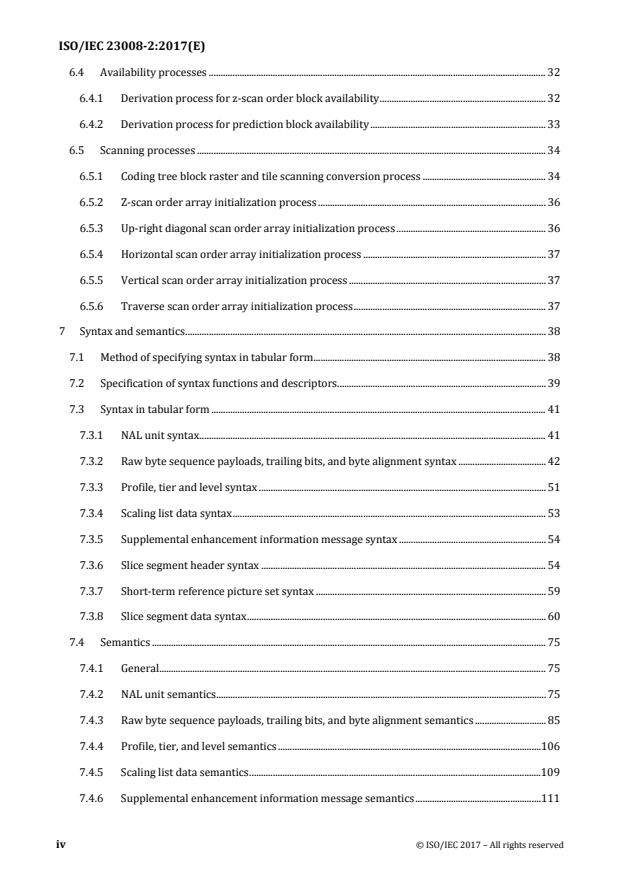
6.4 Availability processes . 32
6.4.1 Derivation process for z-scan order block availability . 32
6.4.2 Derivation process for prediction block availability . 33
6.5 Scanning processes . 34
6.5.1 Coding tree block raster and tile scanning conversion process . 34
6.5.2 Z-scan order array initialization process . 36
6.5.3 Up-right diagonal scan order array initialization process . 36
6.5.4 Horizontal scan order array initialization process . 37
6.5.5 Vertical scan order array initialization process . 37
6.5.6 Traverse scan order array initialization process . 37
7 Syntax and semantics . 38
7.1 Method of specifying syntax in tabular form . 38
7.2 Specification of syntax functions and descriptors . 39
7.3 Syntax in tabular form . 41
7.3.1 NAL unit syntax . 41
7.3.2 Raw byte sequence payloads, trailing bits, and byte alignment syntax . 42
7.3.3 Profile, tier and level syntax . 51
7.3.4 Scaling list data syntax . 53
7.3.5 Supplemental enhancement information message syntax . 54
7.3.6 Slice segment header syntax . 54
7.3.7 Short-term reference picture set syntax . 59
7.3.8 Slice segment data syntax . 60
7.4 Semantics . 75
7.4.1 General . 75
7.4.2 NAL unit semantics . 75
7.4.3 Raw byte sequence payloads, trailing bits, and byte alignment semantics . 85
7.4.4 Profile, tier, and level semantics .106
7.4.5 Scaling list data semantics .109
7.4.6 Supplemental enhancement information message semantics .111
iv
© ISO/IEC 2017 – All rights reserved
7.4.7 Slice segment header semantics .112
7.4.8 Short-term reference picture set semantics .120
7.4.9 Slice segment data semantics .123
8 Decoding process .138
8.1 General decoding process.138
8.1.1 General .138
8.1.2 CVSG decoding process .139
8.1.3 Decoding process for a coded picture with nuh_layer_id equal to 0 .139
8.2 NAL unit decoding process .141
8.3 Slice decoding process .141
8.3.1 Decoding process for picture order count .141
8.3.2 Decoding process for reference picture set .142
8.3.3 Decoding process for generating unavailable reference pictures .148
8.3.4 Decoding process for reference picture lists construction .149
8.3.5 Decoding process for collocated picture and no backward prediction flag .150
8.4 Decoding process for coding units coded in intra prediction mode .150
8.4.1 General decoding process for coding units coded in intra prediction mode .150
8.4.2 Derivation process for luma intra prediction mode .155
8.4.3 Derivation process for chroma intra prediction mode .157
8.4.4 Decoding process for intra blocks .158
8.5 Decoding process for coding units coded in inter prediction mode .170
8.5.1 General decoding process for coding units coded in inter prediction mode .170
8.5.2 Inter prediction process .171
8.5.3 Decoding process for prediction units in inter prediction mode .174
8.5.4 Decoding process for the residual signal of coding units coded in inter prediction mode
.................................................................................................................................................................................206
8.6 Scaling, transformation and array construction process prior to deblocking filter process .210
8.6.1 Derivation process for quantization parameters .210
8.6.2 Scaling and transformation process .212
v
© ISO/IEC 2017 – All rights reserved
8.6.3 Scaling process for transform coefficients.214
8.6.4 Transformation process for scaled transform coefficients .215
8.6.5 Residual modification process for blocks using a transform bypass.218
8.6.6 Residual modification process for transform blocks using cross-component prediction 218
8.6.7 Picture construction process prior to in-loop filter process .219
8.6.8 Residual modification process for blocks using adaptive colour transform .219
8.7 In-loop filter process .222
8.7.1 General .222
8.7.2 Deblocking filter process .222
8.7.3 Sample adaptive offset process .239
9 Parsing process .242
9.1 General .242
9.2 Parsing process for 0-th order Exp-Golomb codes .242
9.2.1 General .242
9.2.2 Mapping process for signed Exp-Golomb codes .244
9.3 CABAC parsing process for slice segment data .244
9.3.1 General .244
9.3.2 Initialization process .247
9.3.3 Binarization process .260
9.3.4 Decoding process flow .269
9.3.5 Arithmetic encoding process (informative) .285
vi
© ISO/IEC 2017 – All rights reserved
10 Sub-bitstream extraction process .291
Annex A (normative) Profiles, tiers and levels .293
A.1 Overview of profiles, tiers and levels .293
A.2 Requirements on video decoder capability .293
A.3 Profiles .293
A.4 Tiers and levels .308
Annex B (normative) Byte stream format .318
B.1 General .318
B.2 Byte stream NAL unit syntax and semantics .318
B.3 Byte stream NAL unit decoding process .319
B.4 Decoder byte-alignment recovery (informative) .320
Annex C (normative) Hypothetical reference decoder .321
C.1 General .321
C.2 Operation of coded picture buffer (CPB) .327
C.3 Operation of the decoded picture buffer (DPB) .333
C.4 Bitstream conformance .335
C.5 Decoder conformance .337
Annex D (normative) Supplemental enhancement information .341
D.1 General .341
D.2 SEI payload syntax .341
D.3 SEI payload semantics .359
Annex E (normative) Video usability information .443
E.1 General .443
E.2 VUI syntax .443
E.3 VUI semantics .446
Annex F (normative) Common specifications for multi-layer extensions .470
F.1 General .470
F.2 References .470
F.3 Definitions .470
vii
© ISO/IEC 2017 – All rights reserved
F.4 Abbreviated terms .473
F.5 Conventions .473
F.6 Bitstream and picture formats, partitionings, scanning processes, and neighbouring relationships
..................................................................................................................................................................................................474
F.7 Syntax and semantics .474
F.8 Decoding process .542
F.9 Parsing process .559
F.10 Specification of bitstream subsets .559
F.11 Profiles, tiers, and levels .561
F.12 Byte stream format .564
F.13 Hypothetical reference decoder .564
F.14 Supplemental enhancement information .589
F.15 Video usability information .617
Annex G (normative) Multiview high efficiency video coding .620
G.1 General .620
G.2 References .620
G.3 Terms and definitions .620
G.4 Abbreviations .620
G.5 Conventions .620
G.6 Bitstream and picture formats, partitionings, scanning processes, and neighbouring relationships
..................................................................................................................................................................................................620
G.7 Syntax and semantics .620
G.8 Decoding processes .620
G.9 Parsing process .622
G.10 Specification of bitstream subsets .622
G.11 Profiles, tiers, and levels .622
G.12 Byte stream format .628
G.13 Hypothetical reference decoder .628
G.14 Supplemental enhancement information .628
G.15 Video usability information .643
viii
© ISO/IEC 2017 – All rights reserved
Annex H (normative) Scalable high efficiency video coding .644
H.1 General .644
H.2 References .644
H.3 Definitions .644
H.4 Abbreviations .644
H.5 Conventions .644
H.6 Bitstream and picture formats, partitionings, scanning processes, and neighbouring relationships
..................................................................................................................................................................................................644
H.7 Syntax and semantics .644
H.8 Decoding processes .644
H.9 Parsing process .662
H.10 Specification of bitstream subsets .662
H.11 Profiles, tiers, and levels .663
H.12 Byte stream format .672
H.13 Hypothetical reference decoder .672
H.14 Supplemental enhancement information .672
H.15 Video usability information .672
Annex I (normative) 3D high efficiency video coding .673
I.1 General .673
I.2 References .673
I.3 Definitions .673
I.4 Abbreviations .674
I.5 Conventions .674
I.6 Bitstream and picture formats, partitionings, scanning processes, and neighbouring relationships
..................................................................................................................................................................................................674
I.7 Syntax and semantics .677
I.8 Decoding process .711
I.9 Parsing process .774
I.10 Specification of bitstream subsets .781
I.11 Profiles, tiers, and levels .781
ix
© ISO/IEC 2017 – All rights reserved
I.12 Byte stream format .783
I.13 Hypothetical reference decoder .783
I.14 Supplemental enhancement information .783
Bibliography .795
x
© ISO/IEC 2017 – All rights reserved
Foreword
ISO (the International Organization for Standardization) and IEC (the International Electrotechnical
Commission) form the specialized system for worldwide standardization. National bodies that are
members of ISO or IEC participate in the development of International Standards through technical
committees established by the respective organization to deal with particular fields of technical
activity. ISO and IEC technical committees collaborate in fields of mutual interest. Other international
organizations, governmental and non-governmental, in liaison with ISO and IEC, also take part in the
work. In the field of information technology, ISO and IEC have established a joint technical committee,
ISO/IEC JTC 1.
The procedures used to develop this document and those intended for its further maintenance are
described in the ISO/IEC Directives, Part 1. In particular the different approval criteria needed for
the different types of document should be noted. This document was drafted in accordance with the
editorial rules of the ISO/IEC Directives, Part 2 (see www. iso. org/d irectives).
Attention is drawn to the possibility that some of the elements of this document may be the subject
of patent rights. ISO and IEC shall not be held responsible for identifying any or all such patent
rights. Details of any patent rights identified during the development of the document will be in the
Introduction and/or on the ISO list of patent declarations received (see www. iso. org/p atents).
Any trade name used in this document is information given for the convenience of users and does not
constitute an endorsement.
For an explanation on the voluntary nature of standards, the meaning of ISO specific terms and
expressions related to conformity assessment, as well as information about ISO’s adherence to the
World Trade Organization (WTO) principles in the Technical Barriers to Trade (TBT) see the following
URL: w w w . i s o. org/i so/f oreword. html.
This document was prepared by ISO/IEC JTC 1, Information technology, Subcommittee SC 29, Coding of
audio, picture, multimedia and hypermedia information, in collaboration with ITU-T. The identical text is
published as ITU-T H.265.
This third edition cancels and replaces the second edition (ISO/IEC 23008-2:2015), which has been
technically revised. It also incorporates the Amendment ISO/IEC 23008-2:2015/Amd 1:2015.
A list of all parts in the ISO/IEC 23008 series can be found on the ISO website.
© ISO/IEC 2017 – All rights reserved xi
Introduction
As the costs for both processing power and memory have reduced, network support for coded video data
has diversified, and advances in video coding technology have progressed, the need has arisen for an
industry standard for compressed video representation with substantially increased coding efficiency
and enhanced robustness to network environments. Toward these ends the ITU-T Video Coding Experts
Group (VCEG) and the ISO/IEC Moving Picture Experts Group (MPEG) formed a Joint Collaborative
Team on Video Coding (JCT-VC) in 2010 and a Joint Collaborative Team on 3D Video Coding Extension
Development (JCT-3V) in 2012 for development of a new Recommendation | International Standard.
This document was developed in the JCT-VC and the JCT-3V.
Purpose
This document was developed in response to the growing need for higher compression of moving
pictures for various applications such as videoconferencing, digital storage media, television
broadcasting, internet streaming, and communications. It is also designed to enable the use of the
coded video representation in a flexible manner for a wide variety of network environments as well
as to enable the use of multi-core parallel encoding and decoding devices. The use of this document
allows motion video to be manipulated as a form of computer data and to be stored on various storage
media, transmitted and received over existing and future networks and distributed on existing and
future broadcasting channels. Supports for higher bit depths and enhanced chroma formats, including
the use of full-resolution chroma are provided. Support for scalability enables video transmission
on networks with varying transmission conditions and other scenarios involving multiple bit rate
services. Support for multiview enables representation of video content with multiple camera views
and optional auxiliary information. Support for 3D enables joint representation of video content and
depth information with multiple camera views.
Applications
This document is designed to cover a broad range of applications for video content including but not
limited to the following:
— broadcast (cable TV on optical networks / copper, satellite, terrestrial, etc.);
— camcorders;
— content production and distribution;
— digital cinema;
— home cinema;
— internet streaming, download and play;
— medical imaging;
— mobile streaming, broadcast and communications;
— real-time conversational services (videoconferencing, videophone, telepresence, etc.);
— remote video surveillance;
— storage media (optical disks, digital video tape recorder, etc.);
— wireless display.
Publication and versions of this document
This document has been jointly developed by ITU-T Video Coding Experts Group (VCEG) and the
ISO/IEC Moving Picture Experts Group (MPEG). It is published as technically-aligned twin text in both
ITU-T and ISO/IEC. As the basis text has been drafted to become both an ITU-T Recommendation and an
xii © ISO/IEC 2017 – All rights reserved
ISO/IEC International Standard, the term “Specification” (with capitalization to indicate that it refers to
the whole of the text) is used herein when the text refers to itself.
This is the fourth version of this document and the third edition published by ISO/IEC.
Rec. ITU-T H.265 | ISO/IEC 23008-2 version 1 refers to the first approved version of this document. The
first edition published by ISO/IEC as ISO/IEC 23008-2:2013 corresponded to the first version.
Rec. ITU-T H.265 | ISO/IEC 23008-2 version 2 refers to the integrated text containing format range
extensions, scalability extensions, multiview extensions, additional supplement enhancement
information, and corrections to various minor defects in the prior content of the specification. The
second edition published by ISO/IEC as ISO/IEC 23008-2:2015 corresponded to the second version.
Rec. ITU-T H.265 | ISO/IEC 23008-2 version 3 refers to the integrated text additionally containing 3D
extensions, additional supplement enhancement information, and corrections to various minor defects
in the prior content of the specification.
Rec. ITU-T H.265 | ISO/IEC 23008-2 version 4 refers to the integrated text additionally containing
screen content coding extensions, additional supplement enhancement information, and corrections to
various minor defects in the prior content of the specification. The third edition published by ISO/IEC
as ISO/IEC 23008-2:2017 corresponds to the fourth version.
Profiles, tiers, and levels
This document is designed to be generic in the sense that it serves a wide range of applications, bit
rates, resolutions, qualities, and services. Applications should cover, among other things, digital storage
media, television broadcasting, and real-time communications. In the course of creating this document,
various requirements from typical applications have been considered, necessary algorithmic elements
have been developed, and these have been integrated into a single syntax. Hence, this document will
facilitate video data interchange among different applications.
Considering the practicality of implementing the full syntax of this document, however, a limited
number of subsets of the syntax are also stipulated by means of “profiles”, “tiers”, and “levels”. These
and other related terms are formally defined in Clause 3.
A “profile” is a subset of the entire bitstream syntax that is specified in this document. Within the
bounds imposed by the syntax of a given profile it is still possible to require a very large variation
in the performance of encoders and decoders depending upon the values taken by syntax elements in
the bitstream such as the specified size of the decoded pictures. In many applications, it is currently
neither practical nor economic to implement a decoder capable of dealing with all hypothetical uses of
the syntax within a particular profile.
In order to deal with this problem, “tiers” and “levels” are specified within each profile. A level of a
tier is a specified set of constraints imposed on values of the syntax elements in the bitstream. These
constraints may be simple limits on values. Alternatively they may take the form of constraints on
arithmetic combinations of values (e.g. picture width multiplied by picture height multiplied by number
of pictures decoded per second). A level specified for a lower tier is more constrained than a level
specified for a higher tier.
Coded video content conforming to this document uses a common syntax. In order to achieve a subset
of the complete syntax, flags, parameters, and other syntax elements are included in the bitstream that
signal the presence or absence of syntactic elements that occur later in the bitstream.
Overview of the design characteristics
The coded representation specified in the syntax is designed to enable a high compression capability
for a desired image or video quality. The algorithm is typically not lossless, as the exact source
sample values are typically not preserved through the encoding and decoding processes. A number of
techniques may be used to achieve highly efficient compression. Encoding algorithms (not specified in
this Recommendation | International Standard) may select between inter and intra coding for block-
shaped regions of each picture. Inter coding uses motion vectors for block-based inter prediction
© ISO/IEC 2017 – All rights reserved xiii
...
Questions, Comments and Discussion
Ask us and Technical Secretary will try to provide an answer. You can facilitate discussion about the standard in here.
Loading comments...