


ISO/IEC 23008-2:2015/Amd 1:2015
(Amendment)Information technology — High efficiency coding and media delivery in heterogeneous environments — Part 2: High efficiency video coding — Amendment 1: 3D video extensions
Information technology — High efficiency coding and media delivery in heterogeneous environments — Part 2: High efficiency video coding — Amendment 1: 3D video extensions
Technologies de l'information — Codage à haute efficacité et livraison des medias dans des environnements hétérogènes — Partie 2: Codage vidéo à haute efficacité — Amendement 1: Extensions vidéo 3D
General Information
- Status
- Withdrawn
- Publication Date
- 14-Sep-2015
- Withdrawal Date
- 14-Sep-2015
- Current Stage
- 9599 - Withdrawal of International Standard
- Start Date
- 09-Oct-2017
- Completion Date
- 14-Feb-2026
Relations
- Effective Date
- 06-Jun-2022
- Effective Date
- 26-Nov-2021
- Effective Date
- 05-Nov-2015



Get Certified
Connect with accredited certification bodies for this standard

BSI Group
BSI (British Standards Institution) is the business standards company that helps organizations make excellence a habit.

NYCE
Mexican standards and certification body.
Sponsored listings
Frequently Asked Questions
ISO/IEC 23008-2:2015/Amd 1:2015 is a standard published by the International Organization for Standardization (ISO). Its full title is "Information technology — High efficiency coding and media delivery in heterogeneous environments — Part 2: High efficiency video coding — Amendment 1: 3D video extensions". This standard covers: Information technology — High efficiency coding and media delivery in heterogeneous environments — Part 2: High efficiency video coding — Amendment 1: 3D video extensions
Information technology — High efficiency coding and media delivery in heterogeneous environments — Part 2: High efficiency video coding — Amendment 1: 3D video extensions
ISO/IEC 23008-2:2015/Amd 1:2015 is classified under the following ICS (International Classification for Standards) categories: 35.040 - Information coding; 35.040.40 - Coding of audio, video, multimedia and hypermedia information. The ICS classification helps identify the subject area and facilitates finding related standards.
ISO/IEC 23008-2:2015/Amd 1:2015 has the following relationships with other standards: It is inter standard links to ISO/IEC 23008-2:2013/FDAmd 4, ISO/IEC 23008-2:2015, ISO/IEC 23008-2:2017. Understanding these relationships helps ensure you are using the most current and applicable version of the standard.
ISO/IEC 23008-2:2015/Amd 1:2015 is available in PDF format for immediate download after purchase. The document can be added to your cart and obtained through the secure checkout process. Digital delivery ensures instant access to the complete standard document.
Standards Content (Sample)
INTERNATIONAL ISO/IEC
STANDARD 23008-2
Second edition
2015-05-01
AMENDMENT 1
2015-10-01
Information technology — High
efficiency coding and media delivery
in heterogeneous environments —
Part 2:
High efficiency video coding
AMENDMENT 1: 3D video extensions
Technologies de l’information — Codage à haute efficacité et livraison
des medias dans des environnements hétérogènes —
Partie 2: Codage vidéo à haute efficacité
AMENDEMENT 1: Extensions vidéo 3D
Reference number
ISO/IEC 23008-2:2015/Amd.1:2015(E)
©
ISO/IEC 2015
ISO/IEC 23008-2:2015/Amd.1:2015(E)
© ISO/IEC 2015, Published in Switzerland
All rights reserved. Unless otherwise specified, no part of this publication may be reproduced or utilized otherwise in any form
or by any means, electronic or mechanical, including photocopying, or posting on the internet or an intranet, without prior
written permission. Permission can be requested from either ISO at the address below or ISO’s member body in the country of
the requester.
ISO copyright office
Ch. de Blandonnet 8 • CP 401
CH-1214 Vernier, Geneva, Switzerland
Tel. +41 22 749 01 11
Fax +41 22 749 09 47
copyright@iso.org
www.iso.org
ii © ISO/IEC 2015 – All rights reserved
CONTENTS
Page
Annex I 3D high efficiency video coding . 5
I.1 Scope . 5
I.2 Normative references . 5
I.3 Definitions . 5
I.4 Abbreviations . 5
I.5 Conventions . 5
I.6 Bitstream and picture formats, partitionings, scanning processes, and neighbouring relationships . 6
I.6.1 Bitstream formats . 6
I.6.2 Source, decoded, and output picture formats . 6
I.6.3 Partitioning of pictures, slices, slice segments, tiles, coding tree units, and coding tree blocks . 6
I.6.4 Availability processes . 6
I.6.5 Scanning processes . 6
I.6.6 Derivation process for a wedgelet partition pattern table . 6
I.6.6.1 Wedgelet partition pattern generation process . 7
I.6.6.2 Wedgelet partition pattern table insertion process . 7
I.7 Syntax and semantics . 8
I.7.1 Method of specifying syntax in tabular form . 8
I.7.2 Specification of syntax functions, categories, and descriptors . 8
I.7.3 Syntax in tabular form . 8
I.7.3.1 NAL unit syntax . 8
I.7.3.2 Raw byte sequence payloads and RBSP trailing bits syntax . 8
I.7.3.3 Profile, tier and level syntax . 13
I.7.3.4 Scaling list data syntax . 13
I.7.3.5 Supplemental enhancement information message syntax . 13
I.7.3.6 Slice segment header syntax . 13
I.7.3.7 Short-term reference picture set syntax . 16
I.7.3.8 Slice segment data syntax . 17
I.7.4 Semantics . 21
I.7.4.1 General . 21
I.7.4.2 NAL unit semantics . 21
I.7.4.3 Raw byte sequence payloads, trailing bits, and byte alignment semantics . 21
I.7.4.4 Profile, tier and level semantics . 27
I.7.4.5 Scaling list data semantics . 27
I.7.4.6 Supplemental enhancement information message semantics . 27
I.7.4.7 Slice segment header semantics . 28
I.7.4.8 Short-term reference picture set semantics . 31
I.7.4.9 Slice segment data semantics . 31
I.8 Decoding process . 36
I.8.1 General decoding process . 36
I.8.1.1 General . 36
I.8.1.2 Decoding process for a coded picture with nuh_layer_id greater than 0 . 36
I.8.2 NAL unit decoding process. 36
I.8.3 Slice decoding process . 36
I.8.3.1 Derivation process for the candidate picture list for disparity vector derivation . 36
I.8.3.2 Derivation process for the default reference view order index for disparity derivation . 37
I.8.3.3 Derivation process for a depth look-up table . 37
I.8.3.4 Derivation process for the alternative target reference index for temporal motion vector prediction in
merge mode . 38
I.8.3.5 Derivation process for the target reference index for residual prediction . 38
I.8.4 Decoding process for coding units coded in intra prediction mode . 38
I.8.4.1 General decoding process for coding units coded in intra prediction mode . 38
I.8.4.2 Derivation process for luma intra prediction mode . 39
I.8.4.3 Derivation process for chroma intra prediction mode . 40
I.8.4.4 Decoding process for intra blocks . 40
I.8.5 Decoding process for coding units coded in inter prediction mode . 46
Draft Rec. ITU-T H.265 (2015 E) iii
© ISO/IEC 2015 – All rights reserved
I.8.5.1 General decoding process for coding units coded in inter prediction mode . 46
I.8.5.2 Inter prediction process . 47
I.8.5.3 Decoding process for prediction units in inter prediction mode . 47
I.8.5.4 Decoding process for the residual signal of coding units coded in inter prediction mode . 75
I.8.5.5 Derivation process for a disparity vector for texture layers . 76
I.8.5.6 Derivation process for a disparity vector for depth layers . 78
I.8.5.7 Derivation process for a depth or disparity sample array from a depth picture . 78
I.8.6 Scaling, transformation and array construction process prior to deblocking filter process . 80
I.8.7 In-loop filter process . 80
I.9 Parsing process . 80
I.9.1 General . 80
I.9.2 Parsing process for 0-th order Exp-Golomb codes . 80
I.9.3 CABAC parsing process for slice segment data . 80
I.9.3.1 General . 80
I.9.3.2 Initialization process . 80
I.9.3.3 Binarization process . 83
I.9.3.4 Decoding process flow. 85
I.9.3.5 Arithmetic encoding process (informative) . 87
I.10 Specification of bitstream subsets . 87
I.11 Profiles, tiers, and levels . 87
I.11.1 Profiles . 87
I.11.1.1 3D Main profile . 87
I.11.2 Tiers and levels . 89
I.11.3 Decoder capabilities . 89
I.12 Byte stream format . 89
I.13 Hypothetical reference decoder . 89
I.14 Supplemental enhancement information . 89
I.14.1 General . 89
I.14.2 SEI payload syntax . 89
I.14.2.1 General SEI payload syntax . 89
I.14.2.2 Annex D, Annex F, and Annex G SEI message syntax for 3D high efficiency video coding . 89
I.14.2.3 Alternative depth information SEI message syntax . 89
I.14.3 SEI payload semantics . 91
I.14.3.1 General SEI payload semantics . 91
I.14.3.2 Annex D, Annex F, and Annex G SEI message semantics for 3D high efficiency video coding . 91
I.14.3.3 Alternative depth information SEI message semantics . 91
I.15 Video usability information . 97
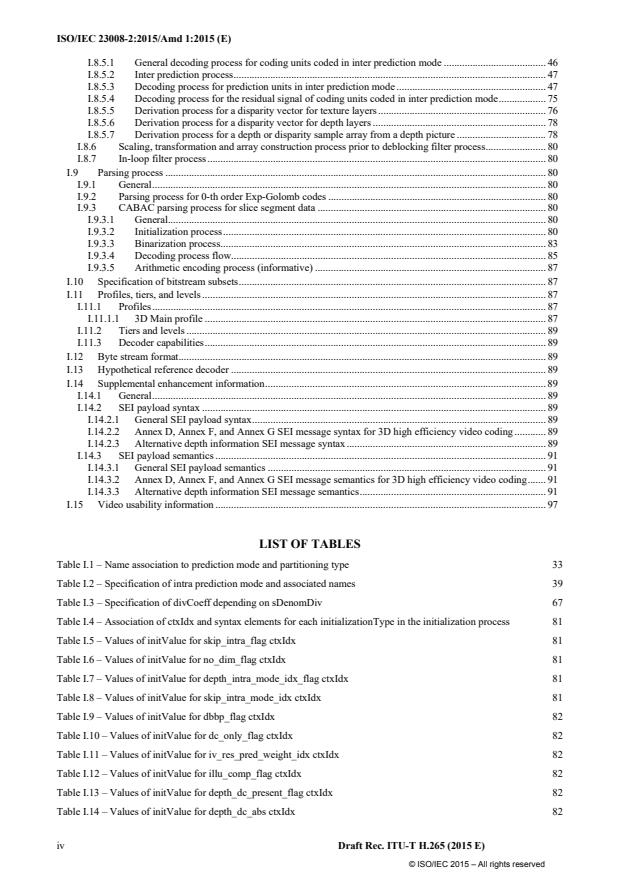
LIST OF TABLES
Table I.1 – Name association to prediction mode and partitioning type 33
Table I.2 – Specification of intra prediction mode and associated names 39
Table I.3 – Specification of divCoeff depending on sDenomDiv 67
Table I.4 – Association of ctxIdx and syntax elements for each initializationType in the initialization process 81
Table I.5 – Values of initValue for skip_intra_flag ctxIdx 81
Table I.6 – Values of initValue for no_dim_flag ctxIdx 81
Table I.7 – Values of initValue for depth_intra_mode_idx_flag ctxIdx 81
Table I.8 – Values of initValue for skip_intra_mode_idx ctxIdx 81
Table I.9 – Values of initValue for dbbp_flag ctxIdx 82
Table I.10 – Values of initValue for dc_only_flag ctxIdx 82
Table I.11 – Values of initValue for iv_res_pred_weight_idx ctxIdx 82
Table I.12 – Values of initValue for illu_comp_flag ctxIdx 82
Table I.13 – Values of initValue for depth_dc_present_flag ctxIdx 82
Table I.14 – Values of initValue for depth_dc_abs ctxIdx 82
iv Draft Rec. ITU-T H.265 (2015 E)
© ISO/IEC 2015 – All rights reserved
Table I.15 – Syntax elements and associated binarizations 83
Table I.16 – Binarization for part_mode 84
Table I.17 – Assignment of ctxInc to syntax elements with context coded bins 86
Table I.18 – Specification of ctxInc using left and above syntax elements 86
Table I.19 – Persistence scope of SEI messages (informative) 91
Table I.20 – Interpretation of depth_type 92
Table I.21 – Locations of the top-left luma samples of constituent pictures packed in a picture with ViewIdx greater than
0 relative to the top-left luma sample of this picture 92
Draft Rec. ITU-T H.265 (2015 E) v
© ISO/IEC 2015 – All rights reserved
Information technology — High efficiency coding and media delivery in heterogeneous
environments — Part 2: High efficiency video coding — Amendment 1
Introduction
Replace the text of 0.2 with the following:
As the costs for both processing power and memory have reduced, network support for coded video data has diversified,
and advances in video coding technology have progressed, the need has arisen for an industry standard for compressed
video representation with substantially increased coding efficiency and enhanced robustness to network environments.
Toward these ends the ITU-T Video Coding Experts Group (VCEG) and the ISO/IEC Moving Picture Experts Group
(MPEG) formed a Joint Collaborative Team on Video Coding (JCT-VC) in 2010 and a Joint Collaborative Team on 3D
Video Coding Extension Development (JCT-3V) in 2012 for development of a new Recommendation | International
Standard. This Recommendation | International Standard was developed in the JCT-VC and the JCT-3V.
In 0.3 add the following sentence to the end of the clause:
Support for 3D enables joint representation of video content and depth information with multiple camera views.
In 0.5 add the following paragraph to the end of the clause:
Rec. ITU-T H.265 | ISO/IEC 23008-2 version 3 refers to the integrated text containing 3D extensions, additional
supplement enhancement information, and corrections to various minor defects in the prior content of the specification.
In 0.8, replace "Annexes A through H" with "Annexes A through I".
In 0.8, add the following sentence after the sentence that starts with "Annex H":
Annex I contains support for 3D coding.
Sequence parameter set RBSP
In 7.3.2.2.1 and F.7.3.2.2.1 replace the row containing "if( sps_extension_present_flag )" and all following rows in the
syntax table by the following:
if( sps_extension_present_flag ) {
sps_range_extension_flag u(1)
sps_multilayer_extension_flag u(1)
sps_3d_extension_flag u(1)
sps_extension_5bits u(5)
}
if( sps_range_extension_flag )
sps_range_extension( )
if( sps_multilayer_extension_flag )
sps_multilayer_extension( ) /* specified in Annex F */
if( sps_3d_extension_flag )
sps_3d_extension( ) /* specified in Annex I */
if( sps_extension_5bits )
while( more_rbsp_data( ) )
sps_extension_data_flag u(1)
rbsp_trailing_bits( )
}
© ISO/IEC 2015 – All rights reserved
In 7.4.3.2.1 replace the semantics of sps_extension_present_flag with the following semantics:
sps_extension_present_flag equal to 1 specifies that the syntax elements sps_range_extension_flag,
sps_multilayer_extension_flag, sps_3d_extension_flag, and sps_extension_5bits are present in the SPS RBSP syntax
structure. sps_extension_present_flag equal to 0 specifies that these syntax elements are not present.
In 7.4.3.2.1 add the following semantics after semantics of sps_multilayer_extension_flag:
sps_3d_extension_flag equal to 1 specifies that the sps_3d_extension( ) syntax structure (specified in Annex I) is
p
resent in the SPS RBSP syntax structure. sps_3d_extension_flag equal to 0 specifies that the sps_3d_extension( ) syntax
structure is not present. When not present, the value of sps_3d_extension_flag is inferred to be equal to 0.
In 7.4.3.2.1 replace all occurrences of "sps_extension_6bits" with "sps_extension_5bits".
Picture parameter set RBSP
In 7.3.2.3.1 replace the row containing "if( pps_extension_present_flag )" and all following rows in the syntax table with
the following:
if( pps_extension_present_flag ) {
pps_range_extension_flag u(1)
pps_multilayer_extension_flag u(1)
pps_3d_extension_flag u(1)
pps_extension_5bits u(5)
}
if( pps_range_extension_flag )
pps_range_extension( )
if( pps_multilayer_extension_flag )
pps_multilayer_extension( ) /* specified in Annex F */
if( pps_3d_extension_flag )
pps_3d_extension( ) /* specified in Annex I */
if( pps_extension_5bits )
while( more_rbsp_data( ) )
pps_extension_data_flag u(1)
rbsp_trailing_bits( )
}
In 7.4.3.3.1 replace the semantics of pps_extension_present_flag with the following semantics:
pps_extension_present_flag equal to 1 specifies that the syntax elements pps_range_extension_flag,
pps_multilayer_extension_flag, pps_3d_extension_flag, and pps_extension_5bits are present in the picture parameter set
RBSP syntax structure. pps_extension_present_flag equal to 0 specifies that these syntax elements are not present.
In 7.4.3.3.1 add the following semantics after semantics of pps_multilayer_extension_flag:
pps_3d_extension_flag equal to 1 specifies that the pps_3d_extension( ) syntax structure (specified in Annex I) is
present in the PPS RBSP syntax structure. pps_3d_extension_flag equal to 0 specifies that the pps_3d_extension( )
syntax structure is not present. When not present, the value of pps_3d_extension_flag is inferred to be equal to 0.
In 7.4.3.3.1 replace all occurrences of "pps_extension_6bits" with "pps_extension_5bits".
General SEI message syntax
In D.2.1 add the following rows to the syntax table after the row containing "multiview_view_position( payloadSize ) /*
specified in Annex G */":
else if( payloadType = = 181 )
alternative_depth_info( payloadSize ) /* specified in Annex I */
2 Draft Rec. ITU-T H.265 (2015 E)
© ISO/IEC 2015 – All rights reserved
Common decoding process for a coded picture
In F.8.1.3 add the following paragraph before the paragraph starting with "After all slices of the current picture have
been decoded,":
– Otherwise, general_profile_idc in the profile_tier_level( ) syntax structure
VpsProfileTierLevel[ profile_tier_level_idx[ TargetOlsIdx ][ lIdx ] ] is equal to 8, the decoding process for the
current picture takes as inputs the syntax elements and upper-case variables from clause I.7 and the decoding
process of clause I.8.1.2 is invoked.
Video parameter set RBSP semantics
In F.7.4.3.1 replace the semantics of vps_extension2_flag with the following semantics:
vps_extension2_flag equal to 0 specifies that no vps_extension_data_flag syntax elements are present in the VPS RBSP
syntax structure. vps_extension2_flag equal to 1 specifies vps_extension_data_flag syntax elements are present in the
VPS RBSP syntax structure. Decoders conforming to a profile specified in Annexes A, G, or H shall ignore all data that
follow the value 1 for vps_extension2_flag in a VPS NAL unit.
In F.7.4.3.1 add the following semantics:
vps_extension_data_flag may have any value. Its presence and value do not affect decoder conformance to profiles
specified in Annexes A, G, or H. Decoders conforming to a profile specified in Annexes A, G, or H shall ignore all
vps_extension_data_flag syntax elements.
In F.7.4.3.1.1 replace Table F.1 with the following table:
Table F.1 – Mapping of ScalabiltyId to scalability dimensions
scalability mask Scalability ScalabilityId
index dimension mapping
0 Texture or depth DepthLayerFlag
1 Multiview ViewOrderIdx
2 Spatial/quality DependencyId
scalability
3 Auxiliary AuxId
4-15 Reserved
In F.7.4.3.1.1 remove Note 2.
In F.7.4.3.1.1 replace the paragraph starting with "The variable ScalabilityId[ i ][ smIdx ] specifying the identifier" and
the following equation (F-2), with the following:
The variable ScalabilityId[ i ][ smIdx ] specifying the identifier of the smIdx-th scalability dimension type of the i-th
layer, and the variables DepthLayerFlag[ lId ], ViewOrderIdx[ lId ], DependencyId[ lId ], and AuxId[ lId ] specifying the
depth flag, view order index, the spatial/quality scalability identifier, and the auxiliary identifier, respectively, of the
layer with nuh_layer_id equal to lId are derived as follows:
NumViews = 1
for( i = 0; i <= MaxLayersMinus1; i++ ) {
lId = layer_id_in_nuh[ i ]
for( smIdx= 0, j = 0; smIdx < 16; smIdx++ ) {
if( scalability_mask_flag[ smIdx ] )
ScalabilityId[ i ][ smIdx ] = dimension_id[ i ][ j++ ]
else
ScalabilityId[ i ][ smIdx ] = 0
}
DepthLayerFlag[ lId ] = ScalabilityId[ i ][ 0 ]
ViewOrderIdx[ lId ] = ScalabilityId[ i ][ 1 ]
DependencyId[ lId ] = ScalabilityId[ i ][ 2 ] (F-2)
AuxId[ lId ] = ScalabilityId[ i ][ 3 ]
if( i > 0 ) {
newViewFlag = 1
Draft Rec. ITU-T H.265 (2015 E)
© ISO/IEC 2015 – All rights reserved
for( j = 0; j < i; j++ )
if( ViewOrderIdx[ lId ] = = ViewOrderIdx[ layer_id_in_nuh[ j ] ] )
newViewFlag = 0
NumViews += newViewFlag
}
}
In F.7.4.3.1.1 replace the semantics of direct_dep_type_len_minus2 with the following:
direct_dep_type_len_minus2 plus 2 specifies the number of bits of the direct_dependency_type[ i ][ j ] and the
direct_dependency_all_layers_type syntax elements. In bitstreams conforming to this version of this Specification the
value of direct_dep_type_len_minus2 shall be equal 0 or 1. Although the value of direct_dep_type_len_minus2 shall be
equal to 0 or 1 in this version of this Specification, decoders shall allow other values of direct_dep_type_len_minus2 in
the range of 0 to 30, inclusive, to appear in the syntax.
In F.7.4.3.1.1 replace the semantics of direct_dependency_all_layers_type with the following:
direct_dependency_all_layers_type, when present, specifies the inferred value of direct_dependency_type[ i ][ j ] for
all combinations of i-th and j-th layers. The length of the direct_dependency_all_layers_type syntax element is
direct_dep_type_len_minus2 + 2 bits. Although the value of direct_dependency_all_layers_type is required to be in the
range of 0 to 6, inclusive, in this version of this Specification, decoders shall allow values of
direct_dependency_all_layers_type in the range of 0 to 2 − 2, inclusive, to appear in the syntax.
In F.7.4.3.1.1 replace the semantics of direct_dependency_type with the following:
direct_dependency_type[ i ][ j ] indicates the type of dependency between the layer with nuh_layer_id equal
layer_id_in_nuh[ i ] and the layer with nuh_layer_id equal to layer_id_in_nuh[ j ]. direct_dependency_type[ i ][ j ] equal
to 0 specifies that the layer with nuh_layer_id equal to layer_id_in_nuh[ j ] may be used for inter-layer sample prediction
but is not used for inter-layer motion prediction of the layer with nuh_layer_id equal layer_id_in_nuh[ i ].
direct_dependency_type[ i ][ j ] equal to 1 specifies that the layer with nuh_layer_id equal to layer_id_in_nuh[ j ] may be
used for inter-layer motion prediction but is not used for inter-layer sample prediction of the layer with nuh_layer_id
equal layer_id_in_nuh[ i ]. direct_dependency_type[ i ][ j ] equal to 2 specifies that the layer with nuh_layer_id equal to
layer_id_in_nuh[ j ] may be used for both inter-layer motion prediction and inter-layer sample prediction of the layer
with nuh_layer_id equal layer_id_in_nuh[ i ]. The length of the direct_dependency_type[ i ][ j ] syntax element is
direct_dep_type_len_minus2 + 2 bits. Although the value of direct_dependency_type[ i ][ j ] shall be in the range of 0
to 2, inclusive, when the layer with nuh_layer_id equal to layer_id_in_nuh[ i ] conforms to a profile specified in Annexes
A, G, or H, and in the range of 0 to 6, inclusive, when the layer with nuh_layer_id equal to layer_id_in_nuh[ i ] conforms
to a profile specified in Annex I, decoders shall allow values of direct_dependency_type[ i ][ j ] in the range of 0 to
2 − 2, inclusive, to appear in the syntax.
Profiles, tiers, and levels
In F.11.2 add the following row to the end of Table F.3:
3D Main 3D Main, Multiview Main, Main, Main Still Picture
In G.11.1.1 and H.11.1.1 remove " and sps_extension_6bits equal to 0 only".
In G.11.1.1 and H.11.1.1 remove " and pps_extension_6bits equal to 0 only".
4 Draft Rec. ITU-T H.265 (2015 E)
© ISO/IEC 2015 – All rights reserved
Add a new Annex I as follows:
Annex I
3D high efficiency video coding
(This annex forms an integral part of this Recommendation | International Standard.)
I.1 Scope
This annex specifies syntax, semantics, and decoding processes for 3D high efficiency video coding that use the syntax,
semantics, and decoding processes specified in clauses 2-10 and Annexes A-G. This annex also specifies profiles, tiers,
and levels for 3D high efficiency video coding.
I.2 Normative references
The list of normative references in clause G.2 apply.
I.3 Definitions
For the purpose of this annex, the following definitions apply in addition to the definitions in clause G.3. These
definitions are either not present in clause G.3 or replace definitions in clause G.3.
I.3.1 depth intra contour prediction: A prediction of a partition pattern for a prediction block in a picture of a
depth layer derived from samples of a picture included in the same access unit and in the texture layer of the
same view.
I.3.2 depth layer: A layer with a nuh_layer_id value equal to i, such that DepthLayerFlag[ i ] is equal to 1 and
DependencyId[ i ] and AuxId[ i ] are equal to 0.
I.3.3 depth look-up table: A list containing depth values.
I.3.4 depth value: A sample value of a decoded picture of a depth layer.
I.3.5 disparity vector: A motion vector used for inter-view prediction.
I.3.6 inter-component prediction: An inter-layer prediction where the reference pictures are associated with a
DepthFlag value different from the DepthFlag value of the current picture.
I.3.7 inter-view prediction: An inter-layer prediction where the reference pictures are associated with reference
view order index values different from the ViewIdx value of the current picture.
I.3.8 intra prediction: A prediction derived from only data elements (e.g., sample values) of the same decoded slice
and additionally may be using depth intra contour prediction.
I.3.9 partition pattern: An MxM (M-column by M-row) array of flags defining two sub-block partitions of an MxM
prediction block.
I.3.10 prediction block: A rectangular MxN block of samples on which either the same prediction or partitioning in
sub-block partitions is applied.
I.3.11 reference view order index: A ViewIdx value associated with a reference picture used for inter-view
prediction.
I.3.12 sub-block partition: A subset of samples of a prediction block on which the same prediction is applied.
I.3.13 texture layer: A layer with a nuh_layer_id value equal to i, such that DepthLayerFlag[ i ], DependencyId[ i ],
and AuxId[ i ] are equal to 0.
I.4 Abbreviations
The specifications in clause G.4 apply.
I.5 Conventions
The specifications in clause G.5 apply.
Draft Rec. ITU-T H.265 (2015 E) 5
© ISO/IEC 2015 – All rights reserved
I.6 Bitstream and picture formats, partitionings, scanning processes, and neighbouring relationships
I.6.1 Bitstream formats
The specifications in clause 6.1 apply.
I.6.2 Source, decoded, and output picture formats
The specifications in clause 6.2 apply.
I.6.3 Partitioning of pictures, slices, slice segments, tiles, coding tree units, and coding tree blocks
The specifications in clause 6.3 and its subclauses apply.
I.6.4 Availability processes
The specifications in clause 6.4 apply.
I.6.5 Scanning processes
The specifications in clause 6.5 and its subclauses apply.
I.6.6 Derivation process for a wedgelet partition pattern table
NOTE – Tables and values resulting from this process are independent of any information contained in the bitstream.
The list WedgePatternTable[ log2BlkSize ] of partition patterns of size ( 1 << log2BlkSize )x( 1 << log2BlkSize ) and
the variable NumWedgePattern[ log2BlkSize ] specifying the number of partition patterns in list
WedgePatternTable[ log2BlkSize ] are derived as follows:
– For log2BlkSize in the range of 2 to 4, inclusive, the following applies:
– NumWedgePattern[ log2BlkSize ] is set equal to 0.
– The variable resShift is set equal to ( log2BlkSize = = 4 ) ? 0 : 1.
– The variable wBlkSize is set equal to ( 1 << ( log2BlkSize + resShift ) ).
– For wedgeOri in the range of 0 to 5, inclusive, the following applies:
– The variable posEnd is set equal to NumWedgePattern[ log2BlkSize ].
– If wedgeOri is equal to 0 or 4, the following applies:
– The variables sizeScaleS and sizeScaleE are derived as follows:
sizeScaleS = ( log2BlkSize > 3 ) ? 2 : 1 (I−1)
sizeScaleE = ( wedgeOri < 4 && log2BlkSize > 3 ) ? : 2 : 1 (I−2)
– For m in the range of 0 to ( wBlkSize / sizeScaleS − 1 ), inclusive, the following applies:
– For n in the range of 0 to ( wBlkSize / sizeScaleE − 1 ), inclusive, the following applies:
– The wedgelet partition pattern generation process as specified in clause I.6.6.1 is invoked with
patternSize equal to ( 1 << log2BlkSize ), the variable resShift, the variable wedgeOri, the
variable ( xS, yS ) equal to ( m * sizeScaleS , 0 ), the variable ( xE, yE ) equal to
( wedgeOri = = 0 ) ? ( 0, n * sizeScaleE ) : ( n * sizeScaleE, wBlkSize − 1 ) as inputs, and the
output is the partition pattern curWedgePattern.
– The wedgelet partition pattern table insertion process as specified in clause I.6.6.2 is invoked
with the variable log2BlkSize and the partition pattern curWedgePattern as inputs.
– Otherwise (wedgeOri is equal to 1, 2, 3, or 5), the following applies:
– For curPos in the range of posStart to posEnd − 1, inclusive, the following applies:
– The partition pattern curWedgePattern[ x ][ y ] is derived as follows:
for( y = 0; y < ( 1 << log2BlkSize ); y++ )
for( x = 0; x < ( 1 << log2BlkSize ); x++ ) (I−3)
curWedgePattern[ x ][ y ] = 1 −
WedgePatternTable[ log2BlkSize ][ curPos ][ y ][ ( 1 << log2BlkSize ) − 1 − x ]
– The variable posStart is set equal to posEnd.
6 Draft Rec. ITU-T H.265 (2015 E)
© ISO/IEC 2015 – All rights reserved
– NumWedgePattern[ 5 ] is set equal to NumWedgePattern[ 4 ].
– For k = 0.NumWedgePattern[ 5 ] − 1, the following applies:
– For x, y = 0.( 1 << 5 ) − 1, the following applies:
WedgePatternTable[ 5 ][ k ][ x ][ y ] = WedgePatternTable[ 4 ][ k ][ x >> 1 ][ y >> 1 ] (I−4)
I.6.6.1 Wedgelet partition pattern generation process
Inputs to this process are:
– a variable patternSize specifying the partition pattern size,
– a variable resShift specifying the precision of the partition pattern start and end locations relative to patternSize,
– a variable wedgeOri specifying the orientation of the partition pattern,
– a location ( xS, yS ) specifying the boundary start of a sub-block partition,
– a location ( xE, yE ) specifying the boundary end of a sub-block partition.
Output of this process is the partition pattern wedgePattern[ x ][ y ] of size ( patternSize )x( patternSize ).
The values of the partition pattern wedgePattern[ x ][ y ] are derived as specified by the following ordered steps:
1. For x, y = 0.patternSize − 1, wedgePattern[ x ][ y ] is set equal to 0.
2. The samples of the partition pattern wedgePattern that form a line between ( xS, yS ) and ( xE, yE ) are set equal
to 1 as follows:
( x0, y0 ) = ( xS, yS )
( x1, y1 ) = ( xE, yE )
if( abs( yE − yS ) > abs( xE − xS ) ) {
( x0, y0 ) = Swap( x0, y0 )
( x1, y1 ) = Swap( x1, y1 )
}
if( x0 > x1 ) {
( x0, x1 ) = Swap( x0, x1 )
( y0, y1 ) = Swap( y0, y1 )
}
sumErr = 0 (I−5)
posY = y0
for( posX = x0; posX <= x1; posX++ ) {
if( abs( yE − yS ) > abs( xE − xS ) )
wedgePattern[ posY >> resShift ][ posX >> resShift ] = 1
else
wedgePattern[ posX >> resShift ][ posY >> resShift ] = 1
sumErr += ( abs( y1 − y0 ) << 1 )
if( sumErr >= ( x1 − x0 ) ) {
posY += ( y0 < y1 ) ? 1 : −1
sumErr −= ( x1 − x0 ) << 1
}
}
3. The samples of wedgePattern are modified as follows:
for( y = 0; y <= ( yE >> resShift ); y++ )
for( x = 0; ( x <= patternSize − 1 ) && ( wedgePattern[ x ][ y ] = = 0 ); x++ ) (I−6)
wedgePattern[ x ][ y ] = 1
I.6.6.2 Wedgelet partition pattern table insertion process
Inputs to this process are:
– a variable log2BlkSize specifying the partition pattern size,
– a partition pattern wedgePattern[ x ][ y ], with x, y = 0.( 1 << log2BlkSize ) − 1.
The variable validPatternFlag is set equal to 0 and the following applies:
1. For x, y = 0.( 1 << log2BlkSize ) − 1, the following applies:
Draft Rec. ITU-T H.265 (2015 E) 7
© ISO/IEC 2015 – All rights reserved
– When wedgePattern[ x ][ y ] is not equal to wedgePattern[ 0 ][ 0 ], validPatternFlag is set equal to 1.
2. For k = 0.NumWedgePattern[ log2BlkSize ] − 1, the following applies:
– The variable patIdenticalFlag is set equal to 1.
– For x, y = 0.( 1 << log2BlkSize ) − 1, the following applies:
– When wedgePattern[ x ][ y ] is not equal to WedgePatternTable[ log2BlkSize ][ k ][ x ][ y ],
patIdenticalFlag is set equal to 0.
– When patIdenticalFlag is equal to 1, validPatternFlag is set equal to 0.
3. For k = 0.NumWedgePattern[ log2BlkSize ] − 1, the following applies:
– The variable patInvIdenticalFlag is set equal to 1.
– For x, y = 0.( 1 << log2BlkSize ) − 1, the following applies:
– When wedgePattern[ x ][ y ] is equal to WedgePatternTable[ log2BlkSize ][ k ][ x ][ y ],
patInvIdenticalFlag is set equal to 0.
– When patInvIdenticalFlag is equal to 1, validPatternFlag is set equal to 0.
When validPatternFlag is equal to 1, the following applies:
– The pattern WedgePatternTable[ log2BlkSize ][ NumWedgePattern[ log2BlkSize ] ] is set equal to wedgePattern.
– The value of NumWedgePattern[ log2BlkSize ] is incremented by one.
I.7 Syntax and semantics
I.7.1 Method of specifying syntax in tabular form
The specifications in clause F.7.1 apply.
I.7.2 Specification of syntax functions, categories, and descriptors
The specifications in clause F.7.2 apply.
I.7.3 Syntax in tabular form
I.7.3.1 NAL unit syntax
The specifications in clause F.7.3.1 and all its subclauses apply.
I.7.3.2 Raw byte sequence payloads and RBSP trailing bits syntax
I.7.3.2.1 Video parameter set RBSP
video_parameter_set_rbsp( ) { Descriptor
vps_video_parameter_set_id u(4)
vps_base_layer_internal_flag u(1)
vps_base_layer_available_flag u(1)
vps_max_layers_minus1 u(6)
vps_max_sub_layers_minus1 u(3)
vps_temporal_id_nesting_flag u(1)
vps_reserved_0xffff_16bits u(16)
profile_tier_level( 1, vps_max_sub_layers_minus1 )
vps_sub_layer_ordering_info_present_flag u(1)
for( i = ( vps_sub_layer_ordering_info_present_flag ? 0 : vps_max_sub_layers_minus1 );
i <= vps_max_sub_layers_minus1; i++ ) {
vps_max_dec_pic_buffering_minus1[ i ] ue(v)
vps_max_num_reorder_pics[ i ] ue(v)
vps_max_latency_increase_plus1[ i ] ue(v)
}
8 Draft Rec. ITU-T H.265 (2015 E)
© ISO/IEC 2015 – All rights reserved
vps_max_layer_id u(6)
vps_num_layer_sets_minus1 ue(v)
for( i = 1; i <= vps_num_layer_sets_minus1; i++ )
for( j = 0; j <= vps_max_layer_id; j++ )
layer_id_included_flag[ i ][ j ] u(1)
vps_timing_info_present_flag u(1)
if( vps_timing_info_present_flag ) {
vps_num_units_in_tick u(32)
vps_time_scale u(32)
vps_poc_proportional_to_timing_flag u(1)
if( vps_poc_proportional_to_timing_flag )
vps_num_ticks_poc_diff_one_minus1 ue(v)
vps_num_hrd_parameters ue(v)
for( i = 0; i < vps_num_hrd_parameters; i++ ) {
hrd_layer_set_idx[ i ] ue(v)
if( i > 0 )
cprms_present_flag[ i ] u(1)
hrd_parameters( cprms_present_flag[ i ], vps_max_sub_layers_minus1 )
}
}
vps_extension_flag u(1)
if( vps_extension_flag ) {
while( !byte_aligned( ) )
vps_extension_alignment_bit_equal_to_one u(1)
vps_extension( )
vps_extension2_flag u(1)
if( vps_extension2_flag ) {
vps_3d_extension_flag u(1)
if( vps_3d_extension_flag ) {
while( !byte_aligned( ) )
vps_3d_extension_alignment_bit_equal_to_one u(1)
vps_3d_extension( )
}
vps_extension3_flag u(1)
if( vps_extension3_flag )
while( more_rbsp_data( ) )
vps_extension_data_flag u(1)
}
}
rbsp_trailing_bits( )
}
I.7.3.2.1.1 Video parameter set extension syntax
The specifications in clause F.7.3.2.1.1 apply.
I.7.3.2.1.2 Representation format syntax
The specifications in clause F.7.3.2.1.2 apply.
Draft Rec. ITU-T H.265 (2015 E) 9
© ISO/IEC 2015 – All rights reserved
I.7.3.2.1.3 DPB size syntax
The specifications in clause F.7.3.2.1.3 apply.
I.7.3.2.1.4 VPS VUI syntax
The specifications in clause F.7.3.2.1.4 apply.
I.7.3.2.1.5 Video signal info syntax
The specifications in clause F.7.3.2.1.5 apply.
I.7.3.2.1.6 VPS VUI bitstream partition HRD parameters syntax
The specifications in clause F.7.3.2.1.6 apply.
I.7.3.2.1.7 Video parameter set 3D extension syntax
vps_3d_extension( ) { Descriptor
cp_precision ue(v)
for( n = 1; n < NumViews; n++ ) {
i = ViewOIdxList[ n ]
num_cp[ i ] u(6)
if( num_cp[ i ] > 0 ) {
cp_in_slice_segment_header_flag[ i ] u(1)
for( m = 0; m < num_cp[ i ]; m++ ) {
cp_ref_voi[ i ][ m ] ue(v)
if( !cp_in_slice_segment_header_flag[ i ] ) {
j = cp_ref_voi[ i ][ m ]
vps_cp_scale[ i ][ j ] se(v)
vps_cp_off[ i ][ j ] se(v)
vps_cp_inv_scale_plus_scale[ i ][ j ] se(v)
vps_cp_inv_off_plus_off[ i ][ j ] se(v)
}
}
}
}
}
I.7.3.2.2 Sequence parameter set RBSP syntax
I.7.3.2.2.1 General sequence parameter set RBSP syntax
The specifications in clause F.7.3.2.2.1 apply.
I.7.3.2.2.2 Sequence parameter set range extensions syntax
The specifications in clause F.7.3.2.2.2 apply.
I.7.3.2.2.3 Sequence parameter set multilayer extension syntax
The specifications in clause F.7.3.2.2.3 apply.
10 Draft Rec. ITU-T H.265 (2015 E)
© ISO/IEC 2015 – All rights reserved
I.7.3.2.2.4 Sequence parameter set 3D extension syntax
sps_3d_extension( ) {
Descriptor
for( d = 0; d <= 1; d++ ) {
iv_di_mc_enabled_flag[ d ] u(1)
iv_mv_scal_enabled_flag[ d ] u(1)
if( d = = 0 ) {
log2_ivmc_sub_pb_size_minus3[ d ] ue(v)
iv_res_pred_enabled_flag[ d ] u(1)
depth_ref_enabled_flag[ d ] u(1)
vsp_mc_enabled_flag[ d ] u(1)
dbbp_enabled_flag[ d ] u(1)
} else {
tex_mc_enabled_flag[ d ] u(1)
log2_texmc_sub_pb_size_minus3[ d ] ue(v)
intra_contour_enabled_flag[ d ] u(1)
intra_dc_only_wedge_enabled_flag[ d ] u(1)
cqt_cu_part_pred_enabled_flag[ d ] u(1)
inter_dc_only_enabled_flag[ d ] u(1)
skip_intra_enabled_flag[ d ] u(1)
}
}
}
I.7.3.2.3 Picture parameter set RBSP syntax
I.7.3.2.3.1 General picture parameter set RBSP syntax
The specifications in clause F.7.3.2.3.1 apply.
I.7.3.2.3.2 Picture parameter set range extensions syntax
The specifications in clause F.7.3.2.3.2 apply.
I.7.3.2.3.3 Picture parameter set multilayer extension syntax
The specifications in clause F.7.3.2.3.
...
Questions, Comments and Discussion
Ask us and Technical Secretary will try to provide an answer. You can facilitate discussion about the standard in here.
Loading comments...