

ISO/TS 5474-5:2024
(Main)Electrically propelled road vehicles — Functional and safety requirements for power transfer between vehicle and external electric circuit — Part 5: Automatic conductive power transfer
General Information
- Abstract
This document defines requirements for the onboard system (vehicle side) related to the automatic connection for conductive alternating current (AC) and/or direct current (DC) power transfer between electrically propelled road vehicles (EVs) and external electric circuits. This document addresses the following aspects: — electrical and mechanical safety requirements; — compatibility requirements; — environmental conditions; — functionality requirements; — test procedures. This document applies to: — EVs supporting automatic connection of a vehicle inlet according to IEC 62196-2, IEC 62196-3, IEC TS 62196-3-1 or IEC TS 63379 (category 1) and — EVs supporting automatic connection of a category 3 vehicle inlet or category 3 plug (typically at the underbody of the vehicle) according to IEC TS 61851-26. NOTE 1 IEC TS 61851-26 does not include automatic connection of vehicle inlets or plugs of category 1 and category 2, that can also be mounted at the underbody of the vehicle. Requirements for EVs equipped with an ACD or ACD counterpart of category 2 are specified in EN 50696 and IEC 63407. Requirements for simultaneous operation of multiple power transfer interfaces are under consideration and not covered in this document. NOTE 2 Requirements for ACD infrastructure, communication sequence and communication interface are specified in IEC 61851-23-1, IEC TS 61851-26 and IEC TS 61851-27. NOTE 3 EMC requirements for vehicles conductively connected to the supply network are defined in IEC 61851-21-1.
- Status
- Published
- Publication Date
- 30-Jan-2024
- Technical Committee
- ISO/TC 22/SC 37 - Electrically propelled vehicles
- Drafting Committee
- ISO/TC 22/SC 37 - Electrically propelled vehicles
- Current Stage
- 6060 - International Standard published
- Start Date
- 31-Jan-2024
- Due Date
- 25-May-2024
- Completion Date
- 31-Jan-2024
Buy Documents

ISO/TS 5474-5:2024 - Electrically propelled road vehicles — Functional and safety requirements for power transfer between vehicle and external electric circuit — Part 5: Automatic conductive power transfer Released:31. 01. 2024
Overview
ISO/TS 5474-5:2024 - "Electrically propelled road vehicles - Part 5: Automatic conductive power transfer" - specifies requirements for the onboard (vehicle-side) system that enables automatic conductive AC and/or DC power transfer between electric vehicles (EVs) and external electric circuits. The technical specification focuses on functional and safety aspects of automatic connection systems (ACD/automatic EV supply equipment), covering electrical/mechanical safety, compatibility, environmental conditions, functionality and test procedures.
Key topics and requirements
- Scope & applicability: Applies to EVs with automatic connection of vehicle inlets per IEC 62196-2/3, IEC TS 62196-3-1 or IEC TS 63379 (category 1), and to category 3 underbody inlets/plugs per IEC TS 61851-26.
- Safety requirements: Electrical and mechanical safety protections for docking/undocking; limits on forces, velocities and energy to prevent mechanically caused injury.
- Compatibility: Interoperability with automatic EV supply equipment (AEVSE), including interlock compatibility and inlet position detection.
- Functional requirements: Vehicle immobilization, vehicle position and inlet position detection, manipulator behavior, mating space and package space definitions, manual undocking provisions, and operational communication sequences.
- Environmental & operational conditions: Performance and durability across defined environmental stresses (see standard for specific test conditions).
- Test procedures: Onboard-side test methods for functional verification and safety validation; Annexes address heavy-duty vehicle considerations (movement/displacement of immobilized vehicle and inlet positions).
- Terminology & control: Definitions include ACD onboard system, EV communication controller (EVCC), supply equipment communication controller (SECC), docking/undocking, manipulator, and point-to-point signals (P2PS).
Practical applications
- EV OEMs designing onboard automatic conductive charging systems and vehicle inlets.
- Charging-equipment manufacturers and integrators developing manipulators and AEVSE interfaces to ensure vehicle-side compatibility.
- Test laboratories and certification bodies performing conformity, safety and interoperability testing for automatic conductive power transfer.
- Fleet operators (including heavy-duty fleets) evaluating or specifying automatic charging solutions for reduced manual handling and faster operations.
- Regulatory and standardization stakeholders aligning vehicle-side requirements with infrastructure-side IEC standards.
Related standards
- IEC TS 61851-26 / IEC TS 61851-27 / IEC 61851-23-1 (infrastructure, communication and AEVSE requirements)
- IEC 62196 series, IEC TS 63379 (vehicle inlet/plug types)
- EN 50696 and IEC 63407 (category 2 ACD requirements)
- IEC 61851-21-1 (EMC for conductively connected vehicles)
- ISO 5474-1 / ISO 5474-2 / ISO 5474-3 (other parts in the ISO 5474 series)
Keywords: ISO/TS 5474-5:2024, automatic conductive power transfer, electric vehicles, EV automatic charging, vehicle inlet, ACD, safety requirements, EVCC, manipulator, interoperability.
Buy Documents
ISO/TS 5474-5:2024 - Electrically propelled road vehicles — Functional and safety requirements for power transfer between vehicle and external electric circuit — Part 5: Automatic conductive power transfer Released:31. 01. 2024
Get Certified
Connect with accredited certification bodies for this standard

TÜV Rheinland
TÜV Rheinland is a leading international provider of technical services.

TÜV SÜD
TÜV SÜD is a trusted partner of choice for safety, security and sustainability solutions.

DEKRA Certification Inc.
DEKRA US certification services.
Sponsored listings
Frequently Asked Questions
ISO/TS 5474-5:2024 is a technical specification published by the International Organization for Standardization (ISO). Its full title is "Electrically propelled road vehicles — Functional and safety requirements for power transfer between vehicle and external electric circuit — Part 5: Automatic conductive power transfer". This standard covers: This document defines requirements for the onboard system (vehicle side) related to the automatic connection for conductive alternating current (AC) and/or direct current (DC) power transfer between electrically propelled road vehicles (EVs) and external electric circuits. This document addresses the following aspects: — electrical and mechanical safety requirements; — compatibility requirements; — environmental conditions; — functionality requirements; — test procedures. This document applies to: — EVs supporting automatic connection of a vehicle inlet according to IEC 62196-2, IEC 62196-3, IEC TS 62196-3-1 or IEC TS 63379 (category 1) and — EVs supporting automatic connection of a category 3 vehicle inlet or category 3 plug (typically at the underbody of the vehicle) according to IEC TS 61851-26. NOTE 1 IEC TS 61851-26 does not include automatic connection of vehicle inlets or plugs of category 1 and category 2, that can also be mounted at the underbody of the vehicle. Requirements for EVs equipped with an ACD or ACD counterpart of category 2 are specified in EN 50696 and IEC 63407. Requirements for simultaneous operation of multiple power transfer interfaces are under consideration and not covered in this document. NOTE 2 Requirements for ACD infrastructure, communication sequence and communication interface are specified in IEC 61851-23-1, IEC TS 61851-26 and IEC TS 61851-27. NOTE 3 EMC requirements for vehicles conductively connected to the supply network are defined in IEC 61851-21-1.
This document defines requirements for the onboard system (vehicle side) related to the automatic connection for conductive alternating current (AC) and/or direct current (DC) power transfer between electrically propelled road vehicles (EVs) and external electric circuits. This document addresses the following aspects: — electrical and mechanical safety requirements; — compatibility requirements; — environmental conditions; — functionality requirements; — test procedures. This document applies to: — EVs supporting automatic connection of a vehicle inlet according to IEC 62196-2, IEC 62196-3, IEC TS 62196-3-1 or IEC TS 63379 (category 1) and — EVs supporting automatic connection of a category 3 vehicle inlet or category 3 plug (typically at the underbody of the vehicle) according to IEC TS 61851-26. NOTE 1 IEC TS 61851-26 does not include automatic connection of vehicle inlets or plugs of category 1 and category 2, that can also be mounted at the underbody of the vehicle. Requirements for EVs equipped with an ACD or ACD counterpart of category 2 are specified in EN 50696 and IEC 63407. Requirements for simultaneous operation of multiple power transfer interfaces are under consideration and not covered in this document. NOTE 2 Requirements for ACD infrastructure, communication sequence and communication interface are specified in IEC 61851-23-1, IEC TS 61851-26 and IEC TS 61851-27. NOTE 3 EMC requirements for vehicles conductively connected to the supply network are defined in IEC 61851-21-1.
ISO/TS 5474-5:2024 is classified under the following ICS (International Classification for Standards) categories: 43.120 - Electric road vehicles. The ICS classification helps identify the subject area and facilitates finding related standards.
ISO/TS 5474-5:2024 is available in PDF format for immediate download after purchase. The document can be added to your cart and obtained through the secure checkout process. Digital delivery ensures instant access to the complete standard document.
Standards Content (Sample)
Technical
Specification
ISO/TS 5474-5
First edition
Electrically propelled road
2024-01
vehicles — Functional and safety
requirements for power transfer
between vehicle and external
electric circuit —
Part 5:
Automatic conductive power
transfer
Véhicules routiers à propulsion électrique — Exigences
fonctionnelles et de sécurité pour le transfert de puissance entre
le véhicule et le circuit électrique externe —
Partie 5: Transfert de puissance automatique par conduction
Reference number
© ISO 2024
All rights reserved. Unless otherwise specified, or required in the context of its implementation, no part of this publication may
be reproduced or utilized otherwise in any form or by any means, electronic or mechanical, including photocopying, or posting on
the internet or an intranet, without prior written permission. Permission can be requested from either ISO at the address below
or ISO’s member body in the country of the requester.
ISO copyright office
CP 401 • Ch. de Blandonnet 8
CH-1214 Vernier, Geneva
Phone: +41 22 749 01 11
Email: copyright@iso.org
Website: www.iso.org
Published in Switzerland
ii
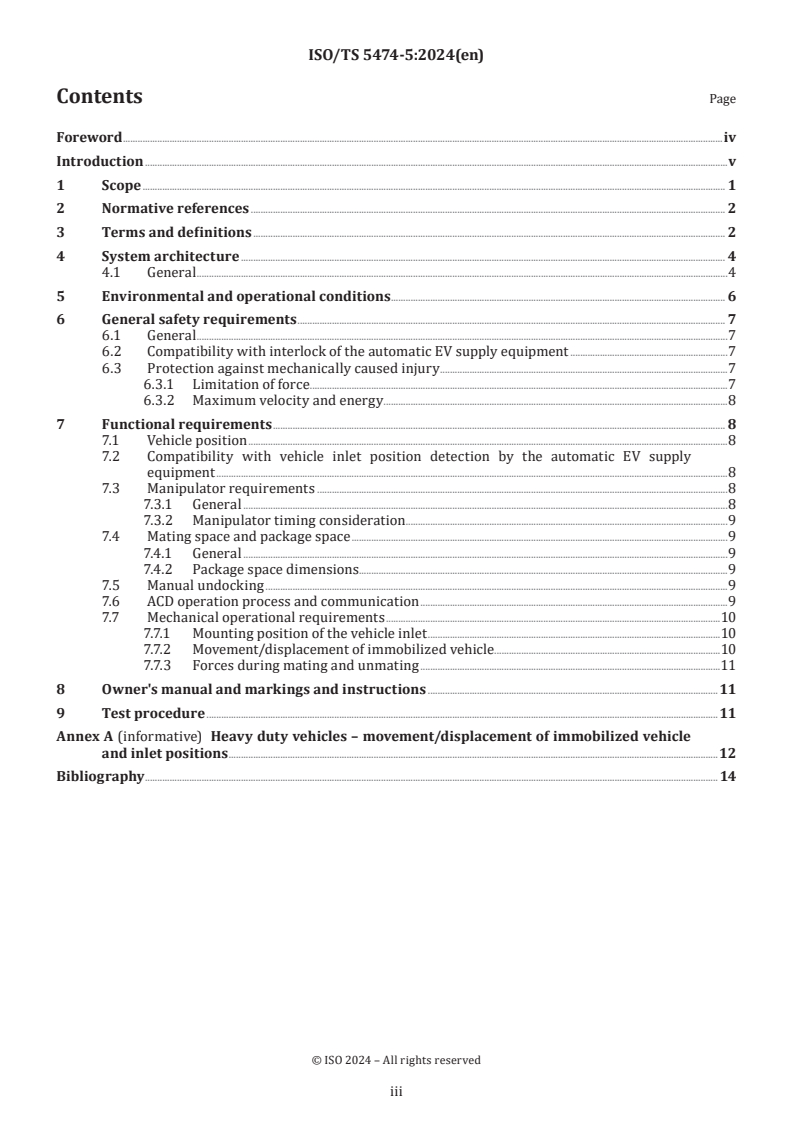
Contents Page
Foreword .iv
Introduction .v
1 Scope . 1
2 Normative references . 2
3 Terms and definitions . 2
4 System architecture . 4
4.1 General .4
5 Environmental and operational conditions . 6
6 General safety requirements . 7
6.1 General .7
6.2 Compatibility with interlock of the automatic EV supply equipment .7
6.3 Protection against mechanically caused injury .7
6.3.1 Limitation of force.7
6.3.2 Maximum velocity and energy .8
7 Functional requirements . 8
7.1 Vehicle position .8
7.2 Compatibility with vehicle inlet position detection by the automatic EV supply
equipment .8
7.3 Manipulator requirements .8
7.3.1 General .8
7.3.2 Manipulator timing consideration . .9
7.4 Mating space and package space .9
7.4.1 General .9
7.4.2 Package space dimensions.9
7.5 Manual undocking .9
7.6 ACD operation process and communication .9
7.7 Mechanical operational requirements .10
7.7.1 Mounting position of the vehicle inlet .10
7.7.2 Movement/displacement of immobilized vehicle .10
7.7.3 Forces during mating and unmating .11
8 Owner's manual and markings and instructions .11
9 Test procedure .11
Annex A (informative) Heavy duty vehicles – movement/displacement of immobilized vehicle
and inlet positions .12
Bibliography . 14
iii
Foreword
ISO (the International Organization for Standardization) is a worldwide federation of national standards
bodies (ISO member bodies). The work of preparing International Standards is normally carried out through
ISO technical committees. Each member body interested in a subject for which a technical committee
has been established has the right to be represented on that committee. International organizations,
governmental and non-governmental, in liaison with ISO, also take part in the work. ISO collaborates closely
with the International Electrotechnical Commission (IEC) on all matters of electrotechnical standardization.
The procedures used to develop this document and those intended for its further maintenance are described
in the ISO/IEC Directives, Part 1. In particular, the different approval criteria needed for the different types
of ISO document should be noted. This document was drafted in accordance with the editorial rules of the
ISO/IEC Directives, Part 2 (see www.iso.org/directives).
ISO draws attention to the possibility that the implementation of this document may involve the use of (a)
patent(s). ISO takes no position concerning the evidence, validity or applicability of any claimed patent
rights in respect thereof. As of the date of publication of this document, ISO had not received notice of (a)
patent(s) which may be required to implement this document. However, implementers are cautioned that
this may not represent the latest information, which may be obtained from the patent database available at
www.iso.org/patents. ISO shall not be held responsible for identifying any or all such patent rights.
Any trade name used in this document is information given for the convenience of users and does not
constitute an endorsement.
For an explanation of the voluntary nature of standards, the meaning of ISO specific terms and expressions
related to conformity assessment, as well as information about ISO's adherence to the World Trade
Organization (WTO) principles in the Technical Barriers to Trade (TBT), see www.iso.org/iso/foreword.html.
This document was prepared by Technical Committee ISO/TC 22, Road vehicles, Subcommittee SC 37,
Electrically propelled vehicles.
A list of all parts in the ISO 5474 series can be found on the ISO website.
Any feedback or questions on this document should be directed to the user’s national standards body. A
complete listing of these bodies can be found at www.iso.org/members.html.
iv
Introduction
This document specifies requirements for the onboard side of an automatic connection system to charge
electric vehicles. It gives guidance in terms of safety and compatibility with the offboard side of automatic
connection systems.
Technological maturity:
It is pointed out, that this document has been established in parallel to the technological development of
automatic connection systems. Due to the fact that the experience with the technology is very limited,
the requirements given in this document do not comprehensively cover all aspects/requirements for an
interoperable operation at this stage. Current and future product developments will continuously prove,
disprove and refine the requirements of this document.
Furthermore, it is worthwhile to mention that at the date of publication of this document, no standard for a
vehicle coupler of category 3 (at the underbody of the vehicle) is available.
Relation to other parts of the ISO 5474 series:
There is no direct relation of content or structure of this document to any other part of the ISO 5474 series
(including ISO 5474-1). Wherever needed, other parts of the series are specifically referenced.
v
Technical Specification ISO/TS 5474-5:2024(en)
Electrically propelled road vehicles — Functional and safety
requirements for power transfer between vehicle and
external electric circuit —
Part 5:
Automatic conductive power transfer
1 Scope
This document defines requirements for the onboard system (vehicle side) related to the automatic
connection for conductive alternating current (AC) and/or direct current (DC) power transfer between
electrically propelled road vehicles (EVs) and external electric circuits. This document addresses the
following aspects:
— electrical and mechanical safety requirements;
— compatibility requirements;
— environmental conditions;
— functionality requirements;
— test procedures.
This document applies to:
— EVs supporting automatic connection of a vehicle inlet according to IEC 62196-2, IEC 62196-3,
1)
IEC TS 62196-3-1 or IEC TS 63379 (category 1) and
— EVs supporting automatic connection of a category 3 vehicle inlet or category 3 plug (typically at the
underbody of the vehicle) according to IEC TS 61851-26.
NOTE 1 IEC TS 61851-26 does not include automatic connection of vehicle inlets or plugs of category 1 and category
2, that can also be mounted at the underbody of the vehicle.
Requirements for EVs equipped with an ACD or ACD counterpart of category 2 are specified in EN 50696
2)
and IEC 63407 .
Requirements for simultaneous operation of multiple power transfer interfaces are under consideration and
not covered in this document.
NOTE 2 Requirements for ACD infrastructure, communication sequence and communication interface are specified
in IEC 61851-23-1, IEC TS 61851-26 and IEC TS 61851-27.
NOTE 3 EMC requirements for vehicles conductively connected to the supply network are defined in IEC 61851-21-1.
1) Under preparation. Stage at the time of publication: IEC TS/CDM 63379:2023.
2) Under preparation. Stage at the time of publication: IEC/CDM 63407:2023.
2 Normative references
The following documents are referred to in the text in such a way that some or all of their content constitutes
requirements of this document. For dated references, only the edition cited applies. For undated references,
the latest edition of the referenced document (including any amendments) applies.
3)
ISO 5474-1 , Electrically propelled road vehicles — Functional requirements and safety requirements for power
transfer — Part 1: General requirements for conductive power transfer
4)
ISO 5474-2 , Electrically propelled road vehicles — Functional requirements and safety requirements for power
transfer — Part 2: AC power transfer
5)
ISO 5474-3 , Electrically propelled road vehicles — Functional requirements and safety requirements for power
transfer — Part 3: DC power transfer
ISO 10218-1:2011, Robots and robotic devices — Safety requirements for industrial robots — Part 1: Robots
ISO 12100:2010, Safety of machinery — General principles for design — Risk assessment and risk reduction
6)
IEC TS 61851-26 , Electric vehicle conductive charging system — Part 26: EV supply equipment with automated
connection of a vehicle coupler located at the underbody of an electric vehicle
7)
IEC TS 61851-27 , Electric vehicle conductive charging system — Part 27: EV supply equipment with automated
connection of a vehicle coupler according to IEC 62196-2 or IEC 62196-3
3 Terms and definitions
For the purposes of this document, the terms and definitions given in ISO 5474-1 and the following apply.
ISO and IEC maintain terminology databases for use in standardization at the following addresses:
— ISO Online browsing platform: available at https:// www .iso .org/ obp
— IEC Electropedia: available at https:// www .electropedia .org/
3.1
ACD onboard system
system with automatic docking (3.6) and undocking (3.14) functions installed in a vehicle and used in
combination with an automatic EV supply equipment (3.3)
3.2
automatic connection device
ACD
active device where the physical connection between an electric vehicle (EV) supply equipment and vehicle
is made without user interaction providing an electromechanical interface
Note 1 to entry: Preparatory steps taken by the user to allow for automatic charging (e.g. opening inlet cover) are not
seen as part of establishing the physical connection.
Note 2 to entry: This term is derived from the term automated connection device.
8)
[SOURCE: IEC 61851-23-1:— , 3.1.203, modified — The original term was "automated connection device"
and Notes to entry were added.]
3) Under preparation. Stage at the time of publication: ISO/FDIS 5474-1:2024.
4) Under preparation. Stage at the time of publication: ISO/FDIS 5474-2:2024.
5) Under preparation. Stage at the time of publication: ISO/FDIS 5474-3:2024.
6) Under preparation. Stage at the time of publication: IEC/CD TS 61851-26:2023.
7) Under preparation. Stage at the time of publication: IEC/CD TS 61851-27:2023.
8) Under preparation. Stage at the time of publication: IEC/CDV 61851-23-1:2023.
3.3
automatic EV supply equipment
electric vehicle (EV) supply equipment with automatic docking (3.6) and undocking (3.14) functions
3.4
communication for docking and undocking
communication between the supply equipment communication controller (SECC) (3.13) and the electric vehicle
communication controller (EVCC) (3.7) for docking (3.6) and undocking (3.14)
3.5
communication for power transfer
communication session established between the supply equipment communication controller (SECC) (3.13)
and the electric vehicle communication controller (EVCC) (3.7), used for charging control
3.6
docking
process in which a manipulator (3.9) performs a controlled motion and mates either a plug to a socket-outlet
or a vehicle connector to a vehicle inlet
Note 1 to entry: Other actuators in addition to the manipulator might be used, e.g. for opening of the inlet cover or for
drawing the vehicle connector into the vehicle inlet.
3.7
EV communication controller
EVCC
embedded system, within the electric vehicle (EV), that implements the communication between the EV and
the supply equipment communication controller (SECC) (3.13) in order to support specific functions
Note 1 to entry: Such specific functions could be, e.g. controlling input and output channels, encryption, or data
transfer between EV and SECC (3.13).
[SOURCE: ISO 15118-1:2019, 3.1.31, modified — “vehicle” was replaced by “electric vehicle”.]
3.8
immobilization
inhibition of vehicle movement by its own propulsion system
3.9
manipulator
machine, the mechanism of which usually consists of a series of segments jointed or sliding relative to one
another, for the purpose of grasping and/or moving objects (pieces or tools) usually in several degrees of
freedom
[SOURCE: ISO/TR 11065:1992, 387, modified — Second sentence deleted.]
3.10
mating space
spatial envelope of points with specified range of orientations where mating of the vehicle connector and
vehicle inlet or plug and socket-outlet is possible
3.11
package space
space around the vehicle inlet or socket-outlet where no obstacles are allowed
3.12
point to point signal
P2PS
unidirectional wireless link between the electric vehicle (EV) and automatic EV supply equipment (3.3)
Note 1 to entry: The P2PS is used for identification and for position detection of vehicle inlet or socket-outlet in the
context of docking (3.6).
EXAMPLE Image recognition with camera-based inlet detection.
[SOURCE: IEC 61980-2:2021, 3.17, modified — “EV device” changed to “EV”, “supply device” changed to “EV
supply equipment” and Note 1 to entry added.]
3.13
supply equipment communication controller
SECC
entity which implements the communication to one or multiple electric vehicle communication controller(s)
(EVCC) (s) (3.7)
Note 1 to entry: Further details regarding possible architectures are given in ISO 15118-1:2019, Annex A.
Note 2 to entry: Functions of a supply equipment communication controller can control input and output channels,
data encryption, or data transfer between the EVCC (3.7) and SECC (3.12).
[SOURCE: ISO 15118-1:2019, 3.1.68, modified — “and which may be able to interact with secondary actors”
is deleted, Note 1 to entry is deleted, in Note 2 to entry “ISO 15118-1:2019” is added and in Note 3 to entry
“may” is replaced by “can” and “vehicle” is replaced by “EVCC”.]
3.14
undocking
process in which a manipulator (3.9) performs a controlled motion and unmates either a plug from a socket-
outlet or a vehicle
...