

ISO 7383-3:2026
(Main)Fine bubble technology — Evaluation method for determining gas content in fine bubble dispersions in water — Part 3: Ozone content
- Abstract
This document specifies two evaluation methods for ozone content (total ozone, including ozone contained in ultrafine bubbles (UFBs) or microbubbles (MBs) and dissolved ozone) in UFB dispersions in water, namely, iodometric titration and UV photometry. Iodometric titration is applicable as a well-established, high accuracy chemical procedure, particularly suitable for single-point determinations. The direct measurement range of this technique is typically 0,01 mg/l to 50 mg/l. Ultraviolet (UV) photometry is applicable for rapid or continuous measurement and real-time monitoring. Its typical measurement range is from 0,075 mg/l to 200 mg/l, depending on instrument specification. This document is applicable to industrial processes that require precise ozone dosing and control when MB or UFB systems are used. NOTE This document does not involve the specific effects of ozone UFB dispersion applications. High concentrations of dissolved oxygen (DO), commonly found in water containing oxygen UFBs, can interfere with iodometric titration and lead to overestimation of ozone content. When extremely high ozone levels are expected, water containing oxygen UFBs can be used as the blank control.
- Status
- Published
- Publication Date
- 13-Jul-2026
- Technical Committee
- ISO/TC 281 - Fine bubble technology
- Drafting Committee
- ISO/TC 281/WG 2 - Fine bubble characterization and measurement
- Current Stage
- 6060 - International Standard published
- Start Date
- 14-Jul-2026
- Due Date
- 20-Feb-2028
- Completion Date
- 14-Jul-2026

ISO 7383-3:2026, published by ISO, specifies two evaluation methods for ozone content in fine bubble technology water dispersions: iodometric titration and UV photometry. It is intended for industrial users who need to measure total ozone in UFB dispersions, including ozone in UFBs or MBs and dissolved ozone, for precise dosing, control, and performance checking.
What does ISO 7383-3:2026 specify?
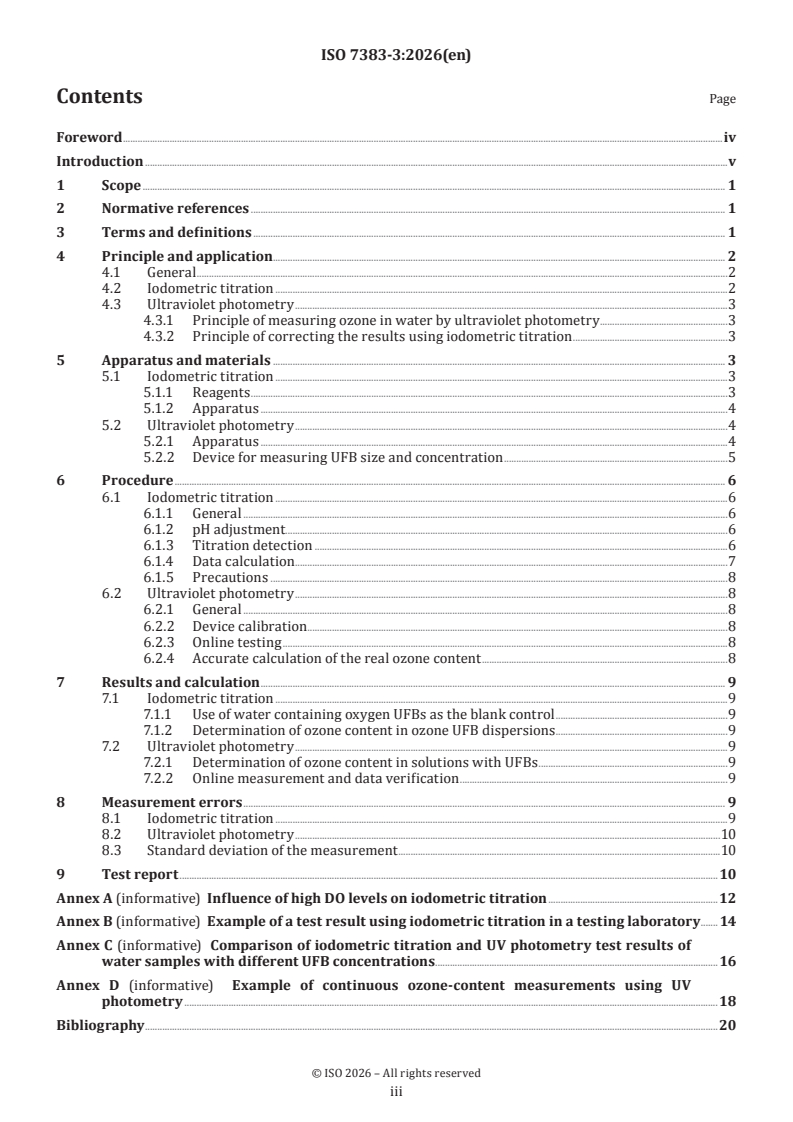
ISO 7383-3:2026 covers the measurement of ozone content in UFB dispersions in water and explains how to use iodometric titration and UV photometry for that purpose. The document is organized into Scope, Terms and definitions, Principle and application, Apparatus and materials, Procedure, Results and calculation, Measurement errors, Test report, and four informative annexes.
| Annex | What it covers |
|---|---|
| Annex A | Influence of high DO levels on iodometric titration |
| Annex B | Example of a test result using iodometric titration in a testing laboratory |
| Annex C | Comparison of iodometric titration and UV photometry test results for different UFB concentrations |
| Annex D | Example of continuous ozone-content measurements using UV photometry |
The scope also notes that the document is for industrial processes that need precise ozone dosing and control when MB or UFB systems are used. In practice, that means it is about measuring ozone content, not describing the application effect of ozone UFB dispersion itself.
What are the key requirements of ISO 7383-3:2026?
ISO 7383-3:2026 gives two measurement routes, each with different strengths. Iodometric titration is the high-accuracy single-point method, while UV photometry is the method for rapid, continuous, or real-time monitoring.
Iodometric titration is the reference chemical method
Clause 4 and Clause 6 describe iodometric titration as a reaction between ozone and potassium iodide, followed by titration with sodium thiosulfate. Before analysis, the sample pH is adjusted to 2.0 ± 0.1 with strong acid. In practice, this matters because low pH helps keep ozone reactive and reduces conversion into other reactive oxygen species.
Clause 6 also requires the analyst to add potassium iodide, acidify the sample, keep it in the dark for a short period, then titrate until the blue starch color disappears. The document warns about a rebluing effect near the end point, so the end point is taken only when the solution stays colorless for a defined time. That makes the manual endpoint judgment more reliable.
High dissolved oxygen must be treated as background
Clause 4, Clause 6, and Annex A show that dissolved oxygen (DO) can interfere with iodometric titration and make ozone appear higher than it is. The document uses water with high oxygen concentration as a blank or background control. In practice, the user must measure a matching blank and subtract that background from the ozone result.
This is especially relevant for water containing oxygen UFBs, where DO is commonly high. The document also indicates that the blank water should be produced with the same UFB generator so the oxygen background matches the test sample as closely as possible.
UV photometry is the continuous monitoring method
Clause 4 and Clause 6 describe UV photometry at 254 nm as the method for online or continuous ozone measurement. The measurement is based on UV absorbance in a flow cell, and the instrument uses the Beer-Lambert law to convert absorbance to ozone concentration. In practice, this is the method to choose when the process needs ongoing tracking rather than a single lab result.
The document also states that UV photometry is sensitive to bubbles and other impurities, so it is best suited to relatively clean water matrices. Because MBs and UFBs can distort the signal, the readings need correction rather than direct acceptance.
UV instruments must be calibrated against iodometric titration
Clause 4.3.2 and Clause 6.2.2 require UV photometry to be calibrated using iodometric titration. The calibration uses 5 to 10 ozone-water samples containing UFBs, compares the two methods, and fits a linear relationship. The practical result is a correction line that adjusts the UV reading for the bubble effect.
The document also says the presence of UFBs should be verified, and points to particle tracking analysis in ISO 19430 or other methods described in ISO/TR 23015:2020. That means the correction is not only about the ozone instrument - it also depends on confirming the bubble population in the sample.
The document gives equipment and handling guidance
Clause 5 specifies the main reagents and apparatus for iodometric titration, including potassium iodide, diluted sulfuric acid, sodium thiosulfate, starch indicator, an iodine flask, burette, volumetric glassware, and a retort stand. Clause 5 also describes UV photometry equipment with a mercury lamp, monochromatic filter at 254 nm, detector, flow cell, and water pump.
For UV systems, the piping should be PFA or equally ozone-resistant, and the tubing should be kept as short as possible. That matters because ozone loss or chemical release from the piping can affect the measured value.
The report must capture the conditions that affect the result
Clause 9 lists the information to include in the test report: date and time, method used, instrument details, bubble characterization method, water properties, measurement conditions, generator information, results, and any circumstances that may have influenced the outcome. In practice, this supports traceability and makes it possible to compare results from different systems or runs.
What terms does ISO 7383-3:2026 define?
- Dissolved ozone - ozone molecules dissolved in water, not trapped in bubbles.
- Ozone ultrafine bubble (ozone UFB) - an ultrafine bubble that contains ozone molecules inside.
- Titration - a method for determining concentration by reacting a known volume of sample with a known concentration of reagent.
- 254 nm - ultraviolet light at 254 nm, the wavelength where ozone absorbs strongly.
- Ultrafine bubble (UFB) - a bubble class used throughout the document when discussing ozone, oxygen, and measurement effects.
- Microbubble (MB) - the larger fine-bubble category mentioned in the scope and principles, relevant because MBs also affect ozone measurement.
- Dissolved oxygen (DO) - oxygen dissolved in the water, important because it can bias iodometric titration.
Who uses ISO 7383-3:2026?
ISO 7383-3:2026 is used by laboratories, process engineers, equipment manufacturers, and quality personnel working with ozone MB and UFB systems. It is relevant in advanced wastewater treatment, semiconductor cleaning, and other cleaning or water-treatment processes where ozone dose must be controlled.
Buyers and technical evaluators can use it to check whether a supplier’s ozone measurement method is suitable for single-point testing, online monitoring, or calibration work. Operators use it to set up the sample handling, blank correction, and reporting needed to produce comparable results.
What changed in ISO 7383-3:2026 from the previous edition?
ISO 7383-3:2026 is identified as the first edition of this part.
Which standards are used with ISO 7383-3:2026?
ISO 7383-3:2026 points users to several related standards and companion parts:
- ISO 7383-1 - covers oxygen content in fine bubble dispersions in water.
- ISO 7383-2 - covers hydrogen content in fine bubble dispersions in water.
- ISO 19430 - gives a particle tracking analysis method that can be used to verify UFB presence.
- ISO/TR 23015:2020 - gives a measurement technique matrix for fine-bubble characterization and alternative verification methods.
- ISO 24758-1 and ISO 24758-2 - cover reactive oxygen species in UFB dispersions, which are related topics but not ozone content.
- ISO 20304-1 - evaluates ozone fine bubble water generating systems by methylene blue decolourization.
What does the ISO 7383-3:2026 document contain?
The document includes the two measurement principles, sample preparation steps, calibration logic for UV photometry, calculation methods, uncertainty considerations, and reporting requirements. It also includes a schematic of the UV photometry setup and a step-by-step titration sequence.
Annex A explains how high DO changes iodometric results and why a blank correction is needed. Annex B gives a worked laboratory example for titration, Annex C compares titration with UV photometry across different bubble densities and shows calibration curves, and Annex D shows continuous UV monitoring before and after calibration.
The document also contains formulas for ozone calculation, statistical measures for measurement quality, and the report items needed for traceable ozone-content testing.
Frequently Asked Questions
ISO 7383-3:2026 is a standard published by the International Organization for Standardization (ISO). Its full title is "Fine bubble technology — Evaluation method for determining gas content in fine bubble dispersions in water — Part 3: Ozone content". This standard covers: This document specifies two evaluation methods for ozone content (total ozone, including ozone contained in ultrafine bubbles (UFBs) or microbubbles (MBs) and dissolved ozone) in UFB dispersions in water, namely, iodometric titration and UV photometry. Iodometric titration is applicable as a well-established, high accuracy chemical procedure, particularly suitable for single-point determinations. The direct measurement range of this technique is typically 0,01 mg/l to 50 mg/l. Ultraviolet (UV) photometry is applicable for rapid or continuous measurement and real-time monitoring. Its typical measurement range is from 0,075 mg/l to 200 mg/l, depending on instrument specification. This document is applicable to industrial processes that require precise ozone dosing and control when MB or UFB systems are used. NOTE This document does not involve the specific effects of ozone UFB dispersion applications. High concentrations of dissolved oxygen (DO), commonly found in water containing oxygen UFBs, can interfere with iodometric titration and lead to overestimation of ozone content. When extremely high ozone levels are expected, water containing oxygen UFBs can be used as the blank control.
This document specifies two evaluation methods for ozone content (total ozone, including ozone contained in ultrafine bubbles (UFBs) or microbubbles (MBs) and dissolved ozone) in UFB dispersions in water, namely, iodometric titration and UV photometry. Iodometric titration is applicable as a well-established, high accuracy chemical procedure, particularly suitable for single-point determinations. The direct measurement range of this technique is typically 0,01 mg/l to 50 mg/l. Ultraviolet (UV) photometry is applicable for rapid or continuous measurement and real-time monitoring. Its typical measurement range is from 0,075 mg/l to 200 mg/l, depending on instrument specification. This document is applicable to industrial processes that require precise ozone dosing and control when MB or UFB systems are used. NOTE This document does not involve the specific effects of ozone UFB dispersion applications. High concentrations of dissolved oxygen (DO), commonly found in water containing oxygen UFBs, can interfere with iodometric titration and lead to overestimation of ozone content. When extremely high ozone levels are expected, water containing oxygen UFBs can be used as the blank control.
ISO 7383-3:2026 is classified under the following ICS (International Classification for Standards) categories: 07.030 - Physics. Chemistry. The ICS classification helps identify the subject area and facilitates finding related standards.
ISO 7383-3:2026 is available in PDF format for immediate download after purchase. The document can be added to your cart and obtained through the secure checkout process. Digital delivery ensures instant access to the complete standard document.
Standards Content (Sample)
International
Standard
ISO 7383-3
First edition
Fine bubble technology —
2026-07
Evaluation method for determining
gas content in fine bubble
dispersions in water —
Part 3:
Ozone content
Technologie des fines bulles — Méthode d'évaluation pour
déterminer la teneur en gaz dans les dispersions de fines bulles
dans l'eau —
Partie 3: Teneur en ozone
Reference number
© ISO 2026
All rights reserved. Unless otherwise specified, or required in the context of its implementation, no part of this publication may
be reproduced or utilized otherwise in any form or by any means, electronic or mechanical, including photocopying, or posting on
the internet or an intranet, without prior written permission. Permission can be requested from either ISO at the address below
or ISO’s member body in the country of the requester.
ISO copyright office
CP 401 • Ch. de Blandonnet 8
CH-1214 Vernier, Geneva
Phone: +41 22 749 01 11
Email: copyright@iso.org
Website: www.iso.org
Published in Switzerland
ii
Contents Page
Foreword .iv
Introduction .v
1 Scope . 1
2 Normative references . 1
3 Terms and definitions . 1
4 Principle and application . . 2
4.1 General .2
4.2 Iodometric titration .2
4.3 Ultraviolet photometry .3
4.3.1 Principle of measuring ozone in water by ultraviolet photometry .3
4.3.2 Principle of correcting the results using iodometric titration .3
5 Apparatus and materials . 3
5.1 Iodometric titration .3
5.1.1 Reagents .3
5.1.2 Apparatus .4
5.2 Ultraviolet photometry .4
5.2.1 Apparatus .4
5.2.2 Device for measuring UFB size and concentration .5
6 Procedure . 6
6.1 Iodometric titration .6
6.1.1 General .6
6.1.2 pH adjustment.6
6.1.3 Titration detection .6
6.1.4 Data calculation . .7
6.1.5 Precautions .8
6.2 Ultraviolet photometry .8
6.2.1 General .8
6.2.2 Device calibration .8
6.2.3 Online testing .8
6.2.4 Accurate calculation of the real ozone content .8
7 Results and calculation . 9
7.1 Iodometric titration .9
7.1.1 Use of water containing oxygen UFBs as the blank control .9
7.1.2 Determination of ozone content in ozone UFB dispersions .9
7.2 Ultraviolet photometry .9
7.2.1 Determination of ozone content in solutions with UFBs .9
7.2.2 Online measurement and data verification .9
8 Measurement errors . 9
8.1 Iodometric titration .9
8.2 Ultraviolet photometry .10
8.3 Standard deviation of the measurement .10
9 Test report .10
Annex A (informative) Influence of high DO levels on iodometric titration .12
Annex B (informative) Example of a test result using iodometric titration in a testing laboratory . 14
Annex C (informative) Comparison of iodometric titration and UV photometry test results of
water samples with different UFB concentrations .16
Annex D (informative) Example of continuous ozone-content measurements using UV
photometry .18
Bibliography .20
iii
Foreword
ISO (the International Organization for Standardization) is a worldwide federation of national standards
bodies (ISO member bodies). The work of preparing International Standards is normally carried out through
ISO technical committees. Each member body interested in a subject for which a technical committee
has been established has the right to be represented on that committee. International organizations,
governmental and non-governmental, in liaison with ISO, also take part in the work. ISO collaborates closely
with the International Electrotechnical Commission (IEC) on all matters of electrotechnical standardization.
The procedures used to develop this document and those intended for its further maintenance are described
in the ISO/IEC Directives, Part 1. In particular, the different approval criteria needed for the different types
of ISO document should be noted. This document was drafted in accordance with the editorial rules of the
ISO/IEC Directives, Part 2 (see www.iso.org/directives).
ISO draws attention to the possibility that the implementation of this document may involve the use of (a)
patent(s). ISO takes no position concerning the evidence, validity or applicability of any claimed patent
rights in respect thereof. As of the date of publication of this document, ISO had not received notice of (a)
patent(s) which may be required to implement this document. However, implementers are cautioned that
this may not represent the latest information, which may be obtained from the patent database available at
www.iso.org/patents. ISO shall not be held responsible for identifying any or all such patent rights.
Any trade name used in this document is information given for the convenience of users and does not
constitute an endorsement.
For an explanation of the voluntary nature of standards, the meaning of ISO specific terms and expressions
related to conformity assessment, as well as information about ISO's adherence to the World Trade
Organization (WTO) principles in the Technical Barriers to Trade (TBT), see www.iso.org/iso/foreword.html.
This document was prepared by Technical Committee ISO/TC 281, Fine bubble technology.
A list of all parts in the ISO 7383 series can be found on the ISO website.
Any feedback or questions on this document should be directed to the user’s national standards body. A
complete listing of these bodies can be found at www.iso.org/members.html.
iv
Introduction
The integration of microbubble (MB) and ultrafine bubble (UFB) technologies with ozonation results in
considerably enhanced solubility and oxidative capacity of ozone. This innovative and effective approach
has been used for applications such as advanced treatment of recalcitrant wastewater, cleaning processes
in the semiconductor industry, and general cleaning tasks. Ozone concentration is a critical parameter in
these applications as it determines the effectiveness of the ozone MB and UFB generation equipment as well
as the efficiency of the cleaning processes. The ozone concentration needs to be accurately measured for
evaluating the performances of different ozone-generation systems and ensuring effectiveness of ozone-
enriched water products used in the abovementioned applications. Common methods for measuring ozone
concentration in water, such as electrochemical sensing via membrane-type polarography, iodometric
titration, and ultraviolet (UV) photometry, are unsuitable for water containing MBs and UFBs because
bubbles introduce complexities in reliable and precise measurements. To accurately determine ozone levels
in such scenarios, the usual methods require adaptations and specific considerations.
Membrane-type polarography has considerable limitations in determining ozone concentrations in water
containing MBs and ultrafine bubbles (UFBs). As the ozone in bubbles adhering to the electrode surface can
permeate the membrane and enter the electrolyte, the measured ozone concentration exceeds the actual
concentration in the water. Furthermore, deviation in measurement results increases with increasing bubble
number concentration because the affected surface area increases with increasing number of bubbles. The
flow rate of the fluid over the electrode surface is another critical factor; inappropriate flow rates do not
always effectively remove the adhering bubbles, further impacting the measurement accuracy. Finally, ozone
at high concentrations can corrode the membrane used in the measurements, affecting its performance
and destabilizing the results. To ensure accuracy and reliability of ozone concentration determination,
membrane-type polarography requires specific adaptations such as a flow cell that maintains suitable flow
rates and regular checking and replacement of damaged membranes. This method can be used to measure
the ozone concentration in bubble-free water up to 20 mg/l but is unsuitable for concentrations exceeding
this threshold.
UV photometry also involves limitations in accurately determining the ozone concentration in water
containing MBs or UFBs; MBs and UFBs scatter and reflect UV light, thereby inflating the involved absorbance
measurements. Moreover, considerable scattering occurs for high bubble concentrations, so the quantity
and size of the bubbles further influence the measurements. Meanwhile, dynamic changes with regard to
the bubbles in water, such as formation and floating, can cause fluctuations in the absorbance readings,
complicating the measurement process. To mitigate such bubble effects, UV photometry in situations with
MBs and UFBs requires specific measures such as titration-based calibration and compensation using data
processing.
Although UFBs do not directly substantially impact the ozone concentration obtained using iodometric
titration in water containing MBs and UFBs, the dissolved-ozone concentration in the water can be altered
when the ozone molecules within the bubbles transition to a dissolved state. This change, which can
manifest as a “titration reflection” phenomenon, requires the operator to quickly and accurately adjust
the speed and amount of reagent addition to accommodate the changing concentration. Consequently, the
single-measurement titration time may be prolonged; the involved manual operations need to be performed
at high precision. Therefore, iodometric titration is appropriate for single measurements in a laboratory
setting but unsuitable for continuous online measurements.
This document recommends iodometric titration for single measurements of ozone concentration in water
containing MBs and UFBs. For online measurements, the data should be preliminarily corrected through
sodium thiosulfate titration and then analysed via UV photometry in combination with a flow cell to
enhance the accuracy and reliability of continuous monitoring. The establishment of the method in this
document provides a common measurement approach for the ozone content, facilitating the comparison and
interpretation of the qualities and functions of ozone-based cleaning products.
ISO 20304-1 assesses the performance of ozone fine bubble systems through the decolourization of
methylene blue, which evaluates the oxidizing ability of the system without measuring the actual ozone
concentration. Although the methylene blue test effectively evaluates the treatment potential of ozone
in certain applications, it does not provide precise ozone concentration data, which are essential for
applications demanding accurate dosing and control.
v
Evaluation methods for determining oxygen and hydrogen contents in fine bubble (FB) dispersions in water
have been published as ISO 7383-1 and ISO 7383-2, respectively. Evaluation methods for determining reactive
oxygen species in UFB dispersions in water have also been published as ISO 24758-1 and ISO 24758-2. These
methods address reactive oxygen species and do not involve the determination of ozone content, which is the
focus of this document. An evaluation method for the ozone content is also necessary because ozone plays a
critical role in various advanced applications, particularly when integrated with MB and UFB technologies.
This document emphasizes the importance of accurately measuring the ozone content in water containing
MBs and UFBs and facilitates industrial applications requiring precise ozone dosing and control, thereby
supporting consistent quality assurance and performance evaluation in processes involving ozone MB and
UFB systems.
vi
International Standard ISO 7383-3:2026(en)
Fine bubble technology — Evaluation method for determining
gas content in fine bubble dispersions in water —
Part 3:
Ozone content
1 Scope
This document specifies two evaluation methods for ozone content (total ozone, including ozone contained
in ultrafine bubbles (UFBs) or microbubbles (MBs) and dissolved ozone) in UFB dispersions in water, namely,
iodometric titration and UV photometry.
Iodometric titration is applicable as a well-established, high accuracy chemical procedure, particularly
suitable for single-point determinations. The direct measurement range of this technique is typically
0,01 mg/l to 50 mg/l.
Ultraviolet (UV) photometry is applicable for rapid or continuous measurement and real-time monitoring.
Its typical measurement range is from 0,075 mg/l to 200 mg/l, depending on instrument specification.
This document is applicable to industrial processes that require precise ozone dosing and control when MB
or UFB systems are used.
NOTE This document does not involve the specific effects of ozone UFB dispersion applications. High
concentrations of dissolved oxygen (DO), commonly found in water containing oxygen UFBs, can interfere with
iodometric titration and lead to overestimation of ozone content. When extremely high ozone levels are expected,
water containing oxygen UFBs can be used as the blank control.
2 Normative references
There are no normative references in this document.
3 Terms and definitions
For the purposes of this document, the following terms and definitions apply.
ISO and IEC maintain terminology databases for use in standardization at the following addresses:
— ISO Online browsing platform: available at https:// www .iso .org/ obp
— IEC Electropedia: available at https:// www .electropedia .org/
3.1
dissolved ozone
ozone molecules dissolved in water
3.2
ozone ultrafine bubble
ozone UFB
ultrafine bubble containing ozone molecules inside
3.3
titration
method that determines the concentration of a dissolved substance in terms of the smallest amount of a
reagent of known concentration that induces a given effect when reacted with a known volume of the test
solution
3.4
254 nm
ultraviolet (UV) light with a wavelength of 254 nm, showing a peak in the UV absorption spectrum of ozone
Note 1 to entry: At this wavelength, UV light is compatible with the molecular structure and electronic configuration
of ozone and is efficiently absorbed
4 Principle and application
4.1 General
The two methods given in 4.2 and 4.3 are available for ozone-content measurements in UFB dispersions
generated by cleaned UFB generation systems utilizing pure water, saline, or buffer solutions, and in
gaseous mixtures containing ozone. These two methods can complement each other to achieve accurate and
continuous determination of ozone content in water containing ozone UFBs.
Iodometric titration has a detection limit of 0,01 mg/l and is suitable for precise single-point determinations.
Prior to sample analysis, the pH of the sample shall be adjusted to 2,0 ± 0,1 using concentrated sulfuric acid
of approximately 3,1 mol/l (6,2 N) to maintain the reactivity of ozone in the water. This method offers a wide
detection range with no upper limit. For more accurate measurements, water with a high concentration of
oxygen (higher than 20 mg/l) should be titrated to provide a background value.
UV photometry is appropriate for continuous sample analysis. Prior to measurement, the results read by the
instrument shall be calibrated using iodometric titration. The maximum detection limit of this method is
200 mg/l and the minimum limit (usually 0,075 mg/l) depends on the precision of the instrument.
Ozone in UFB dispersions is typically generated by passing pure oxygen through a high-voltage corona
discharge system. This process splits the oxygen molecules, which then recombine to form ozone. The
resulting ozone UFB dispersion primarily contains ozone and pure oxygen UFBs; nitrogen UFBs are present
in minimal amounts and can be ignored.
4.2 Iodometric titration
Iodometric titration relies on the reaction between ozone (strong oxidizing agent) and potassium iodide in
aqueous solution, which generates free iodine and reduces ozone to oxygen. The free iodine reacts with a
starch indicator, causing a colour change. During titration with a standard solution of sodium thiosulfate,
the free iodine transforms into sodium iodide. The end point of the reaction is reached when the solution
completely decolourizes. The reaction equations are as follows:
O + 2KI + H O → I (blue colour) + 2KOH+O
3 2 2 2
I + 2Na S O → 2NaI (colourless) + Na S O
2 2 2 3 2 4 6
The stoichiometric ratio of ozone to sodium thiosulfate is 1:2.
Before titration, the pH of the sample to be tested shall be adjusted to 2,0 ± 0,1 using concentrated sulfuric
acid of approximately 3,1 mol/l (6,2 N) to prevent the transformation of ozone into reactive oxygen species
such as hydroxyl radicals. This ensures that the titration process measures the ozone content itself rather
than the content of other reactive oxygen species in water. To correct for the effect of dissolved oxygen (DO)
throughout the titration process, a titration on water with a high oxygen concentration is performed as a
background.
This method allows the simultaneous determination of combined dissolved ozone and UFB-containing
ozone molecules in water.
4.3 Ultraviolet photometry
4.3.1 Principle of measuring ozone in water by ultraviolet photometry
Ozone strongly absorbs in the near UV, peaking at 254 nm. Interference from substances such as air, oxygen
and water is minimal in this spectral region.
The measurement of ozone in water is based on the attenuation of light as the sample passes through an
absorption cell with a quartz window. A low-pressure mercury lamp is positioned at one side of the cell,
while a photodiode equipped with an interference filter centred at 254 nm is placed at the other side.
Applying the Beer–Lambert law, the ozone concentration is calculated from the light-intensity difference
between ozone-containing and ozone-free water samples at the photodiode.
However, as this method is sensitive to bubbles and other impurities in the water, especially in water
containing ozone MBs or UFBs, the measurement results must be appropriately corrected.
Ultraviolet photometry at 254 nm can be subject to interference from natural organic matter and other
UV-absorbing substances present in real water samples. Therefore, this method is primarily applicable to
relatively clean water matrices, and its use in complex natural waters can require additional corrections or
validation.
4.3.2 Principle of correcting the results using iodometric titration
Instruments for UV photometry shall first be calibrated using iodometric titration to ensure accurate
measurements.
MBs and UFBs in water can lower the ozone concentration measured by UV photometry. To correct for the
influence of these bubbles, 5 to 10 ozone water samples containing UFBs are prepared and measured using
both iodometric titration and a commercially available UV photometry device that has been calibrated in
advance. The ozone concentrations determined by UV photometry and iodometric titration are plotted on
the x and y axes of a graph, respectively, and the results are linearly fitted. The fitted curve is represented by
y = kx + b, where b (y-intercept) indicates the contribution of MBs or UFBs to the ozone concentration.
After establishing the standard curve, continuous readings of the ozone UFB dispersions are taken. The real
total ozone content in the ozone UFB dispersion is then obtained by multiplying the read values by k and
adding b to the result.
The presence of UFBs should be verified. Verification may be performed using a particle tracking analysis
method in accordance with ISO 19430, or by other methods described in ISO/TR 23015:2020.
5 Apparatus and materials
5.1 Iodometric titration
5.1.1 Reagents
5.1.1.1 Preparation of a 20 % potassium iodide solution: Dissolve 20 g of analytical-grade potassium
iodide in 80 ml of distilled water that has been boiled and then cooled at 20 °C. Subsequently, make up the
volume to 100 ml using a volumetric flask and store the resultant in a brown bottle in the refrigerator. Allow
the solution to stand for ≥ 1 day before use.
5.1.1.2 Preparation of a 1:5-diluted sulfuric acid solution: Measure 100 ml of concentrated sulfuric acid
(18,4 M), and gradually add it while stirring into a beaker containing 500 ml of distilled water.
--
...