

ISO/FDIS 8504-6
(Main)Preparation of steel substrates before application of paints and related products — Surface preparation methods — Part 6: Laser cleaning
- Abstract
This document specifies laser cleaning methods for the preparation of steel surfaces before coating with paints and related products. It provides information on the effectiveness of the individual methods and their fields of application. It describes the equipment to be used and the procedure to be followed. ISO 8504 series is applicable to new and corroded steel surfaces and to steel surfaces that are uncoated or have been previously coated with paints and related products.
- Status
- Not Published
- Technical Committee
- ISO/TC 35/SC 12 - Preparation of steel substrates before application of paints and related products
- Drafting Committee
- ISO/TC 35/SC 12/WG 3 - Surface preparation methods
- Current Stage
- 5020 - Proof sent to secretariat or FDIS ballot initiated: 8 weeks - 50 Approval
- Start Date
- 20-Nov-2026
- Due Date
- 20-Nov-2026
- Completion Date
- 20-Nov-2026
Buy Documents
ISO/FDIS 8504-6 - Preparation of steel substrates before application of paints and related products — Surface preparation methods — Part 6: Laser cleaning
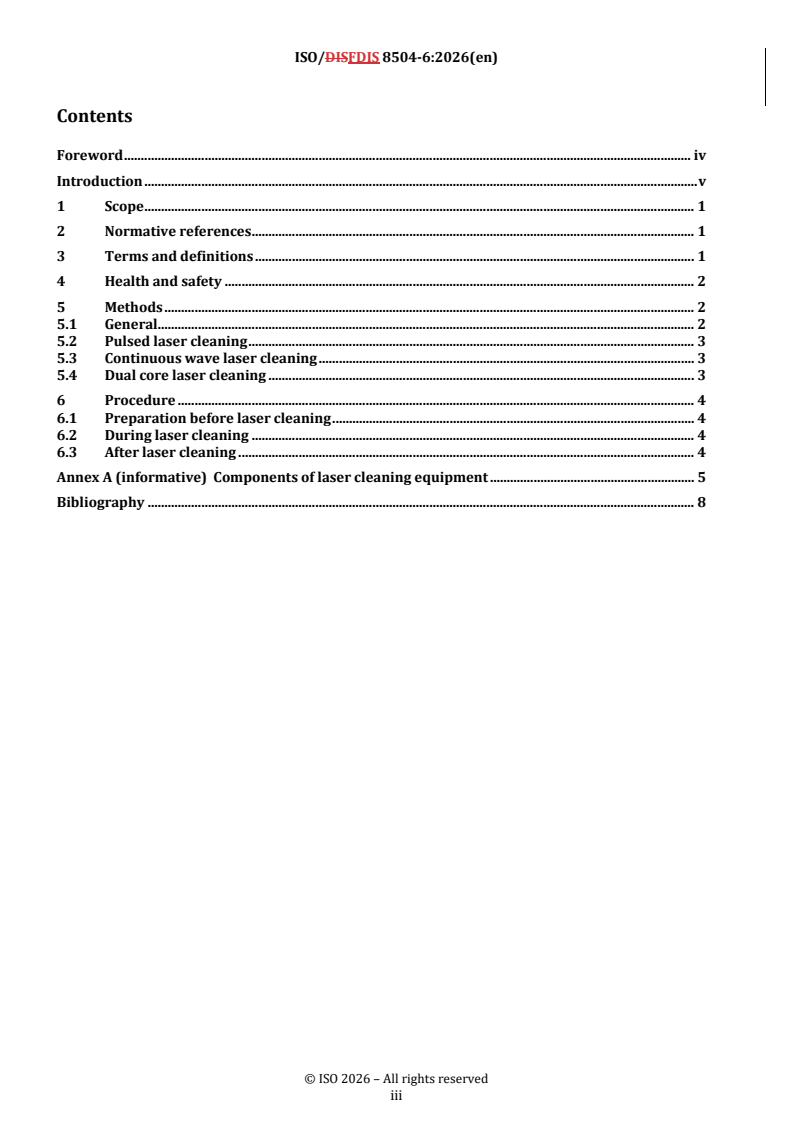
REDLINE ISO/FDIS 8504-6 - Preparation of steel substrates before application of paints and related products — Surface preparation methods — Part 6: Laser cleaning
ISO/FDIS 8504-6 is an ISO standard for laser cleaning as a method of preparing steel substrates before paints and related products are applied. It covers new and corroded steel surfaces, including uncoated steel and steel that has already been coated. The document focuses on the cleaning method, the equipment, the procedure to follow, and the safety controls needed in practice.
What does ISO/FDIS 8504-6 specify?
ISO/FDIS 8504-6 specifies laser cleaning methods for preparing steel surfaces before coating. It gives practical information on how effective each method is, where each method is suited, and what equipment and procedure to use.
The standard is organized into clauses on scope, normative references, terms and definitions, health and safety, methods, and procedure. Annex A gives informative background on the main equipment components.
| Annex | What it covers |
|---|---|
| A | Components of laser cleaning equipment |
The document stays focused on surface preparation. It does not set coating-system recommendations, and it does not give project-specific surface quality targets for every situation.
What are the key requirements of ISO/FDIS 8504-6?
ISO/FDIS 8504-6 requires the cleaning method, equipment, and target cleanliness to be controlled so the steel is prepared without damaging the substrate. In practice, the user has to select the right laser approach, manage heat input, protect workers, and verify the cleaned surface before coating.
Safety and work-area controls
Clause 4 says the work shall be done by suitably trained or supervised personnel. It also requires laser safety eyewear at a minimum, dust control, respiratory protection as appropriate, and laser-controlled work areas with barriers, signage, and other exposure controls.
In practice, this means laser cleaning is not just a process choice - it also needs a defined safety zone, operator training, and protective equipment before the beam is switched on.
Choosing the laser cleaning method
Clause 5.1 says the method depends on the starting condition of the steel, the material to be removed, and the equipment capabilities. The document identifies pulsed laser cleaning, continuous wave (CW) laser cleaning, dual core laser cleaning, and other suitable laser methods.
In practice, the user must match the process to the job. The document emphasizes that laser type, power, scan speed, and spot size interact to determine what is removed.
Method behavior and process control
Clause 5.2 describes pulsed laser cleaning as short, intense energy delivery that is useful for contaminant removal and micro-texturing with limited bulk heating. Clause 5.3 describes CW laser cleaning as continuous energy delivery that can help remove thick corrosion and scale, but it can increase burning and ignition risk. Clause 5.4 describes dual core laser cleaning as a combined beam approach that balances wider-area removal with localized energy input.
In practice, the process has to be tuned so the surface is cleaned without melting the substrate or creating thick oxides. That matters because excessive energy can change the steel surface in ways that affect coating performance.
Preparation before and after cleaning
Clause 6.1 says oil, grease, salts, and similar contaminants should be checked and, if necessary, removed before laser cleaning. Areas not meant to be cleaned should be masked off.
Clause 6.3 says loose dust and debris shall be removed after cleaning, and the cleaned surface shall be checked against the cleanliness grades agreed by the interested parties. Residual dust can be verified using ISO 8502-3.
In practice, the job is not complete when the laser pass ends. The surface must still be cleaned, assessed, and accepted before coating is applied.
Equipment considerations
Annex A describes the typical equipment chain: laser source, beam delivery system, laser cleaning head, laser beam, and vacuum system. It also notes options such as handheld or fixed systems, mobile or stationary arrangements, open or closed beam use, and integrated or separate dust extraction.
In practice, this helps buyers and engineers specify the machine setup that fits the workplace and the required productivity.
What terms does ISO/FDIS 8504-6 define?
- Laser cleaning - removal of rust, paint, mill scale, contaminants, and other unwanted materials from a substrate using a laser beam.
- Pulsed laser - a laser that emits single pulses or pulse trains, with each pulse shorter than 0.25 s.
- Continuous wave laser (CW laser) - a laser that emits radiation continuously for periods of 0.25 s or longer.
- Laser power - the power of the laser beam at each defined process operation, expressed in watts.
Who uses ISO/FDIS 8504-6?
ISO/FDIS 8504-6 is used by engineers, coating specifiers, surface-preparation contractors, quality managers, and buyers who need a laser-based method for preparing steel before painting. It is also relevant to operators and inspectors who have to choose the cleaning method, control the work area, and confirm that the surface is ready for coating.
The standard is most relevant in protective coating work on steel where rust, mill scale, old coatings, dust, oils, and greases must be removed while managing heat input and preserving the steel surface condition.
Which standards are used with ISO/FDIS 8504-6?
- ISO 11553-1 - provides laser processing machine safety requirements.
- ISO 19818-1 - provides requirements and test methods for laser eye and face protection.
- IEC 60825-4 - covers laser guards.
- ISO 8501 (all parts) - supports visual assessment of surface cleanliness.
- ISO 8502 (all parts) - provides tests for assessing surface cleanliness, including dust assessment.
- ISO 8503 (all parts) - covers surface roughness characteristics of blast-cleaned steel substrates.
- ISO 12944-4 - provides surface-type and surface-preparation guidance for protective paint systems.
- EN 14387 - supports selection of respiratory protective devices for gases and combined filters.
- ISO 11145:2026 - supplies laser vocabulary used in the terms and definitions.
- IEC 60825-1 - supports the definition of continuous wave in the terminology section.
What does the ISO/FDIS 8504-6 document contain?
Clause 5 gives the main laser cleaning methods and explains how they differ in energy delivery and cleaning behavior. Clause 6 gives the workflow before, during, and after cleaning, including masking, parameter control, dust removal, and final acceptance.
Annex A describes the main equipment components and how they work together in a laser cleaning system. Figure A.1 shows the equipment chain from laser source to beam delivery, cleaning head, vacuum system, and treated surface.
The document also includes health and safety guidance tied to laser exposure, dust, fumes, and operator protection. Its bibliography points readers to related standards for cleanliness assessment, laser terminology, laser safety, and respiratory protection.
Buy Documents
ISO/FDIS 8504-6 - Preparation of steel substrates before application of paints and related products — Surface preparation methods — Part 6: Laser cleaning
REDLINE ISO/FDIS 8504-6 - Preparation of steel substrates before application of paints and related products — Surface preparation methods — Part 6: Laser cleaning
Get Certified
Connect with accredited certification bodies for this standard

DVS-ZERT GmbH
German welding certification society.

CARES (UK Certification Authority for Reinforcing Steels)
UK certification for reinforcing steels and construction.

EWF/IIW (European/International Welding Federation)
International welding personnel certification.
Sponsored listings
Frequently Asked Questions
ISO/FDIS 8504-6 is a draft published by the International Organization for Standardization (ISO). Its full title is "Preparation of steel substrates before application of paints and related products — Surface preparation methods — Part 6: Laser cleaning". This standard covers: This document specifies laser cleaning methods for the preparation of steel surfaces before coating with paints and related products. It provides information on the effectiveness of the individual methods and their fields of application. It describes the equipment to be used and the procedure to be followed. ISO 8504 series is applicable to new and corroded steel surfaces and to steel surfaces that are uncoated or have been previously coated with paints and related products.
This document specifies laser cleaning methods for the preparation of steel surfaces before coating with paints and related products. It provides information on the effectiveness of the individual methods and their fields of application. It describes the equipment to be used and the procedure to be followed. ISO 8504 series is applicable to new and corroded steel surfaces and to steel surfaces that are uncoated or have been previously coated with paints and related products.
ISO/FDIS 8504-6 is classified under the following ICS (International Classification for Standards) categories: 25.220.10 - Surface preparation. The ICS classification helps identify the subject area and facilitates finding related standards.
ISO/FDIS 8504-6 is available in PDF format for immediate download after purchase. The document can be added to your cart and obtained through the secure checkout process. Digital delivery ensures instant access to the complete standard document.
Standards Content (Sample)
FINAL DRAFT
International
Standard
ISO/TC 35/SC 12
Preparation of steel substrates
Secretariat: BSI
before application of paints
Voting begins on:
and related products — Surface
2026-11-20
preparation methods —
Voting terminates on:
2027-01-01
Part 6:
Laser cleaning
RECIPIENTS OF THIS DRAFT ARE INVITED TO SUBMIT,
WITH THEIR COMMENTS, NOTIFICATION OF ANY
RELEVANT PATENT RIGHTS OF WHICH THEY ARE AWARE
AND TO PROVIDE SUPPOR TING DOCUMENTATION.
IN ADDITION TO THEIR EVALUATION AS
BEING ACCEPTABLE FOR INDUSTRIAL, TECHNO-
LOGICAL, COMMERCIAL AND USER PURPOSES, DRAFT
INTERNATIONAL STANDARDS MAY ON OCCASION HAVE
TO BE CONSIDERED IN THE LIGHT OF THEIR POTENTIAL
TO BECOME STAN DARDS TO WHICH REFERENCE MAY BE
MADE IN NATIONAL REGULATIONS.
Reference number
FINAL DRAFT
International
Standard
ISO/TC 35/SC 12
Preparation of steel substrates
Secretariat: BSI
before application of paints
Voting begins on:
and related products — Surface
preparation methods —
Voting terminates on:
Part 6:
Laser cleaning
© ISO 2026
All rights reserved.
RECIPIENTS OF THIS DRAFT ARE INVITED TO SUBMIT,
WITH THEIR COMMENTS, NOTIFICATION OF ANY
This ISO publication is protected by copyright and is owned by ISO and/or its licensors.
RELEVANT PATENT RIGHTS OF WHICH THEY ARE AWARE
The content of this ISO publication is provided under licence, not sold. Use is subject to the applicable licence terms issued by ISO,
AND TO PROVIDE SUPPOR TING DOCUMENTATION.
an ISO member body, or an authorized third-party distributor.
IN ADDITION TO THEIR EVALUATION AS
BEING ACCEPTABLE FOR INDUSTRIAL, TECHNO-
Except as required for implementation or expressly permitted by a separate licence, no part of this ISO publication may be
LOGICAL, COMMERCIAL AND USER PURPOSES, DRAFT
reproduced, distributed, modified, used, or made available in any form or by any means – electronic or mechanical, including
INTERNATIONAL STANDARDS MAY ON OCCASION HAVE
photocopying, scanning, recording, or posting on internal or external digital platforms. TO BE CONSIDERED IN THE LIGHT OF THEIR POTENTIAL
TO BECOME STAN DARDS TO WHICH REFERENCE MAY BE
Any use beyond the scope of the granted rights is prohibited and may result in legal action.
MADE IN NATIONAL REGULATIONS.
ISO copyright office
CP 401 • CH-1214 Vernier, Geneva
Phone: +41 22 749 01 11
Email: copyright@iso.org
Website: www.iso.org
Published in Switzerland
Reference number
ii
Contents Page
Foreword .iv
Introduction .v
1 Scope . 1
2 Normative references . 1
3 Terms and definitions . 1
4 Health and safety . 2
5 Methods . 2
5.1 General .2
5.2 Pulsed laser cleaning .3
5.3 Continuous wave laser cleaning .3
5.4 Dual core laser cleaning .3
6 Procedure . 4
6.1 Preparation before laser cleaning .4
6.2 During laser cleaning .4
6.2.1 General .4
6.2.2 Grades of cleanliness .4
6.2.3 Selection of laser cleaning method.4
6.2.4 Selection of laser cleaning equipment .4
6.3 After laser cleaning .4
Annex A (informative) Components of laser cleaning equipment . 5
Bibliography . 7
iii
Foreword
ISO (the International Organization for Standardization) is a worldwide federation of national standards
bodies (ISO member bodies). The work of preparing International Standards is normally carried out through
ISO technical committees. Each member body interested in a subject for which a technical committee
has been established has the right to be represented on that committee. International organizations,
governmental and non-governmental, in liaison with ISO, also take part in the work. ISO collaborates closely
with the International Electrotechnical Commission (IEC) on all matters of electrotechnical standardization.
The procedures used to develop this document and those intended for its further maintenance are described
in the ISO/IEC Directives, Part 1. In particular, the different approval criteria needed for the different types
of ISO document should be noted. This document was drafted in accordance with the editorial rules of the
ISO/IEC Directives, Part 2 (see www.iso.org/directives).
ISO draws attention to the possibility that the implementation of this document may involve the use of (a)
patent(s). ISO takes no position concerning the evidence, validity or applicability of any claimed patent rights
in respect thereof. As of the date of publication of this document, ISO had not received notice of (a) patent(s)
which may be required to implement this document. However, implementers are cautioned that this may not
represent the latest information, which may be obtained from the patent database available at www.iso.org/
patents. ISO shall not be held responsible for identifying any or all such patent rights.
Any trade name used in this document is information given for the convenience of users and does not
constitute an endorsement.
For an explanation of the voluntary nature of standards, the meaning of ISO specific terms and expressions
related to conformity assessment, as well as information about ISO's adherence to the World Trade
Organization (WTO) principles in the Technical Barriers to Trade (TBT), see www.iso.org/iso/foreword.html.
This document was prepared by Technical Committee ISO/TC 35, Paints and varnishes, Subcommittee SC 12,
Preparation of steel substrates before application of paints and related products.
[1]
A list of all parts in the ISO 8504 (all parts) can be found on the ISO website.
Any feedback or questions on this document should be directed to the user’s national standards body. A
complete listing of these bodies can be found at www.iso.org/members.html.
iv
Introduction
The performance of protective coatings of paint and related products applied to steel is significantly affected
by the state of the steel surface immediately before painting. The principal factors known to influence this
performance are:
— the presence of rust and mill scale;
— the presence of existing coatings;
— the presence of surface contaminants, including salts, dust, oils and greases;
— the surface profile.
[2] [3] [4]
ISO 8501 (all parts) , ISO 8502 (all parts) and ISO 8503 (all parts) provide methods for assessing these
[1]
factors, while the ISO 8504 (all parts) provides the preparation methods that are available for cleaning
steel substrates, indicating the capabilities of each in attaining the specified levels of cleanliness.
This document describes laser cleaning, which is an effective method for surface preparation.
Laser cleaning technology is still developing, and the quality requirements for laser cleaning are relatively
complex. In the future, some requirements are expected to be individually agreed upon with the user, such
as:
— relevant requirements for laser protection in special application scenarios;
— surface cleaning requirements proposed for typical products;
— surface imperfections should be considered before surface preparation and coating application.
This document does not contain recommendations for the protective coating system to be applied to the
steel surface. Nor does this document contain recommendations on surface quality requirements for specific
situations, even though surface quality can have a direct influence on the choice of protective coating and
its performance. Such recommendations are found in other documents such as national standards and
codes of practice. The cleanliness grades and representative photographic examples of laser cleaning will be
[5] [6]
supplemented in future revisions of ISO 8501-1 and ISO 8501-2 .
v
FINAL DRAFT International Standard ISO/FDIS 8504-6:2026(en)
Preparation of steel substrates before application of paints
and related products — Surface preparation methods —
Part 6:
Laser cleaning
1 Scope
This document specifies laser cleaning methods for the preparation of steel surfaces before coating with
paints and related products. It provides information on the effectiveness of the individual methods and their
fields of application. It also specifies requirements for the equipment and the procedures to be followed.
2 Normative references
The following documents are referred to in the text in such a way that some or all of their content constitutes
requirements of this document. For dated references, only the edition cited applies. For undated references,
the latest edition of the referenced document (including any amendments) applies.
ISO 11553-1, Safety of machinery — Laser processing machines — Part 1: Laser safety requirements
ISO 19818-1, Eye and face protection — Protection against laser radiation — Part 1: Requirements and test
methods
IEC 60825-4, Safety of laser products — Part 4: Laser guards
3 Terms and definitions
For the purposes of this document, the following terms and definitions apply.
ISO and IEC maintain terminology databases for use in standardization at the following addresses:
— ISO Online browsing platform: available at https:// www .iso .org/ obp
— IEC Electropedia: available at https:// www .electropedia .org/
3.1
laser cleaning
removal of rust, paint, mill scale, contaminants and other unwanted materials from the substrates using a
laser beam
3.2
pulsed laser
laser which emits radiation in the form of a single pulse or a train of pulses where the duration of a pulse is
less than 0,25 s
[7]
[SOURCE: ISO 11145:2026 , 3.19.3]
3.3
continuous wave laser
CW laser
laser continuously emitting radiation over periods of time greater than or equal to 0,25 s
[8]
Note 1 to entry: This definition is consistent with the definition of "continuous wave" in IEC 60825-1 .
[7]
[SOURCE: ISO 11145:2026 , 3.19.2]
3.4
laser power
power of the laser beam at each defined process operation
Note 1 to entry: Laser power (3.4) is expressed in watts.
Note 2 to entry: The laser power can be different when producing the contour (outline) of the test specimen and when
hatching the part.
[9]
[SOURCE: ISO/ASTM 52936-1:2023 , 3.2]
4 Health and safety
The procedures described in this document shall be carried out by personnel who are suitably trained or
supervised. The procedures used in these methods can be injurious to health if adequate precautions are not
taken. Atten
...
ISO/DISFDIS 8504-6
ISO/TC 35/SC 12
Secretariat: BSI
Date: 2026-08-1711-06
Preparation of steel substrates before application of paints and
related products — Surface preparation methods —
Part 6:
Laser cleaning
DISFDIS stage
VVVVototototiiiinnnngggg b b b beeeeggggiiiinnnnssss on on on on:::: 2222000022226666----00002222----00002222
VVVVooootintintintingggg te te te termrmrmrmiiiinnnnaaaatetetetessss o o o onnnn:::: 2 2 2 2000022226666----00004444----22227777
ISO/DISFDIS 8504-6:2026(en)
All rights reserved. Unless otherwise specified,
This ISO publication is protected by copyright and is owned by ISO and/or its licensors.
The content of this ISO publication is provided under licence, not sold. Use is subject to the applicable licence terms issued
by ISO, an ISO member body, or an authorized third-party distributor.
Except as required in the context of its for implementation or expressly permitted by a separate licence, no part of this
ISO publication may be reproduced or utilized otherwise, distributed, modified, used, or made available in any form or
by any means, – electronic or mechanical, including photocopying, scanning, recording, or posting on internal or external
digital platforms.
Any use beyond the internet or an intranet, without prior written permission. Permission can be requested from either
ISO at the address below or ISO’s member body in the countryscope of the requestergranted rights is prohibited and may
result in legal action.
ISO copyright office
CP 401 • Ch. de Blandonnet 8
CH-1214 Vernier, Geneva
Phone: + 41 22 749 01 11
E-mailEmail: copyright@iso.org
Website: www.iso.org
Published in Switzerland
ii
ISO/DISFDIS 8504-6:2026(en)
Contents
Foreword . iv
Introduction . v
1 Scope . 1
2 Normative references . 1
3 Terms and definitions . 1
4 Health and safety . 2
5 Methods . 2
5.1 General. 2
5.2 Pulsed laser cleaning . 3
5.3 Continuous wave laser cleaning . 3
5.4 Dual core laser cleaning . 3
6 Procedure . 4
6.1 Preparation before laser cleaning . 4
6.2 During laser cleaning . 4
6.3 After laser cleaning . 4
Annex A (informative) Components of laser cleaning equipment . 5
Bibliography . 8
iii
ISO/DISFDIS 8504-6:2026(en)
Foreword
ISO (the International Organization for Standardization) is a worldwide federation of national standards
bodies (ISO member bodies). The work of preparing International Standards is normally carried out through
ISO technical committees. Each member body interested in a subject for which a technical committee has been
established has the right to be represented on that committee. International organizations, governmental and
non-governmental, in liaison with ISO, also take part in the work. ISO collaborates closely with the
International Electrotechnical Commission (IEC) on all matters of electrotechnical standardization.
The procedures used to develop this document and those intended for its further maintenance are described
in the ISO/IEC Directives, Part 1. In particular, the different approval criteria needed for the different types of
ISO document should be noted. This document was drafted in accordance with the editorial rules of the
ISO/IEC Directives, Part 2 (see www.iso.org/directives).
ISO draws attention to the possibility that the implementation of this document may involve the use of (a)
patent(s). ISO takes no position concerning the evidence, validity or applicability of any claimed patent rights
in respect thereof. As of the date of publication of this document, ISO had not received notice of (a) patent(s)
which may be required to implement this document. However, implementers are cautioned that this may not
represent the latest information, which may be obtained from the patent database available at
www.iso.org/patents. ISO shall not be held responsible for identifying any or all such patent rights.
Any trade name used in this document is information given for the convenience of users and does not
constitute an endorsement.
For an explanation of the voluntary nature of standards, the meaning of ISO specific terms and expressions
related to conformity assessment, as well as information about ISO's adherence to the World Trade
Organization (WTO) principles in the Technical Barriers to Trade (TBT), see
www.iso.org/iso/foreword.htmlwww.iso.org/iso/foreword.html.
This document was prepared by Technical Committee ISO/TC 35, Paints and varnishes, Subcommittee SC 12,
Preparation of steel substrates before application of paints and related products.
A list of all parts in the ISO 8504 (all parts)ISO 8504 series can be found on the ISO website.
Any feedback or questions on this document should be directed to the user’s national standards body. A
complete listing of these bodies can be found at www.iso.org/members.htmlwww.iso.org/members.html.
iv
ISO/DISFDIS 8504-6:2026(en)
Introduction
The performance of protective coatings of paint and related products applied to steel is significantly affected
by the state of the steel surface immediately before painting. The principal factors known to influence this
performance are:
— the presence of rust and mill scale;
— the presence of existing coatings;
— the presence of surface contaminants, including salts, dust, oils and greases;
— the surface profile.
The ISO 8501 (all parts), ISO 8502 (all parts) and ISO 8503 (all parts) provide methods for assessing these
factors, while the ISO 8504 (all parts) provides the preparation methods that are available for cleaning steel
substrates, indicating the capabilities of each in attaining the specified levels of cleanliness.
This document describes laser cleaning, which is an effective method for surface preparation.
Laser cleaning technology is still developing, and the quality requirements for laser cleaning are relatively
complex. In the future, some requirements are expected to be individually agreed upon with the user, such as:
— relevant requirements for laser protection in special application scenarios;
— surface cleaning requirements proposed for typical products;
— surface imperfections should be considered before surface preparation and coating application.
This document does not contain recommendations for the protective coating system to be applied to the steel
surface. Nor does this document contain recommendations on surface quality requirements for specific
situations, even though surface quality can have a direct influence on the choice of protective coating and its
performance. Such recommendations are found in other documents such as national standards and codes of
practice. The cleanliness grades and representative photographic examples of laser cleaning will be
[5] [6]
supplemented in future revisions of ISO 8501-1 and ISO 8501-2 .
v
ISO/DISFDIS 8504-6:2026(en)
Preparation of steel substrates before application of paints and
related products — Surface preparation methods —
Part 6:
Laser cleaning
1 Scope
This document specifies laser cleaning methods for the preparation of steel surfaces before coating with paints
and related products. It provides information on the effectiveness of the individual methods and their fields
of application. It also specifies requirements for the equipment and the procedures to be followed.
2 Normative references
The following documents are referred to in the text in such a way that some or all of their content constitutes
requirements of this document. For dated references, only the edition cited applies. For undated references,
the latest edition of the referenced document (including any amendments) applies.
ISO 11553-1, Safety of machinery — Laser processing machines — Part 1: Laser safety requirements
ISO 19818-1, Eye and face protection — Protection against laser radiation — Part 1: Requirements and test
methods
IEC 60825-4, Safety of laser products — Part 4: Laser guards
3 Terms and definitions
For the purposes of this document, the following terms and definitions apply.
ISO and IEC maintain terminology databases for use in standardization at the following addresses:
— ISO Online browsing platform: available at https://www.iso.org/obphttps://www.iso.org/obp
— IEC Electropedia: available at https://www.electropedia.org/https://www.electropedia.org/
3.1
laser cleaning
removal of rust, paint, mill scale, contaminants and other unwanted materials from the substrates using a laser
beam
3.2
pulsed laser
laser which emits radiation in the form of a single pulse or a train of pulses where the duration of a pulse is
less than 0,25 s
[7]
[SOURCE: ISO 11145:2026 , 3.19.3]
3.3
continuous wave laser (CW laser)
CW laser
laser continuously emitting radiation over periods of time greater than or equal to 0,25 s
[8]
Note 1 to entry: This definition is consistent with the definition of "continuous wave" in IEC 60825-1 .
ISO/DISFDIS 8504-6:2026(en)
[7]
[SOURCE: ISO 11145:2026 , 3.19.2]
3.4
laser power
power of the laser beam at each defined process operation
Note 1 to entry: Laser power (3.4) is expressed in watts.
Note 2 to entry: The laser power can be different when producing the contour (outline) of the test specimen and when
hatching the part.
[9]
[SOURCE: ISO/ASTM 52936-1:2023 , 3.2]
4 Health and safety
The procedures described in this document shall be carried out by personnel who are suitably trained or
supervised. The procedures used in these methods can be injurious to health if adequate precautions are not
taken. Attention is drawn in the text to certain specific hazards. This document refers only to the technical
suitability of the methods.
NOTE Legal requirements can apply.
WARNING — Equipment, materials and procedures for surface preparation can be hazardous. It is
important to ensure that adequate instructions are given and that all precautions are exercised. Only
trained or qualified operators shall use the equipment.
Before activating the laser beam, all persons in the work area shall wear appropriate personal protective
equipment, consisting of specific laser safety eyewear at a minimum in accordance with ISO 19818-1. Laser
cleaning equipment should be equipped with a dust removal unit, and operators should wear respiratory
[10]
protective equipment, such as respiratory masks, as appropriate according to EN 14387 , to provide
protection against dust and fumes.
The extent of the work area shall be assessed to determine the minimal laser-controlled area and process
safety requirements. The laser work area shall have laser safety curtains, or other suitable physical barriers,
laser safety signage posted, and other controls as required to prevent exposure to the laser beam or vapours
from the laser cleaning process to personnel or damage to prop
...