

ISO 22182:2020
(Main)Geotextiles and geotextile-related products — Determination of index abrasion resistance characteristics under wet conditions for hydraulic applications
General Information
- Abstract
This document specifies a test method for determining the abrasion resistance of geotextiles and geotextile-related products under wet conditions. This document is applicable to geotextiles and geotextile-related products intended to be used as e.g. geo bags or filter beneath armourstone. The test method simulates abrasion impacts on geotextiles and geotextile-related products such as that caused by the movement of rocks in an embankment or transport of sediment in rivers. This document provides an index test which can be used for performance and acceptance testing. It can be used as performance test by comparison of mechanical and/or additional hydraulic properties before and after abrasion impact.
- Status
- Published
- Publication Date
- 09-Jun-2020
- Technical Committee
- ISO/TC 221 - Geosynthetics
- Drafting Committee
- ISO/TC 221/WG 3 - Mechanical properties
- Current Stage
- 9093 - International Standard confirmed
- Start Date
- 25-Sep-2025
- Completion Date
- 29-Aug-2026
Buy Documents
ISO 22182:2020 - Geotextiles and geotextile-related products -- Determination of index abrasion resistance characteristics under wet conditions for hydraulic applications
ISO 22182:2020 - Geotextiles and geotextile-related products — Determination of index abrasion resistance characteristics under wet conditions for hydraulic applications/10/2020
Overview
ISO 22182:2020 specifies an index test method to determine the abrasion resistance of geotextiles and geotextile‑related products under wet conditions for hydraulic applications. The standard simulates abrasion caused by moving rock and sediment (e.g., in embankments, rivers, or beneath armourstone) using a rotating drum filled with water and defined crushed‑basalt aggregates. Results are reported as abrasion‑resistance ratios for mechanical and hydraulic properties and can be used for performance and acceptance testing.
Key topics and technical requirements
- Test principle: Specimens mounted in an octagonal rotating drum are exposed to abrasive basalt chippings and water; the drum performs two abrasion phases of 40 000 revolutions each, with rotation reversed every 5 000 revolutions.
- Apparatus: Octagonal steel drum with eight test sections, adjustable motor and control system, specimen mounting plates and seals.
- Abrasive mixture (specified composition):
- 2 kg of 8/11 mm crushed basalt
- 1 kg of 5/8 mm crushed basalt
- 1 kg of 2/5 mm crushed basalt
- 8 L water
- Basalt particle density ≈ 3.0 ± 0.2 Mg/m³; water absorption ≤ 2 %; Micro‑Deval (M_DE) between 10 and 15.
- Specimens and conditioning: Eight test and eight control specimens per run, size 200 × 300 mm (exposed area 280 × 170 mm). Store under water at (20 ± 5) °C for ≥24 h prior to testing.
- Operating parameters: Drum speed 16 r/min; water temperature 18–22 °C.
- Measured properties (before and after abrasion): tensile strength (ISO 9073‑3), mass per unit area (ISO 9864), characteristic opening size (ISO 12956), filtration behaviour (ISO 10772), water permeability (ISO 11058).
- Results: Abrasion resistance R expressed as percentage ratios (property after / property before × 100), reported to 0.1 % resolution. Test report requirements are specified (mean, SD, CV, visual description, number of runs, etc.).
Applications and who uses it
ISO 22182 is used by:
- Geosynthetic manufacturers for product development, QA/QC and acceptance testing of geotextiles intended for geobags, filters beneath armourstone, revetments and riverbank protection.
- Independent testing laboratories to produce comparable index data.
- Civil, coastal and hydraulic engineers to select appropriate geotextiles for erosion‑ and abrasion‑prone environments.
- Specifiers and procurement teams requiring standardized performance evidence in contracts.
Practical benefits include standardized comparison of materials, assessment of durability after simulated hydro‑abrasive exposure, and informed selection for long‑term hydraulic installations.
Related standards
Normative references include ISO 9073‑3, ISO 9862, ISO 9864, ISO 10318‑1, ISO 10772, ISO 11058, ISO 12956, plus aggregate test standards EN 1097‑1 and EN 1097‑6. These provide the measurement methods required before and after abrasion testing.
Buy Documents
ISO 22182:2020 - Geotextiles and geotextile-related products -- Determination of index abrasion resistance characteristics under wet conditions for hydraulic applications
ISO 22182:2020 - Geotextiles and geotextile-related products — Determination of index abrasion resistance characteristics under wet conditions for hydraulic applications/10/2020
Get Certified
Connect with accredited certification bodies for this standard

Control Union Certifications
Global certification for agriculture and sustainability.

Hohenstein Institut
Textile testing and certification.

Bureau Veritas Bangladesh
Bureau Veritas certification services in Bangladesh.
Sponsored listings
Frequently Asked Questions
ISO 22182:2020 is a standard published by the International Organization for Standardization (ISO). Its full title is "Geotextiles and geotextile-related products — Determination of index abrasion resistance characteristics under wet conditions for hydraulic applications". This standard covers: This document specifies a test method for determining the abrasion resistance of geotextiles and geotextile-related products under wet conditions. This document is applicable to geotextiles and geotextile-related products intended to be used as e.g. geo bags or filter beneath armourstone. The test method simulates abrasion impacts on geotextiles and geotextile-related products such as that caused by the movement of rocks in an embankment or transport of sediment in rivers. This document provides an index test which can be used for performance and acceptance testing. It can be used as performance test by comparison of mechanical and/or additional hydraulic properties before and after abrasion impact.
This document specifies a test method for determining the abrasion resistance of geotextiles and geotextile-related products under wet conditions. This document is applicable to geotextiles and geotextile-related products intended to be used as e.g. geo bags or filter beneath armourstone. The test method simulates abrasion impacts on geotextiles and geotextile-related products such as that caused by the movement of rocks in an embankment or transport of sediment in rivers. This document provides an index test which can be used for performance and acceptance testing. It can be used as performance test by comparison of mechanical and/or additional hydraulic properties before and after abrasion impact.
ISO 22182:2020 is classified under the following ICS (International Classification for Standards) categories: 59.080.70 - Geotextiles. The ICS classification helps identify the subject area and facilitates finding related standards.
ISO 22182:2020 is available in PDF format for immediate download after purchase. The document can be added to your cart and obtained through the secure checkout process. Digital delivery ensures instant access to the complete standard document.
Standards Content (Sample)
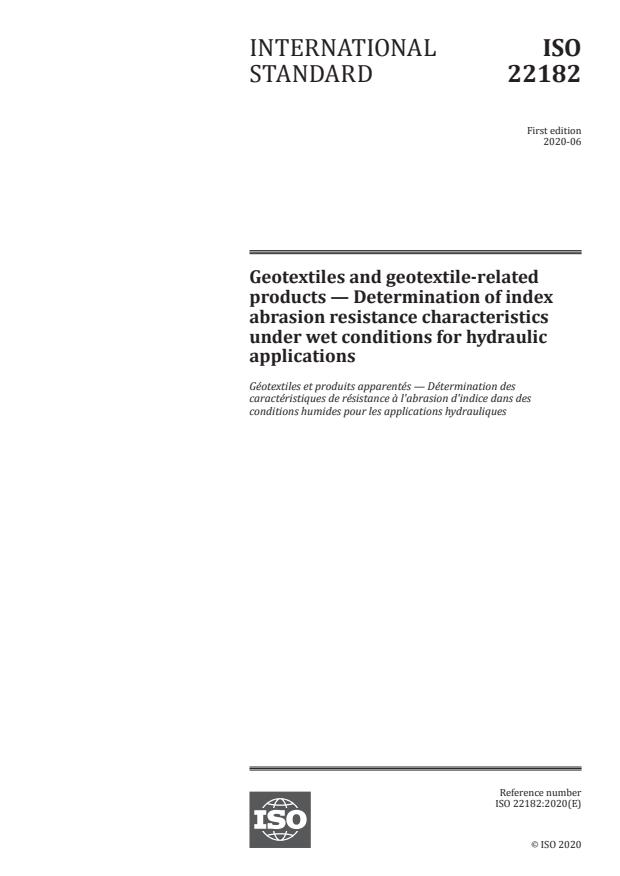
INTERNATIONAL ISO
STANDARD 22182
First edition
2020-06
Geotextiles and geotextile-related
products — Determination of index
abrasion resistance characteristics
under wet conditions for hydraulic
applications
Géotextiles et produits apparentés — Détermination des
caractéristiques de résistance à l'abrasion d'indice dans des
conditions humides pour les applications hydrauliques
Reference number
©
ISO 2020
© ISO 2020
All rights reserved. Unless otherwise specified, or required in the context of its implementation, no part of this publication may
be reproduced or utilized otherwise in any form or by any means, electronic or mechanical, including photocopying, or posting
on the internet or an intranet, without prior written permission. Permission can be requested from either ISO at the address
below or ISO’s member body in the country of the requester.
ISO copyright office
CP 401 • Ch. de Blandonnet 8
CH-1214 Vernier, Geneva
Phone: +41 22 749 01 11
Fax: +41 22 749 09 47
Email: copyright@iso.org
Website: www.iso.org
Published in Switzerland
ii © ISO 2020 – All rights reserved
Contents Page
Foreword .iv
Introduction .v
1 Scope . 1
2 Normative references . 1
3 Terms and definitions . 1
4 Principle . 2
5 Apparatus and materials. 2
6 Test specimens. 4
6.1 Handling. 4
6.2 Sampling . 4
6.3 Number and dimensions . 4
6.4 Conditioning . 4
7 Test procedure . 5
8 Calculation and expression of results . 6
9 Test report . 6
Bibliography . 8
Foreword
ISO (the International Organization for Standardization) is a worldwide federation of national standards
bodies (ISO member bodies). The work of preparing International Standards is normally carried out
through ISO technical committees. Each member body interested in a subject for which a technical
committee has been established has the right to be represented on that committee. International
organizations, governmental and non-governmental, in liaison with ISO, also take part in the work.
ISO collaborates closely with the International Electrotechnical Commission (IEC) on all matters of
electrotechnical standardization.
The procedures used to develop this document and those intended for its further maintenance are
described in the ISO/IEC Directives, Part 1. In particular, the different approval criteria needed for the
different types of ISO documents should be noted. This document was drafted in accordance with the
editorial rules of the ISO/IEC Directives, Part 2 (see www .iso .org/ directives).
Attention is drawn to the possibility that some of the elements of this document may be the subject of
patent rights. ISO shall not be held responsible for identifying any or all such patent rights. Details of
any patent rights identified during the development of the document will be in the Introduction and/or
on the ISO list of patent declarations received (see www .iso .org/ patents).
Any trade name used in this document is information given for the convenience of users and does not
constitute an endorsement.
For an explanation of the voluntary nature of standards, the meaning of ISO specific terms and
expressions related to conformity assessment, as well as information about ISO's adherence to the
World Trade Organization (WTO) principles in the Technical Barriers to Trade (TBT), see www .iso .org/
iso/ foreword .html.
This document was prepared by Technical Committee ISO/TC 221, Geosynthetics.
Any feedback or questions on this document should be directed to the user’s national standards body. A
complete listing of these bodies can be found at www .iso .org/ members .html.
iv © ISO 2020 – All rights reserved
Introduction
The abrasion resistance under wet conditions is an important property for the application of geotextiles
intended to be used as geobags (geotextile bags filled with soil) or filter beneath armourstone. The
abrasion impact on geotextiles can be achieved under wet conditions by installing geotextile samples in
a rotating drum. In the fixed rotating drum test facility, the drum is rotated with a defined speed and is
filled with water and a mixture of angular-grained high-quality basalt chippings with determined sizes.
The abrasion impact is caused by crushed stones tumbling over the geotextile. The assessment of the
geotextile abrasion resistance characteristics can be achieved by comparing thickness and mechanical
properties (tensile strength, elongation) and/or additional hydraulic properties (characteristic opening
size, filtration behaviour) before and after abrasion impact.
INTERNATIONAL STANDARD ISO 22182:2020(E)
Geotextiles and geotextile-related products —
Determination of index abrasion resistance characteristics
under wet conditions for hydraulic applications
1 Scope
This document specifies a test method for determining the abrasion resistance of geotextiles and
geotextile-related products under wet conditions. This document is applicable to geotextiles and
geotextile-related products intended to be used as e.g. geo bags or filter beneath armourstone.
The test method simulates abrasion impacts on geotextiles and geotextile-related products such as that
caused by the movement of rocks in an embankment or transport of sediment in rivers.
This document provides an index test which can be used for performance and acceptance testing. It
can be used as performance test by comparison of mechanical and/or additional hydraulic properties
before and after abrasion impact.
2 Normative references
The following documents are referred to in the text in such a way that some or all of their content
constitutes requirements of this document. For dated references, only the edition cited applies. For
undated references, the latest edition of the referenced document (including any amendments) applies.
ISO 9073-3, Textiles — Test methods for nonwovens — Part 3: Determination of tensile strength and
elongation
ISO 9862, Geosynthetics — Sampling and preparation of test specimens
ISO 9864, Geosynthetics — Test method for the determination of mass per unit area of geotextiles and
geotextile-related products
ISO 10318-1, Geosynthetics — Part 1: Terms and definitions
ISO 10772, Geotextiles - Test method for the determination of the filtration behaviour of geotextiles under
turbulent water flow conditions
ISO 11058, Geotextiles and geotextile-related products — Determination of water permeability
characteristics normal to the
...
INTERNATIONAL ISO
STANDARD 22182
First edition
2020-06
Geotextiles and geotextile-related
products — Determination of index
abrasion resistance characteristics
under wet conditions for hydraulic
applications
Géotextiles et produits apparentés — Détermination des
caractéristiques de résistance à l'abrasion d'indice dans des
conditions humides pour les applications hydrauliques
Reference number
©
ISO 2020
© ISO 2020
All rights reserved. Unless otherwise specified, or required in the context of its implementation, no part of this publication may
be reproduced or utilized otherwise in any form or by any means, electronic or mechanical, including photocopying, or posting
on the internet or an intranet, without prior written permission. Permission can be requested from either ISO at the address
below or ISO’s member body in the country of the requester.
ISO copyright office
CP 401 • Ch. de Blandonnet 8
CH-1214 Vernier, Geneva
Phone: +41 22 749 01 11
Fax: +41 22 749 09 47
Email: copyright@iso.org
Website: www.iso.org
Published in Switzerland
ii © ISO 2020 – All rights reserved
Contents Page
Foreword .iv
Introduction .v
1 Scope . 1
2 Normative references . 1
3 Terms and definitions . 1
4 Principle . 2
5 Apparatus and materials. 2
6 Test specimens. 4
6.1 Handling. 4
6.2 Sampling . 4
6.3 Number and dimensions . 4
6.4 Conditioning . 4
7 Test procedure . 5
8 Calculation and expression of results . 6
9 Test report . 6
Bibliography . 8
Foreword
ISO (the International Organization for Standardization) is a worldwide federation of national standards
bodies (ISO member bodies). The work of preparing International Standards is normally carried out
through ISO technical committees. Each member body interested in a subject for which a technical
committee has been established has the right to be represented on that committee. International
organizations, governmental and non-governmental, in liaison with ISO, also take part in the work.
ISO collaborates closely with the International Electrotechnical Commission (IEC) on all matters of
electrotechnical standardization.
The procedures used to develop this document and those intended for its further maintenance are
described in the ISO/IEC Directives, Part 1. In particular, the different approval criteria needed for the
different types of ISO documents should be noted. This document was drafted in accordance with the
editorial rules of the ISO/IEC Directives, Part 2 (see www .iso .org/ directives).
Attention is drawn to the possibility that some of the elements of this document may be the subject of
patent rights. ISO shall not be held responsible for identifying any or all such patent rights. Details of
any patent rights identified during the development of the document will be in the Introduction and/or
on the ISO list of patent declarations received (see www .iso .org/ patents).
Any trade name used in this document is information given for the convenience of users and does not
constitute an endorsement.
For an explanation of the voluntary nature of standards, the meaning of ISO specific terms and
expressions related to conformity assessment, as well as information about ISO's adherence to the
World Trade Organization (WTO) principles in the Technical Barriers to Trade (TBT), see www .iso .org/
iso/ foreword .html.
This document was prepared by Technical Committee ISO/TC 221, Geosynthetics.
Any feedback or questions on this document should be directed to the user’s national standards body. A
complete listing of these bodies can be found at www .iso .org/ members .html.
iv © ISO 2020 – All rights reserved
Introduction
The abrasion resistance under wet conditions is an important property for the application of geotextiles
intended to be used as geobags (geotextile bags filled with soil) or filter beneath armourstone. The
abrasion impact on geotextiles can be achieved under wet conditions by installing geotextile samples in
a rotating drum. In the fixed rotating drum test facility, the drum is rotated with a defined speed and is
filled with water and a mixture of angular-grained high-quality basalt chippings with determined sizes.
The abrasion impact is caused by crushed stones tumbling over the geotextile. The assessment of the
geotextile abrasion resistance characteristics can be achieved by comparing thickness and mechanical
properties (tensile strength, elongation) and/or additional hydraulic properties (characteristic opening
size, filtration behaviour) before and after abrasion impact.
INTERNATIONAL STANDARD ISO 22182:2020(E)
Geotextiles and geotextile-related products —
Determination of index abrasion resistance characteristics
under wet conditions for hydraulic applications
1 Scope
This document specifies a test method for determining the abrasion resistance of geotextiles and
geotextile-related products under wet conditions. This document is applicable to geotextiles and
geotextile-related products intended to be used as e.g. geo bags or filter beneath armourstone.
The test method simulates abrasion impacts on geotextiles and geotextile-related products such as that
caused by the movement of rocks in an embankment or transport of sediment in rivers.
This document provides an index test which can be used for performance and acceptance testing. It
can be used as performance test by comparison of mechanical and/or additional hydraulic properties
before and after abrasion impact.
2 Normative references
The following documents are referred to in the text in such a way that some or all of their content
constitutes requirements of this document. For dated references, only the edition cited applies. For
undated references, the latest edition of the referenced document (including any amendments) applies.
ISO 9073-3, Textiles — Test methods for nonwovens — Part 3: Determination of tensile strength and
elongation
ISO 9862, Geosynthetics — Sampling and preparation of test specimens
ISO 9864, Geosynthetics — Test method for the determination of mass per unit area of geotextiles and
geotextile-related products
ISO 10318-1, Geosynthetics — Part 1: Terms and definitions
ISO 10772, Geotextiles - Test method for the determination of the filtration behaviour of geotextiles under
turbulent water flow conditions
ISO 11058, Geotextiles and geotextile-related products — Determination of water permeability
characteristics normal to the
...