


ISO/IEC 8802-5:1998
(Main)Information technology — Telecommunications and information exchange between systems — Local and metropolitan area networks — Specific requirements — Part 5: Token ring access method and physical layer specifications
Information technology — Telecommunications and information exchange between systems — Local and metropolitan area networks — Specific requirements — Part 5: Token ring access method and physical layer specifications
Technologies de l'information — Télécommunications et échange d'information entre systèmes — Réseaux locaux et métropolitains — Exigences spécifiques — Partie 5: Méthode d'accès par anneau à jeton et spécifications pour la couche physique
General Information
- Status
- Withdrawn
- Publication Date
- 30-Sep-1998
- Withdrawal Date
- 30-Sep-1998
- Current Stage
- 9599 - Withdrawal of International Standard
- Start Date
- 12-Apr-2019
- Completion Date
- 12-Feb-2026
Relations
- Effective Date
- 06-Jun-2022
- Effective Date
- 15-Apr-2008
- Effective Date
- 15-Apr-2008
Get Certified
Connect with accredited certification bodies for this standard

BSI Group
BSI (British Standards Institution) is the business standards company that helps organizations make excellence a habit.

NYCE
Mexican standards and certification body.
Sponsored listings
Frequently Asked Questions
ISO/IEC 8802-5:1998 is a standard published by the International Organization for Standardization (ISO). Its full title is "Information technology — Telecommunications and information exchange between systems — Local and metropolitan area networks — Specific requirements — Part 5: Token ring access method and physical layer specifications". This standard covers: Information technology — Telecommunications and information exchange between systems — Local and metropolitan area networks — Specific requirements — Part 5: Token ring access method and physical layer specifications
Information technology — Telecommunications and information exchange between systems — Local and metropolitan area networks — Specific requirements — Part 5: Token ring access method and physical layer specifications
ISO/IEC 8802-5:1998 is classified under the following ICS (International Classification for Standards) categories: 35.110 - Networking. The ICS classification helps identify the subject area and facilitates finding related standards.
ISO/IEC 8802-5:1998 has the following relationships with other standards: It is inter standard links to ISO/IEC 8802-5:1998/Amd 1:1998, ISO/IEC 8802-5:1995; is excused to ISO/IEC 8802-5:1998/Amd 1:1998. Understanding these relationships helps ensure you are using the most current and applicable version of the standard.
ISO/IEC 8802-5:1998 is available in PDF format for immediate download after purchase. The document can be added to your cart and obtained through the secure checkout process. Digital delivery ensures instant access to the complete standard document.
Standards Content (Sample)
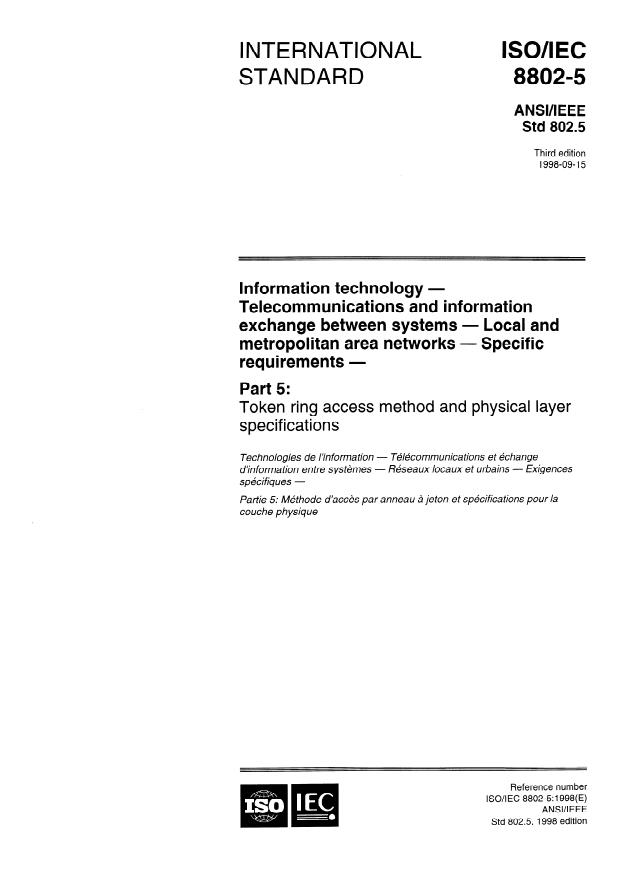
INTERNATIONAL
ISOAEC
STANDARD
8802-5
ANSI/IEEE
Std 802.5
Third edition
1998-09- 15
Information technology -
Telecommunications and information
exchange between systems - Local and
metropolitan area networks - Specific
requirements -
Part 5:
Token ring access method and physical layer
specifications
Technologies de I’informa tion - T6kommunications et kchange
d ’information entre systkmes - Rbseaux locaux et urbains - Exigences
spkcifiques -
Partie 5: Mkthode d ’accks par anneau ti jeton et spkcifications pour la
couche physique
Reference number
ISO/IEC 8802-5: 1998(E)
ANSI/IEEE
Std 802.5, 1998 edition
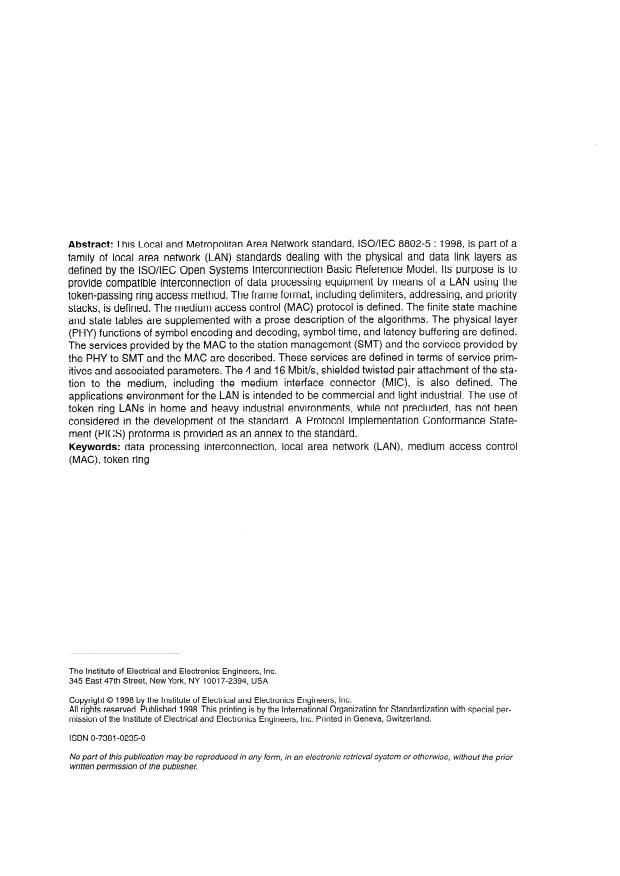
Abstract: This Local and Metropolitan Area Network standard, lSO/IEC 8802-5 : 1998, is part of a
family of local area network (LAN) standards dealing with the physical and data link layers as
defined by the ISO/IEC Open Systems Interconnection Basic Reference Model. Its purpose is to
provide compatible interconnection of data processing equipment by means of a LAN using the
token-passing ring access method. The frame format, including delimiters, addressing, and priority
stacks, is defined. The medium access control (MAC) protocol is defined. The finite state machine
and state tables are supplemented with a prose description of the algorithms. The physical layer
(PHY) functions of symbol encoding and decoding, symbol time, and latency buffering are defined.
The services provided by the MAC to the station management (SMT) and the services provided by
the PHY to SMT and the MAC are described. These services are defined in terms of service prim-
itives and associated parameters. The 4 and 16 Mbit/s, shielded twisted pair attachment of the sta-
tion to the medium, including the medium interface connector (MIC), is also defined. The
applications environment for the LAN is intended to be commercial and light industrial. The use of
token ring LANs in home and heavy industrial environments, while not precluded, has not been
considered in the development of the standard. A Protocol Implementation Conformance State-
ment (PICS) proforma is provided as an annex to the standard.
Keywords: data processing interconnection, local area network (LAN), medium access control
(MAC), token ring
The Institute of Electrical and Electronics Engineers, Inc,
345 East 47th Street, New York, NY 10017-2394, USA
Copyright 0 1998 by the Institute of Electrical and Electronics Engineers, Inc.
All rights reserved. Published 1998. This printing is by the International Organization for Standardization with special per-
mission of the Institute of Electrical and Electronics Engineers, Inc. Printed in Geneva, Switzerland.
ISBN O-7381 -0235-O
No part of this publication may be reproduced in any form, in an electronic re trievai system or otherwise, without the prior
written permission of the publisher.
ISWIEC 8802-5 : 1998
ANSI/IEEE Std 802.5,1998 Edition
(Revision of ISO/IEC 8802-5 : 1995 [ANSI/IEEE Std 802.5-I 9951)
Information technology-
Telecommunications and information
exchange between systems-
Local and metropolitan area networks-
Specific requirements-
Part 5:Token ring access method and
physical layer specifications
Sponsor
LAN MAN Standards Committee
of the
IEEE Computer Society
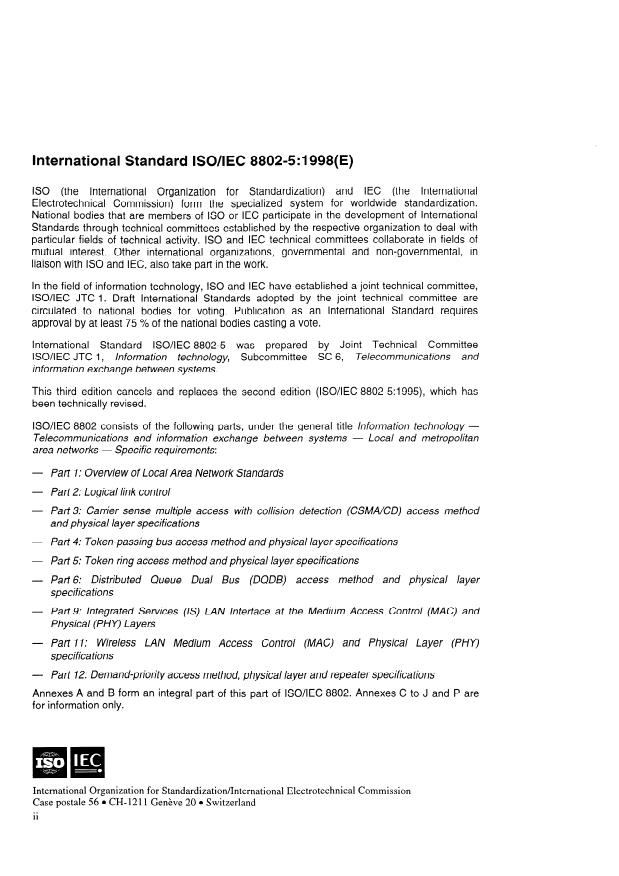
International Standard ISOAEC 8802=5:1998(E)
IS0 (the International Organization for Standardization) and IEC (the International
Electrotechnical Commission) form the specialized system for worldwide standardization.
National bodies that are members of IS0 or IEC participate in the development of International
Standards through technical committees established by the respective organization to deal with
particular fields of technical activity. IS0 and IEC technical committees collaborate in fields of
mutual interest. Other international organizations, governmental and non-governmental, in
liaison with IS0 and IEC, also take part in the work.
In the field of information technology, IS0 and IEC have established a joint technical committee,
ISOAEC JTC 1. Draft International Standards adopted by the joint technical committee are
circulated to national bodies for voting. Publication as an International Standard requires
approval by at least 75 % of the national bodies casting a vote.
International Standard ISO/IEC 8802-5 was prepared by Joint Technical Committee
ISO/IEC JTC 1, information technology, Subcommittee SC 6, Telecommunications and
information exchange between sys terns.
This third edition cancels and replaces the second edition (lSO/lEC 8802~5:1995), which has
been technically revised.
ISO/IEC 8802 consists of the following parts, under the general title information technology -
Telecommunications and information exchange between systems - Local and metropolitan
area networks - Specific requirements:
- Part I: Overview of Local Area Network Standards
- Part 2: Logical link control
- Part 3: Carrier sense multiple access with collision detection (CSMAKD) access method
and physical layer specifications
- Part 4: Token-passing bus access method and physical layer specifications
- Part 5: Token ring access method and physical layer specifications
- Part 6: Distributed Queue Dual Bus (DQDB) access method and physical layer
specifications
- Part 9: Integrated Services (IS) LAN Interface at the Medium Access Control (MAC) and
Physical (PH Y) Layers
- Part I I: Wireless LAN Medium Access Control (MAC) and Physical Layer (PHY)
specifications
- Part 12: Demand-priority access method, physical layer and repeater specifications
Annexes A and B form an integral part of this part of ISOIIEC 8802. Annexes C to J and P are
for information only.
International Organization for Standardization/International Electrotechnical Commission
l CH- 12 11 Genkve 20 l Switzerland
Case postale 56
ii
Foreword to International Standard ISOAEC 88024 : 1998
This International Standard is part of a family of International Standards for Local and Metropolitan Area
Networks. The relationship between this International Standard and the other members of the family is
shown below. (The numbers in the figure refer to ISO/IEC Standard numbers.)
8802-I Overview
i
8802-2 Logical Link Control
Data
Link
8802-3 8802-4 8802-5 8802-6 8802-9 8802-I 1 8802-I 2
Layer
Medium Medium
Medium Medium Medium Medium Medium
Access
Access Access Access Access Access Access
e---w--- 1
-------- -------- -------- .----_--- .--w-e--
8802-3 Physical
8802-5 8802-6 8802-9 8802-l 1 8802-1 2
Physical Physical Physical Layer
Physical Physical Physical
This family of International Standards deals with the Physical and Data Link layers as defined by the IS0
Open Systems Interconnection (OSI) Basic Reference Model (ISO/IEC 7498-l: 1994). The access standards
define seven types of medium access technologies and associated physical media, each appropriate for
particular applications or system objectives. Other types are under investigation.
The International Standards defining the access technologies are as follows:
ISO/IEC 8802-3, utilizing carrier sense multiple access with collision detection (CSMAKD) as the
a>
access method.
ISO/IEC 8802-4, utilizing token passing bus as the access method.
b)
ISO/IEC 8802-5, utilizing token passing ring as the access method.
C>
ISOIIEC 8802-6, utilizing distributed queuing dual bus as the access method.
(0
ISO/IEC 8802-9, a unified access method offering integrated services for backbone networks.
e>
f) ISO/IEC DIS 8802- 11, a wireless LAN utilizing carrier sense multiple access with collision avoidance
(CSMAKA) as the access method.
ISO/IEC DIS 8802- 12, utilizing Demand Priority as the access method.
g>
ISOIIEC TR 8802- 1, Overview of Local Area Network Standards, provides an overview of the series of ISO/
IEC 8802 standards.
ISO/IEC 8802-2, Logical Link Control, is used in conjunction with the medium access standards to provide
the data link layer service to network layer protocols.
ISOIIEC 15802-l) Medium Access Control (MAC) service definition, specifies the characteristics of the
common MAC Service provided by all IEEE 802 LAN MACs. The service is defined in terms of primitives
that can be passed between peer service users, their parameters, their interrelationship and valid sequences,
and the associated events of the service.
ISO/IEC 15802-2, LAN/MAN Management, defines an OSI management-compatible architecture, and
services and protocol elements for use in a LAN/MAN environment for performing remote management.
ISO/IEC 10038, Media Access ControZ (MAC) bridges, specifies an architecture and protocol for the intercon-
nection of IEEE 802 LANs below the level of the logical link control protocol (to be renumbered 15802-3).
ISO/IEC 15802-4, System Load Protocol, specifies a set of services and protocol for those aspects of manage-
ment concerned with the loading of systems on IEEE 802 LANs.
ISO/IEC 15802-5, Remote Media Access Control (MAC) bridging, specifies extensions for the interconnec-
tion, using non-LAN communication technologies, of geographically separated IEEE 802 LANs below the
level of the logical link control protocol.
Copyright 0 1998 IEEE. All rights reserved. iii
ANSI/IEEE Std 802.5,1998 Edition
IEEE Standards documents are developed within the Technical Committees of the IEEE Societies and the
Standards Coordinating Committees of the IEEE Standards Board. Members of the committees serve volun-
tarily and without compensation. They are not necessarily members of the Institute. The standards developed
within IEEE represent a consensus of the broad expertise on the subject within the Institute as well as those
activities outside of IEEE that have expressed an interest in participating in the development of the standard.
Use of an IEEE Standard is wholly voluntary. The existence of an IEEE Standard does not imply that there
are no other ways to produce, test, measure, purchase, market, or provide other goods and services related to
the scope of the IEEE Standard. Furthermore, the viewpoint expressed at the time a standard is approved and
issued is subject to change brought about through developments in the state of the art and comments
received from users of the standard. Every IEEE Standard is subjected to review at least every five years for
revision or reaffirmation. When a document is more than five years old and has not been reaffirmed, it is rea-
sonable to conclude that its contents, although still of some value, do not wholly reflect the present state of
the art. Users are cautioned to check to determine that they have the latest edition of any IEEE Standard.
Comments for revision of IEEE Standards are welcome from any interested party, regardless of membership
affiliation with IEEE. Suggestions for changes in documents should be in the form of a proposed change of
text, together with appropriate supporting comments.
Interpretations: Occasionally questions may arise regarding the meaning of portions of standards as they
relate to specific applications. When the need for interpretations is brought to the attention of IEEE, the
Institute will initiate action to prepare appropriate responses. Since IEEE Standards represent a consensus of
all concerned interests, it is important to ensure that any interpretation has also received the concurrence of a
balance of interests. For this reason IEEE and the members of its technical committees are not able to pro-
vide an instant response to interpretation requests except in those cases where the matter has previously
received formal consideration.
Comments on standards and requests for interpretations should be addressed to:
Secretary, IEEE Standards Board
445 Hoes Lane
P.O. Box 1331
Piscataway, NJ 08855 133 1
USA
Note: Attention is called to the possibility that implementation of this standard mav
require use of subject matter covered by patent rights. By publication of this standard,
no position is taken with respect to the existence or validity of any patent rights in
connection therewith. The IEEE shall not be responsible for identifying patents for
which a license may be required by an IEEE standard or for conducting inquiries into
the legal validity or scope of those patents that are brought to its attention.
Authorization to photocopy portions of any individual standard for internal or personal use is granted by the
Institute of Electrical and Electronics Engineers, Inc., provided that the appropriate fee is paid to Copyright
Clearance Center. To arrange for payment of licensing fee, please contact Copyright Clearance Center, Cus-
tomer Service, 222 Rosewood Drive, Danvers, MA 01923 USA; (508) 750-8400. Permission to photocopy
portions of any individual standard for educational classroom use can also be obtained through the Copy-
right Clearance Center.
iv Copyright 0 1998 IEEE. All rights reserved.
Introduction to ANSI/IEEE Std 802.5,1998 Edition
(This introduction is not a part of ANSI/IEEE Std 802.5, 1998 Edition or of ISO/IEC 8802-5 : 1998.)
This standard is part of a family of standards for local and metropolitan area networks. The relationship
between the standard and other members of the family is shown below. (The numbers in the figure refer to
IEEE standard numbers.)
802.2 LOGICAL LINK CONTROL
c
G
DATA
F
802.1 BRIDGING
LINK
f
iii
LAYER
si
a
,
: 2
802.3 802.4 802.5 802.6 802.9 802.11 802.12
W
. MEDIUM MEDIUM MEDIUM MEDIUM MEDIUM MEDIUM
MEDIUM
ACCESS ACCESS ACCESS ACCESS ACCESS ACCESS
ACCESS
E 2
802.4 802.5 802.6 802.9 802.11 802.12 PHYSICAL
802.3
i2 -PHYSICAL PHYSICAL PHYSICAL PHYSICAL PHYSICAL PHYSICAL PHYSICAL LAYER
~~--
* Formerly IEEE Std 802.1A.
This family of standards deals with the Physical and Data Link layers as defined by the International Organi-
zation for Standardization (ISO) Open Systems Interconnection (OSI) Basic Reference Model (ISO/IEC
7498-l : 1994). The access standards define seven types of medium access technologies and associated
physical media, each appropriate for particular applications or system objectives. Other types are under
investigation.
The standards defining the technologies noted above are as follows:
l IEEE Std 802 Overview and Architecture. This standard provides an overview to the fam-
ily of IEEE 802 Standards.
l ANSI/IEEE Std 802.lB LAN/MAN Management. Defines an OS1 management-compatible architec-
and 802.lk ture, and services and protocol elements for use in a LAN/MAN environ-
[ISO/IEC 15802-21 ment for performing remote management.
l ANSI/IEEE Std 802.1D Media Access Control (MAC) Bridges. Specifies an architecture and protocol
[ISO/IEC 100381 for the interconnection of IEEE 802 LANs below the MAC service boundary.
l ANSI/IEEE Std 802.lE System Load Protocol. Specifies a set of services and protocol for those
[ISO/IEC 15802-41 aspects of management concerned with the loading of systems on IEEE 802
LANs.
l ANSI/IEEE Std 802.1 G Remote Media Access Control (MAC) Bridging. Specifies extensions for the
[ISO/IEC 15802-51 interconnection, using non-LAN communication technologies, of geographically
separated IEEE 802 LANs below the level of the logical link control protocol.
Logical Link Control
l ANSI/IEEE Std 802.2
[ISO/IEC 8802-21
CSMAKD Access Method and Physical Layer Specifcations
l ANSI/IEEE Std 802.3
[ISO/IEC 8802-31
Copyright 0 1998 IEEE. All rights reserved.
l ANSI/IEEE Std 802.4 Token Passing Bus Access Method and Physical Layer Specifications
[ISO/IEC 8802-41
l ANSI/IEEE Std 802.5 Token Ring Access Method and Physical Layer Specifications
[ISO/IEC 8802-51
Distributed Queue Dual Bus Access Method and Physical Layer SpeciJi-
l ANSI/IEEE Std 802.6
[ISO/IEC 8802-61 cations
l ANSI/IEEE Std 802.9 Integrated Services (IS) LAN Interface at the Medium Access Control
[ISO/IEC 8802-91 (MAC) and Physical (PHY) Layers
l ANSI/IEEE Std 802.10 Interoperable LAN/MAN Security
Wireless LAN Medium Access Control (MAC) and Physical Layer SpeciJi-
l IEEE Std 802.11
cations
[ISO/IEC DIS 8802-l l]
Demand Priority Access Method, Physical Layer and Repeater Speci$-
. ANSI/IEEE Std 802.12
cations
[ISO/IEC DIS 8802-121
In addition to the family of standards, the following is a recommended practice for a common Physical
Layer technology:
l IEEE Std 802.7 IEEE Recommended Practice for Broadband Local Area Networks
The following additional working group has authorized standards projects under development:
l IEEE 802.14 Standard Protocol for Cable-TV Based Broadband Communication Network
Conformance test methodology
An additional standards series, identified by the number 1802, has been established to identify the conform-
ance test methodology documents for the 802 family of standards. Thus the conformance test documents for
802.3 are numbered 1802.3.
ANSI/IEEE Std 802.5 [lSO/lEC 8802-5 : 19981
This standard specifies that each octet of the information field shall be transmitted most significant bit
(MSB) first. This convention is reversed from that used in the CSMAKD and Token Bus standards, which
are least significant bit (LSB) first transmission. While the transmission of MSB first is used for token ring,
this does not imply that MSB transmission is preferable.
The IEEE 802.5 Working Group maintains a web site including notices to implementors and up-to-date
information, at http://stdsbbs.ieee.org/groups/SO2/5/.
Copyright 0 1998 IEEE. All rights reserved.
Participants
Voting members of the IEEE 802.5 Working Group who participated in developing this Third Edition of the
standard were as follows:
Robert D. Love, Chair
David W. Wilson,‘ Technical Editor
Ken Kutzler Bob Ross
Jim Carlo
George Lin Tony Rowe11
Jeremy Curtis
Joseph Mazor Bill Sarles
William Douglass
Kelly P McClellan Steve Scandalis
Paul Gessert
John Messenger
Martin Gurthrie Showi-min Shen
John E. Montague
Sharam Hakimi Michael Siegel
Ivan Oakley
Michael Hanrahan Kevin G. Smith
Neil Jarvis Syou-Chin Peng Trevor Warwick
Kirk Preiss
Ivar Jeppesen Kenneth T. Wilson
Allen Kasey Edward C. Wong
The following persons were on the balloting committee:
Richard J. Iliff Ronald C. Petersen
William B. Adams
Neil A. Jarvis Thomas L. Phinney
Don Aelmore
Paul Amer Henry D. Keen Fernando Ramos
Peter M. Kelly
Jack S. Andresen Ivan Reede
Gary C. Kessler Edouard Y. Rocher
Kit Athul
William E. Ayen Yongbum Kim James W. Romlein
Stephen B. Kruger
Frederic Bauchot Floyd E. Ross
Manuel J. Betancor* Lanse M. Leach Michael Salzman
Kathleen L. Briggs Walter Levy Williams F. Sarles
Peter K. Campbell Randolph S. Little Stephen Scandalis
James T. Carlo Robert D. Love Norman Schneidewind
David E. Carlson Joseph G. Maley Rich Seifert
Alan M. Chambers John L. Messenger Lee A. Sendelbach
Robert S. Crowder Bennett Meyer Donald A. Sheppard
Christos Douligeris Richard H. Miller Joseph S. Skorupa
Sourav K. Dutta David S. Millman Rosemary Slager
Paul S. Eastman Warren Monroe Fred J. Strauss
Philip H. Enslow John E. Montague
Efstathios D. Sykas
Changxin Fan Kinji Mori
Geoffrey 0. Thompson
John W. Fendrich David J. Morris Robert C. Tripi
Michael A. Fischer James R. Moulton Mark-Rene Uchida
Harvey A. Freeman Wayne D. Moyers
Yun-Che Wang
Robert J. Gagliano Shimon Muller Frank J. Weisser
Gautam Garai Charles Oestereicher
Raymond P. Wenig
Julio Gonzalez Sanz Donal O ’Mahony
Paul A. Willis
Martin Guthrie Roger Pandanda David W. Wilson
Kenneth C. Heck Lucy W. Person
Qian-Li Yang
*Deceased
*
Copyright 0 1998 IEEE. All rights reserved, vii
When the IEEE Standards Board approved this standard on 16 September 1997, it had the following
membership:
Richard J. Holleman, Vice Chair
Donald C. Loughry, Chair
Andrew G. Salem, Secretary
Louis-Francois Pau
Lowell Johnson
Clyde R. Camp
Gerald H. Peterson
Robert Kennelly
Stephen L. Diamond
John W. Pope
E. G. “Al” Kiener
Harold E. Epstein
Jose R. Ramos
Joseph L. Koepfingert
Donald C. Fleckenstein
Ronald H. Reimer
Stephen R. Lambert
Jay ForsterJf
Ingo Rtisch
Lawrence V. McCall
Thomas F. Garrity
John S. Ryan
L. Bruce McClung
Donald N. Heirman
Chee Kiow Tan
Marco W. Migliaro
Jim Isaak
Howard L. Wolfman
Ben C. Johnson
“fMember Emeritus
Also included are the following nonvoting IEEE Standards Board liaisons:
Satish K. Aggarwal
Alan H. Cookson
Kristin Dittmann
IEEE Standards Project Editor
ISO/IEC 8802-S : 1998 [ANSI/IEEE Std 802.5, 1998 Edition] was approved by the American National Stan-
dards Institute (ANSI) on 15 April 1998.
. . .
Copyright 0 1998 IEEE. All rights reserved.
Vlll
Contents
1. Overview . . . . . . . . . . . . . . . . . . . . . . . . . . . . . . . . . . . . . . . . . . . . . . . . . . . . . . . . . . . . . . . . . . . . . . . . . . . . . . . . . . . . . . . . . . . . . . . . . . . . . . . . . . . . . . . . . . .~.
1.1 Scope .
...................................................................................................................
1.2 Normative references
....................................................................................................................................
1.3 Definitions
.................................................................................................................................
1.4 Conventions
........................................................................................................ 9
1.5 Abbreviations and acronyms
.........................................................................................
1.6 Conformance requirements-station
................................................................................ 13
1.7 Conformance requirements-concentrator
........................................................................................................................
1.8 Local regulations
General description . . . . . . . . . . . . . . . . . . . . . . . . . . . . . . . . . . . . . . . . . . . . . . . . . . . . . . . . . . . . . . . . . . . . . . . . . . . . . . . . . . . . . . . . . . . . . . . . . . . . . . . . . . . . . . . . . . . . . . . . .
2.
2.1 Architectural view .
2.2 Station functional organization and data flow .
................................................................................ 17
2.3 Physical structure of a token ring network
2.4 Data stations, servers, and system management .
. . . . . . . . . . . . . . . . . . . . . . . . . . . . . . . . . . . . . . . . . . . . . . . . . . . . . . . . . . . . . . . . . . . . . . . . . . . . . . . . . . . . . . . . . . . . . . . . . . . . . . . . . . . . . . . . . . . . . . . . .
3. Formats and facilities
......................................................................................................................................
3.1 Farmats
.......................................................................................................................
3.2 Field descriptions
....................................................................................
3.3 Medium Access Control (MAC) frames
..........................................................................................................
3.4 System timing parameters
....................................................................................................................
3.5 Station policy flags
.............................................................................................................................
3.6 Error counters
. . . . . . . . . . . . . . . . . . . . . . . . . . . . . . . . . . . . . . . . . . . . . . . . . . . . . . . . . . . . . . . . . . . . . . . . . . . . . . . . . . . . . . . . . . . . . . . . . . . . . . . . . . . . . . . . . . . . . . . . .
4. Token ring protocols
....................................................................................................................................
4.1 Overview
............................................................................................................
4.2 Specification definitions
Token ring MAC protocol specification .
4.3
. . . . . . . . . . . . . . . . . . . . . . . . . . . . . . . . . . . . . . . . . . . . . . . . . . . . . . . . . . . . . . . . . . . . . . . . . . . . . . . . . . . . . . . . . . . . . . . . . . . . . . . . . . . .
5. Station specific components
.....................................................................................................................................
5.1 General
...................................................................................................................
5.2 Data signaling rate
Symbol coding (differential Manchester 1, 0, J, K) .
5.3
...............................................................................................................................
5.4 Repeat path
.......................................................................................................................
5.5 Symbol encoder
.......................................................................................................................
5.6 Symbol decoder
..............................................................
5.7 Symbol acquisition/loss and timing synchronization
5.8 Latency .
..................................................................................................................
5.9 Ring access control
. . . . . . . . . . . . . . . . . . . . . . . . . . . . . . . . . . . . . . . . . . . . . . . . . . . . . . . . . . . . . . . . . . . . . . . . . . . . . . . . . . . . . . . . . . . . . . . . . . . . . . . . . . . . . . . . . .
6. Token ring management
................................................................................................
6.1 Station management primitives
........................................................................................
6.2 Token ring station managed objects
ix
Copyright 0 1998 IEEE. All rights reserved.
Station attachment specifications . 144
7.
.................................................................................. 144
7.1 Media-independent PHY specifications
..................................................................................... 146
7.2 Media-dependent PMC specifications
.,,.,.,.,. 173
8. Concentrator specifications
............................................................................................................. 173
8.1 Concentrator lobe port
.......................................................................................................... 175
8.2 Concentrator trunk ports
.................................................................................................... 176
8.3 Ring access control function
................................................................................................................. 178
8.4 Passive concentrator
................................................................................................... 182
8.5 Active retiming concentrator
ANNEXES
Annex A (normative) Protocol Implementation Conformance Statement (PICS) proforma. 184
. . . . . . . . . . . . . . . . . . . . . . . . . . . . . . . . . . . . . . . . . . . . . . . . . . . . . . . . . . . . . . . . . . . . . . . . . . . . . . . 198
Annex B (normative) Channel design considerations
. . . . . . . . . . . . . . . . . . . . . . . . . . . . . . . . . . . . . . . . . . . . . . . . . . . . . . . . . . . . . . . . . . . . . . . . . . . . . . . . . . . . . . . . . . . . . 210
Annex C (informative) Jitter considerations
. . . . . . . . . . . . . . . . . . . . . . . . . . . . . . . . . . . . . . . . . . . . . . . . . . . . . . . . . . . . . . . . . . . . . . . . . . . . . . . . . . . . . . . . . . . . 220
Annex D (informative) Transmitter example
. . . . . . . . . . . . . . . . . . . . . . . . . . . . . . . . . . . . . . . . . . . . . . . . . . . . . . . . . . . . 222
Annex E (informative) Safety and environmental considerations
. . . . . . . . . . . . . . . . . . . . . . . . . . . . . . . . . . . . . . . . . . . . . . . . . . . . . . . . . . . . . . 224
Annex F (informative) Low-level finite state machines (FSMs)
Annex G (informative) Differences from 1992 version .
...................................................... 233
Annex H (informative) Example of a MAC frame parsing algorithm
. . . . . . . . . . . . . . . . . . . . . . . . . . . . . . . . . . . . . . . . . . . . . . . . . . . . 235
Annex I (informative) Recommended use of priorities for token ring
. . . . . . . . . . . . . . . . . . . . . . . . . . . . . . . . . . . . . . . . . . . . . . . . . . . . . . . . . . . . . . . . . . . . . . . . . . . . . . . . . . . . . . . . . . . . . . . . . . . . . . . . 241
Annex J (informative) Bibliography
Annex P (normative) Bit error rate (BER) criteria for lobe media testing . . . . . . . . . . . . . . . . . . . . . . . . . . . . . . . . . . . . . . . . . . . . . . .
X Copyright 0 1998 IEEE. All rights reserved.
Information technology-
Telecommunications and information
exchange between systems-
Local and metropolitan area networks-
Specific requirements-
Part 5: Token ring access method and physical
layer specifications
1. Overview
1.1 Scope
For the purpose of compatible interconnection of data processing equipment via a local area network
(LAN) using the token ring access method, this part of ISO/IEC 8802
Provides a general description of the token ring local area network (LAN) architecture (clause 2);
a)
Defines the frame format, including the delimiters, address fields, information field, and frame-
b)
check sequence (FCS). Defines the Medium Access Control (MAC) frames, timers, and error
counters (clause 3);
Defines the MAC protocols including finite state machines and state tables (clause 4);
Defines the system level Physical layer (PHY) signaling specifications that are specific to a ring
station (clause 5);
Defines the managed objects necessary to manage the service and protocol elements that are in-
e>
volved in the management of a token ring station (clause 6);
Defines the PHY station attachment specification for 4 and 16 Mbit/s operation. This includes the
transmitter, receiver, medium interface connector, and transmission channel for both shielded
twisted pair (STP) and unshielded twisted pair (UTP) media (clause 7);
Defines the concentrator, incorporating multiple trunk coupling units (TCUs), for the attachment of
g>
a group of stations to the ring (clause 8);
Copyright 0 1998 IEEE. All rights reserved.
iSO/lEC 8802-5 : 1998 (E)
LOCAL AND METROPOLITAN AREA NETWORKS:
ANSI/IEEE Std 802.5, 1998 Edition
Includes the protocol implementation conformance statement (PICS) proforma in compliance
h)
with the relevant requirements, and in accordance with the relevant guidance, given in ISO/IEC
9646-2 : 1994’ (annex A);
Includes channel design examples and formulas for calculating cabling and concentrator system
configurations (annex B);
.
Describes jitter components and provides an example of jitter buildup using a phase lock loop
J)
recovery circuit (annex C);
Provides informative transmitter filter design example (annex D);
k)
Provides recommended guidelines for safety and operating environments (annex E);
1)
Illustrates the MAC finite state machines in a notation similar to that used in lSO/IEC 8802-5 : 1992
ml
(annex F);
Describes major improvements made after the first edition of the standard (annex G);
n)
Provides a sample algorithm for the parsing of MAC frames (annex H);
O>
Provides recommendations for the use of token ring access priorities to support multimedia traffic
P)
(annex I);
Provides bit error rate (BER) criteria for lobe media testing (annex P).
4)
A particular emphasis of this standard is to specify the externally visible characteristics needed for
interconnection compatibility, while avoiding unnecessary constraints upon and changes to internal design
and implementation of the heterogeneous processing equipment to be interconnected.
The applications environment for the LAN is intended to be commercial and light industrial. The use of
token ring LANs in home and heavy industrial environments, while not precluded, has not been considered
in the development of this standard.
This standard, the Third Edition of this part of ISO/IEC 8802, provides enhancements and corrections to
the Second Edition. The Second Edition provided greater specificity and improved clarity to the First
Edition (1992-06-12) to ensure interoperability of the various components in the token ring network. The
intent of this edition is to maintain interoperability with stations designed to this specification and stations
designed to prior editions of the standard. However, interoperability with prior implementations
(particularly in regard to clause 7) cannot be guaranteed due to nonspecificity within the 1992 edition.
Annex G lists the specific differences between the second edition and the first edition.
The following items are subjects for future study:
Controlled bit altering by any device except a station.
a)
Methodology to assure handling of joining of multiple rings as may be used by managed concen-
b)
trators to assure normal insertion process protection mechanisms (such as duplicate address test or
ring parameter server notification).
Ring data rate determination to allow managed data rate adaptation between stations.
C>
Alternative active concentrators or repeaters that provide increased cabling distances and/or en-
d)
hanced operation of rings containing devices built to the first edition of this standard, ISO/IEC
8802-5 : 1992.
Converters that allow the interconnection of stations on different media types.
e)
f) Methodologies to provide enhanced transmission reliability over the trunk cable.
1 Information on references can be found in 1.2.
Copyright 0 1998 IEEE. All rights reserved.
ISO/IEC 8862-5 : 1998 (E)
TOKEN RING
ANSI/IEEE Std 802.5, 1998 Edition
Definition of concentrator managed objects.
g>
1.2 Normative references
The following standards contain provisions which, through reference in this text, constitute provisions of
this part of ISO/IEC 8802. At the time of publication, the editions indicated were valid. All standards are
subject to revision, and parties to agreements based on ISOIIEC 8802-5 : 1998 are encouraged to investi-
gate the possibility of applying the most recent editions of the standards indicated below. Members of IS0
and IEC maintain registers of currently valid International Standards.
CISPR Publication 22 : 1985, Limits and Methods of Measurement of Radio Interference Characteristics of
Information Technology Equipment2
IEC 6073 : 1996, Basic and safety principles for man-machine interface, marking and identification-
Coding principles for indicating devices and actuators.3
IEC 60603-7 : 1996, Connectors for frequencies below 3 MHz for use with printed boards-Part 7: Detail
specification for connectors, 8-way, including fixed and free connectors with common mating features,
with assessed quality.
IEC 60950 : 1991, Safety of information technology equipment.
-Open Systems Interconnection-Basic Reference
ISO/IEC 7498-l : 1994, Information technology
Model: The Basic Model.4
ISO/IEC 7498-4 : 1989, Information processing systems- Open Systems Interconnection-Basic Refer-
ence Model-Part 4: Management framework.
ISO/IEC 8802-2 : 1994 [ANSI/IEEE Std 802.2, 1994 Edition], Information technology-Tele-
communications and information exchange between systems- Local and metropolitan area networks-
Specific requirements-Part 2: Logical link control?
ISO/IEC 8824 : 1990, Information technology-Open Systems Interconnection-Specification of Abstract
Syntax Notation One (ASN.l).
ISO/IEC 9646-l : 1994, Information technology -Open Systems Interconnection-Conformance testing
methodology and framework-Part 1: General concepts.
ISO/IEC 9646-2 : 1994, Information technology-Open Systems Interconnection-Conformance testing
methodology and framework- Part 2: Abstract Test Suite specification.
ISO/IEC 10038 : 1993 [ANSI/IEEE Std 802.1 D, 1993 Edition], Information technology-Tele-
communication and information exchange between systems- Local area networks-Media access control
(MAC) bridges.
2CISPR and IEC publications are available from the International Electrotechnical Commission, 3, rue de Varembe, Case Postale 131,
CH-1211, Geneve 20, Switzerland/Suisse. These publications are also available in the United States from the Sales Department,
American National Standards Institute, 11 West 42nd Street, 13th Floor, New York, NY 10036, USA.
3See footnote 2.
41SO/IEC publications are available from ISO, Case Postale 56, 1, rue de Varembe, CH-1211, Geneve 20, Switzerland/Suisse. These
publications are also available in the United States from the Sales Department, American National Standards Institute, 11 West 42nd
Street, 13th Floor, New York, NY 10036, USA.
‘ISO/IEC [ANSI/IEEE] are available from ISO. They are also available from the Institute of Electrical and Electronics Engineers, 445
Hoes Lane, P.O. Box 1331, Piscataway, NJ 08855-1331, USA.
Copyright 0 1998 IEEE. All rights resetved.
lSO/lEC 8802-5 : 1998 (E)
LOCAL AND METROPOLITAN AREA NETWORKS:
ANSI/IEEE Std 802.5, 1998 Edition
ISO/IEC 101652 : 1992, Information technology-Open Systems Interconnection-Structure of Man-
agement Information: Definition of management information.
ISO/IEC 10742 : 1994, Information technology-Telecommunications and information exchange between
systems-Elements of management information related to OS1 Data Link Layer standards.
ISO/IEC 11801 : 1995, Information technology-Generic cabling for customer premises
-Telecommunications and information exchange
ISO/IEC TR 11802-2 : 1995, Information technology
between systems -Technical reports and guidelines-Part 2:
-Local and metropolitan area networks
Standard Group MAC Addresses.
-Telecommunications and information exchange
ISO/IEC TR 11802-4 : 1994, Information technology
Local and metropolitan area networks -Technical reports and guidelines-Part 4:
between systems-
-Fibre optic station attachment.
Token ring access method and physical layer specifications
ISO/IEC 15802-l : 1995, Information technology-Telecommunications and information exchange
Local and metropolitan area networks-Common specifications-Part 1: Medium
between systems-
Access Control (MAC) service definition.
ISO/IEC 15802-2 : 1995 [ANSI/IEEE Std 802.1B, 1995 Edition], Information technology-
Local and metropolitan area net-
Telecommunications and information exchange between systems-
Part 2: LAN/MAN management, service, protocol.
works-Common specifications-
1.3 Definitions
1.3.1 abort sequence: A sequence transmitted by an originating ring station that terminates the transmis-
sion of a frame prematurely. It also causes the ring station receiving this frame to terminate the frame ’s
reception.
1.3.2 accumulated jitter: The jitter at a PHY entity in the ring measured against the transmit clock of the
active monitor. It is the total jitter accumulated by all the stations from the active monitor to the measure-
ment point. It is typically used to determine the required size of the elastic buffer.
1.3.3 active monitor: A station on the ring that is performing certain functions to ensure proper operation
of the ring. These functions include 1) establishing clock reference for the ring; 2) assuring that a usable
token is available; 3) initiating the neighbor notification cycle; 4) preventing circulating frames and priority
tokens. In normal operation only one station on a ring may be the active monitor at any instance in time.
1.3.4 active retimed concentrator: A type of token ring concentrator that performs an embedded repeater
function in the lobe port ’s data path, thereby providing ring segment boundaries at the concentrator lobe
port connector (CMIC).
1.3.5 adjusted NEXT loss: The NEXT loss in decibels of a channel plus lSlogW ’,,f, where F is the
measured frequency and F,,f is a reference frequency (4 MHz at 4 Mbit/s and 16 Mbit/s). It is used to
determine the NEXT to interference (NIR) ratio of a channel.
1.3.6 alignment error: Alignment error is the deviation of the recovered clock from the ideal recovered
clock embedded by the transmitter. The deviation from the ideal sampling point may be caused by static
timing errors in the timing recovery circuit, internal jitter generated in the timing recovery circuit, and the
inability to track exactly the jitter on the received data signal.
1.3.7 backup path: Secondary transmission path in trunk cabling and concentrator, normally used for
token ring signal transmission only when there is a failure on the main ring path.
Copyright 0 1998 IEEE. All rights reserved.
lSO/lEC 8802-5 : 1998 (E)
TOKEN RING ANSI/IEEE Std 802.5, 1998 Edition
1.3.8 beaconing: A ring state that occurs when a station on the ring has detected a ring failure. The frame
transmitted by the station to alert the other stations on the ring of the failure is called a beacon frame.
1.3.9 bit error rate (BER): A measurement of error rate stated as a ratio of the number of bits with an
error to the total number of bits passing a given point on the ring. A BER of lOA indicates that an average
of one bit per million bits is in error.
1.3.10 broadcast: The act of sending a frame addressed to all stations.
1.3.11 burst4: Exactly four consecutive signal elements of the same polarity.
1.3.12 burst5 Five or more consecutive signal elements of the same polarity.
1.3.13 burst6: Six or more consecutive signal elements of the same polarity.
1.3.14 channel: The data path from any transmitting MIC to the next downstream receiving MIC.
1.3.15 claiming: A ring state that occurs when a station detects that the active monitor functions are not
being performed and at least one station is contending to become active monitor.
1.3.16 concentrator: A device that contains multiple interconnected trunk coupling units (TCUs). The
concentrator contains two ports, referred to as ring in and ring out, to interface trunk cable.
1.3.17 configuration report server (CRS): A function that monitors and controls the stations of the ring.
It receives configuration information from the stations on the ring and either forwards it to the network
manager or uses it to maintain a configuration of the ring. It can also, when requested by a network
manager, check the status of stations on the ring, change operational parameters of stations on the ring, and
request that a station remove itself from the ring.
1.3.18 converter: A type of repeater that converts the data signal from one media to another.
1.3.19 co
...
Questions, Comments and Discussion
Ask us and Technical Secretary will try to provide an answer. You can facilitate discussion about the standard in here.
Loading comments...