


ISO 22900-2:2022
(Main)Road vehicles — Modular vehicle communication interface (MVCI) — Part 2: Diagnostic protocol data unit (D-PDU API)
Road vehicles — Modular vehicle communication interface (MVCI) — Part 2: Diagnostic protocol data unit (D-PDU API)
This document specifies the diagnostic protocol data unit application programming interface (D‑PDU API) as a modular vehicle communication interface (MVCI) protocol module software interface and common basis for diagnostic and reprogramming software applications. This document covers the descriptions of the application programming interface (API) functions and the abstraction of diagnostic protocols, as well as the handling and description of MVCI protocol module features. Sample MVCI module description files accompany this document. The purpose of this document is to ensure that diagnostic and reprogramming applications from any vehicle or tool manufacturer can operate on a common software interface and can easily exchange MVCI protocol module implementations.
Véhicules routiers — Interface de communication modulaire du véhicule (MVCI) — Partie 2: Interface de programmation d'application d'unité de données du protocole de diagnostic (D-PDU API)
General Information
- Status
- Published
- Publication Date
- 20-Jun-2022
- Technical Committee
- ISO/TC 22/SC 31 - Data communication
- Drafting Committee
- ISO/TC 22/SC 31/WG 5 - Test equipment/Data eXchange Formats
- Current Stage
- 6060 - International Standard published
- Start Date
- 21-Jun-2022
- Due Date
- 29-Apr-2022
- Completion Date
- 21-Jun-2022
Relations
- Effective Date
- 23-Apr-2020
Overview
ISO 22900-2:2022 - titled "Road vehicles - Modular vehicle communication interface (MVCI) - Part 2: Diagnostic protocol data unit (D‑PDU API)" - defines a standardized application programming interface (D‑PDU API) for MVCI protocol modules. The standard establishes a common software interface and abstraction layer so diagnostic and reprogramming applications from any vehicle OEM or tool vendor can interoperate with MVCI protocol module implementations. The document includes API function descriptions, protocol abstraction concepts, handling of MVCI module features, sample MVCI module description files, and a runtime format based on ODX.
Key Topics and Technical Requirements
- D‑PDU API functions: Detailed interface definitions (examples include PDUConstruct, PDUConnect, PDUStartComPrimitive, PDUIoCtl, PDUGetVersion, PDUGetStatus, PDUGetLastError, PDURegisterEventCallback, PDUDisconnect, etc.).
- Communication models: Support for synchronous and asynchronous communication, event callbacks, and ComPrimitives for sending/receiving diagnostic protocol data units.
- Resource management: Mechanisms for resource locking/unlocking, querying resource and module identifiers, and handling conflicting resources.
- IOCTL controls: Extensive I/O control commands for device and session management (e.g., reset, queue control, voltage/programming controls, message filters, TLS/DoIP options).
- Timing, serialization and timestamp requirements: Specifications for protocol handler timing, message serialization and timestamping to ensure deterministic diagnostic exchanges.
- Compatibility & installation: Compatibility mappings, recommended installation processes for Windows and Linux, and guidance for selecting MVCI protocol modules.
- Data structures & extensions: Standardized API data structures, ComParam definitions, manufacturer-specific mappings, and informative annexes for constants and tags.
- Use cases: Single and multiple MVCI protocol module scenarios and cross‑implementation integration strategies.
Practical Applications and Who Uses It
- Automotive tool vendors and diagnostic software developers implement the D‑PDU API to ensure their tools work with multiple MVCI modules and vehicle platforms.
- OEMs and Tier‑1 suppliers use the standard to enable consistent diagnostic/reprogramming workflows across ECU development, central diagnostic databases, and franchised dealer tooling.
- Aftermarket and garage diagnostic solution providers benefit by supporting a common API to access different MVCI hardware modules without per-device rework.
- Typical applications include ECU flashing/reprogramming, diagnostic trouble code (DTC) read/clear, live data streaming, and vehicle commissioning.
Related Standards
- Part of the ISO 22900 MVCI series; the standard also references integration and compatibility with existing industry interfaces such as SAE J2534‑1 and RP1210a for legacy tool interoperability.
Keywords: ISO 22900-2:2022, D-PDU API, MVCI, modular vehicle communication interface, diagnostic protocol data unit, vehicle diagnostics, ECU reprogramming, automotive software interface.


Get Certified
Connect with accredited certification bodies for this standard

TÜV Rheinland
TÜV Rheinland is a leading international provider of technical services.

TÜV SÜD
TÜV SÜD is a trusted partner of choice for safety, security and sustainability solutions.

AIAG (Automotive Industry Action Group)
American automotive industry standards and training.
Sponsored listings
Frequently Asked Questions
ISO 22900-2:2022 is a standard published by the International Organization for Standardization (ISO). Its full title is "Road vehicles — Modular vehicle communication interface (MVCI) — Part 2: Diagnostic protocol data unit (D-PDU API)". This standard covers: This document specifies the diagnostic protocol data unit application programming interface (D‑PDU API) as a modular vehicle communication interface (MVCI) protocol module software interface and common basis for diagnostic and reprogramming software applications. This document covers the descriptions of the application programming interface (API) functions and the abstraction of diagnostic protocols, as well as the handling and description of MVCI protocol module features. Sample MVCI module description files accompany this document. The purpose of this document is to ensure that diagnostic and reprogramming applications from any vehicle or tool manufacturer can operate on a common software interface and can easily exchange MVCI protocol module implementations.
This document specifies the diagnostic protocol data unit application programming interface (D‑PDU API) as a modular vehicle communication interface (MVCI) protocol module software interface and common basis for diagnostic and reprogramming software applications. This document covers the descriptions of the application programming interface (API) functions and the abstraction of diagnostic protocols, as well as the handling and description of MVCI protocol module features. Sample MVCI module description files accompany this document. The purpose of this document is to ensure that diagnostic and reprogramming applications from any vehicle or tool manufacturer can operate on a common software interface and can easily exchange MVCI protocol module implementations.
ISO 22900-2:2022 is classified under the following ICS (International Classification for Standards) categories: 43.040.15 - Car informatics. On board computer systems. The ICS classification helps identify the subject area and facilitates finding related standards.
ISO 22900-2:2022 has the following relationships with other standards: It is inter standard links to ISO 22900-2:2017. Understanding these relationships helps ensure you are using the most current and applicable version of the standard.
ISO 22900-2:2022 is available in PDF format for immediate download after purchase. The document can be added to your cart and obtained through the secure checkout process. Digital delivery ensures instant access to the complete standard document.
Standards Content (Sample)
INTERNATIONAL ISO
STANDARD 22900-2
Third edition
2022-06
Road vehicles — Modular vehicle
communication interface (MVCI) —
Part 2:
Diagnostic protocol data unit (D-PDU
API)
Véhicules routiers — Interface de communication modulaire du
véhicule (MVCI) —
Partie 2: Interface de programmation d'application d'unité de
données du protocole de diagnostic (D-PDU API)
Reference number
© ISO 2022
All rights reserved. Unless otherwise specified, or required in the context of its implementation, no part of this publication may
be reproduced or utilized otherwise in any form or by any means, electronic or mechanical, including photocopying, or posting on
the internet or an intranet, without prior written permission. Permission can be requested from either ISO at the address below
or ISO’s member body in the country of the requester.
ISO copyright office
CP 401 • Ch. de Blandonnet 8
CH-1214 Vernier, Geneva
Phone: +41 22 749 01 11
Email: copyright@iso.org
Website: www.iso.org
Published in Switzerland
ii
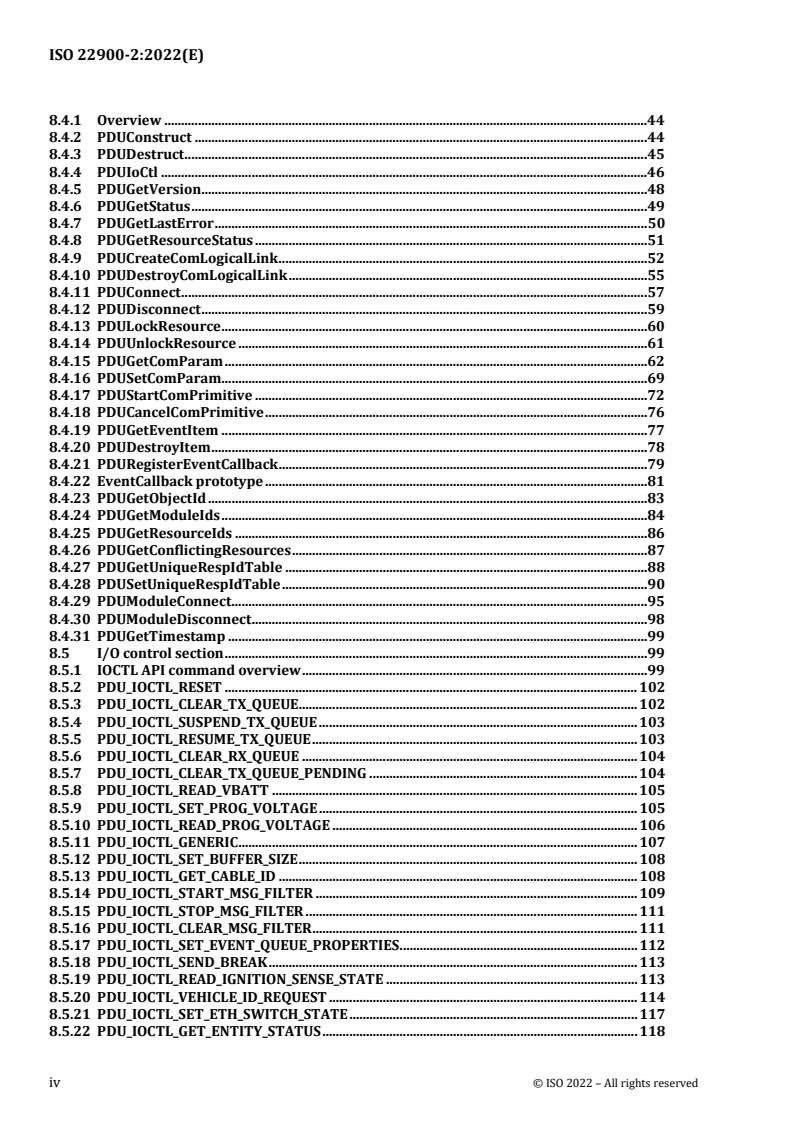
Contents Page
Foreword . vi
Introduction . vii
1 Scope . 1
2 Normative references . 1
3 Terms, definitions and abbreviated terms . 1
3.1 Terms and definitions . 2
3.2 Abbreviated terms . 3
4 Specification release version information . 6
4.1 Specification release version location . 6
4.2 Specification release version. 6
5 Modular VCI use cases . 6
5.1 OEM merger . 6
5.2 OEM cross vehicle platform ECU(s) . 6
5.3 Central source diagnostic data and exchange during ECU development . 7
5.4 OEM franchised dealer and aftermarket service outlet diagnostic tool support . 7
6 Modular VCI software architecture . 7
6.1 Overview . 7
6.2 Modular VCI D-Server software . 8
6.3 Runtime format based on ODX . 9
6.4 MVCI protocol module software . 9
6.5 MVCI protocol module configurations . 9
7 D-PDU API use cases . 10
7.1 Overview . 10
7.2 Use case 1: Single MVCI protocol module . 11
7.3 Use case 2: Multiple MVCI protocol modules supported by same D-PDU API
implementation . 12
7.4 Use case 3: Multiple MVCI protocol modules supported by different D-PDU API
implementations . 13
8 Diagnostic protocol data unit (D-PDU) API . 14
8.1 Software requirements . 14
8.1.1 General requirements . 14
8.1.2 Vehicle protocol requirements . 15
8.1.3 Timing requirements for protocol handler messages . 16
8.1.4 Serialization requirements for protocol handler messages . 17
8.1.5 Compatibility requirements . 19
8.1.6 Timestamp requirements . 19
8.2 API function overview and communication principles . 20
8.2.1 Terms used within the D-PDU API . 20
8.2.2 Function overview . 20
8.2.3 General usage . 21
8.2.4 Asynchronous and synchronous communication . 24
8.2.5 Usage of resource locking and resource unlocking . 25
8.2.6 Usage of ComPrimitives . 25
8.3 Tool integration . 42
8.3.1 Requirement for generic configuration. 42
8.3.2 Tool integrator — Use case . 42
8.4 API functions — Interface description . 44
8.4.1 Overview .44
8.4.2 PDUConstruct .44
8.4.3 PDUDestruct .45
8.4.4 PDUIoCtl .46
8.4.5 PDUGetVersion .48
8.4.6 PDUGetStatus .49
8.4.7 PDUGetLastError .50
8.4.8 PDUGetResourceStatus .51
8.4.9 PDUCreateComLogicalLink .52
8.4.10 PDUDestroyComLogicalLink .55
8.4.11 PDUConnect .57
8.4.12 PDUDisconnect .59
8.4.13 PDULockResource .60
8.4.14 PDUUnlockResource .61
8.4.15 PDUGetComParam .62
8.4.16 PDUSetComParam .69
8.4.17 PDUStartComPrimitive .72
8.4.18 PDUCancelComPrimitive .76
8.4.19 PDUGetEventItem .77
8.4.20 PDUDestroyItem .78
8.4.21 PDURegisterEventCallback .79
8.4.22 EventCallback prototype .81
8.4.23 PDUGetObjectId .83
8.4.24 PDUGetModuleIds .84
8.4.25 PDUGetResourceIds .86
8.4.26 PDUGetConflictingResources .87
8.4.27 PDUGetUniqueRespIdTable .88
8.4.28 PDUSetUniqueRespIdTable .90
8.4.29 PDUModuleConnect .95
8.4.30 PDUModuleDisconnect .98
8.4.31 PDUGetTimestamp .99
8.5 I/O control section .99
8.5.1 IOCTL API command overview .99
8.5.2 PDU_IOCTL_RESET . 102
8.5.3 PDU_IOCTL_CLEAR_TX_QUEUE. 102
8.5.4 PDU_IOCTL_SUSPEND_TX_QUEUE . 103
8.5.5 PDU_IOCTL_RESUME_TX_QUEUE . 103
8.5.6 PDU_IOCTL_CLEAR_RX_QUEUE . 104
8.5.7 PDU_IOCTL_CLEAR_TX_QUEUE_PENDING . 104
8.5.8 PDU_IOCTL_READ_VBATT . 105
8.5.9 PDU_IOCTL_SET_PROG_VOLTAGE . 105
8.5.10 PDU_IOCTL_READ_PROG_VOLTAGE . 106
8.5.11 PDU_IOCTL_GENERIC . 107
8.5.12 PDU_IOCTL_SET_BUFFER_SIZE . 108
8.5.13 PDU_IOCTL_GET_CABLE_ID . 108
8.5.14 PDU_IOCTL_START_MSG_FILTER . 109
8.5.15 PDU_IOCTL_STOP_MSG_FILTER . 111
8.5.16 PDU_IOCTL_CLEAR_MSG_FILTER . 111
8.5.17 PDU_IOCTL_SET_EVENT_QUEUE_PROPERTIES . 112
8.5.18 PDU_IOCTL_SEND_BREAK . 113
8.5.19 PDU_IOCTL_READ_IGNITION_SENSE_STATE . 113
8.5.20 PDU_IOCTL_VEHICLE_ID_REQUEST . 114
8.5.21 PDU_IOCTL_SET_ETH_SWITCH_STATE . 117
8.5.22 PDU_IOCTL_GET_ENTITY_STATUS . 118
iv © ISO 2022 – All rights reserved
8.5.23 PDU_IOCTL_GET_DIAGNOSTIC_POWER_MODE . 119
8.5.24 PDU_IOCTL_GET_ETH_PIN_OPTION . 120
8.5.25 PDU_IOCTL_TLS_SET_CERTIFICATE . 121
8.5.26 PDU_IOCTL_DOIP_GET_CURRENT_SESSION_MODE . 122
8.5.27 PDU_IOCTL_ISOBUS_GET_DETECTED_CFS . 123
8.6 API functions — Error handling . 123
8.6.1 Synchronous error handling . 123
8.6.2 Asynchronous error handling . 123
8.7 Installation . 124
8.7.1 Generic description . 124
8.7.2 Windows installation process . 124
8.7.3 Linux installation process . 125
8.7.4 Selecting MVCI protocol modules . 126
8.8 Application notes . 126
8.8.1 Interaction with the MDF . 126
8.8.2 Accessing additional hardware features for MVCI protocol modules . 126
8.8.3 Documentation and information provided by MVCI protocol module vendors . 126
9 Using the D-PDU API with existing applications . 127
9.1 SAE J2534-1 and RP1210a existing standards . 127
10 Data structures . 128
10.1 API functions — Data structure definitions . 128
10.1.1 Abstract basic data types . 128
10.1.2 Definitions . 129
10.1.3 Bit encoding for UNUM32 . 129
10.1.4 API data structures . 129
Annex A (normative) D-PDU API compatibility mappings . 145
Annex B (normative) D-PDU API standard ComParams and protocols . 146
Annex C (informative) D-PDU API manufacturer-specific ComParams and protocols . 235
Annex D (informative) D-PDU API constants . 237
Annex E (informative) Application defined tags . 253
Annex F (informative) RDF and MDF description files . 254
Annex G (informative) Resource handling scenarios . 325
Annex H (informative) D-PDU API partitioning . 331
Annex I (informative) Use case scenarios . 335
Annex J (informative) OBD protocol initialization . 376
Annex K (normative) DoIP implementation . 392
Annex L (normative) ISOBUS . 425
Bibliography . 433
Foreword
ISO (the International Organization for Standardization) is a worldwide federation of national standards
bodies (ISO member bodies). The work of preparing International Standards is normally carried out
through ISO technical committees. Each member body interested in a subject for which a technical
committee has been established has the right to be represented on that committee. International
organizations, governmental and non-governmental, in liaison with ISO, also take part in the work. ISO
collaborates closely with the International Electrotechnical Commission (IEC) on all matters of
electrotechnical standardization.
The procedures used to develop this document and those intended for its further maintenance are
described in the ISO/IEC Directives, Part 1. In particular, the different approval criteria needed for the
different types of ISO documents should be noted. This document was drafted in accordance with the
editorial rules of the ISO/IEC Directives, Part 2 (see www.iso.org/directives).
Attention is drawn to the possibility that some of the elements of this document may be the subject of
patent rights. ISO shall not be held responsible for identifying any or all such patent rights. Details of any
patent rights identified during the development of the document will be in the Introduction and/or on
the ISO list of patent declarations received (see www.iso.org/patents).
Any trade name used in this document is information given for the convenience of users and does not
constitute an endorsement.
For an explanation of the voluntary nature of standards, the meaning of ISO specific terms and
expressions related to conformity assessment, as well as information about ISO's adherence to the
World Trade Organization (WTO) principles in the Technical Barriers to Trade (TBT), see
www.iso.org/iso/foreword.html.
This document was prepared by Technical Committee ISO/TC 22, Road vehicles, Subcommittee SC 31,
Data communication.
This third edition cancels and replaces the second edition (ISO 22900-2:2017), which has been
technically revised.
The main changes are as follows:
— introduction of reference to ISO 15765-5 for CAN-FD;
— introduction of secured communication for the DoIP protocol based on TLS (as defined in
ISO 13400-2:2019);
— introduction of automatic DoIP reconnect handling;
— introduction of ISOBUS protocol.
A list of all parts in the ISO 22900 series can be found on the ISO website.
Any feedback or questions on this document should be directed to the user’s national standards body. A
complete listing of these bodies can be found at www.iso.org/members.html.
vi © ISO 2022 – All rights reserved
Introduction
The ISO 22900 series is applicable to vehicle electronic control module diagnostics and programming.
This document was established in order to more easily exchange software and hardware of vehicle
communication interfaces (VCIs) among diagnostic applications. It defines a generic and protocol
independent software interface towards the modular vehicle communication interface (MVCI) protocol
module, such that a diagnostic application based on this software interface can exchange the MVCI
protocol module or add a new MVCI protocol module with minimal effort. Today, the automotive
aftermarket requires flexible usage of different protocol modules for vehicles of different brands. Many
of today’s protocol modules are incompatible with regard to their hardware and software interface, such
that, depending on the brand, a different protocol module is required.
The objective of this document is to specify the diagnostic protocol data unit application programming
interface (D-PDU API) as a generic software interface and to provide a “plug and play” concept for access
onto different MVCI protocol modules from different tool manufacturers. The D-PDU API will address the
generic software interface, the protocol abstraction, its exchangeability, as well as the compatibility
towards existing standards such as SAE J2534-1 and RP1210a.
The implementation of the modular VCI concept facilitates co-existence and re-use of MVCI protocol
modules, especially in the aftermarket. As a result, diagnostic or programming applications can be
adapted for different vehicle communication interfaces and different vehicles with minimal effort, thus
helping to reduce overall costs for the tool manufacturer and end user.
Vehicle communication interfaces compliant with ISO 22900 series support a protocol-independent D-
PDU API as specified in this document.
INTERNATIONAL STANDARD ISO 22900-2:2022(E)
Road vehicles — Modular vehicle communication interface
(MVCI) —
Part 2:
Diagnostic protocol data unit (D-PDU API)
1 Scope
This document specifies the diagnostic protocol data unit application programming interface
(D-PDU API) as a modular vehicle communication interface (MVCI) protocol module software interface
and common basis for diagnostic and reprogramming software applications.
This document covers the descriptions of the application programming interface (API) functions and the
abstraction of diagnostic protocols, as well as the handling and description of MVCI protocol module
features. Sample MVCI module description files accompany this document.
The purpose of this document is to ensure that diagnostic and reprogramming applications from any
vehicle or tool manufacturer can operate on a common software interface and can easily exchange MVCI
protocol module implementations.
2 Normative references
The following documents are referred to in the text in such a way that some or all of their content
constitutes requirements of this document. For dated references, only the edition cited applies. For
undated references, the latest edition of the referenced document (including any amendments) applies.
SAE J2411, Single Wire CAN Network for Vehicle Applications
3 Terms, definitions and abbreviated terms
For the purposes of this document, the following terms and definitions apply.
ISO and IEC maintain terminology databases for use in standardization at the following addresses:
— ISO Online browsing platform: available at https://www.iso.org/obp
— IEC Electropedia: available at https://www.electropedia.org/
3.1 Terms and definitions
3.1.1
application
way of accessing the diagnostic protocol data unit application programming interface (D-PDU API)
Note 1 to entry: From the perspective of the D-PDU API, it does not make any difference whether an application
accesses the software interface directly or through an MVCI D-Server. Consequently, in this document, the term
“application” represents both ways of accessing the D-PDU API.
3.1.2
ComLogicalLink
logical communication channel towards a single electronic control unit (ECU) or towards multiple
electronic control units
3.1.3
COMPARAM-SPEC
protocol-specific set of predefined communication parameters (ComParams), the value of which can be
changed in the context of a layer or specific diagnostic service
Note 1 to entry: This part of the model can also contain OEM-specific ComParams.
3.1.4
ComPrimitive
smallest aggregation of a communication service or function
EXAMPLE A request message to be sent to an ECU.
3.1.5
Ethernet
physical network media type
3.1.6
local network
part of the network connected directly to the tester
Note 1 to entry: Also called “primary network” in some subclauses.
3.1.7
remote network
part of the network located behind a gateway connected to the tester
Note 1 to entry: Also called “secondary network” in some subclauses.
3.1.8
DoIP MVCI module
diagnostic communication over Internet Protocol modular vehicle communication interface
module
MVCI module able to handle connections to one or multiple DoIP entities (3.1.11)
3.1.9
DoIP gateway
diagnostic communication over Internet Protocol gateway
gateway connected to the tester via DoIP protocol
2 © ISO 2022 – All rights reserved
3.1.10
DoIP node
diagnostic communication over Internet Protocol node
ECU connected to the tester directly via DoIP protocol
Note 1 to entry: ECU has no gateway capabilities.
3.1.11
DoIP entity
diagnostic communication over Internet Protocol entity
general term for either a DoIP gateway (3.1.9) or a DoIP node (3.1.10)
3.1.12
DoIP entity certificate
certificate issued by an intermediate CA (3.1.13) to DoIP entity (3.1.11)
Note 1 to entry: It is presented during the TLS handshake to the external test equipment to verify the authenticity
of this DoIP entity.
3.1.13
intermediate CA
certificate authority which issues subordinal certificates
Note 1 to entry: A reason to issue subordinal certificates can be, for example to further to another intermediate
CA or DoIP entities (3.1.11).
3.1.14
intermediate certificate
certificate used by an intermediate CA (3.1.13)
Note 1 to entry: The intermediate certificate(s) is/are either stored in the external test equipment or are
presented during authentication together with the end node certificate to complete the chain of trust.
3.1.15
root CA
certificate authority (CA) acting as the root of trust
Note 1 to entry: Root CA typically issues intermediate certificates (3.1.14) to allow an intermediate CA (3.1.13) to
further submit certificates.
3.1.16
root certificate
certificate of the root CA (3.1.15) used as the trust anchor
Note 1 to entry: It is securely stored and used by all entities that wants to validate end node certificates [e.g. from
the DoIP entity (3.1.11)] together with all necessary intermediate certificates (3.1.14) in the chain of trust.
3.2 Abbreviated terms
API application programming interface
ASCII American Standard for Character Information Interchange
CA certificate authority
CAN controller area network
CAN IDs controller area network identifiers
CDF cable description file
CLL ComLogicalLink
ComLogicalLinks communication logical links
ComParam communication parameter
ComParamSpec communication parameter specification
ComPrimitive communication primitive
CRC cyclic redundancy check
DLC data link connector
DLL dynamic link library
DoIP diagnostic communication over Internet Protocol
D-PDU diagnostic protocol data unit
D-Server diagnostic server
ECU electronic control unit
HDD hard disk drive
HI differential line — high
HW Hardware
IEEE 1394 firewire serial bus
IFR in-frame response
IGN Ignition
IOCTL input/output control
IP Internet Protocol
IPv4 Internet Protocol version 4
IPv6 Internet Protocol version 6
K UART K-Line
KWP keyword protocol
L UART L-Line
LL Logical Link
4 © ISO 2022 – All rights reserved
LOW differential line — low
MDF module description file
MOST media oriented systems transport
MVCI modular vehicle communication interface
ODX open diagnostic data exchange
OEM original equipment manufacturer
OSI open systems interconnection
PC personal computer
PCI protocol control information
PGN parameter group number
PROGV programmable voltage
PWM pulse width modulation
RDF root description file
RX UART uni-directional receive
SCI serial communications interface
SCP standard corporate protocol
TCP transmission control protocol
TLS transport layer security
TX UART uni-directional transmit
UDS unified diagnostic services
UDSonCAN unified diagnostic services on CAN
UDSonIP unified diagnostic services on IP
USB universal serial bus
USDT unacknowledged segmented data transfer
UUDT unacknowledged un-segmented data transfer
VCI vehicle communication interface
VPW variable pulse width
XML extensible markup language
4 Specification release version information
4.1 Specification release version location
Specification release version information is contained in each modular VCI release document
specification under the same clause title “Specification release version information”. It is important to
check for feature support between modular VCI release specifications if the most recent API features shall
be implemented. The D-PDU API supports the reading of version information by the API function call
PDUGetVersion.
Release version information is also contained in the following files:
root description file (RDF);
module description file (MDF);
cable description file (CDF);
D-PDU API library file.
4.2 Specification release version
The specification release version of this document is 2.2.2.
5 Modular VCI use cases
5.1 OEM merger
In the past, several OEMs in the automotive industry have merged into one company.
All companies try to leverage existing (legacy) components and jointly develop new products, which are
common across different vehicle types and badges.
If OEMs already had modular VCI compliant test equipment, it would be simple to connect MVCI protocol
modules from merged OEMs into one chassis or device. All protocols would be supported by a single MVCI
protocol module configuration without any replacement of MVCI protocol module hardware at the dealer
site. The same applies for engineering and some of this concept might also work for production plants
(end of line).
5.2 OEM cross vehicle platform ECU(s)
OEMs specify requirements and design electronic systems to be implemented in multiple vehicle
platforms in order to avoid re-inventing a system for different vehicles. The majority of design, normal
operation and diagnostic data of an electronic system are re-used if installed in various vehicles. The
engineering development centres are located worldwide. A great amount of re-authoring of diagnostic
data is performed to support different engineering test tools.
Providing diagnostic data in an industry standard format like ODX and XML will avoid re-authoring into
various test tool specific formats at different system engineering locations. The D-PDU API supports this
re-use concept by fully abstracting vehicle protocols into the industry supported ComParam descriptions.
6 © ISO 2022 – All rights reserved
5.3 Central source diagnostic data and exchange during ECU development
Single source origin of diagnostic data (as depicted in Figure 1), combined with a verification and
feedback mechanism and distribution to the end users, is highly desirable in order to lower engineering
expenses. Engineering, manufacturing and service specify which protocol and data shall be implemented
in the ECU. This information will be documented in a structured format like XML. Furthermore, the same
structured data files can be used to setup the diagnostic engineering tools to verify proper
communication with the ECU and to perform functional verification and compliance testing of the ECU.
Once all quality goals are met, these structured data files shall be released to the OEM database. An Open
Diagnostic data eXchange (ODX) schema has been developed for the purpose of supporting these
structured formatted files used for ECU diagnosis and validation.
Figure 1 — Example of central source engineering diagnostic data process
5.4 OEM franchised dealer and aftermarket service outlet diagnostic tool support
The service shop uses the modular VCI hardware and software for vehicle diagnosis and enhanced
procedural testing. By using the same engineering, manufacturing and service functions as those used for
individual ECU testing, the reliability of the data is maintained. A modular VCI protocol module can be
used with any PC (handheld or stationary) and can be utilized as an embedded device.
6 Modular VCI software architecture
6.1 Overview
The modular VCI concept is mainly based on three software components (see Figure 2):
MVCI D-Server software;
runtime data based on ODX;
MVCI protocol module software.
The application accesses the MVCI D-Server through the MVCI D-Server API. The D-Server obtains all
required information about the ECU(s) out of the ODX runtime data. Using the ODX runtime data
information, the D-Server converts the application’s request into a byte stream, which is called a
diagnostic protocol data unit (D-PDU). The D-PDU is handed over to the MVCI protocol module through
the D-PDU API. The MVCI protocol module transmits the D-PDU to the vehicle’s ECU(s). The other way
around, the MVCI protocol module receives the vehicle’s response(s) and reports the response data to
the D-Server. Again, using the ODX runtime data, the D-Server interprets the D-PDU and provides the
interpreted symbolic information to the application.
Figure 2 — MVCI software architecture
The grey shading of symbols indicates reference to the following International Standards:
ODX: ISO 22901-1;
D-Server API: ISO 22900-3;
D-PDU API: ISO 22900-2;
MVCI protocol module: ISO 22900-1.
6.2 Modular VCI D-Server software
The MVCI D-Server is accessible through the MVCI D-Server API. By accessing this API, the application
may browse the available features for each ECU and initiate a request towards an ECU using simple
symbolic expressions. If the request requires input parameters, they can be specified using symbolic
8 © ISO 2022 – All rights reserved
expressions as well. The MVCI D-server takes the symbolic request, including input parameters, and
converts them into a diagnostic request message as defined at the protocol level. The diagnostic request
message represents the diagnostic protocol data unit (D-PDU) as passed to the MVCI protocol module
through the D-PDU API. Vice versa, the D-Server converts diagnostic response messages as retrieved from
the MVCI protocol module back to symbolic information and provides it to the application.
For a detailed description and the complete MVCI D-Server API definition, see ISO 22900-3.
Mapping of D-PDU API and D-Server API is specified in Annex A.
6.3 Runtime format based on ODX
For every conversion from symbolic requests to diagnostic request messages, and vice versa for
responses, the MVCI D-Server obtains the required information from the runtime database. The database
defines the structure of every diagnostic request and response as supported by an ECU. The database
defines byte and bit positions, width and type of every input and output parameter.
Even though the MVCI D-Server obtains its information from a runtime database, the runtime database
and format are not specified by the MVCI standard. Instead, the MVCI standard defines an exchange
format to import and export the ECU description across OEMs and tool suppliers. The runtime format is
left up to the system designers.
The exchange format is called open diagnostic data exchange format (ODX format). For a detailed
description, see ISO 22901-1.
Mapping of D-PDU API and ODX is specified in Annex A.
6.4 MVCI protocol module software
The MVCI protocol module is accessible through the D-PDU API. The application issues diagnostic
requests through the D-PDU API. The MVCI protocol module takes the request D-PDU and transmits it to
the vehicle’s ECU(s) according to the vehicle communication protocol. Header type, checksum
information and D-PDU segmentation depend on the vehicle communication protocol and shall be
handled transparently by the MVCI protocol module. Also, the MVCI protocol module observes the timing
between message frames and requests and responses on the physical interfaces. After completion, the
MVCI protocol module simply shall deliver the response back to the application or report an error
condition.
6.5 MVCI protocol module configurations
The D-PDU API and MVCI protocol modules work in many configurations. A MVCI D-Server is not
required as the application interface to the D-PDU API.
Figure 3 shows two such configurations to point out the differences.
Key
A application with MVCI D-Server
B application without MVCI D-Server
NOTE From the perspective of the D-PDU API, it does not make a difference whether an application accesses
the software interface directly or through an MVCI D-Server. Consequently, in this document, the term “application”
represents both ways of accessing the D-PDU API.
Figure 3 — MVCI configurations
7 D-PDU API use cases
7.1 Overview
The MVCI protocol module is the key component to exchange implementations of diagnostic protocols
among OEMs and tool suppliers without re-engineering already implemented software. By relying on the
D-PDU API, the application may easily access other or additional MVCI protocol module implementations.
In a similar way to existing standards such as SAE J2534-1 and RP1210a, applications compliant to the
MVCI standard are basically independent of the underlying device as long as the required physical
interface is supported and no tool supplier specific feature is required.
Even though the D-PDU API extends the capabilities beyond the definitions of SAE J2534-1 and RP1210a,
the existing standards and their related devices and applications do not become obsolete by introducing
the D-PDU API. Instead, the transition and co-existence of all standards are facilitated to save
development and investment costs. The definition of the D-PDU API is closely related to SAE J2534-1 and
RP1210a to allow mapping of functionality in both directions. However, it extends their definitions to
cover the full width of enhanced diagnostics.
10 © ISO 2022 – All rights reserved
The fulfilment of the following use cases is crucial for the inter-exchange of protocol module
implementations according to MVCI, SAE J2534-1 and RP1210a.
NOTE In the use case figures (see Figures 4 to 6), the grey boxes suggest a specific software component
architecture. This representation is not intended to be construed as the only possible architectural solution.
Depending on the situation, there can be more software components or fewer software components.
7.2 Use case 1: Single MVCI protocol module
The single MVCI protocol module configuration (see Figure 4) is the simplest configuration where the D-
PDU API implementation and the MVCI protocol module hardware are obtained from the same vendor.
The application will access the single MVCI protocol module through a single D-PDU API. Parallel access
onto multiple D-PDU APIs is not required. Resource handling is completely covered inside the D-PDU API
implementation.
This use case applies to basically all stand-alone MVCI protocol module device configurations.
Figure 4 — MVCI configuration with single MVCI protocol module
7.3 Use case 2: Multiple MVCI protocol modules supported by same D-PDU API
implementation
There are different configurations with multiple MVCI protocol modules
...
Questions, Comments and Discussion
Ask us and Technical Secretary will try to provide an answer. You can facilitate discussion about the standard in here.
Loading comments...