


ISO/IEC 11179-5:2005
(Main)Information technology — Metadata registries (MDR) — Part 5: Naming and identification principles
Information technology — Metadata registries (MDR) — Part 5: Naming and identification principles
ISO/IEC 11179-5:2005 provides instruction for naming and identification of the following administered items: data element concept, conceptual domain, data element, and value domain. It describes the parts and structure of identification. Identification is narrowly defined to encompass only the means to establish unique identification of these administered items within a register. It describes naming in an MDR; includes principles and rules by which naming conventions can be developed; and describes example naming conventions. The naming principles and rules described in ISO/IEC 11179-5:2005 apply primarily to names of data element concepts, conceptual domains, data elements, and value domains.
Technologies de l'information — Registres de métadonnées (RM) — Partie 5: Principes de dénomination et d'identification
General Information
- Status
- Withdrawn
- Publication Date
- 18-Sep-2005
- Withdrawal Date
- 18-Sep-2005
- Technical Committee
- ISO/IEC JTC 1/SC 32 - Data management and interchange
- Drafting Committee
- ISO/IEC JTC 1/SC 32/WG 2 - MetaData
- Current Stage
- 9599 - Withdrawal of International Standard
- Start Date
- 18-Mar-2015
- Completion Date
- 14-Feb-2026
Relations
- Effective Date
- 10-Feb-2026
- Effective Date
- 06-Jun-2022
- Effective Date
- 03-Sep-2011
- Effective Date
- 15-Apr-2008
Get Certified
Connect with accredited certification bodies for this standard

BSI Group
BSI (British Standards Institution) is the business standards company that helps organizations make excellence a habit.

NYCE
Mexican standards and certification body.
Sponsored listings
Frequently Asked Questions
ISO/IEC 11179-5:2005 is a standard published by the International Organization for Standardization (ISO). Its full title is "Information technology — Metadata registries (MDR) — Part 5: Naming and identification principles". This standard covers: ISO/IEC 11179-5:2005 provides instruction for naming and identification of the following administered items: data element concept, conceptual domain, data element, and value domain. It describes the parts and structure of identification. Identification is narrowly defined to encompass only the means to establish unique identification of these administered items within a register. It describes naming in an MDR; includes principles and rules by which naming conventions can be developed; and describes example naming conventions. The naming principles and rules described in ISO/IEC 11179-5:2005 apply primarily to names of data element concepts, conceptual domains, data elements, and value domains.
ISO/IEC 11179-5:2005 provides instruction for naming and identification of the following administered items: data element concept, conceptual domain, data element, and value domain. It describes the parts and structure of identification. Identification is narrowly defined to encompass only the means to establish unique identification of these administered items within a register. It describes naming in an MDR; includes principles and rules by which naming conventions can be developed; and describes example naming conventions. The naming principles and rules described in ISO/IEC 11179-5:2005 apply primarily to names of data element concepts, conceptual domains, data elements, and value domains.
ISO/IEC 11179-5:2005 is classified under the following ICS (International Classification for Standards) categories: 35.040 - Information coding; 35.040.50 - Automatic identification and data capture techniques. The ICS classification helps identify the subject area and facilitates finding related standards.
ISO/IEC 11179-5:2005 has the following relationships with other standards: It is inter standard links to EN 62656-1:2015, ISO 13803:2014, ISO/IEC 11179-5:2015, ISO/IEC 11179-5:1995. Understanding these relationships helps ensure you are using the most current and applicable version of the standard.
ISO/IEC 11179-5:2005 is available in PDF format for immediate download after purchase. The document can be added to your cart and obtained through the secure checkout process. Digital delivery ensures instant access to the complete standard document.
Standards Content (Sample)
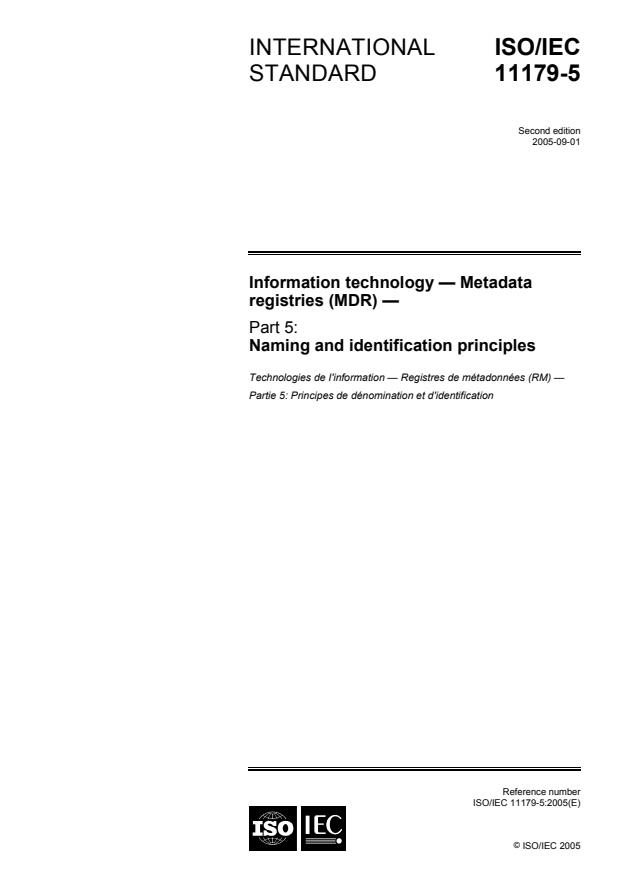
INTERNATIONAL ISO/IEC
STANDARD 11179-5
Second edition
2005-09-01
Information technology — Metadata
registries (MDR) —
Part 5:
Naming and identification principles
Technologies de I'information — Registres de métadonnées (RM) —
Partie 5: Principes de dénomination et d'identification
Reference number
©
ISO/IEC 2005
PDF disclaimer
This PDF file may contain embedded typefaces. In accordance with Adobe's licensing policy, this file may be printed or viewed but
shall not be edited unless the typefaces which are embedded are licensed to and installed on the computer performing the editing. In
downloading this file, parties accept therein the responsibility of not infringing Adobe's licensing policy. The ISO Central Secretariat
accepts no liability in this area.
Adobe is a trademark of Adobe Systems Incorporated.
Details of the software products used to create this PDF file can be found in the General Info relative to the file; the PDF-creation
parameters were optimized for printing. Every care has been taken to ensure that the file is suitable for use by ISO member bodies. In
the unlikely event that a problem relating to it is found, please inform the Central Secretariat at the address given below.
© ISO/IEC 2005
All rights reserved. Unless otherwise specified, no part of this publication may be reproduced or utilized in any form or by any means,
electronic or mechanical, including photocopying and microfilm, without permission in writing from either ISO at the address below or
ISO's member body in the country of the requester.
ISO copyright office
Case postale 56 • CH-1211 Geneva 20
Tel. + 41 22 749 01 11
Fax + 41 22 749 09 47
E-mail copyright@iso.org
Web www.iso.org
Published in Switzerland
ii © ISO/IEC 2005 – All rights reserved
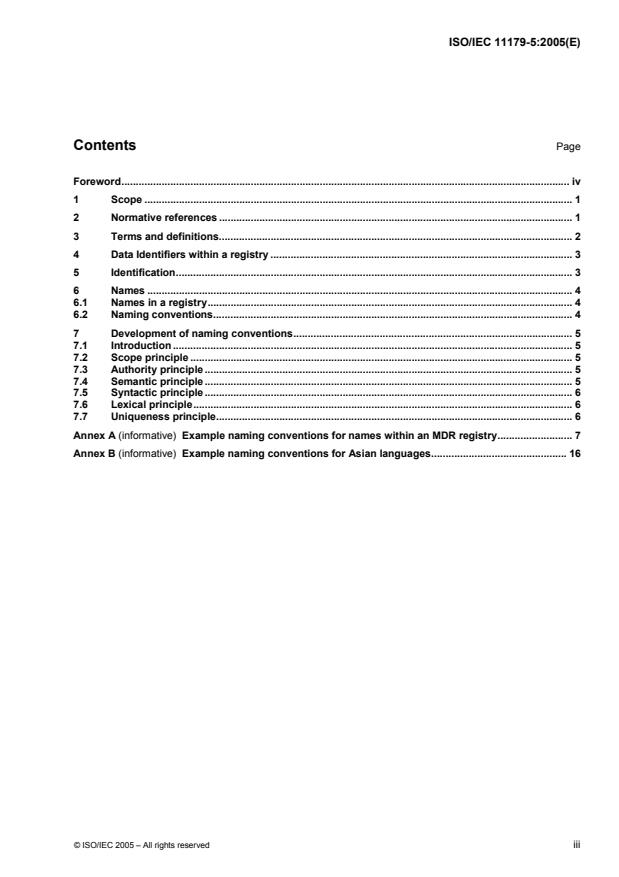
Contents Page
Foreword. iv
1 Scope. 1
2 Normative references. 1
3 Terms and definitions. 2
4 Data Identifiers within a registry . 3
5 Identification. 3
6 Names. 4
6.1 Names in a registry. 4
6.2 Naming conventions. 4
7 Development of naming conventions. 5
7.1 Introduction. 5
7.2 Scope principle. 5
7.3 Authority principle. 5
7.4 Semantic principle. 5
7.5 Syntactic principle. 6
7.6 Lexical principle. 6
7.7 Uniqueness principle. 6
Annex A (informative) Example naming conventions for names within an MDR registry. 7
Annex B (informative) Example naming conventions for Asian languages. 16
© ISO/IEC 2005 – All rights reserved iii
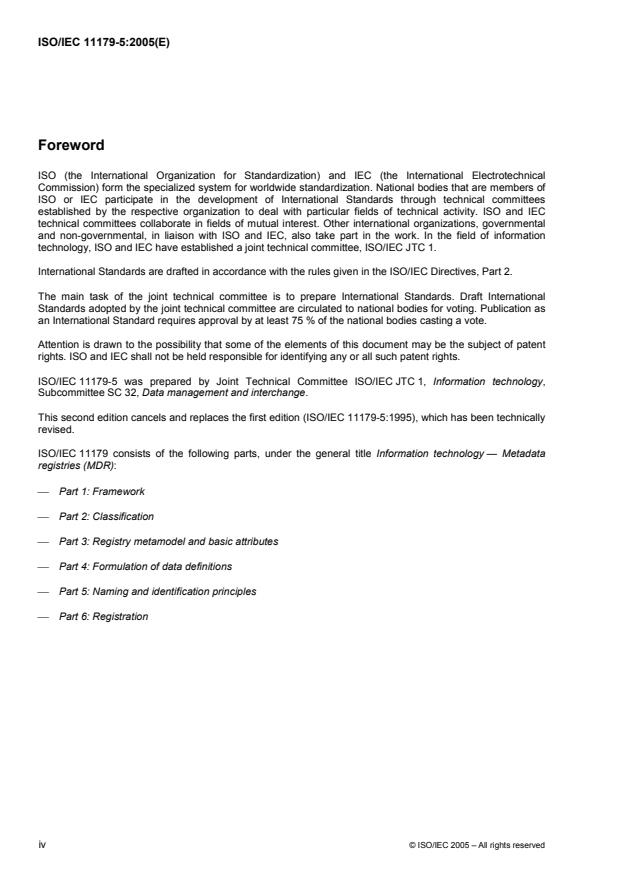
Foreword
ISO (the International Organization for Standardization) and IEC (the International Electrotechnical
Commission) form the specialized system for worldwide standardization. National bodies that are members of
ISO or IEC participate in the development of International Standards through technical committees
established by the respective organization to deal with particular fields of technical activity. ISO and IEC
technical committees collaborate in fields of mutual interest. Other international organizations, governmental
and non-governmental, in liaison with ISO and IEC, also take part in the work. In the field of information
technology, ISO and IEC have established a joint technical committee, ISO/IEC JTC 1.
International Standards are drafted in accordance with the rules given in the ISO/IEC Directives, Part 2.
The main task of the joint technical committee is to prepare International Standards. Draft International
Standards adopted by the joint technical committee are circulated to national bodies for voting. Publication as
an International Standard requires approval by at least 75 % of the national bodies casting a vote.
Attention is drawn to the possibility that some of the elements of this document may be the subject of patent
rights. ISO and IEC shall not be held responsible for identifying any or all such patent rights.
ISO/IEC 11179-5 was prepared by Joint Technical Committee ISO/IEC JTC 1, Information technology,
Subcommittee SC 32, Data management and interchange.
This second edition cancels and replaces the first edition (ISO/IEC 11179-5:1995), which has been technically
revised.
ISO/IEC 11179 consists of the following parts, under the general title Information technology — Metadata
registries (MDR):
Part 1: Framework
Part 2: Classification
Part 3: Registry metamodel and basic attributes
Part 4: Formulation of data definitions
Part 5: Naming and identification principles
Part 6: Registration
iv © ISO/IEC 2005 – All rights reserved
INTERNATIONAL STANDARD ISO/IEC 11179-5:2005(E)
Information technology — Metadata registries (MDR) —
Part 5:
Naming and identification principles
1 Scope
This part of ISO/IEC 11179 provides instruction for naming and identification of the following administered
items: data element concept, conceptual domain, data element, and value domain. It describes the parts and
structure of identification. Identification is narrowly defined to encompass only the means to establish unique
identification of these administered items within a register. It describes naming in an MDR; includes principles
and rules by which naming conventions can be developed; and describes example naming conventions. The
naming principles and rules described herein apply primarily to names of data element concepts, conceptual
domains, data elements, and value domains. When "administered item" is used in this part of ISO/IEC 11179,
it is understood to refer specifically to these four items. This part of ISO/IEC 11179 should be used in
conjunction with those that establish rules and procedures for attributing, classifying, defining, and registering
administered items.
In Annex A, all of the examples are given with English terminologies. However, there is an intention that those
rules be effective in other national languages, even in those languages that use ideographs such as Japanese,
Chinese, or Korean, when the terminologies used in the name are controlled properly. Annex B contains a
version of the rules for Asian languages.
It is out of scope of the naming rules to establish semantic equivalence of the naming among different
languages. Naming must be supplemented by other methods such as ontologies or controlled vocabularies in
establishing semantic equivalence.
2 Normative references
The following referenced documents are indispensable for the application of this document. For dated
references, only the edition cited applies. For undated references, the latest edition of the referenced
document (including any amendments) applies.
ISO/IEC 11179-1, Information technology — Metadata registries (MDR) — Part 1: Framework
1)
ISO/IEC 11179-2, Information technology — Metadata registries (MDR) — Part 2: Classification
ISO/IEC 11179-3, Information technology — Metadata registries (MDR) — Part 3: Registry metamodel and
basic attributes
ISO/IEC 11179-6, Information technology — Metadata registries (MDR) — Part 6: Registration
1) To be published. Revision of ISO/IEC 11179-2:2000
© ISO/IEC 2005 – All rights reserved 1
3 Terms and definitions
For the purposes of this document, the terms and definitions given in ISO/IEC 11179-1, ISO/IEC 11179-2,
ISO/IEC 11179-3, ISO/IEC 11179-6, and the following apply.
3.1
administered item
registry item for which administrative information is recorded in an Administration Record
[ISO/IEC 11179-3:2003]
3.2
context
universe of discourse in which a name or definition is used
[ISO/IEC 11179-3:2003]
3.3
lexical
pertaining to words or the vocabulary of a language as distinguished from its grammar and construction
3.4
name
designation of an object by a linguistic expression
[ISO/IEC 11179-3:2003]
3.5
name part
part of name
discrete term that is used as part of a name of an administered item
3.6
naming convention
set of rules for creating names and their associations
3.7
object class term
part of the name of an administered item which represents the object class to which it belongs, for those
administered items containing object classes
3.8
principle
fundamental, primary assertion which constitutes a source of action determining particular objectives or
results
NOTE A principle is usually supported through one or more rules.
3.9
property term
part of the name of an administered item that expresses a property of an object class, for those administered
items containing property classes
3.10
qualifier term
word or words that differentiate a concept
3.11
representation term
designation of an instance of a representation class
2 © ISO/IEC 2005 – All rights reserved
3.12
rule
statement governing conduct, procedure, conditions and/or relations
3.13
semantics
branch of linguistic science that deals with the meanings of words
3.14
separator
symbol or space enclosing or separating a part within a name; a delimiter
3.15
structure set
concepts in an area of discourse, with their relationships to other concepts; examples include data models,
taxonomies, and ontologies
3.16
syntax
relationships among characters or groups of characters, independent of their meanings or the manner of their
interpretation and use; the structure of expressions in a language, and the rules governing the structure of a
language
4 Data Identifiers within a registry
Each administered item shall have a unique data identifier within the register of a Registration Authority.
The combination of registration authority identifier, data identifier, and version identifier shall constitute a
unique identification of an administered item. See ISO/IEC 11179-6 for detailed information.
A data identifier is assigned for any administered item that is registered. Concurrently, or thereafter, the
administered item may be
classified according to ISO/IEC 11179-2,
specified according to ISO/IEC 11179-3:2003,
defined according to ISO/IEC 11179-4,
named according to ISO/IEC 11179-5, and
registered according to ISO/IEC 11179-6.
5 Identification
The registration authority identifier (RAI), data identifier (DI), and version identifier (VI) constitute the
international registration data identifier (IRDI). An IRDI is required for an administered item. Data identifiers
are assigned by a Registration Authority; data identifiers shall be unique within the domain of a Registration
Authority. Requirements for a Registration Authority, and a discussion of the IRDI, appear in ISO/IEC 11179-6.
As each Registration Authority may determine its own DI assignment scheme, there is no guarantee that the
DI by itself will uniquely identify an administered item. For example, if two RAs both use sequential 6-digit
numbers, there may be two administered items with the same DI's; however, the administered items will
almost certainly not be the same. Both the DI and the RAI are necessary for identification of an administered
item.
© ISO/IEC 2005 – All rights reserved 3
If particular attributes of an administered item change, then a new version of the administered item shall be
created and registered. The registrar shall determine these attributes. In such a case, a VI is required to
complete the unique identification of an administered item. For further guidance, see ISO/IEC 11179-6.
An IRDI can serve as a key when exchanging data among information systems, organizations, or other parties
who wish to share a specific administered item, but might not utilize the same names or contexts.
ISO/IEC 11179 does not specify the format or content of a unique DI.
6 Names
6.1 Names in a registry
An administered item shall have at least one name within a registry of a Registration Authority. If there are
other names by which the administered item is known, preferred names may be identified. Any administered
item in the Registry can be subject to naming conventions. The annexes show examples of naming
conventions applied to several administered items. Others can be developed by extension of the Principles.
An administered item shall have at least one name within a context. See ISO/IEC 11179-3 for detailed
information.
6.2 Naming conventions
Each name for an administered item is specified within a context. A naming convention describes what is
known about how names are formulated. A naming convention may be simply descriptive; e.g., where the
Registration Authority has no control over the formulation of names for a specific context and merely registers
names that already exist. Alternatively, a naming convention may be prescriptive, specifying how names shall
be formulated, with the Registration Authority (or an equivalent authority) expected to enforce compliance with
the naming convention. The objectives of a prescriptive naming convention may include name consistency,
name appearance, and name semantics. An effective naming convention can also enforce the exclusion of
irrelevant facts about the administered item from the name, such as the input source of a data element or its
field position in a file.
A naming convention may be specified in a reference document. A naming convention shall cover all relevant
documentation aspects. This includes, as applicable,
the scope of the naming convention, e.g. established industry name;
the authority that establishes names;
semantic rules governing the source and content of the terms used in a name, e.g. terms derived from
data models, terms commonly used in the discipline, etc.;
syntactic rules covering required term order;
lexical rules covering controlled term lists, name length, character set, language;
a rule establishing whether or not names must be unique.
4 © ISO/IEC 2005 – All rights reserved
7 Development of naming conventions
7.1 Introduction
This clause lists principles used to develop a naming convention. Rules are derived from the principles; these
rules form a naming convention. Syntactic, semantic and lexical rules vary by organizations such as
corporations or standards-setting bodies for business sectors; each can establish rules for name formation
within its context(s). Annexes A and B contain examples of rules for naming conventions that are consistent
with the principles presented in this clause.
Descriptive naming conventions may be applied to administered items which are not under the control of the
Registration Authority for the registry, or other authority previous to entry in the registry. At a minimum, the
rules for scope and authority should be documented. As appropriate, the semantic, syntactic, lexical, and
uniqueness rules may be recorded.
In addition to the scope and authority rules needed to document descriptive naming conventions, prescriptive
conventions should be documented by semantic, syntactic, lexical, and uniqueness rules.
Semantic rules enable meaning to be conveyed.
Syntactic rules relate items in a consistent, specified order.
Lexical (word form and vocabulary) rules reduce redundancy and increase precision.
A uniqueness rule documents how to prevent homonyms occurring within the scope of the naming
convention.
The examples in Annex A show how the names of each of the administered items can be formed from a set of
items selected from sets of available terms for the naming convention. (The names of other administered
items may be formed by rules based on those described in this part of ISO/IEC 11179.) The names of these
items can be developed from the names of the administered items from which they are composed, each
assigned meaning (semantics) and relative or absolute position (syntax) within a name. They may, but need
not, be delimited by a separator symbol. The names may be subject to lexical rules. An authority, e.g., a data
manager within a corporation or an approving committee for an international business sector naming standard,
should control the set or range of values of each item.
7.2 Scope principle
The scope of a naming convention specifies the range within which it is in effect. In terms of the MDR, the
scope of a naming convention may be as broad or narrow as the Registration Authority, or other authority,
determines is appropriate. The scope should document whether the naming convention is descriptive or
prescriptive.
The scope of each naming convention represented in the MDR shall be documented.
7.3 Authority principle
Identification of the authority that assigns names or enforces the naming convention is necessary for full
documentation of the naming convention.
The Authority of each naming convention represented in the MDR shall be documented.
7.4 Semantic principle
Semantics concerns the meanings of name parts and possibly separators that delimit them. The set of
semantic rules documents whether or not names convey meaning, and if so, how.
© ISO/IEC 2005 – All rights reserved 5
Name parts may be derived from structure sets that identify relationships among (classify) members. See
Annex A for examples of semantic rule sets.
The semantic rules of each naming convention represented in the MDR should be documented.
7.5 Syntactic principle
Syntax specifies the arrangement of parts within a name. The arrangement may be specified as relative or
absolute, or some combination of the two.
Relative arrangement specifies parts in terms of other parts, e.g., a rule within a convention might require that
a qualifier term must always appear before the part being qualified appears.
Absolute arrangement specifies a fixed occurrence of the part, e.g., a rule might require that the property term
is always the last part of a name.
The syntactic rules of each naming convention represented in the MDR should be documented.
See Annex A for examples of syntactic rule sets.
7.6 Lexical principle
Lexical issues concern the appearance of names: preferred and non-preferred terms, synonyms,
abbreviations, part length, spelling, permissible character set, case sensitivity, etc. The result of applying
lexical rules should be that all names governed by a specific naming convention have a consistent
appearance.
The lexical rules of each naming convention represented in the MDR should be documented.
See Annex A for examples of lexical rule sets.
7.7 Uniqueness principle
There may or may not be requirements for names to be unique within their scope. The uniqueness rules for
names represented in the MDR should be documented.
6 © ISO/IEC 2005 – All rights reserved
Annex A
(informative)
Example naming conventions for names within an MDR registry
A.1 General
The rules are derived from the principles described in clause 7. Examples are included. They show the
formation of names within registries, and may be applied to the development of names within contexts at the
discretion of the subject area authority. The complete process produces a data element name; other
administered item names are developed during the process.
These examples are written as American English. Users of other languages may specify different or additional
semantic, syntactic and lexical rules as needed to customize naming conventions to their languages. For
example, a rule citing an authority for spelling words within terms might be added to the lexical rules. Annex B
shows examples in Asian languages.
A.2 Semantics of name parts
Name parts consist of discrete terms. The terms in this annex are derived from administered items in the MDR
metamodel described in ISO/IEC 11179-3. These are: object class terms, property terms, representation
terms, and qualifier terms. As these terms are optional in the MDR metamodel, they are presented as
examples of the application of semantic principles to name formation.
Object class term
In the MDR metamodel, an object class is a set of ideas, abstractions or things in the real world that are
identified with explicit boundaries and meaning, and w
...
Questions, Comments and Discussion
Ask us and Technical Secretary will try to provide an answer. You can facilitate discussion about the standard in here.
Loading comments...