

ISO 5778:1998
(Main)Ships and marine technology — Small weathertight steel hatches
General Information
- Abstract
This International Standard specifies the main dimensions, location and number of fittings, materials and quality of manufacture for small weathertight steel hatches for application on board ships in order to ensure interchangeability of the hatches. The remaining dimensions are left to the manufacturer. The hatches are suitable for loading operations and for giving access to storage compartments and dry cargo holds. The hatches are not suitable as an access to any kind of tanks and shall not be used as escape hatches. These hatches generally conform to the requirements of the International Convention on Load Lines 1966 (LLC66). The possibility for application in position 1 and position 2 has to be considered for each situation and, where necessary, the hatch covers shall be provided with additional stiffening. NOTE — Users of this International Standard should note that while observing the requirements of this standard, they should, at the same time, ensure compliance with such statutory requirements, rules and regulations as may be applicable to the individual ship concerned.
- Status
- Published
- Publication Date
- 26-Aug-1998
- Technical Committee
- ISO/TC 8/SC 8 - Ship design
- Drafting Committee
- ISO/TC 8/SC 8 - Ship design
- Current Stage
- 9093 - International Standard confirmed
- Start Date
- 15-Apr-2026
- Completion Date
- 29-Aug-2026
Overview
ISO 5778:1998 - Ships and marine technology - Small weathertight steel hatches - defines standard dimensions, materials and manufacture quality for small weathertight steel hatches used on board ships. The standard ensures interchangeability of hatch covers intended for loading operations and access to storage compartments and dry cargo holds. It also requires compliance with applicable statutory rules (for example, the International Convention on Load Lines 1966, LLC66) and leaves non‑critical dimensions to the manufacturer.
Key topics and technical requirements
- Nominal sizes: Standard nominal sizes include 630×630, 630×830, 830×630, 830×830, 1030×1030 and 1330×1330 mm, based on inside coaming dimensions.
- Coaming and cover geometry: Upper coaming detail, corner shapes (square or rounded) and edge chamfering/rounding to protect the hatch seal.
- Cover plate: Specific cover plate dimensions with larger plates (>830×830 mm) requiring additional stiffening in line with Load Lines Regulation 16(2).
- Hatch seal: Resilient seal cross-section of 45×20 mm; initial compression allowed 2 mm and maximum compression limited to 4 mm using a depth stop.
- Fittings and fastenings:
- Two hinges per hatch with oval holes to allow seal compression.
- Closing devices using toggle bolts and wing nuts; wing nuts sized for single-person tightening without tools.
- Toggle bolt threads to conform to ISO 262 (metric screw thread sizes).
- Materials:
- Coamings, covers and primary fittings: weldable steel with minimum tensile strength of 340 N/mm² (shipbuilding quality).
- Toggle bolts and pins: corrosion‑resistant materials, minimum tensile strength 350 N/mm².
- Seal material suitable for marine service with durable sealing/resealing properties.
- Manufacture & finish: Components must be free from distortion and sharp edges; blast cleaning and priming are required to inhibit corrosion.
- Weathertightness testing: Completed hatch assembly installed on board must pass a hose test or equivalent to the satisfaction of the regulatory representative.
- Designation: Example - "Hatch ISO 5778 - 830 × 630".
Applications and users
ISO 5778 is directly useful for:
- Shipbuilders and shipyards specifying or manufacturing small weathertight steel hatches.
- Naval architects and marine designers detailing hatchways, coamings and cover fittings.
- Hatch manufacturers and suppliers seeking interchangeable, standardized hatch designs.
- Classification societies, flag state inspectors and regulatory authorities for conformity checks and weathertightness tests.
- Maintenance and repair yards specifying replacement hatches or retrofits.
Note: These hatches are not suitable for tank access or escape hatches.
Related standards
- ISO 262 - general-purpose metric screw threads (referenced for toggle bolt and wing nut threads).
- International Convention on Load Lines 1966 (LLC66) - referenced for load line and stiffening requirements.
Keywords: ISO 5778:1998, small weathertight steel hatches, shipbuilding, hatch dimensions, coaming, hatch seal, weathertightness testing, LLC66, marine technology.
Relations
- Effective Date
- 06-Jun-2022
- Effective Date
- 15-Apr-2008
Get Certified
Connect with accredited certification bodies for this standard

DNV
DNV is an independent assurance and risk management provider.

Lloyd's Register
Lloyd's Register is a global professional services organisation specialising in engineering and technology.

FSC International
Forest Stewardship Council certification.
Sponsored listings
Frequently Asked Questions
ISO 5778:1998 is a standard published by the International Organization for Standardization (ISO). Its full title is "Ships and marine technology — Small weathertight steel hatches". This standard covers: This International Standard specifies the main dimensions, location and number of fittings, materials and quality of manufacture for small weathertight steel hatches for application on board ships in order to ensure interchangeability of the hatches. The remaining dimensions are left to the manufacturer. The hatches are suitable for loading operations and for giving access to storage compartments and dry cargo holds. The hatches are not suitable as an access to any kind of tanks and shall not be used as escape hatches. These hatches generally conform to the requirements of the International Convention on Load Lines 1966 (LLC66). The possibility for application in position 1 and position 2 has to be considered for each situation and, where necessary, the hatch covers shall be provided with additional stiffening. NOTE — Users of this International Standard should note that while observing the requirements of this standard, they should, at the same time, ensure compliance with such statutory requirements, rules and regulations as may be applicable to the individual ship concerned.
This International Standard specifies the main dimensions, location and number of fittings, materials and quality of manufacture for small weathertight steel hatches for application on board ships in order to ensure interchangeability of the hatches. The remaining dimensions are left to the manufacturer. The hatches are suitable for loading operations and for giving access to storage compartments and dry cargo holds. The hatches are not suitable as an access to any kind of tanks and shall not be used as escape hatches. These hatches generally conform to the requirements of the International Convention on Load Lines 1966 (LLC66). The possibility for application in position 1 and position 2 has to be considered for each situation and, where necessary, the hatch covers shall be provided with additional stiffening. NOTE — Users of this International Standard should note that while observing the requirements of this standard, they should, at the same time, ensure compliance with such statutory requirements, rules and regulations as may be applicable to the individual ship concerned.
ISO 5778:1998 is classified under the following ICS (International Classification for Standards) categories: 47.020.10 - Hulls and their structure elements. The ICS classification helps identify the subject area and facilitates finding related standards.
ISO 5778:1998 has the following relationships with other standards: It is inter standard links to ISO 22827-1:2005, ISO 5778:1979. Understanding these relationships helps ensure you are using the most current and applicable version of the standard.
ISO 5778:1998 is available in PDF format for immediate download after purchase. The document can be added to your cart and obtained through the secure checkout process. Digital delivery ensures instant access to the complete standard document.
Standards Content (Sample)
INTERNATIONAL ISO
STANDARD 5778
Second edition
1998-08-15
Ships and marine technology — Small
weathertight steel hatches
Navires et technologie maritime — Petits panneaux en acier, étanches aux
intempéries
A
Reference number
Foreword
ISO (the International Organization for Standardization) is a worldwide federation of national standards bodies (ISO
member bodies). The work of preparing International Standards is normally carried out through ISO technical
committees. Each member body interested in a subject for which a technical committee has been established has
the right to be represented on that committee. International organizations, governmental and non-governmental, in
liaison with ISO, also take part in the work. ISO collaborates closely with the International Electrotechnical
Commission (IEC) on all matters of electrotechnical standardization.
Draft International Standards adopted by the technical committees are circulated to the member bodies for voting.
Publication as an International Standard requires approval by at least 75 % of the member bodies casting a vote.
International Standard ISO 5778 was prepared by Technical Committee ISO/TC 8, Ships and marine technology,
Subcommittee SC 8, Structures.
This second edition cancels and replaces the first edition (ISO 5778:1979), of which it constitutes a technical revision.
Amendments
The following amendments have been made to the first edition (1979-12-15).
a) The nominal size 830 × 630 has been added.
b) The inclined and vertical position of the hatch-seal retaining bar has been admitted.
c) The tolerances for a, b, a and b have been added in tables 2 and 3.
1 2
d) The text of 3.4.2 has been supplemented.
e) The distance between the hinge's pivot and the coaming has been changed from 55 mm to 60 mm.
f) The minimum tensile strength of the steel for coamings, cover plates, hinges, etc. has been changed to
340 N/mm .
g) The designation has been added.
h) The standard has been editorially revised.
© ISO 1998
All rights reserved. Unless otherwise specified, no part of this publication may be reproduced
or utilized in any form or by any means, electronic or mechanical, including photocopying and
microfilm, without permission in writing from the publisher.
International Organization for Standardization
Case postale 56 • CH-1211 Genève 20 • Switzerland
Internet iso@iso.ch
Printed in Switzerland
ii
INTERNATIONAL STANDARD © ISO ISO 5778:1998(E)
Ships and marine technology — Small weathertight steel hatches
1 Scope
This International Standard specifies the main dimensions, location and number of fittings, materials and quality of
manufacture for small weathertight steel hatches for application on board ships in order to ensure interchangeability of
the hatches. The remaining dimensions are left to the manufacturer.
The hatches are suitable for loading operations and for giving access to storage compartments and dry cargo holds.
The hatches are not suitable as an access to any kind of tanks and shall not be used as escape hatches.
These hatches generally conform to the requirements of the International Convention on Load Lines 1966 (LLC66).
The possibility for application in position 1 and position 2 has to be considered for each situation and, where necessary,
the hatch covers shall be provided with additional stiffening.
NOTE — Users of this International Standard should note that while observing the requirements of this standard, they should,
at the same time, ensure compliance with such statutory requirements, rules and regulations as may be applicable to the
individual ship concerned.
2 Normative reference
The following standard contains provisions which, through reference in this text, constitute provisions of this
International Standard. At the time of publication, the edition indicated was valid. All standards are subject to revision,
and parties to agreements based on this International Standard are encouraged to investigate the possibility of
applying the most recent edition of the standard indicated below. Members of IEC and ISO maintain registers of
currently valid International Standards.
1)
ISO 262:— , ISO general-purpose metric screw threads – Selected sizes for screws, bolts and nuts.
__________
1) To be published. (Revision of ISO 262:1973)
© ISO
3 Main dimensions
3.1 Nominal size
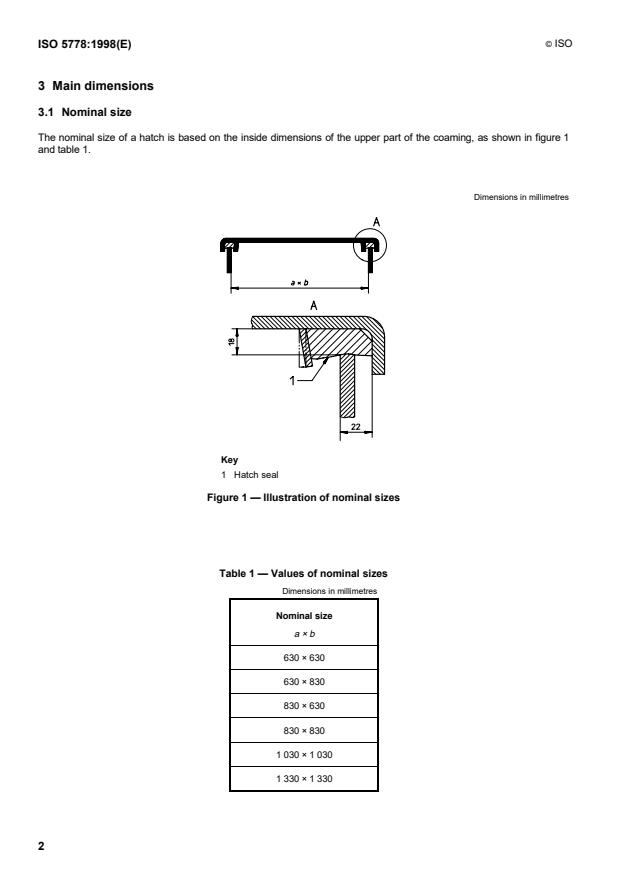
The nominal size of a hatch is based on the inside dimensions of the upper part of the coaming, as shown in figure 1
and table 1.
Dimensions in millimetres
Key
1 Hatch seal
Figure 1 — Illustration of nominal sizes
Table 1 — Values of nominal sizes
Dimensions in millimetres
Nominal size
a × b
630 × 630
630 × 830
830 × 630
830 × 830
1 030 × 1 030
1 330 × 1 330
© ISO
3.2 Upper part of coaming
The upper part of the coaming shall conform to the details of figure 2 and table 2. The coaming may have square or
rounded corners as shown in figure 2.
In order to prevent damage of the hatch seal, the edges of the upper part of the coaming should be rounded or
chamfered.
Dimensions in millimetres
Figure 2 — Upper part of coaming
Table 2 — Sizes of coaming
Dimensions in millimetres
a b
Nominal size
0 0
− 2 − 2
630 × 630 630 630
630 × 830 630 830
830 × 630 830 630
830 × 830 830 8
...