


ISO 22098:2020
(Main)Ships and marine technology - Full-scale test method for propeller cavitation observation and hull pressure measurement
Ships and marine technology - Full-scale test method for propeller cavitation observation and hull pressure measurement
This document specifies a full-scale test method for propeller cavitation observation and hull pressure measurement. The objective of the test is to investigate the propeller cavitation behaviour and its effects on the hull vibration problems. The test method comprises the specification of the test instrumentation and implementation, construction requirements to ensure structural safety, test and measurement procedures, and reporting documentation. This document is applicable to ships in the following stages: - before or during sea-trial, prior to delivery stage (vessels under constructions), and - after delivery stage.
Navires et technologie maritime — Méthode d'essai grandeur nature pour l'observation de la cavitation de l'hélice et le mesurage de la pression de la coque
General Information
Overview
ISO 22098:2020 - Ships and marine technology - Full‑scale test method for propeller cavitation observation and hull pressure measurement - specifies a standardized full‑scale test process to observe propeller cavitation and measure associated hull pressure fluctuations. The standard defines instrumentation and implementation, construction and safety requirements, test procedures, data processing and reporting. It applies to ships during construction (before/during sea trials) and after delivery, supporting validation of model tests, CFD predictions and root‑cause investigations of vibration, noise and blade damage.
Key topics and technical requirements
- Test objective: Investigate propeller cavitation behaviour and its effects on hull vibration and pressure fluctuations.
- Observation methods:
- Traditional CCD camera with stroboscopic lighting (time‑lapse or low‑frequency imaging).
- High‑speed camera in daylight for detailed, high‑frequency imaging; cameras should support synchronization where multiple units are used.
- High‑speed bore‑scope (small M20 bore penetrations) for rapid installation without dry‑docking; dependent on daylight and water quality.
- Observation windows:
- Designed for visibility, ease of setup, structural safety and watertightness.
- Typical components: steel cover and frames, acrylic window glass, O‑ring seals.
- Window sizes and locations selected via 3D CAD analysis of stern structure; adherence to structural verification or class approval is required.
- Hull pressure measurement:
- Pressure transducers mounted on stern surface near propeller plane; recommended minimum of 5 transducers where possible.
- Typical transducer coverage: ~0.8D forward of propeller plane to ~0.6D aft; transverse extension ~0.6D–0.8D; spacing ~0.15D–0.35D (D = propeller diameter).
- Example transducer characteristics in the standard: rated to 345 kPa, frequency range 0 Hz–6 000 Hz (water).
- Transducers must be calibrated per manufacturer’s reference; use signal processors and data systems for analysis.
- Safety & construction: ensure structural strength, watertight integrity and safe access; select installation routes and workspace during design/construction review.
- Reporting: documented test procedures, instrumentation, calibration, data processing and results to support correlation with model tests or CFD.
Applications and who uses it
- Shipbuilders and naval architects validating propeller design and cavitation predictions.
- Ship operators and yards conducting sea trials or post‑delivery investigations into vibration, noise or blade erosion.
- Classification societies, test engineers and researchers performing full‑scale verification to improve model‑ship correlation and CFD validation.
- Propeller and propulsion system designers seeking empirical data for performance tuning.
Related standards and notes
- The standard references established definitions for windows and scuttles as in IACS UI (e.g., LL62) and IMO Resolution MSC.143(77).
- ISO 22098:2020 complements model testing practices and CFD validation workflows used in ship hydrodynamics and propulsion design.
Keywords: ISO 22098:2020, propeller cavitation, hull pressure measurement, full‑scale test, observation window, high‑speed camera, pressure transducer, sea trial, ship vibration, cavitation observation.
Standards Content (Sample)
INTERNATIONAL ISO
STANDARD 22098
First edition
2020-05
Ships and marine technology —
Full-scale test method for propeller
cavitation observation and hull
pressure measurement
Navires et technologie maritime — Méthode d'essai grandeur nature
pour l'observation de la cavitation de l'hélice et le mesurage de la
pression de la coque
Reference number
©
ISO 2020
© ISO 2020
All rights reserved. Unless otherwise specified, or required in the context of its implementation, no part of this publication may
be reproduced or utilized otherwise in any form or by any means, electronic or mechanical, including photocopying, or posting
on the internet or an intranet, without prior written permission. Permission can be requested from either ISO at the address
below or ISO’s member body in the country of the requester.
ISO copyright office
CP 401 • Ch. de Blandonnet 8
CH-1214 Vernier, Geneva
Phone: +41 22 749 01 11
Fax: +41 22 749 09 47
Email: copyright@iso.org
Website: www.iso.org
Published in Switzerland
ii © ISO 2020 – All rights reserved
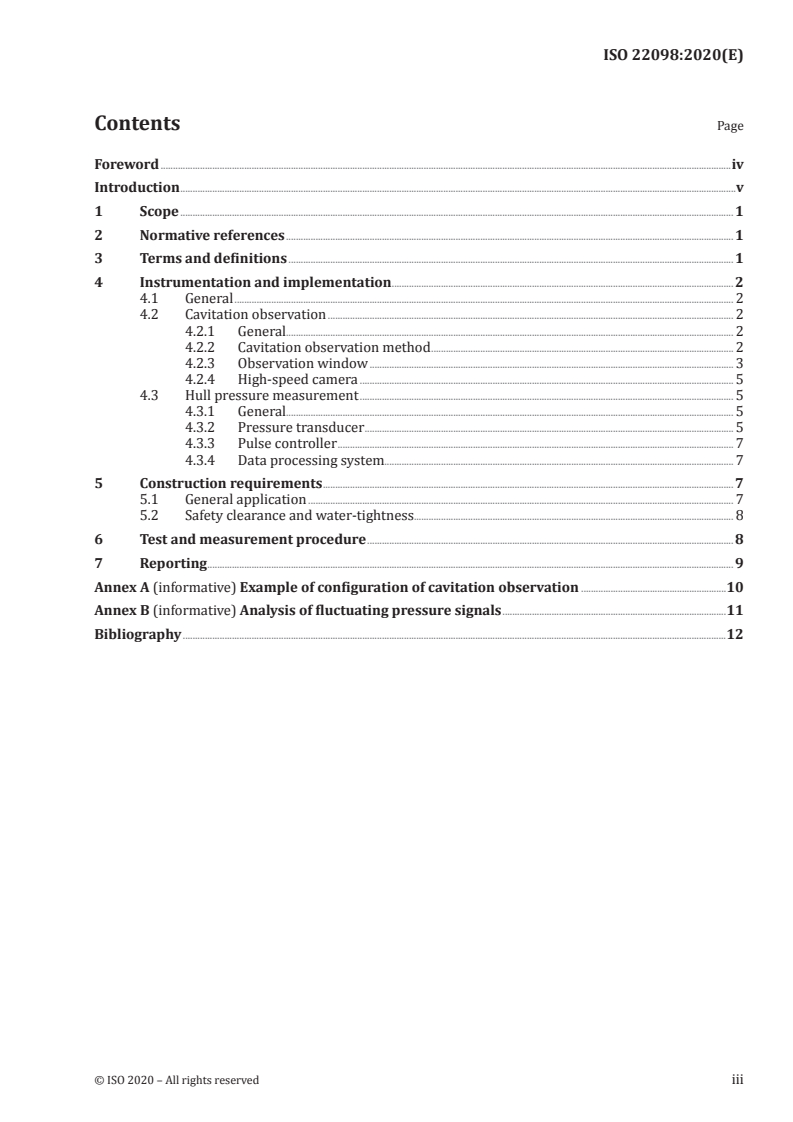
Contents Page
Foreword .iv
Introduction .v
1 Scope . 1
2 Normative references . 1
3 Terms and definitions . 1
4 Instrumentation and implementation . 2
4.1 General . 2
4.2 Cavitation observation . 2
4.2.1 General. 2
4.2.2 Cavitation observation method . 2
4.2.3 Observation window . 3
4.2.4 High-speed camera . 5
4.3 Hull pressure measurement . 5
4.3.1 General. 5
4.3.2 Pressure transducer . 5
4.3.3 Pulse controller . 7
4.3.4 Data processing system. 7
5 Construction requirements . 7
5.1 General application . 7
5.2 Safety clearance and water-tightness. 8
6 Test and measurement procedure . 8
7 Reporting . 9
Annex A (informative) Example of configuration of cavitation observation .10
Annex B (informative) Analysis of fluctuating pressure signals .11
Bibliography .12
Foreword
ISO (the International Organization for Standardization) is a worldwide federation of national standards
bodies (ISO member bodies). The work of preparing International Standards is normally carried out
through ISO technical committees. Each member body interested in a subject for which a technical
committee has been established has the right to be represented on that committee. International
organizations, governmental and non-governmental, in liaison with ISO, also take part in the work.
ISO collaborates closely with the International Electrotechnical Commission (IEC) on all matters of
electrotechnical standardization.
The procedures used to develop this document and those intended for its further maintenance are
described in the ISO/IEC Directives, Part 1. In particular the different approval criteria needed for the
different types of ISO documents should be noted. This document was drafted in accordance with the
editorial rules of the ISO/IEC Directives, Part 2 (see www .iso .org/ directives).
Attention is drawn to the possibility that some of the elements of this document may be the subject of
patent rights. ISO shall not be held responsible for identifying any or all such patent rights. Details of
any patent rights identified during the development of the document will be in the Introduction and/or
on the ISO list of patent declarations received (see www .iso .org/ patents).
Any trade name used in this document is information given for the convenience of users and does not
constitute an endorsement.
For an explanation of the voluntary nature of standards, the meaning of ISO specific terms and
expressions related to conformity assessment, as well as information about ISO's adherence to the
World Trade Organization (WTO) principles in the Technical Barriers to Trade (TBT), see www .iso .org/
iso/ foreword .html.
This document was prepared by Technical Committee ISO/TC 8, Ships and marine technology,
Subcommittee SC 8, Ship design.
Any feedback or questions on this document should be directed to the user’s national standards body. A
complete listing of these bodies can be found at www .iso .org/ members .html.
iv © ISO 2020 – All rights reserved
Introduction
Cavitation is responsible for significant propeller performance degradation and occurs at nearly all
propellers, causing often vibrations, noise and propeller blade erosion. It has been a common practice to
evaluate the propeller cavitation behaviour and its related hull pressure through model tests. However,
the model test might not show the full-scale cavitation phenomena.
Full-scale cavitation observations and hull pressure measurements are very helpful as feedback for
propeller design and prediction of full-scale performance through model test. This full-scale test method
is needed to establish more accurate model-ship correlation, to come up with better experimental
methods and to identify the cause of unexpected problems such as blade damage.
This document was developed to provide a standardized full-scale test method for propeller cavitation
observation and hull pressure measurement.
INTERNATIONAL STANDARD ISO 22098:2020(E)
Ships and marine technology — Full-scale test method
for propeller cavitation observation and hull pressure
measurement
1 Scope
This document specifies a full-scale test method for propeller cavitation observation and hull pressure
measurement. The objective of the test is to investigate the propeller cavitation behaviour and its
effects on the hull vibration problems.
The test method comprises the specification of the test instrumentation and implementation,
construction requirements to ensure structural safety, test and measurement procedures, and
reporting documentation.
This document is applicable to ships in the following stages:
— before or during sea-trial, prior to delivery stage (vessels under constructions), and
— after delivery stage.
2 Normative references
There are no normative references in this document.
3 Terms and definitions
For the purposes of this document, the following terms and definitions apply.
ISO and IEC maintain terminological databases for use in standardization at the following addresses:
— ISO Online browsing platform: available at https:// www .iso .org/ obp
— IEC Electropedia: available at http:// www .electropedia .org/
3.1
measured ship speed
ship’s speed during a speed run derived from the headway distance between start and end position and
the elapsed time of the speed run
3.2
observation window
transparent window allowing to observe and investigate the occurrence of cavitation of a ship propeller
3.3
propeller plane
plane normal to the shaft axis and containing the propeller reference line, i.e. contain the reference
point of the root section
3.4
ship speed
speed of the ship that is realised under stipulated conditions
Note 1 to entry: See also measured ship speed (3.1).
3.5
side scuttle
round or oval opening with an area not exceeding 0,16 m
Note 1 to entry: Round or oval openings with an area exceeding 0,16 m are “windows”, as defined in IACS UI
[3] [4]
LL62 or IMO Resolution MSC. 143(77) .
3.6
sea chest
fitting in a hull below the water line, for admitting or discharging water
4 Instrumentation and implementation
4.1 General
For the ship installation of all test equipment, it is necessary to thoroughly review the drawings on the
ship subject to test, and the selection of sensor and equipment installation location, workspace and
transportation route should be reflected in the design and construction stage.
4.2 Cavitation observation
4.2.1 General
Various methods for observing full-scale cavitation have been developed so far. This document
introduces the characteristic of various cavitation observation methods and specifies the criteria for
the necessary preparations for the cavitation observation test.
4.2.2 Cavitation observation method
A traditional method using a CCD camera with a stroboscopic lighting source has been commonly
used for full-scale cavitation observation. Recently, a technique using a high-speed camera in daylight
condition has been used. This technique minimizes the number of observation windows compared to the
traditional method and enables to observe detailed motion of cavitation to study the phenomenological
behaviour of the cavitation.
Furthermore, instead of the existing observation window, a high-speed bore-scope technique has been
used in consideration of relative installation time and cost reduction. The small penetrations needed
for the bore-scope equipment can be drilled with the ship in a float condition, which reduces the
installation time from days to hours and saves money from expensive ship docking operations.
However, the high-speed bore-scope technique requires strong sun light and good water quality.
The observation windows are more robust against the weather conditions and sea conditions. Thus,
observation windows are still useful if there is sufficient construction time and space. Appropriate
equipment should be selected depending on the purpose, situation and timing of the installation.
Although frequency of image heavily depends on illumination condition, Table 1 shows several examples
of various observation methods for full-scale propeller cavitation.
2 © ISO 2020 – All rights reserved
Table 1 — Examples of cavitation observation methods
Dry docking
Window/ Dependence
Observation method required for Comments
hole size on daylight
preparation
Easily affected by the environment
Photographs/videos
about (daylight, water quality, etc.)
in daylight no yes
M20 bores Easy installation
using a bore-scope
Low frequency image
Moderately affected by the environment
Photographs/videos about
(daylight, water quality, etc.)
in daylight 200 mm to yes yes
To be installed during docking
using windows 300 mm
Low frequency image
Moderately affected by the environment
High speed camera about
(daylight, water quality, etc.)
in daylight 200 mm to yes yes
To be installed during docking
using windows 300 mm
High frequency image
Easily affected by the environment
High speed camera (daylight, water qu
...
Frequently Asked Questions
ISO 22098:2020 is a standard published by the International Organization for Standardization (ISO). Its full title is "Ships and marine technology - Full-scale test method for propeller cavitation observation and hull pressure measurement". This standard covers: This document specifies a full-scale test method for propeller cavitation observation and hull pressure measurement. The objective of the test is to investigate the propeller cavitation behaviour and its effects on the hull vibration problems. The test method comprises the specification of the test instrumentation and implementation, construction requirements to ensure structural safety, test and measurement procedures, and reporting documentation. This document is applicable to ships in the following stages: - before or during sea-trial, prior to delivery stage (vessels under constructions), and - after delivery stage.
This document specifies a full-scale test method for propeller cavitation observation and hull pressure measurement. The objective of the test is to investigate the propeller cavitation behaviour and its effects on the hull vibration problems. The test method comprises the specification of the test instrumentation and implementation, construction requirements to ensure structural safety, test and measurement procedures, and reporting documentation. This document is applicable to ships in the following stages: - before or during sea-trial, prior to delivery stage (vessels under constructions), and - after delivery stage.
ISO 22098:2020 is classified under the following ICS (International Classification for Standards) categories: 47.020.10 - Hulls and their structure elements; 47.020.20 - Marine engines and propulsion systems. The ICS classification helps identify the subject area and facilitates finding related standards.
You can purchase ISO 22098:2020 directly from iTeh Standards. The document is available in PDF format and is delivered instantly after payment. Add the standard to your cart and complete the secure checkout process. iTeh Standards is an authorized distributor of ISO standards.
Questions, Comments and Discussion
Ask us and Technical Secretary will try to provide an answer. You can facilitate discussion about the standard in here.
Loading comments...